

Knowing Exactly How to React to a Downed Power Line Can Save Your Life and Protect Your Community
Key Takeaways
- Stay at least 35 feet away from the downed wire and anything it is touching.
- Call 911 and your local utility provider immediately to report the hazard.
- Never attempt to move the line with any object, even non-conductive materials like wood.
If you are wondering what to do if you find a downed power line, the answer is simple: stop moving immediately, assume the wire is actively energized, and call 911. Knowing exactly how to handle this dangerous hazard is critical for your survival, as high-voltage electricity demands instant action and respect. The moment you spot a fallen utility cable, your absolute first priority is always securing a safe perimeter. Severe weather, traffic accidents, or falling trees can unexpectedly bring down these cables, creating a lethal, invisible threat right in your neighborhood. By following established power line safety guidelines, you can comfortably isolate the hazard, avoid dangerous missteps, and get emergency professionals on the scene before anyone is harmed.
1. Stop: Assume All Downed Lines Are Live
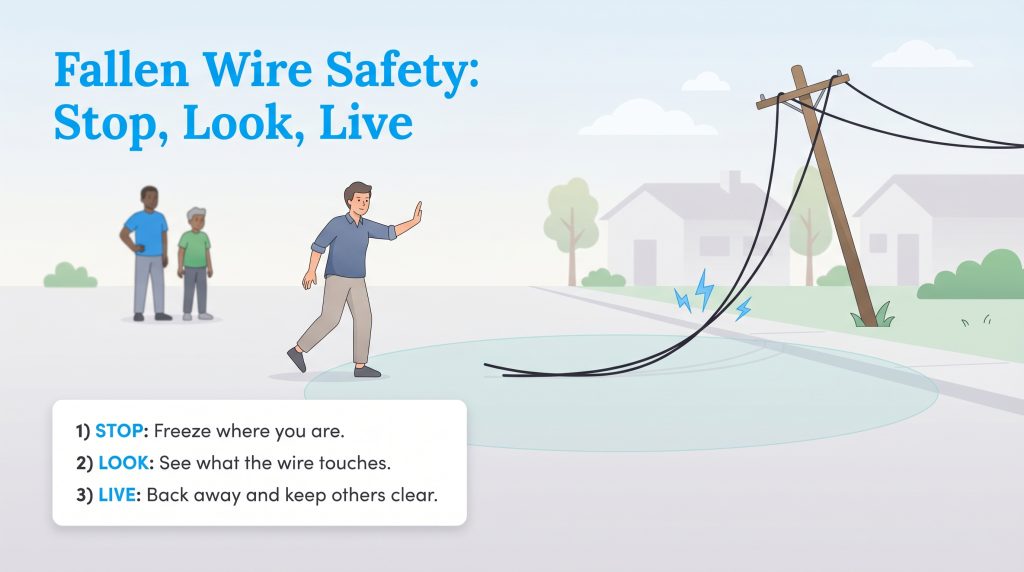
As soon as you spot a fallen wire, your only priority is securing the immediate area to protect human life. Because you cannot tell if a power line is active just by looking at it, you must assume all downed lines are live. Modern electrical grids utilize automated systems called reclosers that can silently re-energize a dormant wire without warning, meaning a line that looks completely dead could surge with thousands of volts seconds later. To maintain strict safety, immediately follow these vital warnings:
- Do not attempt to evaluate the damage yourself: Retreat to a safe distance immediately and warn bystanders to stay far away from the perimeter.
- Do not touch the wire with a broom, branch, or any other object: Materials like wood contain trace amounts of moisture, which means high-voltage electricity can instantly turn a seemingly dry branch into a deadly conductor.
- Do not attempt to rescue someone being shocked: The human body is composed primarily of water, making it a highly efficient conductor. If you touch an electrocution victim, the current will pass into your body too.
- Do not drive over fallen lines: They can easily tangle in your axle and completely electrify the metal frame of your vehicle.
2. Keep Your Distance (The 35-Foot Rule)
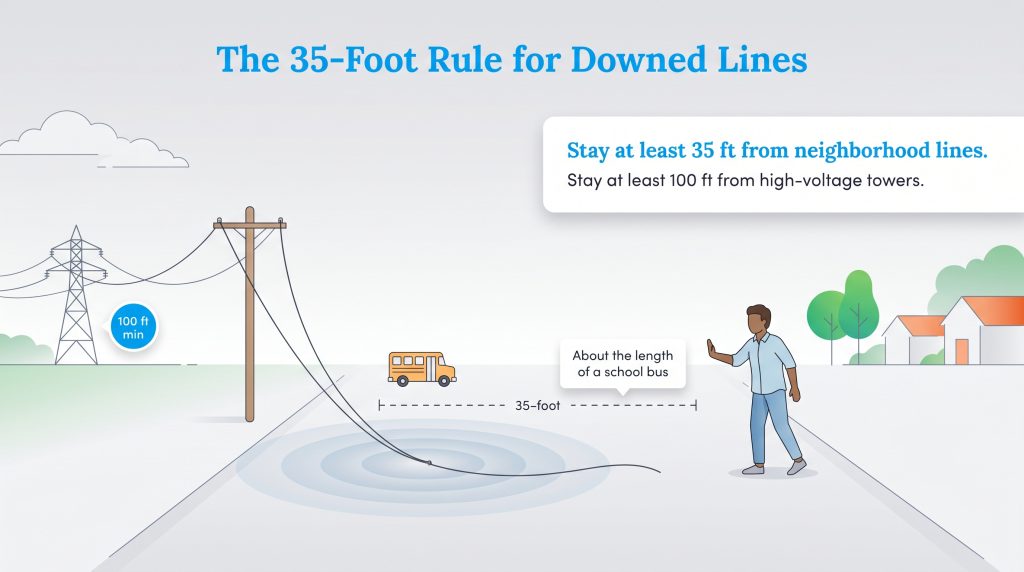
If you are wondering how far away from a downed power line you should be, safety experts emphasize prioritizing maximum distance. Electricity does not simply vanish when a line hits the dirt; it energizes the ground surrounding the point of contact in invisible rings. To keep yourself out of this dangerous zone, safety protocols mandate a strict safety perimeter.
You must stay at least 35 to 50 feet away from standard neighborhood distribution lines. This distance is roughly equivalent to the length of a standard school bus. Furthermore, if you are dealing with massive transmission lines — the tall steel towers that transport power across cities — you must stay at least 100 feet away to ensure your safety. Understanding where electricity comes from illustrates why this larger infrastructure requires such a massive berth.
3. What Is Step Potential? (And Why You Must Shuffle Away)
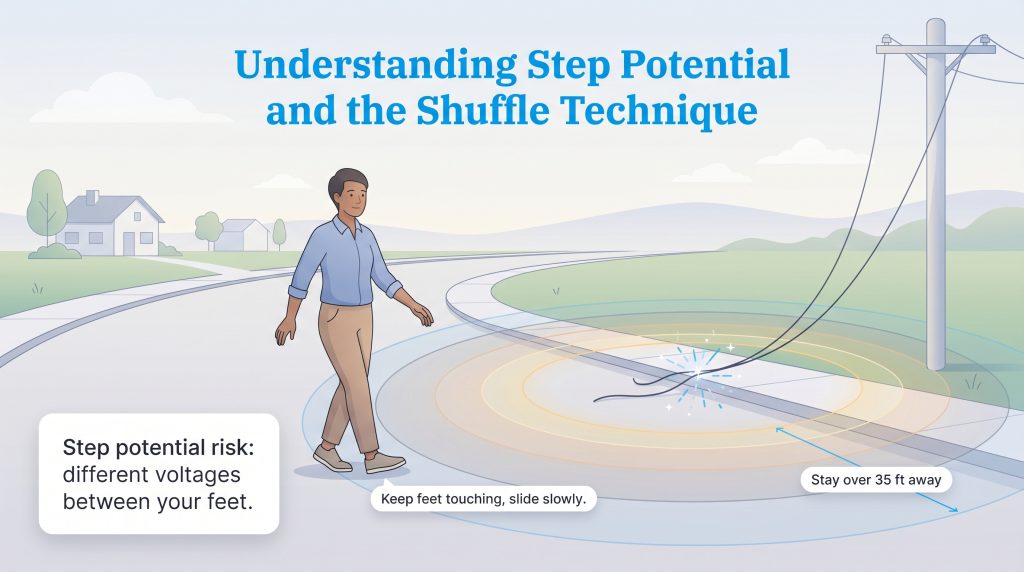
When a live wire touches the earth, the ground itself acts as a conductor. The voltage is highest directly at the source and gradually decreases as it ripples outward, much like the ripples created when you drop a stone into a pond. This creates a dangerous voltage differential. This hidden threat is known as step potential, and it makes walking near step potential power lines incredibly hazardous.
If you take a normal stride within this energized field, your feet land in two different voltage zones. Electricity will instantly travel up one leg and exit down the other, using your body to complete the fatal circuit. If you realize you are standing too close to a fallen cable, you must execute the shuffle away from downed line technique:
- Keep your feet completely together: Ensure your heels and toes are touching firmly.
- Do not lift your feet off the ground: Maintain constant contact with the earth to prevent breaking the safe voltage plane.
- Shuffle away slowly: Make short, sliding, and gliding movements until you are at least 50 feet away from the hazard.
4. Who to Call for a Downed Power Line
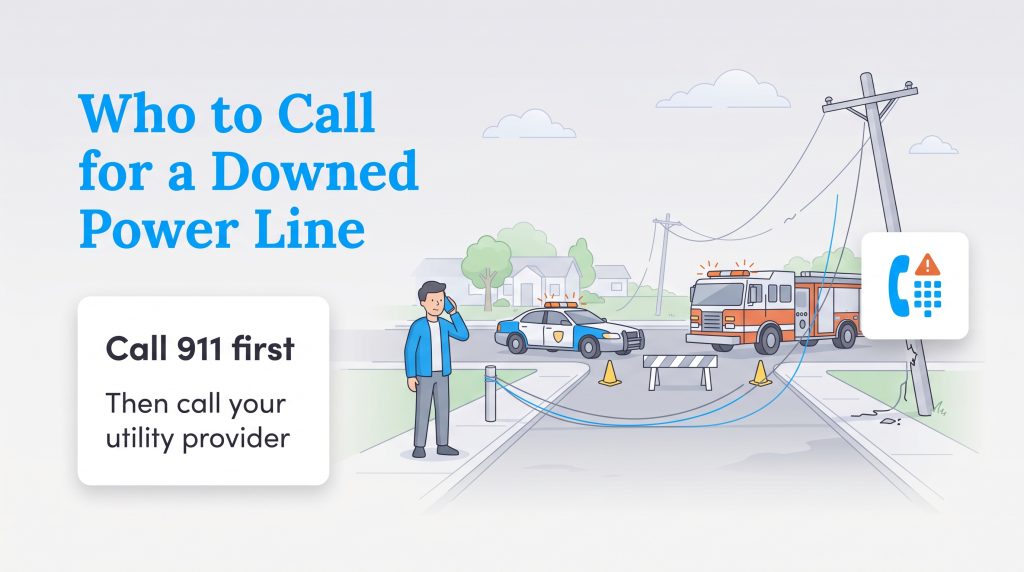
Knowing exactly who to call for downed power line emergencies drastically speeds up the response time of emergency services and utility repair crews. When a major storm drops infrastructure in the street, you must follow a strict hierarchy to get the right personnel dispatched.
Call 911 first. Dispatchers will send fire and police units to physically block off the street and manage traffic away from the active voltage. Never assume someone else has already reported it. After speaking with emergency services, call your local utility provider. The 911 dispatcher will automatically route the emergency to the correct transmission and delivery utility, but calling their hotline ensures they have the precise location to dispatch technicians. Note that you must contact the utility maintaining the poles, not your retail electric provider, as retail suppliers do not handle physical line repairs.
Never call 311 or a non-emergency police line for an active fallen wire. Downed power lines are always considered immediate life-safety emergencies, which means 911 is your first and only call.
5. Emergency Scenarios and Quick Reference Guide
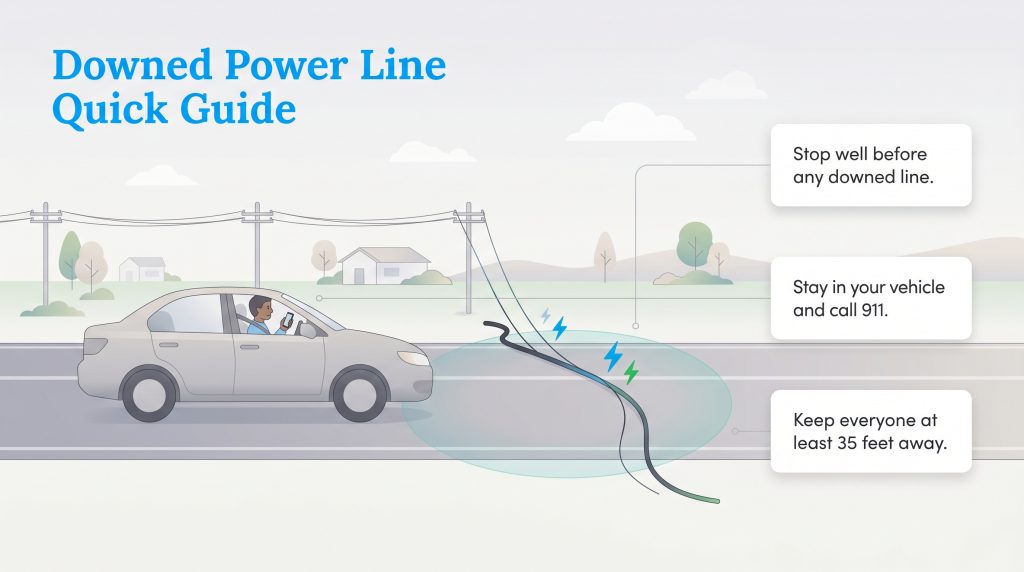
Emergencies require fast decision-making, especially when unexpected factors like traffic or bad weather complicate the situation. Keep this reference guide in mind to protect yourself and your family.
| Scenario | What to Do | What NOT to Do |
|---|---|---|
| Line across a road | Stop your vehicle well before the wire, turn around if safe, and call 911. Block other drivers if possible. | Do not attempt to drive over the line, as it can tangle in your axle and electrocute the chassis. |
| Line resting on a car | Stay inside the vehicle, warn bystanders to stay 35 feet back, and call for help. | Do not touch the metal frame or attempt to step out unless the car is actively on fire. |
| Line touching a fence | Keep a 35-foot distance from the entire length of the fence and call 911. | Do not touch any part of the fence, even if you are hundreds of feet from the original point of contact. |
| Line near standing water | Stay far away and prevent children or pets from approaching the water. | Do not step into puddles or flooded areas anywhere near the downed line. |
6. What to Do if a Power Line Falls on Your Car
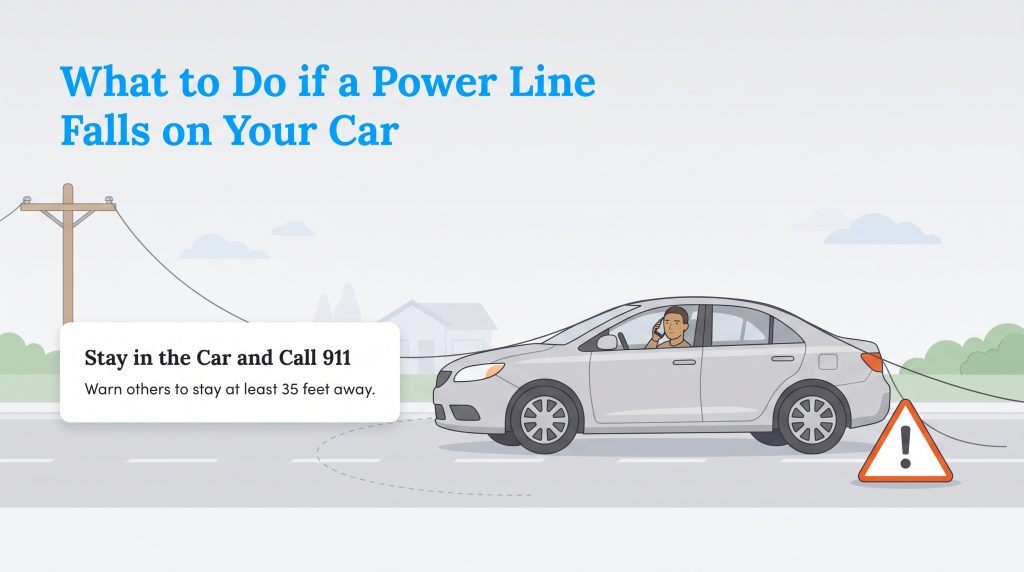
Figuring out what to do if a power line falls on your car is terrifying, but your initial reaction will dictate your survival. You must stay inside the car and call 911, as the tires provide insulation and the vehicle’s metal frame acts as a Faraday cage, safely routing the electrical current around the cabin and into the ground. Loudly warn anyone trying to help you to stay at least 35 feet back while you wait for utility workers to officially de-energize the line.
Fire Exception: You must only abandon your vehicle if a secondary, life-threatening emergency occurs, such as the car catching on fire. If heavy smoke fills the cabin and you absolutely must escape, open the door completely, cross your arms tightly over your chest, and jump out with both feet landing on the ground simultaneously. You must never touch the car and the ground at the same time. Once you land, execute the shuffle technique to glide to a safe distance.
7. How to Handle Downed Power Lines in Puddles or Floods
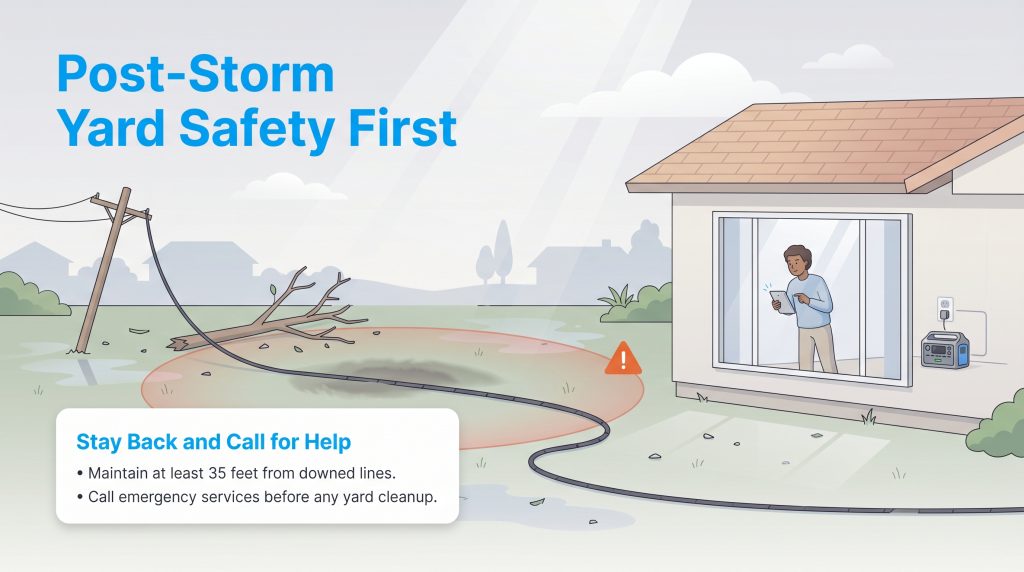
Water is an incredible conductor of electricity, making post-storm cleanup exceptionally dangerous. If a storm brings a downed power line in yard puddles or flooded streets, remember that moisture drastically expands the energized zone well beyond the normal perimeter. A downed power line in water can silently electrify everything it touches, including soggy tree branches and scattered debris. Avoid all standing water, wet leaves, and metal fences near the hazard, and leave the hazardous outdoor storm cleanup to professional utility arborists.
8. Preparing Your Home for Power Emergencies
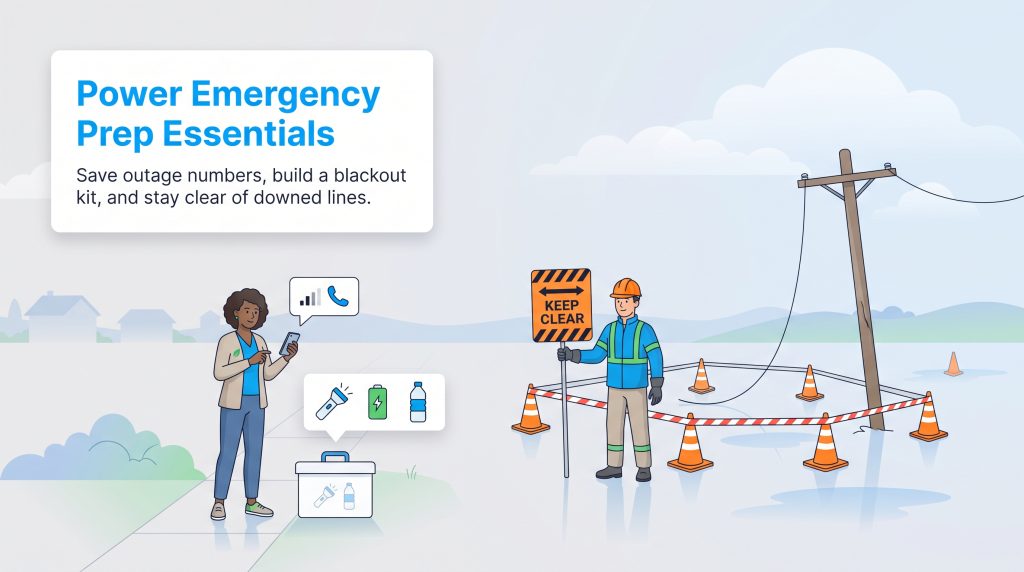
While understanding what happens during a power outage is helpful, proactively preparing your property reduces panic when severe weather strikes. Start by saving your local utility provider’s emergency outage numbers directly in your cell phone. This ensures you can report neighborhood hazards immediately without relying on an internet connection. Build a blackout emergency kit with flashlights, backup batteries, and bottled water so you stay comfortable indoors while crews repair the grid.
9. Preventing Generator Backfeed During Outages
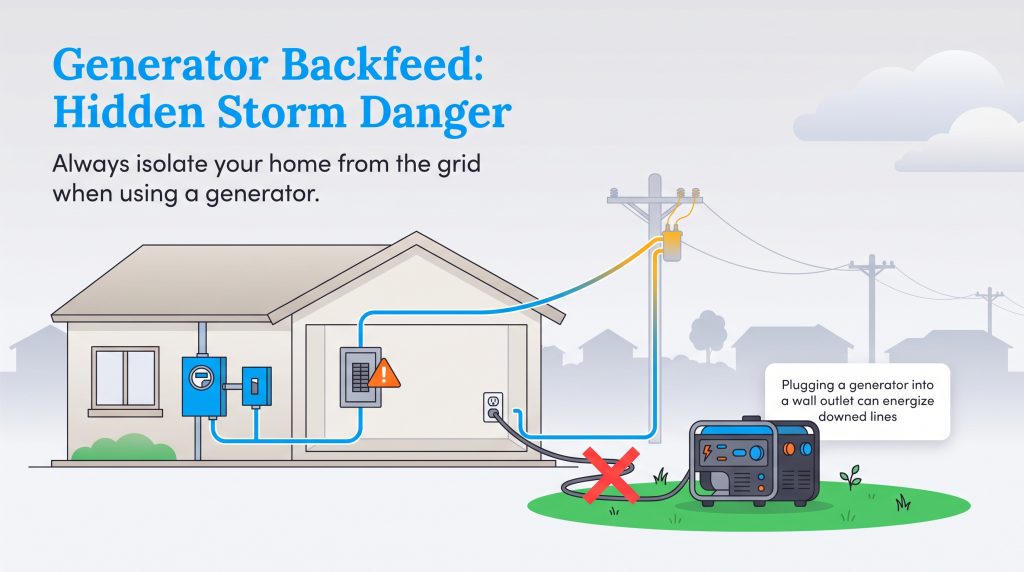
Additionally, trim dead branches away from your property lines before storm season to prevent limbs from snapping cables in the first place. If you rely on backup power, never plug a portable gas generator directly into a wall outlet. This creates a deadly backfeed hazard, sending high-voltage electricity back into neighborhood lines and directly threatening repair workers. For a cleaner, environmentally mindful choice, consider investing in home battery backup systems to safely power your essentials indoors.
10. Protecting Your Community from Electrical Hazards
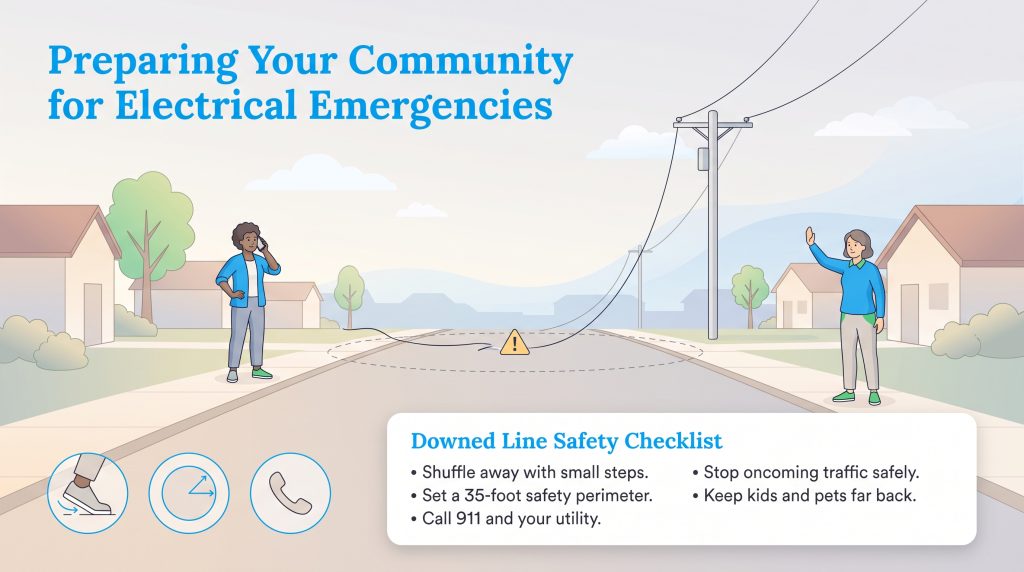
Electrical safety is a communal effort. By internalizing these procedures and consulting official government recommendations for power outages, you become the first line of defense for your neighborhood. Prioritize distance over everything else, and let the grid professionals handle the hazards safely.
Frequently Asked Questions About Downed Power Lines
Who should I call if I see a downed power line?
You must call 911 immediately to report an active downed wire. Emergency dispatchers will secure the location with first responders and automatically route the information to the correct local electric utility for specialized repairs.
How far away should you stay from a downed power line?
You should stay at least 35 to 50 feet away from standard neighborhood distribution lines and anything they are touching. For larger, high-voltage transmission towers, you must maintain a distance of at least 100 feet to avoid the risk of electrical shock. If the ground is flooded, extend your perimeter even further.
What happens if you accidentally touch a downed power line?
If you touch an active utility line, high-voltage electricity will instantly travel through your body to reach the ground. This creates a complete electrical circuit, which can result in severe thermal burns, internal organ damage, or a fatal electrocution.
Is a downed power line always live and dangerous?
You must always assume that a fallen wire is fully energized and lethal. Power lines often make no sound and produce no sparks or smoke, even when carrying thousands of volts. Never trust visual cues to determine if a line is active.
Can a downed power line start a fire?
Yes, an energized line hitting dry grass, fallen trees, or building materials can immediately spark a serious fire. This is why you should never approach the area and must always call emergency services to clear the scene before the hazard spreads.
What happens if you drive over a downed power line?
You should never attempt to drive over a fallen wire under any circumstances. The active line can easily become tangled in your vehicle’s axle, pulling down additional utility poles onto your car while electrifying the metal frame.
How can you tell the difference between a downed power line and a telephone wire?
You cannot reliably tell the difference by sight alone. Telephone lines frequently share utility poles with high-voltage distribution lines, meaning a fallen telecommunications wire can easily cross paths with a power cable and become lethally energized. Always treat every hanging wire as a live threat.
About the Author

David has been an integral part of some of the biggest utility sites on the internet, including InMyArea.com, HighSpeedInternet.com, BroadbandNow.com, and U.S. News. He brings over 15 years of experience writing about, compiling and analyzing utility data.

Jared Evans is a licensed electrician and the owner of Full Circuit Electric in Omaha, Nebraska. As an expert reviewer for UtilitiesForMyHome.com, Jared uses his 10+ years of hands-on experience to ensure our electrical advice is safe, accurate, and easy to follow. Whether he's troubleshooting a complex wiring issue or sharing tips on green energy upgrades, Jared is dedicated to helping you power your home efficiently — and safely.