


How solar panels turn sunlight into reliable power and long-term savings for your home.
Key Takeaways
- Solar cells capture sunlight and turn it into direct current (DC) electricity inside your panels.
- An inverter converts DC to AC so your home can safely use that solar power for everyday appliances.
- Net metering lets you trade excess power with the grid, earning credits when you overproduce and drawing power when the sun isn’t shining.
A solar panel is an advanced device that absorbs natural sunlight and converts it into clean, usable electricity to power your home. If you want to understand exactly how do solar panels work?, the process is a straightforward series of chemical and electrical steps. You don’t need a physics degree to grasp the basics, but knowing the underlying mechanics helps you make smarter decisions when investing in renewable energy. Our goal is to demystify the incredible journey of a photon from the sun all the way to your wall socket, empowering you to confidently explore the best eco-conscious alternative for your household.
The Short Answer: Turning Sunlight Into Home Energy
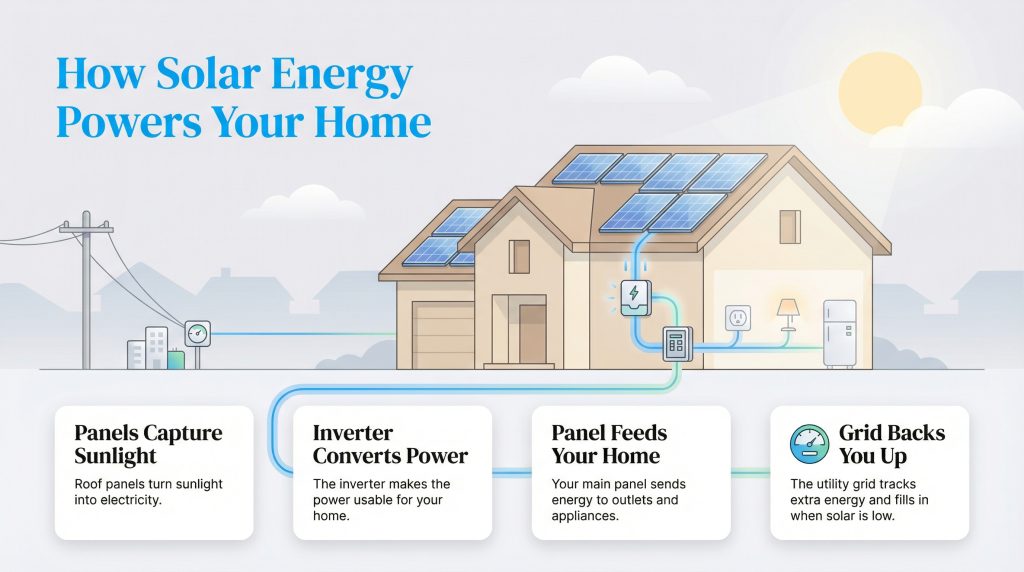
The entire residential solar process boils down to a reliable, multi-step chain reaction. Before tracing the exact path of electricity from your roof down to your home appliances, it helps to identify the primary hardware components that make this energy journey possible. Every system requires a specific set of tools to capture, translate, and distribute power safely.
| Component | What It Does | What You Notice | Average Lifespan |
|---|---|---|---|
| Solar Panels (PV Modules) | Capture sunlight and create DC electricity. | Panels mounted on your roof facing the sun. | 25 to 30 years |
| Inverter | Converts DC power to AC power for your home. | Usually a box on the side of your house or microinverters under panels. | 10 to 15 years |
| Electrical Panel | Distributes solar power through your home circuits. | Your lights and appliances run like normal. | 20 to 30 years |
| Utility Meter & Grid | Tracks how much power you send to and take from the grid. | Lower electric bills and possible credits when you export power. | 15 to 20 years |
What Are Solar Panels Made Of?
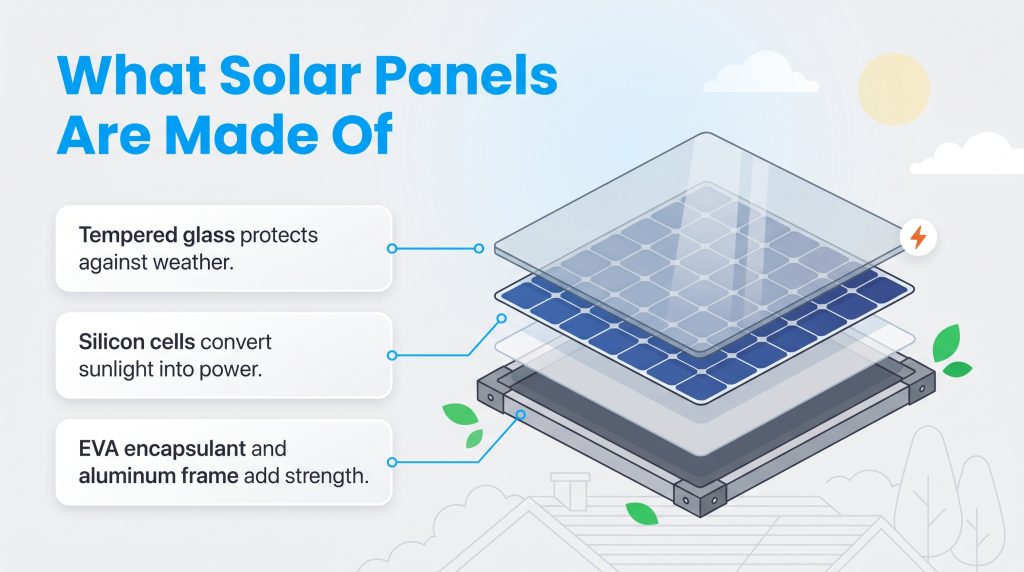
When homeowners ask what are solar panels made of, they are usually surprised to learn about the highly durable, multilayered materials required to protect the sensitive internal technology. A standard module is essentially a robust technological sandwich designed to withstand decades of harsh weather and extreme temperatures.
- Silicon photovoltaic cells: These specially treated semiconductor wafers are the active components responsible for capturing sunlight and converting it into raw power.
- Conductive wiring and protective encapsulants: Surrounding the delicate silicon cells is a tough layer of polymer resin, typically made of ethylene-vinyl acetate (EVA). This encapsulant seals out moisture and holds the fragile cells firmly in place, while thin conductive wires connect the cells to channel the electrical current.
- Anti-reflective glass casing: The front face of the module is covered by heavy-duty tempered glass. It protects against hail and falling debris while featuring an anti-reflective coating to ensure maximum sunlight penetrates straight through to the cells.
- Metal frames: Binding the entire assembly together is an anodized aluminum frame. This lightweight but rigid structure prevents the panel from bending in high winds and allows it to be securely mounted to your roof’s racking system.
This layered construction guarantees physical reliability while maintaining optimal energy production over the 25-plus year lifespan of your system.
Step-by-Step: How Solar Panels Generate Electricity
To fully appreciate this energy-saving option, we need to follow the exact path of a photon as it travels from the sun into your home. The transition from pure sunlight to the electricity that brews your morning coffee happens in five distinct stages.
1. PV Cells Absorb Sunlight (The Photovoltaic Effect)
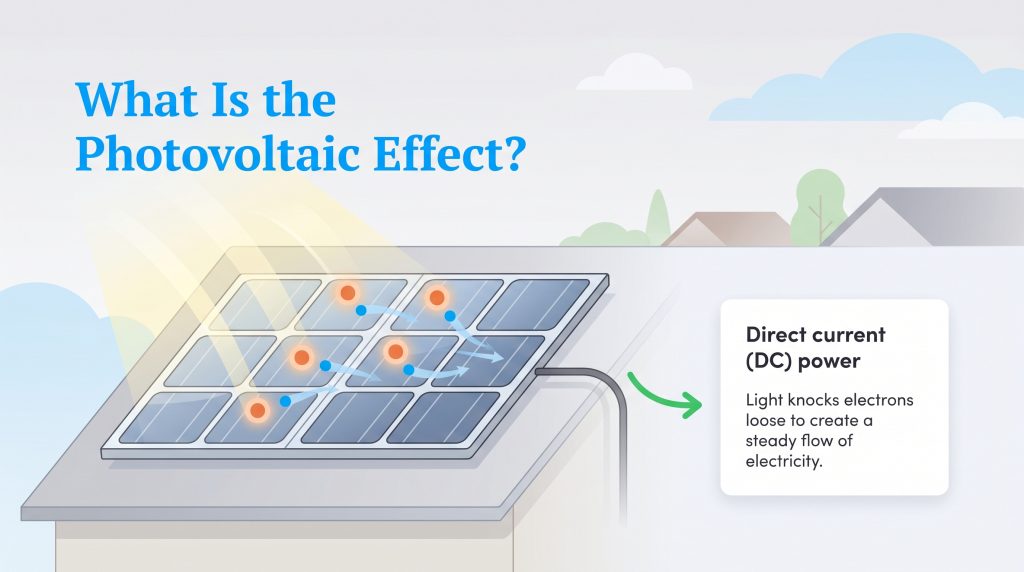
The journey begins with fundamental physics. The photovoltaic effect explained simply is the process where specific semiconductor materials generate an electrical current when exposed to natural light. When sunlight strikes the silicon cells inside a panel, tiny packets of solar energy called photons interact with the silicon atoms. This physical reaction forces electrons to be knocked loose from their standard atomic orbits. Once freed, these electrons are ready to flow and generate raw power.
2. Generating Direct Current (DC) Electricity
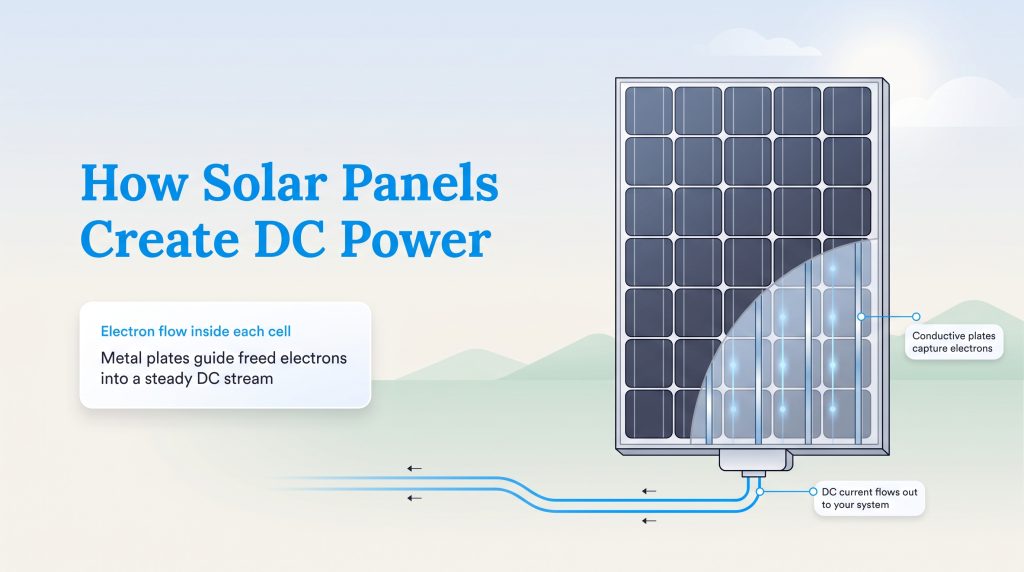
If you are wondering how do solar panels generate electricity efficiently, the secret lies in the internal wiring. The newly freed electrons don’t just float away — they are instantly funneled by thin metal conductive plates built directly into the cells. As the electrons flow through this wiring, they create a steady, reliable stream of Direct Current (DC) electricity. This active DC generation forms the foundation of your entire home solar array.
3. The Solar Inverter Converts DC to AC Power
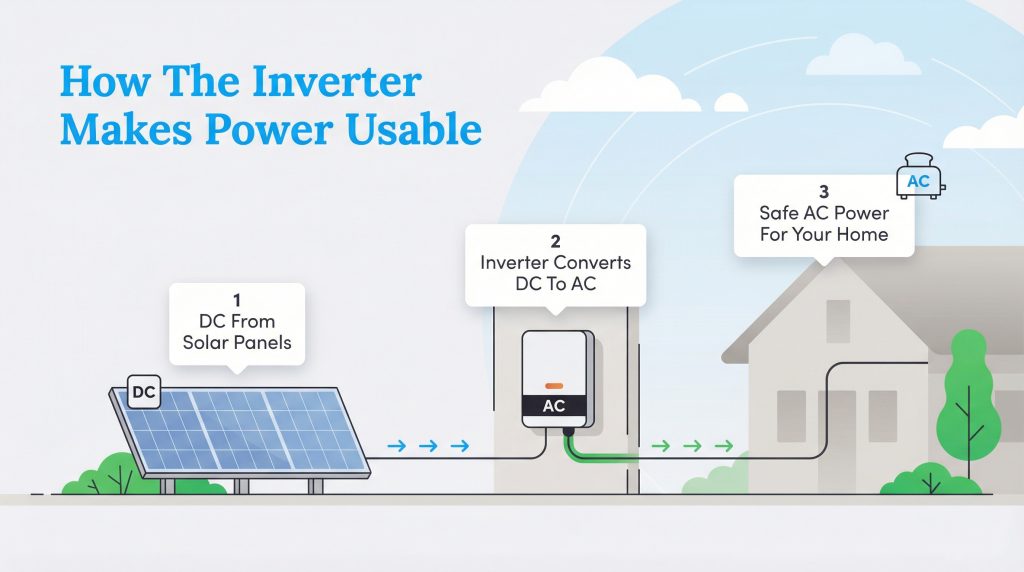
The electricity created during the first two stages flows as DC power. While DC is highly efficient for charging small electronics and batteries, nearly all modern American homes and heavy-duty appliances run exclusively on Alternating Current (AC) power. This creates a technical gap. So, how do solar inverters work to solve this issue? The solar inverter acts as a mandatory technological translator. It takes the incoming raw DC energy and rapidly oscillates it to create safe, usable AC electricity. This critical DC to AC solar conversion step is what actually makes the power compatible with your household.
| Power Type | How It Works | Solar Application |
|---|---|---|
| DC Power (Direct Current) | Electricity flows in a single, continuous direction without varying. | Produced directly by your solar array when sunlight hits the cells. |
| AC Power (Alternating Current) | Electricity periodically reverses direction, allowing for safe residential use. | Created by the solar inverter to safely run your home’s appliances. |
4. Electricity Powers Your Home
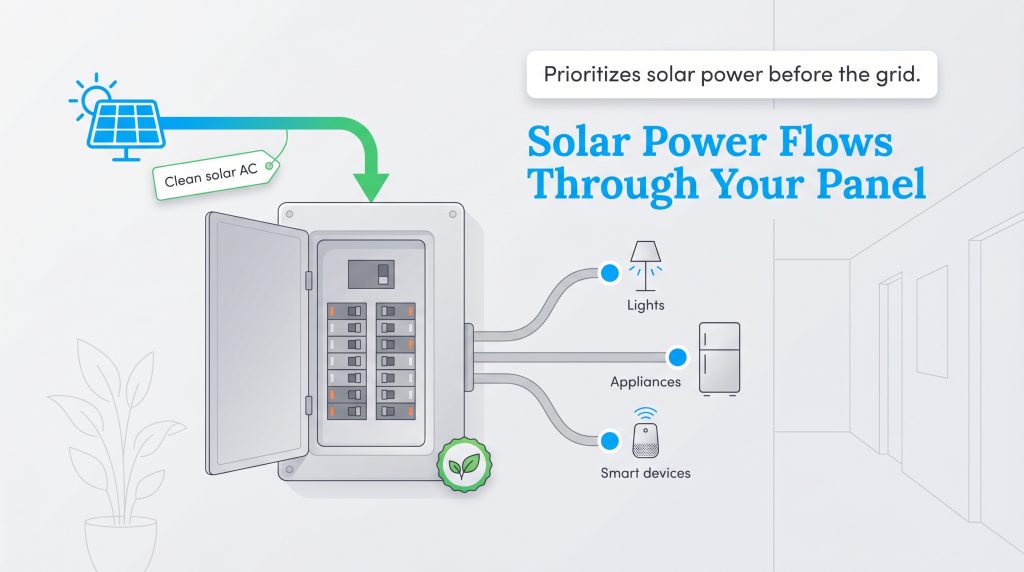
Once the electricity has been safely converted to AC power, it moves straight from the inverter into your home’s main electrical panel, commonly known as the breaker box. Using solar energy for home applications is completely hands-off. The breaker box acts as a central distribution hub, routing the newly generated energy through the walls to your active circuits.
Your home will intelligently prioritize using this free solar power first. It flows directly to your lights, refrigerator, and HVAC system just like standard utility power. The transition between grid electricity and solar power is entirely seamless — you won’t ever notice a flicker of the lights.
🌱 Eco Edge: Every kilowatt-hour of clean energy you consume from your roof is one less kilowatt-hour generated by burning fossil fuels. This immediately lowers your household’s carbon footprint.
5. Excess Energy Goes to the Grid (Net Metering)
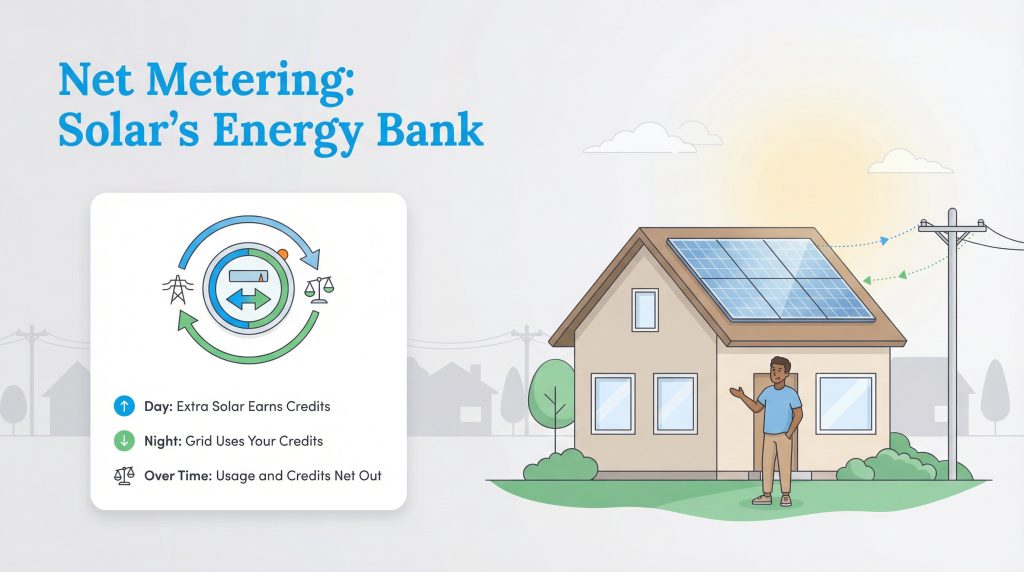
Most residential setups maintain an active grid connection, meaning your home stays linked to your local municipal utility company. On bright, sunny afternoons, your panels will frequently produce far more power than your home is actively consuming. This excess solar energy doesn’t just disappear. Instead, it flows backward through your utility meter and out onto the grid to help power your neighborhood.
Through a specialized billing mechanism called net metering, your utility company tracks this exported energy and credits your account. With net metering explained simply, think of the utility grid as a massive virtual battery. The credits you earn during the day directly offset the cost of the power you inevitably pull from the grid at night. If you prefer to keep your power fully independent, you can invest in a home battery system to store the excess energy on-site. For more details on how municipal systems manage integration, explore our guide on electric utilities.
Types of Solar Panels: Monocrystalline vs. Polycrystalline
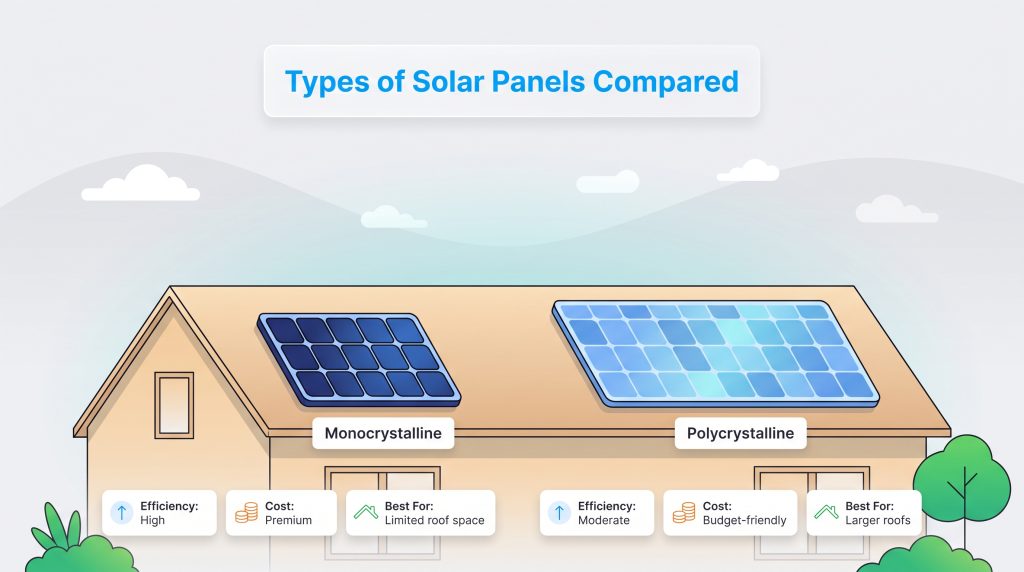
Not all solar arrays are built the same. When evaluating hardware for your roof, the conversation typically comes down to monocrystalline vs polycrystalline panels. While both effectively harness the sun’s energy, they differ in how their silicon is manufactured, resulting in distinct advantages depending on your goals and budget.
| Panel Type | Efficiency | Cost | Best Use Case |
|---|---|---|---|
| Monocrystalline | High (19% to 22%+) | Premium pricing | Homes with limited roof space that want to maximize power output. |
| Polycrystalline | Moderate (15% to 18%) | Budget-friendly | Larger roofs where maximizing space is less of a concern. |
| Thin-Film | Low (10% to 13%) | Highly variable | Commercial buildings or unique structures that require flexible materials. |
How Weather and Time of Day Affect Solar Performance
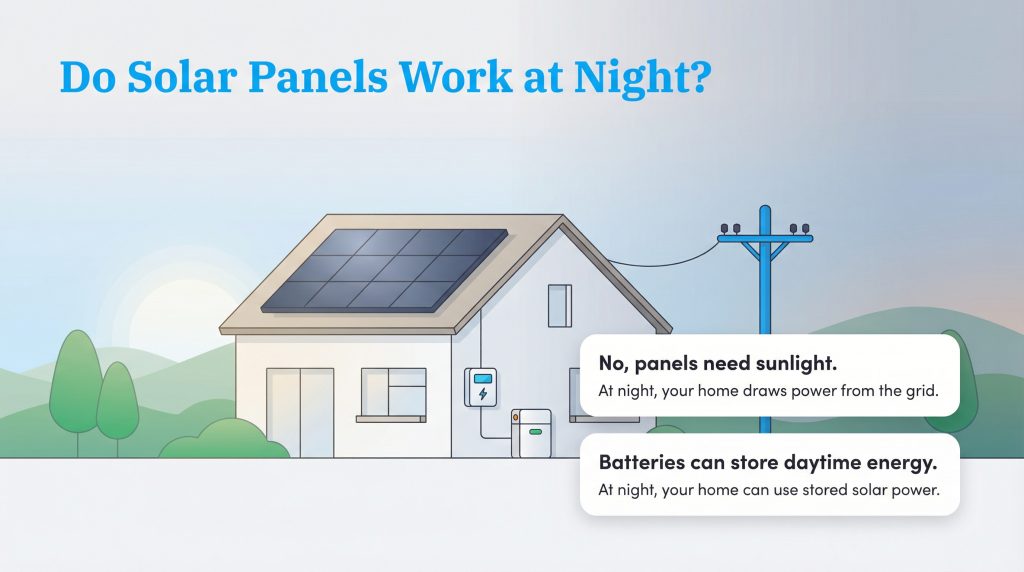
A frequent concern for homeowners is how changing weather conditions impact reliable energy generation. Because photovoltaic cells respond directly to visible light rather than ambient environmental heat, they remain highly resilient across varied climates and changing seasons.
- Cloudy Days: Can you rely on solar panels on cloudy days? Absolutely. While overall output drops because less direct sunlight pierces the cloud cover, ambient light still reaches your roof. Your panels will generate a steady, albeit reduced, stream of electricity even during overcast weather.
- Rain and Snow: Rain provides a helpful natural cleaning service that washes away accumulated dust and debris, improving cell performance. During winter, the dark color of the modules absorbs enough ambient heat to cause snow to melt and slide off quickly. Surprisingly, panels operate more efficiently in cooler winter temperatures than they do during blistering summer heat waves.
- Nighttime: Do solar panels work at night? No. Panels entirely lack the incoming photons required to trigger the photovoltaic effect in the dark. As soon as the sun sets, generation stops, and your home automatically switches to drawing power from the utility grid or your personal battery storage system.
This automatic integration ensures you never experience a disruption in your daily routine. You can explore further technical details regarding this grid relationship on the Department of Energy’s website.
Evaluating Your Home for Solar Readiness
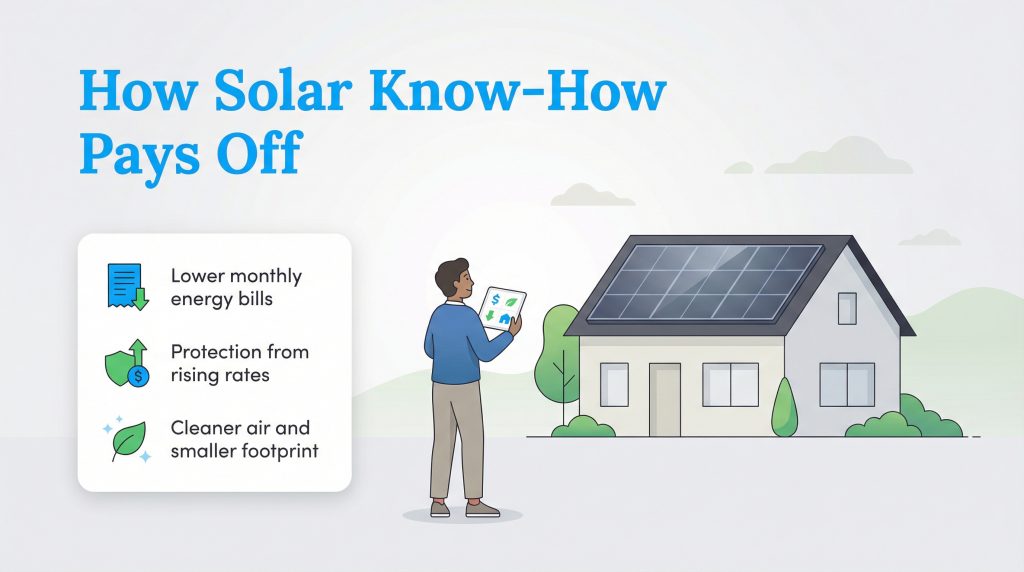
Once you understand the impressive inner workings of this renewable technology, the next logical step is determining if your property is actually a strong candidate for an installation. By evaluating your home’s unique layout and historical energy demands, you can better estimate how much solar panels cost and ensure you achieve the lower monthly bills you are aiming for.
- Assess your roof orientation: In the United States, south-facing roofs generally capture the most direct sunlight throughout the day, maximizing power output. East and west-facing roofs are also highly effective candidates if they offer wide, unobstructed surface areas.
- Check for heavy shading: Large trees, neighboring buildings, or prominent chimneys casting deep shadows over your roof during peak afternoon hours can significantly limit your energy production.
- Review your historical usage: Look at your past utility bills to determine your average monthly kilowatt-hour (kWh) consumption, which averages over 900 kWh per residential customer in the US. A professional installer relies on this precise data to properly size your array and review the different types of solar panels that match your household demands.
- Investigate local utility policies: Consult municipal guidelines to understand exactly how net metering credits are applied in your area, as compensation structures and connection fees vary widely by state and provider.
Making the Switch to Reliable Solar Power
Transitioning to an environmentally mindful choice like solar energy is an exciting journey that provides lasting financial benefits. By taking control of your own power generation, you protect your household against volatile utility rates while actively supporting a cleaner grid. If you are ready to evaluate your property’s precise potential, explore financing options like power purchase agreements, and receive tailored guidance, visit our extensive solar energy hub to connect with local setup resources and start collecting customized installation quotes.
Frequently Asked Questions About Solar Panels
Do solar panels work at night?
Do solar panels work on cloudy days?
How long do solar panels last on a house?
Can solar panels power a whole house off-grid?
Do solar panels work when the power goes out?
Do I need a battery for my solar panels to work?
About the Author

David has been an integral part of some of the biggest utility sites on the internet, including InMyArea.com, HighSpeedInternet.com, BroadbandNow.com, and U.S. News. He brings over 15 years of experience writing about, compiling and analyzing utility data.

Jared Evans is a licensed electrician and the owner of Full Circuit Electric in Omaha, Nebraska. As an expert reviewer for UtilitiesForMyHome.com, Jared uses his 10+ years of hands-on experience to ensure our electrical advice is safe, accurate, and easy to follow. Whether he's troubleshooting a complex wiring issue or sharing tips on green energy upgrades, Jared is dedicated to helping you power your home efficiently — and safely.

LaLeesha has a Masters degree in English and enjoys writing whenever she has the chance. She is passionate about gardening, reducing her carbon footprint, and protecting the environment. She also recently served as President of the Board for City Sprouts (a community garden).