


Compare home battery backup systems by cost, capacity, solar compatibility, and outage protection so you can choose the right setup for your home.
Key Takeaways
- A single installed home battery often costs $10,000 to $20,000, while true whole-home backup may cost more if you need multiple batteries or panel upgrades.
- You don’t need solar panels to use a home battery, but solar pairing can recharge your battery during longer outages.
- Battery size should match your backup goal, since essentials-only backup may need one battery while HVAC or whole-home coverage often requires multiple units.
As severe storms roll through with increasing intensity, unexpected blackouts have transformed from rare inconveniences into seasonal guarantees. If you are tired of throwing away spoiled groceries or sweating through humid summer nights without air conditioning, finding the best home battery backup systems can completely change how you weather the storm. Whether you want to pair a new storage unit with rooftop panels or simply need a standalone system that charges straight from the grid, taking control of your electricity provides unmatched peace of mind. True grid independence means knowing your lights, internet, and essential appliances will keep running smoothly the second the neighborhood goes dark.
How We Evaluated the Top Home Energy Storage Systems
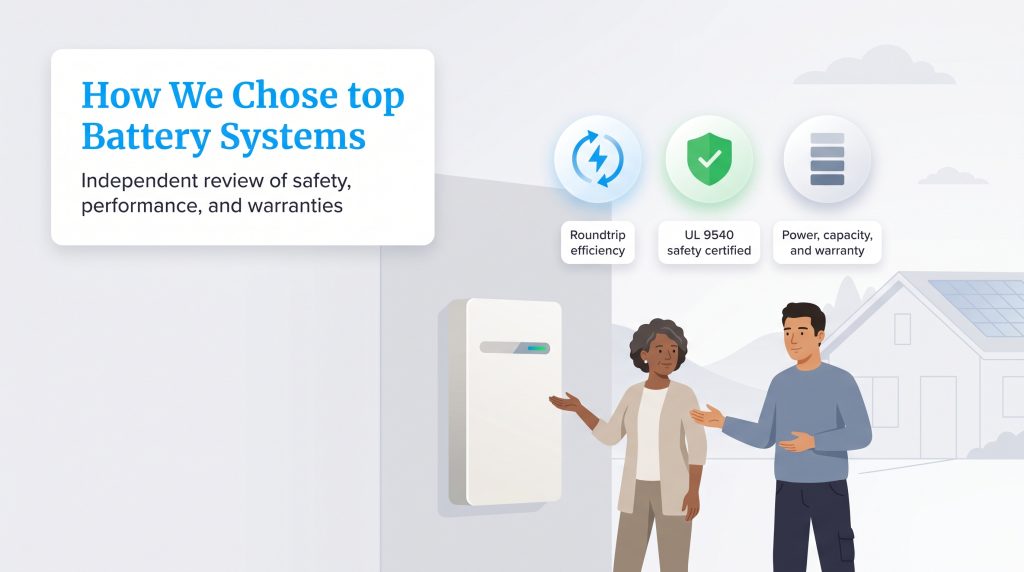
Deciding which energy solution deserves a spot on your wall requires more than just picking a familiar brand name. We did not rank these systems based on paid placement. Instead, we compared published manufacturer specifications, warranty terms, safety certifications, system expandability, chemistry, and common homeowner use cases. We evaluated these home energy storage systems by looking closely at their roundtrip efficiency, which tells us how much usable electricity you actually get back after charging. High efficiency keeps your energy losses to an absolute minimum.
We also prioritized continuous power output to ensure these units can handle the heavy lifting of modern appliances without tripping a breaker. Finally, we sifted through installer availability and checked for strong warranties to guarantee you are making a secure, long-term investment in your property’s resilience. Modern lithium-ion and Lithium Iron Phosphate (LFP) batteries typically offer better usable capacity, longer cycle life, and a smaller footprint than older lead-acid options, making them the superior choice for modern home setups.
💡 Pro Tip: Before purchasing any energy storage equipment, verify that the battery carries a UL 9540 certification, which is the most critical safety standard for reducing fire risks and ensuring thermal stability.
Our Top Picks for the Best Home Battery Backup Systems
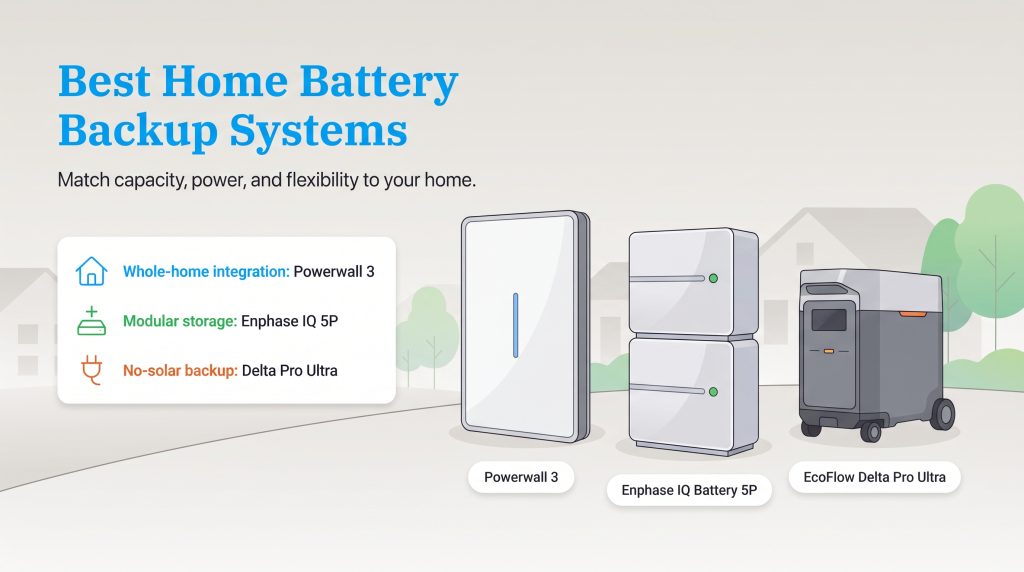
Finding the right fit for your property involves balancing capacity requirements, surge power capability, and your overall budget. To help you compare the best home battery backup systems and the best solar battery backup systems for home at a glance, we broke down our top contenders based on their core specs and ideal use cases.
| Model | Best For | Usable Capacity (kWh) | Continuous Power (kW) | Chemistry | Expandable? | Solar Required? | Warranty | Price Range |
|---|---|---|---|---|---|---|---|---|
| Tesla Powerwall 3 | Full-home integration | 13.5 | 11.5 | Lithium-ion | Yes | No | 10 years | By Quote |
| Enphase IQ Battery 5P | Modular expansion | 5.0 | 3.84 | LFP | Yes | No | Up to 15 years | ~$1099 |
| EcoFlow Delta Pro Ultra | Portable or grid-only backup | 6.0 (up to 90.0) | 7.2 | LFP | Yes | No | 5 years (extendable) | ~$4199 |
Which Battery System Should You Choose?
Comparing specifications is helpful, but matching those numbers to your specific goals is the key to finding the right fit. Here is a quick breakdown to help you make your final decision based on your household’s unique energy needs.
- Choose the Tesla Powerwall 3 if you want strong whole-home integration, a built-in inverter, and high output to support heavy appliances.
- Choose the Enphase IQ Battery 5P if you prioritize safer LFP chemistry and want to scale your storage incrementally over time.
- Choose the EcoFlow Delta Pro Ultra if you want a portable or semi-permanent backup option that doesn’t require rooftop solar panels.
Best Overall: Tesla Powerwall 3
The Tesla Powerwall 3 remains one of the most widely recognized whole-home battery options, combining sleek aesthetics with reliable everyday performance. Outfitted with a 13.5kWh capacity and a powerful built-in inverter, this system handles everything from everyday energy arbitrage to sudden grid failures seamlessly. It is incredibly efficient if you plan on connecting solar panels, as the integrated inverter cuts down on installation complexity and eliminates extra hardware clutter on the side of your house.
What truly sets the Powerwall 3 apart from earlier iterations is its ability to push out a massive 11.5kW of continuous power. Its high continuous power output gives it a better chance of supporting larger loads, but whether it can run your central AC depends on your system size, startup surge, and installer-designed load plan.
- Pros: Built-in inverter simplifies installation, exceptional continuous power output, and a highly intuitive mobile app.
- Cons: Customer service response times can occasionally drag, and wait times for professional installation are sometimes lengthy.
Top Tesla Powerwall Alternative: Enphase IQ Battery 5P
If you want a highly modular setup or simply prefer to step outside the Elon Musk ecosystem, the Enphase IQ Battery 5P is a strong choice. When looking at Enphase vs Tesla Powerwall, the 5P stands out by utilizing Lithium Iron Phosphate (LFP) chemistry. LFP is inherently safer, degrades slower over time, and operates exceptionally well in extreme temperatures compared to the traditional lithium-ion composition found in older battery units.
This top-tier Tesla Powerwall alternative also punches way above its weight class when it comes to raw strength. Its superior continuous power output relative to its size, coupled with a massive surge capacity, makes it specifically adept at starting heavy, power-hungry appliances. Because the modules are smaller (5kWh each), you can easily scale your storage over time by simply adding another battery when your budget allows.
- Pros: Safer LFP battery chemistry, easily scalable modular design, and a longer warranty than many competing home batteries.
- Cons: Lower capacity per individual unit means you need to buy multiple batteries for a true whole-home backup.
Best Home Battery Backup Without Solar: EcoFlow Delta Pro Ultra
Not everyone has the roof space or budget for a large solar array, which is precisely where the EcoFlow Delta Pro Ultra shines. As the premier home battery backup without solar, this system allows renters or homeowners to rapidly scale their capacity by stacking battery modules. You can tie it directly to a smart home panel and charge it straight from the grid, ensuring it is always full and ready when the next storm hits.
The greatest advantage of the EcoFlow system is its flexibility. While it operates beautifully as a standalone grid-tied backup, it also functions as a portable unit if you ever decide to move. Portable systems may involve less permanent installation work than wall-mounted batteries, but connecting one to a home panel should still be handled by a qualified electrician and may require permits.
- Pros: No rooftop solar needed, portable modular design, and capable of extreme storage expansion up to 90kWh.
- Cons: The physical footprint is quite large and bulky compared to sleek wall-mounted alternatives.
Comparing Portable Power Stations vs. Permanent Home Battery Backup
When deciding how to protect your home from blackouts, you typically choose between a permanent wall-mounted battery or a portable power station. Both options provide clean, silent energy, but they serve very different use cases depending on your living situation and overall budget.
| Feature | Portable Power Station | Permanent Home Battery |
|---|---|---|
| Installation | Plug-and-play or simple panel connection | Requires professional wiring and mounting |
| Cost | Generally lower upfront | Higher initial investment |
| Portability | Easy to move or take on trips | Fixed to the property |
| Whole-Home Capability | Limited to specific circuits or appliances | Can often power the entire house |
| Permitting | Often minimal or none | Requires city permits and inspections |
Breaking Down Whole House Battery Backup Costs
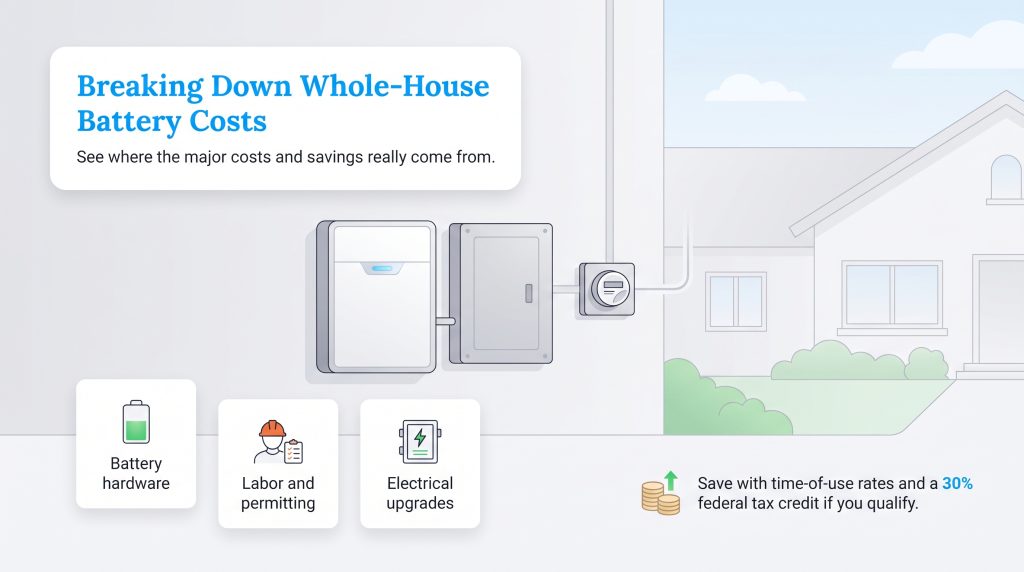
Pricing out a battery system can feel a bit overwhelming because the numbers advertised online rarely reflect what you actually pay. A single professionally installed home battery often costs about $10,000 to $20,000 before incentives. A true whole-home battery backup system can cost more, especially if you need multiple batteries, a critical-load panel, or electrical upgrades.
| Expense Category | What It Covers |
|---|---|
| Battery Hardware | The physical storage unit and built-in components. |
| Inverter | Converts stored DC power into usable AC power (if not integrated). |
| Critical-Load Panel | A separate subpanel to manage essential circuits during an outage. |
| Labor and Permitting | Professional electrician fees, city permits, and utility inspections. |
| Electrical Upgrades | Upgrading an older main electrical panel to handle new equipment. |
While that initial price tag looks steep, these systems offer a distinct financial return on investment (ROI). By charging your battery during off-peak hours when electricity is cheap and discharging it during peak evening hours when utility rates skyrocket, you can actively shave dollars off your monthly bill. This strategy, known as time-of-use arbitrage, helps your battery slowly pay for itself even when the grid is functioning perfectly.
💸 Money-Saver: You may be able to lower your upfront cost with the 30% Residential Clean Energy Credit for battery storage, which can apply to qualified standalone battery storage systems with at least 3 kWh of capacity. Be sure to confirm your eligibility with a tax professional.
Sizing Guide: How Many kWh to Backup a House?
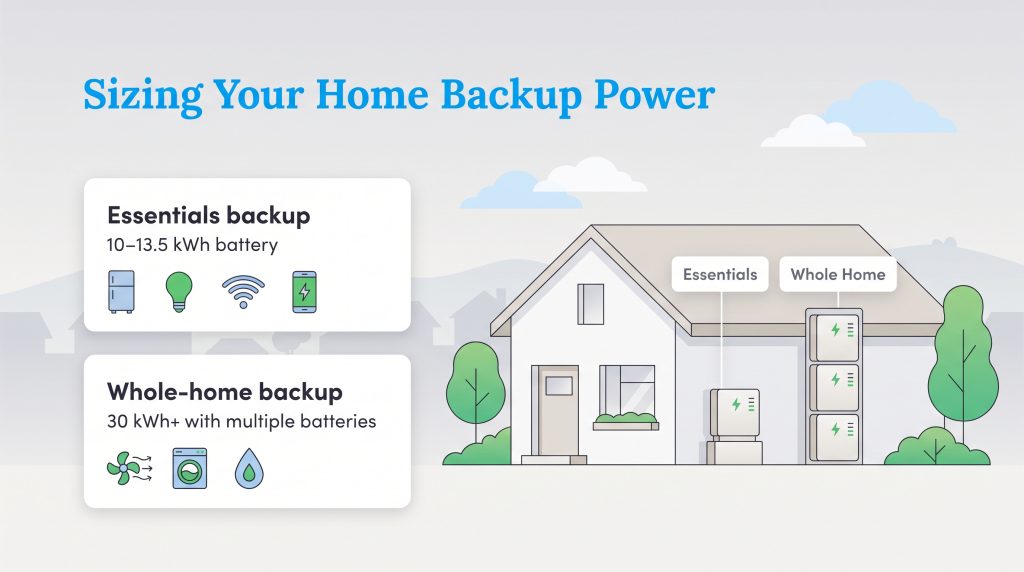
Figuring out exactly how many kWh to backup a house comes down to understanding the difference between essential loads and a true whole-home backup. Essential loads include the absolute necessities: your refrigerator, some LED lighting, a few outlets to charge phones, and your Wi-Fi router. A 10 kWh to 13.5 kWh battery can often run essentials like a refrigerator, lights, Wi-Fi, and device charging for roughly 12 to 24 hours, depending on your usage. Conversely, a whole-home backup requires running power-hungry devices like your HVAC system, an electric dryer, or a well pump, which normally requires stacking two or three large batteries together.
To put those technical “kWh” numbers into practical terms, think about your daily habits. If you want to know how to calculate your energy usage, simply look at the wattage rating on your appliances. Here are a few real-world examples to help you gauge your needs:
- Standard Refrigerator: Uses roughly 1 to 2 kWh per day.
- Central Air Conditioning: Uses about 3 to 4 kWh per hour of active cooling.
- LED Lights (5 bulbs): Uses less than 0.05 kWh per hour.
- Wi-Fi Router and Modem: Often around 0.2 to 0.5 kWh per day, depending on equipment.
| Backup Goal | Typical Battery Size | What It May Run |
|---|---|---|
| Essentials only | 5 to 10 kWh | Fridge, lights, Wi-Fi, select outlets |
| Extended essentials | 10 to 20 kWh | Essentials plus limited microwave, TV, fans |
| Partial-home backup | 20 to 30 kWh | Essentials plus some larger standard loads |
| Whole-home backup | 30 kWh+ | Larger appliances, HVAC, well pump (depending on design) |
When estimating your capacity, remember that if your main concern is food spoilage and keeping your Wi-Fi active during short outages, one battery may be enough. However, if you want to run central AC, you should talk to an installer about surge loads and multiple-battery configurations.
Choosing a Home Battery Backup Without Solar vs. Solar-Paired Systems
The main difference between a grid-tied home battery backup and a solar-plus-storage setup boils down to endurance. Grid-only batteries are excellent for surviving short blackouts or capitalizing on time-of-use rate arbitrage. You fill the battery up using city power, and when the grid goes down, you have a set bucket of energy to use until utility workers restore the lines. If you do not have solar panels, you will want to look for grid-charging capabilities and programmable time-of-use settings to maximize your investment.
However, only the best solar battery backup systems for home provide extended resilience during multi-day outages. With the right system design, solar panels can recharge your battery during the day and extend your backup window during multi-day outages. Your actual runtime depends on sunlight, battery capacity, and how much electricity you use. If you expect multi-day outages, a solar-plus-storage configuration is usually a more resilient choice than a grid-only battery.
🌱 Eco Edge: Combining battery storage with a rooftop solar array is the most environmentally mindful choice you can make, as it directly reduces your reliance on fossil-fuel power plants and shrinks your home’s overall carbon footprint.
As extreme weather power outages continue to stress aging utility infrastructure, choosing between solar-paired or grid-only setups ultimately depends on how long you expect blackouts to last in your specific area.
Questions to Ask an Installer Before Buying
Purchasing a new storage system is a significant investment, and working with a knowledgeable professional guarantees your equipment performs properly. Asking the right questions upfront helps you avoid hidden costs and unrealistic performance expectations.
- Which specific electrical loads will this battery actually support?
- Do I need to install a separate critical-load panel?
- Can this particular system run my HVAC, well pump, or specialized medical equipment?
- Is the battery model eligible for the Residential Clean Energy Credit?
- What happens to my power and system monitoring if my home loses internet connectivity during an outage?
- What specific warranty applies to the battery and labor, and is the warranty transferable if I sell the house?
- Does my local utility allow grid-charging or time-of-use battery discharge?
Securing Grid Independence With Your New Home Battery
Investing in a home battery provides a profound sense of security when storm clouds begin to gather. Upgrading your home’s resilience not only keeps your family comfortable during emergencies, but it also unlocks powerful new ways to save on your electric bill year-round. Taking the leap toward a decentralized energy setup ensures you are ready for a more energy-independent future, allowing you to tackle the next storm with confidence.
Frequently Asked Questions About Home Battery Backup Systems
Do I need solar panels for a home battery backup system?
How long will a 10kWh battery run a house during an outage?
Is it cheaper to buy a home battery backup or a gas generator?
Can I install a home battery backup system myself?
Do home battery backup systems increase property value?
What is the lifespan of a lithium-ion home battery?
Will my home battery power my air conditioner?
About the Author

LaLeesha has a Masters degree in English and enjoys writing whenever she has the chance. She is passionate about gardening, reducing her carbon footprint, and protecting the environment. She also recently served as President of the Board for City Sprouts (a community garden).

Jared Evans is a licensed electrician and the owner of Full Circuit Electric in Omaha, Nebraska. As an expert reviewer for UtilitiesForMyHome.com, Jared uses his 10+ years of hands-on experience to ensure our electrical advice is safe, accurate, and easy to follow. Whether he's troubleshooting a complex wiring issue or sharing tips on green energy upgrades, Jared is dedicated to helping you power your home efficiently — and safely.

David has been an integral part of some of the biggest utility sites on the internet, including InMyArea.com, HighSpeedInternet.com, BroadbandNow.com, and U.S. News. He brings over 15 years of experience writing about, compiling and analyzing utility data.