


The best camping solar panel is the one that matches your devices, battery size, trip length, and available sunlight.
Key Takeaways
- Evaluating your total wattage needs is the most critical step before investing in a camping solar panel or battery kit.
- The best portable solar panels combine high conversion efficiency with rugged, weather-resistant durability for unpredictable outdoor weather.
- Switching from gas generators to solar power provides a silent, eco-conscious energy solution that protects the environment while you explore it.
Nothing quite ruins the serenity of an off-grid escape like realizing your emergency radio, GPS, or smartphone has a completely dead battery. We want to help you avoid that exact frustration by guiding you toward the best solar panels for camping, ensuring your gear stays charged no matter where you pitch your tent. Whether you’re a casual family camper organizing weekend getaways or a remote worker setting up a mobile office in the woods, finding the right portable power solution is entirely within reach. You just need to match your specific outdoor lifestyle with the appropriate renewable energy setup.
How We Evaluated the Best Camping Solar Panels
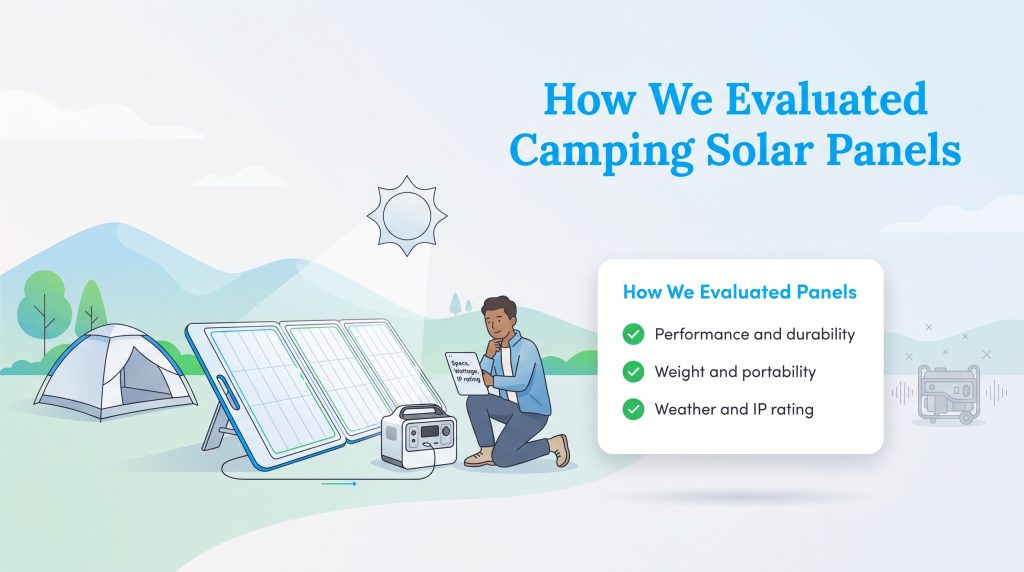
Selecting the right equipment requires looking far beyond flashy marketing claims. We evaluated these camping solar panels based on manufacturer specifications, portability, wattage, weather-resistance ratings, battery compatibility, and use-case fit for common camping scenarios. An off-grid setup has to withstand unpredictable conditions while consistently delivering enough power to keep your devices running smoothly.
You also need a system that respects the quiet nature of the outdoors. We highly recommend following guidance from the National Park Service’s Natural Sounds division, which heavily encourage minimizing noise pollution at your campsite. Silent solar setups are infinitely preferable to loud, exhaust-spewing gas generators when you want to preserve the peaceful atmosphere of nature. Furthermore, the true test of any panel is its ability to handle physical abuse on the trail. We focus on options that do not easily crack or fray after repeated deployments, ensuring your investment outlasts many seasons of heavy use.
💡 Pro Tip: Always check a solar panel’s IP (Ingress Protection) rating before you purchase it, as a rating like IP67 or IP68 is designed to resist dust and temporary water exposure under tested conditions.
| Pick | Best For | Wattage | Weight | Battery Included? | Main Trade-Off |
|---|---|---|---|---|---|
| Jackery SolarSaga 200W | Car camping and overlanding | 200W | 14.1 lbs | No | Higher price |
| BigBlue 28W | Backpacking and phone charging | 28W | 1.25 lbs | No | Limited output |
| EcoFlow DELTA 2 Bundle | RVs and overnight power | Varies | Varies | Yes | Heavier and pricier |
| Renogy 100W Flexible Panel | Lightweight vehicle/RV mounting | 100W | ~4 lbs | No | Needs accessories |
Our Top Picks: The Best Solar Panels for Camping
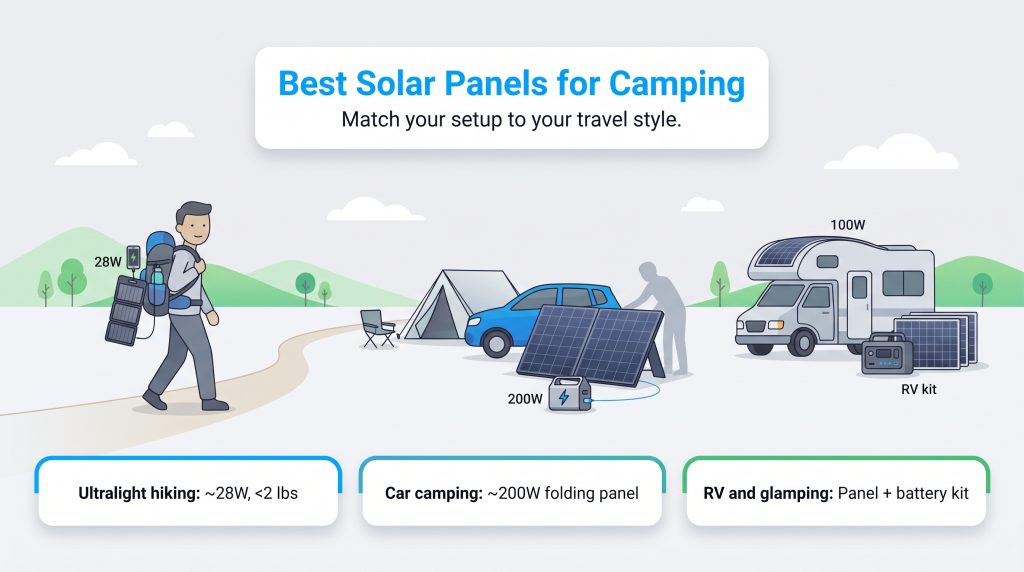
No single power solution fits every camper perfectly, since an RV owner requires a vastly different setup than an ultralight hiker. The following options are carefully categorized by specific use cases so you can track down the exact match for your unique travel style. Finding the ideal portable solar panels for camping comes down to balancing weight, wattage, and your overall budget.
Best Overall: Jackery SolarSaga 200W Portable Solar Panel
A 200-watt panel often hits a great balance of output and manageability for most car campers and overlanders. The Jackery SolarSaga 200W delivers exceptional power while maintaining a highly portable physical footprint. You can fold it down easily to slide alongside your camping gear in the trunk, yet it unfolds to harvest enough sunlight to keep high-demand electronics alive. When paired with a compatible power station, a 200W panel can help recharge the battery used for laptops, camera gear, and some efficient camping fridges, depending on weather and daily power use. Because you do not want to waste time wrestling with complicated mounts, the integrated kickstands make it incredibly straightforward to chase the sun.
- Best For: Car campers who want to recharge a medium or large power station during the day.
- Skip It If: You need something light enough for backpacking or you only need to charge a phone.
- Key Specs: 200W output, 14.1 lbs, IP68 rating.
- Pros: Highly efficient monocrystalline cells, easy to set up with built-in kickstands, and folds compactly for transport.
- Cons: Premium price point, and it is slightly bulky if you have limited vehicle storage space.
- Compatibility Notes: Uses proprietary connectors, making it best paired with a Jackery power station.
Best Foldable Solar Panel for Backpacking: BigBlue 28W
If you consider yourself a minimalist backpacker, every ounce in your pack matters. You cannot lug around a rigid 30-pound panel while trekking through the backcountry. Instead, clipping a lightweight panel directly to your backpack allows you to continuously trickle-charge a smartphone or GPS unit while you hike under the open sky. Small solar panels for backpacking must prioritize weight, packability, and durability over sheer power.
The BigBlue 28W excels in these harsh environments. It features a rugged, weather-resistant canvas exterior and multiple attachment points, making it incredibly simple to strap to the outside of your gear. While exploring the best foldable solar panels for camping, you will find that this unit provides reliable direct charging capabilities without dragging you down on steep inclines. It folds up to the size of a standard magazine, ensuring you barely notice the extra cargo on your back.
- Best For: Backpackers and hikers who only need to charge small electronics like smartphones, GPS devices, or headlamps.
- Skip It If: You need to charge a laptop or run high-draw appliances.
- Key Specs: 28W output, 1.25 lbs, IPX4 water-resistant exterior.
- Pros: Incredibly lightweight, easy to attach to a backpack, and provides reliable direct USB charging.
- Cons: Very limited power output; relies strictly on direct sunlight since it does not store power.
- Watch Out For: Because the USB ports may not be fully waterproof, keep the charging device and connection points protected from rain.
Best Solar Panel Kit With Battery for RVs: EcoFlow DELTA 2 Power Station Bundle
RV owners and modern “glampers” typically need to store substantial energy for overnight use to run lights, fans, and small kitchen appliances. For this crowd, buying a comprehensive bundle — featuring both the panel and a portable power station — is an incredibly smart choice. A complete kit also reduces compatibility headaches because the panel, battery, cables, and controller are designed to work together.
The EcoFlow DELTA 2 Power Station Bundle pairs a robust lithium iron phosphate battery with high-efficiency panels to keep you fully powered up off the grid. For example, pairing the DELTA 2’s 1024Wh capacity with a 220W bifacial panel gives you ample off-grid capability. Choosing camping solar panels with battery storage is the most reliable way to guarantee you have electricity long after the sun goes down. If you are serious about building a reliable solar energy system for an RV, opting for a proven bundle eliminates the headache of mismatched components and gets you back to enjoying the outdoors.
- Best For: RV owners, van-lifers, and glampers who need to run larger electronics overnight.
- Skip It If: You camp far away from your vehicle or have a very strict budget.
- Key Specs: 1024Wh battery capacity, ~27 lbs (power station weight), paired with various panel sizes (often 220W).
- Pros: Massive power storage, highly reliable LFP battery chemistry, and excellent app integration.
- Cons: A much heavier and more expensive investment than a standalone panel.
- Battery Pairing Recommendation: The power station is already included, making this a self-contained system.
Best Budget-Friendly Solar Setup: Renogy 100W Flexible Panel
Not everyone needs a flagship model to enjoy the benefits of renewable energy in the woods. The weekend warrior who wants an eco-conscious alternative without breaking the bank can absolutely find fantastic value in the current market. The best budget solar panels for camping still deliver reliable energy, provided you know exactly what features you might be sacrificing for that lower price tag.
The Renogy 100W Flexible Panel offers an incredibly cost-effective way to start harvesting sunlight. Because it sits at a lower price point, you give up premium conveniences like rigid, adjustable kickstands or a padded carrying case. Its lightweight design works well for temporary mounting on a vehicle roof rack, RV surface, or other stable, ventilated surface. Avoid placing flexible panels directly on heat-sensitive fabric or surfaces that prevent airflow unless the manufacturer says it is safe. You still gain dependable power generation, keeping your essential electronics fully charged without draining your wallet before the trip even begins.
- Best For: DIY enthusiasts looking for a budget-friendly way to mount solar to a camper or vehicle.
- Skip It If: You want a plug-and-play, portable folding setup with a built-in kickstand.
- Key Specs: 100W output, extremely lightweight (~4 lbs), bendable design.
- Pros: Highly affordable, very low profile, and easy to mount on curved surfaces.
- Cons: Lacks a kickstand for optimal sun angling; requires a separate charge controller to connect to a battery.
- Compatibility Notes: This is just a bare panel. You will need to purchase a compatible charge controller and wiring to safely charge your battery.
100W vs. 200W Solar Panels for Camping
Deciding between a 100-watt and a 200-watt panel often comes down to what you actually need to power. A 100W panel is usually enough for charging phones, running LED lights, powering small fans, and keeping a small battery topped off during the day. However, a 200W panel is much better suited for running efficient camping fridges, charging laptops or camera gear, and gathering power quickly during short windows of direct sunlight. Keep in mind that a larger panel is not always better if space, weight, or budget is severely limited. Real-world solar output is almost always lower than the rated wattage due to clouds and imperfect panel angles, so plan your purchase with that buffer in mind.
How Many Watts Do You Need for Camping?
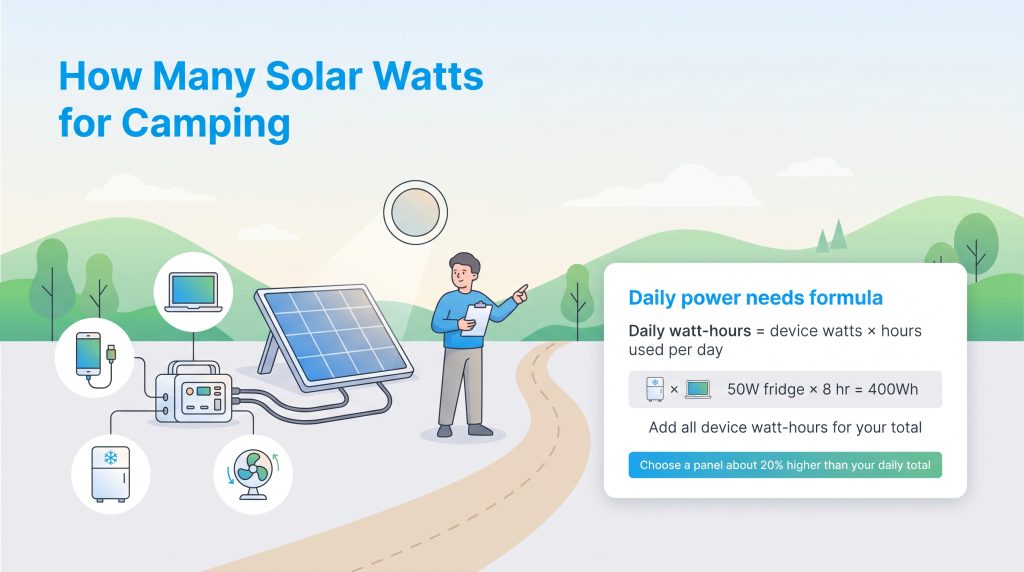
Before purchasing any equipment, you must solve the fundamental technical problem of matching a panel to your daily power consumption. Figuring out exactly how many watts solar panel for camping equipment you need simply involves adding up the watt-hours of the devices you plan to charge. Think of watt-hours as the total volume of electricity a device pulls over a set period of time.
📌 Quick Fact: You can easily estimate your power needs using a simple formula: Daily watt-hours = device watts × hours used per day. For example, a 50W fridge running the equivalent of eight hours per day uses about 400Wh daily.
To determine your exact needs, list everything you want to power. Multiply each device’s running wattage by the number of hours you expect to use it daily. Once you have that total, you can better understand how solar energy generation works to replenish that specific capacity. Always aim to buy a panel that generates about 20% more power than your calculated daily minimum, as clouds, shade, and imperfect panel angles will inevitably reduce your real-world output.
| Camping Device | Estimated Average Wattage | Typical Daily Usage | Estimated Daily Watt-Hours |
|---|---|---|---|
| Smartphone | 5W – 10W | 1 – 2 hours (charging) | 5Wh – 20Wh |
| Laptop | 45W – 65W | 2 – 3 hours (charging) | 90Wh – 195Wh |
| Portable Fan | 10W – 15W | 8 hours (overnight) | 80Wh – 120Wh |
| Mini-Fridge | 35W – 50W | 24 hours (cycling on and off) | ~300Wh – 400Wh |
Powering Critical Devices Off-Grid: CPAP Solar Setups
Taking your sleep apnea therapy into the great outdoors used to mean dragging heavy marine batteries to your campsite. Now, creating a dedicated camping solar setup for CPAP machines is highly accessible, provided you plan the logistics correctly. A solar panel alone will not keep your medical device running at night since it obviously stops generating power once the sun sets. You must pair the panel with a high-capacity portable power station that features a reliable AC outlet or a dedicated DC port specifically rated for your CPAP brand.
When you rely on medical equipment off-grid, ensuring you have enough battery storage to make it through the night is non-negotiable. Always check your CPAP manufacturer’s power requirements, use a compatible DC adapter when available, and test your exact setup at home before relying on it overnight in the woods. Bring backup power just in case.
🚩 Heads Up: Turning off the humidifier and heated hose can reduce power use significantly, but you should test your exact CPAP-and-battery setup at home before relying on it overnight.
Keeping Your Panels at Peak Performance
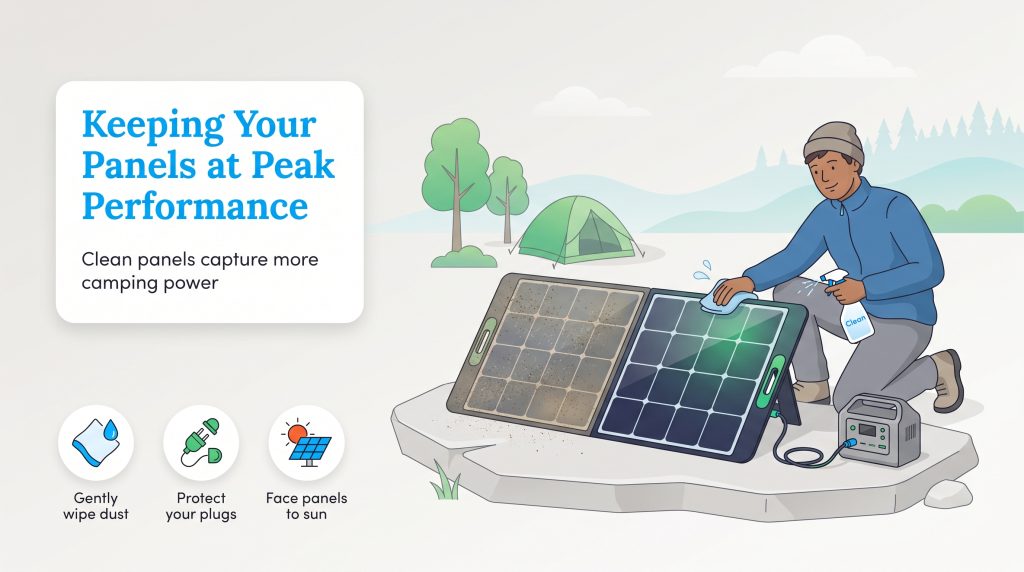
A frustrating post-purchase maintenance gap often leaves campers confused when their equipment suddenly stops charging efficiently halfway through a trip. Solar cells are highly sensitive to physical obstructions, meaning a thin layer of trail dust, sticky pine pollen, or accidental mud splatter drastically reduces their conversion efficiency. You should regularly wipe down the surface of your panels using a soft microfiber cloth and a splash of distilled water to keep them operating at maximum capacity. Never use harsh chemical cleaners or abrasive sponges, as scratching the protective coating will permanently degrade the panel’s ability to harvest light.
To ensure your panels last for years, keep these simple maintenance habits in mind:
- Store panels dry and loosely folded, rather than crushed under heavy camping gear.
- Keep your connectors capped or protected from dirt and grit when not in use.
- Avoid dragging your flexible or foldable panels across sharp rocks and rough surfaces.
- Never aggressively scrub the coated surface of the solar cells.
🌱 Eco Edge: You can maximize your renewable energy capture simply by properly angling your panels directly toward the sun, making sure to adjust them periodically throughout the day as the sun moves across the sky.
Making the Switch to Sustainable Campsite Power
Embracing renewable energy on your next outdoor adventure offers far more than just a convenient way to keep your phone charged. Compared with gas generators, solar panels are quiet, do not require fuel during use, and produce no exhaust at the campsite. It is an environmentally mindful choice that aligns perfectly with sustainable living goals and actively preserves the quiet, clean nature of the outdoors we all love to explore. By thoughtfully selecting the right equipment, reducing your overall electricity footprint becomes a seamless part of your packing routine. You can confidently head off-grid knowing your campsite will stay fully powered and wonderfully peaceful.
Frequently Asked Questions About Camping Solar Panels
What is the difference between flexible and rigid solar panels for camping?
Can a 100W solar panel run a camping fridge?
Do portable solar panels work in the rain or heavy clouds?
How do I connect a foldable solar panel to a portable power station?
Are solar panel kits for camping worth the investment over gas generators?
About the Author

LaLeesha has a Masters degree in English and enjoys writing whenever she has the chance. She is passionate about gardening, reducing her carbon footprint, and protecting the environment. She also recently served as President of the Board for City Sprouts (a community garden).

David has been an integral part of some of the biggest utility sites on the internet, including InMyArea.com, HighSpeedInternet.com, BroadbandNow.com, and U.S. News. He brings over 15 years of experience writing about, compiling and analyzing utility data.

Jared Evans is a licensed electrician and the owner of Full Circuit Electric in Omaha, Nebraska. As an expert reviewer for UtilitiesForMyHome.com, Jared uses his 10+ years of hands-on experience to ensure our electrical advice is safe, accurate, and easy to follow. Whether he's troubleshooting a complex wiring issue or sharing tips on green energy upgrades, Jared is dedicated to helping you power your home efficiently — and safely.