

Discover how community solar programs let you save on your electricity bill and support clean energy without installing a single rooftop panel.
Key Takeaways
- Community solar programs allow you to subscribe to a local solar farm and receive energy credits directly on your utility bill.
- Many community solar offers advertise bill savings in the 5% to 15% range, though actual savings depend on utility rates and provider fees.
- This shared solar model is an environmentally mindful choice for renters, condo owners, or anyone with a roof unsuitable for traditional solar panels.
Wanting to support renewable energy and lower your utility bills sounds like an obvious choice, but the reality of renting an apartment or dealing with a heavily shaded roof often puts most types of solar panels entirely out of reach. We know how frustrating it is to seek out an energy-saving option while feeling blocked by your current living situation or restrictive homeowner association rules. That is exactly where community solar programs step in to help. They offer a practical, eco-conscious alternative that bridges the gap between your desire for clean energy and your housing constraints, especially when you are ready to set up electricity at your new home.
What Are Community Solar Programs?
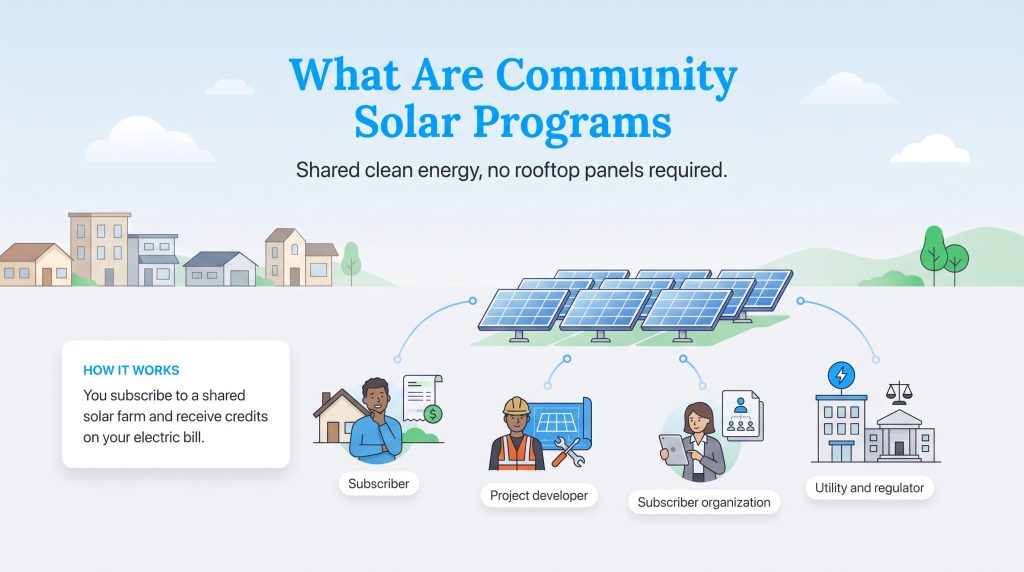
When we start researching sustainable utility choices, the first question we usually hear is exactly what is community solar, and how can it possibly work without attaching massive panels directly to your property? Essentially, community solar programs are large, centrally located solar power plants that distribute their benefits across a localized network of households. Instead of one single homeowner financing and owning the entire system, the electricity generated by this centralized site is made available through shared solar farm subscriptions. You simply subscribe to a specific portion of the solar array based on your annual power usage, and the clean energy produced goes straight into your local power grid. If community solar is available in your utility territory, you can easily participate and reap the financial rewards even if you rent, live in a high-rise condo, or simply have a roof that is too old to support a heavy panel installation.
🌱 Eco Edge: Even if you can’t install panels on your property, participating in a shared solar program actively adds fresh, renewable electricity to your local grid, which heavily reduces your community’s reliance on fossil fuel generation over time.
If you want to compare solar energy options, this subscription-based model provides an incredibly practical entry point without any heavy construction, permitting delays, or ongoing maintenance demands. According to the Department of Energy, these unique setups are designed specifically to expand access to renewable energy for households that simply cannot host rooftop panels. It democratizes green energy, tearing down the financial and physical barriers that traditionally locked lower-income households and renters out of the clean energy transition, allowing absolutely anyone with an active electric bill to explore taking part.
The Main Players in Community Solar
Because you are bypassing the traditional rooftop setup, a few different organizations have to work together behind the scenes to deliver your savings. To better understand the process and know exactly who you are dealing with, it helps to identify the main players involved in a shared solar program:
- Subscriber: That is you. As a subscriber, you are the residential customer leasing a portion of the farm’s output and receiving the financial bill credits for the energy your share produces.
- Project Developer: This is the engineering and construction company responsible for securing the land, securing the permits, and physically building the solar farm. They maintain the physical hardware so you don’t have to.
- Subscriber Organization: Often a third-party management company, this group handles all the customer service. They manage your specific account, process your enrollment, and coordinate your subscription size with the utility.
- Utility Company: Your local, traditional power provider remains highly involved. They physically maintain the grid infrastructure, continue delivering continuous electricity to your home, and apply the solar credits to your monthly invoice.
- State Regulator or Energy Office: This is the government agency that legislates how the program works, establishes the compensation rates for the solar power, and oversees vital consumer protections to keep the market fair.
How Does Community Solar Work?
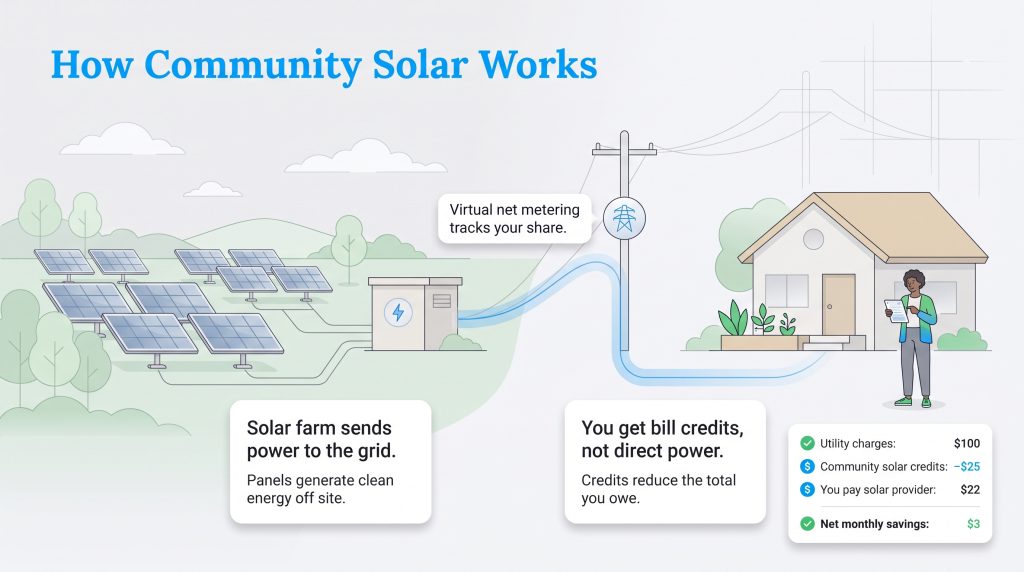
Understanding exactly how community solar works comes down to tracking the flow of electricity and the flow of money. The most important concept to grasp is that you do not receive electricity directly from the solar panels. There is no special, dedicated power line running from the rural solar farm straight to your living room. Instead, your home continues to pull its necessary electricity from the general grid, exactly as it always has. Shared solar programs exist as an accounting and sustainability mechanism to ensure more clean power enters the regional energy mix while financially rewarding you for supporting its generation.
To successfully map the exact flow of electricity from the sun all the way to your final monthly savings, you can look at the process in three distinct, sequential phases:
- The Farm Generates Power: The centralized solar plant converts daily sunlight into clean, renewable electricity.
- Power Enters the Grid: The farm immediately exports all of that generated electricity into the local utility grid, increasing the total supply of clean energy in your region.
- The Utility Calculates Credits: Your local utility company measures exactly how much power the farm exported, determines your specific subscribed share of that output, and assigns a monetary value to it.
- Credits Lower Your Bill: The utility applies those earned financial credits directly to your standard electric bill, effectively lowering the final amount you owe for the month.
A Simple Billing Example: Virtual Net Metering Explained
This entire off-site credit process is made possible through a regulatory billing framework known as virtual net metering. Having virtual net metering explained is crucial because it is the legislative backbone that forces your utility company to compensate you for power generated somewhere else. Standard net metering applies to panels directly on your roof; virtual net metering allows you to reap identical billing benefits when the panels are located miles away.
Let’s look at a practical example of how this plays out on paper. Suppose your standard utility bill for the month shows $100 in regular electricity charges. Based on your subscription size and the sunny weather that month, your share of the community solar farm produced enough energy to earn $25 in virtual net metering credits. Your utility subtracts that $25, leaving you owing them just $75. Meanwhile, your community solar provider charges you a discounted rate — say, $22 — to purchase those $25 worth of credits. When you combine your $75 utility payment and your $22 solar payment, your total monthly energy cost is $97, leaving you with $3 of net savings. While those numbers seem small on a monthly basis, they compound significantly over a full calendar year of usage.
Community Solar State Availability and Policies
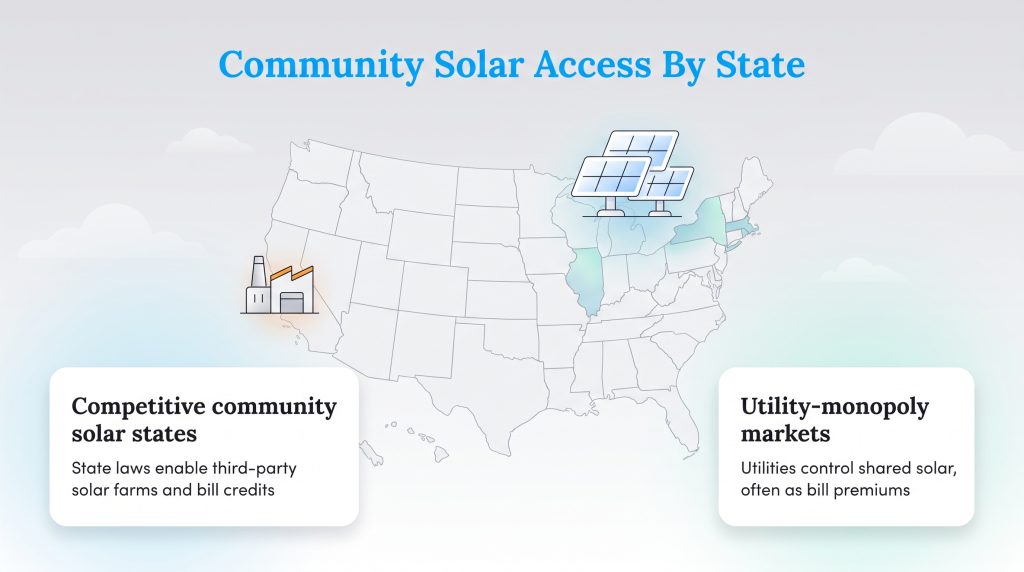
One of the biggest hurdles consumers face when trying to sign up is realizing that these programs are not universally accessible across the United States. Community solar state availability is entirely dependent on localized state-level legislation. Because electricity is a highly regulated sector, a solar farm cannot simply start selling subscriptions to residents unless the state government has passed specific laws forcing the traditional utility monopolies to integrate virtual net metering and accept third-party billing credits.
This localized legislation creates a fractured market where residents in one state might have dozens of competitive solar farms to choose from, while residents just one state over have absolutely zero access. Understanding the policy landscape helps you know what to expect when you start searching for providers:
- Fully Deregulated, Competitive Markets: States with robust community solar legislation mandate that utility networks play fair with third-party developers. In leading states like New York, Massachusetts, and Illinois, consumers enjoy highly competitive markets with multiple private companies vying for their subscription. This heavy competition usually leads to better discounts, no cancellation fees, and easier enrollment terms for the average household.
- Utility-Monopoly Markets: In states without competitive community solar mandates, the local utility company usually retains complete control over the energy supply. If a shared solar program exists in these areas, it is typically owned and operated directly by the utility itself. These programs often take the form of “green pricing” premiums rather than cost-saving discount structures, meaning you might actually pay slightly more on your bill to support the solar farm.
Community Solar vs. Rooftop Solar: Which Is Better?
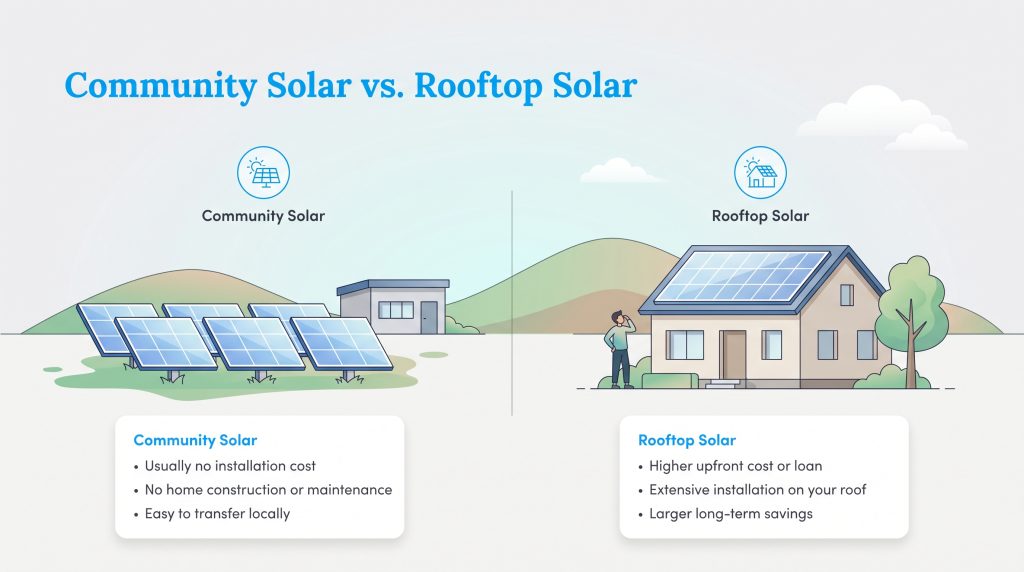
When looking closely at community solar vs rooftop solar, the best choice depends entirely on your current living situation, your household budget, and your long-term financial goals. Rooftop panels usually require you to own your property outright and often involve a massive upfront cash purchase or taking out a substantial long-term loan. However, once that system is paid off, rooftop panels offer exceptional long-term home equity boosts and much higher total financial savings over their 25-year lifespan. On the flip side, shared solar subscriptions bypass the headache of home construction, demand virtually no upfront installation investment, and remain fully portable if you decide to move to a new apartment across town.
| Feature | Community Solar | Rooftop Solar |
|---|---|---|
| Upfront Cost | Usually no installation cost | High (cash or loan required) |
| Installation Required | None | Extensive home modifications |
| Maintenance | Handled by the provider | Homeowner responsibility |
| Portability | Easy to transfer locally | Stays attached to the house |
| Average Savings | Varies (often 5% to 15%) | Substantial over 10 to 20 years |
| Environmental Impact | Offsets broader grid reliance | Offsets direct home power usage |
When Community Solar Makes Sense
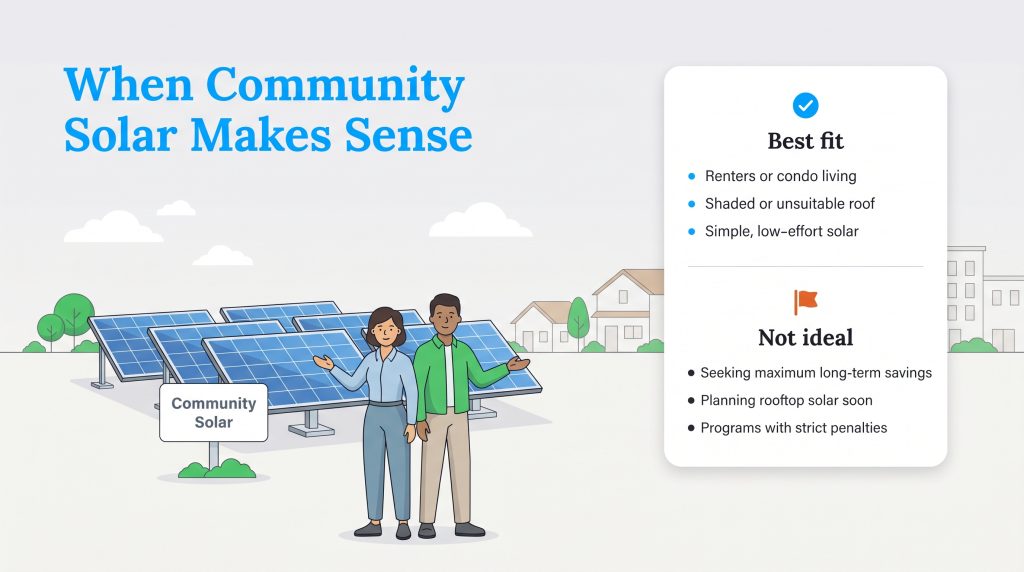
We believe community solar is a fantastic, accessible alternative for thousands of people, but we also acknowledge that it simply isn’t the perfect fit for every single household. Analyzing your lifestyle and homeownership plans is critical before signing an agreement. Knowing precisely when this model works best can save you an immense amount of time and frustration during your utility search.
| Makes Sense If | May Not Be Ideal If |
|---|---|
| You rent an apartment or live in a condo with a strict HOA. | You want the highest possible long-term financial savings on solar. |
| Your roof is heavily shaded, old, small, or faces the wrong direction. | You plan to invest in and install your own rooftop solar panels soon. |
| You do not want to finance hardware or take out a large personal loan. | The local provider contract has stiff cancellation penalties or fees. |
| You may move within the same utility territory in the near future. | You live in a state without mandated consumer bill credit rules. |
| You want a lower-effort, hands-off renewable energy option. | You need dedicated battery backup power during grid outages. |
Special Protections for Low-Income Households
Historically, the upfront costs and strict credit requirements associated with green energy upgrades locked millions of families out of the transition to renewables. Recognizing this glaring inequity, many states have recently overhauled their legislation to heavily incentivize and protect low-to-moderate-income (LMI) participation. Today, targeted low income community solar initiatives are specifically engineered to remove financial friction, ensuring that vulnerable communities can directly benefit from utility bill reductions without jumping through impossible hoops.
To qualify for these specialized LMI programs, households generally need to demonstrate participation in existing assistance programs — like SNAP, Medicaid, or LIHEAP — or prove their household income falls below a certain percentage of the area’s median income. If you qualify, state-mandated consumer protections make enrollment incredibly safe. Three of the most common benefits built into LMI shared solar programs include:
- Waived Credit Checks: Providers are strictly forbidden from running hard credit pulls, ensuring past financial hardships never block access to future savings.
- Zero Upfront Fees: State laws often mandate that low-income subscribers cannot be charged any enrollment deposits, sign-up fees, or hidden administrative costs.
- Guaranteed Higher Savings: While standard subscribers might see a 10% discount on energy credits, specialized LMI tiers frequently guarantee a minimum savings threshold of 20% or more, creating more impactful monthly relief.
The Pros and Cons of Shared Solar Programs
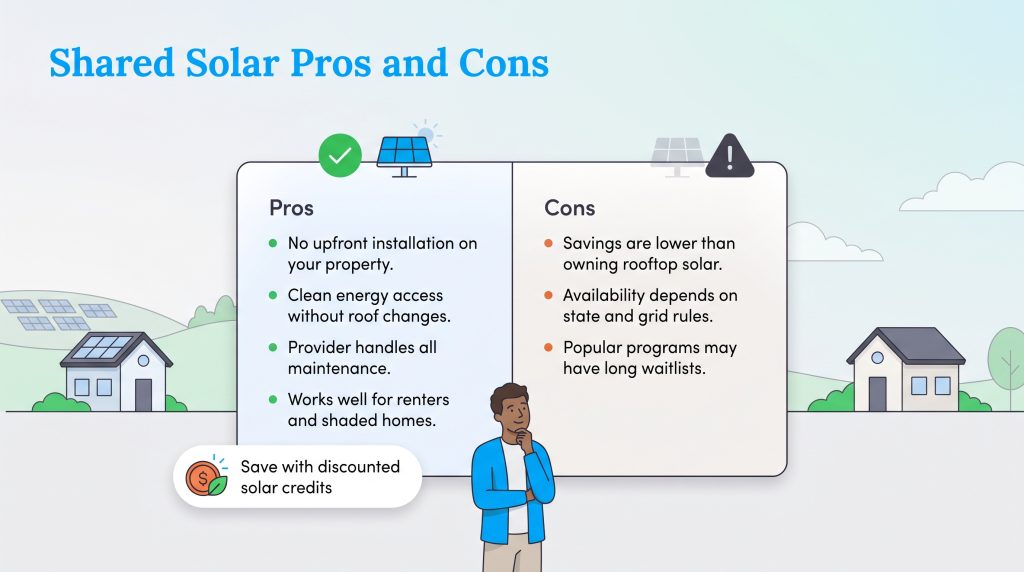
Objectively weighing the community solar pros and cons helps you make a truly informed, confident decision about your home’s utility setup. While the benefits are highly attractive for renters and budget-conscious homeowners alike, there are a few notable drawbacks to keep in mind, such as restrictive legislative availability and potentially frustrating waitlists for the most popular farms.
- Pro: Eliminates the need for massive upfront cash investments or complex hardware installations on your personal property.
- Pro: Provides immediate access to clean, renewable energy production without physically altering your roof or dealing with HOA approvals.
- Pro: Delegates all cleaning, repair, and operational maintenance entirely to the professional project developer.
- Pro: Maximizes eco-conscious accessibility for long-term renters, condo owners, and homeowners with heavy tree coverage.
- Con: Yields lower overall, long-term financial savings compared to outright owning and operating your own rooftop panels.
- Con: Restricts widespread participation, as program availability heavily depends on highly specific state laws and local grid capacity constraints.
- Con: Creates potential enrollment delays, as high consumer demand often leads to lengthy waitlists for newly constructed projects.
💸 Money-Saver: Many subscription programs charge you based on the solar credits your share produces, often at a discount to the value of those credits, meaning you can start saving without a large upfront investment.
How to Find and Enroll in Community Solar Near You
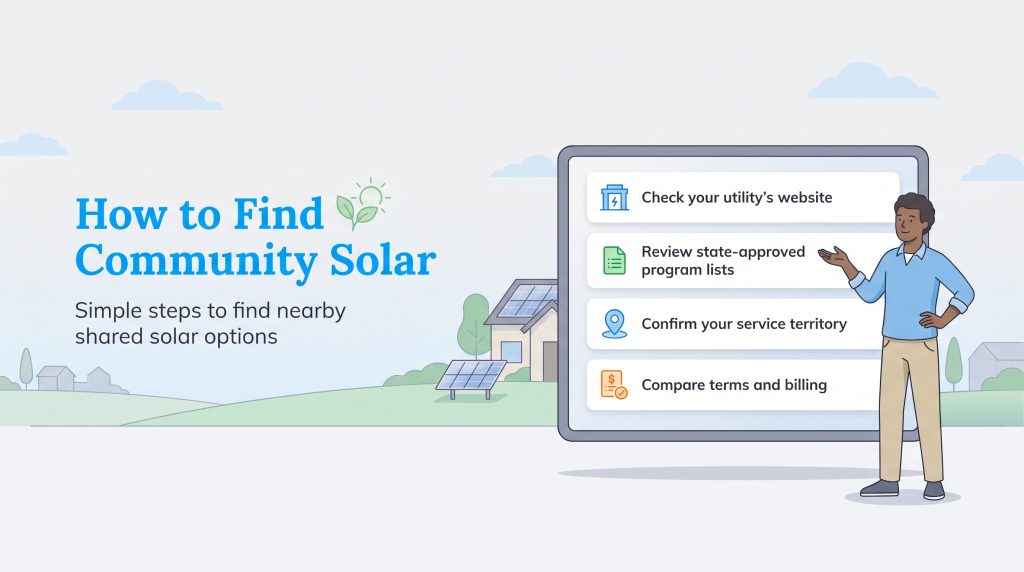
If you have decided that a subscription model is the perfect fit for your home, the next logical step is figuring out how to find community solar providers operating in your specific zip code. Because this industry is still growing, finding a reliable, trustworthy shared solar program requires a bit of localized research. Instead of simply trusting the first advertisement you see on social media, we recommend following a formalized, four-step enrollment process to secure the best rates and terms.
- Evaluate Eligibility: Before doing anything else, pull up your most recent electric bill. You will need your utility account number and a clear picture of your average annual kilowatt-hour (kWh) usage, as providers use this data to size your specific solar subscription correctly.
- Find a Provider: Start your search at authoritative sources. Visit your state’s public utility commission website or your state energy office to find official, vetted lists of approved subscriber organizations. You can also check directly with your utility provider’s website to see if they host a marketplace of authorized local projects.
- Contact and Confirm: Once you locate a promising farm, reach out to their customer service team. You must explicitly ask and confirm whether their specific project serves your exact utility territory. Even if a farm is built in your state, it cannot offset your bill if it connects to a different regional power grid than your home does.
- Sign the Agreement: Carefully review the subscription lengths, discount rates, and cancellation policies. Compare these terms across at least two or three providers if your state’s competitive market allows it. Once you find a contract that offers guaranteed savings with minimal penalties, sign your agreement and provide your utility account number for linking.
How to Spot a Community Solar Scam
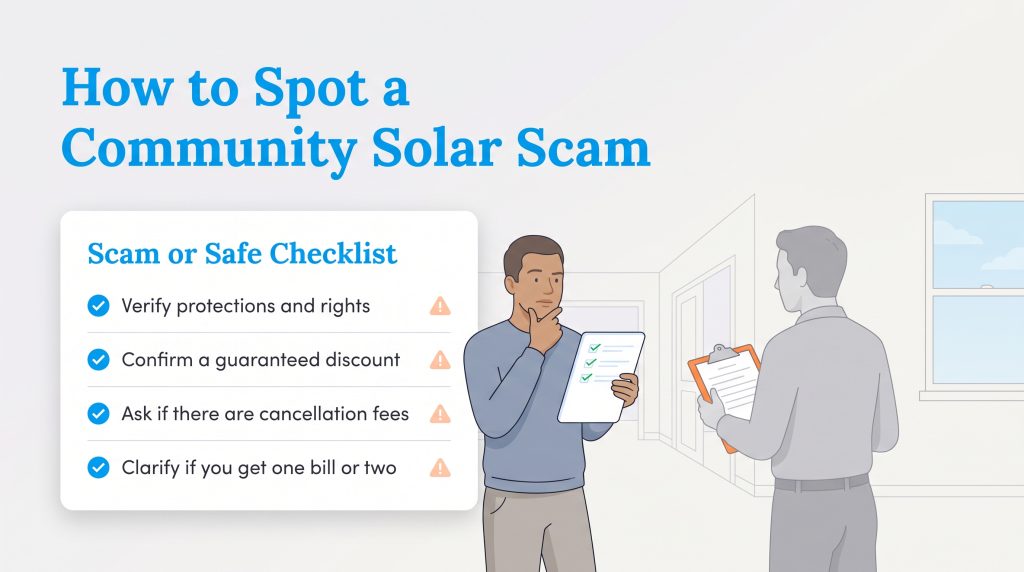
Because the core pitch — saving money on your power bill without installing panels or paying any hefty upfront fees — sounds entirely too good to be true, consumer skepticism is perfectly natural and incredibly smart. Unfortunately, predatory sales tactics and misleading contracts do exist in the retail energy market. Door-to-door salespeople or aggressive telemarketers sometimes misrepresent their affiliations, claiming to be directly from your utility company when they are actually third-party brokers. A legitimate solar program will always provide transparent terms and ample time for review, whereas a scam might aggressively pressure you into signing a confusing, penalty-laden contract on the spot.
Your Provider Comparison Checklist
Before you commit your utility account to a long-term agreement, always take a step back and review the dense details carefully. Keep your emotions out of the decision and use this practical checklist to protect your finances:
- Verify your community solar consumer protections: Always check your state’s attorney general website or public utility commission to confirm what specific rights you have regarding contract disclosures, right-to-cancel grace periods, and standardized billing formats.
- Guaranteed discount: Check if there is an explicitly written, guaranteed discount percentage on the solar credits (e.g., you will always pay 10% less than the utility credit value).
- Billing structure: Fully understand whether your credits will appear seamlessly on your main utility bill or if you will be forced to manage a secondary, separate invoice from the solar company.
- Cancellation fees: Look deeply into the fine print for hidden financial penalties if you need to unexpectedly exit the contract early.
- Contract length: Note exactly how many months or years you are locked into the agreement, as some stretch up to 20 years.
- Moving policies: Find out the required notice period if you move to a new home, and whether you can transfer the account.
- Usage limits: Ensure your subscription size is firmly capped so it cannot exceed your historical annual electricity usage, preventing you from overpaying for credits you cannot use.
- Operational status: Ask bluntly if the project is physically operating right now or if it is still under development with an unconfirmed, hypothetical future launch date.
📌 Quick Check: Before you enroll, ask whether you will receive one bill or two, how your discount is calculated, whether there is a cancellation fee, and what happens if you move. A legitimate provider should be able to answer those questions clearly.
Always scrutinize the fine print to ensure the provider explicitly guarantees a financial discount on your standard utility rate. If a salesperson demands a massive upfront deposit via a strange payment method, rushes you to sign quickly on a tablet, or outright refuses to clearly explain how your bill credits will be calculated and applied, walk away immediately. We always recommend stepping back to explore other ways to lower your electric bill securely if any solar offer feels dishonest or poorly explained.
Preparing for Your First Community Solar Bill
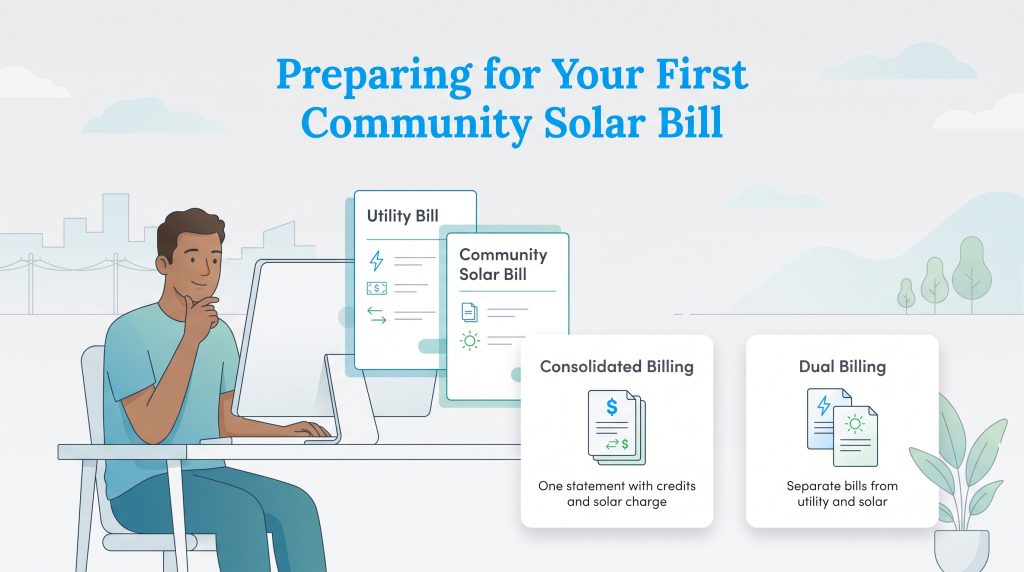
Once you navigate the provider checklist and successfully sign your enrollment agreement, you might expect immediate savings. However, patience is required. There is typically a standard 30-to-60-day waiting period before your newly assigned utility account properly syncs with the solar farm’s production data. During this setup phase, the subscriber organization works behind the scenes with your local utility grid operators to ensure everything is mapped correctly. You will continue to pay your normal electric rate during this waiting period.
When the system finally goes live, your monthly invoice experience will change based on your state’s specific billing legislation. You must actively check your statements to ensure the community solar bill credits are successfully manifesting. In some states, you will experience consolidated billing, meaning everything is elegantly bundled into one single statement from your original utility company. You will see your normal usage charges, a line item deducting the value of your solar credits, and a final line item charging you the discounted rate for those credits. In other states, you might encounter dual billing. This means you will still receive a bill from your utility showing the credit deduction, but you will also receive a completely separate invoice from the solar developer charging you for the subscription. Always review these documents closely during the first three months to ensure the math aligns with your promised discount. To make sure you are maximizing your financial return, take a moment today to dig into your current paperwork, find your average monthly usage, and check your current electric rates.
Frequently Asked Questions About Community Solar Programs
Is community solar a scam?
What is the average community solar subscription cost?
Can community solar replace my current utility provider?
Do I still get an electric bill if I use community solar?
Can I take my community solar subscription with me if I move?
How do I find community solar projects near me?
Why is there a waitlist for community solar farms?
What happens if my community solar credits are more than my electric bill?
Is community solar better than a green power plan?
Will community solar work during a power outage?
About the Author

David has been an integral part of some of the biggest utility sites on the internet, including InMyArea.com, HighSpeedInternet.com, BroadbandNow.com, and U.S. News. He brings over 15 years of experience writing about, compiling and analyzing utility data.

LaLeesha has a Masters degree in English and enjoys writing whenever she has the chance. She is passionate about gardening, reducing her carbon footprint, and protecting the environment. She also recently served as President of the Board for City Sprouts (a community garden).