

Setting clear expectations and choosing the right split method keeps the peace in a shared apartment
Key Takeaways
- Discuss utility budgets and payment methods before moving in together to avoid future conflicts and surprise costs.
- Consider usage-based splits if one roommate works from home or has significantly higher energy consumption than others.
- Use bill-splitting apps like Splitwise or Venmo to organize expenses and keep a digital paper trail of who paid what.
Moving in with friends or new roommates is an exciting milestone, but the first conversation about finances can instantly bring down the mood. While money talks are often awkward, ignoring them is a recipe for disaster when the first electricity bill lands in your inbox. Figuring out exactly how to split utility bills in shared apartment spaces is a vital step toward a peaceful living arrangement. Many renters assume a simple 50/50 split is the only way to go, but equal doesn’t always mean fair — especially if lifestyles and incomes vary wildly. By establishing a clear system upfront, you can ensure everyone pays their fair share without ruining relationships. This guide will walk you through the best methods, apps, and strategies to handle shared expenses so you can focus on enjoying your new home.
Types of Shared Utilities Versus Individual Expenses
Before you debate the best way to split bills with roommates, you need to know exactly what expenses belong in the communal pot. A comprehensive budget prevents end-of-the-month surprises and helps everyone plan their finances effectively. When setting up utilities for a new home, the standard shared expenses typically include:
- Electricity: Often your most variable bill, fluctuating significantly based on the season, your heating or cooling preferences, and the types of electronics running.
- Natural Gas: Typically covers your furnace, water heater, and stovetop, seeing much higher usage during the winter months.
- Water and Sewer: While sometimes rolled into rent, many modern apartments pass these usage-based costs directly to the tenants.
- Internet: A fixed monthly cost essential for streaming, gaming, and remote work.
- Trash and Recycling: Usually a small, flat monthly fee for municipal or private collection services.
A frequent source of tension in shared apartments is blurring the line between essential utilities and individualized household supplies. To avoid making anyone feel nickel-and-dimed, establish strict boundaries regarding what qualifies as a mandatory shared expense. We recommend keeping basic infrastructure costs joint while leaving lifestyle choices separate.
| Strict Utilities (Shared Proportionally) | Individualized Household Expenses (Keep Separate) |
|---|---|
| Electricity and Natural Gas | Groceries and Personal Snacks |
| Water, Sewer, and Trash Collection | Streaming Services (Netflix, Hulu, Spotify) |
| High-Speed Internet Service | Personal Care and Specific Cleaning Supplies |
Five Fair Methods to Split Utility Bills
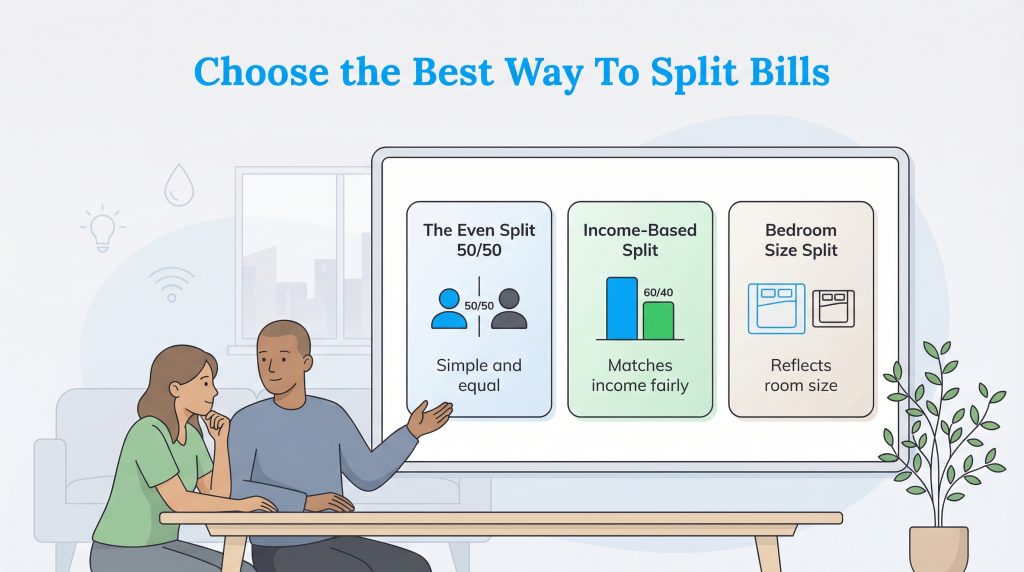
Once you open the lines of communication, the next step is agreeing on the math. Finding the fairest breakdown often requires looking beyond basic division. We highly recommend using a free roommate bill splitting calculator online to experiment with different percentages and eliminate any guesswork. Depending on your household’s unique dynamic, here are five methods to help you decide what works best.
The Even Split
This is the most common and straightforward method. You take the total amount of the bill and divide it by the number of people living in the apartment. This method works best for roommates who have similar schedules, income levels, and energy usage habits. It requires the least amount of math and eliminates petty arguments over who left the living room lights on for an extra hour. However, the even split can cause friction if one person is rarely home while the other runs the air conditioning non-stop.
The Income-Based Split
For households with significant wage gaps, choosing to split rent and utilities based on income focuses on equity rather than strict equality. If one roommate earns significantly more, they might agree to pay a larger percentage of the shared living costs so that the financial burden feels identical to both parties. For example, if you earn $60,000 and your roommate earns $40,000, your combined household income is $100,000. Under this model, you would handle a 60/40 split. If your monthly electric bill is $100, you pay $60 and your roommate pays $40. This approach requires deep trust and salary transparency, but it is excellent for couples or close friends.
The Bedroom Size Split
In many apartments, the rooms aren’t created equal. If one person scores the primary suite with a private bathroom and walk-in closet while the others share a smaller room and a hall bath, the person with the better amenities often pays more. While this is commonly applied to base rent, you can also apply it to your energy and water costs. When splitting utilities based on square footage, the logic is that the person with the larger footprint and private bathroom naturally consumes more heating, cooling, and water.
The Usage-Based Split for Remote Workers
The rise of remote and hybrid schedules has introduced a new complication to roommate dynamics. Splitting bills when one roommate works from home requires a nuance that the old 50/50 rule often misses. A remote worker consumes significantly more heating, cooling, and electricity during daytime hours compared to someone working at a traditional corporate office.
In this scenario, sticking to an even split can quickly lead to resentment. If you are wondering how to divide utility bills unevenly without tracking every single kilowatt, you should negotiate a slight offset for variable bills like electricity and natural gas. A practical adjustment is having the remote worker cover 60% of variable costs while the office worker pays 40%. This properly accounts for the extra hours spent running the HVAC system, monitors, and laptops during the day.
The Days-Occupied Split Method
Frequent travelers and touring professionals often feel cheated by standard utility splits. If you are dealing with splitting utility bills when roommate is on vacation for weeks at a time, the Days-Occupied method offers mathematical fairness. In this system, you divide the total variable bill (like electricity or water) by the number of days in the billing cycle to get a daily rate. Then, multiply that daily rate by the number of days each roommate actually occupied the apartment.
For example, if your $150 electric bill covers a 30-day cycle, the daily rate is $5. If one roommate was away for 10 days, their variable cost obligation decreases. Keep in mind that fixed costs — like high-speed internet or base connection fees — should still be split evenly, as the infrastructure remains active regardless of who is sleeping in the apartment.
To make choosing easier, reference this quick comparison of the five primary billing methods:
| Method | Best For | Pros / Cons |
|---|---|---|
| The Even Split (50/50) | Roommates with similar habits and incomes. | Pros: Easy math. Cons: Ignores unequal usage. |
| Income-Based Split | Couples or roommates with large wage gaps. | Pros: Highly equitable. Cons: Requires sharing salary details. |
| Bedroom Size Split | Apartments with a clear “master bedroom” advantage. | Pros: Pays for space utilized. Cons: Doesn’t factor in actual energy use. |
| Usage-Based Split | Households with a remote worker. | Pros: Accounts for daytime energy draw. Cons: Requires negotiating arbitrary percentages. |
| Days-Occupied Split | Frequent travelers or touring professionals. | Pros: Mathematically precise. Cons: Tedious tracking of travel dates. |
The Best Apps to Split Rent and Utilities
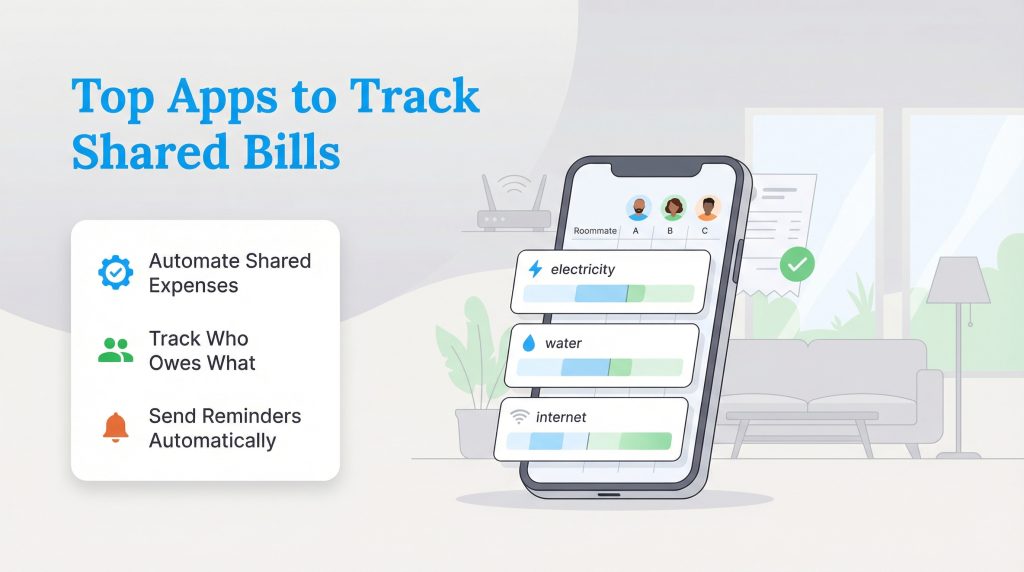
Finding the right digital tools should be your first priority if you want to avoid managing crumpled paper receipts and mental math. Because most utility providers only allow one or two names on an account, you need reliable apps to split rent and utilities to ensure the primary account holder is reimbursed promptly. Here is a breakdown of the best platforms for managing your shared expenses:
| App Name | Best Use Case | Core Features | Pricing |
|---|---|---|---|
| Splitwise | Complex households tracking ongoing monthly expenses. | Running net balances, group categorization, receipt scanning, and automated weekly digest reminders. | Free basic version; Splitwise Pro offers receipt scanning and removes ads for a monthly fee. |
| Venmo | Instant, casual transfers for immediate reimbursement. | Direct bank integration, instant mobile reminders, and a social feed for fast, documented payments. | Free for standard bank transfers; small fee for instant deposit to debit cards. |
| Settle Up | International roommates or complex uneven splits. | Works offline, supports multiple currencies, and handles complex uneven split ratios easily. | Free with ads; Premium version removes ads and allows receipt photo uploads. |
Combining a robust tracking platform like Splitwise with a fast payment processor like Venmo creates a stress-free ecosystem, ensuring everyone knows exactly what they owe without the awkward follow-up conversations. This digital approach prevents lost receipts and frustrating arguments over who paid what at the end of the month.
Automating Payments and Shared Accounts
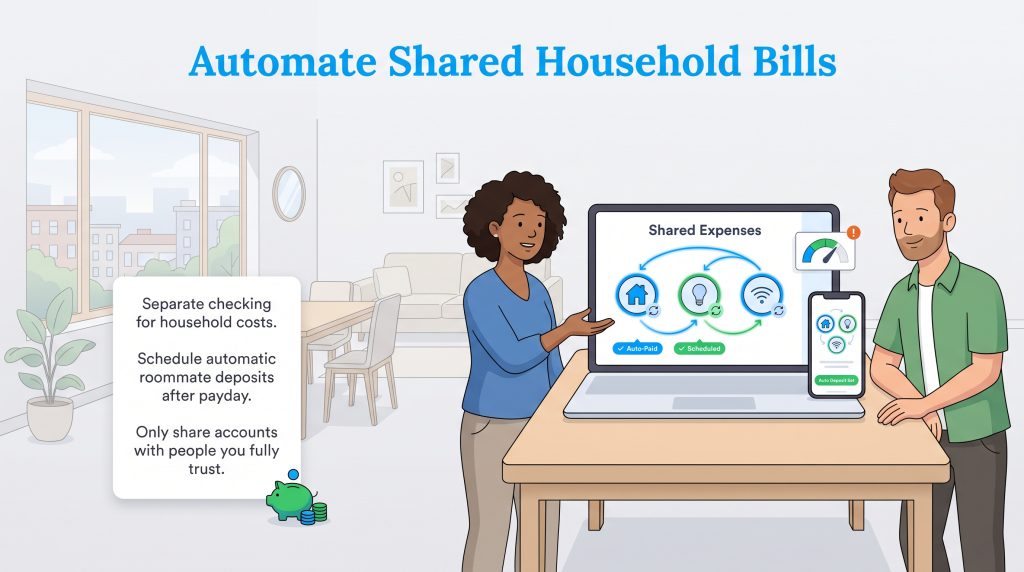
While peer-to-peer payment apps are great for fast, casual transfers, households seeking a highly organized financial system should consider opening a separate checking account for household expenses. This method treats your apartment like a small business, completely removing the emotional friction of requesting rent and utility money every single month.
By opening a dedicated joint checking account, all roommates can schedule automatic payroll transfers from their personal bank accounts directly into the shared fund right after payday. Once this reliable pool of money is established, you can use the account to automate shared bill payments directly with your property manager and utility providers.
🚩 Heads Up: Opening a joint bank account legally links your financial profiles. Only pursue this strategy with roommates you deeply trust, as any overdrafts, negative balances, or missed deposits will impact all account holders equally and can damage your credit score.
How to Handle Utility Security Deposits
Many utility providers require an upfront security deposit to establish service, particularly if the account holder has a limited credit history or a low credit score. These deposits can range from $50 to well over $200 per utility, adding a hefty chunk of change to your move-in costs.
Even if the utility account is only in one person’s name, the most equitable approach is to divide upfront connection fees and utility security deposits equally among all roommates. Because the entire household benefits from having running water and electricity on day one, everyone should shoulder the initiation costs.
When the lease ends — or if a roommate decides to move out early — you must have a plan for the deposit refund. Typically, utility companies credit the deposit back to the account after 12 months of on-time payments, or they mail a refund check when the service is disconnected. Make sure your household agreement stipulates that the primary account holder will reimburse the other roommates for their original deposit share once the utility company issues the refund.
Assigning Utility Bills to Different Account Holders
When setting up a new household, one of the biggest missed opportunities is placing every essential service under a single person’s name. You might be wondering exactly whose name should be on the utility bill. Instead of defaulting to one primary account holder for everything, you should use a strategic approach by assigning different bills to different roommates.
First, this method distributes the financial liability evenly. The person whose name is on the bill is the one who assumes the legal responsibility and takes the credit score hit for any missed payments. By spreading the accounts around, one person is not carrying the legal burden of thousands of dollars in annual utility costs. If the apartment has four roommates, one person can handle the electricity, one can manage the water, and another can take ownership of the internet connection.
More importantly, this strategy allows multiple individuals to build a positive credit history simultaneously. Consistent, on-time payments for utilities can be reported to major credit bureaus through opt-in services. This approach fosters mutual accountability; if everyone is responsible for maintaining a service in their name, the entire household becomes equally invested in keeping payments punctual and the lights on.
Creating a Roommate Utility Agreement
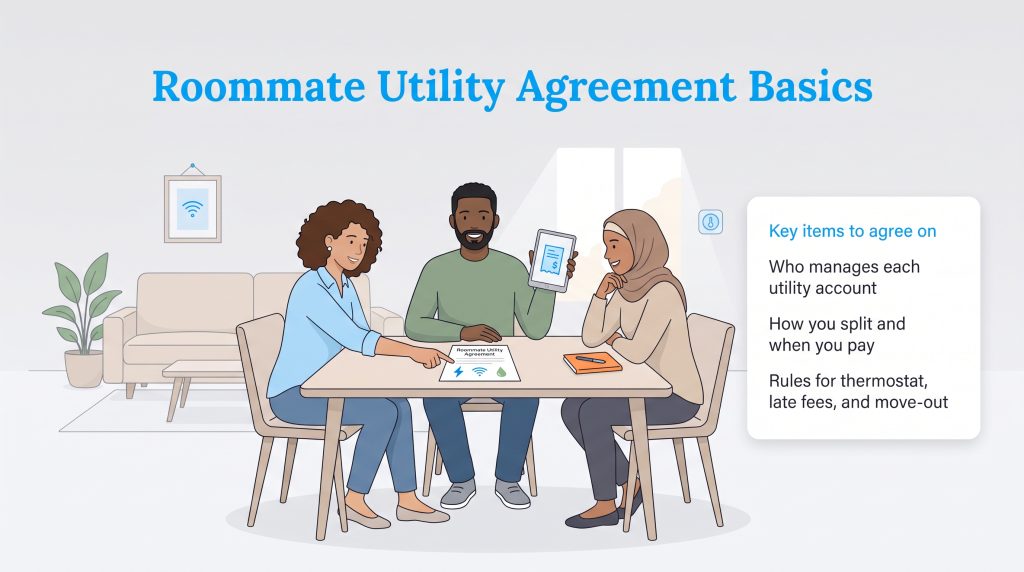
Timing is everything when it comes to shared finances. The worst time to figure out how to manage shared expenses is after a surprisingly high statement has already been issued. Instead, we highly recommend having this chat during the lease-signing phase or, at the very latest, on move-in day. By setting ground rules early, you normalize money talk and prevent resentment from building up over time.
During this initial meeting, it helps to create a structured document. Utilizing a roommate utility agreement template removes the ambiguity from your monthly obligations. You can copy and customize the following framework for your own household:
[Roommate Utility Agreement Template]
- Account Assignments: [Roommate A] manages the electricity. [Roommate B] manages the internet. [Roommate C] manages the water/sewer.
- Split Method: We agree to split all shared utility bills using the [Even Split / Income-Based Split / Usage-Based Split] method. The exact breakdown is: [List Percentages].
- Payment Deadlines: All roommates agree to transfer their portion of the bill via [Splitwise/Venmo] within [48 hours] of the primary account holder posting the receipt in the group chat.
- Late Fee Penalty Clause: If a roommate fails to pay their share on time, resulting in a utility late fee, the roommate responsible for the delay will pay 100% of the incurred late fee.
- Thermostat & Usage Rules: The thermostat will be kept no higher than [72 degrees] in the winter and no lower than [70 degrees] in the summer.
- Move-Out Policy: If a roommate moves out early, they remain financially responsible for their share of the utilities until a replacement subletter is found or the lease concludes. Deposit refunds will be distributed within [5 days] of receipt from the provider.
You should also prepare for seasonal fluctuations. Utility costs aren’t static; heating and cooling can cause your bills to jump significantly during extreme summer or winter weather. Ask your landlord for typical seasonal costs or budget a little higher than your average month so you can set realistic expectations from day one.
💡 Pro Tip: If you feel awkward bringing this up, try a simple icebreaker script like this: “Hey, I want to make sure we’re all on the same page about bills so no one gets stuck paying more than their share. Can we grab coffee and map out our plan for electricity and internet?”
Handling Late Fees and Roommate Conflicts
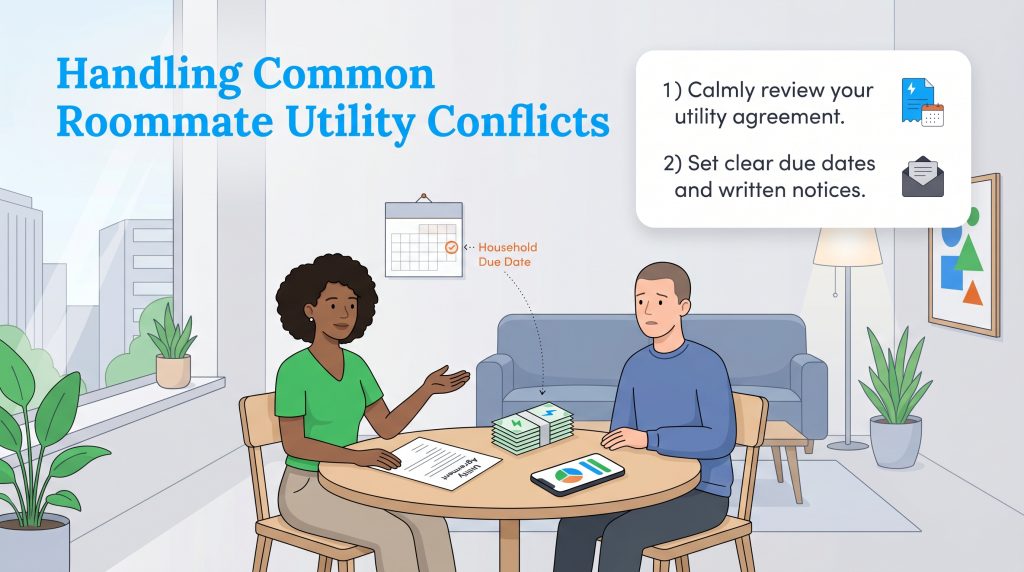
Even with clear agreements and helpful apps, disputes can still arise when money is tight. Knowing exactly what to do if a roommate doesn’t pay utilities can save you from severe financial stress and utility shut-offs. If someone repeatedly misses the payment deadline, address the issue immediately by referring back to your written agreement.
First, communicate calmly to see if it is a simple oversight or a temporary cash flow issue. If they are genuinely struggling, you might temporarily restructure the payment timeline. However, if the situation escalates and they refuse to pay, issue a formal, written warning detailing the total amount owed. Ultimately, the utility company will hold the primary account holder responsible. You must pay the bill on time to protect your credit score while resolving the internal dispute, even if it means covering their share temporarily.
If the delinquency continues, you may need to speak to your landlord about a lease violation, or in extreme cases, file a claim in small claims court utilizing your documented app payments and roommate agreement as evidence.
Saving Money Together With an Eco-Conscious Approach
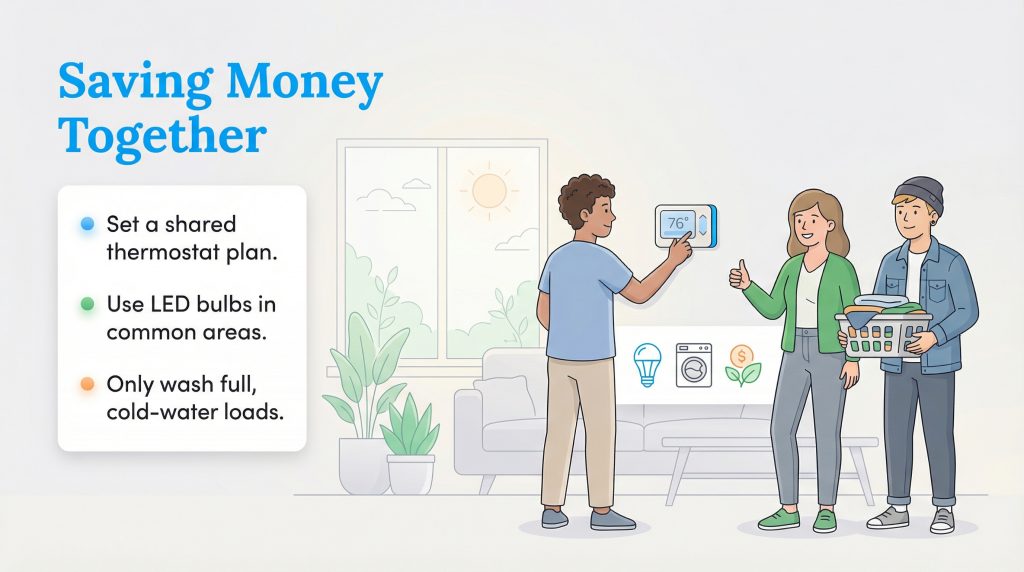
The most effective way to lower your individual financial burden is to lower the total household consumption. Adopting an environmentally mindful choice as a group not only helps the planet but also keeps more money in everyone’s pockets. It is significantly easier to figure out how to split an electricity bill in apartment settings when the overall monthly total is surprisingly low.
When you move in, agree on an energy-saving option that everyone can follow without feeling inconvenienced. In common areas, ensure you are using LED light bulbs, which use at least 75% less energy than incandescent lighting according to Energy.gov. Agree to only run the washer and dryer when you have full loads, and use cold water whenever possible. If you want to dive deeper into home efficiency, check out our guide on how to save on your electric bill.
Action Plan for Move-In Day
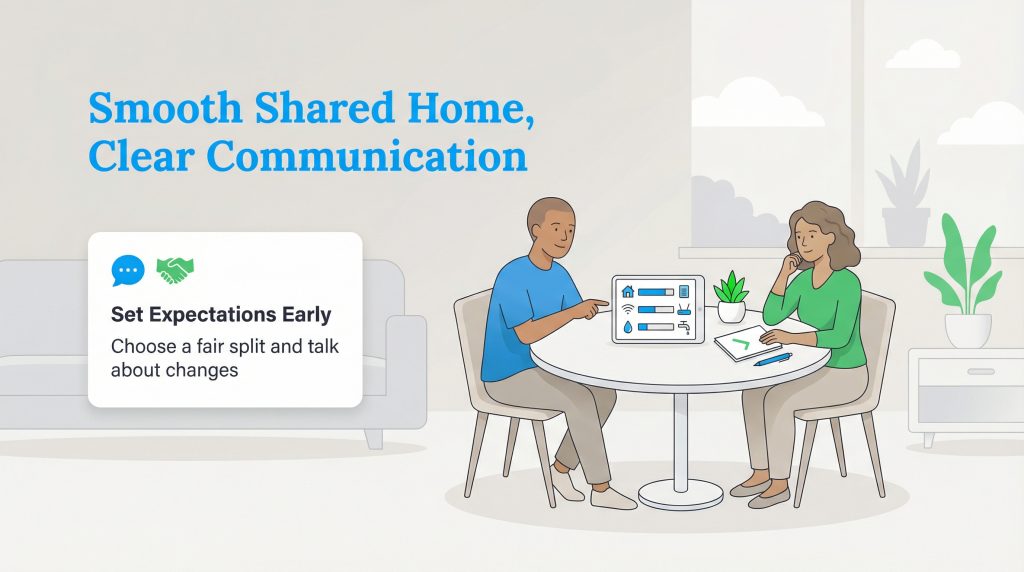
Splitting utilities doesn’t have to be a source of stress or awkwardness. While math equations and digital apps are helpful tools, open and honest communication is the real secret to a happy home. By setting clear expectations early, choosing a fair split method, and respecting each other’s financial situations, you can easily prevent conflicts before they start.
Draft your comprehensive roommate utility agreement before you even unpack your first box. Outline your budget, decide exactly whose names will go on which accounts, and download your preferred expense-sharing apps today. With a solid plan in place, you can spend less time stressing over money and more time enjoying your new living space.
Frequently Asked Questions About Splitting Utility Bills
What is the fairest way to split utilities?
While the standard 50/50 split is the most common, usage-based or income-based splits are often considered fairer for complex living situations. If one person uses significantly more energy or earns a much higher salary, adjusting the percentages creates a more equitable environment.
How do you split utilities when one roommate travels frequently?
If someone is away for large portions of the month, the “Days-Occupied” method works well. Divide the variable portion of the utility bill by the days in the billing cycle, and charge the traveling roommate only for the days they actually resided in the apartment. However, fixed costs like high-speed internet should still be split evenly.
How do you split bills when one person works from home?
If one roommate works remotely, it is standard practice to negotiate a slight percentage increase for that person regarding variable costs. A 60/40 split on electricity and heating bills effectively covers the extra daytime energy used for climate control and electronics.
Can you split utility bills directly through the utility provider?
Generally, no. Most utility providers only allow one primary account holder (or occasionally two) and require a single payment for the full balance each month. You will need to collect individual shares internally using an app like Venmo or Splitwise, and then have the primary account holder pay the provider directly.
Who pays the utility security deposit when moving in together?
Even if the utility is only in one roommate’s name, upfront security deposits and connection fees should be divided evenly among all residents. Once the utility company refunds the deposit (usually after a year of on-time payments or upon move-out), the primary account holder must reimburse the other roommates.
Can you split utilities based on income?
Yes, you can utilize a proportional split. It requires total transparency regarding annual salaries and an agreement that the higher earner contributes a larger percentage, ensuring utility costs impact everyone’s monthly budget equally.
What usually counts as a shared utility bill?
Standard shared utilities strictly include electricity, natural gas, water, sewer, trash, and high-speed internet. Discretionary services like premium streaming subscriptions or individual groceries should be kept entirely separate.
How do you split an electricity bill in an apartment with different room sizes?
While variable rent is usually calculated via square footage, electricity can be factored into this same equation. The roommate occupying the primary suite with a private bathroom naturally consumes a higher percentage of heating, cooling, and water, justifying a slightly higher utility share.
Whose name should the apartment utilities be under?
Instead of placing all accounts under one person, it is smarter to distribute them. Putting the internet in one roommate’s name and the electricity in another’s spreads out the legal liability and allows multiple people to build positive credit histories.
Does having a utility bill in my name build my credit score?
It can, provided you utilize opt-in credit-building services that report consistent, on-time utility payments to major credit bureaus. Just remember that missed payments will also be reported, which can harm your credit profile.
About the Author

LaLeesha has a Masters degree in English and enjoys writing whenever she has the chance. She is passionate about gardening, reducing her carbon footprint, and protecting the environment. She also recently served as President of the Board for City Sprouts (a community garden).

Claudio is a sustainability-focused writer with a background in Anthropology and Psychology from NC State University. He has spent over 15 years working in writing, interpretation, and translation, driven by a deep interest in how human culture shapes the environment. Today, he shares his curiosity with readers by writing about sustainable living solutions and the connection between everyday choices and environmental impact.