
- Free Xfinity Mobile Line for 1 year
- Free Peacock Premium*
- Free WiFi Equipment for 24 months
- $100 Visa Prepaid Cards for students
Quick Utility Facts
- If you experience a power outage call FPL, the electric utility in Miami.
- Depending on your address, your natural gas utility is either Florida City Gas or TECO Peoples Gas.
- Internet service is available from Xfinity and AT&T Fiber. The fastest internet plan is 5 Gbps from AT&T.
- The cheapest internet plan in Miami is $30.00/month from Xfinity.
- Miami-Dade provides water, sewer, trash, and recycling.
Electric Providers in Miami

MySolarCost
- Service
- Home solar
- Quotes
- Free
Electricity across the Miami metro area is provided exclusively by Florida Power & Light (FPL), a subsidiary of NextEra Energy operating under a regulated electric utility framework overseen by the Florida Public Service Commission. Because service is bound to FPL’s territorial grid, your service account is established directly through their portal. Effective for 2026, an approved multi-year rate settlement sets typical residential bills for 1,000 kWh of usage at approximately $136.64 per month — translating to an all-in effective rate of roughly 13.66 cents per kWh — which combines base energy charges, fuel recovery riders, and a fixed $10 monthly customer charge. With sub-tropical heat and high humidity driving central air conditioning nearly year-round, cooling represents the single largest component of a home’s power bill. To manage summer electric overhead, FPL offers optional Time-of-Use (TOU) tariffs alongside smart thermostat programs, encouraging households to pre-cool living spaces in the morning and shift high-draw tasks — like running clothes dryers, pool pumps, and electric vehicle chargers — away from afternoon peak windows.


Top 2 Natural Gas Providers in Miami
Natural gas distribution across Miami and surrounding Miami-Dade County is managed primarily by TECO Peoples Gas (alongside Florida City Gas in select suburban pockets), operating as a fully regulated public utility. Natural gas supply rates and pipeline delivery costs are bundled into state-approved tariffs, protecting consumers from independent retail broker markups. Under an approved base rate settlement, residential statements reflect an adjusted distribution baseline fee that adds roughly $8.00 to $8.50 per month to standard residential bills. Because natural gas in South Florida is predominantly utilized for domestic tankless water heaters, gas cooktops, clothes dryers, and luxury outdoor pool/spa heaters, volumetric fuel consumption is modest. However, TECO Peoples Gas assesses a mandatory fixed monthly customer charge plus infrastructure safety riders, ensuring your account carries a persistent baseline cost year-round even during sweltering summer months when space-heating equipment lies completely dormant.
Top 10 Internet Providers in Miami

- 2 Gbps
- Cable & Fiber
- Unlimited
- TV & Phone
- 96.86%
- $30.00/mo
- Lock in Your Price for 5 Years

- 5 Gbps
- Fiber
- Unlimited
- Mobile
- 88.81%
- $35.00/mo
- Get a $200 Reward Card*

- 400 Mbps
- Satellite
- Unlimited
- None
- 100%
- $55.00/mo

- 300 Mbps
- 5G
- Unlimited
- Mobile
- 100%
- $35.00/mo
- Wireless Internet Great for Renters

- 498 Mbps
- 5G
- 1.2 TB
- Mobile
- 66.31%
- $35.00/mo
- Wireless Internet

- 300 Mbps
- 5G
- Unlimited
- Mobile
- 80.85%
- $40.00/mo
- Wireless Internet

- 150 Mbps
- Satellite
- 150-850 GB
- Phone
- 99.98%
- $39.99/mo

- Varies
- Fiber, Cable, 5G, & Satellite
- Varies
- 95%
- $39.95/mo

- 8 Gbps
- Fiber
- Unlimited
- None
- 8.63%
- $70.00/mo

- 1 Gbps
- Cable
- Unlimited
- 12.72%
- $20.00/mo
Internet and digital broadband connectivity across Magic City is a fast-paced, multi-provider battlefield heavily dominated by symmetrical fiber-to-the-home networks from AT&T Fiber, a universal hybrid-coaxial cable footprint from Xfinity, regional competition from Breezeline, and gigabit point-to-point wireless from Google Fiber Webpass in high-rise corridors. Symmetrical multi-gigabit fiber connections offer exceptional low-latency data streams ideal for remote employment and high-definition streaming, but physical line availability depends heavily on neighborhood density and architectural history. Moving into an established historic single-family neighborhood like Coconut Grove, Coral Gables, or Little Havana can reveal older overhead utility pole easements or dense tropical tree canopies that delay physical fiber drops. Conversely, modern luxury high-rise condo towers in Brickell, Edgewater, and Downtown Miami frequently feature exclusive corporate property marketing agreements that restrict inside wiring access to a single ISP.
Water & Sewage Providers in Miami
Water and wastewater treatment utilities are managed by the Miami-Dade Water and Sewer Department (WASD) — or passed through via municipal entities like the City of Miami Beach — drawing raw supply from the shallow Biscayne Aquifer. Billed on a monthly or quarterly cycle, WASD utilizes an aggressive tiered volumetric water pricing model where per-gallon rates escalate sharply as monthly consumption breaches higher threshold brackets to promote conservation. Wastewater collection and regional sewage processing form the single largest financial component of your municipal statement, with wholesale sewer treatment charges scaling directly against your total incoming metered water volume. Furthermore, statements incorporate dedicated base facility charges based on meter size alongside county stormwater management fees, making undetected plumbing leaks, running toilets, or frequent swimming pool refills immediate financial liabilities.
Top 4 Trash and Recycling Providers in Miami
Solid waste and recycling collection within the City of Miami limits is operated directly by the City of Miami Department of Solid Waste for single-family homes and small residential properties up to four units. Miami stands out from almost every other major American metropolis by offering twice-weekly household garbage pickup using green rolling carts. Single-stream recycling is collected every other week in blue carts, and all recyclables — such as cardboard, glass bottles, metal cans, and rigid plastic containers — must be placed in the blue bin completely loose and unbagged. City of Miami residents also receive once-a-week bulk item pickup on their first garbage collection day for large household furniture and yard waste. Carts must be rolled to the curb by 7:00 AM on collection morning with lids closed flat, maintaining a strict 3-foot spatial clearance from vehicles, mailboxes, and palm trees so automated mechanical truck arms can pick up the containers safely.
Utilities Summary for Miami, FL
| Electric Companies: | 1 |
| Natural Gas Companies: | 2 |
| Water & Sewage Providers: | 2 |
| Garbage, Trash & Recycling Providers: | 4 |
| Municipal Electricity: | No |
Find Utility Providers for Your Home in Miami
Miami is Miami, vibrant, sun-soaked, multicultural, and full of life. From the Art Deco vibrancy of South Beach to the calm of Coconut Grove and the thriving Little Havana, every neighborhood has its own zing. It’s a coastal city with tropical weather, so being “utility-savvy” feels extra important: think high summer electricity bills from air‑conditioning, water conservation, and hurricane preparedness.
Electric
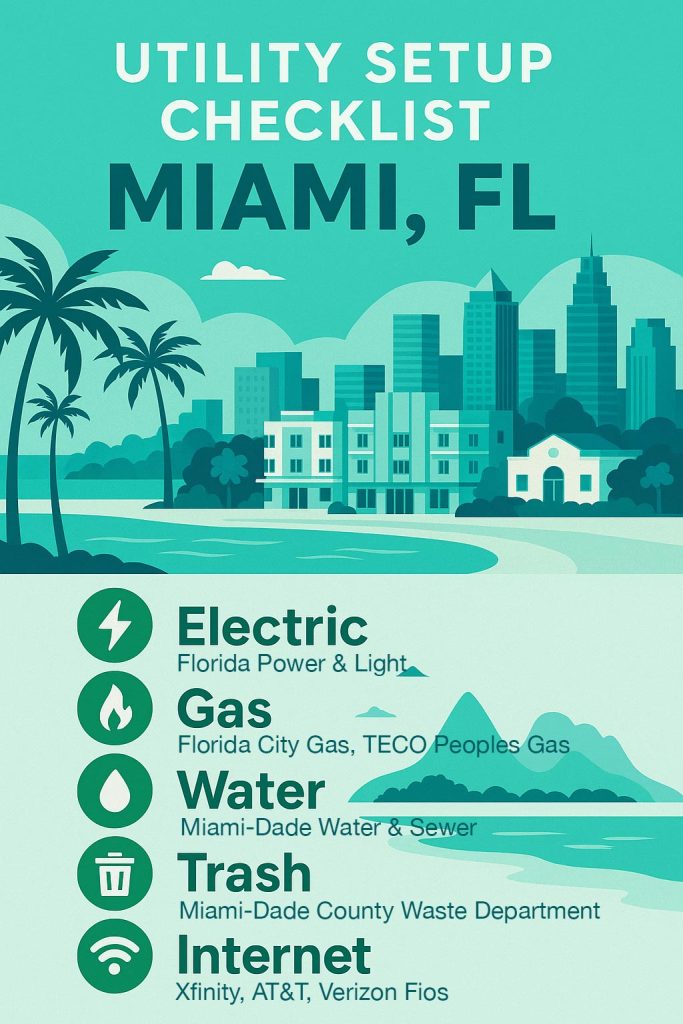
Florida Power & Light (FPL) is Florida’s largest utility, known for reliable power and smart-grid infrastructure. FPL has earned reliability awards and invests heavily in wildlife protection (sea turtles, manatees, crocodiles) around its nuclear plants.
- Rebates & Efficiency:
- New energy-efficient A/C units eligible for up to $2,150 in rebates, plus federal tax credits.
- Ceiling insulation rebates up to $1,420.
- Instant $150 rebate for qualifying A/C from certified contractors.
- Smart-home tools like Energy Manager survey, plus “On Call” scheduling plans to cut costs.
- Green Programs:
- FPL runs one of the country’s largest utility-scale solar portfolios, 66 solar facilities (~4.8 GW), community solar “SolarNow,” and school solar initiatives.
- FPL runs one of the country’s largest utility-scale solar portfolios, 66 solar facilities (~4.8 GW), community solar “SolarNow,” and school solar initiatives.
Natural Gas
Natural gas service in Miami is available through several providers, giving residents some flexibility depending on their exact location. The three main companies serving the area are Florida City Gas, TECO Peoples Gas, and Florida Public Utilities, each offering a mix of residential rebates, energy efficiency programs, and online tools to help manage your usage. While electric power is more common for heating and cooking in Miami homes, natural gas remains a reliable and cost-effective option for water heating, generators, and large appliances. Before signing up, it’s a good idea to check which provider services your address and compare available rebates.
Florida City Gas
- Who they are: A major local distributor, serving roughly 123,000 residential and commercial customers in Miami-Dade (including Hialeah & surrounding areas), as a subsidiary of Chesapeake Utilities Corporation.
- Coverage: Extensive, use their “check availability” tool to see if your ZIP is in their network .
- Rebates & Programs: The Florida Energy Conservation Program offers over $1,000 in rebates for installing efficient gas appliances (water heaters, space heating, etc.). They also periodically run energy-efficiency campaigns, reporting large therm savings and emissions reductions.
- Interesting Info: Operating since 1946 with around 4,000 miles of distribution lines, the company highlights both infrastructure safety and community impact.
TECO Peoples Gas
- Who they are: Part of the TECO Energy utility holding company (now under Emera), Peoples Gas is Florida’s largest natural gas distributor, with about 470,000 customers statewide, that includes Miami-Dade.
- Coverage in Miami: They provide service in Miami and surrounding areas; you can start or transfer service through their online portal.
- Rebates & Tools: Offers water‑heater, cooking-appliance, and heating/cooling rebates (up to $700 for efficient water heaters, space-heating upgrades, etc.) plus energy audits and calculators.
- Interesting Info: Emphasizes safety (“Call before you dig”), supports natural-gas generators for storm preparedness, and markets natural gas vehicles and fleet conversions.
Florida Public Utilities (FPU)
- Area: Smaller coverage in parts of South Florida, may overlap where FPU has existing pipelines.
- Programs & Rebates: They provide natural gas service with residential and commercial rebates, plus budget billing and energy conservation tips.
- Interesting Info: Also part of Chesapeake Utilities (same parent as Florida City Gas), FPU provides energy assistance, safety programs, and promotes sustainability.
So What Does This Mean for You?
- Check availability via provider websites by ZIP (Florida City Gas, TECO, FPU).
- Compare rebate programs: Florida City Gas offers some of the highest rebate ceilings, but TECO and FPU also offer strong incentives.
- Think about extras like energy audit tools, assistance programs, storm readiness (e.g., generator support), and customer-service offerings.
- Get energy-smart: All providers support conservation and efficiency; choose the one whose programs (and coverage) align best with your needs.
Water & Trash
Water & Sewer Provider: Miami-Dade Water and Sewer Department (WASD).
- Offers reliable service across the county and partners on conservation initiatives.
- Assistance Programs: Participates in LIHWAP, providing federally-funded relief for low-income customers covering water/sewer bills.
- Green Efforts: Ongoing campaigns to reduce leaks and encourage efficient fixtures (e.g., faucets, toilets), check their site for free or discounted water-saving devices.
Trash & Recycling: Managed by Miami-Dade County. Service includes weekly pick-up of trash and recyclables, plus yard waste collection. They also offer seasonal bulk pickup and electronics drop-off events. Visit the county’s waste management site for schedules and holiday changes.
Best Internet Providers in Miami
Miami offers numerous high-speed options. Here are the top picks:
- Xfinity: Widely available, serving about 97% of the area. Offers cable broadband up to 2 Gbps; bundling options with cable TV and home phone. Known for robust service but variable pricing.
- AT&T Fiber: Fast and reliable fiber in many neighborhoods (about 85%); plans from 300 Mbps up to 5 Gbps. Strong performance, good for streaming, gaming, and work-from-home.
- Verizon Fios: Another fiber alternative, but limited coverage to only about half of Miami. Fast and reliable with speeds up to 2.3 Gbps.
- Google Fiber (select areas): Ultra-fast gigabit service via fiber or wireless; very limited coverage (less than 10%), so check your address.
Conservation & Green Energy Strategies in Miami
- Tax Credits & Rebates: Beyond local offers, the federal Residential Clean Energy Tax Credit covers 30% of solar, heat pump, and battery installations through 2032.
- Rooftop Solar & Net Metering: Florida allows net metering (up to 2 MW), though previous statewide rebate programs ended in 2015. Still, federal credits and group solar co‑ops (e.g., Solar United Neighbors) can reduce costs.
- Home Efficiency: Conduct an energy audit (through FPL’s Energy Manager or FPU’s free check-up), upgrade insulation, ceiling fans, weather stripping, LED bulbs, and smart thermostats.
- Community Solar: FPL’s SolarNow and solar-for-schools initiatives invite low/no-solar homes to benefit from community installations.
Financial Assistance for Utility Bills in Miami
Available Through Providers
- FPL CARE to Share: Emergency grants up to $500 annually for those facing a disconnection.
- LIHEAP (Electric): Federally funded assistance up to $2,000/year for low-income households in Miami-Dade, able to cover cooling/heating bills, disconnections, and reconnections.
- LIHWAP (Water): Covers water/sewer costs via Miami-Dade WASD’s partnership with the FL Dept. of Economic Opportunity.
City & Community Support
- Miami‑Dade Light Bill Assistance: Application via county resource centers for energy crisis support.
- City of Miami Assistance: Through Axis South Florida, Aunt Bertha, United Way, Catalyst Miami, etc., they connect households with rent and utility aid.
Moving Smart in Miami
To make your transition smooth:
- Set up accounts early with FPL (electric), WASD (water), and your preferred internet provider.
- Sign up for rebates and audits: these can cut months off the cost of new equipment.
- Apply for assistance (LIHEAP, LIHWAP, CARE to Share) before bills stack up.
- Adopt green habits now, LEDs, smart thermostats, water-efficient fixtures.
- Explore solar options down the road, taking advantage of federal and community programs.
About the Author

David has been an integral part of some of the biggest utility sites on the internet, including InMyArea.com, HighSpeedInternet.com, BroadbandNow.com, and U.S. News. He brings over 15 years of experience writing about, compiling and analyzing utility data.
Miami Internet Connectivity
Fastest Internet Providers in Miami
| Provider | Connection Type | Download Speed |
|---|---|---|
| Xfinity | Cable & Fiber | 2 Gbps |
| AT&T Fiber | Fiber | 5 Gbps |
| Starlink | Satellite | 400 Mbps |
| Verizon 5G Home Internet | 5G | 300 Mbps |
| T-Mobile 5G Home Internet | 5G | 498 Mbps |
| AT&T Air | 5G | 300 Mbps |
| Viasat | Satellite | 150 Mbps |
| Earthlink | Fiber, Cable, 5G, & Satellite | Varies |
| Google Fiber | Fiber | 8 Gbps |
| Breezeline | Cable | 1 Gbps |
*Not all speeds available in all areas
Miami Drinking Water Quality Information
Clean drinking water is essential for maintaining good health and overall well-being. Safe, contaminant-free water helps prevent the spread of diseases, supports proper hydration, and ensures the body's vital functions operate smoothly.
Miami's Primary Drinking Water Source: Ground Water
Drinking Water Contaminant Levels
Legal limit: 15 ppb
Legal limit: No Limit Set
Legal limit: No Limit Set
Legal limit: No Limit Set
Legal limit: No Limit Set
Legal limit: 100 ppb
Legal limit: No Limit Set
Legal limit: 60 ppb
Legal limit: No Limit Set
Legal limit: No Limit Set
Legal limit: No Limit Set
Legal limit: No Limit Set
Legal limit: No Limit Set
Legal limit: No Limit Set
Legal limit: No Limit Set
Legal limit: No Limit Set
Legal limit: No Limit Set
Legal limit: 0.01 ppb
Legal limit: 0.01 EPA
Legal limit: 0.004 ppb
Legal limit: 0.004 ppb
Legal limit: No Limit Set
Legal limit: No Limit Set
Legal limit: No Limit Set
Utilities in Nearby Cities
Frequently Asked Questions
How far in advance should I schedule my utility connections in Miami?
It is recommended to contact your providers (FPL, Miami-Dade WASD, and internet) at least 1 to 2 weeks before your move-in date. However, FPL can often accommodate requests within 1 to 2 business days.
Will I need to pay a deposit to start my utilities in Miami?
Yes, both Florida Power & Light (FPL) and the Miami-Dade Water and Sewer Department (WASD) typically require a deposit to start service. FPL deposits are based on your credit history, while WASD usually charges a flat deposit of $50 plus a $45 service fee.
How do I request trash and recycling bins for a newly built home?
If you are moving into a brand-new home without existing bins, you will need to contact the Miami-Dade County Department of Solid Waste Management online or by calling 311 to request your initial set of carts.
Who do I contact to report a power outage or downed power line?
You should report all power outages or dangerous downed power lines directly to Florida Power & Light (FPL) via their mobile app, online outage tracker, or by calling 1-800-4-OUTAGE.
What should I do about my utilities before a hurricane hits?
If a major storm is approaching, do not turn off your natural gas at the meter, but you can turn off the valve to individual appliances. Turn off your sprinkler system to prevent unnecessary watering during heavy rain, and keep your devices charged in case FPL needs to temporarily shut down the grid to protect the infrastructure.
Are there lawn watering restrictions in Miami-Dade County?
Yes, Miami-Dade County enforces year-round water restrictions to conserve water. Residents are typically only allowed to water their lawns two days a week, and never between the hours of 10:00 a.m. and 4:00 p.m.
Are there programs to help pay my utility bills in Miami?
Yes. You can apply for the federally funded LIHEAP (for electric) or LIHWAP (for water) programs, or request assistance through FPL’s CARE to Share program, which provides emergency grants for those facing disconnection.
Does Miami allow solar net-metering?
Yes, Florida mandates that investor-owned utilities like FPL offer 1-to-1 net metering, meaning the excess energy your solar panels produce is credited to your electric bill.
What is FPL's typical residential electric rate in 2026?
Following an approved base rate settlement, FPL’s typical residential customer using 1,000 kWh per month pays approximately $136.64. This translates to an all-in rate of roughly 13.66 cents per kWh, which includes base generation, fuel cost recovery riders, and a fixed $10 monthly customer charge.
Why is Miami's residential trash pickup schedule unique?
Unlike most major US cities that collect garbage once per week, the City of Miami Department of Solid Waste provides twice-weekly household garbage collection. Furthermore, single-family residents receive once-weekly curbside bulk waste collection on their first assigned garbage day for oversized items and yard trimmings.
How do Miami-Dade WASD water tiers impact pool owners and lawn care?
Miami-Dade WASD uses an escalating volumetric rate structure paired with direct sewer volume pass-through charges. Because sewage treatment fees are calculated straight from your total incoming water meter reading, topping off a swimming pool or running outdoor irrigation will push your water consumption into higher, more expensive pricing tiers while simultaneously inflating your sewer bill.