Understand your rates, find outage tools, and navigate Florida’s largest electric utility with ease.
Key Takeaways
- FPL serves over 12 million people, making it the largest electric utility in the state and the primary option for most South and East Florida residents.
- Review your rate plans carefully, as time-of-use pricing and the FPL budget billing program can help offset seasonal air conditioning spikes.
- Take advantage of eco-conscious rebates like the FPL Solar Together program and smart thermostat incentives to lower your long-term energy costs.
Moving to a new home in the Sunshine State often means setting up your electricity with Florida Power & Light. Because Florida operates a regulated energy market in most regions, you likely won’t have the option to shop around for a different electric provider. As a subsidiary of NextEra Energy and the largest electric utility in the United States by customer count, FPL provides power to millions who rely entirely on their grid. While this lack of energy choice can feel restrictive at first glance, FPL is widely recognized for its robust infrastructure, hurricane response times, and growing renewable energy portfolio. Whether you are transferring service to a new apartment in Miami or setting up utilities for a house in Fort Myers, understanding how this utility structures its pricing, fees, and money-saving programs is the key to keeping your monthly utility bills under control.
Understanding FPL Rates and Pricing in a Regulated Market
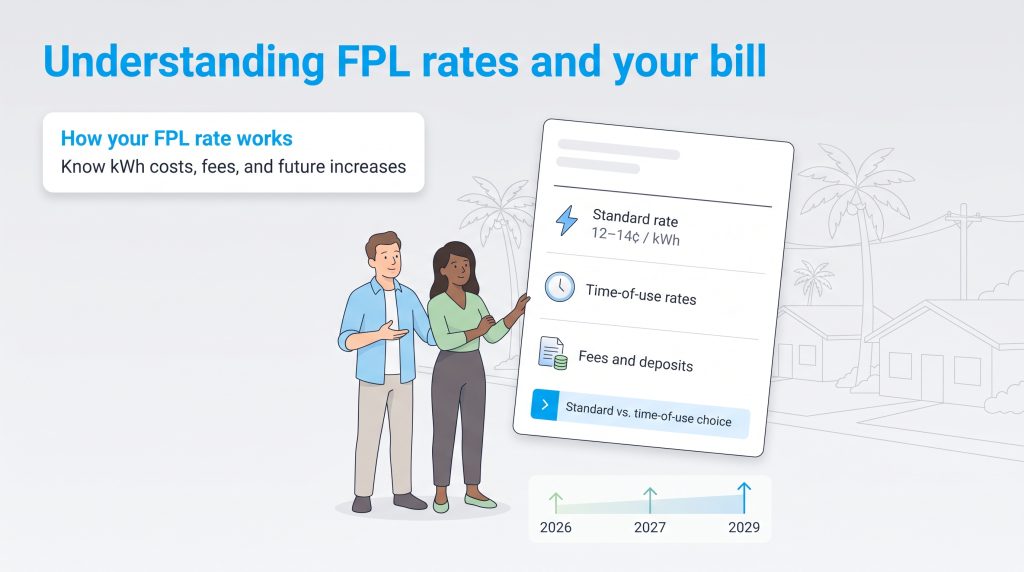
Because FPL operates as a regulated utility monopoly in its service areas, your residential rates are determined by the Florida Public Service Commission (PSC) rather than competitive market pricing. Understanding your average Florida Power and Light rates per kWh is essential for predicting your monthly expenses, especially during those scorching summer months when the air conditioner runs non-stop. Currently, standard residential rates typically hover between 12 and 14 cents per kWh, though this fluctuates based on seasonal fuel charges and your specific usage tier.
Beyond the cost of the electricity itself, FPL enforces several administrative fees you should budget for when setting up your account. New account connections typically trigger a one-time fee of $12 to $25, depending on meter requirements. Additionally, start-service deposit requirements are determined by your credit history. New customers without an established credit file are often required to pay a security deposit equivalent to two months of estimated billing, though FPL generally refunds this as a statement credit after 23 months of consecutive on-time payments. If you miss a payment deadline down the line, FPL assesses a rigid late penalty of $5.00 or 1.5% of your past-due balance, whichever amount is greater.
Standard vs. Time-of-Use Rates
Most residential customers default to the standard residential tier, but you can also opt into a Time-of-Use (TOU) plan if your lifestyle allows you to shift heavy energy consumption to off-peak hours.
| Plan Type | Base Customer Charge | Energy Charge (Per kWh) | Best For |
|---|---|---|---|
| Standard Residential (RS-1) | $8.99 / month | Tiered based on usage (typically lower for the first 1,000 kWh, higher beyond that limit). | Typical households with consistent daytime energy needs. |
| Time-of-Use (RTU-1) | $8.99 / month | Higher during peak afternoon hours; significantly discounted during off-peak hours. | EV owners, out-of-house workers, and flexible households. |
The 2025 Rate Increase Debate
It’s worth noting that energy costs are subject to change. In February 2025, FPL proposed a four-year rate hike that consumer advocacy groups heavily criticized. Under the proposal, average monthly increases could reach $17.85 for Peninsular Florida users by 2029, and the minimum monthly bill would incrementally increase from $25 to $30. FPL maintains that these increases are necessary to fund grid hardening and clean energy investments.
Table: Proposed Monthly Residential Rate Increases (1,000 kWh Monthly Usage)
| Region | 2026 | 2027 | 2028 | 2029 | Total Increase by 2029 |
|---|---|---|---|---|---|
| Peninsular Florida | +$8.23 | +$5.92 | +$1.64 | +$2.06 | +$17.85 |
| Northwest Florida | +$3.50 | +$1.19 | +$8.39 | N/A | +$13.08 |
💸 Money-Saver: Use FPL’s online calculator to estimate your future bills under the proposed rates. If you’re concerned about these increases, you can join local advocacy efforts or voice your concerns at ongoing public commission hearings.
FPL Coverage Area and Major Cities Served
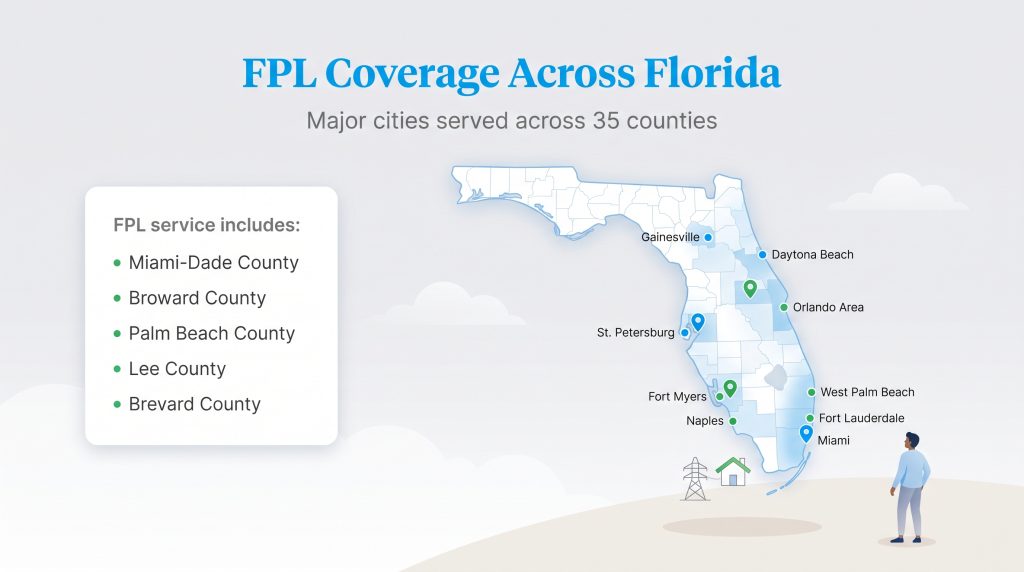
Before you pack your boxes, you’ll want to check the official FPL coverage area map to ensure your new address falls within their active territory. FPL’s massive service region spans across Eastern and Southern Florida, providing electricity to 35 unique counties. This includes major regions and highly populated cities like Miami, Fort Lauderdale, West Palm Beach, St. Petersburg, Fort Myers, Naples, Daytona Beach, Gainesville, and select areas surrounding Orlando.
To give you an idea of their substantial footprint, the top five largest counties served by Florida Power & Light include:
- Miami-Dade County
- Broward County
- Palm Beach County
- Lee County
- Brevard County

- Calculate Your Moving Costs
- Compare Moving Companies
- Get Multiple Quotes
- Move with Confidence
How to Start, Stop, or Move Your FPL Service
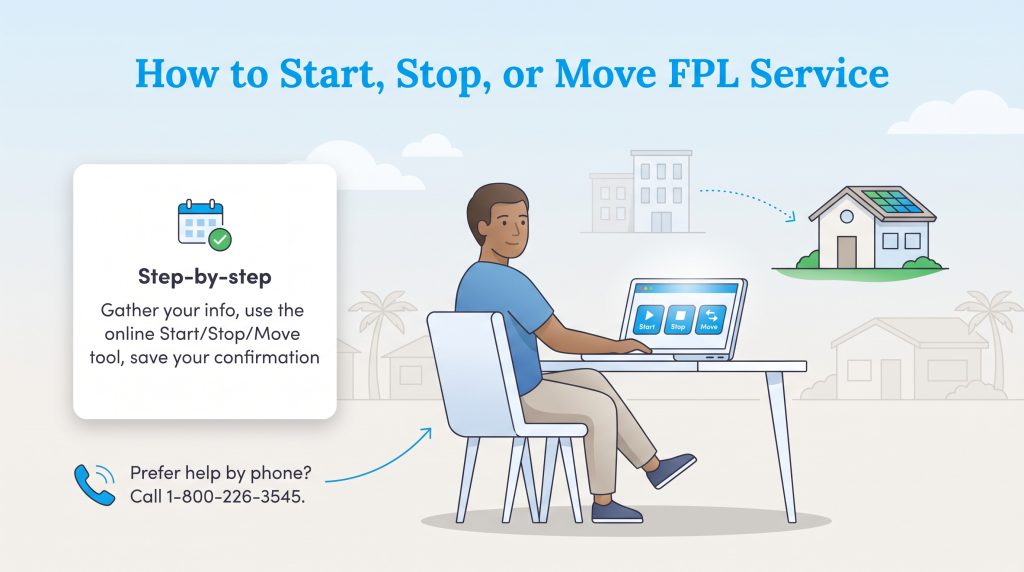
Whether you are moving into your first apartment or purchasing a new home, initiating your Florida Power and Light start service request is a straightforward process. Because you are dealing with a regulated utility, you will need to establish your account directly with FPL rather than relying on a third-party broker.
Follow these actionable steps to create an FPL account online and transfer your service efficiently:
- Gather your information: You will need your new service address, your Social Security Number (or a passport/driver’s license for identity verification), and your preferred move-in date.
- Visit the portal: Navigate to the official FPL website and select the “Start, Stop, Move” tool from the main dashboard.
- Verify your address: Enter your new street address to confirm it falls within the official FPL coverage area.
- Complete the credit check: FPL will run a soft credit inquiry to determine if you need to pay an upfront security deposit.
- Submit and confirm: Review your administrative details, submit the request, and save your confirmation number for your records.
If you prefer to speak directly with a representative to set up your account or handle a complex move, you can call the primary Florida Power and Light customer service phone number for new service requests at 1-800-226-3545.
💡 Pro Tip: Submit your start or transfer request at least three to five business days before your move-in date. This ensures the physical meter is activated and ready the moment you walk through the door.
Managing Your Account: FPL Login, App, and Bill Pay
Once your service is active, creating an FPL login is the best way to monitor your usage and handle your monthly statements. The free FPL mobile app, available in the Apple App Store and Google Play, offers a highly convenient way to manage your energy usage from anywhere. The app integrates multi-factor authentication for enhanced security and even allows for biometric fingerprint or facial recognition access.
When it comes time to utilize the FPL pay bill online features, the platform gives you several distinct methods to clear your balance:
- Mobile App: Securely pay bills using a saved bank account or credit card directly from your dashboard.
- AutoPay: Set it and forget it by enrolling in the automated system, which deducts your balance on the exact same day each month.
- Guest Pay: If a roommate or family member needs to cover the bill without having full account access, they can use the Guest Pay feature with just the account number and zip code.
- Pay by Phone: You can submit an automated payment 24/7 by calling their dedicated billing line.
Additionally, the app features robust tracking tools so you can view your projected bills and identify daily usage trends. This gives you a clear opportunity to adjust your thermostat habits before a high statement arrives in your inbox.
FPL Power Tracker: How to Report and Check Outages
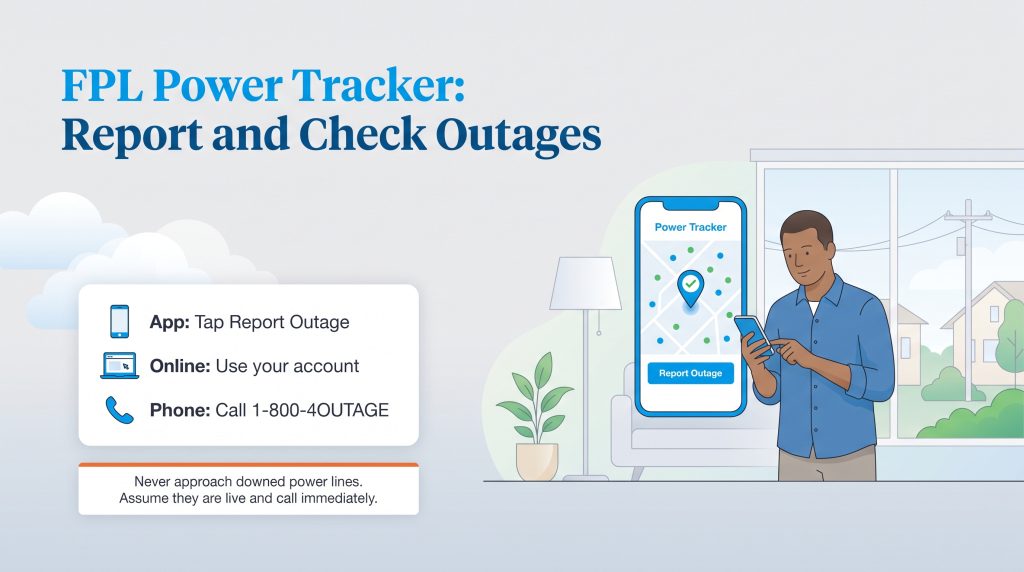
Florida’s stormy season is no joke, but FPL has earned high marks for its rapid power restoration. A major reason for this is their massive investment in automated smart grid technology. This modernized infrastructure successfully prevented 2.7 million localized outages in 2024 alone and significantly reduced overall restoration times across the coast.
Checking for Outages
If you find yourself in the dark, you don’t have to guess when the AC will kick back on. The official FPL outage map, also known as the Power Tracker, is an interactive online tool that provides real-time updates and restoration estimates. You can easily enter your address, city, or ZIP code to view specific details regarding your neighborhood’s grid status.
Reporting an Outage
FPL makes it quick and easy to report a downed power line or local blackout using multiple channels:
- Mobile App: Tap the “Report Outage” button directly from the home screen of the FPL app for immediate dispatch.
- Online Portal: Log into your account portal to report the issue via your personalized dashboard.
- Phone: Call 1-800-4OUTAGE (1-800-468-8243) to report power loss or highly dangerous localized electrical issues.
🚩 Heads Up: Never approach downed power lines! Always assume they are live and highly dangerous. Call the emergency line immediately to report them.
Deals, Discounts, and Ways to Save on Your FPL Bill
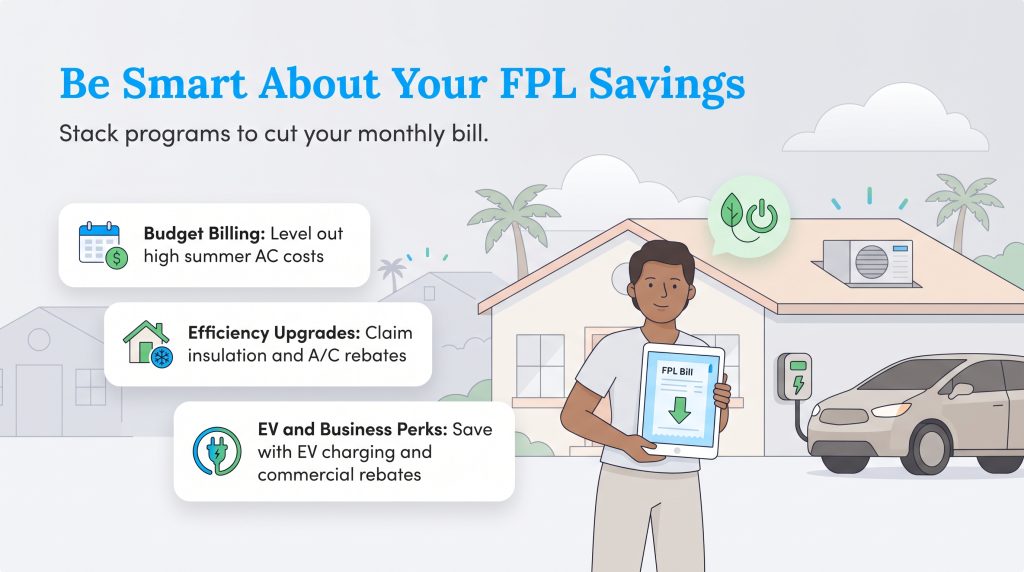
Cooling a Florida home requires a lot of electricity, but FPL offers various financial relief options to help offset the burden. We highly recommend enrolling in the FPL budget billing program, which averages your annual electricity usage into a flat, predictable monthly payment to successfully level out those high summer AC costs.
By utilizing their specific weatherization and appliance upgrade incentives, you can also drastically increase the efficiency of your home to lower your baseline usage:
- Ceiling Insulation Rebate: Save up to $1,420 through combined FPL rebates and federal tax credits when you upgrade your home’s ceiling insulation.
- A/C Rebates: Qualify for federal tax credits up to $2,000 for high-efficiency heat pumps and $600 for traditional straight cool systems when upgrading your primary A/C unit.
- EV Love: The FPL EVolution® program offers home chargers (with installation included) and unlimited off-peak electric vehicle charging for a flat monthly fee.
- BuildSmart® Program: A certification program for energy-efficient new construction homes that ensures maximum insulation and HVAC efficiency.
- Surge Protection: Affordable lease plans for meter-based surge protectors to shield your major appliances from Florida lightning storms.
- Business Incentives: Commercial rebates for upgrading enterprise HVAC systems, commercial lighting, and smart thermostats.
Sustainability and FPL Solar Programs
As the primary power provider for the region, FPL utilizes a massive and diverse mix of energy sources to keep the grid stable. If you are wondering where your electricity comes from, natural gas currently serves as their primary fuel, accounting for around 73% of their energy mix. They also operate high-output nuclear plants, like Turkey Point and St. Lucie, which provide reliable base-load generation without producing carbon emissions.
However, FPL is actively pivoting toward a sustainable energy future. Their parent company, NextEra Energy, has set an aggressive “Real Zero Goal” to completely eliminate carbon emissions by 2045. As part of this push, FPL solar programs are expanding rapidly to offer residents more eco-conscious alternatives.
Here are a few ways they are actively working toward that milestone:
- FPL SolarNow & SolarTogether Programs: These community solar initiatives allow customers to support local solar energy development and earn monthly bill credits without having to install rooftop panels on their own homes.
- Net Metering: For homeowners who want to install their own rooftop solar panels, FPL offers robust net metering rules. When your panels produce more energy than your home consumes, the excess is sent back to the grid in exchange for utility bill credits.
- 30-by-30 Plan: A landmark initiative aiming to install over 30 million solar panels across the state by 2030, projecting an addition of over 11,000 megawatts of solar capacity.
- Utility-Scale Battery Storage: To solve the problem of solar downtime, FPL is building massive solar-powered battery storage facilities to hold energy for use during peak evening demand.
FPL Reviews, Ratings, and Customer Satisfaction
When searching for Florida Power and Light reviews online, you will likely encounter a stark contrast between official industry accolades and everyday consumer sentiment. This split is very common, and low user review scores are standard for government-mandated utility monopolies where customers cannot simply switch away if they are dissatisfied.
On the industry side, FPL regularly takes home top honors. J.D. Power consistently ranks them among the best in the South for residential customer satisfaction, praising their highly reliable power delivery, proactive storm communications, and highly functional mobile app interface.
Conversely, aggregate customer score platforms paint a vastly different picture. On sites like the Better Business Bureau (BBB) and Reddit, ratings skew heavily toward the one- and two-star range. If you browse local community forums, you’ll find that user complaints rarely focus on actual grid outages. Instead, the frustration centers squarely on their monopoly status. Common grievances include mandatory deposit requirements for new renters, sudden spikes in seasonal fuel charges, and the inability to shop around for more competitive kilowatt-hour rates.
Preparing for Your Next FPL Utility Bill
Setting up your electricity with FPL comes with a few inherent trade-offs. While you don’t have the luxury of shopping the open market for a cheaper provider, you do benefit from the resources of a massive, technologically advanced grid.
Pros:
- Industry-leading storm response and automated smart grid restoration.
- Excellent mobile app for tracking real-time usage and paying bills.
- Robust eco-conscious alternatives like the community SolarTogether program.
Cons:
- No ability to choose an alternate energy provider in your local service area.
- Strict adherence to late fees and high initial deposit requirements based on credit.
- Vulnerability to rate hikes tied to natural gas price fluctuations and infrastructure costs.
Ultimately, electric vehicle owners utilizing off-peak charging and eco-conscious residents who tap into their solar rebate programs stand to benefit the most from FPL’s service structure. Just keep a close eye on your monthly statements, enroll in budget billing to smooth out those aggressive summer AC spikes, and always pay on time to avoid rigid late penalties.
Frequently Asked Questions About Florida Power & Light
Who is Florida Power & Light?
FPL is Florida’s largest electric utility, serving over 12 million customers across 35 counties. They are widely known for their grid reliability, rapid storm recovery, and extensive clean energy initiatives.
Is FPL the only electricity provider in Florida?
While FPL is the largest electric utility in the state, it is not the only provider. Other regions in Florida are serviced by different regulated utilities, such as Duke Energy or TECO, as well as municipal power companies and electric cooperatives. However, if your address falls within FPL’s mapped territory, they will be your exclusive electricity provider.
Is FPL a monopoly, and can I choose another provider?
In most of Florida, FPL operates as a regulated monopoly, meaning customers cannot switch to another electric company to shop for cheaper rates. However, you can explore their community solar programs or utilize energy efficiency incentives to actively lower your monthly bills.
How do I report a power outage to FPL?
You can report a power outage directly through the FPL mobile app by tapping the “Report Outage” button. Alternatively, you can log into your online account portal or call their dedicated emergency line at 1-800-4OUTAGE (1-800-468-8243).
Does Florida Power & Light have a mobile app?
Yes, the FPL mobile app is available for free on both the Apple App Store and Google Play. It allows users to securely pay their bills, monitor daily energy usage, and receive real-time updates during local power outages.
Why is FPL requesting a rate increase?
FPL cites essential grid upgrades, storm hardening, and clean energy investments as the primary reasons for their proposed hikes. However, critics argue the proposed increases (which could reach up to $17.85 per month by 2029) are excessive, leading to ongoing public commission hearings.
Does FPL offer budget billing?
Yes! FPL Budget Billing averages your annual usage into predictable monthly payments. You can easily enroll in this feature through your online account portal or the mobile app.
How long do outages usually last?
FPL aims for fast restoration, and most localized outages are fixed within hours. Major storms or hurricanes may take days to fully resolve, but their automated smart grid helps minimize overall disruptions.
How do I contact Florida Power & Light customer service?
You can reach Florida Power & Light customer service by calling their general support line at 1-800-226-3545. For emergency situations, such as reporting a downed power line or an active neighborhood outage, you should immediately call 1-800-4OUTAGE (1-800-468-8243).
What is the FPL SolarTogether program?
The FPL SolarTogether program is an eco-conscious community solar initiative that allows residential and commercial customers to offset their carbon footprint without installing their own roof panels. Participants pay a monthly subscription fee to support local solar centers and, in return, receive progressive bill credits based on the energy produced.
How do I waive the FPL deposit fee?
You can often bypass the initial security deposit by demonstrating a strong credit history during your account application. Alternatively, providing a letter of good credit from a previous utility provider can sometimes waive the requirement. If you are required to pay it, FPL generally refunds the deposit as a statement credit after 23 months of consecutive on-time payments.
About the Author

David has been an integral part of some of the biggest utility sites on the internet, including InMyArea.com, HighSpeedInternet.com, BroadbandNow.com, and U.S. News. He brings over 15 years of experience writing about, compiling and analyzing utility data.