

Getting Your Florida Utilities Connected Ahead of Time Ensures Your New Home Is Cool, Comfortable, and Ready for Moving Day
Key Takeaways
- Some Florida utilities may reduce or waive deposit fees if you provide a strong payment history, such as a Letter of Credit from your previous provider, but policies vary by company and municipality.
- Florida does not have statewide retail electric choice for residential customers, meaning your specific address dictates whether you use an investor-owned utility, municipal utility, or electric cooperative.
- Checking for solar net metering programs and using an ENERGY STAR-certified smart thermostat are highly effective ways to offset the increased electricity usage from running your air conditioning year-round.
Planning a relocation to the Sunshine State brings the exciting promise of year-round beaches and endless sunny days, but navigating your moving utilities checklist shouldn’t cast a cloud over your big transition. From coordinating with regional power companies to untangling tricky homeowners association rules, getting everything connected before you cross state lines is essential for a comfortable arrival. We designed this comprehensive utility transfer guide to walk you through exactly what you need to know about the local regulatory landscape, helping you confidently set up utilities in Florida without any last-minute stress. By tackling the administrative details early, you can seamlessly establish your connections for electricity, water and sewer, natural gas, and high-speed internet.
Why Florida Utility Setup Is Different
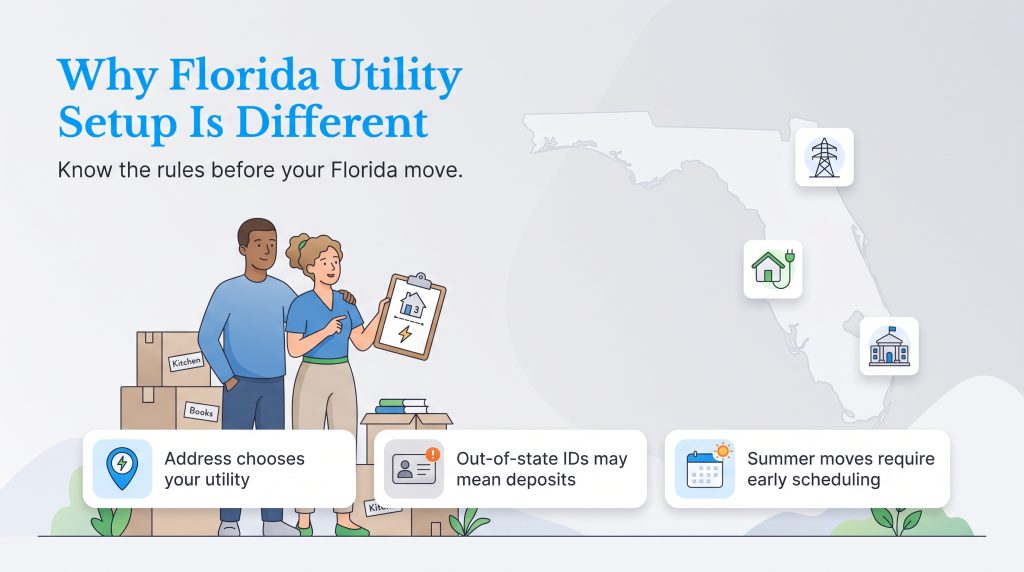
If you are relocating from the Northeast or Texas, adjusting to Florida’s unique infrastructure might take a minute. Understanding the state’s regional quirks early on prevents frustrating delays during a busy relocation. A successful utility setup in Florida requires you to be mindful of a few crucial differences that often catch out-of-state movers off guard.
- Lack of deregulation for electricity: Unlike states that allow consumers to shop around for the cheapest retail energy rates, Florida does not offer statewide electric choice. Your specific property address dictates exactly which power company serves your home.
- Out-of-state ID deposits: Providing an out-of-state driver’s license often triggers mandatory deposit requirements. Fortunately, providing a formal Letter of Credit detailing 12 months of on-time payments from your previous provider can sometimes waive these fees.
- Summer peak moving hurdles: Because summer is prime time for real estate transitions and extreme air conditioning demand, municipal utility offices get booked incredibly quickly. You must provide ample advance notice to guarantee active service when you arrive.
Step 1: Secure Your Florida Electricity Provider
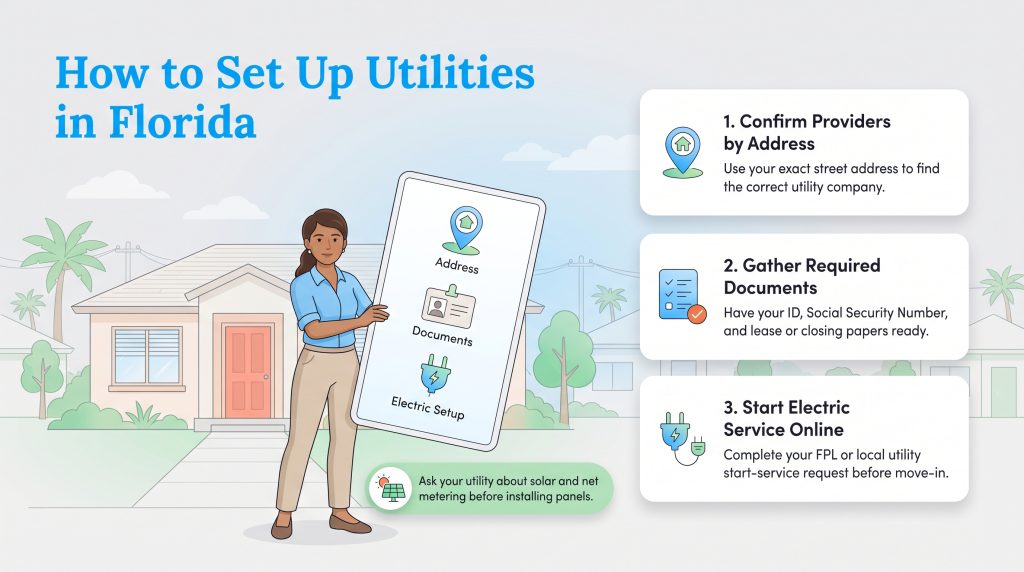
When researching how to transfer utilities when moving, establishing reliable power is the undisputed priority. Because your specific address determines your electric company, your first step is to plug your new street address into a local county site or provider map to confirm your designated utility. The state’s grid is dominated by a few major investor-owned entities and supplemented by robust municipal organizations.
Florida Power & Light (FPL) is the state’s largest electric utility, serving millions of accounts across the east coast and southern regions. Initiating an FPL start service request is incredibly straightforward and can be completed entirely online. Navigating their digital portal is a fantastic first step toward effectively managing your electric utility account long after moving day. If you are not in FPL territory, you will likely work with Duke Energy in the central or northern regions, or Tampa Electric (TECO) if you are near the Tampa Bay area. Certain cities operate highly efficient municipal grids instead, such as the Orlando Utilities Commission (OUC), JEA in Jacksonville, and Gainesville Regional Utilities (GRU).
💡 Pro Tip: If you are relocating from out of state, ask your current utility company for a “Letter of Credit” showing 12 months of on-time payments. Providing this to your new Florida utility provider can sometimes help reduce or waive mandatory setup deposit fees, depending on the company’s specific policies, keeping more cash in your pocket during the move.
Step 2: Navigate Water and Sewer Services
Unlike privately managed electric grids, water and solid waste are almost exclusively handled at the local city or county level. For example, if you relocate to the Miami area, you will establish your service directly through the Miami-Dade Water and Sewer Department. Timing is critical when setting up utilities for a new home, particularly for water and electric service.
Because local municipal government offices can experience processing delays during the busy summer season, we highly advise contacting your specific municipality three to five days before closing or move-in. Keep your lease agreement or closing disclosure readily available, as utility departments routinely request strict proof of residency before turning on the taps.
Step 3: Natural Gas Providers in Florida
Electricity dominates whole-home heating and cooling in this balmy climate, but many residents still seek out the natural gas providers Florida offers for specialized household amenities. Gas is incredibly popular for powering high-efficiency water heaters, producing precise heat for kitchen stovetops, and running outdoor pool heaters during brief winter cold fronts.
The state is serviced by major regional suppliers like TECO Peoples Gas and Florida City Gas. If your new property features gas appliances, simply verify the current supplier with the seller or landlord and request a transfer of service. If you are interested in upgrading appliances in the future, checking your proximity to residential natural gas lines early is a smart move.
Step 4: Choose the Best Florida Internet Providers
Securing a reliable home network is just as vital as turning on the lights, particularly if you work remotely or stream your family’s entertainment. Finding the best internet providers in Florida depends heavily on your specific neighborhood’s infrastructure. While cable internet is widely available, fiber-optic availability varies drastically from block to block.
Major telecommunications companies like AT&T, Frontier, Xfinity, and Spectrum dominate the region. We suggest researching speed tiers and promotional packages early. Setting up reliable high-speed internet ahead of time guarantees your Wi-Fi router is fully activated the day you unpack your first boxes.
Factoring in HOA Utility Rules
Moving into a planned community or condominium complex is incredibly common in Florida, but these neighborhoods often come with unique utility stipulations. Before you start paying individual deposits across town, you must factor in your Homeowners Association (HOA) rules.
Check your lease agreement or real estate closing documents thoroughly. Many gated communities and high-rise condos actually bundle water, sewer, basic cable, and trash removal directly into their required monthly HOA dues. If this is the case for your new property, you will not need to open separate municipal accounts for those specific utilities. Always clarify exactly what services your dues cover to avoid double-paying or missing an important connection during your busy move.
Average Utility Costs in the Sunshine State
One distinct financial advantage of moving south is the complete absence of a state income tax, which frequently leaves extra room in the household budget. However, to avoid hidden moving costs, you must realistically prepare for your average utility costs, which are heavily influenced by the region’s intense humidity and prolonged cooling season.
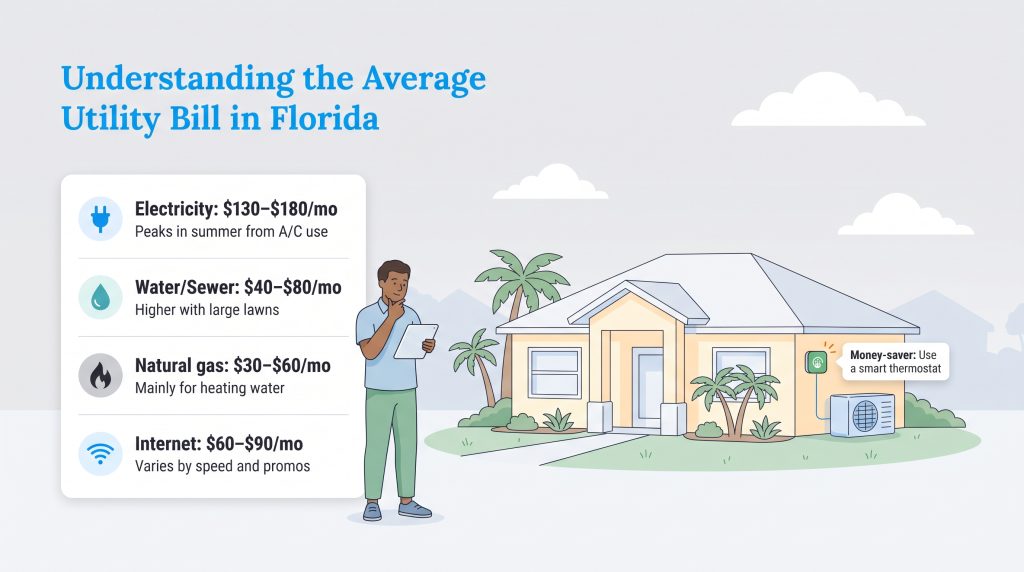
Reviewing Florida’s residential energy consumption data confirms that air conditioning drastically drives up monthly bills from May through October. During the peak summer months, it is incredibly common for electricity bills in a standard 2,000-square-foot home to soar between $250 and $350 or more. Fortunately, as the humidity breaks and winter rolls in, those cooling expenses drop significantly. These ranges are planning estimates based on typical residential usage patterns and publicly available utility data.
| Utility Type | Estimated Monthly Cost (2,000 sq. ft. Home) |
|---|---|
| Electricity | $130 to $180 (Can exceed $250 to $350+ in summer) |
| Water and Sewer | $40 to $80 |
| Natural Gas (If applicable) | $30 to $60 |
| High-Speed Internet | $60 to $90 |
| Trash and Recycling | $20 to $40 (Often included in HOA dues) |
💸 Money-Saver & 🌱 Eco Edge: Because air conditioning accounts for a massive portion of the average utility bill in Florida, using an ENERGY STAR-certified smart thermostat can help reduce cooling energy use when it is programmed consistently. Additionally, if you are buying a home, ask your electric utility about current solar interconnection and net metering rules before installing panels. Program terms can vary, and payback depends on your usage, roof exposure, and local rates. Generating your own clean energy is an environmentally mindful choice that lowers your reliance on the grid.
Hurricane Preparedness for Florida Utilities
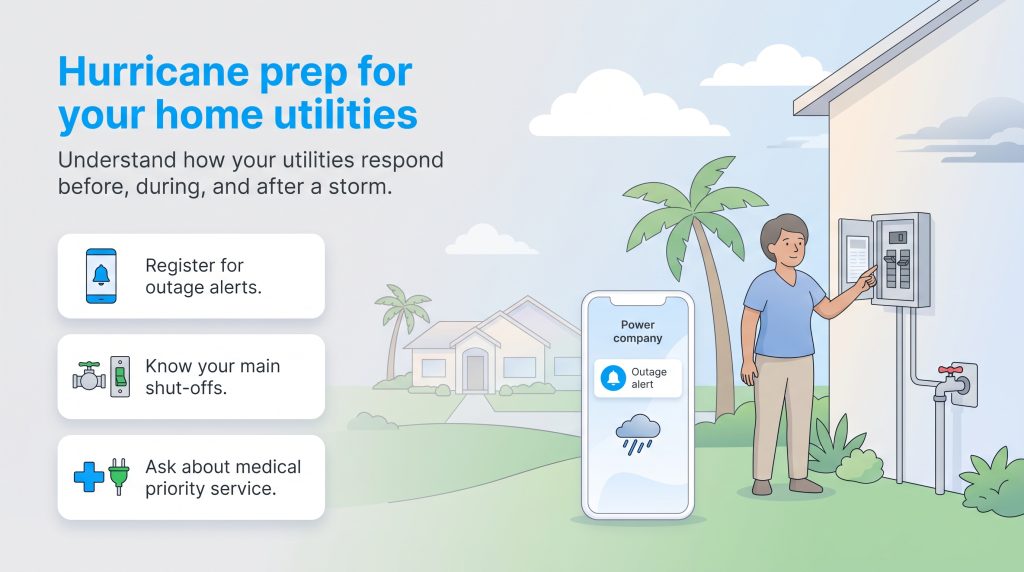
Severe summer weather is an unavoidable reality of living in a coastal state, making storm readiness an essential part of your moving process. Knowing exactly how your utilities function before, during, and after a severe storm protects your property and your family.
- Register for outage alerts: Immediately download your electric provider’s mobile app and opt into SMS text alerts so you receive real-time updates regarding grid repairs and storm tracking.
- Locate physical shut-off valves: Familiarize yourself with the exact location of your home’s main water shut-off valve and your main breaker box before a storm hits to rapidly prevent plumbing disasters.
- Inquire about medical essential service lists: If anyone in your household relies on electricity for life-sustaining medical equipment, contact your power company to register for their critical care program. This alerts the utility to prioritize your address during power restoration efforts whenever safely possible.
Mastering Your Florida Relocation
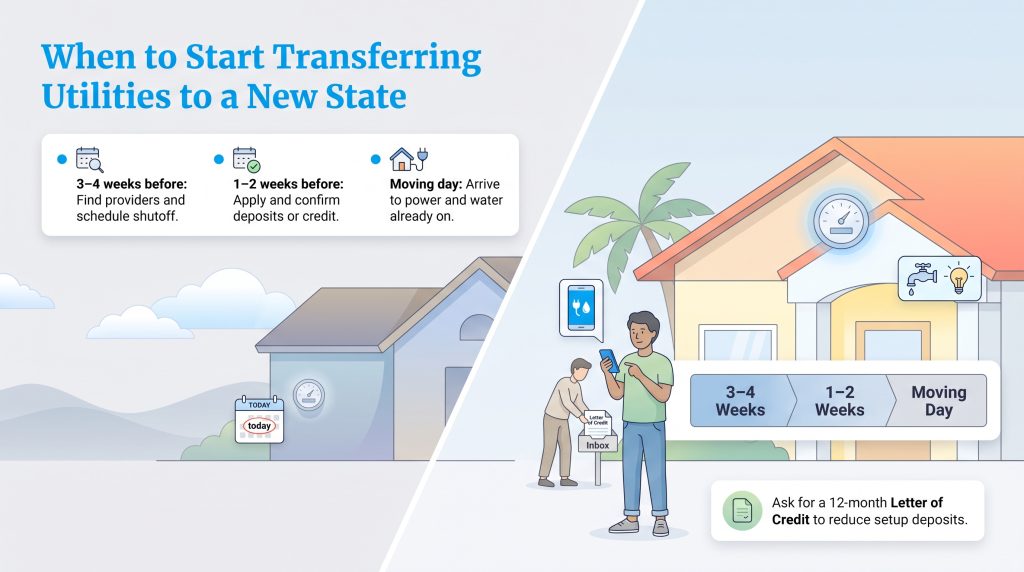
Relocating to a completely new environment requires excellent organization, but tackling your essential utility connections early keeps your moving stress to an absolute minimum. By identifying your exact local providers, understanding the regional quirks of municipal billing, and factoring in seasonal cooling costs, you position yourself for a seamless move. Secure your services with plenty of lead time, leverage smart home technology to keep your summer bills manageable, and review your HOA documents to avoid surprises. Enjoying a smooth transition means you can stop worrying about administrative details and finally start enjoying your exciting new chapter in the beautiful Sunshine State.
Frequently Asked Questions About Florida Utilities
Utility setup can vary heavily by city, provider, and home type, so it is perfectly normal to have a few lingering questions. These quick answers cover the most common details Florida movers ask about before officially opening their new accounts.
How early should I transfer my utilities when moving to Florida?
Does Florida Power and Light charge a deposit for new service?
Are utilities cheaper in Florida compared to other states?
Do I need natural gas service in Florida?
Who are the cheapest electricity providers in Florida?
What happens to my utilities if a hurricane hits?
About the Author

David has been an integral part of some of the biggest utility sites on the internet, including InMyArea.com, HighSpeedInternet.com, BroadbandNow.com, and U.S. News. He brings over 15 years of experience writing about, compiling and analyzing utility data.

LaLeesha has a Masters degree in English and enjoys writing whenever she has the chance. She is passionate about gardening, reducing her carbon footprint, and protecting the environment. She also recently served as President of the Board for City Sprouts (a community garden).