

Set up Nevada utilities early by confirming your electric, gas, water, internet, and trash providers by address before move-in day.
Key Takeaways
- Start setting up your services at least two weeks before your move-in date to avoid service gaps, appointment delays, or last-minute installation issues.
- Identify your regional providers, as Nevada’s utility grid is largely divided between the North (Reno/Sparks) and South (Las Vegas), though some rural areas have independent cooperatives.
- Prepare your documentation, including previous utility payment history, to potentially waive upfront deposit fees when establishing new accounts.
Welcome to the Silver State! Whether you are relocating to the Mojave Desert or heading to the Reno–Tahoe area, getting your home up and running shouldn’t be a headache. We know out-of-state moves come with a mountain of tasks, but checking off your moving to Nevada utilities checklist doesn’t have to be one of them. We will walk you through the main providers, setup timing, and local details that can trip up new residents so you can have your essential services ready the moment you walk through the front door.
What You Will Need Before You Start
Gathering your information before contacting providers saves time and helps you avoid getting stuck midway through an application. Make sure you have these details handy:
- Your exact new service address and ZIP code
- Your targeted move-in date
- Government-issued ID and Social Security number (or tax ID) for credit checks
- Lease agreement, deed, or closing documents
- Previous utility account numbers and payment history (to help waive deposits)
- Your preferred payment method
- Contact information for your new landlord or homeowners association (HOA)
When to Set Up Utilities in Nevada
Ideally, you want to tackle your utility setup timeline well before the moving truck is packed. Establishing service early prevents sudden outages — which is especially critical given the extreme Nevada climate, where a lack of summer air conditioning or winter heating quickly becomes a safety hazard. We recommend plotting your activation dates to overlap slightly with your arrival. If you are planning your moving utility setup, you can easily map out this stress-free chronological timeline to keep everything on track:
- Two weeks out: Contact your new electricity, gas, and water providers to create your accounts. Gather any necessary letters of good credit from your previous utility companies to potentially waive deposit fees.
- One week out: Confirm your activation dates. If your home requires an in-person appointment to unlock the natural gas meter, make sure you lock in a specific time window so you don’t miss the technician.
- Moving day: Verify that all essential services are active upon arrival. Run a quick check on the HVAC system, test the hot water, and switch on the lights.
Who Provides Electricity in Nevada?
When figuring out who provides electricity in Nevada, most households are served by NV Energy, especially in the Las Vegas and Reno-Sparks metro areas. However, some rural communities, municipalities, and power districts — like Boulder City Utilities or Valley Electric Association — have separate electric providers, so it is always worth confirming your provider by address. NV Energy operates through regional utility subsidiaries, including Nevada Power Company in Southern Nevada and Sierra Pacific Power Company in Northern Nevada, but residential customers generally start and manage service directly through NV Energy.
To get the lights on, you will need to open a residential account. New customers moving from out of state are typically required to pay a security deposit, which varies by provider, credit history, and service address. However, you can often bypass this extra upfront expense if you request a letter of good credit from your former out-of-state utility provider proving a history of on-time payments.
How to Start NV Energy Service
To initiate your connection, navigate over to NV Energy’s start service portal. You will be prompted to enter your new address, your desired move-in date, and basic identification details like your Social Security number to run a soft credit check. Provider boundaries do not always follow the city name on your mailing address. Before opening accounts, use your exact service address and ZIP code on each utility’s start-service page to prevent processing errors.
Natural Gas Providers Across the Silver State
Southwest Gas stands as the dominant natural gas provider serving both Northern and Southern Nevada. While you might assume every home requires a gas connection, that is not entirely true in the Silver State. Many properties — especially newer apartment complexes and modern housing developments in Las Vegas — are built completely all-electric. Before attempting to open an account, check with your landlord or real estate agent to confirm if your new residence actually features gas appliances for heating, cooking, or hot water.
If your home does utilize natural gas, you can initiate your service transfer through the official Southwest Gas start service page. Keep in mind that activating gas service often involves more than just a digital flip of a switch. If the previous owners shut the gas completely off, safety regulations dictate that a technician must physically visit the property to unlock the meter and inspect the connections.
Internet, Trash, and Sewer Services to Check Before Move-In
Electricity and water keep the house running, but setting up your internet and waste management are just as important for daily life. These services vary widely depending on your exact neighborhood and housing type.
- Internet: Check availability by your exact address before signing a contract. Depending on your city, common providers may include Cox, Spectrum, Quantum Fiber, AT&T Fiber, or 5G home internet options from T-Mobile and Verizon.
- Trash and Recycling: Managing your residential waste collection could involve municipal services, a private hauler like Republic Services, or coverage through your HOA.
- Sewer: In many areas, sewer billing is handled separately from your water bill, often by the city or county directly.
Quick-Reference Utility Guide for Major Nevada Cities
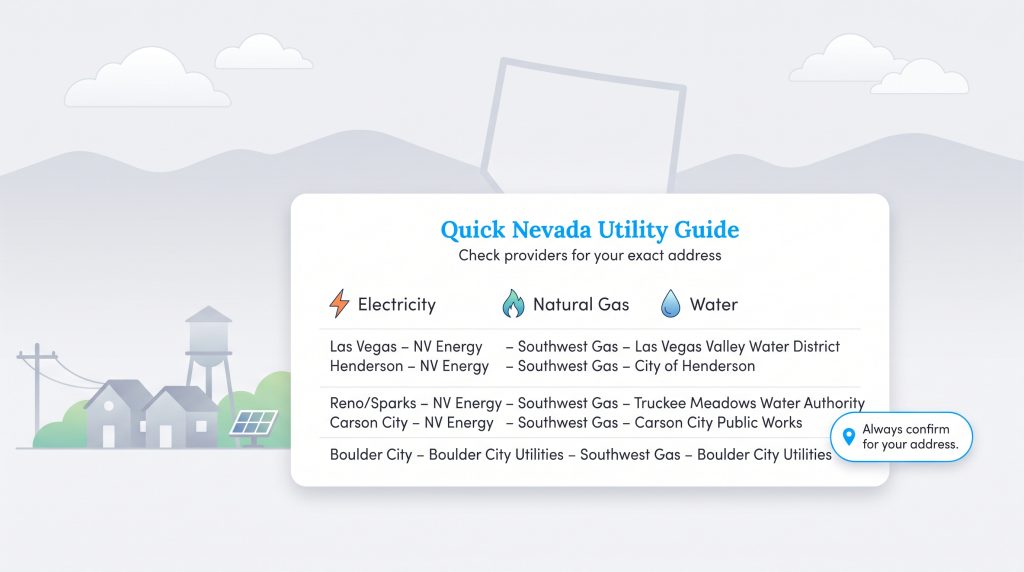
To help you figure out who to call, we mapped out the likely providers for major municipalities. Always verify these against your specific service address before you sign up.
| City | Likely Electric Provider | Likely Gas Provider | Likely Water Provider |
|---|---|---|---|
| Las Vegas | NV Energy | Southwest Gas | Las Vegas Valley Water District |
| Henderson | NV Energy | Southwest Gas | City of Henderson |
| North Las Vegas | NV Energy | Southwest Gas | City of North Las Vegas |
| Reno / Sparks | NV Energy | Southwest Gas | Truckee Meadows Water Authority |
| Carson City | NV Energy | Southwest Gas | Carson City Public Works |
| Boulder City | Boulder City Utilities | Southwest Gas | Boulder City Utilities |
| Pahrump | Valley Electric Association | Propane (No Natural Gas) | Various / Private Wells |
Managing Your Water and Sewer Services
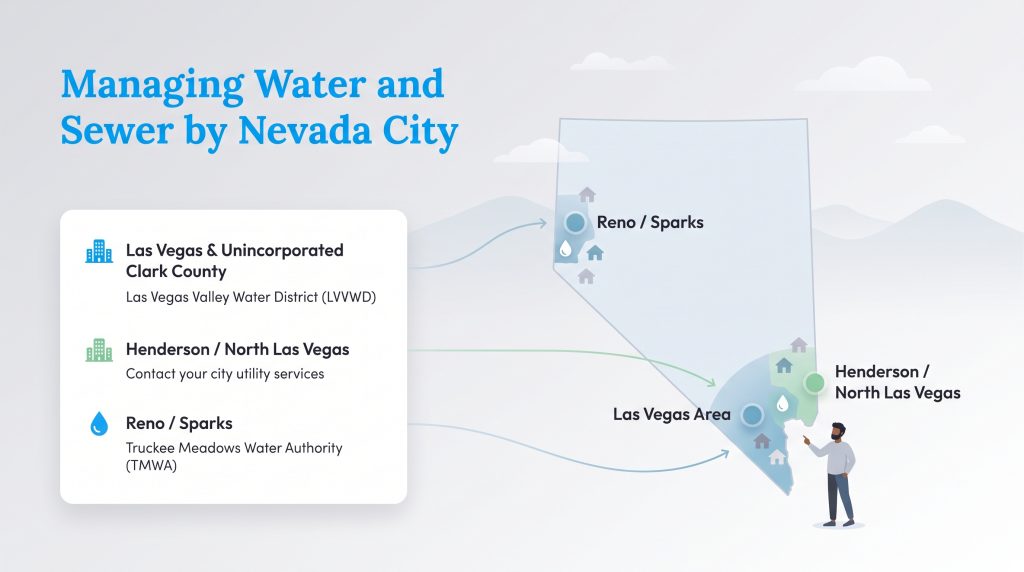
Unlike electricity and gas, managing your water services is a highly localized process in Nevada. Your provider is strictly determined by city and county lines. For those moving to Southern Nevada, the Las Vegas Valley Water District (LVVWD) handles the bulk of residential distribution. However, if your new address technically sits within the borders of Henderson or North Las Vegas, you will need to bypass the LVVWD entirely and contact their respective municipal water departments. Up north, residents in the Reno and Sparks area are primarily serviced by the Truckee Meadows Water Authority (TMWA).
Figuring out who to call doesn’t have to be confusing. We have broken down the primary providers below to help you navigate setting up your residential water services based on your specific destination city.
| Major City | Water Provider | How to Connect |
|---|---|---|
| Las Vegas & Unincorporated Clark County | Las Vegas Valley Water District (LVVWD) | Use the Las Vegas Valley Water District setup page |
| Henderson | City of Henderson Utility Services | Apply online via the City of Henderson website |
| Reno / Sparks | Truckee Meadows Water Authority (TMWA) | Request service transfers via the TMWA customer portal |
Utility Setup in Northern Nevada: Reno, Sparks, and Carson City
While Las Vegas worries about summer heat, Northern Nevada faces a different climate reality. If you are moving to Reno, Sparks, Carson City, or Washoe County, prepare for snow and freezing winter temperatures. This makes establishing your natural gas service for heating a top priority before you arrive. If you are relocating near the Tahoe area, you may also rely on propane tanks or wood-burning stoves depending on your home’s elevation and infrastructure, so connect with your real estate agent to understand your specific winter heating setup.
Renters vs. Homeowners Utility Responsibilities
Knowing who pays for what is essential to avoiding surprise bills. While lease agreements vary, this table outlines standard utility expectations for renters versus homeowners in Nevada.
| Utility Service | Renters Usually Pay | Homeowners Usually Pay |
|---|---|---|
| Electricity | Yes | Yes |
| Natural Gas | Yes | Yes |
| Water & Sewer | Sometimes (often landlord-paid) | Yes |
| Trash Collection | Sometimes (often landlord-paid) | Yes (or via HOA) |
| Internet & Cable | Yes | Yes |
What Is the Average Utility Bill in Nevada?
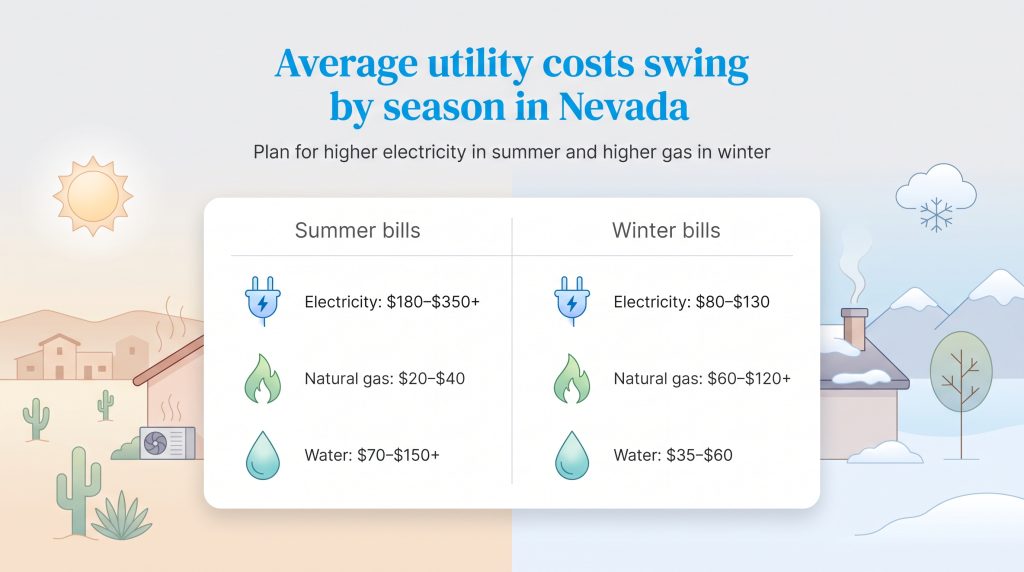
Budgeting for an average utility bill in Nevada requires understanding how drastically the weather impacts consumption. Because the state endures such extreme temperature fluctuations, your monthly costs will swing significantly depending on the season. During the scorching summer months, air conditioning units work overtime, pushing electricity bills well over the $200 mark for a standard single-family home. On the flip side, natural gas bills drop off completely during this time because furnaces remain untouched for months.
When winter arrives — bringing chilly nights to the south and freezing snow to the north — the financial burden shifts. Electricity usage drops considerably, but natural gas expenses rise as residents turn on their heating systems. Water bills also tend to decrease during the winter since outdoor irrigation is drastically reduced. These ranges below are planning estimates, not guaranteed averages. Your actual bill depends on your home size, rate schedule, season, thermostat settings, landscaping, and whether your home uses gas or all-electric appliances.
| Utility Type | Average Summer Monthly Costs | Average Winter Monthly Costs |
|---|---|---|
| Electricity | $180 – $350+ (High AC demand) | $80 – $130 (Lower cooling demand) |
| Natural Gas | $20 – $40 (Cooking and water heating) | $60 – $120+ (High furnace demand) |
| Water | $70 – $150+ (Increased outdoor irrigation) | $35 – $60 (Minimal outdoor watering) |
How to Lower Utility Bills After Moving to Nevada
Nevada weather demands a lot from your HVAC system, but a few smart habits can keep your energy costs manageable year-round. Try implementing these cost-saving strategies once you unpack:
- Optimize your thermostat: Set your summer thermostat efficiently — ideally around 78 degrees when you are home and higher when you leave.
- Change air filters: Swap out your HVAC filters before heavy summer AC use to improve airflow and efficiency.
- Check for time-of-use plans: Utility providers may offer discounted electricity rates if you shift heavy appliance use to off-peak hours.
- Fix irrigation leaks: Desert soils drain quickly, so a hidden sprinkler leak can quietly add hundreds of dollars to your water bill.
The Sustainable Move: Eco-Friendly Programs in Nevada
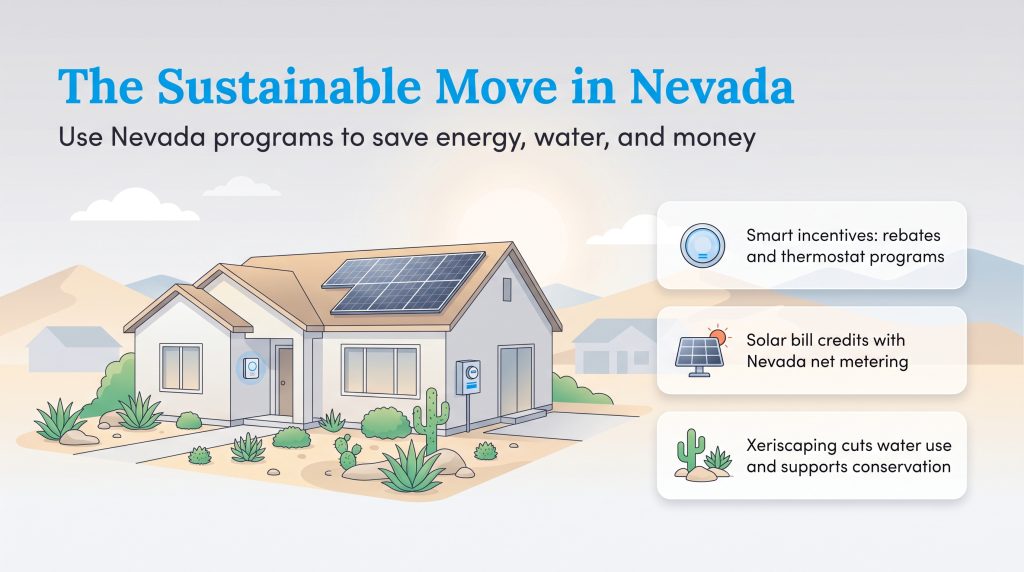
Nevada isn’t just about glowing neon lights and vast desert landscapes; it is also a strong state for renewable energy and conservation efforts. Moving into a new residence presents the perfect opportunity to make an environmentally mindful choice regarding your consumption habits. For instance, NV Energy’s PowerShift programs may offer eligible customers smart thermostat incentives, energy-saving tools, or demand-management options. Additionally, before buying major appliances, check current NV Energy, local water agency, and ENERGY STAR rebate resources to see whether efficient models qualify for incentives.
If you plan on purchasing property, taking advantage of the abundant sunshine is a fantastic energy-saving option. Nevada offers net metering for qualifying rooftop solar customers, allowing excess generation to earn bill credits under current utility rules. Taking the time to research Nevada solar energy benefits can dramatically slash your long-term reliance on fossil fuels while shrinking your carbon footprint.
Ensuring a Smooth Transition for Your Nevada Move
Handling your utility connections proactively helps set you up for a comfortable, illuminated first night in your new Nevada home. By checking these essential administrative tasks off your to-do list early, you avoid the frustrating scramble of dealing with customer service hold times while surrounded by cardboard boxes. With your power, water, and gas firmly established, you can finally relax and focus on enjoying the state’s vibrant communities, stunning mountain ranges, and endless sunny days.
Frequently Asked Questions About Moving to Nevada Utilities
Still sorting out the details? These quick answers cover common Nevada utility setup questions for renters, homeowners, and out-of-state movers.
How Do I Transfer My Utilities If I’m Moving Within Nevada?
Can I Choose My Electricity Provider in Nevada?
How Much Is a Typical Utility Deposit in Nevada?
Does My Landlord Pay for Water and Trash in Las Vegas?
How Do I Transfer Utilities in Nevada If I’m Moving From Out of State?
About the Author

David has been an integral part of some of the biggest utility sites on the internet, including InMyArea.com, HighSpeedInternet.com, BroadbandNow.com, and U.S. News. He brings over 15 years of experience writing about, compiling and analyzing utility data.

LaLeesha has a Masters degree in English and enjoys writing whenever she has the chance. She is passionate about gardening, reducing her carbon footprint, and protecting the environment. She also recently served as President of the Board for City Sprouts (a community garden).