

Competing Head-to-Head on Price and Perks, Find Out Whether TXU’s Reliable Service or Just Energy’s Flexible Plans Are the Better Fit for Your Energy Needs
Key Takeaways
- Just Energy offers competitive introductory pricing for budget-conscious shoppers, while TXU Energy delivers long-term stability and premium customer service for established homeowners.
- Understanding Early Termination Fees (ETFs) is crucial, as Just Energy typically relies on a predictable flat rate, whereas TXU Energy often charges a costly fee based on the remaining months of your contract.
- Shifting your usage is the key to Free Nights plans, and evaluating the exact hours of these time-of-use contracts will determine if you actually secure massive monthly savings or face a skyrocketing bill.

- 10.9¢ /kWh
- 3-100%
- 60 days
- 1-36 Months
- Highest Trustpilot Rating 4.7/5 ★

- 8.7¢ /kWh
- 31%
- 60 days
- 12-36 Months
- Popular Bill Credit Plans
*rates may vary by location and household usage
When navigating the Texas deregulated electricity market, you often have to choose between massive utility giants promising identical savings but delivering vastly different monthly statements. You have likely seen the ubiquitous advertisements for TXU Energy and Just Energy boasting about free electricity periods, renewable energy options, and rock-bottom prices. However, the real truth lies buried within the fine print of the Electricity Facts Label (EFL). We are here to break down the complex math behind the flashy marketing, offering a comprehensive TXU Energy vs. Just Energy comparison so you can uncover hidden fees, compare current 2026 rates, and confidently pick the right energy provider for your household.
At A Glance: TXU Energy Vs Just Energy
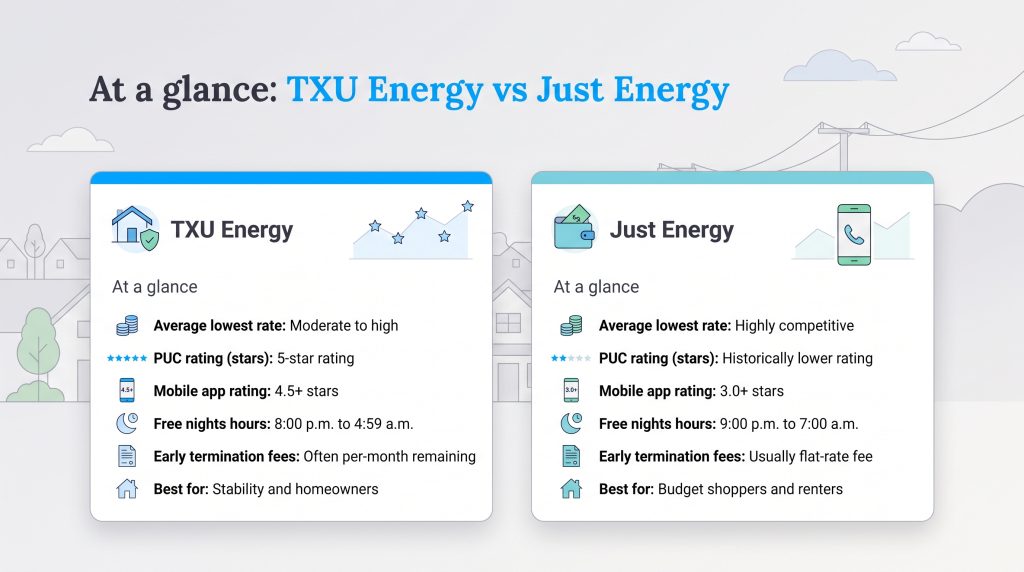
Before diving into the intricate details of tiered rates and time-of-use plans, reviewing a high-level overview of how these two providers stack up is incredibly helpful. This side-by-side comparison matrix highlights the critical metrics you need to evaluate the best electricity provider in Texas for your specific budget and lifestyle.
| Comparison Metric | TXU Energy | Just Energy |
|---|---|---|
| Lowest Advertised Rate | Moderate to High | Highly Competitive |
| PUC Rating (Stars) | 5-Star Rating | Historically Lower Rating |
| Plan Count | Extensive (10+ Options) | Streamlined (5–7 Options) |
| 100% Green Plans Available | Yes (Integrated Plans) | Yes (JustGreen Offsets) |
| Early Termination Fee Structure | Per-Month Remaining Formula | Flat-Rate Fee ($175+) |
Comparing Electricity Rates And Plan Types
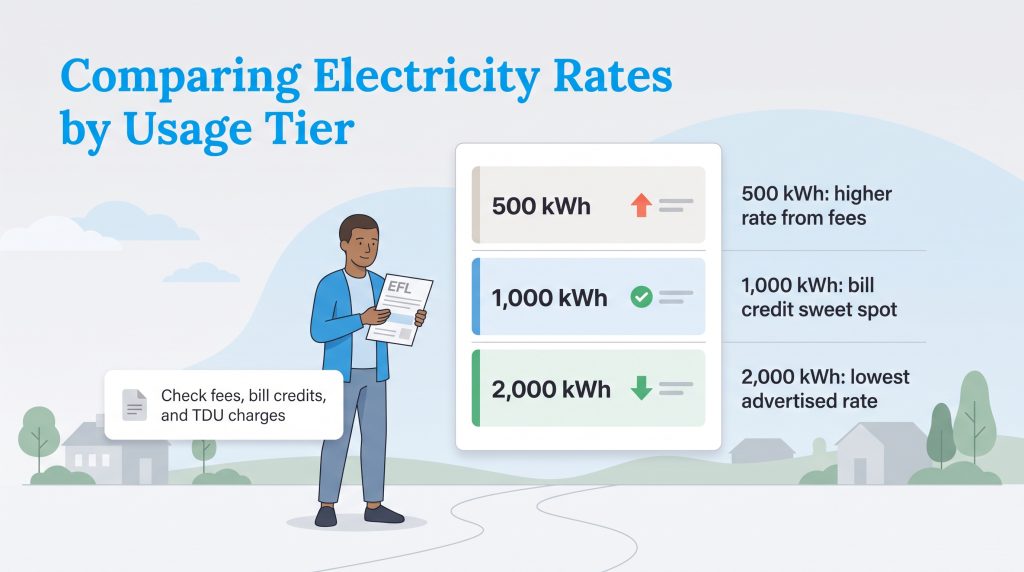
The most critical thing to recognize about Texas deregulated electricity is that the bold, advertised price you see is rarely what you actually pay — unless your home consumes exactly 2,000 kilowatt-hours (kWh) per month. Both providers structure their plans around the three standard usage tiers required by the Public Utility Commission of Texas (PUCT): the 500 kWh, 1,000 kWh, and 2,000 kWh usage rate benchmarks. When analyzing flagship plans like the TXU Energy Clear Deal or the Just Energy Basics portfolio, you must scrutinize how the rates shift across these specific tiers.
- 500 kWh Tier (Small Apartments): At this lower usage level, standard monthly administrative fees heavily inflate your overall cost. Because you are dividing a fixed monthly charge across fewer kilowatt-hours, your effective rate spikes. You should keep a close eye on the Just Energy base charge (frequently ranging between $4.95 and $9.95), which can penalize light energy users who don’t consume enough power to offset the flat fee.
- 1,000 kWh Tier (Small to Medium Homes): This is the sweet spot where many plans offer a promotional bill credit. If you hit the 1,000 kWh usage rate, a provider might apply a $30 to $50 credit to your statement, dropping your average rate considerably. TXU Energy is famous for these credit thresholds on plans like the TXU Energy Value Edge.
- 2,000 kWh Tier (Large Homes or Summer Months): At this heavy usage tier, you typically unlock the absolute lowest advertised rate, diluting any base charges across a massive pool of energy usage. Both providers are highly competitive at this tier, making them solid options for large homes running dual HVAC systems in July.
As you evaluate pricing, always check the Electricity Facts Label (EFL) for “TDU Delivery Charges.” These are non-negotiable pass-through fees mandated by your local utility transmission company (like Oncor or CenterPoint). These fees are applied identically regardless of whether you sign up with TXU or Just Energy. For more details on your billing rights, you can visit the Public Utility Commission of Texas (PUCT) consumer guide.
Fixed-Rate And Variable-Rate Options
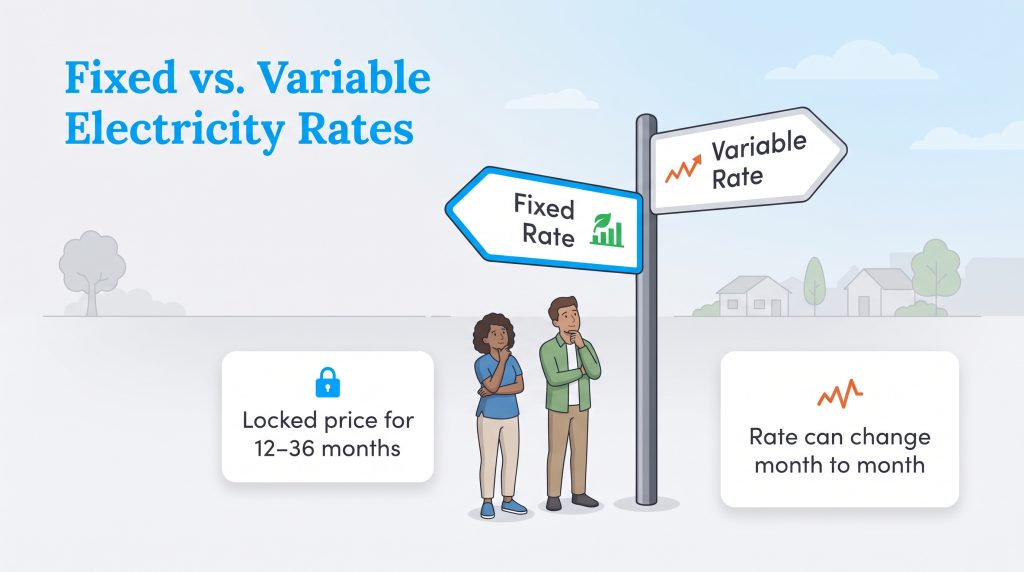
Rather than staring at massive, easily outdated static rate tables, the smartest way to shop for electricity is to understand the actual product categories. When analyzing Just Energy vs. TXU fixed-rate plans, you are looking at the most stable and predictable option on the market. A fixed-rate contract locks in your price per kWh for the duration of the term, usually between 12 and 36 months. This protects you entirely from summer price spikes and wholesale grid volatility. TXU’s fixed plans reward consistent usage, while Just Energy’s fixed options strip away complex credits to give you a straightforward, no-nonsense rate.
Variable-rate or month-to-month plans operate differently. Neither provider will lock in your rate on these plans, meaning your cost per kWh can swing wildly depending on market conditions. While they are a great short-term fix if you only need power for a brief 60-day gap before a big move, they are financially dangerous for long-term use. The flexibility is nice, but it comes at a premium.
Time-Of-Use TXU Free Nights Vs Just Energy Free Nights
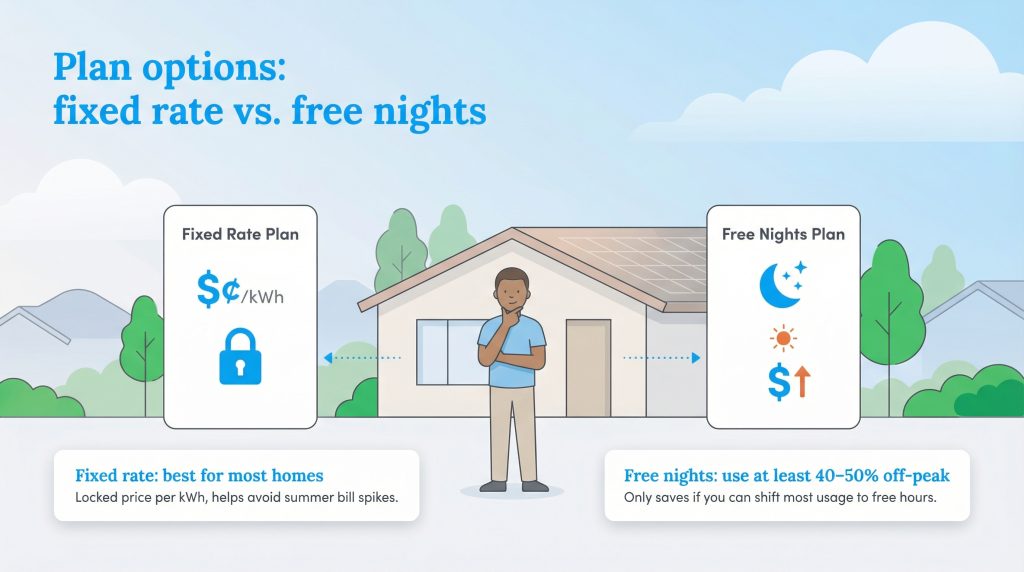
The marketing battle over TXU Free Nights vs. Just Energy Free Nights is incredibly competitive. While the concept sounds flawless — enjoying zero energy charges while you sleep — these time-of-use free nights plans only save you money if you shift roughly 40% to 50% of your total household energy consumption into the designated free window. If you fail to adjust your habits, the substantially higher daytime rates will cause your bill to skyrocket.
- TXU Energy Free Nights: TXU offers nine hours of free power, running from 8:00 p.m. to 4:59 a.m. While you get one less hour of free energy overall, that earlier 8:00 p.m. start time is a massive advantage. Families can start running the dishwasher, doing laundry, or dropping the AC temperature immediately after dinner.
- Just Energy Free Nights: Just Energy provides a broader 10-hour window, operating from 9:00 p.m. to 7:00 a.m. Waiting until 9:00 p.m. to run major appliances can be inconvenient for early sleepers. However, the extended morning coverage until 7:00 a.m. is perfect if you like running a load of laundry or brewing coffee right before you head out the door for work.
If you work from home or blast your air conditioning heavily during the peak afternoon heat, a standard fixed-rate plan is almost always the safer financial bet over these complex time-of-use structures.
| Plan Name | Rate /kWH | Plan Term | Cancellation Fee | |
|---|---|---|---|---|
| Smart 1000 Saver 12 | 11.5¢ | Month to Month | N/A | Check Availability |
| Smart 1000 Select 12 | 11.5¢ | Fixed Months | $3 | Check Availability |
| Smart Edge 12 | 13.5¢ | 12 Months | $150.00 | Check Availability |
| Smart Edge 24 | 13.9¢ | 24 Months | $295.00 | Check Availability |
| Clear Deal 12 | 14.5¢ | Month to Month | N/A | Check Availability |
| Solar Value 12 | 15.9¢ | Month to Month | N/A | Check Availability |
| Simple Rate 12 | 16.4¢ | Month to Month | N/A | Check Availability |
| On Your Terms | 16.9¢ | Month to Month | N/A | Check Availability |
| Smart 500 Start 12 | 17.1¢ | Month to Month | N/A | Check Availability |
| Simple Value 12 | 18¢ | 12 Months | $150.00 | Check Availability |
| Ultimate Season Pass 12 | 18.7¢ | Month to Month | N/A | Check Availability |
| Flex Forward | 19.1¢ | Month to Month | N/A | Check Availability |
| Solar Club 12 | 19.1¢ | 12 Months | $150.00 | Check Availability |
| Texas Choice 12 | 19.2¢ | 12 Months | $150.00 | Check Availability |
| Texas Choice 24 | 19.2¢ | 24 Months | $295.00 | Check Availability |
| Flex Rewards | 19.3¢ | Month to Month | $0.00 | Check Availability |
| Smart Deal 12 | 19.6¢ | 12 Months | $150.00 | Check Availability |
| Smart Deal 24 | 20.4¢ | 24 Months | $295.00 | Check Availability |
| Smart Deal 36 | 20.4¢ | 36 Months | $395.00 | Check Availability |
| Solar Saver 12 | 21.3¢ | Month to Month | N/A | Check Availability |
| Saver's Discount 12 | 21.9¢ | Month to Month | N/A | Check Availability |
| Plan Name | Rate /kWH | Plan Term | Cancellation Fee | |
|---|---|---|---|---|
| Smart Choice - 24 | 8.7¢ | 24 Months | $0.00 | Check Availability |
| Smart Choice - 6 | 10.3¢ | 6 Months | $0.00 | Check Availability |
| Power Plus - 12 | 10.9¢ | 12 Months | $0.00 | Check Availability |
| Sustainable Days Bundle - 3 | 11.5¢ | 3 Months | $175.00 | Check Availability |
| Sustainable Living Bundle - 3 | 11.5¢ | 3 Months | $175.00 | Check Availability |
| Smart Choice - 12 | 12.1¢ | 12 Months | $175.00 | Check Availability |
| Power Plus - 24 | 12.5¢ | 24 Months | $0.00 | Check Availability |
| Simple Choice- 12 | 15.4¢ | 12 Months | $0.00 | Check Availability |
| Basics - 12 | 16.3¢ | 12 Months | $0.00 | Check Availability |
| Simple Choice- 24 | 16.5¢ | 24 Months | $0.00 | Check Availability |
| Basics - 24 | 16.7¢ | 24 Months | $0.00 | Check Availability |
| Basics PTC - 60 | 16.9¢ | 60 Months | $175.00 | Check Availability |
| Basics PTC - 24 | 16.9¢ | 24 Months | $175.00 | Check Availability |
| Mega Saver - 24 | 20.2¢ | 24 Months | $0.00 | Check Availability |
Renewable Energy And Solar Buyback Programs
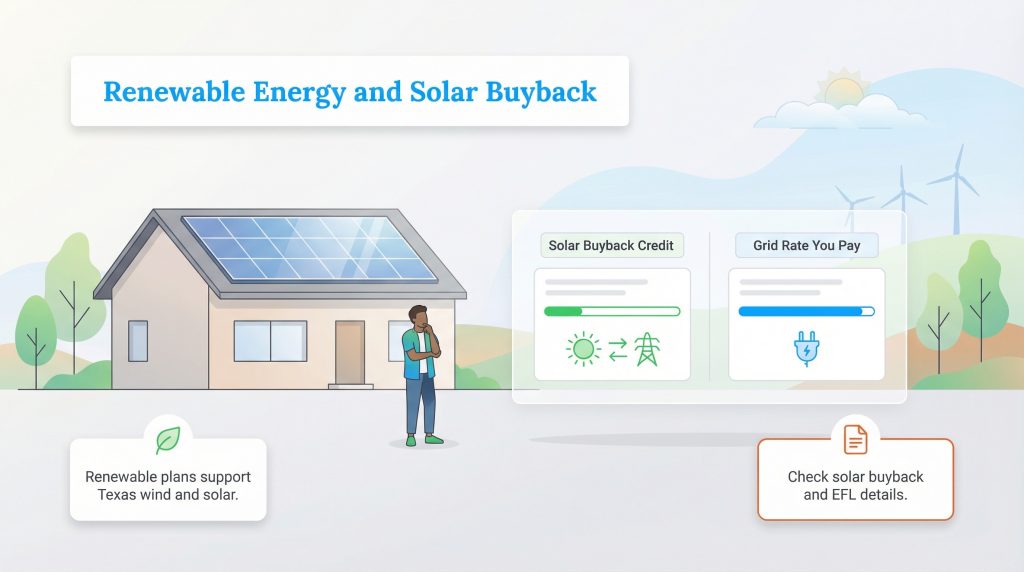
If sustainability is a priority for your household, you will be pleased to know that both companies offer excellent ways to support green energy. When weighing JustGreen vs. TXU renewable plans, their approaches differ significantly. Just Energy relies heavily on their “JustGreen” add-on product. For a small additional monthly fee, they will purchase enough Renewable Energy Certificates (RECs) to offset 100% of your home’s usage. This makes it an environmentally mindful choice that you can append to almost any of their base plans. You can learn more about how RECs operate on the EPA’s Green Power Partnership page.
TXU Energy takes a more integrated approach, often baking renewable generation directly into specific plan tiers, such as their popular Solar Saver or Texas Wind plans. These act as an energy-saving option that guarantees a fixed rate backed by solar or wind farms, without needing a separate add-on fee.
Furthermore, TXU Energy’s Solar Days and Free Nights plans offer a unique advantage for homeowners with solar panels and a home battery system. You can rely on your rooftop solar generation to power your home during the day, switch to stored battery power in the early evening, and then pull electricity from the grid entirely for free overnight. This synergy is incredibly powerful for advanced eco-conscious consumers.
However, when choosing TXU or Just Energy for actual rooftop solar exportation, solar buyback programs become a major sticking point. Standard retail plans from these providers will not credit you for the excess energy your panels push back into the grid. You must seek out specific net metering plans. Unfortunately, in Texas’s deregulated market, many buyback programs pay you a low wholesale rate for exported energy while charging you a much higher retail rate for the power you consume at night. Always compare the exact buyback rate directly against the consumption rate on the EFL before finalizing any solar plan.
Hidden Costs: Early Termination Fees And Base Charges
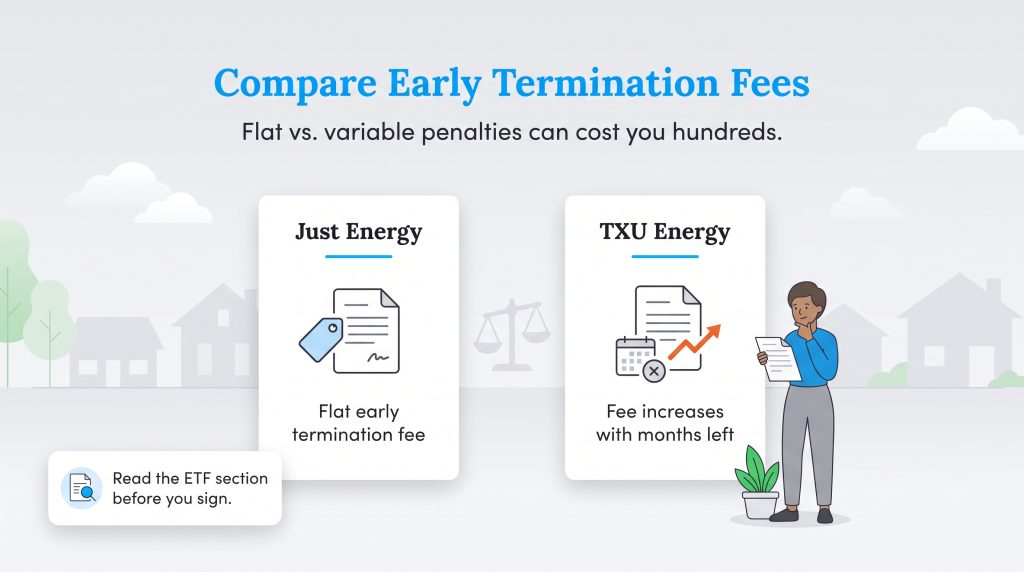
Life happens, and occasionally you need to break an electricity contract to move or switch to a cheaper rate. This is where the fine print regarding Early Termination Fees (ETFs) becomes a major financial factor. Both of these energy providers approach penalties differently, and misunderstanding them can cost you hundreds of dollars when it is time to switch.
- Just Energy ETF Model: This provider typically utilizes a simple, flat-fee structure for cancellations. Depending on the length of the term you signed, breaking your contract will result in a set fee (frequently ranging from $175 to $295). It is easy to understand, and the penalty remains exactly the same whether you cancel in month two or month 11.
- TXU Energy ETF Model: Conversely, the TXU Energy cancellation fee is often variable. Many of their long-term plans charge a set dollar amount multiplied by the remaining months left on your contract. For example, if they charge $20 for every month remaining, canceling a 36-month contract after just six months will result in a staggering $600 penalty.
Customer Service, PUC Ratings, And App Experience
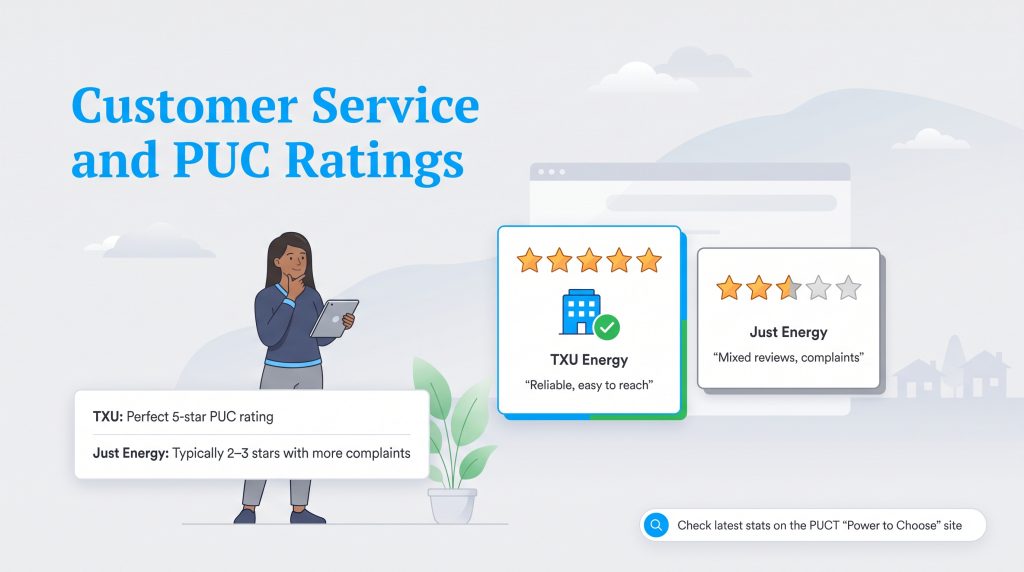
Trust is a massive component of choosing a utility provider. Fortunately, the state of Texas provides objective regulatory data so you don’t have to rely solely on flashy marketing claims. When researching TXU Energy vs. Just Energy customer service, verified third-party review scores point to a very clear winner. TXU consistently maintains a perfect 5-star rating with the Public Utility Commission (PUC) of Texas. Their customer service reviews continually praise the company’s reliability, ease of contact, and speedy resolution times.
On the flip side, Just Energy’s PUC rating historically hovers in the lower to middle tiers (often settling between two and three stars depending on the quarter). While customers love their enrollment simplicity and initial introductory pricing, their lower complaint scorecard is often driven by frustrations regarding renewal communications. Some users report confusion over billing clarity after their introductory contracts expire and automatically shift to variable rates. For official, up-to-date complaint statistics, we highly recommend visiting the PUCT Power to Choose website.
The digital experience further separates these two brands. Managing your power bill should not require waiting on hold for 45 minutes, making a reliable smartphone application a necessity. The Just Energy Advisor App offers essential functionality, allowing users to easily view their current bill, make immediate payments, and review historical usage charts. It also features basic smart thermostat integration. However, consumer reviews sometimes point out occasional lagging and interface quirks during peak billing cycles.
TXU Energy sets the gold standard for utility digital tools in Texas. The TXU Energy mobile app is highly polished, frequently boasting top-tier ratings across both Apple and Android app stores. Beyond standard bill payment, it offers predictive usage alerts, meaning the app will notify you mid-cycle if your current energy habits are tracking toward an unusually high bill. This proactive alert system is a massive money-saver for families on a strict budget.
How To Switch Between TXU Energy And Just Energy

If you are currently enrolled with one of these providers and want to jump ship to take advantage of the other’s rates, the process is incredibly straightforward. Texas deregulation was designed to make switching easy, and you do not need to endure a lengthy phone call with your old provider to get it done. Just follow these three simple steps:
- Compare and Select Your New Plan: Review the EFLs for both providers. Ensure your current contract is within 14 days of expiring so you aren’t hit with an early termination penalty. Once you find the right fixed-rate or free nights plan, proceed to checkout.
- Enroll Online: Sign up for your new plan either through the provider’s website or via a certified broker platform. You will simply need your service address and some basic identification details. Choose a switch date that aligns with the end of your old contract.
- Let the Provider Do the Heavy Lifting: Here is the best part — you do not need to call your old provider to cancel. Your new provider will contact the local Transmission and Distribution Utility (TDU), such as Oncor or CenterPoint, to process the switch automatically. The transition is seamless, handled electronically, and requires no physical visit to your home.
Choosing The Best Energy Provider For Your Home
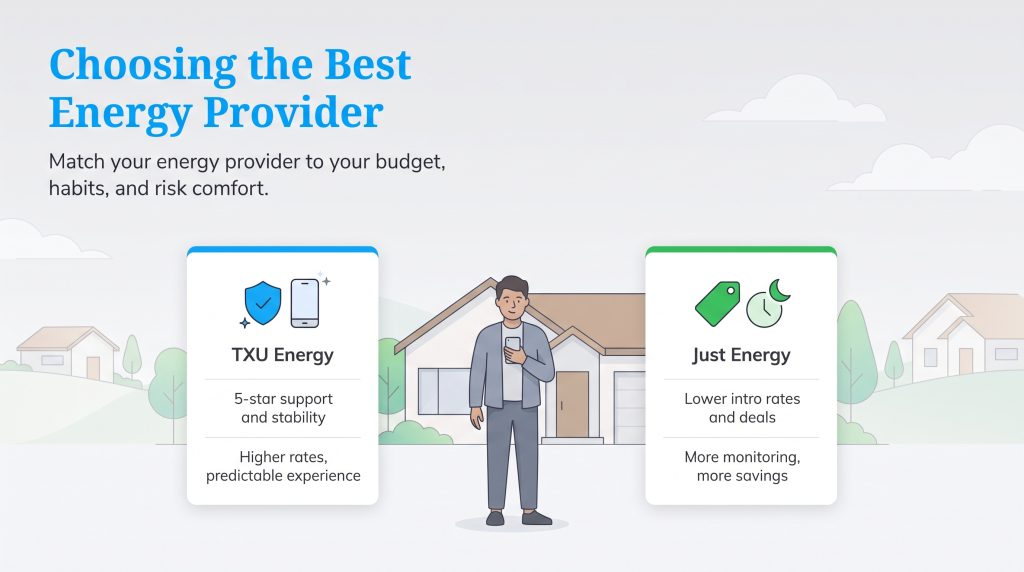
Choosing between these two energy heavyweights ultimately comes down to your personal management style, your monthly usage, and your budget tolerance. Both companies have deeply rooted histories in Texas, but they cater to very different types of consumers.
TXU Energy
- Pro: Consistently earns a perfect 5-star PUC rating for exceptional customer support.
- Pro: Offers highly intuitive digital tools and a robust, top-rated mobile app.
- Pro: Free nights plans start at a convenient and manageable 8:00 p.m.
- Con: Generally carries slightly higher premium rates across all usage tiers.
- Con: Complex tiered bill credits can severely penalize low-usage homes.
Just Energy
- Pro: Frequently provides very competitive introductory pricing to win new business.
- Pro: Flat-rate Early Termination Fees are predictable and transparent.
- Pro: Free nights plans offer a generous 10-hour window (9:00 p.m. to 7:00 a.m.).
- Con: Historically maintains a lower PUC rating regarding billing complaints.
- Con: Base monthly charges can inflate the final bill for small apartments.
If you are an established homeowner who values predictability, strong digital tools, and a reliable brand reputation, TXU Energy is the ultimate choice for peace of mind. You might pay a fraction more, but the 5-star stability is often well worth the premium. Conversely, if you are a diligent budgeter willing to monitor expiration dates and plan terms to lock in the absolute lowest introductory rate, Just Energy provides incredible value and flexible options. No matter which provider you end up signing with, reviewing your EFL and understanding your own household usage patterns remains the most guaranteed way to save money on your electric bill.
Frequently Asked Questions About TXU Energy Vs Just Energy
Which is cheaper, TXU Energy or Just Energy?
Just Energy frequently offers cheaper introductory rates and straightforward plans that strip away extra frills for budget-conscious shoppers. However, if your home consistently hits exactly 1,000 kWh or 2,000 kWh per month, TXU Energy can sometimes end up being cheaper due to their aggressive usage-based bill credits. The true cost always depends on your specific monthly consumption.
What is the difference between Just Energy and TXU Energy’s free nights plans?
The primary difference lies in the exact hours of the free energy window. Just Energy’s free nights plan typically runs from 9:00 p.m. to 7:00 a.m., giving you 10 hours of free power. TXU Energy shifts the window earlier, offering nine hours of free electricity from 8:00 p.m. to 4:59 a.m. To see real savings with either plan, you must be willing to shift at least 40% to 50% of your energy usage into these designated off-peak periods.
Does TXU Energy or Just Energy have better customer reviews?
TXU Energy consistently holds stronger verified customer reviews and a better Public Utility Commission (PUC) rating. TXU boasts a stellar 5-star score, reflecting excellent customer service, transparent billing, and a top-tier app. Just Energy historically holds a lower rating on the Power to Choose scorecard due to a higher volume of consumer complaints regarding billing communication.
Will I have to pay an early termination fee if I switch from TXU to Just Energy?
Yes, you will likely have to pay an Early Termination Fee if you break your active, fixed-rate contract with TXU Energy before it naturally expires (unless you are physically moving to a new address). TXU Energy frequently employs a variable structure, charging a specific dollar amount multiplied by the remaining months left on your contract, which can be quite expensive. Always check your exact EFL before initiating a switch.
Is TXU Energy or Just Energy better for apartments?
Just Energy is typically the better choice for small apartments that use around 500 kWh per month, as their base plans do not rely heavily on high-usage bill credits. TXU Energy plans often require you to hit 1,000 kWh before a massive credit kicks in, meaning apartment renters usually pay a higher premium rate. Just remember to check the EFL for Just Energy’s flat monthly base charge, which can slightly inflate a small bill.
Can I get 100% renewable energy with TXU Energy or Just Energy?
Yes, both providers offer eco-conscious alternatives that include 100% renewable energy content. These plans utilize Renewable Energy Certificates (RECs) to offset your household usage. Simply look for “Green” or “Renewable” in the plan’s title or check the EFL for the verified renewable content percentage before you sign up.
Do TXU Energy and Just Energy require a deposit?
Both providers usually require an upfront deposit for customers with lower credit scores or those who lack sufficient credit history. However, both companies also offer options to legally waive the deposit for seniors, victims of family violence, or residents who can provide a standard letter of credit from a previous utility provider demonstrating a flawless payment history.
Do I lose power when switching between TXU Energy and Just Energy?
No, you will absolutely never lose power when switching between retail energy providers in Texas. Electricity is always delivered to your home by the same local utility company using the same exact wires and poles. The switch is purely an administrative change on the billing side, and the transition happens seamlessly without any interruption to your service.
About the Author

David has been an integral part of some of the biggest utility sites on the internet, including InMyArea.com, HighSpeedInternet.com, BroadbandNow.com, and U.S. News. He brings over 15 years of experience writing about, compiling and analyzing utility data.

LaLeesha has a Masters degree in English and enjoys writing whenever she has the chance. She is passionate about gardening, reducing her carbon footprint, and protecting the environment. She also recently served as President of the Board for City Sprouts (a community garden).