

Understanding Which Texas Provider Offers Better Value For Your Specific Energy Usage Habits
Key Takeaways
- TXU Energy provides robust digital tools, a true 60-day penalty-free exit guarantee, and top-tier customer satisfaction ratings, making it ideal for those who value premium service and smart home perks.
- TriEagle Energy advertises lower baseline fixed rates and a $4.95 monthly base charge, appealing to budget-conscious households that prefer straightforward billing over complex rewards.
- Both providers operate under parent company Vistra Corp, though they enforce vastly different early termination fees and usage tier structures across all six deregulated Texas utility zones.

- 9.5¢ /kWh
- 3-100%
- 60 days
- 1-36 Months
- Highest Trustpilot Rating 4.7/5 ★

- 7.2¢ /kWh
- 3-100%
- 60 days
- 12-36 Months
- Best for Straightforward Contracts
*rates may vary by location and household usage
If you’re moving to a deregulated area, your mailbox is likely overflowing with offers from Texas electricity providers promising the lowest rates or free energy weekends. Sifting through the marketing noise to find a plan that genuinely fits your budget can feel overwhelming, especially when you’re weighing recognizable giants like TXU Energy against value-focused competitors like TriEagle Energy. This comprehensive TXU Energy vs. Trieagle comparison examines their 2026 electricity rates across multiple usage tiers, hidden base fees, contract cancellation rules, and 60-day satisfaction guarantees to help you confidently choose the right provider for your home.
At A Glance: Core Brand Differences & The Vistra Corp Connection

If you’re in a rush and just want to know the major differences in the TXU Energy vs TriEagle Energy matchup, we can quickly contrast how these brands stack up on the features that matter most to homeowners and renters. While both companies keep your lights on reliably, their main differentiator lies directly in their brand positioning and corporate structure:
- TXU Energy (PUCT License #10004): Founded in 2002 when the Texas market first deregulated, TXU operates as a premium, feature-rich flagship brand. It delivers a top-rated mobile app, lifestyle rewards plans, a 60-Day Penalty-Free Exit satisfaction guarantee, and 24/7 customer support.
- TriEagle Energy (PUCT License #10064): Founded in 2003, TriEagle positions itself as a lean, budget-friendly value brand. It offers competitive fixed baseline pricing, a lower $4.95 monthly base fee, and a 60-Day Plan Swap Only (Tri Us Guarantee) in exchange for fewer digital bells and whistles.
- Renewable Energy Mix: Both brands support plans ranging from 9%–100% (State Average to 100% Green), allowing you to match your household’s sustainability goals.
Understanding the corporate connection between these two Vistra Corp electricity providers clarifies why their pricing models look so different on the surface. Vistra Corp — an energy powerhouse headquartered in Irving, Texas — owns and manages both companies. While TXU has always been Vistra’s flagship retail brand, Vistra acquired TriEagle Energy via its buyout of Crius Energy in 2019.
In late 2024, TriEagle migrated onto TXU’s underlying billing and account management infrastructure. This backend upgrade modernized TriEagle’s payment portal and boosted its regulatory customer service ratings, yet both brands still maintain strictly separate rate sheets, contract rules, and marketing teams. TXU captures shoppers willing to pay for white-glove service, while TriEagle captures cost-conscious Texans who just want a straightforward rate.
Plan Types And Pricing Structures Explained
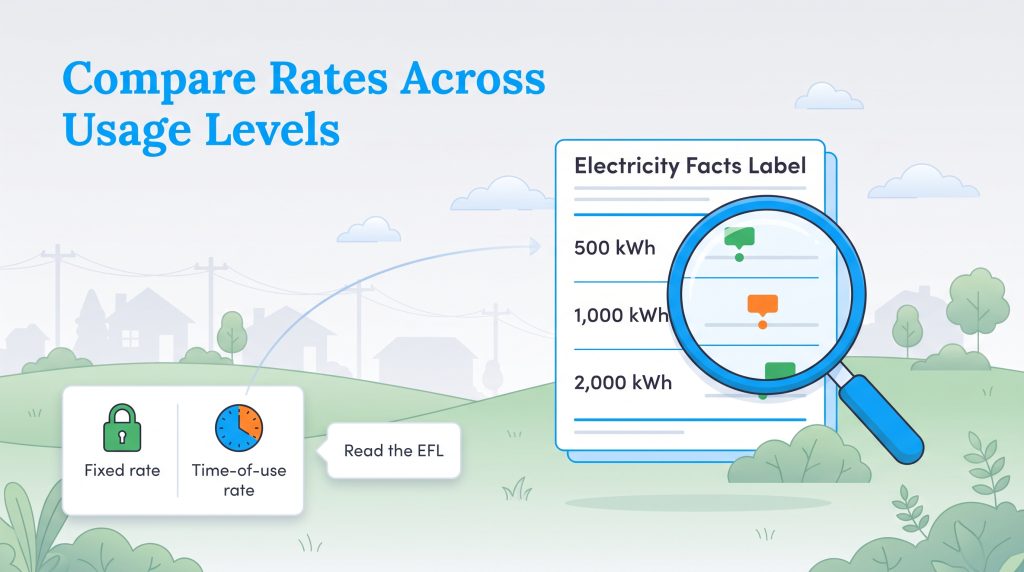
Navigating the modern Texas energy market requires you to look past the big bold numbers on a promotional flyer. The lowest advertised price is rarely the whole story, and both companies tailor their contracts to look attractive at specific consumption levels.
Fixed-Rate Vs. Time-Of-Use Plans
For most households, fixed-rate electricity plans are the safest and most predictable choice. Under a fixed-rate contract, the energy charge you pay per kilowatt-hour (kWh) remains locked in for the duration of your term, protecting you from wholesale price spikes during sweltering Texas summers or winter freezes. TriEagle predominantly champions these straightforward, predictable fixed-rate structures across 12-, 24-, 28-, and 36-month terms.
TXU offers fixed-rate plans too, but it heavily promotes time-of-use energy plans like its popular “Free Nights & Solar Days” or “Season Pass” offerings. While getting free power overnight or 50% off during certain months sounds amazing, these plans offset the cost of the discounted periods by charging much higher energy rates during peak daytime hours. If you work from home or run your air conditioning heavily during summer afternoons and can’t shift your heavy appliance usage to the late evening, a time-of-use plan will quickly cost you more than a standard fixed rate.
Usage Tiers, Bill Credits, And Minimum Usage Fees
Before you sign up for any new plan, you need to check how the rate behaves across the three standard Texas electricity usage tiers: 500 kWh (typical for a small apartment), 1,000 kWh (small-to-midsize home), and 2,000 kWh (larger family home). A poorly matched plan can cost you hundreds of extra dollars a year based on three pricing mechanics:
- Bill Credits: Many heavily marketed plans offer a $30 to $100 financial credit, but only when your monthly usage crosses a strict threshold (typically 1,000 kWh). If you sign up for a bill-credit plan like TriEagle Sure Value 12 or TXU Smart Edge 12 and only use 950 kWh in a mild spring month, you miss the credit entirely and your effective rate spikes.
- Base Charges and Minimum Usage Fees: Monthly base fees apply regardless of how much power you use. While neither provider relies heavily on separate “minimum usage penalties” today, a flat $9.95 monthly base charge acts the same way — disproportionately inflating the per-kWh rate for energy-efficient apartments consuming around 500 kWh.
- Energy Charge per kWh: Always check the raw, underlying cost of the electricity itself before base fees, TDU delivery charges, and credits are applied. This gives you the truest sense of the provider’s actual markup.
🚩 Heads Up: Never sign a contract based solely on the marketing headline at 1,000 kWh. Always read the Electricity Facts Label (EFL) to see how your effective price per kWh changes at 500 kWh and 2,000 kWh.
Head-To-Head Rate Comparison By Usage Tier (500, 1,000, And 2,000 kWh)

To truly evaluate TriEagle vs TXU electricity rates, we have to look at the math across all three ERCOT usage tiers. Looking only at the 1,000 kWh column hides how monthly base charges and usage credits warp your bill when the weather cools down or heats up. Below is a side-by-side comparison of four flagship 12-month plans demonstrating how effective rates and monthly bills shift at 500, 1,000, and 2,000 kWh.
| Provider & Plan Name | 500 kWh Rate (Est. Bill) | 1,000 kWh Rate (Est. Bill) | 2,000 kWh Rate (Est. Bill) | Key Plan Mechanics & Credit Rules |
|---|---|---|---|---|
| TriEagle Simple Savings 12 | 14.5¢ ($72.50) | 13.5¢ ($135.00) | 13.0¢ ($260.00) | Straightforward fixed rate, $4.95 base charge, zero bill credit gimmicks. |
| TriEagle Sure Value 12 (Real Deal 1000) | 16.9¢ ($84.50) | 11.4¢ ($114.00) | 13.7¢ ($274.00) | Includes a $50 bill credit at 1,000+ kWh; rate spikes if usage drops to 500–999 kWh. |
| TXU Smart Edge 12 | 19.8¢ ($99.00) | 15.8¢ ($158.00) | 16.8¢ ($336.00) | Includes a $30 bill credit at 1,000+ kWh and a $9.95 base fee; costly for low usage. |
| TXU Clear Deal 12 (Value Edge) | 17.9¢ ($89.50) | 16.5¢ ($165.00) | 15.8¢ ($316.00) | Flat fixed-rate structure without usage credits, carries a $9.95 monthly base charge. |
Notice what happens when you compare flat-rate plans against bill-credit plans across tiers. On paper, TriEagle Sure Value 12 looks like the runaway winner at 1,000 kWh with an estimated $114.00 bill. However, if you live in an apartment and only use 500 kWh — or if you have a mild November and use 950 kWh — you forfeit the $50 credit. At 950 kWh, your bill on Sure Value 12 would actually cost around $155, whereas TriEagle Simple Savings 12 would only cost around $128.
The same math applies to TXU Smart Edge 12. Missing TXU’s 1,000 kWh threshold removes the $30 usage credit, driving the 500 kWh effective rate up to nearly 20¢ per kWh. For most households whose power consumption fluctuates with the seasons, TriEagle’s unbundled flat-rate plans keep your monthly statement much lower. For more ways to trim your monthly statement regardless of which company you pick, check out our guide on how to save on your electric bill.
Full TXU Energy Plans & Pricing Breakdown
When reviewing live rate tables for TXU Energy, watch out for automated feed glitches that sometimes mislabel long-term contracts. While true variable plans like TXU Flex Forward or Flex Rewards operate month-to-month with no cancellation fee, numbered contracts like TXU Clear Deal 12, Solar Value 12, and Smart Edge 12/24 are fixed-term commitments. They carry strict early termination fees of $150 (12-month), $295 (24-month), or $395 (36-month).
| Plan Name | Rate /kWH | Plan Term | Cancellation Fee | |
|---|---|---|---|---|
| Smart 1000 Saver 12 | 9.9¢ | Month to Month | N/A | Check Availability |
| Smart Edge 12 | 13.5¢ | 12 Months | $150.00 | Check Availability |
| Smart Edge 24 | 13.9¢ | 24 Months | $295.00 | Check Availability |
| Clear Deal 12 | 14.6¢ | Month to Month | N/A | Check Availability |
| Smart 500 Start 12 | 15.2¢ | Month to Month | N/A | Check Availability |
| Simple Rate 12 | 15.4¢ | Month to Month | N/A | Check Availability |
| Solar Value 12 | 15.5¢ | Month to Month | N/A | Check Availability |
| On Your Terms | 16.5¢ | Month to Month | N/A | Check Availability |
| Free Nights & Cool Summer 12 | 16.8¢ | Month to Month | $Fixed | Check Availability |
| Ultimate Season Pass 12 | 17.4¢ | Month to Month | N/A | Check Availability |
| Campus Choice | 17.9¢ | Month to Month | N/A | Check Availability |
| Solar Club 12 | 19.1¢ | 12 Months | $150.00 | Check Availability |
| Texas Choice 12 | 19.2¢ | 12 Months | $150.00 | Check Availability |
| Texas Choice 24 | 19.2¢ | 24 Months | $295.00 | Check Availability |
| Flex Forward | 19.2¢ | Month to Month | N/A | Check Availability |
| Flex Rewards | 19.3¢ | Month to Month | $0.00 | Check Availability |
| Smart Deal 12 | 19.6¢ | 12 Months | $150.00 | Check Availability |
| Solar Saver 12 | 20.2¢ | Month to Month | N/A | Check Availability |
| Smart Deal 24 | 20.4¢ | 24 Months | $295.00 | Check Availability |
| Smart Deal 36 | 20.4¢ | 36 Months | $395.00 | Check Availability |
| Saver's Discount 12 | 22¢ | Month to Month | N/A | Check Availability |
Full TriEagle Energy Plans & Pricing Breakdown
TriEagle structures its lineup around contract length: the number at the end of plans like Simple Savings 12/24/36, Sure Value 12/24/36, or Green Eagle 12/36 denotes the exact number of months in your fixed-rate contract (not a month-to-month agreement), and every fixed term carries a $20 per remaining month cancellation fee. TriEagle also offers a unique mid-length 28-month contract option — Simple Savings 28 — which lets you lock in a rate through two full Texas summers without committing to a full three-year term, an option TXU doesn’t offer.
| Plan Name | Rate /kWH | Plan Term | Cancellation Fee | |
|---|---|---|---|---|
| Real Deal 1000 12 | 7.5¢ | 12 Months | $20.00 | Check Availability |
| Sure Value 24 | 12.5¢ | Month to Month | N/A | Check Availability |
| Sure Value 36 | 12.9¢ | Month to Month | N/A | Check Availability |
| Savvy Value 12 | 13.3¢ | Month to Month | N/A | Check Availability |
| Real Deal 12 | 13.5¢ | 12 Months | $20.00 | Check Availability |
| Simple Savings 24 | 13.8¢ | Month to Month | N/A | Check Availability |
| Sure Value 12 | 13.9¢ | Month to Month | N/A | Check Availability |
| Simple Savings 12 | 14.2¢ | Month to Month | N/A | Check Availability |
| Savvy Value 36 | 14.7¢ | Month to Month | N/A | Check Availability |
| Savvy Value 24 | 14.7¢ | Month to Month | N/A | Check Availability |
| Simple Green 36 | 14.8¢ | Month to Month | N/A | Check Availability |
| Simple Savings 36 | 14.8¢ | Month to Month | N/A | Check Availability |
| Real Deal 36 | 14.9¢ | 36 Months | $20.00 | Check Availability |
| Real Deal 24 | 14.9¢ | 24 Months | $20.00 | Check Availability |
| Simple Green 12 | 15.2¢ | Month to Month | N/A | Check Availability |
| Simple Green 24 | 15.8¢ | Month to Month | N/A | Check Availability |
| Silver Eagle 12 | 15.9¢ | 12 Months | $20.00 | Check Availability |
| Golden Eagle 12 | 16¢ | 12 Months | $20.00 | Check Availability |
| Bronze Eagle 24 | 16.5¢ | 24 Months | $20.00 | Check Availability |
| Golden Eagle 36 | 16.5¢ | 36 Months | $20.00 | Check Availability |
| Real Saver 12 | 16.7¢ | 12 Months | $20.00 | Check Availability |
| Green Eagle 12 | 16.9¢ | 12 Months | $20.00 | Check Availability |
| Real Saver 36 | 17.3¢ | 36 Months | $20.00 | Check Availability |
| Real Saver 24 | 17.3¢ | 24 Months | $20.00 | Check Availability |
| Green Eagle 36 | 17.5¢ | 36 Months | $20.00 | Check Availability |
| Green Eagle 24 | 17.5¢ | 24 Months | $20.00 | Check Availability |
*plans and pricing may vary by area and household usage
Hidden Costs: Base Charges And Early Termination Fees
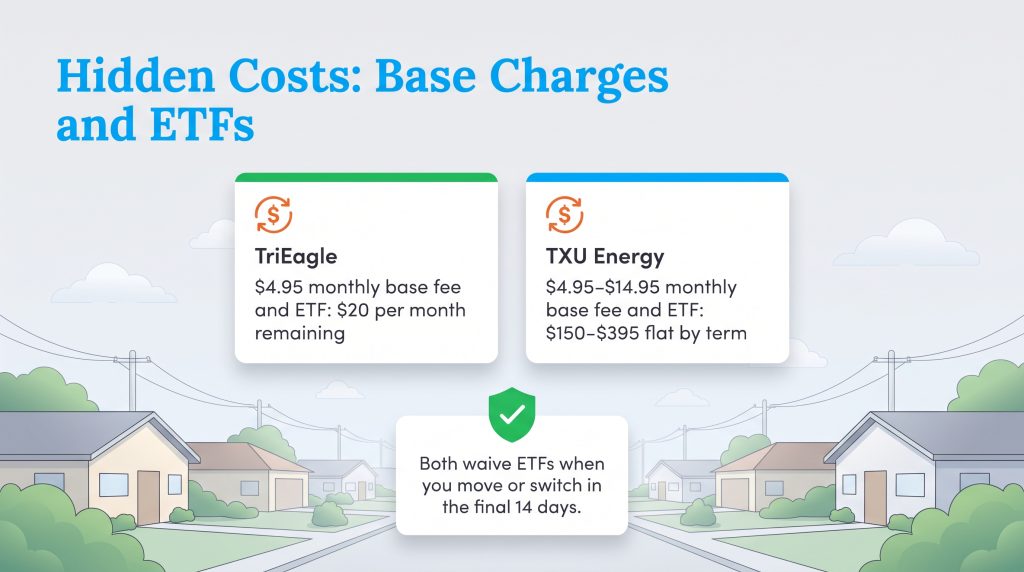
The devil is always in the fine print. Aside from tricky bill credits, monthly base charges represent one of the most frustrating hidden costs in Texas energy. TriEagle charges a flat $4.95 monthly base fee across almost all of its residential plans. In contrast, TXU Energy’s monthly base charges range from $4.95 to $14.95 — most commonly sitting at $9.95 per month. Over a 12-month contract, TXU’s $9.95 base fee adds nearly $120 in mandatory connection costs before you even flip on a light switch.
When comparing TXU vs TriEagle early termination fees (ETFs), the math gets even more interesting depending on the length of your contract and when you decide to cancel:
- TriEagle Early Termination Fee (Pro-Rated): TriEagle charges a pro-rated ETF of $20 for every month remaining on your contract. That means your maximum initial penalty is up to $240 on a 12-month plan, up to $560 on a 28-month plan, and up to $720 on a 36-month plan. If you only have three months left on your contract, your exit fee drops to a manageable $60. However, on a 36-month contract, TriEagle’s pro-rated fee will actually exceed TXU’s flat fee during the first 16 months of your term.
- TXU Energy Cancellation Fee (Flat Fee): TXU relies on a flat-fee ETF structure: $150 for a 12-month plan, $295 for a 24-month plan, and $395 for a 36-month plan. Whether you have 11 months left or just two months left on your agreement, you owe the full flat penalty.
Fortunately, Texas consumer protection rules give you two penalty-free exit ramps regardless of which company you choose. Both TXU and TriEagle waive early termination fees if you move out of your current home (provided you submit proof of forwarding address or a lease termination), or if you switch to a new electricity provider within the final 14 days before your contract expires.
The 60-Day Satisfaction Guarantee Catch: TXU Vs. TriEagle
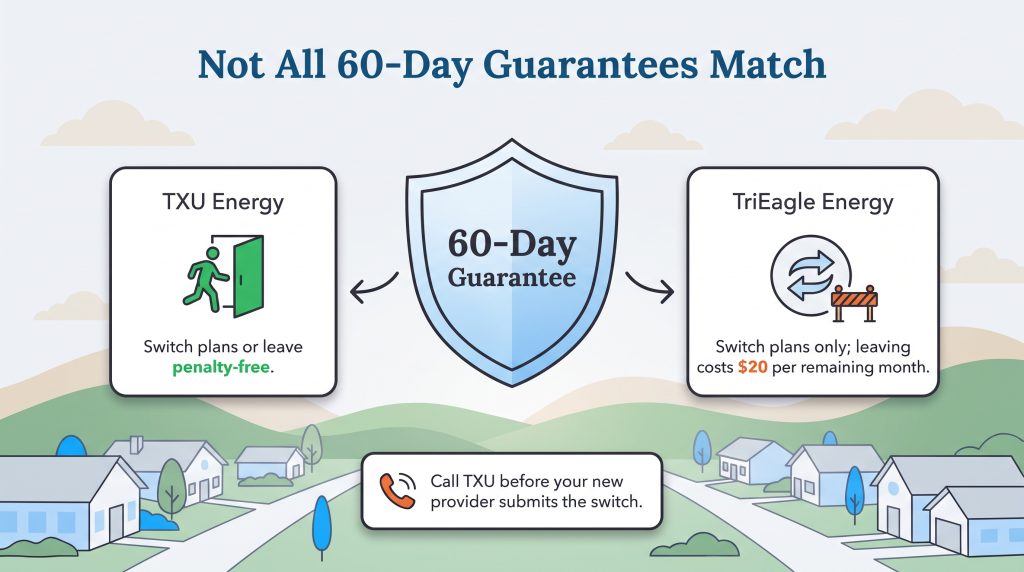
At first glance, both providers appear to offer the exact same 60-day trial period for new customers. However, reading the terms of service reveals a massive consumer catch between the TXU Energy 60-day satisfaction guarantee and the TriEagle 60-day Tri Us Guarantee.
| Guarantee Feature | TXU Energy 60-Day Satisfaction Guarantee | TriEagle Energy 60-Day “Tri Us” Guarantee |
|---|---|---|
| Can You Switch to Another Internal Plan? | Yes, penalty-free within 60 days. | Yes, penalty-free within 60 days. |
| Can You Leave for a Competitor Penalty-Free? | Yes. You can cancel and leave TXU entirely with $0 ETF. | No. Leaving TriEagle triggers the $20/month ETF. |
| How to Activate the Guarantee | Call TXU prior to switching within your first 60 days of service. | Call TriEagle within 60 days to select a different TriEagle plan. |
TXU Energy offers a true no-strings-attached safety net. If you enroll in a TXU plan and aren’t happy with your first two bills, you can call TXU within 60 days of your start date to either switch to a different TXU plan or leave TXU for a competing provider without paying the $150 to $395 early termination fee.
TriEagle’s “Tri Us Guarantee” is strictly an internal plan swap. If you accidentally sign up for a bill-credit plan that doesn’t fit your usage, TriEagle will gladly let you switch over to a flat-rate Simple Savings plan within your first 60 days without charging a fee. However, if you decide to leave TriEagle for another electricity company during those first 60 days, you’re still on the hook for the full $20 per remaining month cancellation penalty.
💸 Money-Saver: If you want to use TXU’s 60-day guarantee to switch to a cheaper competitor, you must call TXU customer care to log your cancellation request before your new provider submits the switch order, or the system will automatically bill you the flat ETF.
Green Energy, Renewable Percentages, And Solar Buyback Options

If home sustainability is a priority for you, both companies offer ways to support renewable energy in Texas, though they approach this eco-conscious alternative very differently. Standard baseline plans from both providers include around 9% to 11% renewable content — matching the general ERCOT state grid average — while their dedicated green plans jump to 100% renewable power.
TXU Energy leans heavily into lifestyle-based green plans and Texas solar buyback plans that cater to high-tech households. Plans like Free Nights & Solar Days incentivize you to shift your usage to times when wind power or grid solar is most abundant. Additionally, TXU offers specialized solar buyback programs (like TXU Home Solar Buyback) for homeowners with rooftop solar panels, allowing you to sell surplus energy back to the grid for bill credits.
TriEagle Energy keeps green energy much simpler by offering standard 100% renewable fixed-rate plans rather than net metering. Plans like Green Eagle 12 and Green Eagle 36 are backed by renewable energy certificates (RECs) and don’t force you into time-of-use schedules. While TriEagle does not offer a solar buyback plan for rooftop panel owners, its Green Eagle options are a straightforward, environmentally mindful choice for renters and homeowners looking to shrink their carbon footprint.
☀️ Solar Buyback Defined: A solar buyback program (also called net metering) is a specialized electricity plan that credits you for the surplus power your home solar panels generate and send back into the Texas grid. Provider payout rates vary wildly, so checking the exact export credit value on the EFL is crucial.
Texas Service Areas And TDU Delivery Zones
Before comparing plans, it helps to understand how the deregulated Texas power grid divides responsibilities. While retail electricity providers like TXU and TriEagle set your energy charge, manage your contract, and send your monthly bill, your local Transmission and Distribution Utility (TDU) owns and maintains the physical poles, wires, and smart meters. Because your TDU is determined strictly by your home’s physical address, TDU delivery fees are regulated by the state and passed through at the exact same rate whether you pick TXU or TriEagle.
Both TXU Energy and TriEagle Energy operate across all six deregulated ERCOT TDU service areas in Texas:
- Oncor Electric Delivery: Covers North, Central, and West Texas, including Dallas, Fort Worth, Arlington, Waco, Midland, and Odessa.
- CenterPoint Energy: Covers the Greater Houston metropolitan area and the Texas Gulf Coast, including Houston, Beaumont, Sugar Land, and Katy.
- Texas-New Mexico Power (TNMP): Covers non-contiguous pockets across North Texas, the Gulf Coast, and West Texas, including League City, Texas City, Glen Rose, and Pecos.
- AEP Texas Central: Covers South Texas and the Rio Grande Valley, including Corpus Christi, McAllen, Laredo, Victoria, and Harlingen.
- AEP Texas North: Covers rural West and Central-West Texas, including Abilene, San Angelo, and Vernon.
- Lubbock Power & Light (LP&L): Covers the recently deregulated Lubbock metropolitan area.
Customer Service, PUCT Ratings, And Referral Perks
When a confusing billing issue pops up or you need to transfer service to a new address, you want a provider that answers the phone quickly. Official regulatory data from the Public Utility Commission of Texas (PUCT) tracks formal complaints filed against all retail energy providers over a rolling six-month period, while the agency also provides an online complaint portal for unresolved customer disputes. Looking at the late-2026 PUCT complaint scorecard shows that both Vistra brands perform well above the state average.
| Provider | PUCT Complaint Score (Late 2026) | Customer Support Hours & Channels |
|---|---|---|
| TXU Energy | 5.0 out of 5.0 | 24/7 phone and live chat support, plus full mobile app management. |
| TriEagle Energy | 4.0 out of 5.0 | 7 a.m. to 10 p.m. CST, seven days a week (1-877-933-2453). |
Since migrating onto TXU’s billing platform, TriEagle Energy has improved its PUCT rating from 3.0 to an impressive 4.0 out of 5.0 stars. Furthermore, TriEagle doesn’t restrict its call center to standard weekday business hours — you can reach TriEagle customer care at 1-877-933-2453 from 7 a.m. to 10 p.m. CST, seven days a week. TXU Energy still holds the edge with a top-tier 5.0 out of 5.0 PUCT rating, true 24/7 phone and chat support, and a highly rated smartphone app that tracks your usage down to the hour.
Both providers also offer ongoing perks and referral rewards for existing customers, though they structure their payouts differently:
- TXU Energy Referral Program (“Give $50, Get $50”): When you refer a friend using your unique TXU referral link and they stay enrolled for 60 days, both you and your friend receive a $50 bill credit. There is no cap on how many friends you can refer each year.
- TriEagle Energy Referral & Weekly Usage Perks: TriEagle’s referral program lets you choose your reward for each successful sign-up: a $25 Visa Prepaid Card, $25 in shopping and dining gift cards, or a $75 credit toward energy-efficient smart home products in the TriEagle marketplace. TriEagle also sends detailed weekly usage summary emails so you can spot consumption spikes before your monthly bill arrives.
Matching Your Home To The Right Texas Energy Provider

Ultimately, TXU Energy and TriEagle are both reliable providers backed by Vistra Corp’s massive generation portfolio. Because they cater to different household priorities, the right choice comes down to your monthly usage tier, your appetite for digital tools, and how much you want to pay per kilowatt-hour.
- Choose TriEagle Energy If: You want affordable, no-nonsense fixed electricity rates. If you prefer a low $4.95 base charge, predictable billing, and a pro-rated $20/month early termination fee on 12- or 24-month plans, TriEagle delivers far better everyday value on your monthly statement.
- Choose TXU Energy If: You want a top-rated mobile app, 24/7 customer support, and the security of a true 60-day penalty-free exit guarantee. TXU is also the clear winner if you own rooftop solar panels or an electric vehicle and want to leverage specialized solar buyback or overnight EV charging plans.
- Choose Based on Home Size & Usage Tier: If you rent an apartment or small townhome averaging around 500 kWh per month, avoid bill-credit plans (like TriEagle Sure Value or TXU Smart Edge) from both brands. Instead, stick to a low-base-fee flat rate like TriEagle Simple Savings so you aren’t penalized during low-usage months.
Before locking into a multi-year agreement, take two minutes to pull up a recent power bill and check your winter and summer kilowatt-hour totals. Whether you live in Houston or Dallas, matching your historical usage against the plan’s EFL is the smartest way to keep your Texas utility costs in check all year long.
Frequently Asked Questions About TXU Energy And TriEagle Energy
Is TriEagle Energy or TXU Energy cheaper?
What is the catch with TriEagle’s 60-day satisfaction guarantee compared to TXU’s?
Do TriEagle or TXU charge early termination fees?
What happens when my TXU Energy or TriEagle Energy contract expires?
Why did my TriEagle or TXU electric bill suddenly spike in a single month?
Who do I call during a power outage if I have TXU or TriEagle?
Does Vistra Corp own both TXU and TriEagle?
About the Author

David has been an integral part of some of the biggest utility sites on the internet, including InMyArea.com, HighSpeedInternet.com, BroadbandNow.com, and U.S. News. He brings over 15 years of experience writing about, compiling and analyzing utility data.

Claudio is a sustainability-focused writer with a background in Anthropology and Psychology from NC State University. He has spent over 15 years working in writing, interpretation, and translation, driven by a deep interest in how human culture shapes the environment. Today, he shares his curiosity with readers by writing about sustainable living solutions and the connection between everyday choices and environmental impact.