

Understanding the mandatory fees on your Houston electricity bill and how they impact your total costs
Key Takeaways
- CenterPoint delivery charges are non-negotiable fees set by the utility company, not your electricity provider, to cover the cost of maintaining poles, wires, and meters.
- These rates typically change twice a year (usually March 1 and September 1) with approval from the Public Utility Commission of Texas, though emergency storm recovery adjustments can occur at any time.
- While you cannot lower the rate itself, you can reduce your total cost by lowering your energy usage through smart thermostats and home efficiency upgrades.
There is nothing more frustrating than signing up for a great electricity rate, only to open your first bill and see it is noticeably higher than you expected due to additional fees. If you live in Houston or the surrounding areas, those specific line items are your CenterPoint delivery charges in Texas. These mandatory Houston electricity delivery fees appear on every single statement, whether you choose Gexa, Reliant, or any other retail provider. It isn’t a mistake, and your provider is not hiding anything from you — it is simply the standard cost of keeping the regional power grid running safely and smoothly. We are here to demystify these numbers, explore the recent TDU charge increase Texas residents are facing, and help you verify your monthly charges to avoid billing surprises.
What Is the CenterPoint Delivery Charge in Texas?
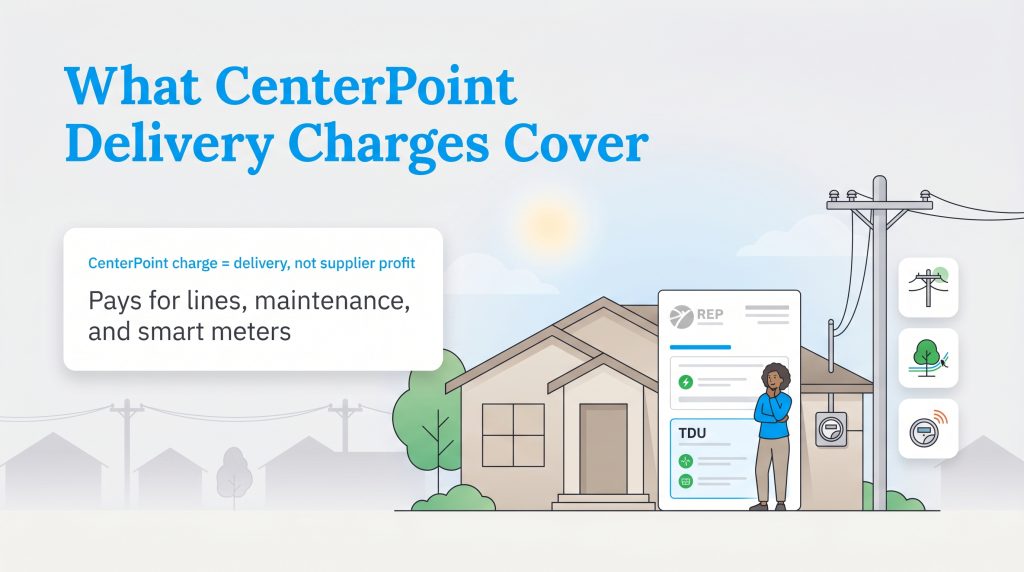
To make sense of your bill, you first need to understand who does what regarding Texas deregulated energy market fees and exactly what is a TDU charge in Texas. CenterPoint Energy is your Transmission and Distribution Utility (TDU). They own the actual physical infrastructure that delivers electricity to your home. In contrast, companies like TXU, Chariot, or Green Mountain Energy are Retail Energy Providers (REPs). They buy the power wholesale and handle your customer service and monthly billing.
The CenterPoint TDU charges collected are passed directly to the utility to fund ongoing grid operations. On your bill, these fees may appear under line items like “TDU Delivery Charges,” “TDU Metering Charge,” or “CenterPoint Energy Delivery Charges,” depending on your provider’s unique statement layout. Your electricity company does not profit from these specific fees. Instead, this money funds critical infrastructure improvements, including routine tree trimming around power lines, storm hardening initiatives to protect against severe weather, and advanced smart meter technology upgrades. Think of it like shipping costs for an online order: you pay for the product (electricity), but you also have to pay the carrier (CenterPoint) to transport it safely to your doorstep.
Reporting Outages Versus Billing Issues
Because multiple companies are involved in keeping your lights on, it is crucial to know exactly who to call when things go wrong. Directing your inquiry to the right organization saves you time and frustration during a crisis.
Contact Your Retail Energy Provider (REP)
- Billing disputes and payment plans
- Account setup, transferring, or stopping service
- Renewing or changing your energy contract
Contact CenterPoint Energy Directly
- Downed power lines
- Suspected gas leaks
- Blackout restorations and neighborhood power outages
Current 2026 CenterPoint Delivery Rates (Updated)
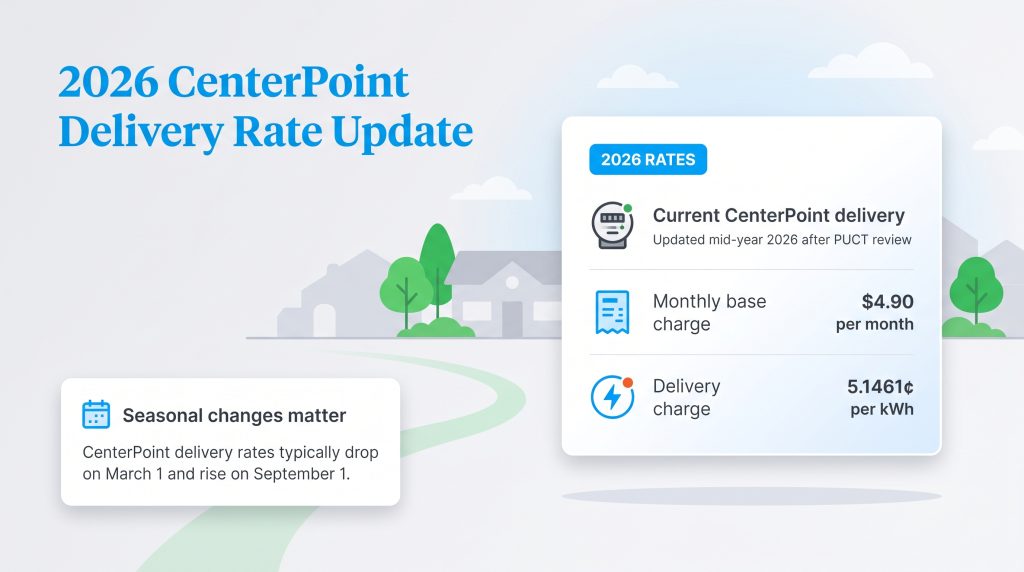
Updated for mid-year 2026. Always confirm the latest published rate before you calculate your monthly budget.
| Fee Type | Current Rate |
|---|---|
| Monthly Base Charge | $4.90 per month |
| Per kWh Delivery Charge | 5.1461¢ per kWh |
Rates reflect the mid-year 2026 PUCT update. Rates are subject to change based on seasonal requirements and emergency cost recovery.
The most recent regulatory update brought a noticeable adjustment in utility costs for current CenterPoint delivery rates. Following severe weather events that required emergency infrastructure repairs, the Public Utility Commission of Texas (PUCT) approved a mid-year increase, bumping the per-kWh charge up to 5.1461 cents. This rate hike directly impacts your monthly electricity bill, making it more vital than ever for households to actively manage their energy consumption during the high-usage summer season where air conditioning demands skyrocket.
📌 Quick Fact: CenterPoint delivery charges traditionally decrease on March 1 and increase on September 1. Knowing this schedule helps you anticipate seasonal shifts in your monthly electricity budget.
Fixed Versus Variable: Breaking Down Your TDU Fees
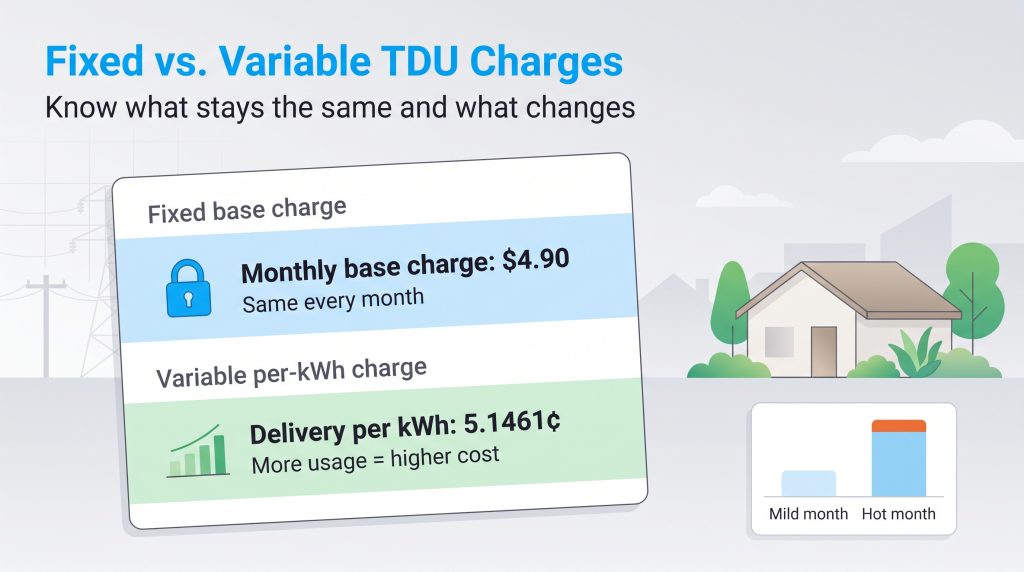
CenterPoint delivery costs are not just one lump sum; they are split into two distinct categories. Understanding the difference between CenterPoint fixed vs variable delivery charges is key to predicting how your utility bill will fluctuate throughout the calendar year.
The Monthly Base Charge
This is a flat fee you pay simply for being physically connected to the Texas power grid. Whether you leave for a month-long vacation and use zero electricity or you run your AC around the clock, this number remains exactly the same. It covers routine administrative costs and metering services. Currently, this base fee sits at $4.90 per billing cycle.
The Per-kWh Charge
This is the variable portion of your delivery fees and the one that impacts your household wallet the most. For every single kilowatt-hour (kWh) of electricity you consume, the utility charges a specific rate (currently 5.1461 cents). This means in the hot summer months when your electricity usage spikes, your delivery charges will naturally rise right alongside it. It acts as a strict multiplier: the more power you draw from the grid, the more you pay to have it delivered.
CenterPoint Residential Versus Commercial Delivery Rates
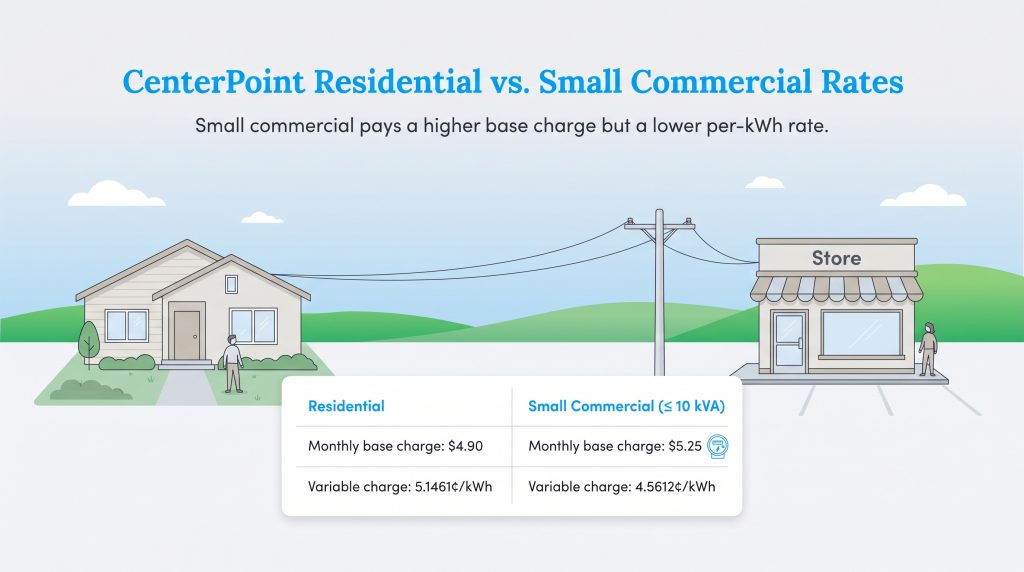
While homeowners are highly familiar with standard residential pricing, local business owners operate under a different set of tariffs. CenterPoint commercial delivery rates are segmented by demand, with the most common category being “Secondary Service Less Than or Equal to 10 kVA” — generally applicable to small businesses, retail shops, and small standalone offices.
Here is how the current 2026 rates compare between standard residential homes and small commercial properties:
| Customer Type | Monthly Base Charge | Variable Charge (Per kWh) |
|---|---|---|
| Residential | $4.90 | 5.1461¢ |
| Small Commercial (≤ 10 kVA) | $5.25 | 4.5612¢ |
Commercial accounts often carry a slightly higher fixed base charge due to the complex metering equipment required for business locations. However, their variable per-kWh rate is sometimes slightly lower to accommodate consistent, higher-volume daily usage. If you run a larger facility requiring more than 10 kVA of demand, CenterPoint utilizes a much more complex calculation based on your peak kW demand rather than just your total kWh volume.
How Recent Storms Impact CenterPoint Delivery Rates
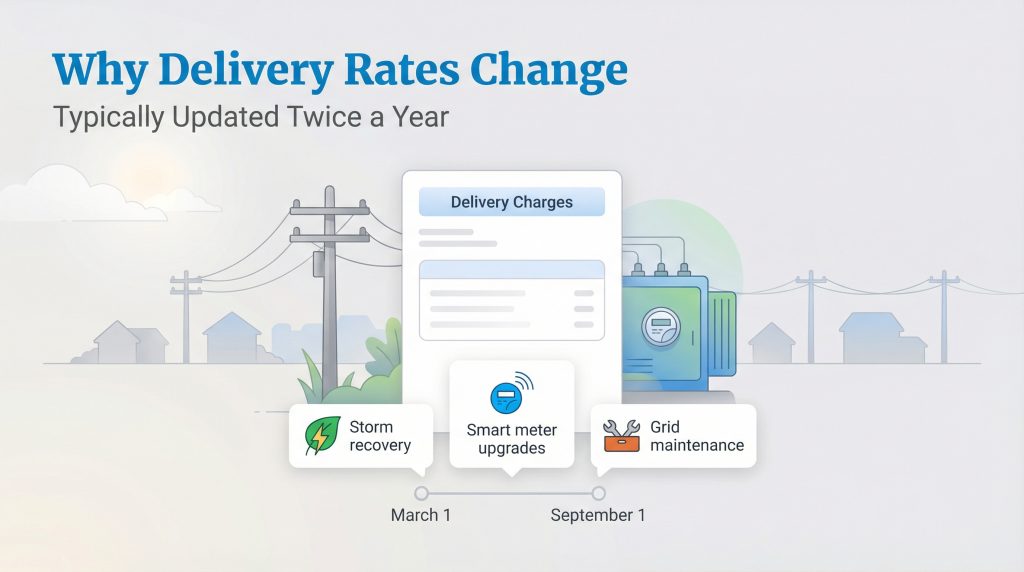
If you’ve opened a recent statement and felt stunned by the sudden leap in costs, you are not alone. Recent extreme weather events — ranging from devastating hurricanes to powerful straight-line wind derechos — caused catastrophic damage to the Houston-area power grid. When thousands of utility poles snap and miles of electrical wire are ripped down, CenterPoint spends hundreds of millions of dollars deploying emergency crews to restore power as quickly as possible. But who ultimately foots the bill for these repairs?
Under Texas state regulations, the Public Utility Commission of Texas (PUCT) allows the utility to recoup those emergency expenses by increasing CenterPoint storm recovery fees on residential bills. These PUCT approved TDU rates ensure the utility remains financially solvent enough to prepare for the next major weather event. Because these emergency costs are passed through the volumetric charge, households consuming the most power inadvertently shoulder a larger portion of the repair burden.
Beyond extreme weather, delivery rates also fluctuate due to natural seasonal usage dips. The utility is legally permitted to collect a specific baseline of revenue to maintain the grid. When customer electricity usage naturally drops during milder fall and winter months, CenterPoint typically increases the per-kWh delivery rate to ensure they still meet their state-approved funding requirements for year-round infrastructure maintenance and smart grid modernization. For the latest official tariff sheets and detailed rate breakdowns, you can visit the CenterPoint Energy Rates & Regulations page.
CenterPoint Rate History and Seasonal Trends
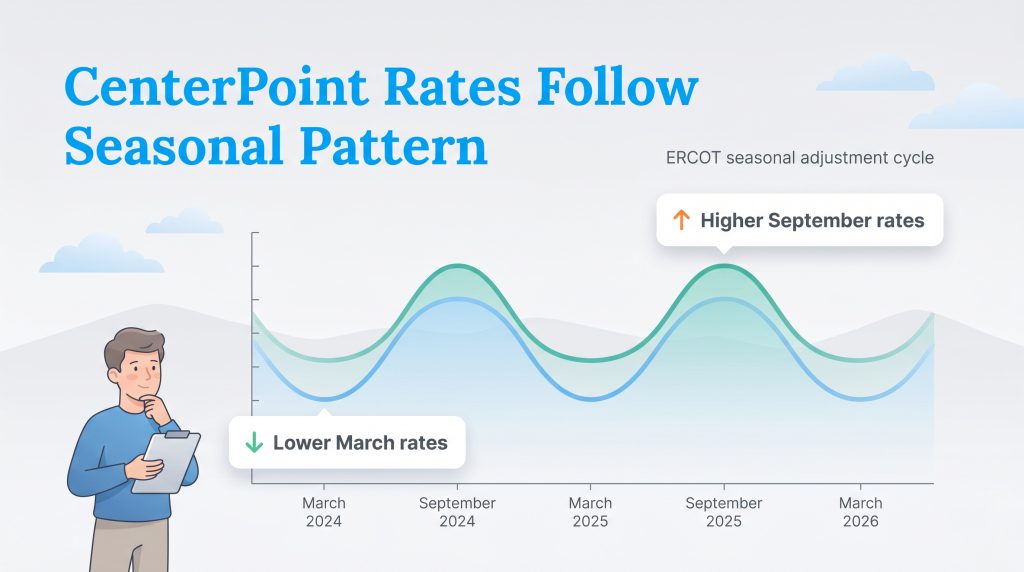
To truly master your utility budget, it helps to look at the big picture. Viewing the CenterPoint energy rate history over the past few years reveals a highly predictable pattern, occasionally interrupted by storm recovery efforts. While the exact numbers shift based on grid investments and inflation, the timing of standard changes runs like clockwork.
- March 2024: 4.0410¢ per kWh
- September 2024: 5.8612¢ per kWh
- March 2025: 4.5412¢ per kWh
- September 2025: 6.0015¢ per kWh
- March 2026: 4.9993¢ per kWh
- June/August 2026: 5.1461¢ per kWh
This pattern illustrates the standard ERCOT seasonal adjustment cycle. CenterPoint typically decreases its delivery rates in March because massive summer cooling demand yields higher total volume. Conversely, when September rolls around and temperatures bring a steep drop in electricity usage, CenterPoint increases the per-kWh rate. The notable mid-year 2026 hike stands out as an emergency adjustment rather than a standard seasonal shift.
How CenterPoint Compares to Other Texas TDUs
If you are relocating across Texas, you might notice that utility delivery charges vary significantly depending on your zip code. Regulators approve different rates for each regional utility based on the unique costs of maintaining their specific grid infrastructure. Houston residents often ask how their costs stack up against cities like Dallas or Corpus Christi.
Here is a quick look at how the updated 2026 utility rates compare across the major deregulated markets:
| Utility Company | Monthly Base Charge | Variable Charge (Per kWh) |
|---|---|---|
| CenterPoint Energy | $4.90 | 5.1461¢ |
| Oncor Electric Delivery | $4.23 | 6.1345¢ |
| AEP Texas North | $3.24 | 5.6677¢ |
| AEP Texas Central | $3.24 | 5.8007¢ |
| Texas-New Mexico Power (TNMP) | $7.85 | 7.2739¢ |
Because you cannot choose your utility company — it is determined entirely by where you physically live — this table serves as a helpful baseline. While TNMP and Oncor customers are currently facing steeper infrastructure and repair costs, CenterPoint residents still benefit from relatively competitive delivery rates compared to the rest of the deregulated market.
How to Calculate Your Total Delivery Cost
You don’t need an accounting degree to figure out if your recent statement is accurate. Knowing how to calculate CenterPoint delivery charges empowers you to confidently separate the energy charge (what your provider charges) from the delivery charge (what CenterPoint collects).
The Formula:
($ Base Charge) + (Your Monthly Usage × $ Rate per kWh) = Total Delivery Cost
Example Scenario 1: Mild Spring Usage
Let’s say you used 1,000 kWh of electricity this month. Using the current rates effective mid-year 2026:
- Start with the base charge: $4.90.
- Calculate the variable charge: 1,000 kWh × $0.051461 = $51.46.
- Add them together: $4.90 + $51.46 = $56.36.
Example Scenario 2: Heavy Summer Usage
During a Texas heatwave, your AC runs non-stop, and you consume 2,500 kWh in a single month:
- Start with the base charge: $4.90.
- Calculate the variable charge: 2,500 kWh × $0.051461 = $128.65.
- Add them together: $4.90 + $128.65 = $133.55.
As you can see, the variable fees scale rapidly. During peak summer usage, well over $130 of your total bill goes purely toward delivery infrastructure before you pay a single cent for the actual electricity consumed.
Bundled Versus Unbundled: Spotting Hidden TDU Fees on Your EFL
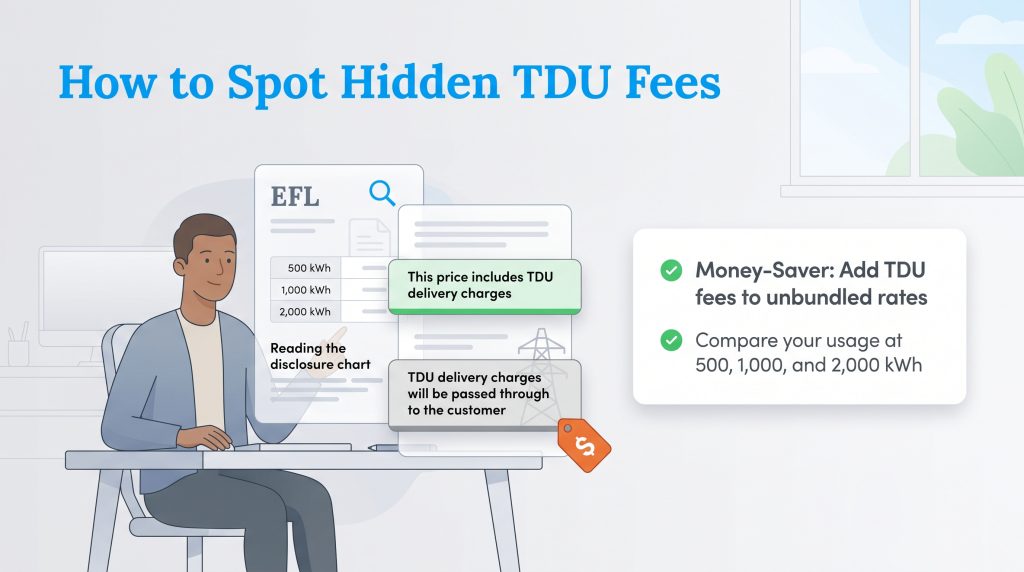
One of the biggest mistakes consumers make is looking only at the large, advertised price on a provider’s website. To avoid billing shock, you need to understand the difference between bundled and unbundled electricity plans Texas companies offer. The key to uncovering these details lies in reading your Electricity Facts Label (EFL) — the standardized document that details the true cost of your contract.
- Locate the EFL: Before signing up for any plan, click the link to view the EFL. It is legally required to be easily accessible on the provider’s sign-up page.
- Check the Disclosure Chart: Look just underneath the main pricing table (which shows average rates at 500, 1,000, and 2,000 kWh). You will find a detailed breakdown of the base charge and the energy charge.
- Identify the TDU Structure: Read the fine print carefully. If the document states, “This price includes TDU Delivery Charges,” you are looking at a bundled plan. The advertised rate already bakes in the CenterPoint fees. If it states, “TDU Delivery Charges will be passed through to the customer,” you are looking at an unbundled plan. This means the CenterPoint fees will be added on top of your advertised energy rate.
💸 Money-Saver: Unbundled plans often look significantly cheaper at first glance because they hide the delivery costs in the fine print. Always calculate your estimated usage against the unbundled rate plus the CenterPoint delivery charges to find the true cost of the plan.
Lowering Your CenterPoint Bill Through Energy Efficiency
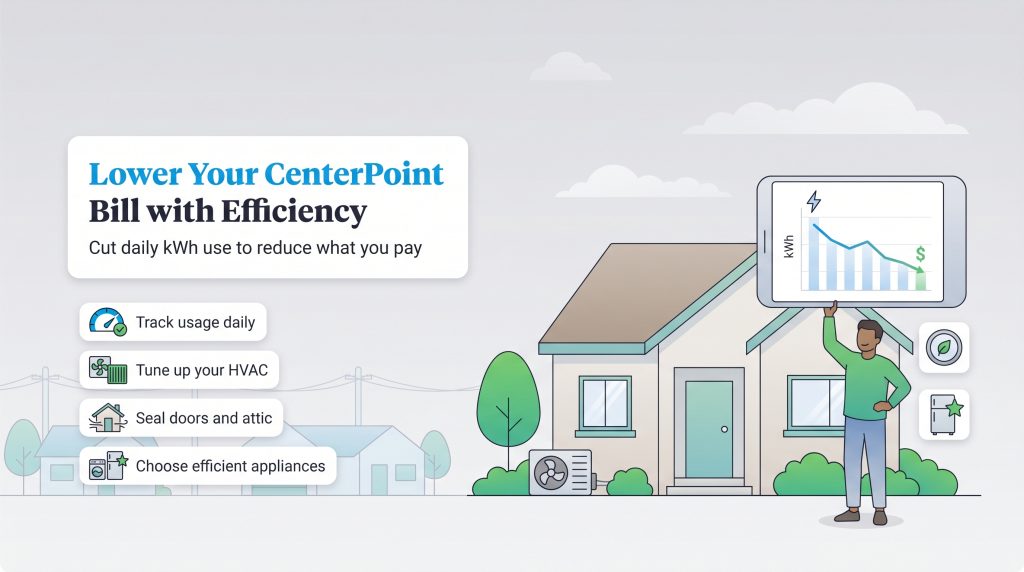
Because delivery fees are strictly set by state regulators, you cannot shop around for a cheaper delivery tier. However, you absolutely can control the variable portion of your bill by actively reducing your daily energy consumption. Every single kilowatt-hour you conserve keeps over 5 cents in your own pocket before factoring in your provider’s energy charge.
Here are highly effective ways to lower your usage:
- Smart Thermostat Integration: Utilize a smart thermostat to monitor and offset peak delivery charge times. Scheduling your air conditioner to ease off during the hottest hours of the day slashes your overall volume significantly.
- Prepaid Electricity Tracking: Utilizing a prepaid electricity plan or logging into your smart meter portal allows you to monitor your daily usage trends in real-time. Catching a spike on a Tuesday means you can adjust your habits by Wednesday, rather than waiting a month for a shockingly high bill.
- HVAC Maintenance: Your air conditioner is the biggest energy draw in your home. Changing your air filters every one to three months ensures the system runs efficiently, decreasing the time it takes to cool your space.
- Seal the Envelope: Inspect your exterior doors and windows for hidden drafts. Simple weatherstripping or upgrading your attic insulation keeps the conditioned air inside, meaning your AC doesn’t have to work as hard to maintain a comfortable temperature.
- Upgrade for Efficiency: Upgrading your home appliances directly reduces your CenterPoint pass-through charges. When it is time to replace a washer, dryer, or refrigerator, look for the Energy Star label. These high-efficiency appliances are an energy-saving option that trim your variable usage and serve as a more environmentally mindful choice each time they run.
🌱 Eco Edge: Every kWh you save doesn’t just lower your energy charge — it also lowers your delivery charge. Choosing an eco-conscious alternative like a smart thermostat pays you back double while reducing strain on the Texas grid.
For more deep-dive strategies on reducing your consumption, check out our comprehensive guide on how to save on your electric bill.
Preparing for Rate Fluctuations
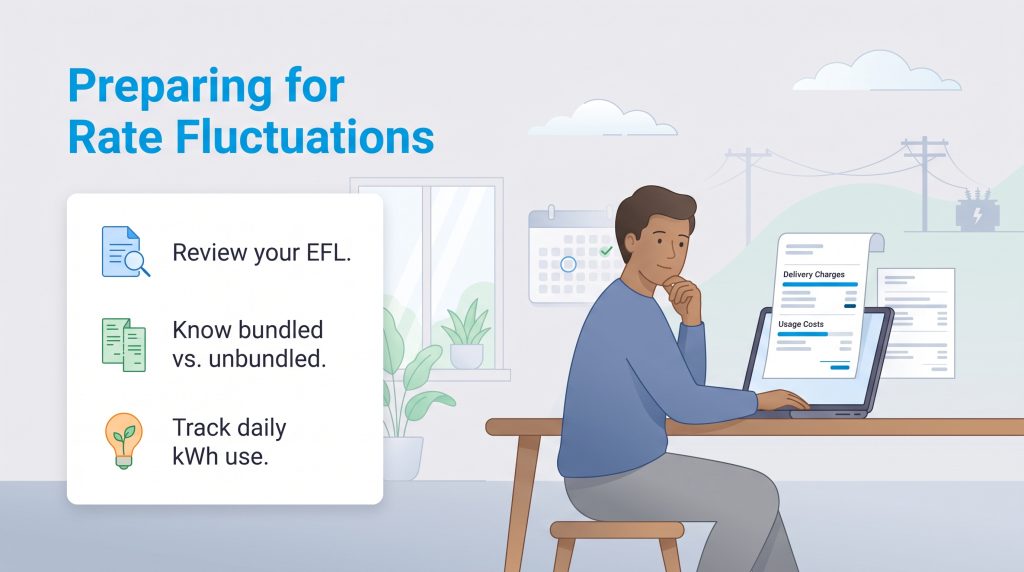
Understanding the intricacies of your CenterPoint delivery charges is the first crucial step toward smart, sustainable home budgeting. While these infrastructure fees are an unavoidable part of living in a modern, connected society, they do not have to dictate your entire financial landscape. By carefully reviewing your Electricity Facts Label, identifying whether your plan is bundled or unbundled, and actively managing your daily kilowatt-hour consumption, you maintain control over the final number at the bottom of your statement.
As you prepare for your next billing cycle, take a few minutes to audit your home’s efficiency and review your current contract terms. If you are ready to focus on the part of the bill you can directly negotiate, our guide to comparing plans can help you find the absolute best retail energy option for your specific household needs.
Frequently Asked Questions About CenterPoint Delivery Charges
Why did the CenterPoint delivery charge increase in June 2026?
The PUCT approved a mid-year rate adjustment for CenterPoint to recoup massive emergency spending caused by recent destructive storms. This increase allows the utility to offset the costs of widespread infrastructure repairs and ongoing grid hardening.
What is the difference between an energy charge and a delivery charge?
The energy charge is the fee you pay your retail electricity provider for the actual electricity you consume. The delivery charge is the fee paid to your utility company (like CenterPoint) for the physical transportation of that electricity across power lines and into your home.
Why did my CenterPoint delivery charge increase in September?
CenterPoint frequently increases its per-kWh rate in September as part of the standard ERCOT seasonal adjustment cycle. Because electricity usage drops significantly in the fall and winter, the utility must raise the rate slightly to ensure they collect enough revenue to continue maintaining the grid year-round.
Can I opt out of CenterPoint delivery charges in Texas?
No. These are mandatory fees regulated by the state for all residential and commercial customers connected to the local power grid. As long as you receive power at a physical address within CenterPoint’s service territory, you are legally required to pay for the delivery infrastructure.
Does my retail electricity provider profit from TDU fees?
No. TDU fees are exact pass-through charges. This means your provider collects the funds on their monthly bill and sends 100% of that money directly to CenterPoint Energy to fund the local grid maintenance.
Are CenterPoint delivery charges included in my advertised electricity rate?
It depends entirely on your specific retail provider and plan. Bundled plans automatically include the CenterPoint TDU charges in the advertised price, while unbundled plans list the energy rate separately from the utility’s delivery fees. Always review your plan’s Electricity Facts Label (EFL) to confirm exactly what is included.
What are TDU delivery charges?
TDU charges are mandatory fees paid to the Transmission and Distribution Utility (like CenterPoint) for maintaining the local grid’s poles, wires, and smart meters. They are separate from the cost of the electricity itself, which you pay to your chosen retail provider.
Does choosing a prepaid electricity plan eliminate CenterPoint delivery charges?
No. CenterPoint delivery charges are mandatory for every residential customer connected to their grid, regardless of how you pay for your power. Prepaid electricity providers simply deduct these fixed and variable utility fees from your account balance alongside your energy usage charges.
How often do CenterPoint rates change?
CenterPoint delivery rates typically change twice a year, usually on March 1 and September 1, as part of routine seasonal adjustments. However, emergency rate hikes can also be implemented mid-year if approved by the Public Utility Commission of Texas (PUCT) to recover extreme storm damage costs.
Can I choose a different TDU to lower my rates?
No, you cannot choose your TDU. Your specific utility is determined solely by the physical geography of your home’s zip code. If you live within the Houston area’s CenterPoint service territory, you must pay CenterPoint delivery fees.
Why is my CenterPoint delivery charge higher than my actual energy charge?
In months where electricity usage is incredibly high, or if you secured a very low retail energy rate, the combination of the fixed $4.90 base charge plus the per-kWh delivery fee can sometimes exceed the cost of the energy itself. This simply reflects the high physical cost of delivering that power during peak seasons or immediately following costly storm repair efforts.
Are CenterPoint charges the same for every provider?
Yes. Whether you use Provider A or Provider B, the CenterPoint fees are identical pass-through costs for every single residential customer in the territory. Your choice of provider only affects the “energy charge” portion of your total bill.
About the Author

LaLeesha has a Masters degree in English and enjoys writing whenever she has the chance. She is passionate about gardening, reducing her carbon footprint, and protecting the environment. She also recently served as President of the Board for City Sprouts (a community garden).

David has been an integral part of some of the biggest utility sites on the internet, including InMyArea.com, HighSpeedInternet.com, BroadbandNow.com, and U.S. News. He brings over 15 years of experience writing about, compiling and analyzing utility data.