

Understanding your AEP Texas delivery charges helps you navigate your electricity bill and lower your overall energy costs.
Key Takeaways
- AEP Texas separates its delivery charges into two distinct utility zones: AEP Texas North Company and AEP Texas Central Company.
- Delivery charges are regulated by the state and cannot be changed by switching retail electric providers.
- You can lower your overall electricity bills by locking in a fixed-rate supply plan and using eco-conscious energy-saving habits.
Opening your first deregulated utility bill in Texas often brings an unpleasant surprise: bill shock from seemingly hidden delivery fees tacked onto your monthly statement. If you live in an area serviced by American Electric Power, those AEP Texas delivery charges might leave you wondering why your costs are higher than expected. While it is easy to feel frustrated by unexpected utility expenses, understanding exactly how these state-regulated fees are calculated gives you the power to take back control of your household budget. We are breaking down precisely how the newly updated 2026 AEP rates work, explaining the true cost of power delivery, and sharing straightforward, eco-conscious strategies to help you drastically reduce your overall energy expenses.
What Are TDU Delivery Charges on Your Electric Bill?
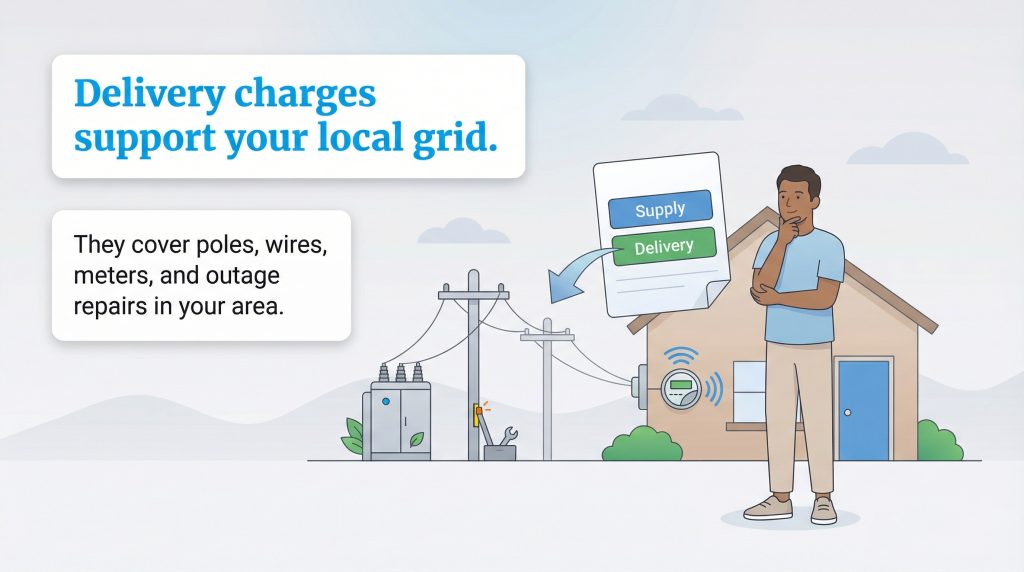
Navigating the deregulated Texas energy market feels a lot simpler once you understand the players involved in getting the lights turned on at your house. Think of your electricity service like online shopping. You actively shop around and choose a Retail Electric Provider (REP) to purchase your actual product — the electricity itself — based on their rates and perks. However, your chosen REP does not actually own the physical infrastructure required to transport that product to your outlets.
Instead, a Transmission and Distribution Utility (TDU) acts as the necessary shipping and delivery service. They manage the local poles, wires, substations, and meters that make up your neighborhood’s physical power grid. You cannot shop around for a different TDU; the state assigns them based entirely on your geographic location. The delivery charge on your electric bill essentially pays your local utility company to maintain that grid infrastructure, read your smart meter, and safely deploy crews to restore power during severe weather outages.
Pro Tip: When reading about your electricity bill, you might see the terms TDU (Transmission and Distribution Utility) and TDSP (Transmission and Distribution Service Provider) used interchangeably, but they both refer to the local company responsible for your physical power grid.
AEP Energy Charge vs Delivery Charge: What’s the Difference?
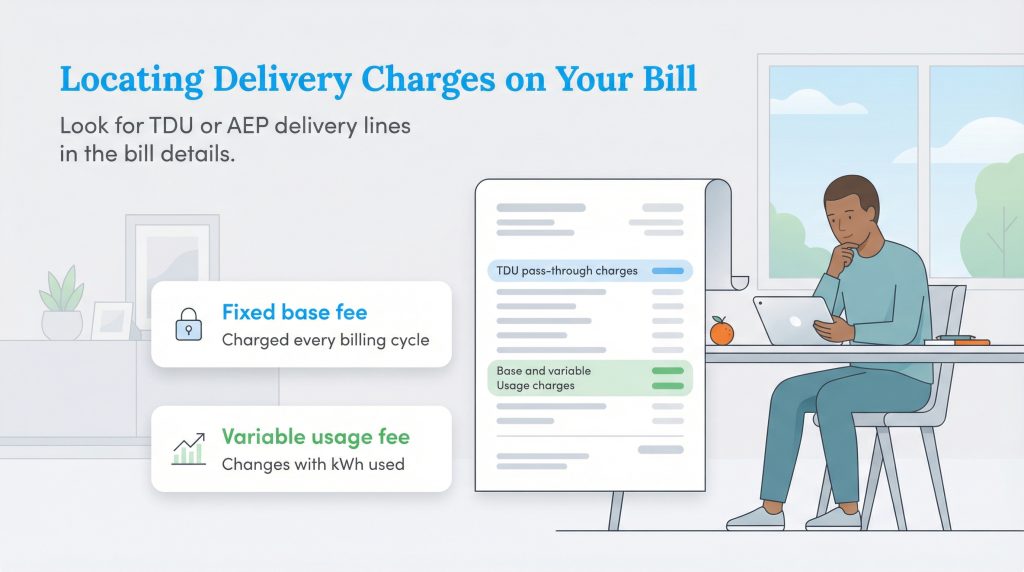
When you start comparing Texas electricity plans, you will notice that your monthly statement splits your costs into two distinct categories. Understanding the difference between your retail supply charge and your regulated delivery charge is the fundamental key to effectively managing your monthly expenses.
- The Energy Charge: This is the price you pay for the actual electricity you consume in your home. This rate is set directly by your chosen Retail Electric Provider. Because this portion of the bill operates in a competitive deregulated market, you can shop around for cheaper rates, lock in long-term fixed contracts, or choose an environmentally mindful option like 100% renewable wind energy from a provider such as Green Mountain Energy.
- The Delivery Charge: This fee covers the physical cost of transporting that electricity safely to your home. It is mandated by the Public Utility Commission of Texas (PUCT) and collected by your local utility company, such as AEP Texas. Because TDUs hold natural geographic monopolies, these charges are strictly regulated by the state, meaning you cannot switch to a competitor to find a cheaper delivery rate.
Current AEP Texas Delivery Charges
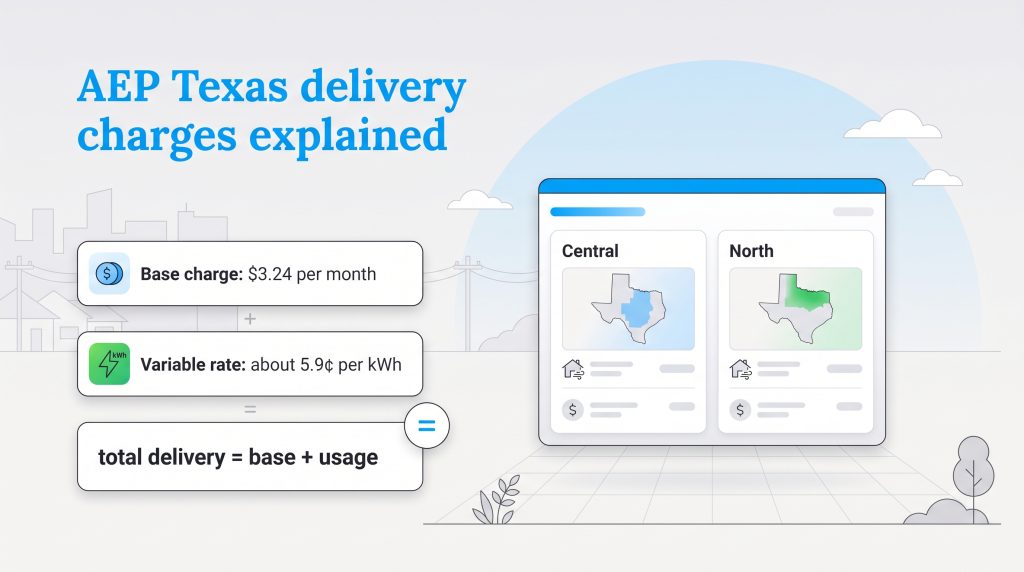
Because Texas covers such a massive geographic footprint, AEP splits its service territories into two distinct zones with completely separate pricing structures. The state evaluates and adjusts these rates frequently, but they always consist of two main components: a flat monthly base charge and a variable per-kWh usage charge.
Regardless of your specific zone, the PUCT sets a fixed base charge of $3.24 applied every single billing cycle. This flat monthly rate combines a $1.27 customer service charge and a $1.97 metering charge to cover standard administrative costs. Additionally, you pay a variable volumetric charge based exactly on how many kilowatt-hours (kWh) of electricity you pull from the grid. The rates below reflect the most recent 2026 adjustments, but it is always a smart habit to verify your specific service territory and tariff details on the official AEP Texas website.
AEP Texas Central Delivery Charges
If your home is situated in the southern or coastal regions of the state, you likely fall under the AEP Texas Central Company jurisdiction. The variable volumetric rate in this zone tends to be slightly lower than its northern counterpart because the population density is generally higher.
| Service Territory | Flat Monthly Base Charge | Variable Rate Charge (Per kWh) |
|---|---|---|
| AEP Texas Central Company | $3.24 | 5.86¢ ($0.0586) |
AEP Texas North Delivery Charges
Residents in West Texas and the Big Country region are typically serviced by the AEP Texas North Company division. The variable volumetric rate here generally runs slightly higher to support the expansive, rural grid infrastructure connecting a more spread-out customer base.
| Service Territory | Flat Monthly Base Charge | Variable Rate Charge (Per kWh) |
|---|---|---|
| AEP Texas North Company | $3.24 | 5.91¢ ($0.0591) |
To figure out exactly how much you will pay each month, you can use a straightforward formula combining your fixed and variable costs:
Example 1,000 kWh Bill Calculation (AEP Central): $3.24 (Flat Base Charge) + [1,000 kWh × $0.0586 (Variable Rate)] = $61.84 Total Monthly Delivery Charge
How Your Usage Changes the Effective Delivery Rate
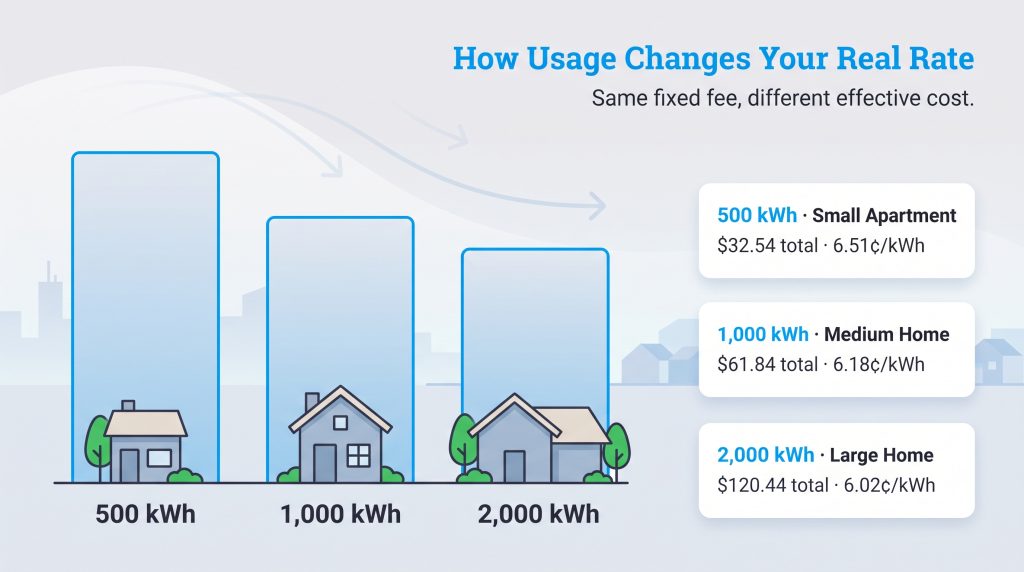
Because your total AEP delivery cost includes a mandatory flat fee, the actual mathematical rate you pay per unit of electricity shifts depending on your household’s total consumption. We call this your “effective delivery rate.” Understanding this concept is crucial when estimating your total monthly costs.
The fixed $3.24 monthly base charge impacts low-usage customers much more heavily than high-usage households. When you use very little electricity, that flat fee makes up a larger percentage of your overall bill. As your consumption increases, the fixed fee dilutes across more kilowatt-hours, driving your effective rate down closer to the raw variable charge.
500 kWh vs 1,000 kWh vs 2,000 kWh Breakdown
Here is exactly how the effective delivery rate calculation looks for a customer in the AEP Texas Central zone at three standard usage tiers:
- 500 kWh (Small Apartment): You pay the $3.24 base charge plus $29.30 in variable charges (500 × $0.0586). Your total delivery cost is $32.54. Because you used so little power, your effective delivery rate is 6.51¢ per kWh.
- 1,000 kWh (Medium Home): You pay the $3.24 base charge plus $58.60 in variable charges. Your total delivery cost is $61.84. The flat fee is diluted slightly more, bringing your effective delivery rate down to 6.18¢ per kWh.
- 2,000 kWh (Large Home): You pay the $3.24 base charge plus $117.20 in variable charges. Your total delivery cost is $120.44. Spread across a massive amount of power, your effective delivery rate drops to 6.02¢ per kWh.
How AEP Delivery Charges Impact Prepaid Electricity Plans
Prepaid electricity plans are incredibly popular across South and West Texas because they allow consumers to bypass credit checks and expensive utility deposits. However, if you are managing a pay-as-you-go account, understanding how AEP delivery charges deplete your daily balance is essential to keeping your lights on.
Unlike traditional post-paid bills that bundle all charges at the end of the month, prepaid providers deduct your usage costs from your account balance every single day. The variable per-kWh TDU charge is simply added to your retail energy rate and deducted based on exactly how much power you consumed the previous day.
The fixed monthly base charge, however, is handled slightly differently depending on your retail provider. Some prepaid companies deduct the entire $3.24 AEP flat fee upfront on the first day of your billing cycle. Others prorate that fee, dividing it by 30 days and deducting roughly 10 to 11 cents from your balance each morning alongside your variable usage costs. Being aware of these automatic, hidden deductions helps you accurately calculate when you actually need to reload your account to avoid a sudden disconnection.
Why Do Transmission and Distribution Utility Fees Change?
We often hear from frustrated homeowners asking why their delivery portion rivals or even exceeds the cost of the actual energy they used. However, maintaining a sprawling, reliable power grid across brutal Texas weather conditions demands massive, ongoing financial investment.
Every time you see an AEP Texas delivery charges increase, it typically reflects approved utility costs necessary to keep the system functioning. Delivery charges rise when essential investments in poles, wires, metering, storm resilience projects, and other grid-related compliance programs are required. For example, recent rate increases have directly funded massive expansions in advanced smart meter technology and critical infrastructure hardening designed to protect the grid against extreme heat and severe winter weather.
Fortunately, local utilities cannot simply raise these fees whenever they want to boost their profit margins. The Public Utility Commission of Texas carefully reviews, regulates, and approves these rate hikes. The commission evaluates the utility’s operating costs and capital investments, standardizing rate updates strictly on a bi-annual schedule. You can expect these mandated adjustments to hit your bill twice a year: specifically on March 1, 2026, and Sept. 1, 2026.
AEP Texas vs Other Texas TDUs
When you talk to friends or family living in different parts of the state, you might notice their TDU delivery charges look entirely different from yours. Because each utility manages a unique geographic footprint, the costs associated with maintaining those grids vary wildly. AEP Texas rates often run slightly higher than utilities operating in dense urban centers due to the massive costs associated with servicing rural infrastructure and a more spread-out customer base.
| Texas Utility Company | Flat Monthly Base Charge | Variable Rate Charge (Per kWh) |
|---|---|---|
| AEP Texas North | $3.24 | 5.91¢ |
| AEP Texas Central | $3.24 | 5.86¢ |
| Oncor Electric Delivery | $4.23 | 4.54¢ |
| CenterPoint Energy | $4.39 | 4.04¢ |
For context, companies like CenterPoint Energy service tightly packed areas like Houston, where thousands of customers might share just a few miles of power lines. AEP Texas, on the other hand, maintains thousands of miles of wire stretching across empty plains just to reach a handful of remote homes, which naturally drives the per-kWh maintenance cost higher for everyone in that zone.
AEP Texas Service Area Map and ESI-ID Lookup
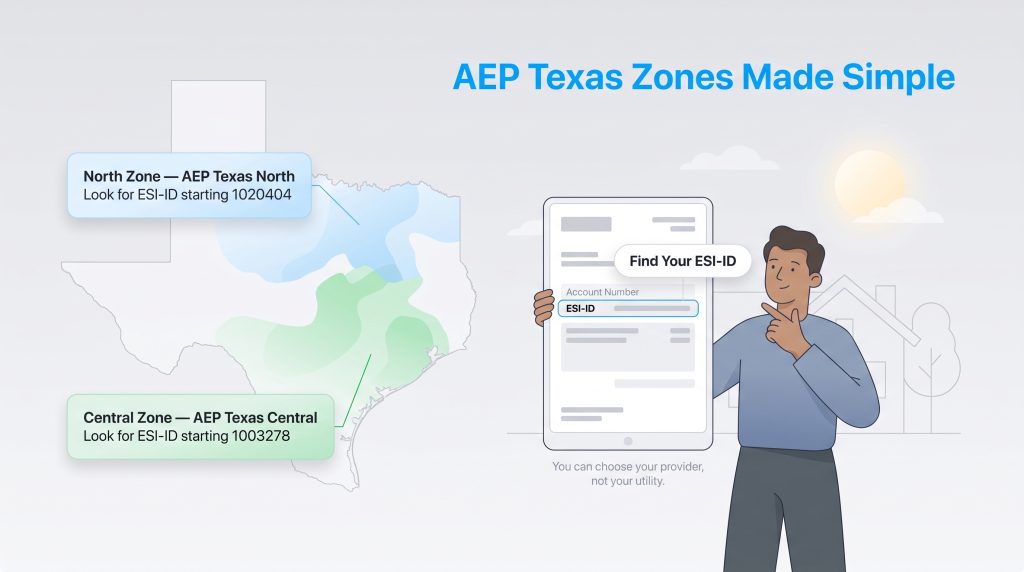
Since you cannot choose your delivery utility, figuring out which AEP zone covers your specific address is the crucial first step when setting up service. AEP Texas covers massive geographic territories with very distinct regional boundaries.
If you reside in West Texas, including cities like Abilene, San Angelo, or Alpine, you fall under the North Company zone. Meanwhile, residents living further south in South Texas and coastal regions — such as Corpus Christi, Victoria, Laredo, or McAllen — fall under the Central Company zone.
The most precise way to confirm your specific AEP jurisdiction is by checking your Electric Service Identifier (ESI-ID) number, which is a unique 17-digit code assigned permanently to your home’s physical power meter. Here is exactly how to locate and identify your ESI-ID:
- Grab a recent physical or digital electric bill from your current provider.
- Look near your account number or at the top of the detailed usage section for a 17-digit numerical code.
- Alternatively, look at the top right corner of a prospective provider’s Electricity Facts Label (EFL).
- Check the first seven digits of the number to identify your utility zone:
- AEP Texas Central: Look for an ESI-ID prefix starting with 1003278.
- AEP Texas North: Look for an ESI-ID prefix starting with 1020404.
Quick Fact: You can shop around for your retail electric provider, but you cannot shop for your delivery utility. Your Transmission and Distribution Utility is assigned based entirely on where your home is geographically located.
Actionable Steps to Lower AEP Delivery Charges
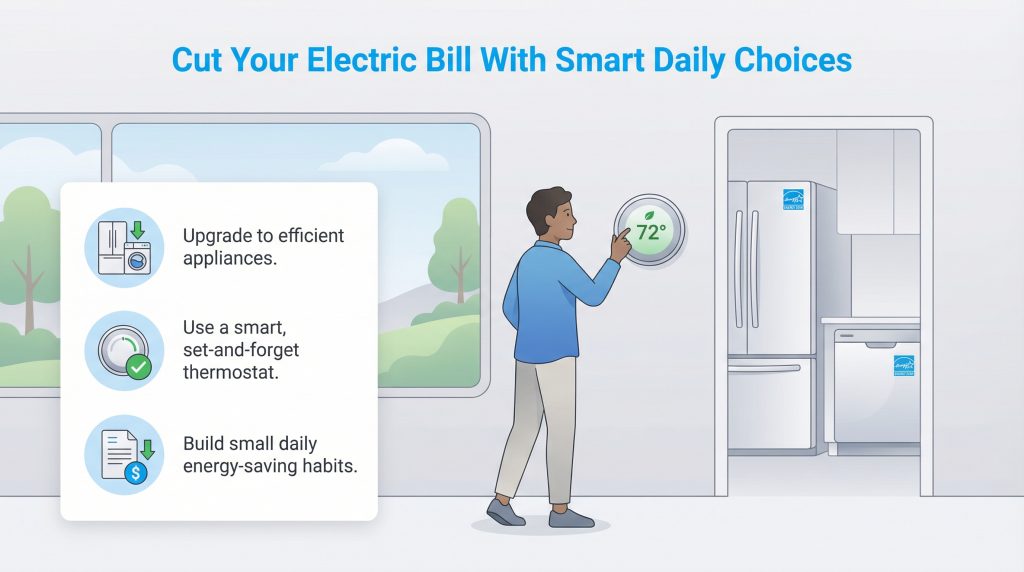
You cannot legally bypass the fixed $3.24 base fee, nor can you shop around for a competing utility company with cheaper wires. However, because the variable volumetric rate makes up the absolute largest chunk of your delivery costs, your monthly TDU bill is tied directly to your overall household consumption. Emphasizing usage reduction is the only guaranteed way to shrink your regulated delivery fee.
If you want to know exactly how to save on your electric bill, start with these actionable energy-saving options:
- Install a smart thermostat: Automating your climate control prevents your HVAC system from running excessively while you are away or sleeping. Because cooling makes up a massive portion of Texas energy use, this instantly curbs variable TDU usage fees.
- Perform basic HVAC maintenance: Replacing dirty air filters routinely ensures your unit runs efficiently and does not pull unnecessary excess power from the grid.
- Invest in ENERGY STAR appliances: Upgrading to certified eco-conscious alternatives like an efficient refrigerator or heat-pump water heater drastically reduces your daily baseline power draw.
- Shop your precise historical usage tier: Use the official Power to Choose platform to compare retail electric providers—such as Reliant Energy or TXU Energy—but filter the results strictly based on your actual historical usage tier (500 kWh, 1,000 kWh, or 2,000 kWh). Guessing your usage often leads to selecting a plan with hidden penalties, negating any savings you might have achieved.
Eco Edge: Choosing a 100% renewable, environmentally mindful choice through your retail provider not only shrinks your household carbon footprint but also supports the necessary expansion of sustainable wind and solar generation across the state.
Preparing for Your Next AEP Texas Bill
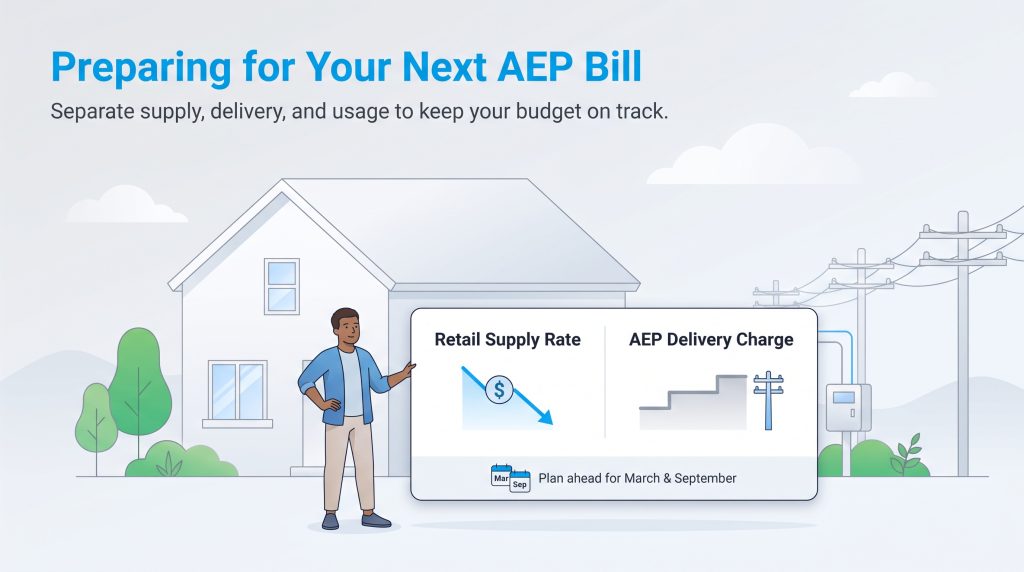
Your electricity bill does not have to feel like an unpredictable monthly burden. Understanding the distinct difference between your chosen retail supply rate and your regulated AEP delivery charge empowers you to make smarter, more sustainable financial decisions for your home. While you cannot opt out of funding grid maintenance or switch physical utilities, actively managing your household consumption directly shields you from steep seasonal cost spikes. Factoring in the bi-annual PUCT adjustments ensures your budget stays balanced, guaranteeing you navigate the Texas energy market with confidence.
Frequently Asked Questions About AEP Texas Delivery Charges
Can I opt out of AEP Texas delivery charges?
No, you cannot opt out of these fees. Delivery charges are legally mandatory for anyone physically connected to the local power grid in an AEP service area. Regardless of which retail electric provider you choose to supply your energy, the local utility still must safely transport that power to your home.
Can I switch utility companies to avoid AEP Texas delivery charges?
No. Unlike your retail electric provider, which you can switch at any time in the deregulated market, your utility company is determined purely by your geographic address. Because AEP Texas operates as a natural monopoly for the physical grid in your area, you cannot change to a different utility company unless you physically move to a different region of the state.
Why are AEP Texas delivery charges higher than Oncor?
AEP Texas covers massive stretches of rural and less densely populated areas compared to Oncor, which primarily services the highly condensed Dallas-Fort Worth metroplex. Because AEP must maintain significantly more miles of wire and infrastructure per customer to reach remote homes, the shared per-kWh maintenance costs are naturally higher across their service zones.
Can switching providers lower my AEP Texas delivery charge?
No, you cannot lower your delivery charge by switching providers. While you can reduce your overall electric bill by shopping for a cheaper energy supply rate, the TDU delivery fee itself remains identical regardless of which retail electric provider you select.
Do I still pay AEP Texas delivery charges if I have solar panels?
Yes. If your solar panel system remains tied to the AEP Texas physical grid, you will still be responsible for the fixed monthly base charge. Additionally, any supplemental electricity you pull from the grid when your panels are not producing power will be subject to the standard variable per-kWh delivery rate.
Why did my AEP Texas delivery charges go up this month?
Your delivery charges typically increase for one of two reasons. The most common cause is that your household consumed more kilowatt-hours of electricity during the billing cycle, which directly inflates the variable portion of your delivery fee. Alternatively, the Public Utility Commission of Texas (PUCT) may have just implemented its scheduled bi-annual rate adjustment.
When does the PUCT update AEP Texas fixed vs. variable delivery fees?
The Public Utility Commission of Texas standardized a bi-annual review schedule for all regulated Transmission and Distribution Utilities across the state. As a result, you can expect AEP Texas delivery charges to be updated twice per year, routinely taking effect on March 1 and Sept. 1.
Can I dispute a high delivery charge on my AEP Texas bill?
If you suspect your delivery charge is inaccurate, you should first contact your retail electric provider to request a review of your meter reading. If there is a legitimate technical error with the smart meter data, your provider will coordinate with AEP Texas to resolve it. If the issue remains unresolved, you can file a formal complaint directly with the PUCT.
How do I know whether I am in AEP Texas North or AEP Texas Central?
The easiest method is to review a recent electricity bill or look at your prospective energy plan’s Electricity Facts Label (EFL). You can also look closely at your physical meter’s unique 17-digit ESI-ID number. Central zone meters typically start with the prefix 1003278, while North zone meters start with 1020404.
What happens if I experience a power outage at my home?
If the lights go out, you should contact AEP Texas directly to report the outage rather than calling your retail electric provider. Because AEP owns and manages the physical infrastructure, their crews are solely responsible for repairing downed lines and safely restoring power to your neighborhood.
Is a TDU the same thing as a TDSP?
Yes, Transmission and Distribution Utility (TDU) and Transmission and Distribution Service Provider (TDSP) mean exactly the same thing. Both terms refer to the company that owns the poles and wires in your area. You will frequently see these acronyms used interchangeably when discussing TDU delivery charges from AEP on your monthly statement.
About the Author

LaLeesha has a Masters degree in English and enjoys writing whenever she has the chance. She is passionate about gardening, reducing her carbon footprint, and protecting the environment. She also recently served as President of the Board for City Sprouts (a community garden).

David has been an integral part of some of the biggest utility sites on the internet, including InMyArea.com, HighSpeedInternet.com, BroadbandNow.com, and U.S. News. He brings over 15 years of experience writing about, compiling and analyzing utility data.