

Understanding How This Government Agency Influences Your Energy Bills, Protects Your Consumer Rights, and Ensures Safe Service Delivery
Key Takeaways
- A Public Utilities Commission (PUC) is a state agency responsible for regulating essential services like electricity, natural gas, water, and telecommunications.
- These commissions often go by different names depending on your state, such as a Public Service Commission (PSC) or Board of Public Utilities (BPU).
- Beyond setting fair rates, the PUC empowers you to file formal complaints against utility providers if severe issues cannot be resolved directly with the company.
A Public Utilities Commission (PUC) is a state-level regulatory agency responsible for overseeing the rates, safety standards, and service quality of essential monopolies like electricity, natural gas, and water. If you are wondering exactly what is a Public Utilities Commission, you are certainly not alone in navigating this vital consumer resource. Moving into a new home brings a flurry of paperwork, setup fees, and confusing acronyms, but few organizations impact your monthly budget and daily comfort quite like this regulatory body. Whether you are questioning why your electric rate just increased right before winter, trying to dispute an unfair billing error, or exploring local solar panel incentives to reduce your carbon footprint, this agency serves as the invisible hand guiding the services you rely on every day. In this comprehensive guide, we break down how a PUC works, demystify its critical role in the modern energy market, and provide specific, actionable steps you can take to enforce your legal rights as a ratepayer.
Understanding the Public Utilities Commission Definition
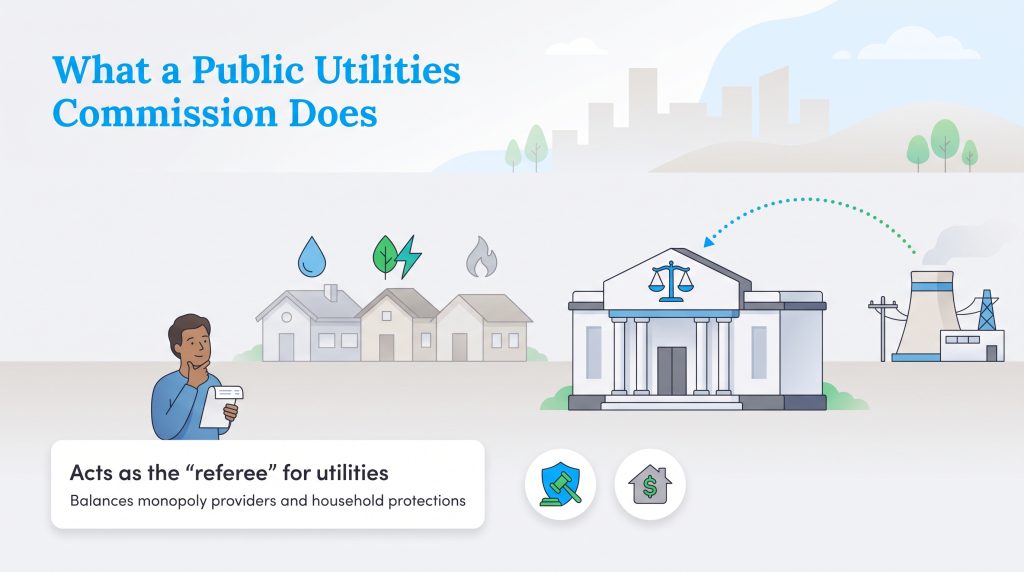
Navigating local regulations can feel overwhelming, especially when trying to understand the subtle differences between a public service commission vs public utility commission. Because government naming conventions vary wildly across the country, you might be confused about the precise title of your local regulator. However, regardless of the exact acronym printed on the back of your monthly bill, a Public Utilities Commission definition always points back to the exact same fundamental purpose. This agency acts as the official, legally empowered referee between regional monopoly providers and the residential households they serve. Today, whether your state refers to this body as a state public service commission (PSC), a Board of Public Utilities (BPU), or a Commerce Commission, it functions identically to safeguard your home’s essential services while balancing the financial needs of the infrastructure operators.
| Alternative Commission Name | State Examples |
|---|---|
| Public Service Commission (PSC) | New York, Florida, Georgia |
| Board of Public Utilities (BPU) | New Jersey |
| Commerce Commission | Illinois |
| Corporation Commission | Arizona, Oklahoma |
| Public Utilities Regulatory Authority (PURA) | Connecticut |
Quick Fact: No matter what acronym your state uses — PUC, PSC, URC, or BPU — they function identically when it comes to overseeing utility service quality and establishing consumer protection laws for your home.
A Brief History of the Public Utilities Commission
To truly grasp the power these agencies hold over your monthly budget, looking at public utility commission history provides critical context. The origins of utility regulation trace back to the late 19th century when state governments first established specialized boards to oversee expanding railroad networks and prevent price discrimination against local farmers. As technological advancements introduced electricity, indoor plumbing, and natural gas lines to early 20th-century cities, these regulatory bodies expanded their jurisdiction to oversee the massive energy companies building our early power grids. State legislators quickly realized that having multiple companies stringing competing electrical wires down the same street was physically dangerous and financially disastrous. This led to the legislative compromise that defined modern regulation: the end of unregulated monopolies. In exchange for granting these companies exclusive territorial rights to provide service without competition, the government established the PUC to strictly limit their profit margins and ensure universal, affordable access for all citizens.
What Does a Public Utilities Commission Do?
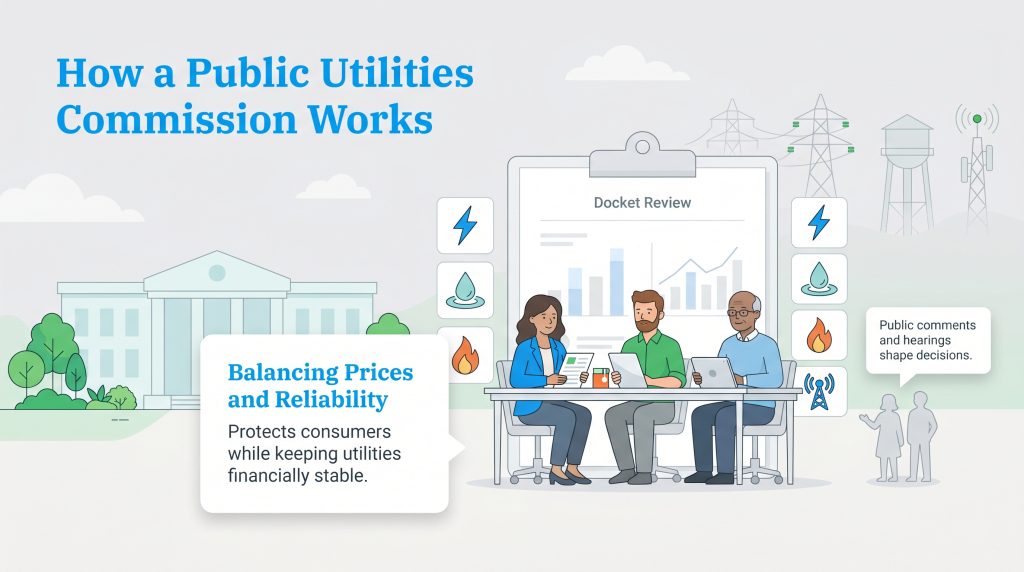
Understanding the core duties of this agency helps clarify why it holds so much leverage over your household finances. Rather than operating like a traditional courtroom, a utility regulatory commission utilizes a highly technical, quasi-judicial process where administrative law judges, financial analysts, and consumer advocates evaluate massive applications from regional energy providers. The commissioners must constantly weigh the public’s need for affordable utility bills against the company’s need to generate enough revenue to maintain a functional, safe grid. So, what does a PUC do exactly? The commission focuses on three primary, heavily scrutinized responsibilities:
- Public utility rates approval: Regulated monopolies cannot simply hike their prices whenever profit margins shrink. Through rigorous evidentiary hearings, the commission evaluates financial evidence and public input to determine if a requested price increase is genuinely justified to cover rising fuel costs or emergency storm repairs.
- Safety standard enforcement: The agency mandates strict maintenance schedules, environmental compliance checks, and emergency response protocols to ensure that power lines, gas pipes, and water mains operate safely within your community.
- Supplier licensing: In states with open retail markets, the commission heavily vets and licenses third-party energy suppliers. This strict oversight helps prevent fraudulent marketing practices and guarantees reliable service delivery.
The Utility Rate Case Process Explained
When your electricity provider decides they need more money to operate — perhaps to upgrade aging substations or cover the rising cost of natural gas — they cannot just update your bill overnight. They must survive the incredibly rigorous utility rate case process. This process takes months, and sometimes over a year, to complete. By participating in this timeline, informed consumers can actually influence the final outcome.
- Application Filed: The utility company submits a massive legal and financial document to the PUC outlining exactly how much money they want to increase rates by and their specific justification for the extra revenue.
- Testimony and Discovery: PUC staff, independent financial analysts, and consumer advocacy groups dive into the utility’s financial books. They challenge inflated expenses, request additional documentation, and file expert testimony arguing against unnecessary price hikes.
- Public Hearings: The commission schedules town hall-style meetings where everyday residential ratepayers can voice their concerns. This is your direct opportunity to testify on the public record about how a rate increase will impact your household budget.
- Final Decision: After reviewing all evidence, the administrative law judge issues a recommendation. The appointed commissioners then vote to either approve, modify, or completely deny the requested rate increase, ultimately establishing the new official tariff you see on your bill.
The PUC’s Role in Regulated vs Deregulated Energy Markets
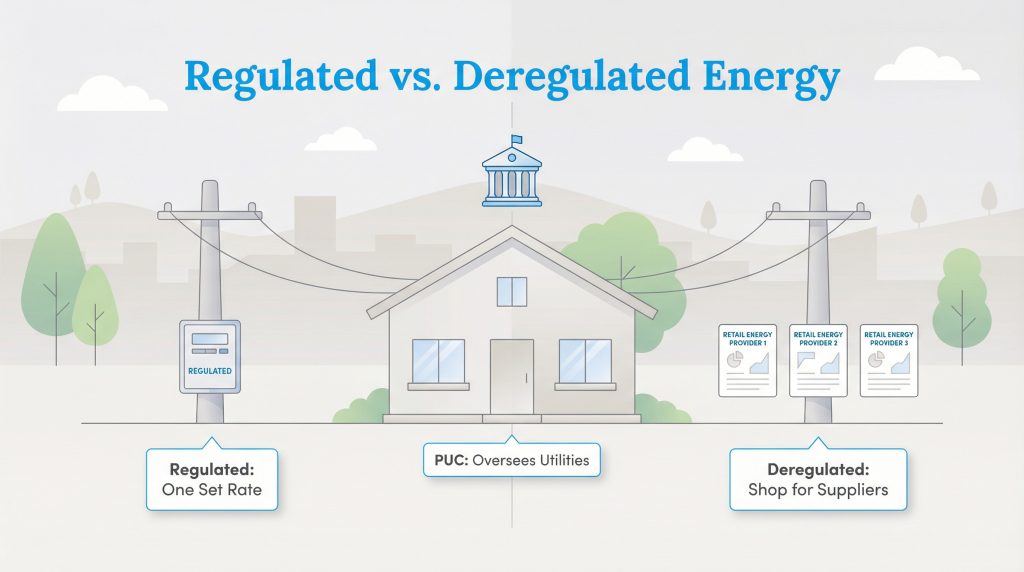
The amount of direct leverage a regulatory body holds over your monthly budget depends heavily on state laws regarding regulated vs deregulated utilities. Understanding this crucial distinction is a foundational step for protecting your financial resources and learning how to save on your electric bill. In fully regulated markets, the commission controls the entire vertical energy process — from the power plant generating the electricity to the wires delivering it to your porch. In deregulated states, their power shifts away from setting the supply cost and focuses heavily on overseeing delivery systems and managing a fair, open marketplace.
| Market Type | Supply Oversight | Delivery Oversight | Consumer Choice | Renewable & Solar Impact |
|---|---|---|---|---|
| Regulated Market | PUC sets the exact retail rate for energy supply. | PUC sets delivery rates and enforces safety rules. | You receive one bundled rate from a single authorized monopoly provider. | The PUC dictates universal solar buyback plans and limits independent green energy options. |
| Deregulated Market | PUC licenses third-party suppliers via energy choice programs. | PUC sets delivery rates and enforces safety rules. | You can shop for competitive supply rates from independent Retail Energy Providers (REPs). | Consumers can actively choose 100% renewable plans and shop for better solar net metering rates. |
It is important to note that even in a deregulated environment, the PUC maintains strict authority over the physical infrastructure. While you might purchase your electricity from a third-party supplier, your local utility company still owns the poles and wires. The PUC regulates those delivery charges to ensure safety and reliability. States that currently offer robust, widespread retail electricity deregulation for residential consumers include:
- Connecticut
- Delaware
- Illinois
- Maine
- Maryland
- Massachusetts
- New Hampshire
- New Jersey
- New York
- Ohio
- Pennsylvania
- Rhode Island
- Texas
Pro Tip: If you live in a deregulated state, your PUC may manage an official “Apples to Apples” comparison website. Always utilize this official government tool to compare current rates before signing a binding contract with a third-party supplier.
Which Types of Utilities Do PUCs Regulate?
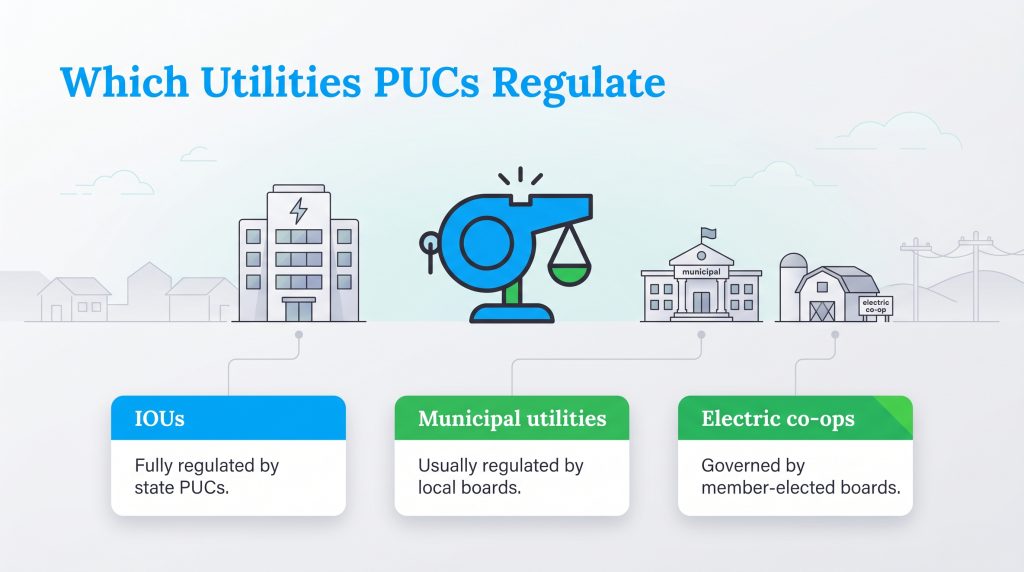
A frequent point of confusion for new residents is assuming that the state utility commission oversees every single power, internet, and water provider operating in their ZIP code. In reality, their legal jurisdiction heavily depends on the specific ownership structure of the utility company. Understanding who actually regulates your provider ensures you know exactly where to turn if you ever need to escalate a frustrating problem.
- Investor-Owned Utilities (IOUs): These are massive, for-profit companies owned by private shareholders that operate as legal monopolies in designated service territories. Because their primary goal is maximizing shareholder return, state PUCs exert absolute regulatory authority over investor-owned utilities to guarantee profit motives never result in unfair consumer costs.
- Municipal Utilities: When your local city or town owns the utility infrastructure, it operates as a non-profit municipal entity managed directly by the local government. Because municipal utility leaders are accountable to local voters and taxpayers, state PUCs generally step back and allow local city councils to determine rates and resolve disputes.
- Rural Electric Cooperatives: Often found in rural regions, co-ops are private, non-profit organizations owned entirely by the very customers who purchase their power. Customers vote to elect a board of directors that makes all financial decisions, meaning most state PUCs have limited or zero jurisdiction over these self-regulating entities.
Essential PUC Glossary: Dockets, Tariffs, and Intervenors
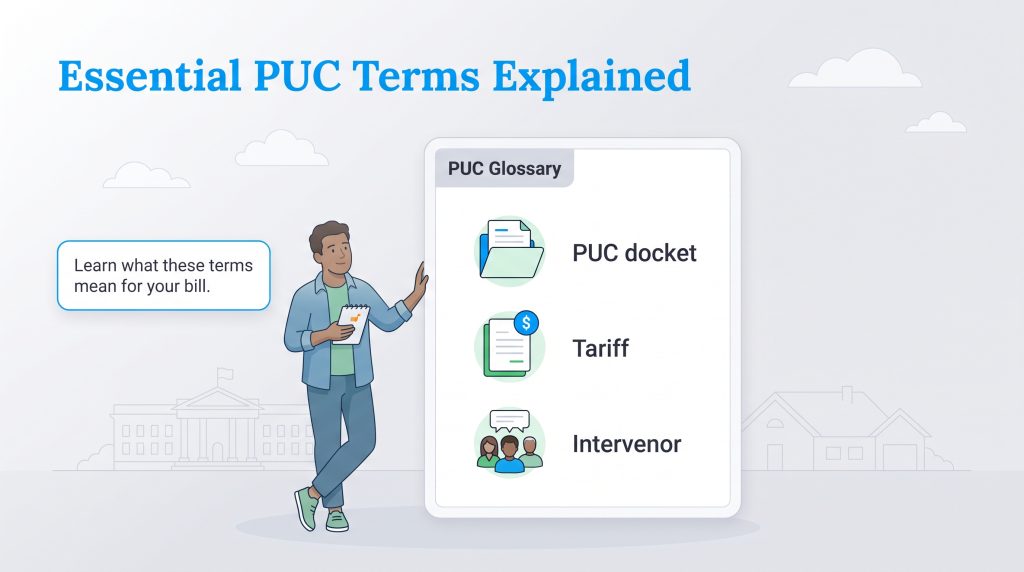
Reading through an official utility commission website can often feel like trying to decipher a foreign language. The legal terminology utilized in government proceedings is highly specific and can easily alienate the average homeowner trying to understand a rate hike. To help you confidently navigate your state’s portal, we have compiled a quick-reference glossary defining the most common regulatory jargon.
| Regulatory Term | What It Actually Means for You |
|---|---|
| PUC Docket | A PUC docket is the official, publicly accessible file containing all legal documents, testimony, and public comments related to a specific utility case or regulatory issue. |
| Tariff | The official, legally binding document approved by the commission that explicitly outlines your utility’s approved rates, service fees, and consumer rules. |
| Intervenor | An individual, business, or advocacy group granted official legal status to actively participate in a rate case and challenge the utility company’s requests. |
| Evidentiary Hearing | A formal proceeding resembling a courtroom trial where lawyers and expert witnesses present financial data and argue for or against a proposed utility change. |
How to File a Complaint With Your State’s PUC
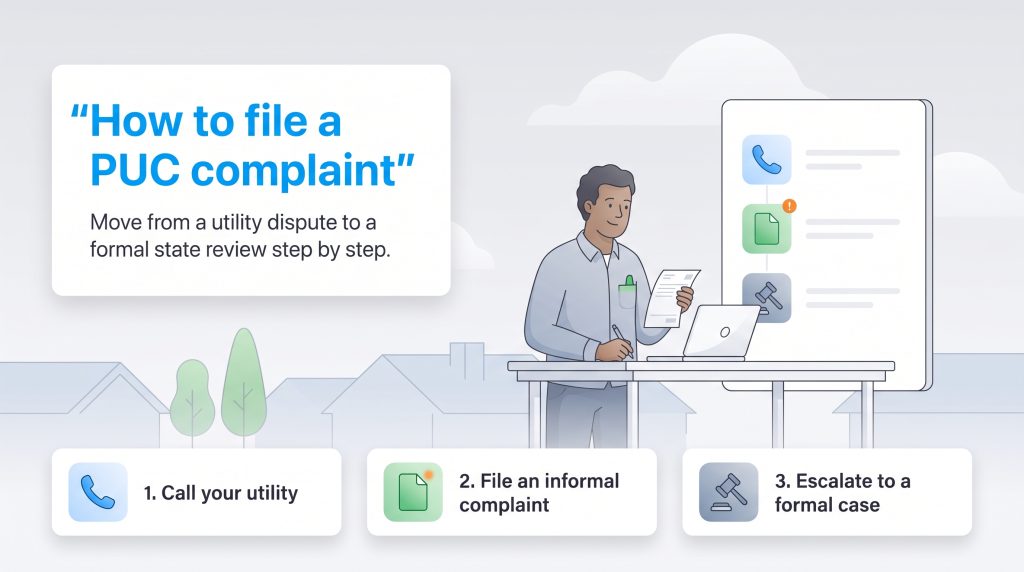
If you are dealing with an incredibly persistent issue — such as a severe billing error, an abrupt service refusal, or an unresolved utility bill dispute — you have the absolute legal right to escalate the problem beyond the company’s automated call center. Understanding how to file a PUC complaint is a highly valuable skill for any renter or homeowner looking to enforce their rights and protect their budget. By utilizing our state directory above, you can confidently navigate the official escalation process by following these specific steps:
- Call your utility provider directly. Before a government agency steps in, the utility regulatory commission will almost always demand verified proof that you attempted to resolve the issue with the company first. Clearly explain the problem, and explicitly ask to speak to a supervisor to exhaust your internal options.
- Document the interaction meticulously. Keep a highly detailed record of the specific date, the exact time, the name of the representative you spoke to, and the final outcome of the call. Gather your official account number, recent electric bills, and bank statements showing proof of your recent payments.
- Submit an informal complaint with the state commission. Navigate to your state agency’s website using our directory and submit an informal complaint form online. This action triggers an official mediation process where the PUC forwards your grievance directly to the utility company’s executive team and mandates a written response within a strict timeframe.
- Initiate a formal legal proceeding if necessary. If the informal mediation process does not yield a satisfactory resolution, you maintain the right to file a formal complaint. This initiates a rigorous legal proceeding that often resembles a court hearing, requiring you to submit hard evidence against the utility provider before a regulatory judge.
Taking Charge of Your Utility Bills
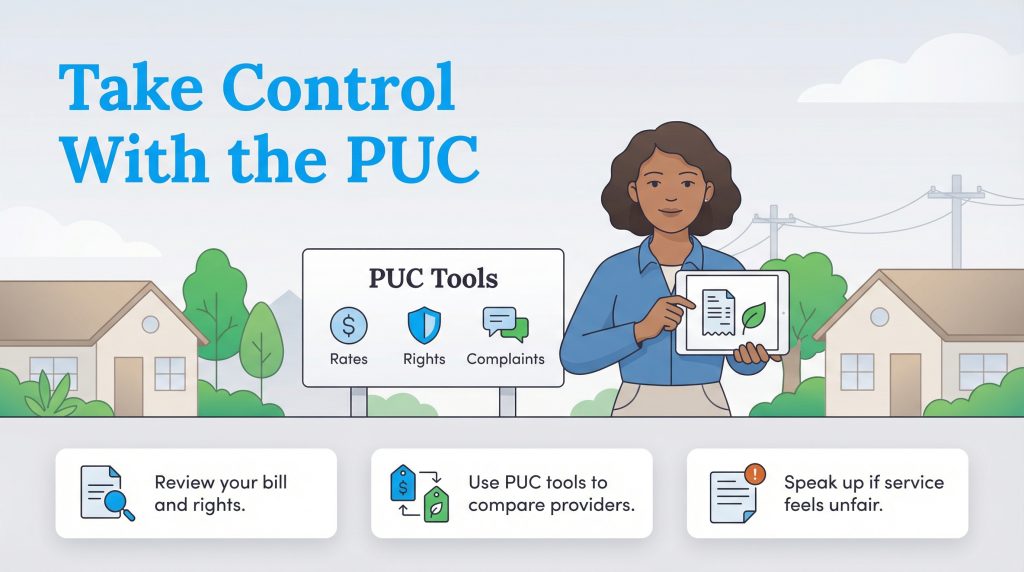
Moving into a new home brings enough stress without having to worry about unfair energy costs or hidden service fees unexpectedly draining your bank account. By understanding how local regulators manage your utility landscape, you ensure your household remains protected against unapproved rate hikes and aggressive monopoly practices. Whether you are living under the strict oversight of a fully regulated energy market or navigating the complexities of independent supplier contracts, knowing your legal rights instantly transforms you from a passive ratepayer into an empowered, highly informed consumer.
Take control of your monthly budget today by utilizing the robust consumer protections put in place by your state’s commission. If you happen to live in a deregulated area and want to explore your energy choice programs, take a moment to compare energy plans on the UtilitiesForMyHome platform. By making an informed, environmentally mindful choice when setting up utilities in a new home, you can lock in a highly competitive rate while actively supporting a more sustainable grid for everyone.
Frequently Asked Questions About Public Utilities Commissions
Is a Public Utilities Commission a government agency?
What is the difference between a Public Service Commission and a Public Utilities Commission?
What is the difference between a PUC and a utility company?
What is the difference between a PUC and FERC?
Who oversees the Public Utilities Commission?
Are public utility commissioners elected or appointed?
Can a Public Utilities Commission lower my electric bill?
Do public utility commissions regulate the internet and broadband?
What is the difference between an investor-owned utility and a cooperative?
How do public utilities commissions impact home solar panels?
Can the PUC force my utility to switch to renewable energy?
How do I submit a public comment to my state PUC?
How do I find the contact information for my state’s PUC?
About the Author

LaLeesha has a Masters degree in English and enjoys writing whenever she has the chance. She is passionate about gardening, reducing her carbon footprint, and protecting the environment. She also recently served as President of the Board for City Sprouts (a community garden).

David has been an integral part of some of the biggest utility sites on the internet, including InMyArea.com, HighSpeedInternet.com, BroadbandNow.com, and U.S. News. He brings over 15 years of experience writing about, compiling and analyzing utility data.