

Understand Your Rights During Rescission Periods for Energy to Switch Providers Safely and Avoid Unexpected Cancellation Fees
Key Takeaways
- Energy rescission periods give you a legal window to cancel a newly signed utility contract without paying early termination fees.
- Cancellation timeframes vary by state, commonly lasting three federal business days, though some states and enrollment methods allow longer windows.
- Switching to an environmentally mindful choice is easy when you know how to safely back out of an unfavorable deregulated energy contract.
We’ve all felt that sudden pit in our stomach immediately after locking into a new service agreement, but if buyer’s remorse is already creeping in over a utility plan, take a deep breath. You are protected by rescission periods for energy, a legal safety net designed to let you back out of a signed contract penalty-free. Maybe you signed up for what looked like a stellar electricity rate, only to realize minutes later that the plan relies heavily on fossil fuels or carries steep hidden charges. We’ll show you exactly how these public utility commission rescission laws work, how long your energy supplier grace period lasts, and the exact steps you need to take to safely break an electricity contract so you can find an eco-conscious alternative that actually fits your household budget.
What Is a Rescission Period in an Energy Contract?
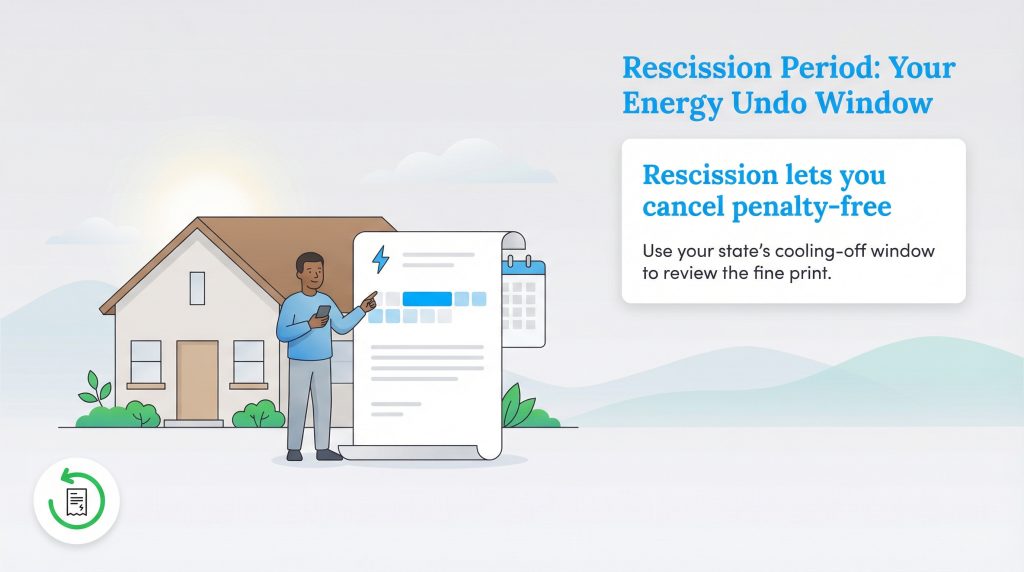
A rescission period is a legally protected grace period allowing consumers to back out of a new energy contract without paying an early termination fee. At its core, an energy contract cooling off period is a mandated window of time where you hold all the power to reconsider your choice. When you shop for electricity or natural gas in deregulated energy markets, state regulators want to make sure you have enough time to review the fine print. This timeframe allows you to cancel the service without any financial consequences if you realize the terms do not match what you expected or what a pushy salesperson promised.
In the utility sector, navigating the exact definition of this timeline is critical, particularly when determining the right of rescission federal business days. A massive point of confusion for consumers is understanding exactly what counts as a “business day.” Unlike a traditional corporate workweek, federal business days officially include Saturdays. This means if you sign up for a plan on a Thursday, Friday is day one, Saturday is day two, and Monday is your final third day to cancel (assuming there are no federal holidays). Sundays and federally recognized holidays are the only days excluded from the clock.
It is also important to note how this grace period applies to different plan types. For a fixed-rate plan, rescission is a vital safeguard because breaking these contracts later usually triggers severe exit fees. Conversely, variable-rate contracts might not charge an early termination fee electricity penalty at all, but using your rescission rights ensures you can back out immediately without going through a tedious cancellation process or paying for a single day of unexpected high rates.
Think of retail electric provider cancellation during this window as a guaranteed undo button for your utility bill. Without this consumer protection, stepping away from a newly signed agreement would likely trigger severe penalties. State Public Utility Commission regulations enforce these deregulated energy market rescission rules to keep the market fair. Here are the core facts about how these rules protect you:
- Mandatory cooling-off windows: Suppliers must provide a set number of days for you to review the final contract terms before locking you in.
- No financial penalties: Canceling within the legally defined window guarantees you will not face an early termination fee.
- Automatic return to default: If you cancel a switch, your service simply remains with your current provider or defaults back to your local utility without any power interruption.
💡 Pro Tip: Always pull up a calendar when calculating your energy cancellation deadline. Remember that Saturdays count as federal business days, but Sundays and federal holidays do not. Miscounting by a single day can result in unexpected and costly cancellation fees.
Locating the Rescission Clause in Your Paperwork
Before you can safely cancel an energy contract penalty free, you have to know exactly where to look to confirm your personal deadline. When you sign up for a new deregulated plan, your provider will send you a welcome packet full of dense legal jargon. Buried within that stack of documents is the specific language detailing your cancellation window. Instead of reading every single page, you should focus your attention on three primary documents:
- The Terms of Service (TOS): This is the massive, multi-page legal agreement dictating the rules of your plan. Your exact right of rescission deadline will be explicitly outlined in this document, typically under headers like “Cancellation Rights,” “Rescission,” or “Right to Cancel.”
- The Electricity Facts Label (EFL): While the EFL is incredibly useful for breaking down your exact rate, tiered usage charges, and renewable energy percentages, it rarely contains your specific cancellation window dates. Use the EFL to check your price, but rely on the TOS to find your cancellation deadline.
- Your Rights as a Customer (YRAC): This document outlines state-mandated consumer protections. It will explain the general cooling-off rules for your state, confirming that you have a legal right to cancel, though the TOS will provide the specific contractual date.
To find your deadline efficiently, open your digital welcome email and search the terms of service disclosure for the words “rescission” or “cancel.” The language will usually clearly state that you have a set number of federal business days from the receipt of the document to void the agreement. If the exact date is not pre-calculated for you in a welcome letter, use the receipt date of the TOS document as day zero and begin counting forward.
State-by-State Energy Rescission Guidelines
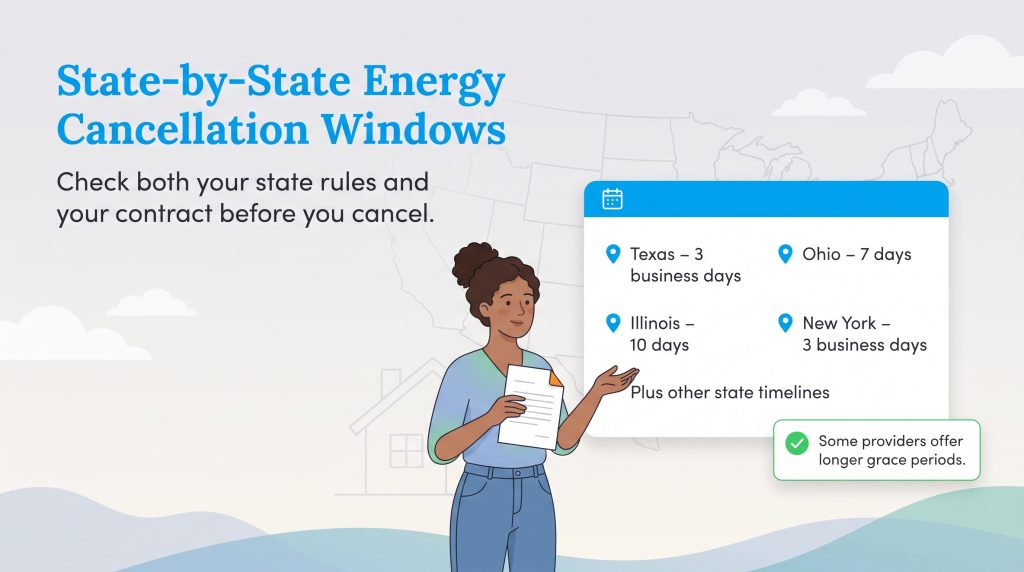
Your exact timeframe to break an electricity contract early depends entirely on where you live, as state Public Utility Commissions (PUCs) set and enforce these consumer protection laws. Some regions give you a brisk 72 hours to make up your mind, while others offer a more generous buffer. Before making any assumptions about how to cancel your specific service, always check your local regulations to avoid missing a tight deadline.
For example, understanding the 3-day right of rescission Texas energy residents rely on is crucial if you use the Power to Choose portal. Under Public Utility Commission of Texas (PUCT) rules and broader FTC guidelines, you have exactly three federal business days to cancel. A very common myth in Texas is that weekends do not count toward this window. In reality, Saturday is legally considered a valid federal business day, meaning your window might close faster than expected if you enroll late in the week. However, Texas residents also benefit from a secondary loophole: a 14-day fee-free window near the very end of their contract expiration, allowing them to switch providers early without penalty once the term is nearly over.
Other states offer entirely different structures to protect their residents. In Illinois, consumers are granted a full 10 calendar days, which simplifies the math significantly since you don’t have to separate business days from weekend days. In Ohio, the Public Utilities Commission offers seven days. Below is a detailed breakdown of the rescission periods for key deregulated energy markets across the country.
| State | Rescission Period | Regulating Authority |
|---|---|---|
| Texas | 3 federal business days | Public Utility Commission of Texas (PUCT) |
| Pennsylvania | 3 business days | Pennsylvania Public Utility Commission (PUC) |
| Ohio | 7 days | Public Utilities Commission of Ohio (PUCO) |
| Illinois | 10 calendar days | Illinois Commerce Commission (ICC) |
| Massachusetts | 3 days | Department of Public Utilities (DPU) |
| Maryland | 3 business days | Maryland Public Service Commission (PSC) |
| New Jersey | 7 calendar days | New Jersey Board of Public Utilities (BPU) |
| New York | 3 business days | New York State Public Service Commission (PSC) |
While state laws mandate the absolute minimum cooling-off period, some utility companies willingly offer more flexible timelines as a customer service perk. Never assume the state minimum is your only guideline. You always want to cross-reference local laws with your actual signed documents to pinpoint your final cancellation date.
The Contract Start Date Myth Explained
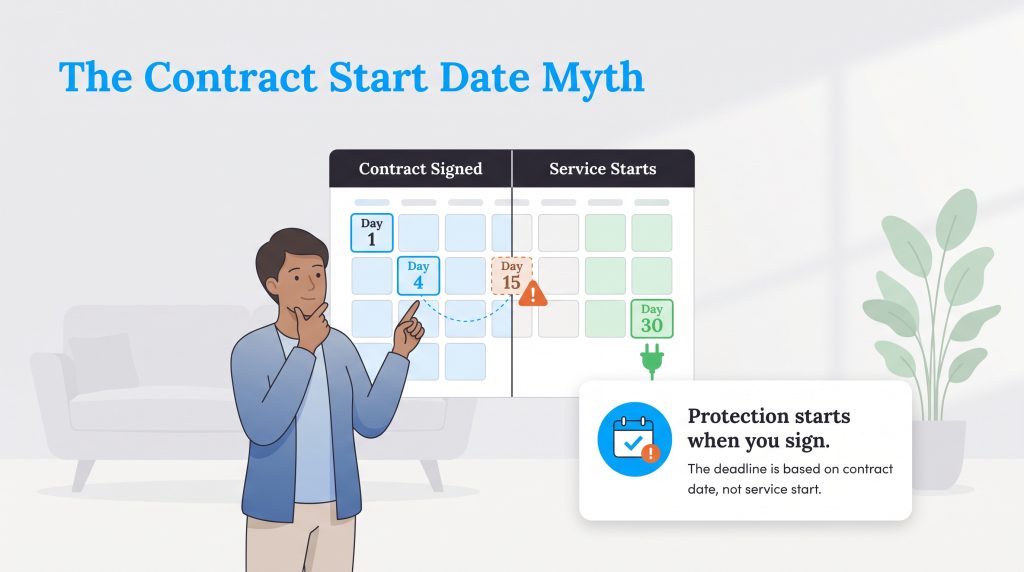
One of the most common and costly misconceptions in the deregulated market involves the energy contract start date. Many consumers mistakenly believe that as long as their new utility service has not officially turned on, they can cancel the agreement without penalty. Unfortunately, this is a myth that routinely traps well-meaning people into paying steep exit fees. Your legally protected window does not start when your lights turn on.
The exact trigger that starts your countdown clock occurs when the customer receives the Terms of Service disclosure. It does not begin when you give verbal authorization to a sales agent over the phone, nor does it necessarily begin the second you click a web button, unless that web button immediately delivers the formal TOS document to your screen or inbox. The law relies on your receipt of the actual contractual rules.
Consider this standard step-by-step example timeline to see how the start date myth can cost you:
- Day 1: You sign a future-dated energy contract for a service starting next month and instantly receive your Terms of Service disclosure via email.
- Day 4: Your legally mandated three-day rescission period officially expires at midnight.
- Day 15: You find a better rate on a comparison site and attempt to cancel your pending agreement, assuming you are safe because your service hasn’t started.
- Day 30: Your service begins. Because you canceled on Day 15 — well past Day 4 but before Day 30 — you are still hit with a severe early termination fee.
You cannot back out penalty-free just because the start date hasn’t arrived. Always base your timeline on the execution and document receipt date to ensure your cancellation request is legally valid.
Acceptable Methods for Canceling Your Contract
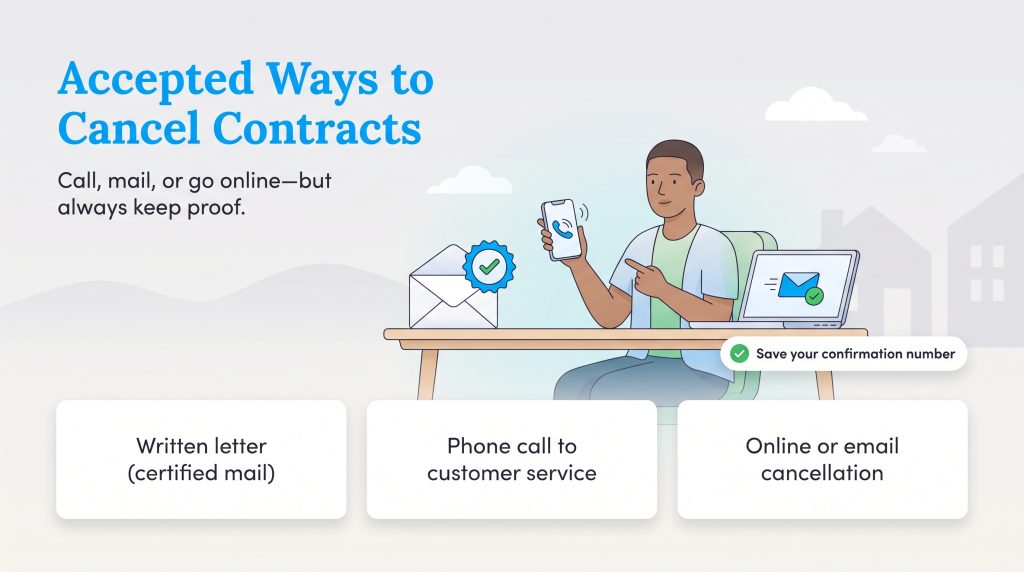
Once you locate your deadline and decide to invoke your rights, you must communicate your decision clearly and within the allowed timeframe. Regulators typically require suppliers to accept multiple methods of cancellation, ensuring all consumers can easily back out of an agreement. Do not simply ignore the provider’s emails and hope the transfer fails. Walking away from a bad contract requires quick, documented action. The three most common and legally recognized methods include:
- Written Cancellation: Sending a physical letter is the most traditional method. If you choose this route, always use certified mail with a return receipt requested so you have undeniable physical proof of the exact delivery date.
- Oral Cancellation: Calling the supplier’s customer service line is often the fastest method. Be sure to note the date, time, and the exact name of the representative who handled your request. Do not assume leaving a quick voicemail guarantees your contract is officially terminated.
- Electronic Cancellation: Many modern suppliers provide secure online portals or dedicated email addresses for cancellation requests. This creates an immediate digital paper trail. Always screenshot the final confirmation screen in case the automated email receipt fails to arrive in your inbox.
Regardless of the method you choose, you must request an official energy supplier cancellation confirmation number. This number is your definitive proof that you acted within the legal window, shielding you from improper fees if the provider later claims they never received your request. A supplier like Gexa Energy might structure their internal instructions slightly differently than a municipal cooperative, but state laws require them to honor these standardized cancellation requests.
🚩 Heads Up: Keep all cancellation documentation for at least three full billing cycles. Sometimes, administrative errors cause a switch to accidentally go through, and you will need that confirmation number to force the supplier to reverse the charges without penalty.
Residential vs. Commercial Energy Contracts
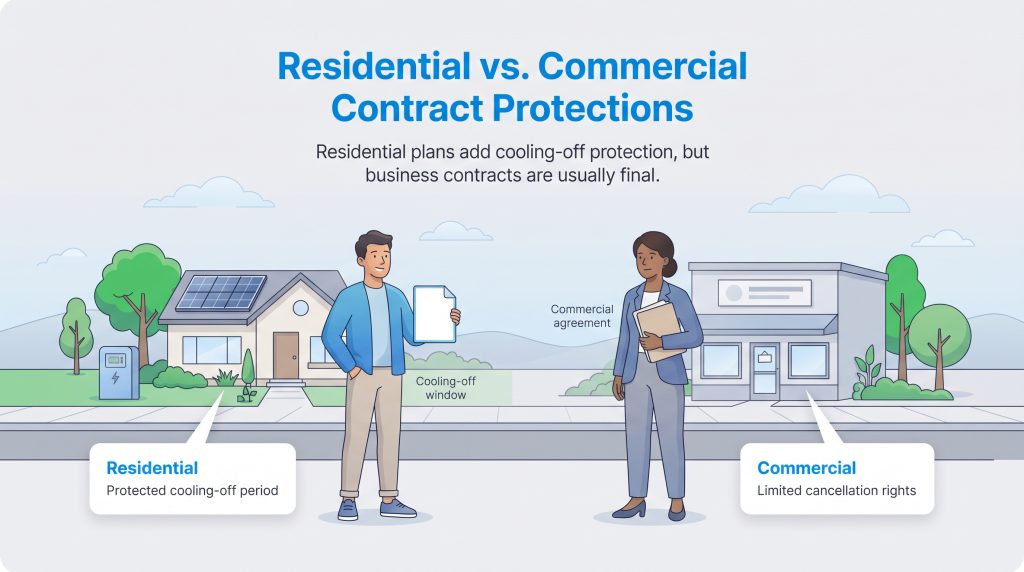
When navigating cooling-off periods, residential customers are treated as a protected class under state law. Regulators mandate strict rescission periods for residential plans to ensure families have adequate time to review required disclosures, spot hidden fees, and safely back out if a plan does not meet their household budget or sustainability goals.
Conversely, business owners face a much stricter landscape. Commercial energy contracts generally do not offer rescission protections because businesses are legally expected to perform rigorous due diligence, possess the resources to negotiate complex terms, and utilize legal counsel before signing a binding agreement. State Public Utility Commissions assume that a commercial entity understands the gravity of executing an agreement. Therefore, breaking a commercial contract can be incredibly costly, often triggering damages that dwarf standard residential fees. Business owners should consult trusted energy advisors or legal representatives before finalizing any new supplier agreement.
Solar Contracts vs. Standard Energy Contracts
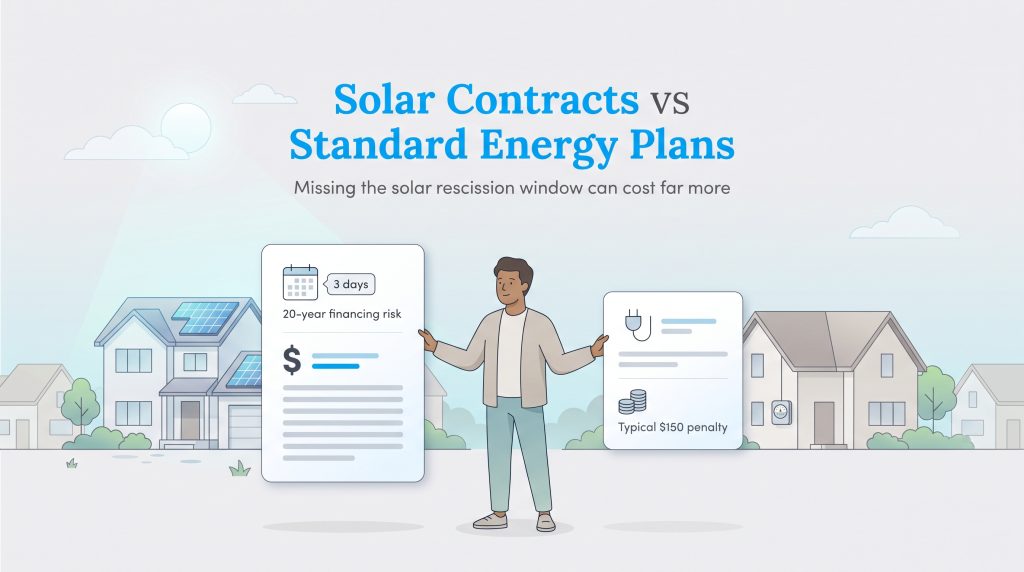
Exploring renewable energy options often leads homeowners to consider installing rooftop solar panels. However, it is crucial to understand that solar contract rescission periods differ significantly from standard retail energy contracts. While deregulated electricity plans are governed by local utility commissions, solar installations and lease agreements generally fall under the overarching FTC cooling-off rule for door-to-door or in-home sales, which explicitly grants a three-day window to cancel.
Missing this specific cancellation window carries monumental financial risks compared to a standard energy agreement. If you fail to cancel a standard utility plan on time, you might face an upfront flat fee penalty of around $150 to $200. If you miss your three-day solar rescission window, you could be legally locked into a 20-year financing agreement for tens of thousands of dollars worth of expensive equipment, which can even result in property liens if terms are breached. Always review your solar paperwork meticulously, ask specific questions about the installation timeline, and exercise your cancellation rights immediately if the projected savings do not align perfectly with your expectations.
How Early Termination Fees (ETFs) Work
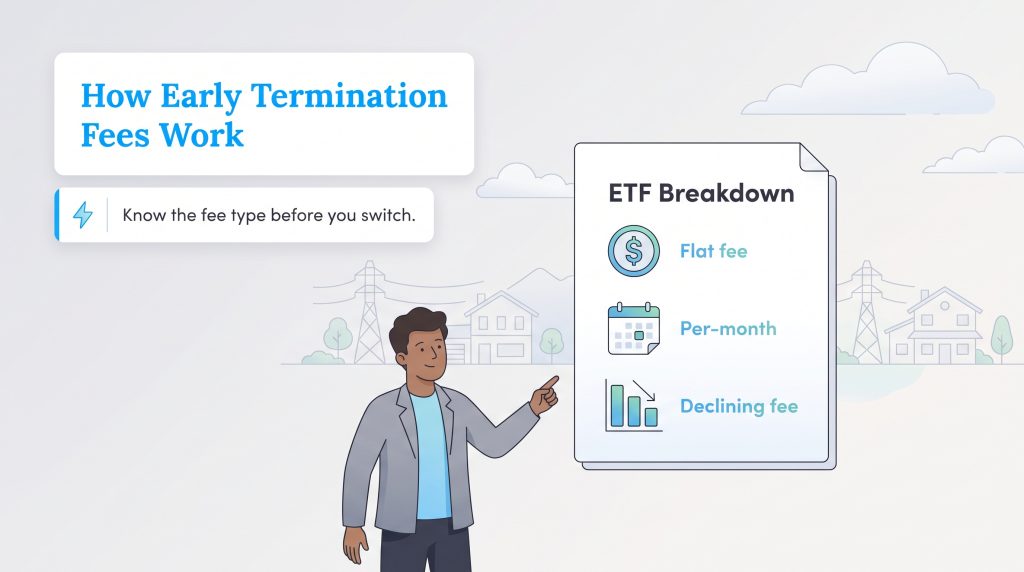
If you completely miss your guaranteed cooling-off period, you will likely encounter an ETF when trying to leave your supplier. Energy providers purchase power on the futures market based on the anticipated usage of their contracted customers. When you cancel within the rescission window, the supplier can adjust easily. But if you break the contract months later, it leaves the provider with excess energy they already paid for. To recoup those financial losses, companies enforce early termination fees. It is vital to understand the exact structure of these fees before you decide to walk away from an active agreement.
Utility companies typically structure their exit penalties in one of three easy-to-understand formats:
- Flat Fee: A single set amount that never changes, whether you leave 10 months early or just one month early (e.g., $150 total).
- Per-Month Remaining Fee: A specific dollar amount multiplied by your remaining months (e.g., $20 multiplied by 5 remaining months equals a $100 penalty).
- Declining Fee: A high upfront penalty that drops consistently each month you stay enrolled (e.g., starting at $300 and dropping $25 each month until it hits zero).
Step-by-Step: Calculating If Paying an ETF Is Worth It
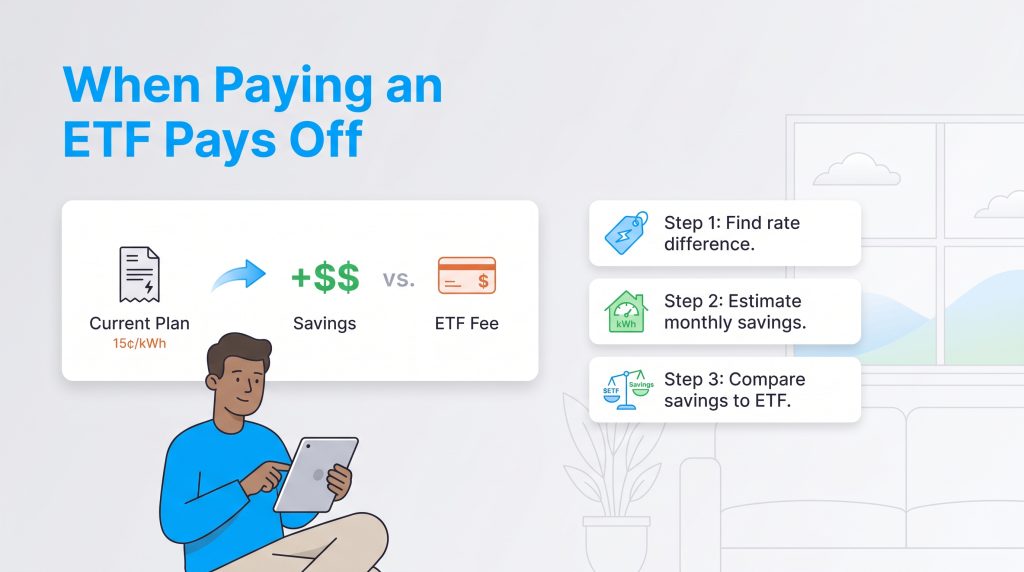
Sometimes, uncovering a far better deal shortly after signing makes financial sense even if you missed your cancellation window and have to pay a penalty. If you find a dramatically lower price per kilowatt-hour, or if you find a renewable energy plan you truly love backed by renewable energy certificates (RECs), the long-term savings might easily outweigh the upfront exit cost. Instead of guessing, you can use a simple three-step mathematical formula to determine exactly whether breaking your contract is a smart money move.
- Find your price difference: Subtract the proposed new plan’s energy rate from your current plan’s rate to find your exact savings per kilowatt-hour (kWh).
- Calculate monthly savings: Multiply that price difference by your average monthly usage (how many kWh your home uses in a typical month).
- Compare against the fee: Multiply your monthly savings by the number of months left on your current contract. If that total savings number is significantly higher than your provider’s early termination fee, it is financially worth breaking the contract.
Let’s look at an example. Imagine you have six months left on your current contract, which charges an ETF of $150. Your current rate is 15 cents per kWh, but you find a new plan offering 11 cents per kWh. That means you save 4 cents ($0.04) for every kWh you use. If your home uses an average of 1,200 kWh per month, you will save $48 each month ($0.04 x 1,200 = $48). When you multiply that $48 by the six months left on your contract, your total projected savings equals $288. Because saving $288 is much greater than paying the $150 penalty, paying the fee to switch is a highly profitable move that leaves you with an extra $138 in your pocket.
Preparing for Your Next Utility Switch
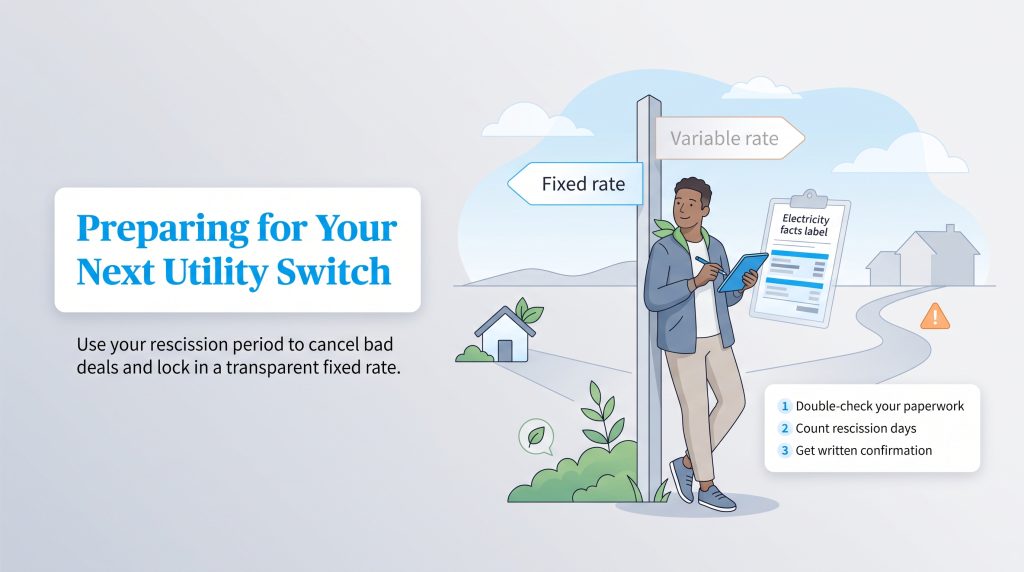
When you are ready to shop for a new energy plan, preparation is your best defense against buyer’s remorse. Always check the Electricity Facts Label carefully before signing anything to understand the exact price breakdown. You should actively avoid variable rate traps that offer low introductory pricing but skyrocket after the first billing cycle. For a seamless experience, use our electric comparison resources to evaluate top-rated suppliers and lock in a transparent, fixed-rate plan that aligns perfectly with your household’s budget and sustainability standards.
Navigating the deregulated utility market doesn’t have to feel like walking a tightrope without a net. Understanding how to save on your electric bill and how to choose an electric provider keeps you in control. Rescission periods for energy are powerful consumer protection tools that give you a vital second chance to make the right choice for your wallet and the environment. By meticulously double-checking your paperwork, counting your federal business days accurately, and demanding written confirmation when exiting an agreement, you hold the power to confidently secure an energy plan that truly works for you.
Frequently Asked Questions About Rescission Periods for Energy
Does the 3-day rescission period include Saturdays?
Where is the rescission clause located in my enrollment packet?
What happens if my energy provider ignores my cancellation request?
Does the rescission period start the day I sign the contract?
Can I be charged an early termination fee during the rescission period?
What happens to my power if I cancel during the rescission window?
Are rescission periods the same for natural gas and electricity?
How do I find a better, eco-friendly energy provider after canceling?
Can I cancel an electricity contract if I signed up door-to-door?
About the Author

David has been an integral part of some of the biggest utility sites on the internet, including InMyArea.com, HighSpeedInternet.com, BroadbandNow.com, and U.S. News. He brings over 15 years of experience writing about, compiling and analyzing utility data.

LaLeesha has a Masters degree in English and enjoys writing whenever she has the chance. She is passionate about gardening, reducing her carbon footprint, and protecting the environment. She also recently served as President of the Board for City Sprouts (a community garden).