

Understanding the Specific Line Items on Your Texas Electricity Bill Is the First Step Toward Managing Your Monthly Energy Costs
Key Takeaways
- Oncor delivery charges represent the exact cost of maintaining the power grid, including poles, wires, and meters, and are passed through directly to consumers without a single cent of markup by retail providers.
- The current October 2026 Oncor residential delivery rate consists of a $4.06 fixed monthly base fee plus a volumetric charge of 6.8673 cents per kilowatt-hour (kWh).
- You cannot negotiate or avoid these specific delivery fees, but you can drastically reduce your total utility bill by lowering your home energy consumption through efficiency upgrades and mindful usage habits.
Staring at the “Oncor Delivery Charge” on your monthly statement can cause serious bill shock, especially if you live in the Dallas-Fort Worth metroplex or other parts of North Texas where the recent October 4, 2026, Public Utility Commission of Texas (PUCT) rate increase just took effect. Before we dive into the deep end, here are the exact numbers you need to audit your invoice right now: the newly approved Oncor residential delivery rate includes a fixed monthly base charge of $4.06 combined with a steep volumetric charge of 6.8673 cents per kWh. While you have the power to choose your retail electricity provider, these specific TDU delivery charges Oncor collects are mandated by the state to cover physical grid maintenance. We are here to help you decode what these specific fees are, calculate how they impact your invoice, and discover the most effective ways to lower your total electric bill this year.
What Is the Oncor Delivery Charge?

If you want the Oncor delivery charge explained simply, it is a strictly regulated, mandatory pass-through fee collected to cover the physical cost of delivering electricity safely to your home. While your Retail Electric Provider (REP) — companies like TXU, Reliant, or Green Mountain Energy — sells you the actual electricity, Oncor is the Transmission and Distribution Utility (TDU) responsible for the physical infrastructure. Oncor owns the neighborhood poles, the high-voltage wires, and the advanced smart meters mounted on the side of your house.
It is crucial to understand that your chosen REP does not mark up this fee and keeps exactly 0% of the delivery charge profits. They simply collect the money on your monthly invoice and pass it directly back to the utility company without a single cent of markup. Even if you switch electricity providers in search of a cheaper energy rate, your Oncor delivery costs will remain identical because they are tied exclusively to your physical address, not your provider.
🚩 Heads Up: Your Retail Electric Provider (REP) cannot change, discount, or waive this fee. If a provider claims to have “no delivery fees” in their marketing, they have likely just bundled the Oncor charges into their advertised kilowatt-hour rate rather than listing it separately to make the math look cleaner.
Energy Charge vs Delivery Charge
Understanding the two main components of your Texas electricity bill is the absolute secret to managing your monthly budget. When reviewing your statement, you will notice your costs are split into two distinct categories:
- Energy Charge (What You Can Control): This is the price you pay for the actual electricity you consume. You have the power to shop around on the open market and lock in a competitive, low rate from a retail electric provider.
- Delivery Charge (What You Cannot Control): This is the pass-through TDU fee charged by Oncor to maintain the physical power grid. You cannot negotiate this rate, and it is strictly regulated by the state to ensure reliable service across the region.
Current Oncor Delivery Rates Updated October 2026
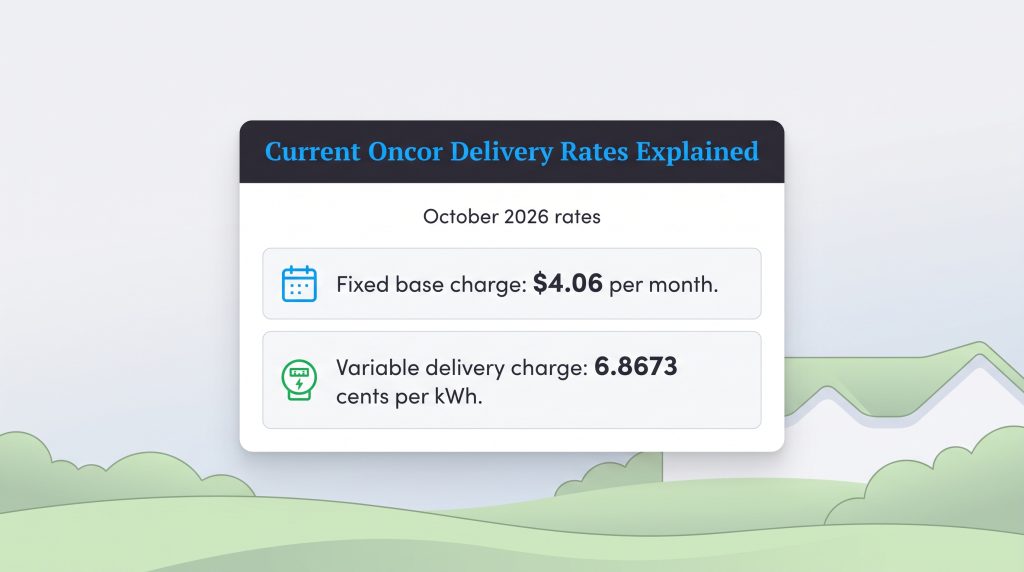
To accurately audit your utility bill, you need to know the most up-to-date figures. The current Oncor delivery charge 2026 rate structure is made up of two distinct parts: a fixed monthly customer base charge and a variable volumetric charge based on how much energy your household actually consumes. These rates are reviewed and adjusted periodically after receiving formal approval from the Public Utility Commission of Texas (PUCT).
| Charge Type | October 2026 Rate |
|---|---|
| Fixed Monthly Base Charge | $4.06 per month |
| Variable Delivery Charge | 6.8673 cents ($0.068673) per kWh |
Fixed Monthly Base Charge
The Oncor base charge remains steadfast at $4.06 per month. This flat fee applies to your account no matter how much electricity you use. Even if you go on vacation and turn off every appliance in your house, you will still see this fixed charge on your statement to cover the basic administrative costs of keeping your home physically connected to the grid.
Variable Per-kWh Charge (Volumetric)
The variable portion of the Oncor rate per kWh increased to 6.8673 cents on Oct. 4, 2026. Your exact fee fluctuates every single month based on your total energy consumption. When you look at the “average price per kWh” on an electricity plan advertisement, it usually includes an estimate of these charges based on a baseline of 1,000 or 2,000 kWh of usage. Because this variable rate is tied directly to your consumption, it is the primary driver behind massive seasonal bill spikes.
Recent Oncor Rate Increases and Surcharges
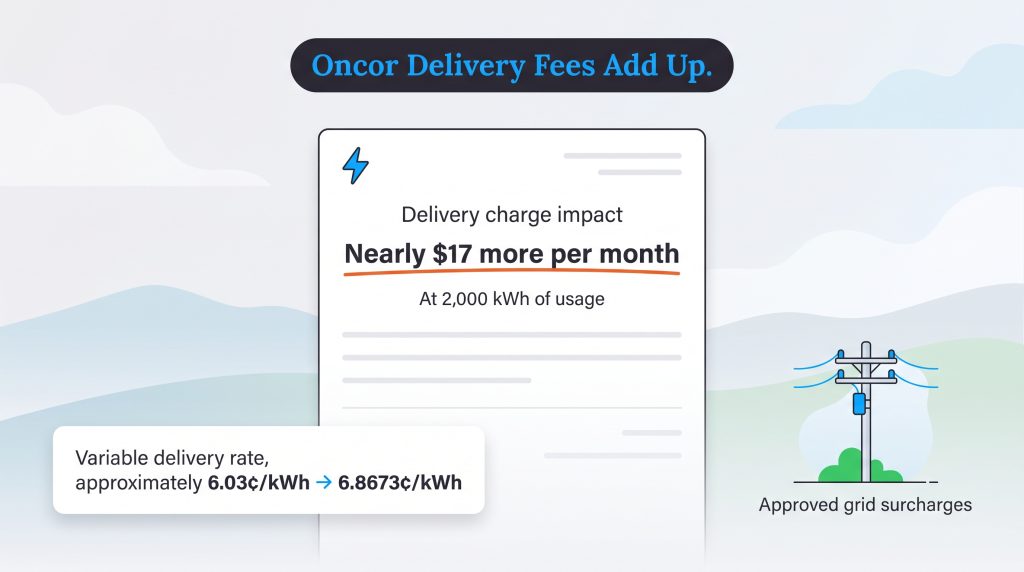
If your autumn energy bill caused a double-take, you are experiencing the direct result of the recent PUCT rate update. Oncor received approval to jump its variable delivery fee from roughly 6.03 cents to 6.8673 cents per kWh. For a household using 2,000 kWh during a warm month, that seemingly small fraction of a cent adds nearly $17 to your monthly invoice instantly, which can seriously derail your household budget.
These hikes do not happen overnight. They go through a rigorous rate case process. During a rate case, Oncor must legally prove to state regulators that it spent money on necessary grid improvements — like replacing storm-damaged poles, clearing vegetation near high-voltage lines, or upgrading digital infrastructure — before it can pass those expenses on to consumers. Once approved, these costs are often applied as temporary, state-approved surcharges. For example, specific surcharges like Rider IS (Infrastructure Surcharge) allow the utility to recover capital costs for continuous grid expansion, directly inflating the final variable rate you see on your statement. Because North Texas is growing so rapidly, Oncor is constantly building new substations and transmission lines, meaning these surcharges are an unavoidable reality for residents.
How to Calculate Your Total Oncor Delivery Fee
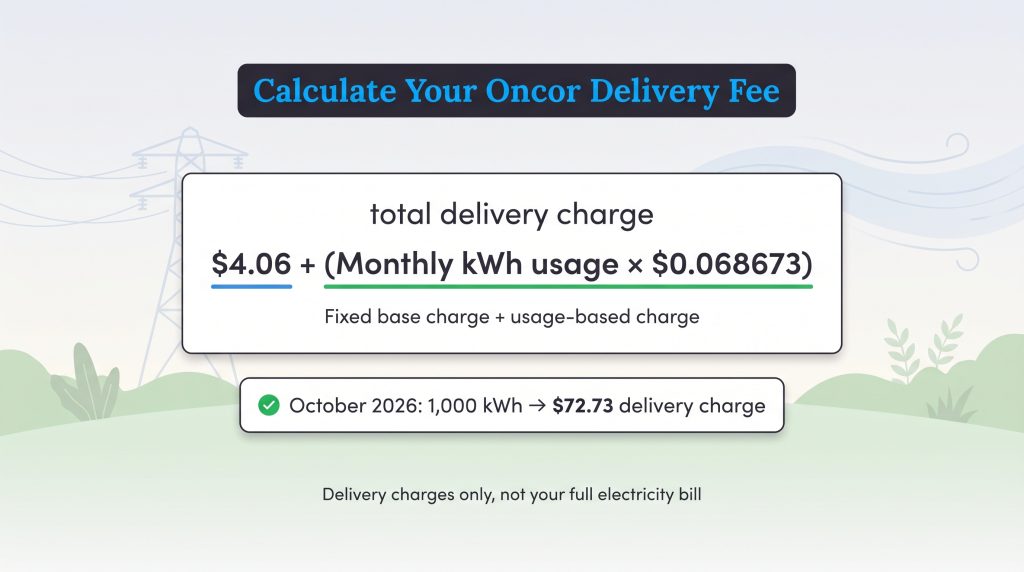
Learning how to calculate Oncor delivery charge totals is surprisingly straightforward once you have the newest figures on hand. Because the PUCT Oncor delivery rates are mathematically identical for all residential customers within the territory, you can project your monthly liability using a simple formula.
Total Delivery Charge = Fixed Base Charge + (Monthly kWh Usage × Volumetric Rate)
To help you estimate what to expect on your next bill, we calculated the average Oncor delivery charge based on three very common household usage benchmarks using the current October 2026 rates:
| Monthly Usage | Fixed Base Charge | Volumetric Cost (6.8673¢ per kWh) | Total Estimated Delivery Charge |
|---|---|---|---|
| 500 kWh (Small Apartment) | $4.06 | $34.34 | $38.40 |
| 1,000 kWh (Medium Home) | $4.06 | $68.67 | $72.73 |
| 2,000 kWh (Large Home) | $4.06 | $137.35 | $141.41 |
By checking your historical usage on a previous statement and multiplying it by $0.068673, you can instantly see how much of your upcoming bill belongs strictly to the utility company rather than your retail provider.
Why Are Oncor Delivery Charges So High?
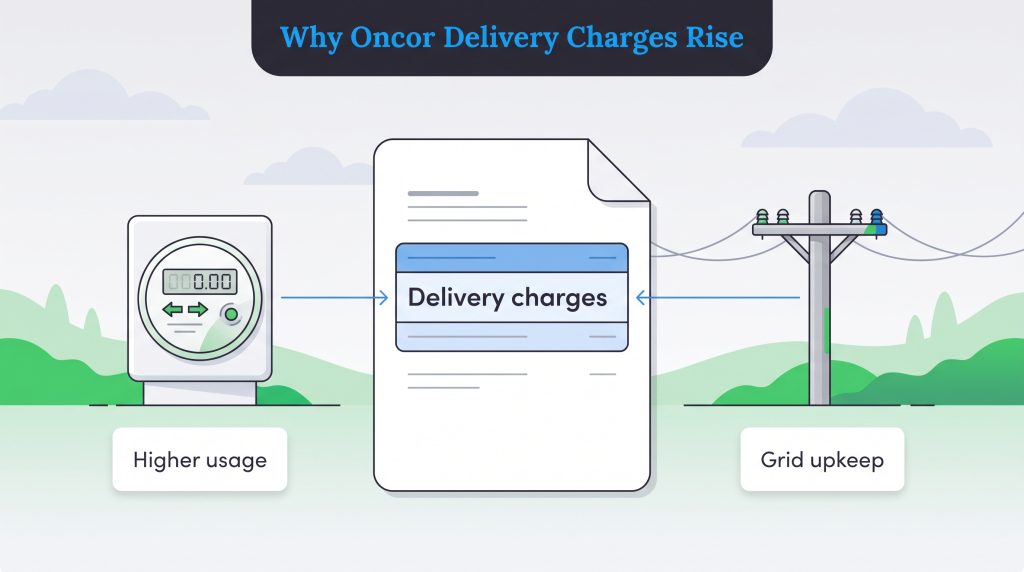
If you are frequently asking yourself, “why is my Oncor delivery charge so high?”, you are certainly not alone. “Bill shock” is incredibly common for Texas residents, especially when extreme weather hits. Because the vast majority of the fee is usage-based, high energy consumption drastically inflates the final charge. But beyond your personal usage, every authorized Oncor delivery charge increase is heavily driven by the sheer cost of maintaining the sprawling Oncor electric delivery service area.
The PUCT ensures that the utility only recovers verified costs associated with running and upgrading the regional power grid. Those major infrastructure costs include:
- Maintaining 140,000+ Miles of Power Lines: The continuous upkeep, repair, and replacement of physical transmission lines across a rapidly growing North Texas population.
- Aggressive Grid Weatherization: Hardening essential equipment against extreme weather events, ensuring the grid can withstand severe winter freezes and prolonged summer heatwaves.
- Smart Meter Deployment: Securing and maintaining the advanced metering infrastructure that seamlessly tracks your daily usage via Smart Meter Texas and advanced smart meter technology.
- Economic Inflation: Covering the rising costs of heavy construction materials, fleet maintenance, and specialized labor required to keep the lights on safely.
Do All Texas Electricity Providers Charge the Same Oncor Fees?
A widespread and frustrating misconception surrounding Texas energy deregulation is the idea that changing retail providers will somehow reduce or eliminate utility delivery costs. Because provider advertisements often focus heavily on their low “energy supply rates,” customers are frequently caught off guard when the massive TDU delivery charges Oncor requires appear on their new bill anyway.
To be perfectly clear: switching electricity providers does absolutely nothing to lower your Oncor delivery fee. Your local utility company is assigned by your geographic address, meaning every single retail provider in your area must pass through the exact same PUCT-approved Oncor rate. If you want to meaningfully lower your monthly utility bill, you must focus your shopping efforts entirely on securing a lower energy supply rate instead. When you lock in a cheaper per-kWh supply cost, it helps cushion the blow of the unavoidable delivery fees during high-usage months.
How to Shrink the Impact of TDU Charges on Your Bill
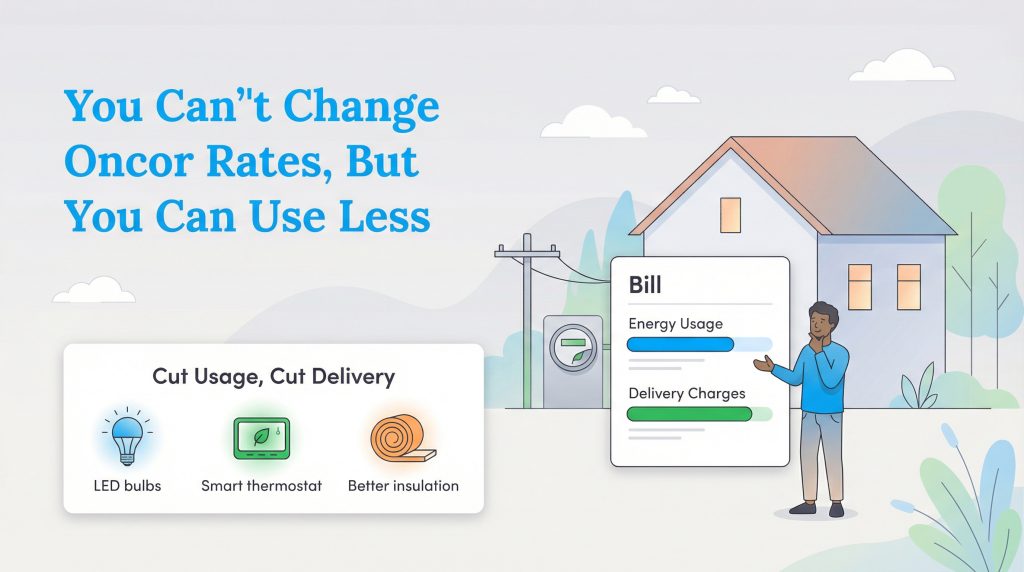
Because the state actively regulates these baseline rates, you cannot call Oncor to negotiate a lower fee. However, you absolutely can reduce the financial impact on your wallet by actively shrinking your household consumption and making smarter daily choices. Here are actionable directives to help offset these utility fees:
- Lower Your Overall kWh Consumption: The bulk of the delivery fee is strictly usage-based, meaning every single kilowatt-hour you avoid using saves you money on both your energy and delivery costs simultaneously. Upgrading to a smart thermostat, which can save 8% on heating, or improving your home’s attic insulation directly reduces the painful variable portion of the fee. For more ideas, check out our guide on how to save on your electric bill.
- Shop for Flat-Rate Energy Plans: Look for fixed-rate electricity plans that offer a low, predictable energy charge. Securing a cheaper energy rate balances out the high TDU costs during peak summer months.
- Invest in Home Efficiency Upgrades: Swap out old incandescent bulbs for LED lighting and ensure your HVAC system is regularly serviced to passively lower the amount of power you draw from the grid each day.
🌱 Eco Edge: Installing solar panels is an environmentally mindful choice that significantly offsets the power you draw from the grid. Every self-consumed kilowatt-hour is one less unit subject to the variable Oncor delivery rate.
Read Your Electricity Facts Label (EFL)
The single most powerful weapon against bill shock is a standardized document called the Electricity Facts Label (EFL). Every retail electric provider is legally required to provide this document before you sign up for a new plan, ensuring total transparency. Here is exactly how to find and decode your Oncor delivery costs within it:
- Locate the Price Section: Open the EFL and look at the very top table, which outlines the average price per kWh at 500, 1,000, and 2,000 kWh usage levels. This gives you a baseline estimate of your all-in costs.
- Find the Disclosures: Scroll down to the “Disclosure Chart” or “Base Charge” section. This is where providers separate their own energy supply cost from the mandatory utility fees.
- Identify the TDU Fees: Look for the specific line items labeled “TDU Delivery Charge” or “Oncor Delivery Charge.” You should see the exact $4.06 fixed base fee and the 6.8673-cent volumetric charge broken out clearly. If a provider claims to have “zero delivery fees,” checking the EFL will quickly reveal whether they simply bundled that cost into a higher overall energy rate.
Beware of “Free Nights and Weekends” Plans
Texas energy marketing can be incredibly persuasive, and “Free Nights and Weekends” plans are among the most heavily advertised options on the market. However, you need to read the fine print carefully. While your retail provider might completely waive the energy supply charge during those specified nighttime hours, the Oncor TDU delivery charges still apply to every single kilowatt-hour you pull from the grid.
If you run your high-energy appliances — like the dishwasher, dryer, or air conditioner — exclusively at night believing the power is 100% free, you will still generate massive Oncor volumetric fees. The utility company does not care what time of day you use electricity; they only care about the volume traveling through their wires. Furthermore, these plans typically charge significantly higher energy rates during the daytime to offset the “free” nighttime hours. Always factor in these unavoidable delivery costs and check your historical usage before committing to a time-of-use plan.
Who to Contact for Power Outages

When the lights unexpectedly go out, many Texans mistakenly reach for the phone to call their retail electricity provider. Remember, your REP just handles the monthly billing and customer service side of your plan. Oncor manages the physical poles, transformers, and wires. If you experience a local grid emergency, spot a downed power line, or lose power during a storm, you need to contact the utility directly so they can dispatch a repair crew.
- Phone: Call the 24/7 Oncor outage reporting line directly at 888-313-4747.
- Text: Text “OUT” to 66267 (MyOncor) from a registered mobile device for quick reporting.
- Online: Visit the official Oncor Online Outage Map to report an issue, track neighborhood outages, or check the estimated restoration time for your specific address.
Comparing Oncor to Other Texas TDUs
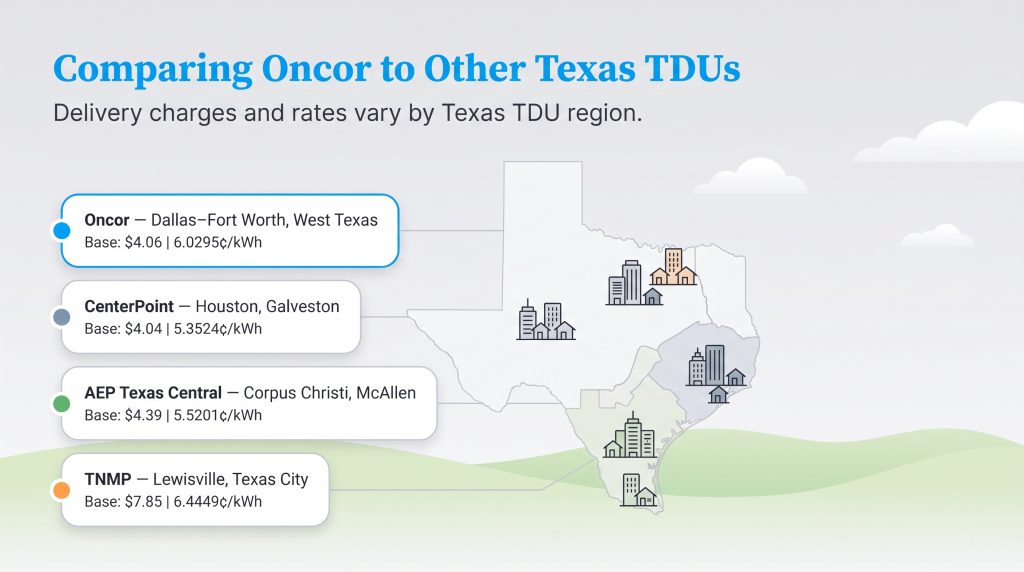
If you are moving across the state, you might notice an immediate difference in your utility costs. Texas is divided into several regional TDU service areas. While Oncor is the largest, it is just one piece of the statewide grid. Here is how the Oncor delivery rate per kWh stacks up against the other major Texas transmission and distribution utilities as of Q4 2026:
| TDU Provider | Primary Service Area | Fixed Base Charge | Variable Rate (per kWh) |
|---|---|---|---|
| Oncor | Dallas, Fort Worth, West Texas | $4.06 | 6.8673¢ |
| CenterPoint Energy | Houston, Galveston | $4.90 | 6.4130¢ |
| AEP Texas Central | Corpus Christi, McAllen | $3.24 | 5.7554¢ |
| Texas-New Mexico Power (TNMP) | Lewisville, Texas City | $7.85 | 7.4022¢ |
Taking Control of Your Texas Energy Bill

Seeing the Oncor delivery charge consistently inflate your monthly statement can feel incredibly frustrating. However, understanding that this specific fee pays for the essential wires, poles, and storm recovery efforts that keep your home powered safely helps put the cost into better perspective. You may not be able to change the regulatory rate set by the Public Utility Commission of Texas, but by understanding the math and focusing heavily on your personal energy efficiency, you can exert real control over your final invoice. Focus heavily on what you can change — your home’s baseline efficiency and your daily habits — to make smart, sustainable decisions that keep your electricity bills manageable regardless of the season.
Frequently Asked Questions About Oncor Delivery Charges
What was the October 2026 Oncor delivery charge increase?
Can I opt out of or avoid Oncor delivery charges?
Are Oncor delivery charges included in my advertised energy rate?
How often do Oncor delivery charges change?
Who approves Oncor’s delivery rate increases?
Do all Texas electricity providers charge the same Oncor delivery fee?
How do I dispute an Oncor delivery charge on my bill?
Does Oncor make a profit off the delivery charges on my bill?
Why is my Oncor delivery charge higher than my energy charge?
Do solar panels eliminate Oncor delivery charges?
Where can I find the official Oncor tariff rates?
About the Author

David has been an integral part of some of the biggest utility sites on the internet, including InMyArea.com, HighSpeedInternet.com, BroadbandNow.com, and U.S. News. He brings over 15 years of experience writing about, compiling and analyzing utility data.

LaLeesha has a Masters degree in English and enjoys writing whenever she has the chance. She is passionate about gardening, reducing her carbon footprint, and protecting the environment. She also recently served as President of the Board for City Sprouts (a community garden).