
How the Oncor Settlement Impacts Texas Residential Electricity Bills and What Ratepayers Can Do
Key Takeaways
- The Public Utility Commission of Texas approved a settlement authorizing an average $4.64 monthly delivery fee increase for residential customers using 1,000 kWh.
- Negotiated settlements with city coalitions reduced Oncor’s initial $834 million rate request by over 30%, capping the annual revenue increase at $565 million.
- Texas households in Oncor service territories can offset higher delivery fees through energy efficiency upgrades and competitive retail electric plan selection.
Texas electricity customers in the Oncor service territory are seeing an adjustment in their monthly utility bills following a major regulatory decision. The Public Utility Commission of Texas (PUCT) finalized a comprehensive base rate settlement for Oncor Electric Delivery Company LLC, approving an average increase of $4.64 per month for a typical residential home using 1,000 kilowatt-hours (kWh) of power. While any rate increase adds pressure to household budgets, consumer advocacy groups successfully negotiated to scale back Oncor’s original rate hike proposal by more than 30%. In this guide, we break down why delivery rates are rising, how transmission charges affect your bill, and what practical steps you can take to manage your energy expenses.
Why Oncor Filed for a Delivery Rate Increase
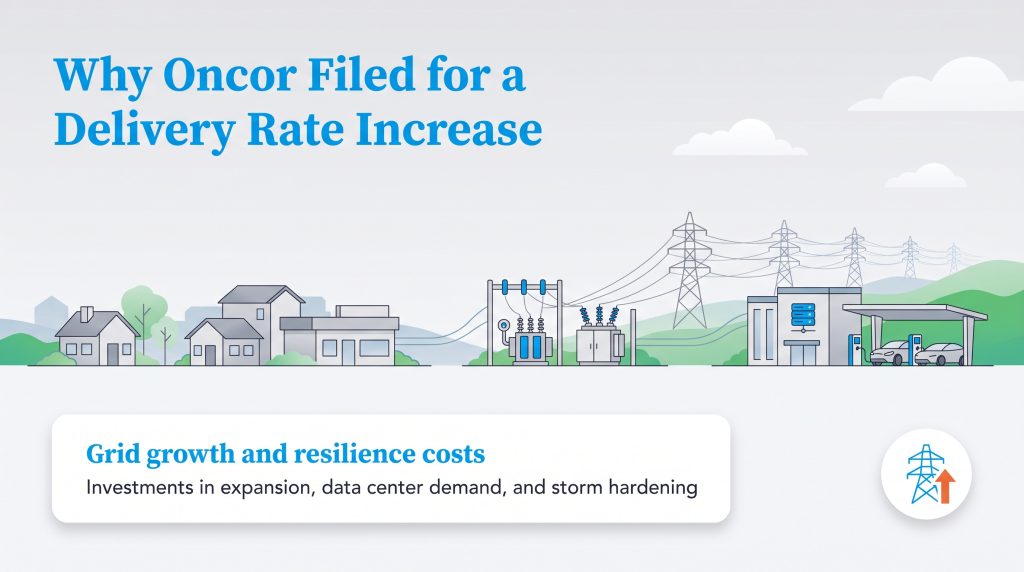
Transmission and distribution service providers must periodically request rate reviews from state regulators to align their revenue with system expansion expenses. Oncor serves more than 13 million customers across North, Central, and West Texas, maintaining thousands of miles of power lines and substations.
Grid Infrastructure and Data Center Demand
Texas continues to experience unprecedented population growth alongside rapid industrial expansion. High-density commercial connections — including artificial intelligence data centers, manufacturing plants, and EV charging networks — place significant demand on the ERCOT power grid. To maintain reliability, Oncor invested heavily in high-voltage transmission lines, substation upgrades, and smart grid automation.
Storm Recovery and Cost Inflation
Prior to this review, Oncor’s base rates were set using 2021 operating costs. Since then, general inflation has increased the expense of electrical equipment, specialized labor, and raw materials like copper and steel. Additionally, severe weather events across Texas required emergency repairs and system hardening. The approved rate adjustment allows Oncor to recover capital costs incurred while repairing storm damage and reinforcing grid resilience against extreme heat and winter freezing.
Breaking Down the $4.64 Monthly Bill Impact
Understanding how utility delivery charges work can help you interpret the line items on your monthly electric bill. In Texas, your bill is split into two primary components: electricity supply charges set by your Retail Electric Provider (REP) and delivery charges set by your TDSP utility like Oncor.
According to official filings on the Oncor Electric Delivery Rate Case Notice, Oncor originally requested an $834 million annual revenue increase, which would have added roughly $7 per month to average residential bills. However, negotiations led by the Texas Cities Coalition for Affordable Utility Rates Settlement Announcement successfully reduced the approved increase to $565 million.
The table below outlines the rate changes approved by the PUCT and analyzed by BKV Energy Delivery Charge Analysis:
| Rate Component | Previous Oncor Rate | Approved Oncor Rate | Net Change |
| Fixed Monthly Base Charge | $4.23 / month | $4.06 / month | -$0.17 / month |
| Volumetric Delivery Charge | $0.056183 / kWh | $0.061196 / kWh | +$0.005013 / kWh |
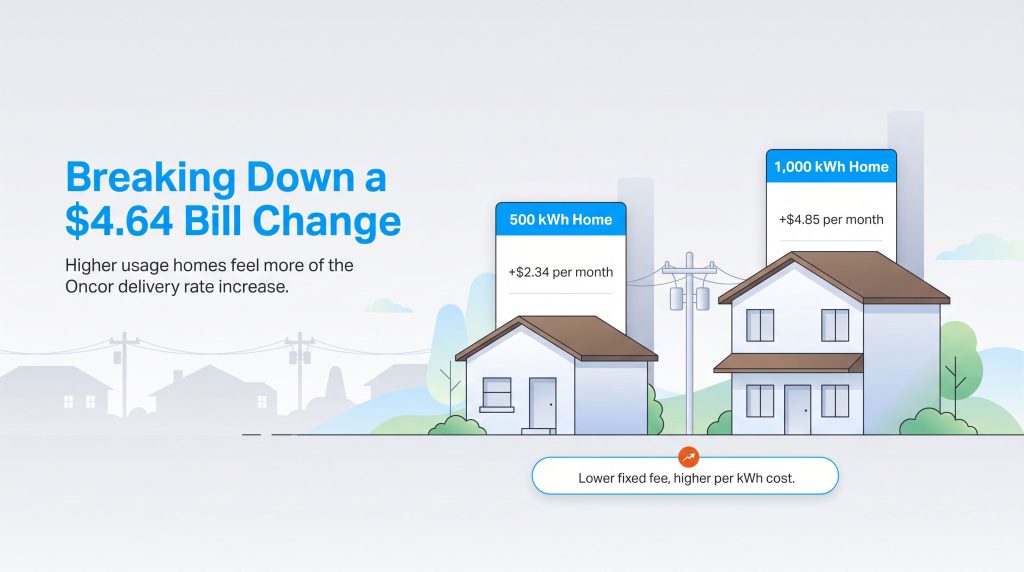
| Total Monthly Bill (at 500 kWh) | $32.32 / month | $34.66 / month | +$2.34 / month (+7.2%) |
| Total Monthly Bill (at 1,000 kWh) | $60.41 / month | $65.26 / month | +$4.85 / month (+8.0%) |
Because the volumetric fee increased while the fixed monthly customer charge decreased slightly, households with lower monthly power usage see a smaller total dollar increase than high-usage homes.
Major Cities and Texas Regions Impacted by the Rate Hike
Oncor operates as the largest transmission and distribution electric utility in Texas, delivering electricity across 91 counties and more than 400 communities. If you live in North, Central, or West Texas, your monthly electric bill is likely subject to Oncor’s newly approved TDSP delivery rates.
The rate increase affects millions of residential and commercial customers across key Texas metropolitan areas and economic hubs, including:
- Dallas-Fort Worth Metroplex: Dallas, Fort Worth, Arlington, Plano, and Irving.
- Central Texas and Brazos Valley: Waco, Temple, and Killeen.
- West Texas and Permian Basin: Midland, Odessa, and San Angelo.
Because Oncor’s service territory covers the state’s fastest-growing residential markets and major energy production centers, households throughout these regions will see the $4.64 monthly delivery fee adjustment reflected on their Retail Electric Provider statements.
How ERCOT and Retail Electric Providers Pass Through TDSP Charges
It is important to remember that Oncor does not generate electricity or sell energy plans directly to consumers. In the deregulated ERCOT market, Retail Electric Providers manage your account, billing, and customer service.
When the PUCT approves a TDSP delivery rate change, REPs pass these regulated charges through directly to consumers on a dollar-for-dollar basis. Even if you hold a fixed-rate retail electricity contract, state regulations allow your REP to update the pass-through delivery line item when utility rates change. Your supply rate per kWh remains fixed, but the Oncor delivery fee portion reflects the new approved tariff.
Actionable Steps Texas Homeowners Can Take to Lower Energy Costs
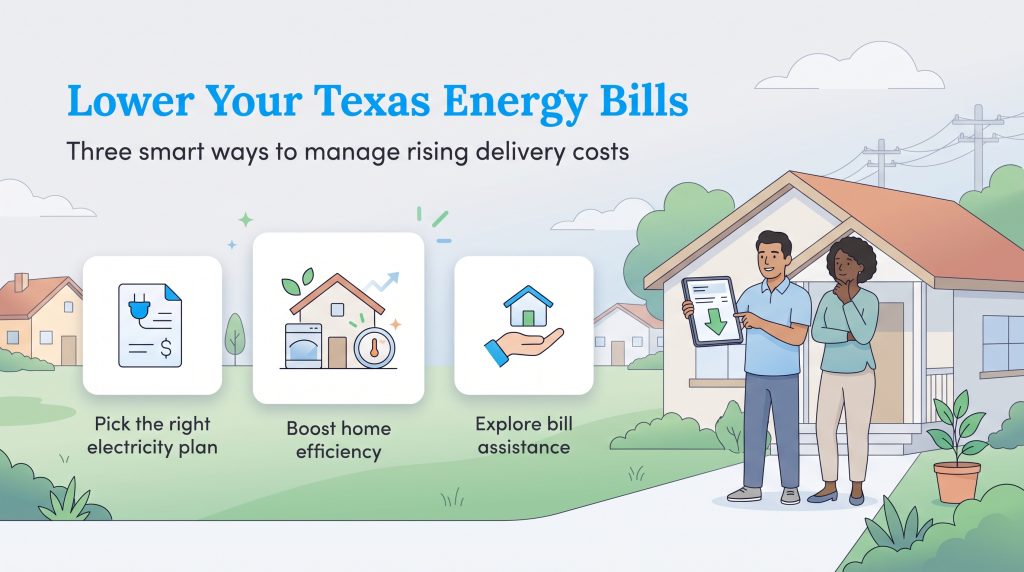
While you cannot choose a different delivery utility in Oncor’s service territory, you have full control over your electricity usage and choice of retail provider. Here are three effective strategies to protect your household budget against rising utility delivery rates.
Select the Right Retail Electricity Plan
Compare active electricity offers in your ZIP code to ensure you are not overpaying for energy supply. Look for fixed-rate contracts that match your seasonal usage patterns, and avoid plan structures with steep minimum usage fees or hidden penalties.
Invest in Home Energy Efficiency
Reducing your total kilowatt-hour consumption directly lowers both your energy supply costs and Oncor’s volumetric delivery charges. Simple, eco-conscious alternatives include installing a programmable smart thermostat, sealing air leaks around doors and windows, and upgrading to ENERGY STAR certified appliances.
Explore Financial Assistance Programs
If rising utility bills create financial hardship, explore federal and state assistance programs. The Low-Income Home Energy Assistance Program (LIHEAP) and local community action agencies provide grant assistance and weatherization support for qualifying households.
Navigating Higher Utility Delivery Rates in Texas
As Texas continues to invest in grid modernization and capacity growth, delivery charges will remain a critical focus for consumer regulators and ratepayers. By staying informed about PUCT decisions and implementing proactive home energy management, you can keep your monthly utility expenses predictable and manageable.
About the Author

Claudio is a sustainability-focused writer with a background in Anthropology and Psychology from NC State University. He has spent over 15 years working in writing, interpretation, and translation, driven by a deep interest in how human culture shapes the environment. Today, he shares his curiosity with readers by writing about sustainable living solutions and the connection between everyday choices and environmental impact.