


Understanding How This Digital Upgrade Affects Your Energy Bills, Privacy, and Home Efficiency
Key Takeaways
- Smart meters communicate wirelessly with your utility company to provide accurate, real-time energy usage data without manual readings.
- They enable Time-of-Use rates, allowing you to lower your monthly bill by shifting energy-intensive chores to off-peak hours.
- You can often opt out of a smart meter installation due to health or privacy concerns, though this usually comes with an extra monthly fee.
If you recently received a notice from your utility company about a meter upgrade, or you just noticed a digital device replacing the old spinning dials on the side of your house, you might be feeling a bit skeptical. While new hardware can feel intrusive, these devices are designed to modernize the aging power grid and give you much better control over your daily energy consumption. Here is everything you need to know about what this device actually does, how it calculates your monthly expenses, and why utility providers are pushing for this technological leap.
What Is a Smart Meter and How Is It Different?
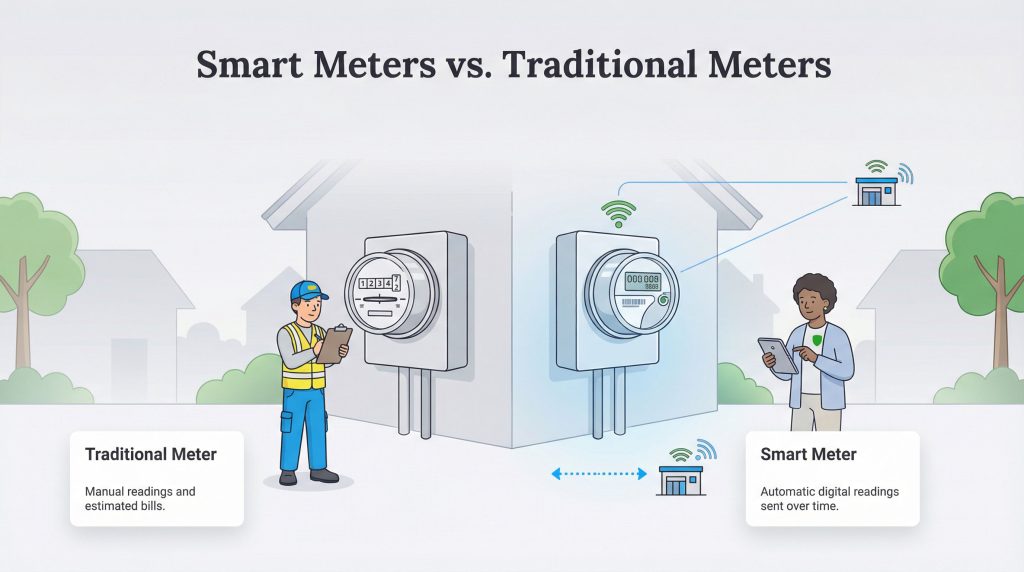
A smart meter is a highly accurate digital device that records your energy consumption and sends that information directly to your electricity supplier. In the utility industry, this specific technology is known as Advanced Metering Infrastructure (AMI). At its core, AMI represents a robust two-way communication system between your home and your utility provider. Unlike the old mechanical meters that required a utility worker to physically walk through your yard and log the numbers manually, smart meters automate the entire process from start to finish.
The real game-changer is this active communication. Traditional electromechanical meters are entirely passive devices that just sit on your wall until someone comes to inspect them. Smart meters, however, are active data loggers. They capture your usage in regular intervals — usually every 15 minutes or every hour — and transmit it wirelessly back to the central office. This constant feed of information means your electric service provider never has to estimate your monthly bill during bad weather or times when they cannot safely access your property.
AMI vs. AMR Technologies
Before modern smart meters became the national standard, many utility companies deployed a transitional technology known as Automatic Meter Reading (AMR). While AMR was a massive step up from manual readings, it was fundamentally limited by its one-way communication design.
| Technology | Communication Direction | Data Collection Method | Outage Detection |
|---|---|---|---|
| AMR (Automatic Meter Reading) | One-way | Utility workers drive down your street and collect data via local radio signals. | Manual (You must call the utility to report a power loss). |
| AMI (Advanced Metering Infrastructure) | Two-way | Continuous remote transmission directly to the utility’s central hub. | Automatic and instant (The system alerts the utility immediately). |
How Do Smart Meters Actually Measure Electricity?
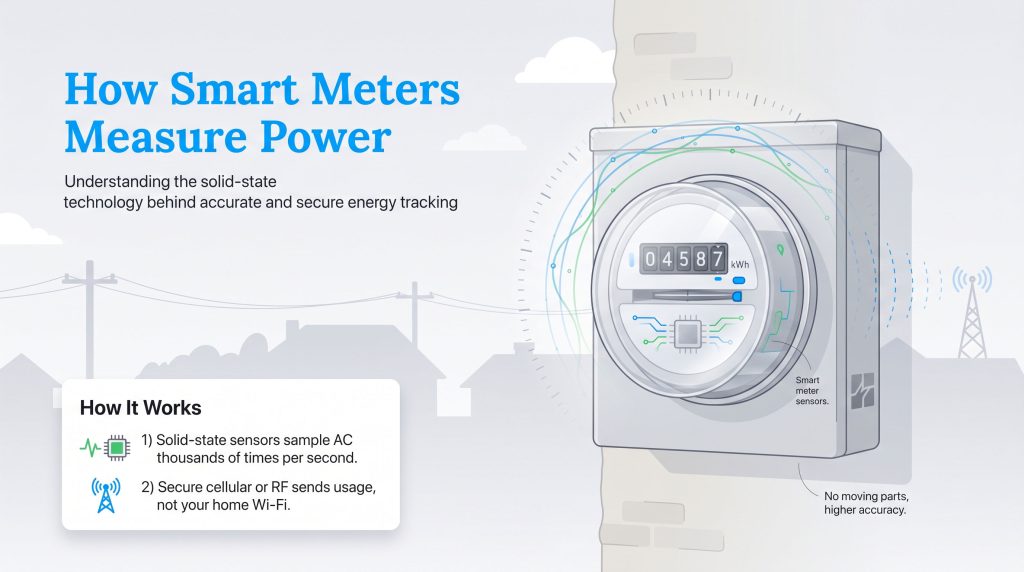
To understand why this upgrade is necessary, you have to look inside the hardware. Traditional analog meters relied heavily on passive magnetic forces and moving parts. As electricity flowed into your home, it created an electromagnetic field that physically spun an aluminum disc inside the glass casing. Over decades, this spinning disc experienced constant friction, causing the internal gears to wear down and gradually lose their accuracy.
Modern smart meters throw out those moving parts entirely. Instead of physical gears, they use solid-state digital encoders. Advanced alternating current (AC) sensors sit inside the meter and take thousands of high-frequency digital samples every second. These sample rates calculate your real-time power consumption with pinpoint mathematical accuracy, eliminating the mechanical wear and tear that plagued old analog models.
Once the digital encoder measures your usage, the device relies on its secure network to relay the data. We find it helpful to distinguish between the smart meter itself and an In-Home Display (IHD). The smart meter is the gray box bolted to your outside wall containing the secure cellular or radio frequency (RF) chips. The In-Home Display is a separate, small portable screen that you can keep inside your house to track your usage in real time. Your smart meter functions perfectly fine even if you never plug in an IHD, but the display is an incredibly helpful tool for spotting energy hogs in your living room or kitchen.
A frequent misconception is that smart meters tap into your home internet connection. Generally, they do not. Because they utilize a dedicated municipal cellular connection or a secure RF mesh network, they operate completely independently of your personal internet setup and never require your Wi-Fi password.
💡 Pro Tip: You don’t need Wi-Fi for a smart meter to work, but connecting your In-Home Display to your local Wi-Fi can help you track real-time data directly on your smartphone app.
The Pros and Cons of Smart Meters
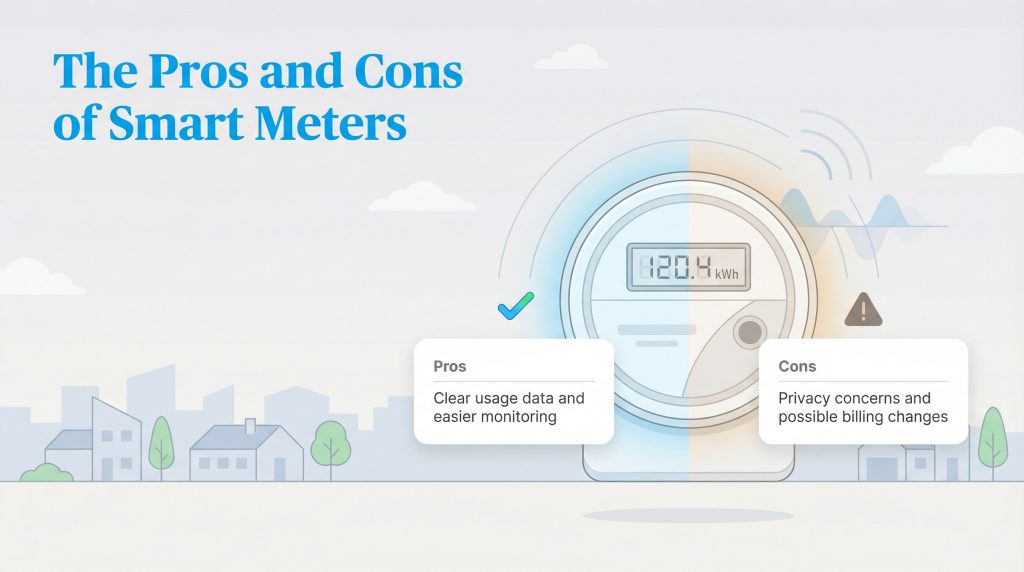
Like any major infrastructure upgrade, smart meters come with distinct daily advantages and a few valid drawbacks. Understanding both sides of the coin will help you decide if you want to fully utilize the technology or explore local opt-out programs in your municipality.
| Aspect | Pros | Cons |
|---|---|---|
| Billing & Accuracy | Accurate, no estimated reads; you pay for exactly what you use. | Opt-out programs may add ongoing monthly fees to your bill. |
| Grid Convenience | Faster outage detection and significantly improved smart grid reliability. | Remote power disconnects can feel abrupt if bills go unpaid. |
| Home Privacy | Less need for utility workers accessing your property or backyard. | Detailed digital usage data can potentially reveal your routine home patterns. |
Do Smart Meters Save You Money?
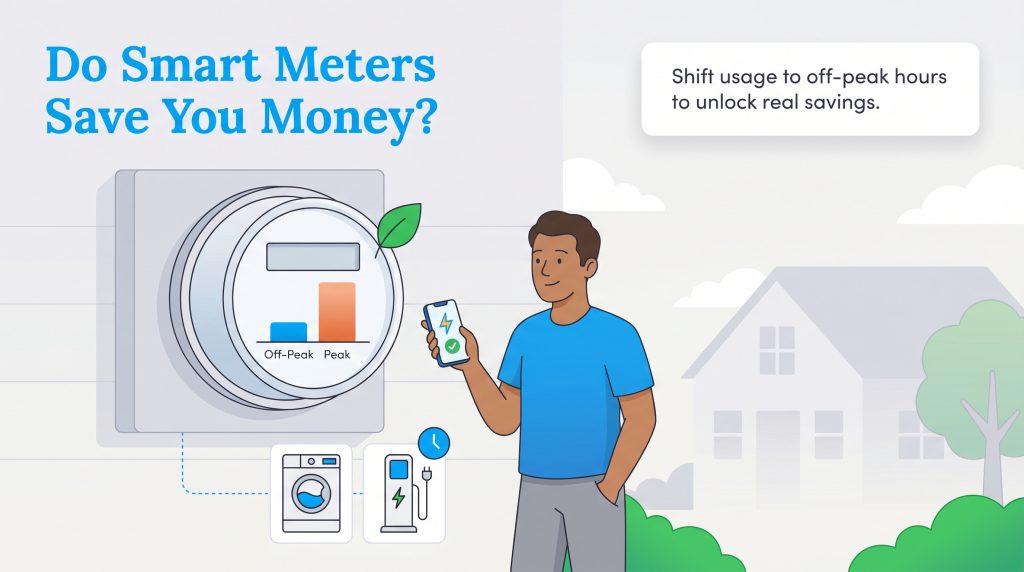
The short answer is that the hardware itself doesn’t magically save you money. It is simply a highly accurate measuring device. However, it acts as a powerful financial tool that helps you save money if you actively change your household behavior. Because smart meters track exactly when you use electricity, they open the door to highly specific billing plans that reward household efficiency.
The biggest financial benefit stems from Time-of-Use (TOU) rates. With a standard analog meter, you pay a flat rate for electricity regardless of the time of day. With a smart meter, your provider can offer cheaper rates during “off-peak” hours when regional demand on the power grid drops. You can significantly lower your bill by shifting energy-intensive chores to these inexpensive times.
For example, running your electric dryer at 4:00 p.m. usually costs you more because that is a peak demand period. If you wait and run that exact same load at 9:00 p.m., the rate per kilowatt-hour might drop considerably. Smart meters grant you the raw data needed to make these strategic decisions. Using your smart meter to shift usage away from peak hours is an energy-saving option that also lowers the strain on local power plants, supporting a more environmentally mindful choice for your community. If you want to dive deeper into reducing your monthly costs, check out our guide on how to save on your electric bill.
💸 Money-Saver: Check if your utility provider offers a “free nights or weekends” electricity plan. These massive discount structures are only made possible by smart meter technology.
Integrating Home Energy Management Systems (HEMS)
To maximize your savings, consider connecting your meter to a centralized Home Energy Management System (HEMS). A HEMS serves as a digital hub, pulling continuous data from your meter and translating it into actionable automated insights. Here are a few practical ways to leverage a HEMS in your daily routine:
- Automate smart appliances: Link your HEMS to a smart washing machine or EV charger so they automatically power on only during the cheapest off-peak rate windows.
- Control thermostat behavior: Sync your smart thermostat to dial back the air conditioning by a few degrees whenever real-time electricity prices spike in the afternoon.
- Track hidden phantom loads: Identify major appliances that slowly drain power even when turned off, helping you unplug energy vampires around your living room.
- Establish rigid monthly budgets: Receive instant push notifications on your phone the moment you cross your target utility spending limit for the month.
Smart Meters and Solar Power: Bidirectional Metering
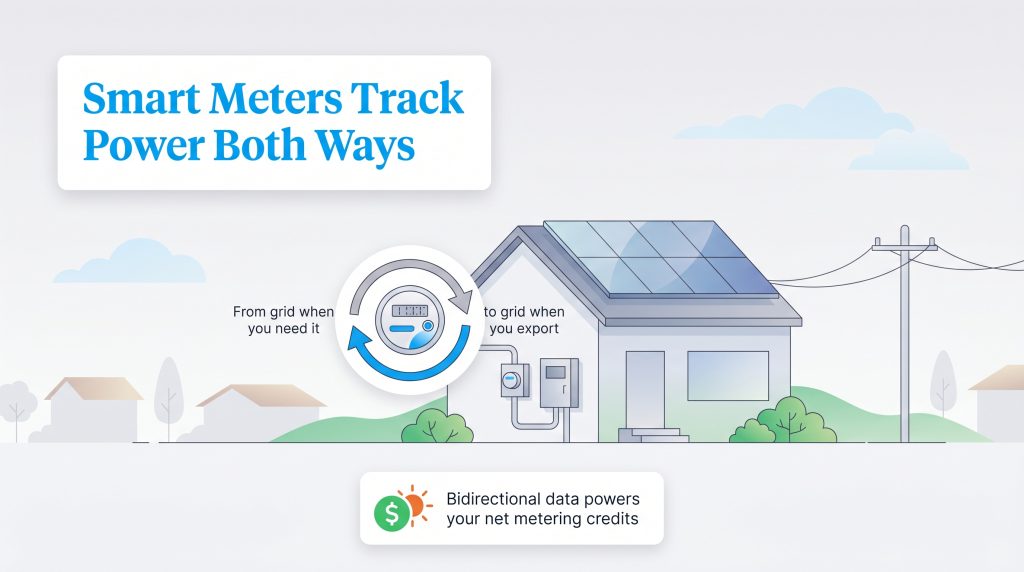
If you are planning to install rooftop solar panels, a smart meter is an absolutely essential component of your home’s infrastructure. Whenever you generate your own renewable electricity through a grid-tied solar system, you require a specialized device capable of handling bidirectional metering.
Unlike standard meters that only count forward, bidirectional smart meters record energy flowing in two distinctly different directions. First, they measure the electricity you pull from the municipal grid on cloudy days or late at night when your solar array isn’t generating sufficient power. Second, they meticulously track the excess solar energy your panels produce and push back into the public grid during peak sunlight hours.
This two-way tracking forms the backbone of modern net metering policies. Utility companies rely on this bidirectional data stream to calculate your net metering credits, effectively paying you back for the surplus clean energy you supply to your neighborhood. Without a bidirectional smart meter, monetizing your solar investment and securing those valuable credits would be virtually impossible. Upgrading to one represents a brilliant eco-conscious alternative to traditional grid reliance.
☀️ Solar Savings: If you are installing solar panels, thoroughly review your provider’s specific net metering policies, as buyback rates for your excess power can vary significantly by state.
Addressing Health, Privacy, and Security Concerns
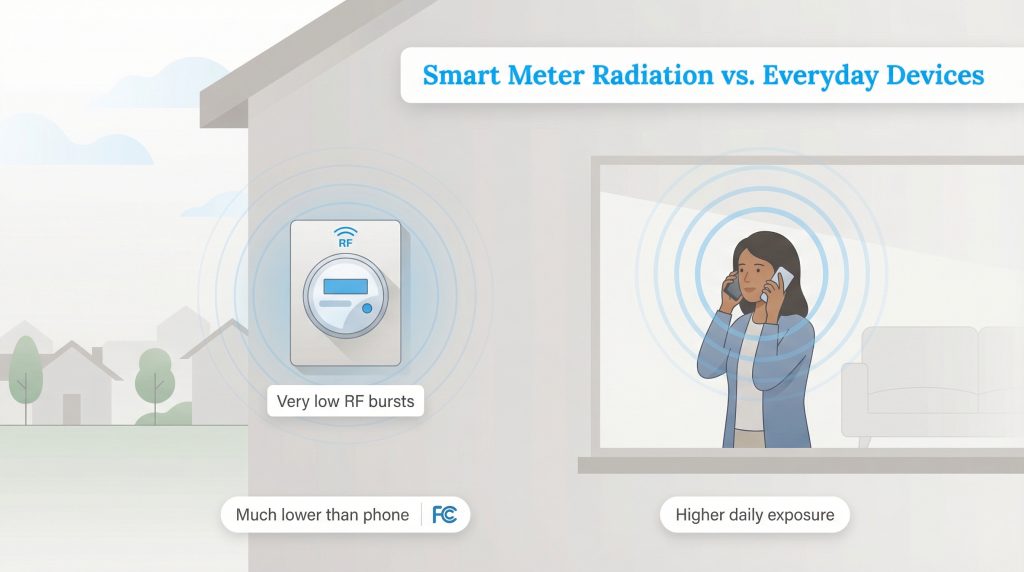
We understand that health and data privacy concerns often make homeowners hesitate to accept this new infrastructure. The worry typically centers on radio frequency (RF) radiation and data security. It is true that smart meters emit RF waves to communicate across neighborhoods, much like your cell phone or Wi-Fi router does. However, the everyday exposure levels are vastly different.
According to regulatory bodies like the Federal Communications Commission (FCC), the RF energy emitted by smart meters is well below the safety limits for public exposure. In fact, a person standing near a smart meter receives significantly less RF exposure than they would from holding a cell phone to their ear or using a baby monitor in a nursery. The intensity of RF energy drops off very quickly as you move just a few feet away from the source.
Smart meters don’t broadcast a continuous signal. They transmit their data packets in short micro-bursts that usually total less than a minute of actual transmission time per day. Additionally, these devices must meet rigorous physical safety standards. Modern smart meters must pass stringent UL Certification for fire and electrical safety to guarantee they won’t overheat or cause dangerous electrical shorts against the side of your home. If you ever detect a burning plastic smell near your meter box, contact your utility provider immediately — though such malfunctions are exceedingly rare with properly certified hardware.
On the digital privacy side, utility networks use heavy encryption to protect your usage habits. While the meter transmits how many kilowatts you draw, it absolutely does not record your name, address, or financial details over the open airwaves. The raw data is routed through a secure, closed network directly to your provider’s billing department.
Can You Opt Out of a Smart Meter?
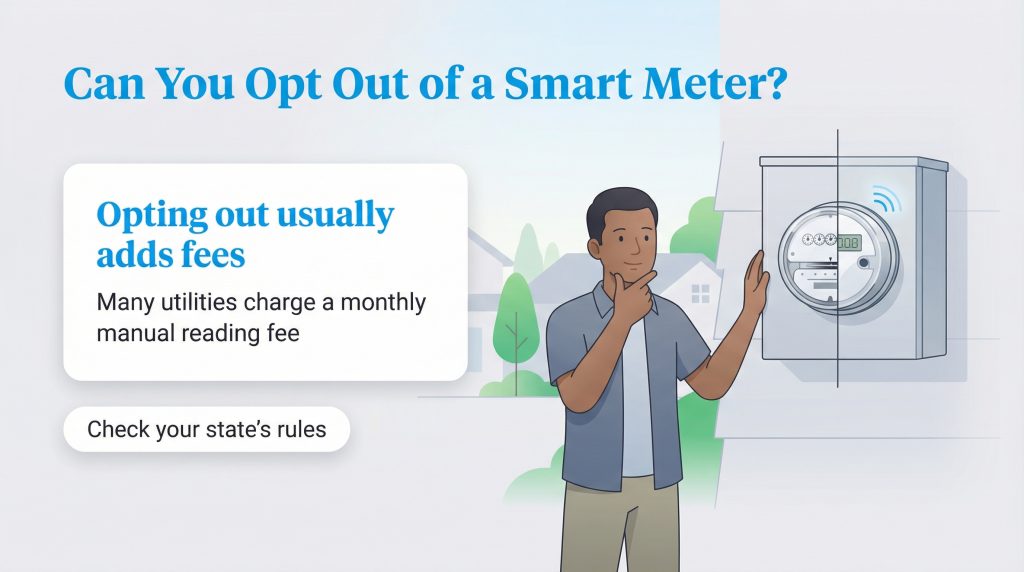
If you weigh the pros and cons and ultimately decide a smart meter isn’t a good fit for your family, you can usually elect to keep your old analog meter. However, the policies regarding refusal vary wildly depending on your state legislation and your specific utility provider. Unlike in some European countries where installation is entirely voluntary, in the U.S., you almost always have to take active, formal steps to refuse the hardware upgrade.
The primary hurdle is the financial cost. Because opting out completely breaks the utility’s automated network in your neighborhood, the company must continue sending a commercial truck and an employee to your address to read your meter manually. They will quickly pass this labor cost directly to you. You can expect to pay a one-time setup fee to reinstall a non-transmitting meter, plus a recurring monthly manual reading fee that routinely ranges from $10 to $30. Because these rules are determined at the state level, we highly recommend checking your state public utility commission’s website or your utility’s tariff schedule for the exact fees in your zip code.
If you remain determined to opt out, call your utility provider’s primary customer service line and ask specifically for their Opt-Out Program department. They will mail you the necessary legal forms and thoroughly explain the local fee structure.
🚩 Heads Up: Moving into a new home? Check the existing electrical meter immediately upon arrival. If it’s already a smart model, reverting backward to an analog device might be difficult or legally impossible depending on your local grid laws.
Preparing for a Modern Energy Grid
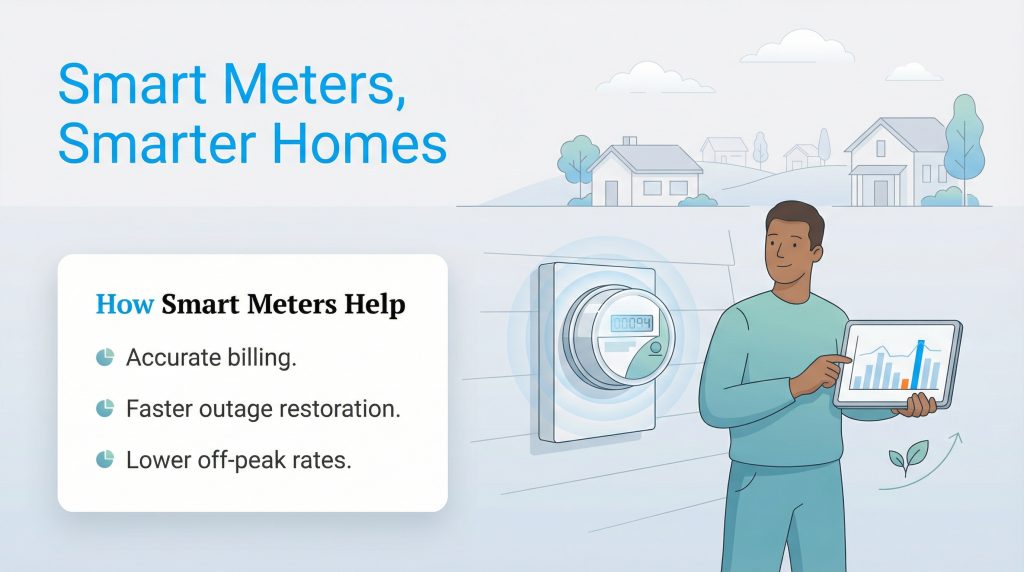
Smart meters serve as the technological backbone of a highly responsive, decentralized energy grid. While the immediate personal benefits like pinpoint accurate billing and discounted off-peak rates are excellent for your wallet, these devices carry far more weight on a macro level. They play an essential role in balancing the broader power grid to prevent rolling blackouts. By feeding grid operators constant real-time demand data, utility companies can instantaneously reroute power and manage loads during extreme weather events, ensuring neighborhood reliability.
To fully prepare your home for this dynamic energy landscape, we recommend taking three immediate steps to utilize your new smart meter data:
- Register for your digital portal: Create an account on your provider’s website to access your personal dashboard and review your hourly usage charts.
- Audit your family’s routines: Identify your peak household usage hours and brainstorm which heavy appliances you can permanently shift to off-peak times.
- Evaluate alternative rate plans: Contact your provider to see if they offer specialized Time-of-Use tiers or EV charging plans that perfectly align with your newly discovered habits.
Taking Charge of Your Utility Costs
Ultimately, observing precisely where your energy dollars go is the foundational step toward securing a lower monthly bill and cultivating a truly sustainable home environment. Whether you are aiming to shrink your carbon footprint with eco-friendly optimizations or simply trying to keep more cash in your wallet each month, leveraging the rich data from your smart meter puts you firmly in the driver’s seat. Embrace these digital insights, tweak your daily routines, and watch your household efficiency soar.
Frequently Asked Questions About Smart Meters
Will a smart meter increase my electric bill?
How accurate are smart meters compared to old analog meters?
Can smart meters spy on my specific appliances?
Can I connect my smart meter to my smart home devices?
Do I need to be home for a smart meter installation?
Does a smart meter use my Wi-Fi bandwidth?
How do I read a smart meter?
Are smart meters safe for my health?
Are smart meters UL certified for fire safety?
About the Author

David has been an integral part of some of the biggest utility sites on the internet, including InMyArea.com, HighSpeedInternet.com, BroadbandNow.com, and U.S. News. He brings over 15 years of experience writing about, compiling and analyzing utility data.

Jared Evans is a licensed electrician and the owner of Full Circuit Electric in Omaha, Nebraska. As an expert reviewer for UtilitiesForMyHome.com, Jared uses his 10+ years of hands-on experience to ensure our electrical advice is safe, accurate, and easy to follow. Whether he's troubleshooting a complex wiring issue or sharing tips on green energy upgrades, Jared is dedicated to helping you power your home efficiently — and safely.

LaLeesha has a Masters degree in English and enjoys writing whenever she has the chance. She is passionate about gardening, reducing her carbon footprint, and protecting the environment. She also recently served as President of the Board for City Sprouts (a community garden).