

Find Out If Time-Of-Use Energy Plans Actually Save You Money Or Just Shift The Costs To Your Daytime Usage
Key Takeaways
- Free nights or weekends plans charge higher daytime rates to offset the cost of the free off-peak periods.
- You typically need to shift half or more of your energy usage to the free hours to see actual financial savings compared to a fixed-rate plan.
- Reading the Electricity Facts Label (EFL) is essential to uncover easy-to-miss delivery charges and minimum usage fees.
Are free nights or weekends plans actually worth it, or are they just a clever marketing gimmick designed to lock you into a higher bill? While getting a crucial household utility for free sounds incredibly appealing, signing up for one of these contracts requires a significant lifestyle shift. In a deregulated energy market, this promotional perk is always subsidized by substantially higher daytime energy rates. We want to protect your budget from unexpectedly high bills, so let’s break down exactly how these promotions work, expose the hidden costs, and help you decide if an energy plan with an off-peak schedule genuinely fits your household’s average monthly usage.
What Are Free Nights And Weekends Electricity Plans?
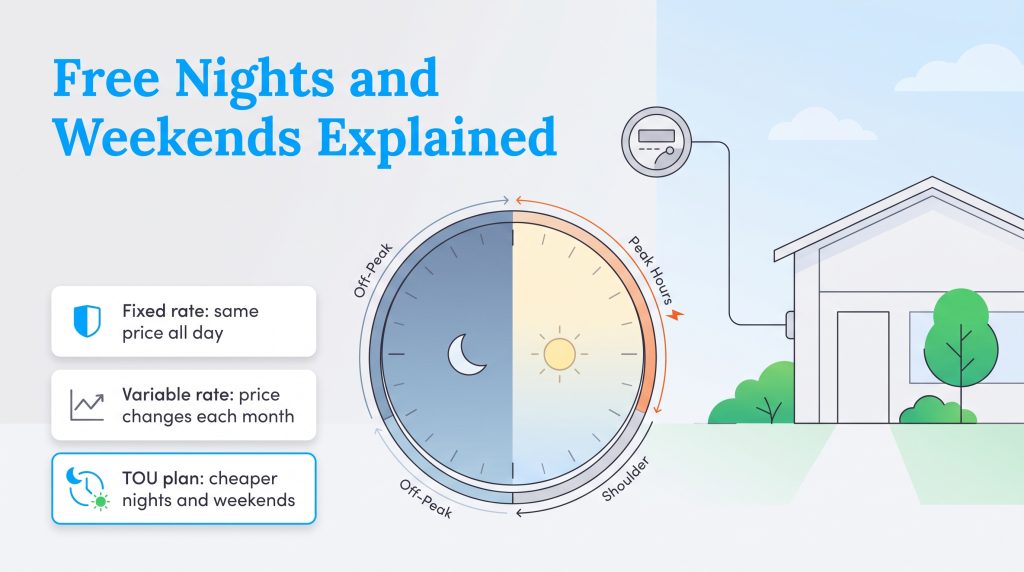
Understanding the mechanics behind these contracts requires looking at how grid demand fluctuates. A free nights or weekends contract is essentially a specialized arrangement that divides your billing into distinct periods based on the time of day. Energy providers can offer these unique structures because your home is equipped with a digital device allowing for precise smart meter energy tracking in real time. When you’re shopping for electric plans, you’ll notice these companies define specific windows where your energy supply charge drops to absolutely zero.
For standard free nights plans, the free window typically stretches from 8:00 p.m. to 6:00 a.m. the following morning. If you opt for a free weekends plan, the zero-charge period usually begins Friday evening around 8:00 p.m. and ends Sunday night at midnight. These precise windows incentivize you to shift your heavy electricity usage to times when the overall power grid is less stressed.
Time-Of-Use (TOU) Pricing Explained
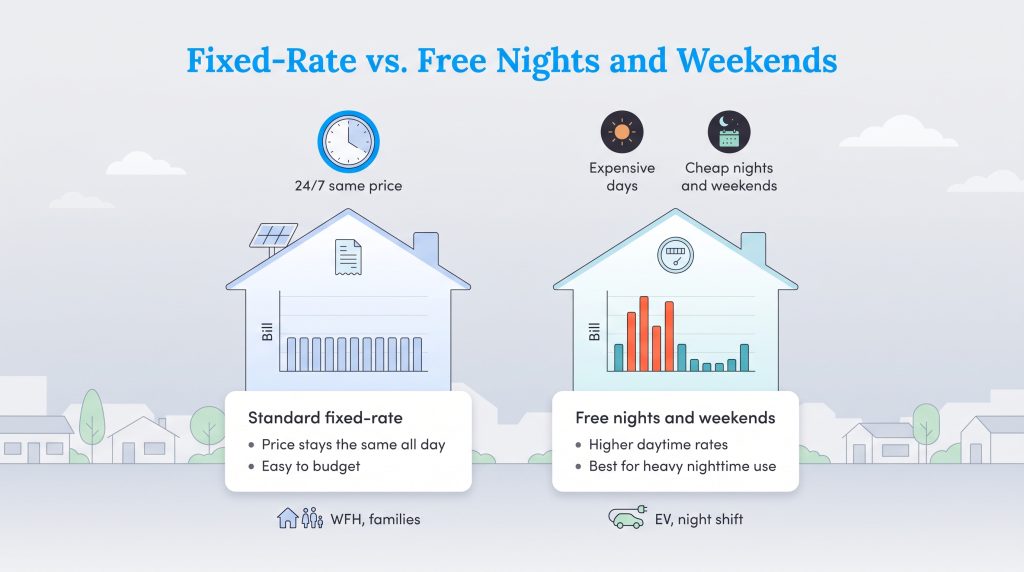
Instead of charging a flat rate, these promotions rely on time-of-use energy plans to encourage electricity consumption when the broader power grid is quiet. To understand fixed-rate vs time-of-use pricing, it helps to break down the three main structures in the modern energy market:
- Standard Fixed-Rate Plan: You pay the exact same price per kilowatt-hour (kWh) regardless of the time of day or season, providing ultimate bill predictability and peace of mind.
- Variable-Rate Plan: Your price per kWh fluctuates month-to-month based on wholesale energy market conditions, meaning your bills can spike unexpectedly during heatwaves or winter storms.
- Time-of-Use (TOU) Plan: Your rate changes predictably throughout the day, offering cheaper or entirely free off-peak hours (like nights or weekends) but charging a steep premium during high-demand daylight periods.
Generating power during daytime peak hours is notoriously expensive, so providers offer TOU incentives to persuade you to shift energy consumption away from late afternoon spikes.
The Catch: Beware Of High Daytime Energy Rates
The primary reason these promotions frequently backfire is a total lack of awareness regarding the inflated pricing during non-promotional hours. High daytime energy rates act as the hidden catch, quietly inflating your monthly costs while you cook dinner, run the air conditioning, or go about your normal morning routine. Providers design these products knowing that most households simply cannot drastically alter their established energy usage habits.
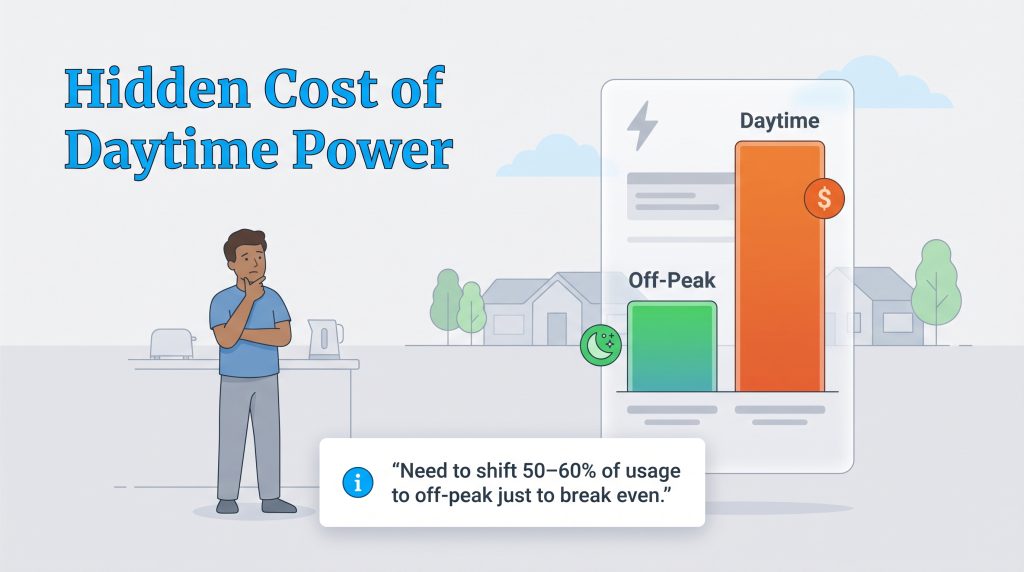
Because your daytime usage is penalized with a steep utility markup, the math is rarely in the average consumer’s favor. As a general rule of thumb, you typically need to shift at least 50% to 60% of your total energy consumption to off-peak electricity hours just to break even against the cost of a standard fixed-rate electricity plan. If you fail to hit that threshold, the inflated daytime rates will cause you to lose money.
How To Read The Electricity Facts Label For Hidden Fees
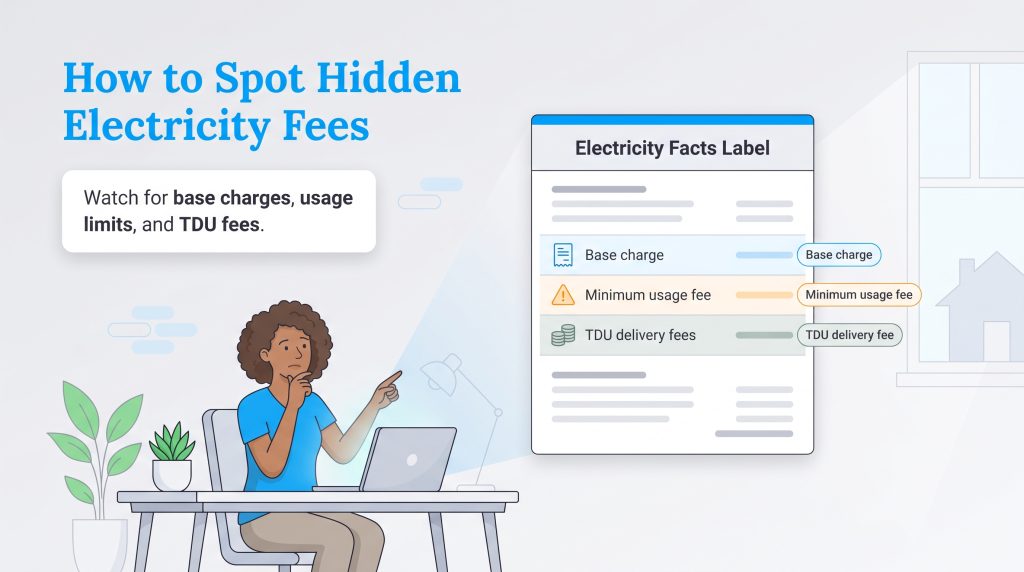
Furthermore, “free” rarely means entirely free. You must pull up the Electricity Facts Label (EFL) for the plan you are considering to spot base charges, minimum usage penalties, and sneaky pass-through costs. Even when your energy supply charge is zeroed out, many providers still pass along local delivery costs from your transmission and distribution utility (known as TDU or TDSP fees in Texas) during the free window. As the U.S. Energy Information Administration highlights, local fuel costs dictate prices nationwide, and those delivery fees can still add up while you sleep.
🚩 Heads Up: Working from home or having a stay-at-home family member makes these promotional plans a notoriously poor fit. The inflated daytime rates will quickly drain your budget while you run your computer, lighting, and air conditioning during peak hours.
Who Should (And Shouldn’t) Choose A Free Energy Plan
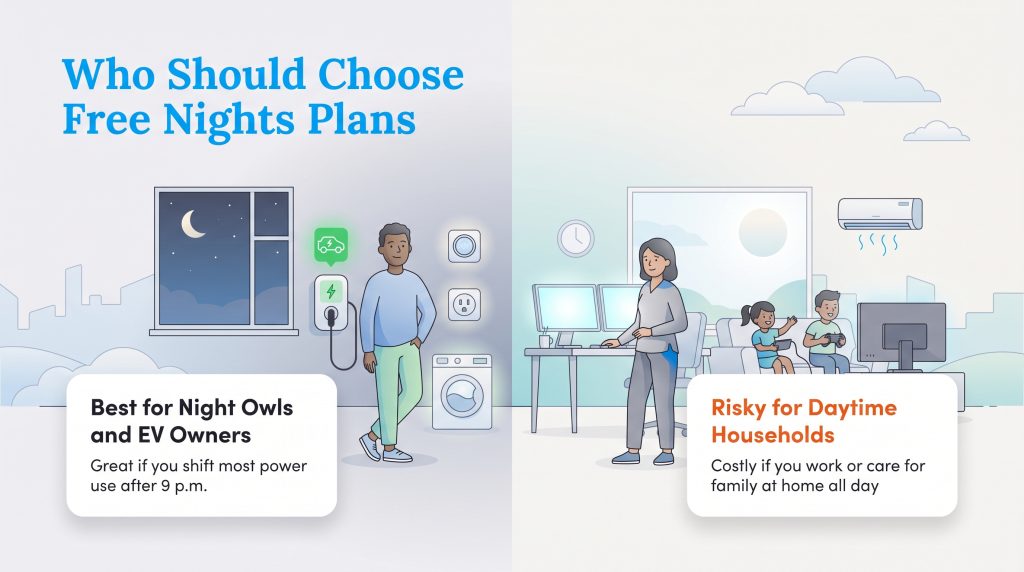
While standard households are almost always better off avoiding these complex billing structures, certain lifestyles can genuinely exploit free nights vs free weekends electricity to achieve massive utility savings. Deciding whether an energy plan contract like this is right for you requires a brutally honest look at your daily routine.
Ideal Candidates for Free Energy Plans:
- Night-shift workers: If you work throughout the day and naturally stay awake all night, your routine perfectly aligns with off-peak electricity hours.
- Households prioritizing EV charging: Electric vehicles demand a tremendous amount of electricity. If you commute daily and program your vehicle to exclusively charge overnight, a free nights plan can effectively eliminate your transportation fuel costs.
- Empty nesters and frequent travelers: If your home sits empty during the peak daytime heat and you primarily use electricity after dark or strictly on weekends, you can easily bypass the highest rates.
- Smart-home automation users: If your home is fully equipped with automated thermostats, smart plugs, and Wi-Fi-enabled appliances, you can effortlessly schedule heavy power loads to kick on the exact minute the free window opens.
The Worst Candidates for These Plans:
- Work-from-home employees: Running your computer monitors, home office lighting, and daytime AC during peak hours will quickly result in exorbitant bills.
- Stay-at-home parents: If you are cooking, doing laundry, or running the dishwasher throughout the morning and afternoon, the inflated daytime rates will heavily punish your budget.
- Large families home during summer days: Kids home from school running electronics and cooling systems during the hottest part of the day will easily wipe out any overnight savings.
Top Free Nights And Weekends Plans Compared
If you live in a deregulated market, you have the power to shop around and find a contract that suits your specific habits. To help you evaluate the best free nights and weekends energy plans, we have compiled a snapshot of how top providers commonly structure their offers. While rates constantly fluctuate based on your zip code, the season, and market conditions, this table highlights what you can generally expect when browsing free electricity plans in Texas and other energy-choice states.
| Provider Name | Plan Type | Free Hours | Estimated Daytime Rate |
|---|---|---|---|
| Just Energy | Free Nights | 9:00 p.m. — 7:00 a.m. | Heavily Inflated Premium |
| Direct Energy | Free Weekends | Friday 6:00 p.m. — Sunday 11:59 p.m. | Heavily Inflated Premium |
| Reliant Energy | Free Nights | 8:00 p.m. — 6:00 a.m. | Heavily Inflated Premium |
Always review the Electricity Facts Label for specific pricing details before enrolling. The base energy charges during the day are often double the standard market rate to financially compensate the provider for the promotional zero-cost period.
Five Ways To Maximize Savings During Free Electricity Hours
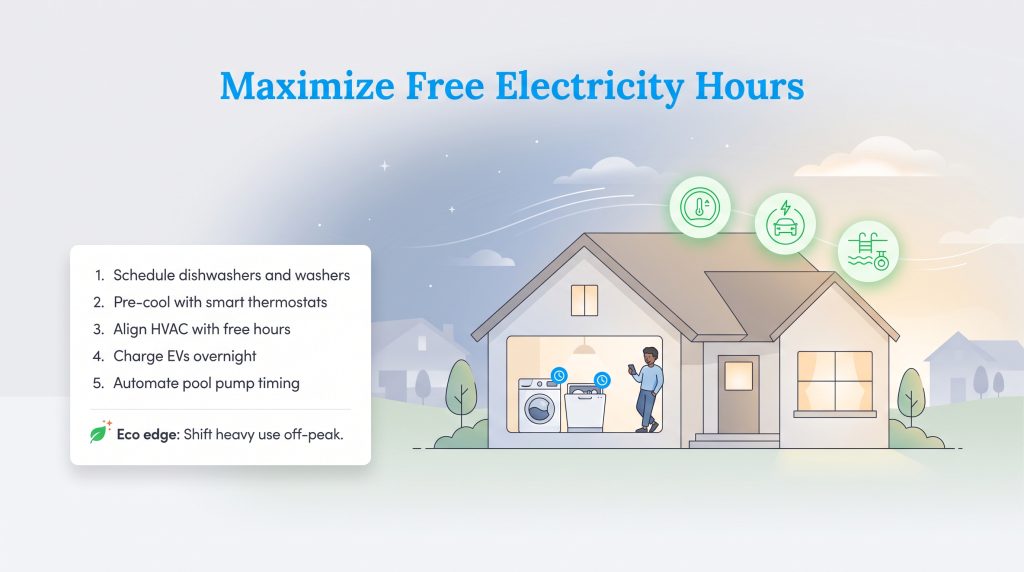
If you passed the self-assessment and want to tackle a time-of-use contract, technology will be your greatest ally. Relying on your memory to manually flip switches at 9:00 p.m. is a recipe for expensive mistakes. Instead, you must actively shift energy consumption by automating your household routines. Try implementing these five practical habit changes to maximize your savings:
- Schedule heavy appliance usage: Modern dishwashers and washing machines feature built-in delay settings. Load your machines after dinner, but program them to delay their start times until your free window begins.
- Pre-cool the home using smart thermostats: Leverage your smart thermostat to drop the temperature a few extra degrees just before the free window ends in the early morning. This lets the lingering chill keep your home comfortable while expensive daytime energy rates kick in.
- Set up smart thermostat automations: Program your HVAC system to match the specific off-peak electricity hours of your energy plan contract. Let the house run slightly warmer during the peak afternoon heat, then blast the AC the minute rates drop to zero.
- Charge electric vehicles overnight: Use your vehicle’s onboard software or a smart Level 2 charger to block all charging activity during peak hours, ensuring your car only draws massive amounts of power overnight.
- Automate your pool pumps: Pool pumps are massive energy drains that must run for several hours a day. Installing a simple timer to restrict your pump’s operation strictly to the overnight window can slash your bill significantly.
🌱 Eco Edge: Shifting your heavy consumption to the middle of the night helps reduce the massive strain on local power plants during high-demand afternoons, making it an environmentally mindful choice for your household.
Choosing The Right Electricity Plan For Your Home
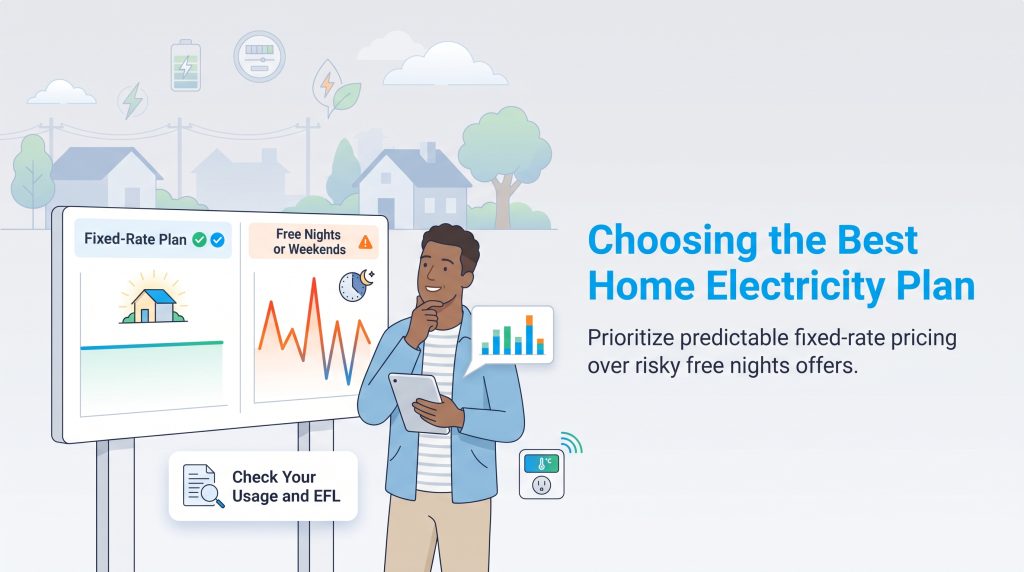
At the end of the day, free nights or weekends plans are incredibly powerful tools for a very specific subset of consumers. However, they easily trap average households with punishing daytime rates that secretly drive up monthly costs. Are free nights and weekends worth it? The allure of a zero-cent energy charge is strong, but you absolutely must do the math on your historical usage before signing a legally binding contract.
We strongly recommend prioritizing steady, predictable pricing with a standard fixed-rate plan unless you possess the strict discipline and smart home tech required to shift massive amounts of consumption into the dark. If you are struggling to manage your usage, there are plenty of other strategies to lower your overall electric bill without resorting to a stressful billing structure. Take your time, read the fine print on the EFL, and leverage official state shopping portals when comparing energy plans in Houston or any other deregulated market.
Frequently Asked Questions About Free Nights Or Weekends Plans
Are free nights and weekends electricity plans worth it?
What time do free nights start for most electricity plans?
Do free nights and weekends plans include utility delivery charges?
Are free nights and weekends worth it if I work from home?
Is it better to have a fixed rate or free nights?
Is a free nights plan better than a free weekends plan?
Can I switch from a fixed-rate plan to a free weekends plan mid-contract?
About the Author

David has been an integral part of some of the biggest utility sites on the internet, including InMyArea.com, HighSpeedInternet.com, BroadbandNow.com, and U.S. News. He brings over 15 years of experience writing about, compiling and analyzing utility data.

LaLeesha has a Masters degree in English and enjoys writing whenever she has the chance. She is passionate about gardening, reducing her carbon footprint, and protecting the environment. She also recently served as President of the Board for City Sprouts (a community garden).