

Choosing the right electricity provider for your Texas home requires looking past flashy promotional rates to understand true costs, hidden fees, and long-term value.

- 6.9¢ /kWh
- 6-100%
- None
- 1-36 Months
- Best for Low Rates

- 8.8¢ /kWh
- 31%
- 60 days
- 12-36 Months
- Popular Bill Credit Plans
*rates may vary by location and household usage
Key Takeaways
- APG&E fixed-rate plans offer a straightforward structure, making them an ideal choice for homeowners who want predictable, stable energy bills without complex usage tiers.
- Just Energy provides time-of-use and lifestyle plans, including their popular free nights and weekends, but these require careful tracking of your home’s energy habits to actually see savings.
- Always review the Electricity Facts Label for early cancellation and base fees before signing a contract, as unexpected charges can quickly wipe out the savings from a seemingly cheap promotional rate.
Setting up your new house is stressful enough without having to navigate a maze of confusing utility contracts, which is exactly why figuring out the real winner between APG&E vs. Just Energy matters so much. Whether you are moving into a fresh build or taking over an older property, you want affordable, reliable electricity that fits your household’s actual usage. As consumer advocates, we know that the lowest advertised rate isn’t always the cheapest option once you read the full story. We are diving deep into the fine print of both providers so you can avoid unexpected bill fluctuations and choose a plan that genuinely respects your household budget.
Quick Verdict on APG&E vs. Just Energy
APG&E may be the better fit if you want straightforward fixed-rate pricing and fewer usage-timing decisions to make throughout your day. Just Energy may be worth considering if a time-of-use or lifestyle plan matches your specific daily schedule. Either way, the standard facts document should be your ultimate deciding factor, not just the large font on an advertisement.
How Texas Electricity Choice Works When You Move
Moving to a state where you have the power to select your electricity provider is fantastic for competitive pricing, but it certainly places the heavy lifting squarely on your shoulders. Provider choice is available in most deregulated areas of Texas, but not everywhere. If your home is served by a municipal utility or electric cooperative, you may not be able to choose between APG&E, Just Energy, or another retail electric provider. If you are in a deregulated zone, a proper Texas electricity comparison means you cannot just pick the first flashy ad you see and hope for the best. Retail electric providers buy wholesale energy and sell it to you, meaning they constantly adjust rates, terms, and incentives to win your business. While this competition drives down costs, it also breeds intentionally complex pricing tiers that can blindside an unprepared buyer. We highly recommend utilizing resources like the official Texas energy comparison tool to compare current Texas electricity plans on Power to Choose. Keep in mind that while your chosen provider sells you electricity, your local Transmission and Distribution Utility handles the physical delivery and lines, adding regulated charges to every bill.
What to Check Before Starting Service at Your New Address
Setting up your power involves more than just picking a brand name. Before you sign a new contract, gather a few key details to ensure you make the most cost-effective choice.
- Confirm whether your new address is actually in a deregulated area.
- Identify the local Transmission and Distribution Utility serving your specific neighborhood.
- Estimate your square footage and determine the type of heating and cooling system installed.
- Ask the previous owner or landlord for prior usage history if it is available.
- Align your exact move-in date with your requested service start timing.
- Review the contract length and note any early termination terms in case you need to move again.
💡 Pro Tip: Have your past energy usage data, or a reliable estimate for a new build, handy when comparing plans so you can match your expected kilowatt-hour consumption to the most cost-effective tier.
APG&E vs. Just Energy Rates by Usage Level
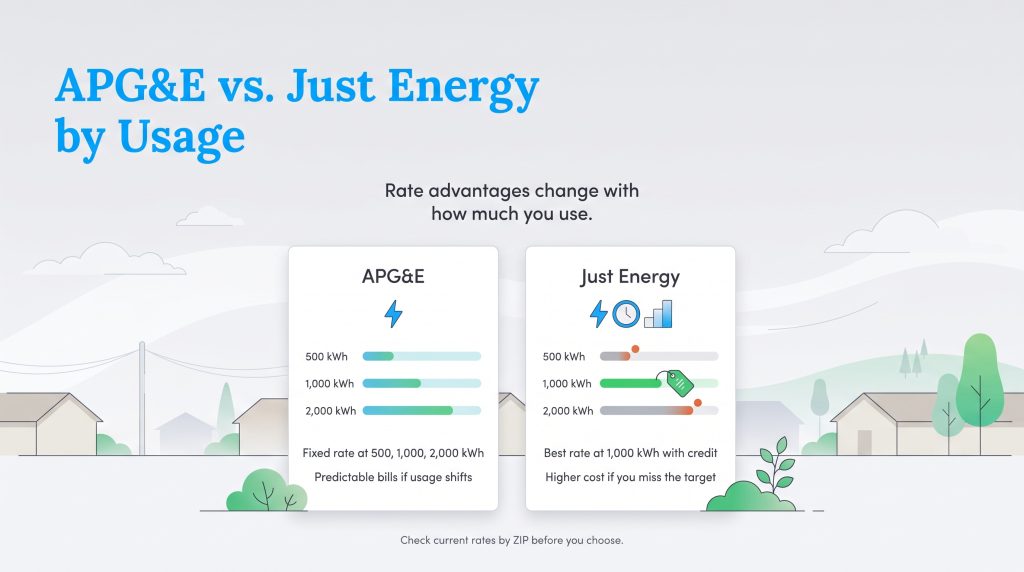
When it comes to pricing, these two providers take entirely different approaches to how they bill your monthly usage. You might naturally wonder, is Just Energy cheaper than APG&E? The honest answer hinges completely on how much power you consume and when you consume it. Energy plans in Texas are generally structured around three usage milestones: 500 kWh for apartments or small homes, 1,000 kWh for average single-family homes, and 2,000 kWh for large homes or heavy summer air conditioning usage.
If you’re comparing electricity providers in Houston, Dallas, or another deregulated Texas market, check rates by ZIP code because delivery charges vary. If you look closely at the standardized facts labels for both companies, the differences become glaring.
To illustrate how these structural differences play out, here is a sample comparison of typical plan styles you might find from each provider. Note that actual rates vary by location and change frequently, so always verify current numbers through Power to Choose.
| Provider | Plan Style | Example 1,000 kWh Rate | Base Charge | Bill Credit Structure | Best For |
|---|---|---|---|---|---|
| APG&E | Standard Fixed Rate | 14.5¢ | $0 – $5 | Usually none | Predictable billing without usage tiers |
| Just Energy | Tiered or Time-of-Use | 12.5¢ (with credit) | Often $4.95+ | Common at 1,000 kWh | Targeted usage and strict schedules |
- APG&E’s Approach: They frequently offer straightforward fixed-rate options across all three usage tiers. While base charges and delivery fees still apply, the core energy rate often remains steady, helping keep your bill more proportional to your usage.
- Just Energy’s Strategy: Some of their plans utilize bill credits and tiered structures. You might see a very competitive advertised rate at exactly 1,000 kWh because a bill credit kicks in. However, if your usage falls short or exceeds the optimal window, your effective average rate could increase.
APG&E Plans & Pricing
| Plan Name | Rate /kWH | Plan Term | Cancellation Fee | |
|---|---|---|---|---|
| SimpleSaver 12 | 6.6¢ | 12 Months | $150.00 | Check Availability |
| SimpleSaver 24 | 6.8¢ | 24 Months | $250.00 | Check Availability |
| Simple Saver Smart Credit 9 | 6.9¢ | Month to Month | N/A | Check Availability |
| SimpleSaver 9 | 7¢ | 9 Months | $150.00 | Check Availability |
| Simple Saver Smart Credit 12 | 7¢ | Month to Month | N/A | Check Availability |
| Simple Saver Smart Credit 24 | 7.3¢ | Month to Month | N/A | Check Availability |
| SimpleSaver 36 | 10.8¢ | 36 Months | $350.00 | Check Availability |
| Simple Saver Smart Credit 36 | 11.5¢ | Month to Month | N/A | Check Availability |
| True Classic 12 | 13.1¢ | Month to Month | N/A | Check Availability |
| True Classic 11 | 13.2¢ | Month to Month | N/A | Check Availability |
| True Classic 13 | 13.9¢ | Month to Month | N/A | Check Availability |
| Simple Choice 10 | 14.2¢ | 10 Months | $150.00 | Check Availability |
| True Classic 24 | 14.4¢ | Month to Month | N/A | Check Availability |
| Simple Choice 11 | 15.2¢ | 11 Months | $150.00 | Check Availability |
| True Classic 36 | 15.3¢ | Month to Month | N/A | Check Availability |
| Simple Choice 12 | 15.9¢ | 12 Months | $150.00 | Check Availability |
| Simple Choice 24 | 16.2¢ | 24 Months | $250.00 | Check Availability |
| Simple Choice 36 | 16.3¢ | 36 Months | $350.00 | Check Availability |
| Simple Choice 13 | 16.4¢ | 13 Months | $150.00 | Check Availability |
| Simple Choice Green 12 | 16.6¢ | 12 Months | $150.00 | Check Availability |
| Simple Choice Green 24 | 16.7¢ | 24 Months | $250.00 | Check Availability |
| Simple Choice Green 36 | 16.8¢ | 36 Months | $350.00 | Check Availability |
| Simple Choice Green 14 | 17.4¢ | 14 Months | $150.00 | Check Availability |
Just Energy Plans & Pricing
| Plan Name | Rate /kWH | Plan Term | Cancellation Fee | |
|---|---|---|---|---|
| Power Plus - 24 | 8.8¢ | 24 Months | $0.00 | Check Availability |
| Smart Choice - 24 | 8.9¢ | 24 Months | $0.00 | Check Availability |
| Smart Choice - 6 | 10.3¢ | 6 Months | $0.00 | Check Availability |
| Power Plus - 12 | 10.9¢ | 12 Months | $0.00 | Check Availability |
| Sustainable Living Bundle - 3 | 11.5¢ | 3 Months | $175.00 | Check Availability |
| Sustainable Days Bundle - 3 | 11.5¢ | 3 Months | $175.00 | Check Availability |
| Smart Choice - 12 | 12.1¢ | 12 Months | $175.00 | Check Availability |
| Simple Choice- 12 | 15.4¢ | 12 Months | $0.00 | Check Availability |
| Basics - 12 | 16.3¢ | 12 Months | $0.00 | Check Availability |
| Simple Choice- 24 | 16.5¢ | 24 Months | $0.00 | Check Availability |
| Basics - 24 | 16.7¢ | 24 Months | $0.00 | Check Availability |
| Basics PTC - 60 | 16.9¢ | 60 Months | $175.00 | Check Availability |
| Basics PTC - 24 | 16.9¢ | 24 Months | $175.00 | Check Availability |
| Mega Saver - 24 | 20.2¢ | 24 Months | $0.00 | Check Availability |
How to Compare APG&E and Just Energy Plans Before You Sign
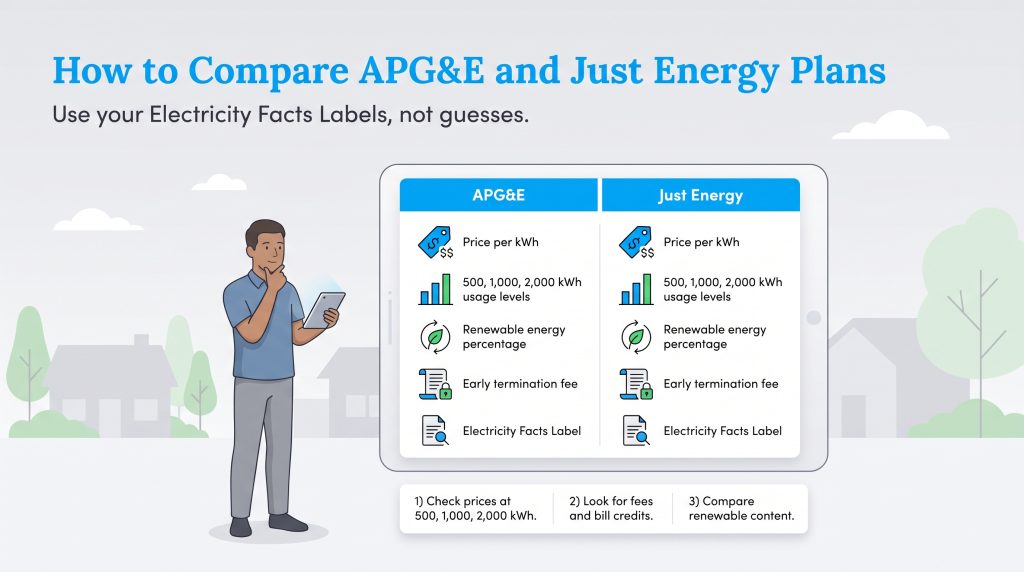
Taking the guesswork out of your energy shopping requires a methodical approach. Follow these steps to evaluate your options effectively:
- Enter your ZIP code on Power to Choose or the provider’s direct website.
- Download or open the Electricity Facts Label for each plan you are considering.
- Compare prices at the 500, 1,000, and 2,000 kWh levels.
- Check for bill credits, base charges, minimum usage rules, and local delivery charges.
- Review the early termination fee structure carefully.
- Compare the renewable energy content percentages.
- Estimate your usage based on your home size, heating and cooling system type, and daily work schedule.
Fixed-Rate Plans vs. Free Nights and Weekends
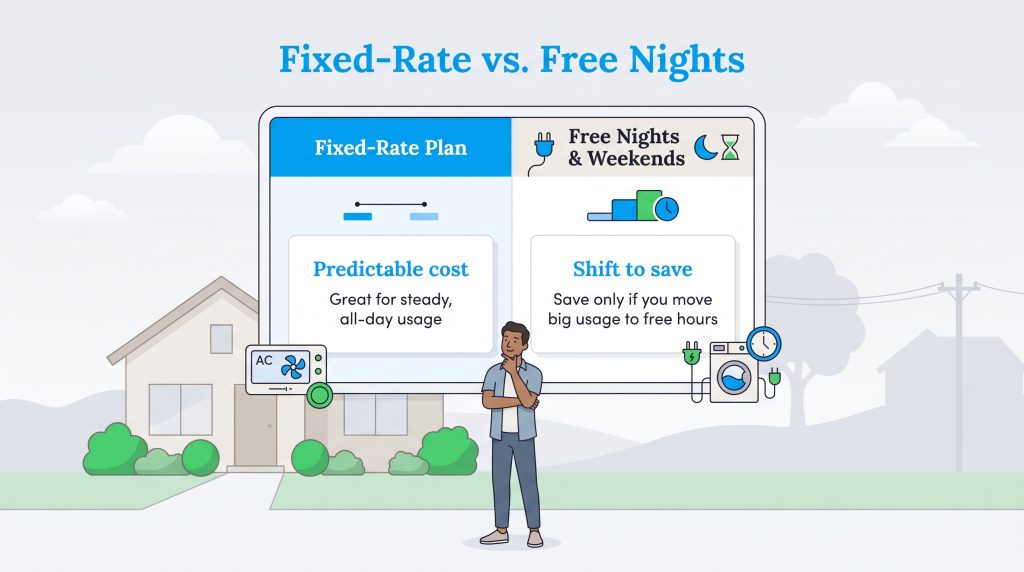
Choosing between a traditional fixed rate and a lifestyle plan is one of the biggest decisions you will make for your new home’s energy profile.
APG&E Fixed-Rate Predictability
For budget-conscious homeowners who despise financial surprises, APG&E fixed rate plans offer a highly appealing sense of security. A fixed-rate plan can help protect you from changes in the energy supply rate during your contract, although your total bill can still change based on usage and delivery charges. This is particularly crucial during those brutal Texas summers when grid demand skyrockets. Instead of wondering what the wholesale energy market is doing, you know your energy charge per kilowatt-hour is locked in. This makes it significantly easier to forecast your monthly expenses and keep your household budget firmly on track.
Just Energy Free Nights and Weekends: The Real Math
Understanding the heavily marketed Just Energy free nights and weekends plans requires a hard look at the math. With free nights or weekends plans, the paid-hour rate is often higher than a standard fixed-rate plan, so the savings depend on how much usage you can shift into the free period. To see whether the plan works for you, compare your paid-hour usage against the lower or free usage window using the standard facts document. The only people who actually save money on these plans are those who can shift major appliance usage to specific off-peak hours. Estimate what percentage of your monthly usage happens during the free period. If most of your HVAC, laundry, electric vehicle charging, and dishwasher use happens during paid hours, the plan may not save money.
Fees, Bill Credits, and Cancellation Costs to Review
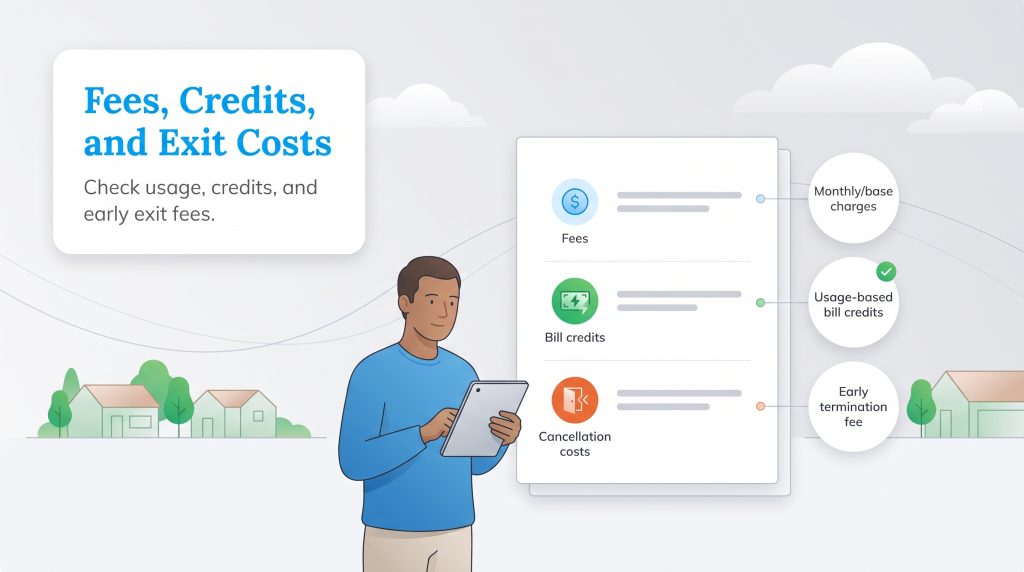
Navigating utility contracts means looking closely at the disclosures to avoid surprises on your first bill. What many consider hidden fees are usually clearly outlined in the standardized plan documents. Some Just Energy plans may include monthly base charges or minimum usage requirements that apply regardless of how much power you actually use.
If your household uses 1,000 kWh per month and a plan offers a $50 bill credit only after hitting 1,000 kWh, your effective rate may look great at exactly 1,000 kWh. But if your new home uses 950 kWh during a mild spring month, you may lose the credit and pay more than expected. That is why you should compare your likely usage against all three standard usage levels.
You also must weigh the financial risk of leaving your contract early. Check the Electricity Facts Label for the current early termination fee, which may be flat or monthly depending on the plan. APG&E frequently charges a flat early termination fee, while some Just Energy plans utilize a monthly prorated model. Depending on when you need to cancel a long-term agreement, those fees can quickly outweigh your expected savings.
🚩 Heads Up: Always read the standardized Electricity Facts Label before you authorize a switch, as this document clearly lists all base fees, minimum usage penalties, and early termination costs associated with the plan.
Renewable Energy Options From APG&E and Just Energy
Powering your home responsibly shouldn’t mean bankrupting your monthly budget, which is why hunting for the cheapest green energy Texas has to offer is a priority for many eco-conscious movers. Both APG&E and Just Energy provide renewable options, but they take different approaches to carbon neutrality. Be sure to check the renewable content percentage on any plan you consider. Some renewable electricity plans are backed by Renewable Energy Certificates, or RECs. That means the provider purchases certificates representing renewable generation equal to some or all of your electricity use. Just Energy also frequently markets carbon offset programs alongside their green plans, allowing you to pay a slight premium to neutralize the footprint of traditional electricity usage.
If you are serious about minimizing your reliance on fossil fuels, exploring these plans is a great first step before taking on bigger projects like supplementing with home solar panels. We encourage you to reference the EPA guidance on renewable energy certificates to understand how your utility choices directly support national grid sustainability.
🌱 Eco Edge: Keep in mind that a 100% renewable plan doesn’t necessarily mean electrons from a wind farm go directly to your house. Instead, it ensures an equivalent amount of clean power enters the broader electrical grid on your behalf.
Smart Home Tips for Lowering Your Electricity Bill
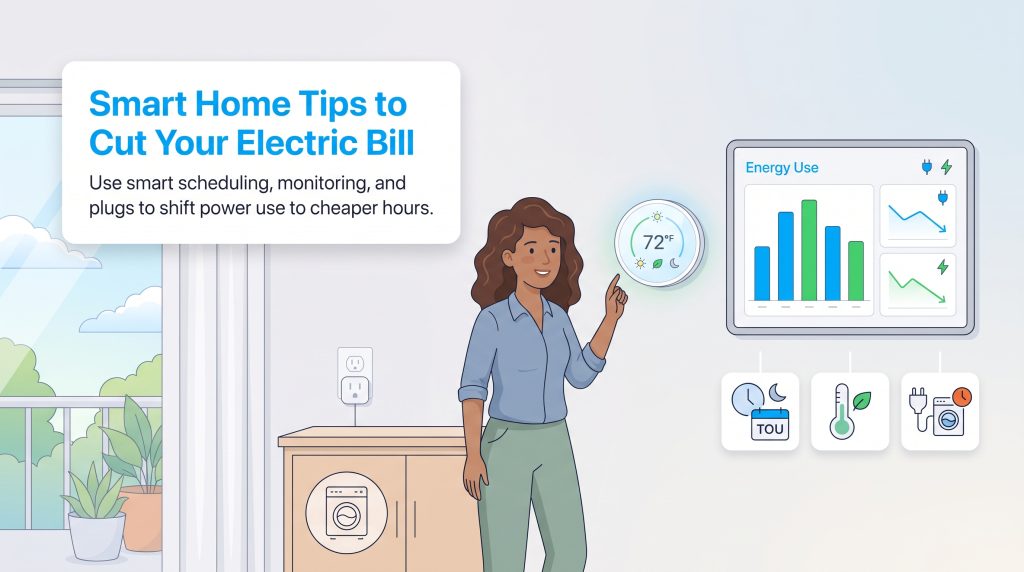
One of the most exciting aspects of moving into a new space is upgrading your technology, and pairing a smart home ecosystem with your utility plan is a brilliant way to automate your savings. If you decide to utilize a time-of-use schedule like Just Energy’s nights and weekends offering, a smart thermostat is virtually mandatory. You can match your system’s scheduling to the exact free window listed in your plan contract, pre-cooling your space right as the discount begins.
APG&E’s stable rates also pair beautifully with energy monitoring apps, allowing you to spot phantom drains and inefficiencies throughout the day. Consider setting up smart plugs to delay running your dishwasher and laundry machines until optimal off-peak hours. By combining modern home automation with a contract that fits your actual lifestyle, you can drastically reduce your monthly electric bill with almost zero daily effort. Let your smart tech do the heavy lifting while you simply enjoy your new living space.
Which Provider Is Better for Your Household?
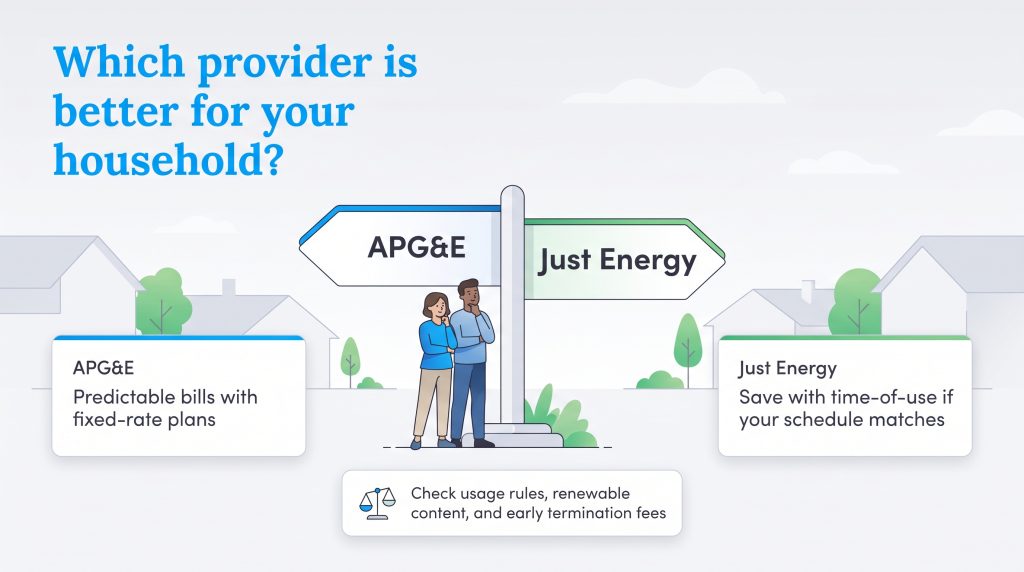
Choosing between APG&E and Just Energy ultimately comes down to your personal priorities and household routine. Use this quick comparison to guide your decision:
| Situation | Better Fit | Why |
|---|---|---|
| You want predictable bills | APG&E | Fixed-rate plans may be easier to budget around. |
| You can shift usage to nights or weekends | Just Energy | Time-of-use plans may work if your schedule matches the free period. |
| You use less than 1,000 kWh most months | Depends on the plan | Bill credits and minimum usage rules can drastically change your effective rate. |
| You want renewable electricity | Compare both | Check the renewable content and certificate documentation on each plan. |
| You may move again soon | Depends on cancellation terms | Early termination fees can outweigh rate savings if you break a long contract. |
Make Your Choice Based on the Facts, Not the Advertisement
Selecting your electricity provider shouldn’t feel like a gamble, and understanding your own household habits is the true secret to picking a winner. If you are a homeowner who values a simpler billing structure, APG&E is likely a strong option to explore. Their straightforward fixed-rate pricing helps minimize market chaos and makes household budgeting a breeze. Alternatively, if you have a highly regimented schedule, utilize smart home automation, and consume the vast majority of your power during off-peak windows, Just Energy’s lifestyle plans could offer you a strategic financial advantage. We want you to feel confident setting up your utilities, so always match the contract structure to your specific energy footprint rather than just chasing the lowest advertised number on a billboard.
Frequently Asked Questions About APG&E vs. Just Energy
Is Just Energy cheaper than APG&E?
Does Just Energy charge hidden base fees?
Are APG&E fixed rate plans available across all of Texas?
Where can I find honest APG&E reviews in Texas?
How do free nights and weekends plans actually work?
Do APG&E and Just Energy include local delivery charges in advertised rates?
What usage level should I compare for a new house?
About the Author

David has been an integral part of some of the biggest utility sites on the internet, including InMyArea.com, HighSpeedInternet.com, BroadbandNow.com, and U.S. News. He brings over 15 years of experience writing about, compiling and analyzing utility data.

LaLeesha has a Masters degree in English and enjoys writing whenever she has the chance. She is passionate about gardening, reducing her carbon footprint, and protecting the environment. She also recently served as President of the Board for City Sprouts (a community garden).