

Choosing Between Gexa Energy and BKV Energy Comes Down to Comparing Hidden Fees, Fixed-Rate Plan Structures, and Your Home’s Unique Energy Usage
Key Takeaways
- Gexa Energy often offers tiered plans that can benefit households with highly predictable, high-volume energy usage.
- BKV Energy frequently focuses on straightforward pricing without complex usage fees, making it ideal for budget-conscious consumers.
- Reviewing the Electricity Facts Label (EFL) is the most effective way to accurately compare base charges and TDU pass-through fees before switching.

- 7.3¢ /kWh
- 100%
- 60 days
- 12-36 Months
- Committed to Renewable Energy

- 6.8¢ /kWh
- 29-100%
- 30 days
- 12-36 Months
- Best for Long Term Value
*rates may vary by location and household usage
If you feel overwhelmed trying to decode the fine print while searching for cheap electricity plans Texas offers, you are definitely not alone. The sheer volume of providers, confusing promotional rates, and complex usage tiers make finding an honest deal feel like a full-time job. Our goal is to cut through that noise by offering a completely unbiased, head-to-head comparison of Gexa Energy and BKV Energy. We break down how to compare complicated pricing structures, expose where to look for hidden fees, and evaluate their green energy options so you can make a smart, money-saving choice for your home without the usual headache.
At a Glance: Gexa Energy vs BKV Energy
When you are comparing two prominent power companies in the deregulated Texas energy market, getting a quick overview can save you hours of exhausting research. Here is a high-level look at how Gexa Energy and BKV Energy stack up across the most important categories for everyday consumers. This breakdown highlights their foundational differences in pricing strategy, eco-friendly offerings, and overall customer satisfaction.
| Feature | Gexa Energy | BKV Energy |
|---|---|---|
| Best For | High-volume, predictable usage | Budget-conscious, straightforward pricing |
| Pricing Structure | Tiered usage with bill credits | Flat-rate pricing with no hidden tiers |
| Green Options | 100% renewable plans standard | Eco-options available |
| Cancellation Fees | Often a flat fee based on term | Often a per-month remaining fee |
| Average Trustpilot Score | 2.0 out of 5 stars | 4.5 out of 5 stars |
Understanding the Deregulated Texas Energy Market
Living in a deregulated region of the Electric Reliability Council of Texas (ERCOT) grid means you actually have the power to choose who supplies your home’s power. Instead of being locked into a single local utility, deregulation forces retail electric companies to compete for your business through varied pricing structures, renewable energy incentives, and customer perks. Taking the time to properly compare Texas electricity providers ensures you secure a rate that aligns perfectly with your household’s monthly energy consumption. When you simply accept the first offer you see, you risk overpaying for power you don’t even use.
While the state grid operator manages the physical flow of electricity, retail providers act as the middleman handling your billing and plan structures. According to Texas energy production and consumption data from the U.S. Energy Information Administration, the state produces and consumes more electricity than any other in the nation. This massive demand fuels a hyper-competitive market where companies like Gexa and BKV battle for your monthly utility budget.
Head-to-Head: Rates, Plans, and Pricing Structures
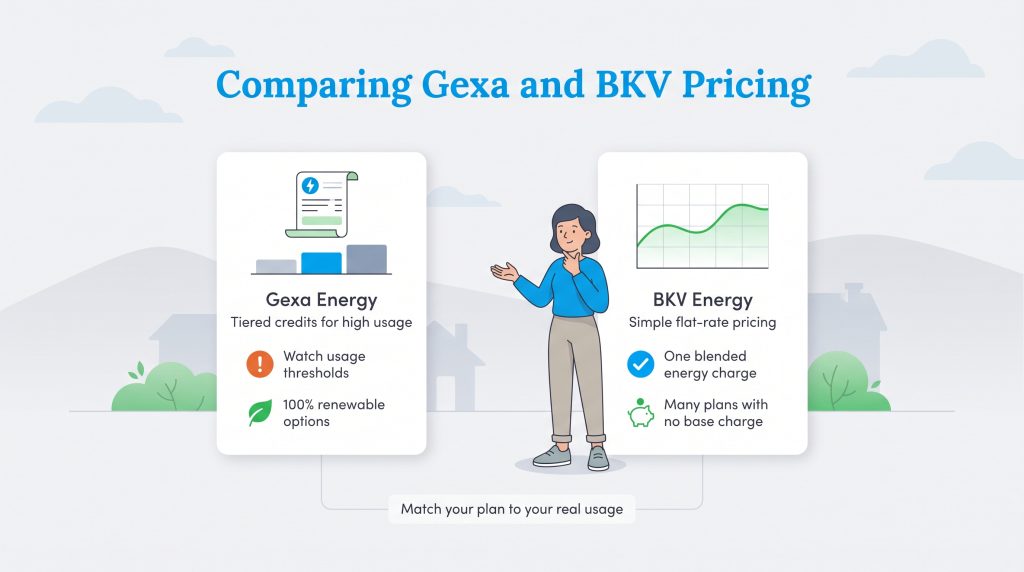
When evaluating fixed-rate electricity plans, Texas residents often assume all contracts operate the same way, but Gexa Energy and BKV Energy take remarkably different approaches to pricing. Finding the best electricity provider in Texas requires matching their unique plan structures to your actual household consumption, as what works for a massive four-bedroom house will likely penalize a one-bedroom apartment.
BKV Energy Plans & Pricing
BKV Energy built its reputation on transparency, offering straightforward options that emphasize simpler rate structures. Many of their contracts provide a single, blended energy charge across all usage levels, helping to eliminate the anxiety of hitting specific kilowatt-hour benchmarks to get a decent rate. If you value predictable pricing without needing a spreadsheet to track your thermostat habits, BKV provides an incredibly user-friendly experience.
| Plan Name | Rate /kWH | Plan Term | Cancellation Fee | |
|---|---|---|---|---|
| Pepper Tree 10 | 6.8¢ | Month to Month | N/A | Check Availability |
| Pepper Tree 12 | 7.2¢ | Month to Month | N/A | Check Availability |
| Lantana 6 | 13.3¢ | Month to Month | N/A | Check Availability |
| Lantana 11 | 14.3¢ | Month to Month | N/A | Check Availability |
| Lantana 12 | 14.4¢ | Month to Month | N/A | Check Availability |
| Lantana 18 | 14.4¢ | Month to Month | N/A | Check Availability |
| Lantana 15 | 14.6¢ | Month to Month | N/A | Check Availability |
| Lantana Green 12 | 14.7¢ | Month to Month | N/A | Check Availability |
| Lantana 24 | 14.9¢ | Month to Month | N/A | Check Availability |
| Lantana 36 | 15.1¢ | Month to Month | N/A | Check Availability |
| Lantana Green 24 | 15.1¢ | Month to Month | N/A | Check Availability |
| Lantana Green 36 | 15.8¢ | Month to Month | N/A | Check Availability |
BKV Energy Pros:
- Straightforward, flat-rate pricing without complicated usage tiers.
- Zero base charges on many of their most popular residential plans.
- Highly rated customer satisfaction and exceptionally transparent billing.
BKV Energy Cons:
- Fewer 100% renewable plan options compared to competitors.
- A newer company in the Texas market, resulting in a shorter operational track record.
Gexa Energy Plans & Pricing
Conversely, Gexa Energy often leans heavily into structured tier plans that reward households with high, consistent energy usage. These plans can feature a higher base rate but offer substantial bill credits if your usage falls perfectly within a narrow window outlined in the plan details. If you master your consumption, these tiered plans can be incredibly lucrative, serving as an excellent strategy for lowering monthly utility costs. Miss that sweet spot by just a few kilowatt-hours, however, and your invoice could skyrocket overnight.
| Plan Name | Rate /kWH | Plan Term | Cancellation Fee | |
|---|---|---|---|---|
| Gexa Saver Plus 12 | 7.3¢ | Month to Month | N/A | Check Availability |
| Gexa Eco Saver Plus 12 | 7.3¢ | Month to Month | N/A | Check Availability |
| Gexa Eco Saver Plus 14 | 7.5¢ | 14 Months | $150 | Check Availability |
| Gexa Eco Saver Plus 24 | 8.4¢ | Month to Month | N/A | Check Availability |
| Gexa Eco Choice 3 | 11¢ | 3 Months | $150.00 | Check Availability |
| Gexa Eco Choice 8 | 11.7¢ | 8 Months | $150.00 | Check Availability |
| Gexa Eco Choice 12 | 13.9¢ | 12 Months | $150.00 | Check Availability |
| Gexa Prime Preferred 24 Plan | 13.9¢ | 24 Months | $295.00 | Check Availability |
| Gexa Prime Preferred 12 Plan | 14.4¢ | 12 Months | $150.00 | Check Availability |
| Gexa Eco Saver Value 12 | 15.1¢ | Month to Month | N/A | Check Availability |
| Gexa Light Saver 12 | 15.2¢ | Month to Month | N/A | Check Availability |
| Gexa Saver Edge 12 | 15.4¢ | Month to Month | N/A | Check Availability |
| Gexa Eco Saver Lite 12 | 16.8¢ | Month to Month | N/A | Check Availability |
| Gexa Straight Saver 24 | 18¢ | 24 Months | $295.00 | Check Availability |
| Gexa Eco Saver Advantage 12 | 18.2¢ | Month to Month | N/A | Check Availability |
| Gexa Freedom 12 | 18.4¢ | 12 Months | $150.00 | Check Availability |
| Gexa Eco Saver Premier 24 | 18.9¢ | Month to Month | N/A | Check Availability |
| Gexa Saver Freedom 24 | 19.1¢ | 24 Months | $295.00 | Check Availability |
| Gexa Straight Saver 12 | 19.5¢ | 12 Months | $150.00 | Check Availability |
| Gexa Saver Freedom 36 | 19.8¢ | Month to Month | N/A | Check Availability |
| Gexa Eco Saver Premier 12 | 20.4¢ | Month to Month | N/A | Check Availability |
| Gexa Prime Preferred Plus 24 | 21.4¢ | 24 Months | $295.00 | Check Availability |
| Gexa Prime Preferred Plus 12 | 21.7¢ | 12 Months | $150.00 | Check Availability |
Gexa Energy Pros:
- Generous bill credits for households with predictable, high-volume energy usage.
- 100% green energy plans available across their entire residential lineup.
- Backed by NextEra Energy, providing two decades of stability in the deregulated market.
Gexa Energy Cons:
- Complex tiered pricing heavily penalizes missing strict usage thresholds.
- Requires meticulous, ongoing monitoring of your daily electricity consumption to ensure you hit credit targets.
📌 Quick Fact: A fixed-rate electricity plan locks in your energy rate for the duration of your contract, which we strongly recommend over variable-rate plans to protect your budget against unpredictable summer price spikes.
| Feature | Gexa Energy | BKV Energy |
|---|---|---|
| Plan Structure | Often features tiered usage with bill credits | Typically straightforward, flat-rate pricing |
| Average Term Lengths | 12 to 24 months | 12 to 36 months |
| Base Charges | Varies (check EFL for specific base fees) | Varies (frequently zero base charges) |
| Cancellation Fees | Varies by plan term (often a flat fee) | Varies by plan term (often a per-month fee) |
| Green Energy Options | 100% renewable plans available | Standard grid mix with some eco-options |
Uncovering Hidden Fees: Base Charges and TDU Pass-Throughs
Nothing ruins the excitement of settling into a new home quite like an unexpectedly massive utility bill. Navigating the hidden fees Texas electricity companies sometimes bury in their contracts requires a sharp eye and a bit of basic math. Both Gexa and BKV outline their costs in the mandatory Electricity Facts Label, but understanding how these charges stack up on a typical 1,000 kWh monthly bill reveals exactly where your money goes. We fiercely protect your wallet, which means digging past the flashy advertised rates to find the true cost of keeping your lights on.
To accurately compare the two, you have to break down the core components of a standard invoice. Let’s look at a template math breakdown for both providers to highlight how differently they can structure their costs.
- Base Charges: BKV Energy often skips the monthly base fee, keeping things simple. Gexa Energy may include a Base Charge on certain plans, which you pay regardless of how much power you consume.
- Energy Usage Charges: BKV frequently offers a flat cent-per-kWh rate, meaning your cost scales linearly. Gexa plans might charge a slightly higher base energy rate but apply a generous bill credit exactly at a specified kWh mark (such as 1,000 kWh), drastically lowering the effective rate if you meet the requirement.
- TDU Pass-Throughs: Both companies pass along the exact TDU Pass-Throughs mandated by your local utility (like CenterPoint or Oncor). TDU charges are the same no matter which retail electric provider you pick in that service area, as they cover essential grid maintenance.
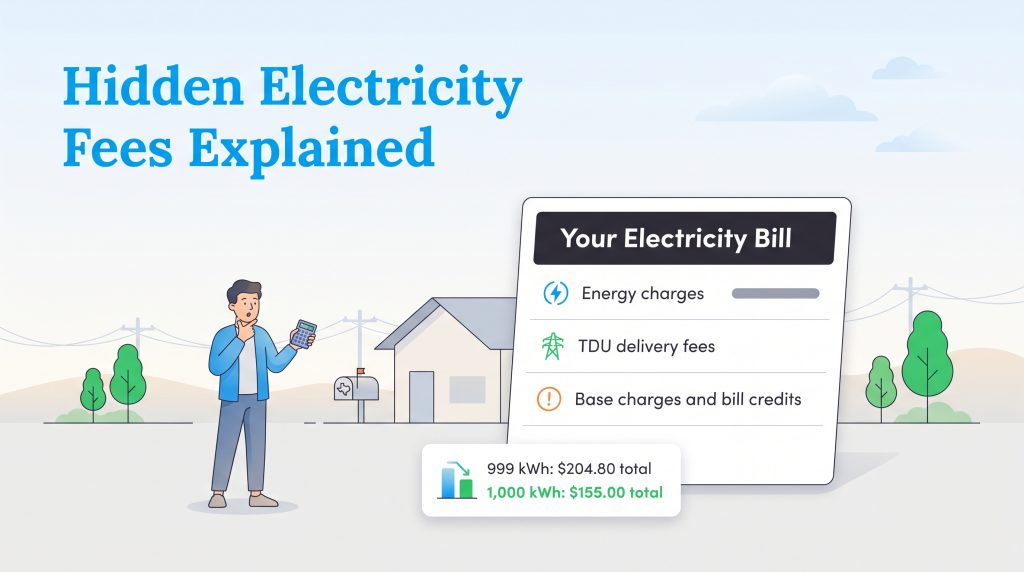
To illustrate just how drastically a tiered plan can affect your invoice, let us run a real-world calculation comparing a bill at 999 kWh versus 1,000 kWh on a typical Gexa Energy credit plan. Imagine a plan with a 15-cent energy rate, standard TDU Pass-Throughs (roughly $5 flat plus 5 cents per kWh), and a generous $50 bill credit that only triggers when you hit exactly 1,000 kWh.
- At 999 kWh: Your energy charge is $149.85. Your TDU Pass-Throughs total $54.95. Since you missed the threshold by a single unit of power, you receive no credit. Your total bill is $204.80.
- At 1,000 kWh: Your energy charge is $150.00. Your TDU Pass-Throughs total $55.00. Because you reached the milestone, the $50 credit is applied. Your total bill drops to $155.00.
As you can see, using just one additional unit of electricity saved the hypothetical household nearly $50. This is the notorious “bill credit cliff” that catches many consumers completely off guard.
💸 Money-Saver: To properly estimate your actual costs, run a “Bill Reality Check” by plugging the rates from your EFL into this formula: Total Bill = (Energy Charge × Your Average kWh) + Base Charge + TDU Delivery Charges – Any Applicable Bill Credits. Do this for 500, 1,000, and 2,000 kWh thresholds to see how your invoice changes.
| Bill Component | Where to Find It on the EFL | How It Affects Your Bill |
|---|---|---|
| Energy Charge | Listed as “Energy Charge” in cents per kWh | Multiplied by your total monthly usage (e.g., 11.5¢ × 1,000 kWh = $115) |
| Base Charge | Listed as “Base Charge” per month | Added as a flat fee every month (e.g., $0 or $9.95) |
| TDU Delivery Charge | Listed as a per-kWh fee and a fixed monthly fee | Added to your total regardless of the provider (e.g., ~$4.39/month + 4.5¢/kWh) |
| Bill Credits | Found in the fine print under the pricing table | Subtracted from your total only if you hit the exact usage target |
Because these promotional credits can disappear if you use one kilowatt-hour too few or too many, your total invoice with a tiered plan can fluctuate wildly based on minor lifestyle changes. Always verify current live rates and read the official EFLs directly on the Texas Public Utility Commission’s official shopping site before signing any agreement.
Green Energy and Sustainability: Who Has the Eco Edge?
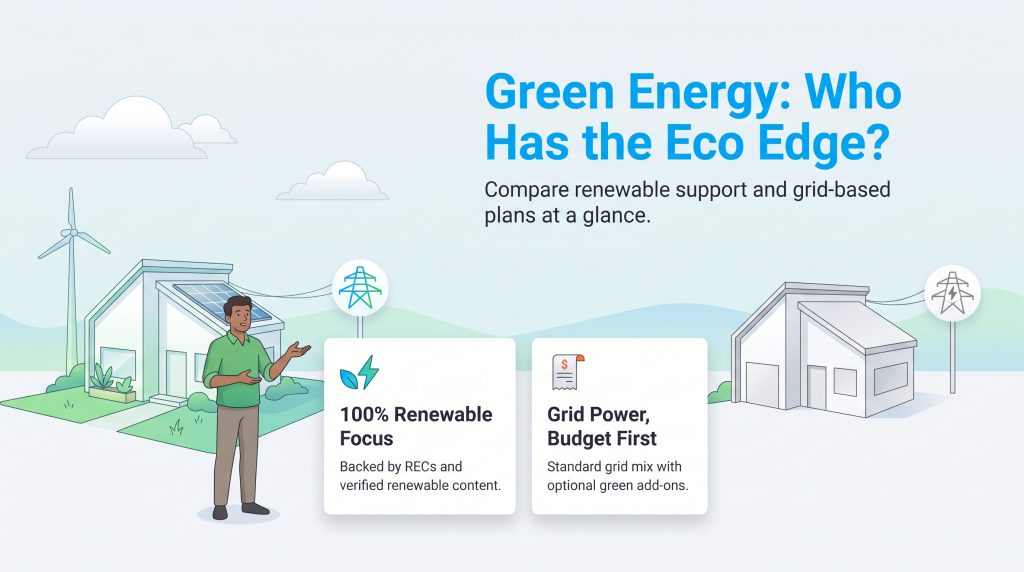
As the demand for renewable power grows, figuring out who ranks among the best green energy providers Texas has to offer requires looking past the marketing jargon. When it comes to pure sustainability, Gexa Energy is the definitive winner in this category for eco-conscious consumers. They are well-known for offering residential plans backed entirely by 100% renewable energy. They achieve this primarily by purchasing Renewable Energy Certificates (RECs) to offset your household’s fossil fuel consumption. This means that while the actual electrons flowing into your home come from the standard grid mix, your financial contribution directly funds wind and solar generation across the state.
BKV Energy approaches sustainability slightly differently, focusing more heavily on standard grid plans while maintaining competitive pricing. They do offer eco-conscious alternatives, but their primary draw remains budget predictability rather than an exclusive focus on renewables. If supporting the renewable sector is a major priority for your household, Gexa provides a highly accessible, environmentally mindful choice. If you want a 100% renewable match, verify the EFL’s renewable content percentage and whether it is backed by RECs. You can learn exactly how utility companies substantiate their green claims by visiting the EPA’s Green Power Partnership page.
🌱 Eco Edge: Choosing a 100% green energy plan reduces your household’s carbon footprint and provides essential financial support for the broader transition to renewable energy sources on the Texas grid. To actively lower your consumption, pair these plans with efficient habits like upgrading to LED bulbs and setting your thermostat up a few degrees in the summer.
Customer Reviews and PUC Complaint Data

Instead of relying entirely on marketing claims, evaluating real customer reviews and official regulatory data paints a much clearer picture of what you can expect after signing a contract. When reviewing BKV Energy and Gexa Energy, their public track records reveal distinctly different consumer experiences that are crucial for you to consider.
BKV Energy currently boasts a stellar reputation online, maintaining an impressive 4.5 out of 5 stars on aggregate platforms like Trustpilot. Customers frequently praise their straightforward billing, transparent communication, and notable lack of hidden base fees. The most common critique regarding BKV Energy is simply their shorter track record. Because they are a newer entrant to the retail electricity space, they do not possess the decades of historical data that legacy providers offer, which can make some conservative buyers hesitant.
On the other hand, Gexa Energy holds a substantially lower average online rating, hovering around 2.0 out of 5 stars on aggregate review platforms. While they have been a staple in the Texas market for decades, their highly structured tiered plans often lead to immense customer frustration. A dive into Texas Public Utility Commission (PUC) complaint data reveals that Gexa maintains a relatively low complaint volume compared to the industry average — roughly 56 formal complaints over a recent 12-month tracking period. However, when complaints do arise, the most common issues revolve almost entirely around missing bill credits, confusing renewal rates, and unexpected spikes in billing when customers fail to hit their narrow usage thresholds.
Moving and Transferring Service
Transferring your electricity service during a move adds another layer of complexity to the comparison process. If your current contract overlaps with your move-out date, you need to understand exactly how each provider handles the transition. Luckily, if you are moving to a new address, both Gexa Energy and BKV Energy will often waive their early termination fees entirely, provided you can supply proper proof of your move, such as a forwarding address or a new lease agreement. This flexibility is a massive benefit for renters who might need to relocate before a 24-month agreement expires.
When timing your switch, try to schedule your start and stop dates strategically. We recommend setting your new service to begin one or two days before you actually arrive, ensuring your lights and air conditioning are running the moment you start unloading boxes. Disconnect your old address a day after you leave so you aren’t left in the dark during the final cleaning sweep. Both companies make this process relatively seamless through their online portals, but getting ahead of the game prevents last-minute headaches.
🚩 Heads Up: Always set a calendar reminder 30 days before your electricity contract expires. This gives you ample time to shop for a new plan or negotiate a renewal without defaulting to an expensive variable rate.
Your Texas Electricity Plan Shopping Checklist
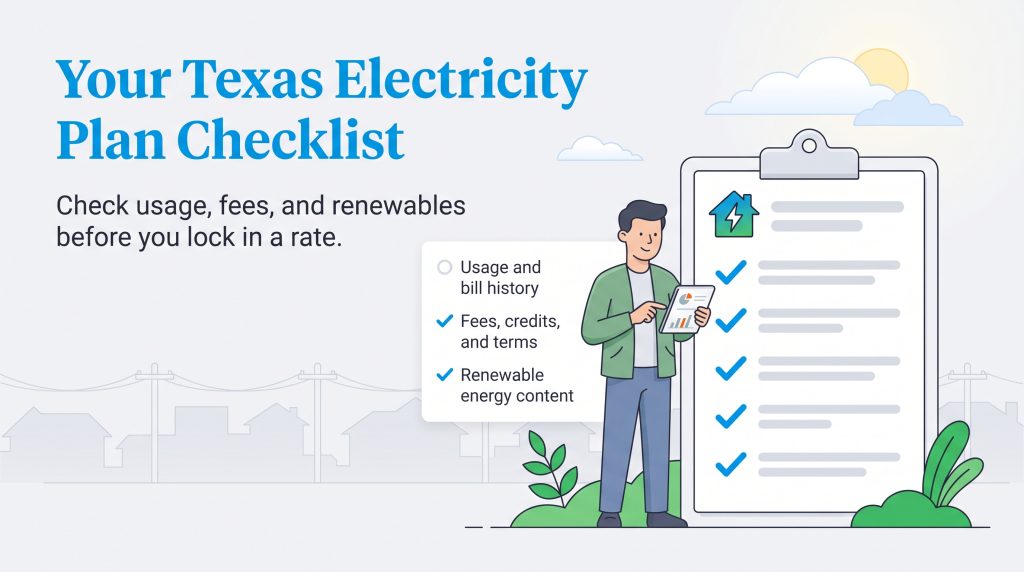
Before you commit to either Gexa Energy or BKV Energy, use this brief shopping checklist to ensure you are selecting the smartest possible option for your home. Taking five minutes to review these details saves you from a year of buyer’s remorse and guarantees you secure the lowest possible electric rate.
- Verify your historical usage: Pull your past 12 months of utility bills to find your true average monthly kilowatt-hour consumption. Guessing your usage is the easiest way to end up on the wrong tiered plan.
- Read the fine print for credits: Look closely at the EFL for any exact usage thresholds required to trigger a bill credit, and calculate what happens if you miss it by just one unit.
- Check for base fees: Confirm whether the plan charges a flat monthly administrative fee regardless of your energy use.
- Review cancellation terms: Note the specific early termination fee structure (flat fee versus per-month penalty) in case you need to switch providers later.
- Confirm renewable percentages: Verify the plan’s renewable energy content directly on the EFL to ensure it aligns with your household’s sustainability goals.
Best Fit Profiles: Who Should You Choose?
Deciding between these two providers ultimately comes down to your living situation, your appetite for tracking energy usage, and your core financial goals. There is no universally perfect provider, but mapping your habits to their distinct pricing models makes the choice much clearer. We recommend auditing your past three months of utility bills to see exactly how many kilowatt-hours you consume before making a commitment.
To help you confidently navigate this decision, we created two distinct best-fit profiles based on home size and energy habits:
- Choose Gexa Energy if: You live in a mid-to-large single-family home with highly predictable energy habits. If your household consistently uses the exact amount of power required to unlock a plan’s bill credit, you can maximize their lucrative promotions and score some of the lowest effective rates on the market. You can learn more about Gexa Energy’s service options to see if their current tiers match your lifestyle.
- Choose BKV Energy if: You are an apartment renter or a homeowner who prioritizes simple, straightforward pricing. If your usage fluctuates wildly depending on the season, or if you simply despise tracking your daily consumption, finding a BKV plan with no base charges and flat-rate pricing provides unmatched peace of mind.
Making Your Final Texas Electricity Choice
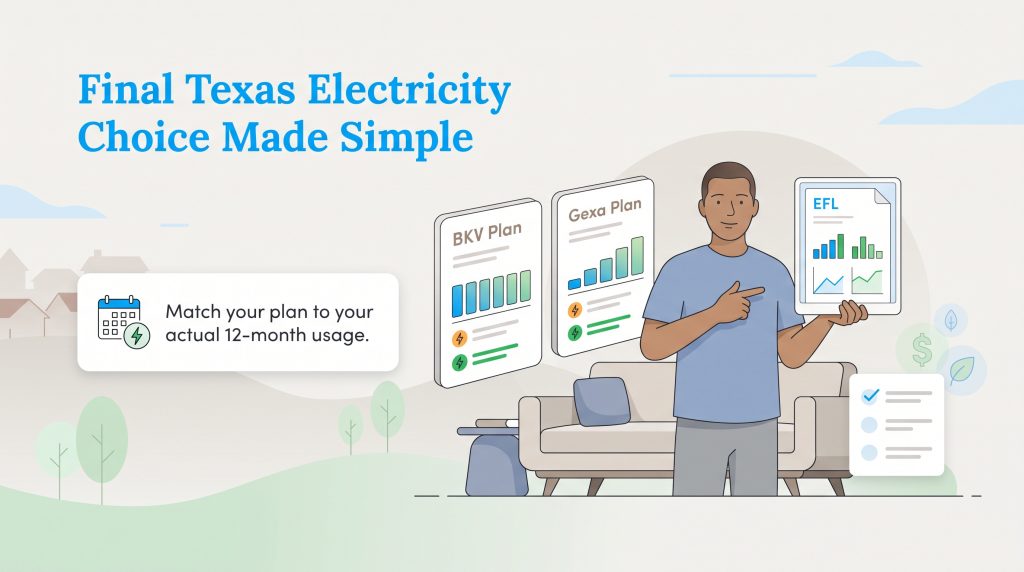
Selecting the right power company does not have to be a stressful endeavor if you know exactly what to look for. Based on our comprehensive evaluation of pricing models, historical customer reviews, and green energy availability, we have compiled a definitive scoring matrix to help you make your ultimate decision.
| Category | Gexa Energy | BKV Energy |
|---|---|---|
| Pricing Structure | 3.0 out of 5 Stars | 4.5 out of 5 Stars |
| Billing Transparency | 3.0 out of 5 Stars | 5.0 out of 5 Stars |
| Sustainability | 5.0 out of 5 Stars | 3.5 out of 5 Stars |
| Overall Verdict | 3.6 out of 5 Stars | 4.3 out of 5 Stars |
Overall, BKV Energy takes the definitive lead for the everyday consumer seeking predictable, flat-rate pricing and highly rated customer support. The lack of hidden traps makes them an excellent choice for a wide variety of households. However, if you possess a larger home with highly consistent energy demands and prioritize a 100% renewable plan, Gexa Energy remains a strong, eco-conscious alternative that can unlock substantial long-term savings.
By taking a few extra minutes to analyze your historical energy data and aligning it with the right pricing structure, you guarantee a comfortable, affordable living environment. As a concrete next step, pull your last 12 months of kilowatt-hour usage from your current provider’s portal to see where you stand. Trust your research, match your choice to your budget and eco-values, and enjoy the peace of mind that comes with making a smart utility decision.
Frequently Asked Questions About Gexa Energy and BKV Energy
Are Gexa Energy and BKV Energy the same company?
Why is my Gexa Energy bill so high this month?
Does BKV Energy have a mobile app for tracking usage?
Does Gexa Energy or BKV Energy have cheaper electricity plans?
What are the hidden fees to watch out for with Texas energy providers?
Can I cancel my BKV Energy or Gexa Energy plan without a penalty?
Are Gexa Energy’s 100% green plans actually good for the environment?
How long does it take to switch electricity providers in Texas?
How do I read an Electricity Facts Label (EFL) for bill credits?
What happens when my fixed-rate electricity term ends?
About the Author

David has been an integral part of some of the biggest utility sites on the internet, including InMyArea.com, HighSpeedInternet.com, BroadbandNow.com, and U.S. News. He brings over 15 years of experience writing about, compiling and analyzing utility data.

LaLeesha has a Masters degree in English and enjoys writing whenever she has the chance. She is passionate about gardening, reducing her carbon footprint, and protecting the environment. She also recently served as President of the Board for City Sprouts (a community garden).