
Find Out Which Texas Energy Provider Offers the Best Value for Your Home

- 14.1¢ /kWh
- 24%
- 90 days
- 0-36 Months
- Best for Smart Home Tools & App

- 6.8¢ /kWh
- 29-100%
- 30 days
- 12-36 Months
- Best for Long Term Value
*rates may vary by location and household usage
Key Takeaways
- BKV Energy often markets simpler fixed-rate pricing without the tiered credit structures frequently found in legacy Reliant Energy plans.
- Switching providers is easier than you think, and breaking a current contract might be financially worth it if your new rate covers the early termination fee within a few months.
- Both providers offer plans with renewable options, but you must carefully check the Electricity Facts Label (EFL) to verify the exact percentage of renewable energy.
If you live in a deregulated area of Texas, choosing your electricity provider can feel like navigating a minefield of confusing terms, temporary teaser rates, and hidden fees. When comparing Reliant Energy vs. BKV Energy, you are ultimately weighing a well-established legacy giant against a newer, transparency-focused challenger. It is incredibly common to sign up for what looks like a great rate, only to get hit with base charges and usage penalties the moment the summer heat kicks in. To help you cut through the marketing jargon, we analyzed how to compare the costs, evaluate contract terms, uncover buried fees, and interpret customer reviews for both companies so you can confidently decide which provider deserves to power your home.
At a Glance: Head-to-Head Provider Comparison
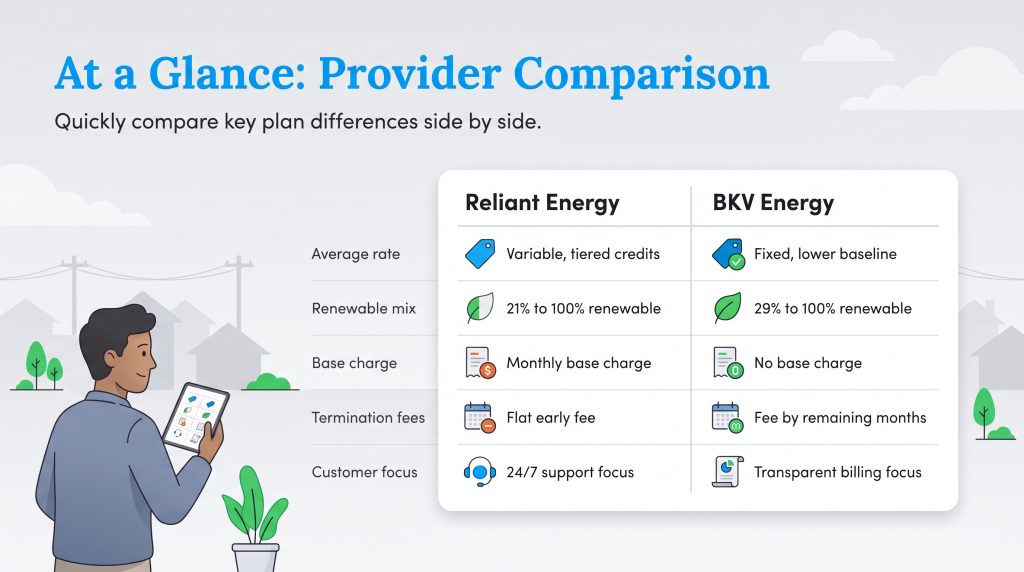
If you are simply trying to find the cheapest electricity in Texas, scanning the top-level features of each provider is the best place to start. Our Texas electric provider comparison table below breaks down the core differences between Reliant Energy and BKV Energy so you can see exactly how they stack up before diving into the fine print.
| Comparison Metric | Reliant Energy | BKV Energy |
|---|---|---|
| Average Rate (cents/kWh) | Variable; relies heavily on tiered usage credits | Fixed; lower baseline without tier gimmicks |
| Renewable Energy Options | 21% standard mix; 100% on Pure Power plans | 29% standard mix; up to 100% on Bluebonnet Green |
| Base Charge | Yes, typically $4.95 to $9.95 per month | No, $0 base charges on standard fixed plans |
| Early Termination Fee | Often flat fees ranging from $150 to $295 | Typically $20 per remaining month on the contract |
| Customer Rating Focus | Legacy stability and 24/7 robust support | Billing transparency and budget predictability |
Plan Types and Pricing Structures
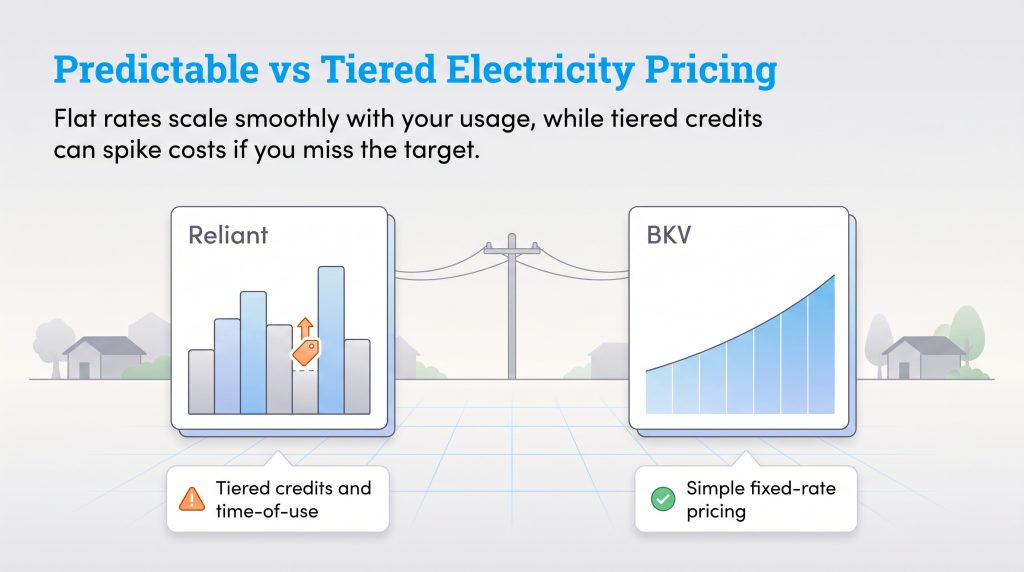
As highlighted in the table above, the starkest contrast between these two competitors lies in their pricing structures. When you compare Texas electricity rates, you will notice that Reliant typically leans on tiered plans offering heavily advertised credits when you hit specific usage marks. In contrast, BKV focuses entirely on flat, predictable pricing. This means your bill with BKV scales smoothly with your actual power consumption.
Reliant might initially catch your eye with flashy promotions, but missing their usage window by a single kilowatt-hour can instantly spike your rate. When reviewing plans from either company, it is vital to read the Electricity Facts Label (EFL). This document outlines your base charge, the provider’s energy charge, and pass-through Transmission and Distribution Service Provider (TDSP) delivery charges. TDSP charges cover the cost of maintaining the power grid and are identical no matter which retail energy provider you choose.
🚩 Heads Up: Always review the Electricity Facts Label (EFL) before signing any power contract. This document legally outlines the exact base charges, usage tiers, and delivery fees so you know exactly what to expect on your first bill.
Reliant Energy Plans Explained
Reliant Energy offers a wide variety of tiered, time-of-use, and standard fixed-rate plans. Their most popular options often reward customers with substantial bill credits if their monthly usage falls precisely within a specific window (such as 1,000 to 1,500 kWh). If your household consistently meets these usage requirements, these plans can be highly competitive.
| Plan Name | Rate /kWH | Plan Term | Cancellation Fee | |
|---|---|---|---|---|
| Reliant Power on 9 Plan | 13.2¢ | 9 Months | $95.00 | Check Availability |
| Reliant Power On 12 Plan | 13.9¢ | 12 Months | $150.00 | Check Availability |
| Reliant Power On 18 | 14.9¢ | 18 Months | $180.00 | Check Availability |
| Reliant Power On 24 Plan | 15.4¢ | 24 Months | $295.00 | Check Availability |
| Reliant Basic Power 12 plan | 15.6¢ | Month to Month | N/A | Check Availability |
| Reliant Basic Power 24 plan | 15.9¢ | Month to Month | N/A | Check Availability |
| Reliant Power Savings 2,000 kWh 12 plan | 18.2¢ | Month to Month | N/A | Check Availability |
| Reliant Power Savings 2,000 kWh 24 plan | 20.7¢ | Month to Month | N/A | Check Availability |
BKV Energy Plans Explained
BKV Energy keeps things incredibly simple. They skip the usage credits entirely and focus on providing a straightforward, fixed-rate experience. Because they prioritize a flat energy charge without minimum usage penalties, your bill remains highly predictable month over month, making it easier to budget for seasonal changes.
| Plan Name | Rate /kWH | Plan Term | Cancellation Fee | |
|---|---|---|---|---|
| Pepper Tree 10 | 6.8¢ | Month to Month | N/A | Check Availability |
| Pepper Tree 12 | 7.2¢ | Month to Month | N/A | Check Availability |
| Lantana 6 | 13.3¢ | Month to Month | N/A | Check Availability |
| Lantana 11 | 14.3¢ | Month to Month | N/A | Check Availability |
| Lantana 12 | 14.4¢ | Month to Month | N/A | Check Availability |
| Lantana 18 | 14.4¢ | Month to Month | N/A | Check Availability |
| Lantana 15 | 14.6¢ | Month to Month | N/A | Check Availability |
| Lantana Green 12 | 14.7¢ | Month to Month | N/A | Check Availability |
| Lantana 24 | 14.9¢ | Month to Month | N/A | Check Availability |
| Lantana 36 | 15.1¢ | Month to Month | N/A | Check Availability |
| Lantana Green 24 | 15.1¢ | Month to Month | N/A | Check Availability |
| Lantana Green 36 | 15.8¢ | Month to Month | N/A | Check Availability |
Uncovering Hidden Fees: Base Charges and Usage Penalties
One of the biggest frustrations for Texas residents is discovering surprise charges on their monthly statements. Uncovering Reliant Energy hidden fees and contrasting them with BKV’s billing approach highlights exactly why reading the EFL is non-negotiable. While both companies are legally required to disclose their charges, the way they structure those fees can drastically change your final payout.
- Reliant Energy Base Charges: Many of Reliant’s “Bill Credit” and “Time-of-Use” plans (like Free Nights and Weekends) carry a mandatory base charge, frequently set at $9.95 per month. This fee applies regardless of whether you use 10 kWh or 2,000 kWh. Furthermore, if you fall short of a minimum usage threshold on a tiered plan, you lose the advertised bill credit, resulting in a significantly higher effective per-kWh rate.
- BKV Energy Base Charges: BKV Energy actively markets its lack of hidden fees. When you sign up for the popular BKV Energy Bluebonnet plan, you will find a $0 base charge. BKV Energy fixed-rate plans rely strictly on your actual consumption multiplied by your locked-in rate plus the standard utility pass-through fees. There are no minimum usage penalties.
For anyone looking for reliable tactics to save on your electric bill, escaping tiered usage penalties and monthly base charges is one of the most effective steps you can take. You won’t have to stress about a sudden heatwave pushing you out of a specific credit zone and unexpectedly doubling your expenses.
Green Energy Options: Who Is More Sustainable?
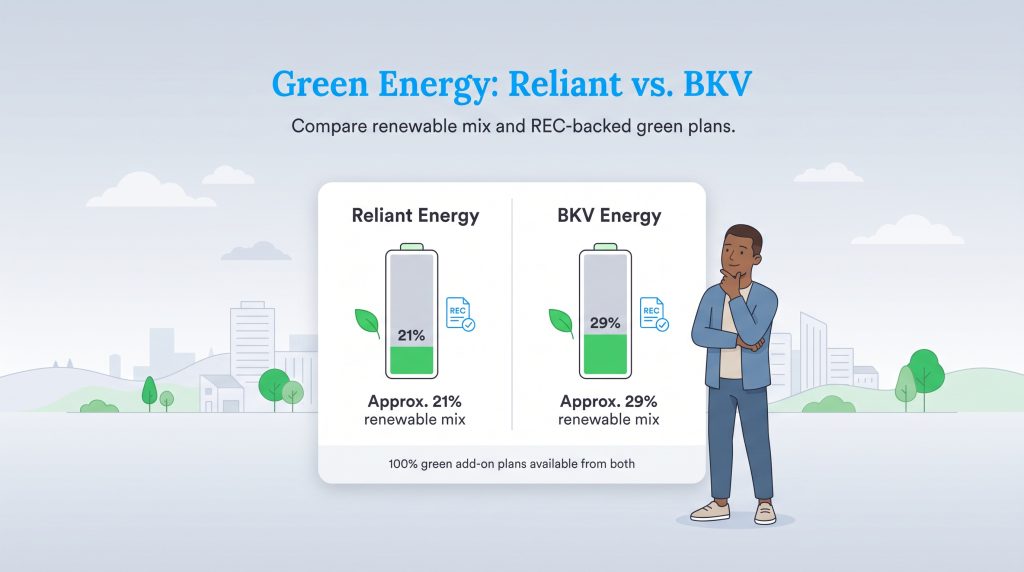
Texas produces more wind power than any other state, but the overall grid still relies heavily on natural gas. According to the latest U.S. Energy Information Administration (EIA) data, the standard power flowing through the Texas grid is a mixture of fossil fuels and renewables. However, the energy generated for the overall grid is different from the specific renewable content of your chosen electricity plan. If you are hunting for the best renewable energy plans in Texas, you must compare how both companies offset their carbon footprint using Renewable Energy Certificates (RECs).
Reliant Energy offers a baseline renewable mix that typically hovers around 21% for their standard plans, but they do offer the dedicated “Pure Power” tier for those who want 100% renewable generation. Conversely, BKV Energy provides an environmentally mindful choice right out of the gate. Their standard BKV Energy Bluebonnet plan often features an impressive 29% renewable mix, and they offer dedicated Bluebonnet Green plans that reach 100% renewable energy depending on your zip code. Opting for these green plans remains a highly accessible way to support sustainable infrastructure without having to install expensive solar panels on your own roof.
Customer Perks, Reviews, and Rewards

When digging into Reliant vs BKV reviews, it helps to know how to filter the noise from genuine feedback. Customers frequently mention the vastly different perks and rewards each company offers. While legacy brands leverage their size to offer physical hardware, challengers like BKV focus their perks directly on lowering your monthly costs and enhancing your experience.
- BKV Energy Perks: BKV sets itself apart with program transparency. They offer ElectroShare, a profit-sharing model that occasionally rewards long-term customers, and VoltPoints, a loyalty program where paying your bill earns points toward future discounts. Perhaps most uniquely, they offer a 30-Day Power Pilot, allowing you to test out their service risk-free for a month without being locked in.
- Reliant Energy Perks: As a massive established brand, Reliant bundles tangible lifestyle perks into their contracts. They are famous for offering promotions that include Google Nest smart thermostats, home security bundles, or discounted HVAC and AC maintenance. If you value robust, 24/7 customer service infrastructure and smart home tech, Reliant’s legacy presence offers significant value.
Contract Terms and Early Termination Fees (ETFs)
If you decide to make a switch, you must navigate your current contract terms. A Reliant Energy early termination fee typically operates as a flat penalty — often ranging from $150 to $295, depending on how long your initial term was. BKV Energy, conversely, generally calculates their ETF at $20 per remaining month on your contract, which can be far more forgiving if you need to move shortly before your term expires.
Switching between the two is a surprisingly quick process, and you don’t even have to call your old provider to cancel. If you live in a deregulated market like Houston or Dallas, the state handles the heavy lifting behind the scenes. Before making the leap, check the official Texas Power to Choose platform or reliable Power to Choose Texas alternatives to ensure you are locking in the best rate for your specific zip code.
- Check your current contract: Log into your current portal to see what your specific early termination fee will be.
- Calculate your potential savings: Compare your current average bill to what you would pay with a new provider. If your current provider charges a $150 ETF, but a new plan saves you $40 a month, you will recoup that penalty fee in under four months. Breaking the contract is often financially worth it.
- Enroll online: Simply enter your address on your new provider’s website and select your preferred start date. They will communicate directly with the state grid operators to transfer your service seamlessly.
💸 Money-Saver: During the switch, your new provider handles the actual transition with ERCOT, meaning your power will never be interrupted or shut off. The only thing that changes is the logo on your monthly bill.
Powering Your Home Smartly
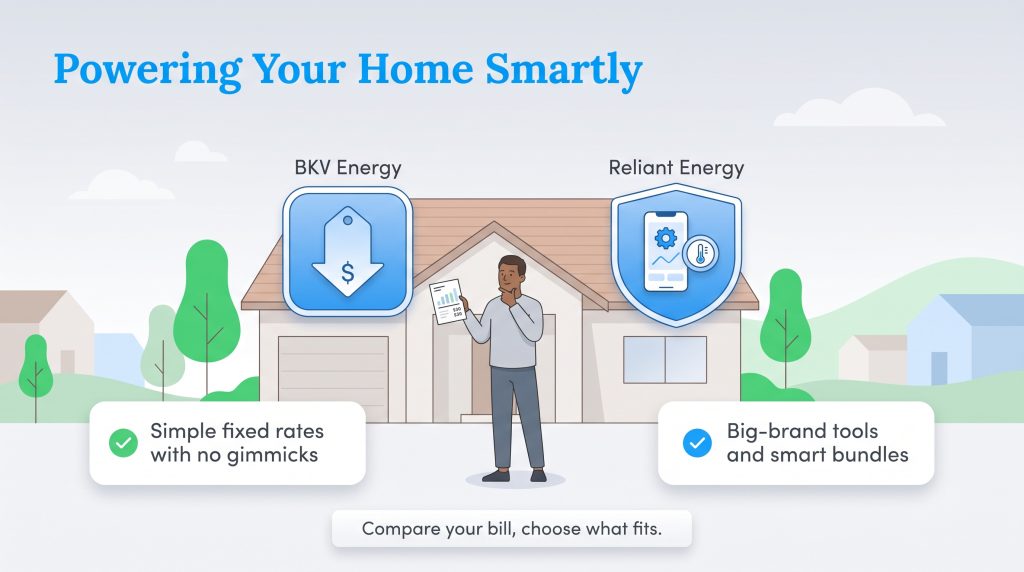
When it comes down to making the final decision, your choice largely depends on what you value most in a utility company. We found that BKV Energy is the superior option for cost-conscious Texans who simply want straightforward, affordable fixed rates without having to navigate usage gimmicks, complex bill credits, or hidden base charges. Their transparent approach makes budgeting for your home significantly easier.
Conversely, Reliant Energy remains a solid choice for those who prioritize the stability, robust customer service apps, and legacy presence of a massive, established brand. If your household consumption routinely hits the precise tiers required to unlock their massive bill credits, or if you want to bundle your electricity with a new smart thermostat, Reliant might offer the exact package you need. We encourage you to grab your latest electricity bill, run the math for your standard monthly usage, and confidently take control of your monthly utility costs.
Frequently Asked Questions About Reliant Energy vs BKV Energy
Is BKV Energy cheaper than Reliant Energy?
Do Reliant Energy and BKV Energy charge an early termination fee?
Which provider offers the best 100% renewable energy plan in Texas?
Does BKV Energy require a deposit to start service?
Will I lose power if I switch my electricity provider in Texas?
Are BKV Energy’s rates actually fixed?
About the Author

David has been an integral part of some of the biggest utility sites on the internet, including InMyArea.com, HighSpeedInternet.com, BroadbandNow.com, and U.S. News. He brings over 15 years of experience writing about, compiling and analyzing utility data.