

Compare the Perks of a Legacy Provider Against the Straightforward Pricing of a Newer Challenger to Find the Best Fit for Your Texas Home
Key Takeaways
- BKV Energy often provides simpler pricing models, making it highly competitive for budget-conscious Texans looking to avoid complex bill credits.
- TXU Energy offers extensive plan variety, including popular free nights and weekends ideal for high-consumption smart homes and EV owners.
- Both providers offer eco-conscious choices, allowing you to easily support renewable energy generation regardless of which company you choose.

- 10.9¢ /kWh
- 3-100%
- 60 days
- 1-36 Months
- Highest Trustpilot Rating 4.7/5 ★

- 6.8¢ /kWh
- 29-100%
- 30 days
- 12-36 Months
- Best for Long Term Value
*rates may vary by location and household usage
Navigating the deregulated Texas energy market often feels overwhelming. When examining the TXU Energy vs BKV Energy comparison, the choice comes down to straightforward pricing versus specialized lifestyle rewards. BKV Energy stands out for budget-conscious consumers seeking transparent, fixed-rate electricity without hidden minimums. Conversely, TXU Energy delivers unmatched variety and massive savings if you leverage smart technology to shift heavy power usage. Let’s break down exactly which provider saves you the most money.
At a Glance: TXU vs BKV Energy Comparison
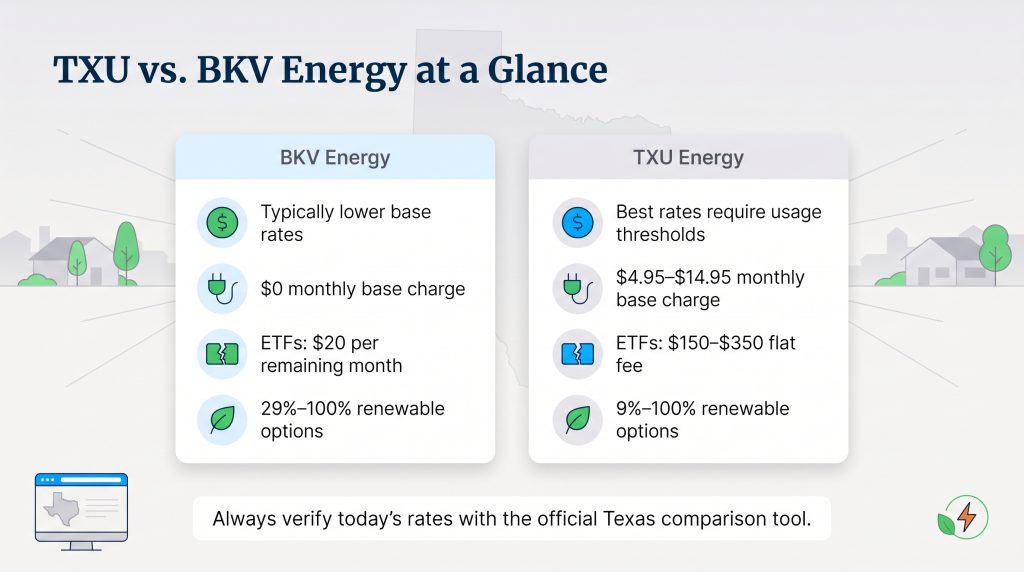
When you start to compare Texas electricity providers, the contrast between a seasoned giant and an agile newcomer becomes stark. TXU Energy operates as one of the oldest and largest residential electricity providers within the deregulated market, offering a deeply established infrastructure and incredible plan variety. BKV Energy entered the market more recently but quickly gained traction by aggressively targeting customers who are exhausted by confusing rate tiers and deceptive bill credits. We highly recommend verifying current localized rates through the official state electricity comparison tool to ensure you find competitive pricing for your specific ZIP code.
| Comparison Metric | BKV Energy | TXU Energy |
|---|---|---|
| Cheapest Starting Rate | Typically lower average base rates across all tiers | Requires meeting strict usage thresholds for the best price |
| Base Charges | $0.00 base monthly charge | $4.95 to $14.95 per month depending on the plan |
| Early Termination Fees (ETFs) | $20 per remaining month on the contract | Flat fee ranging from $150 to $350 |
| Renewable Energy Options | 29% to 100% renewable plan variance | 9% to 100% renewable plan variance |
| Customer Service Ratings | Highly rated for billing transparency and simplicity | Established support network with robust digital tools |
TXU Energy Overview: Pros, Cons, and Top Plans
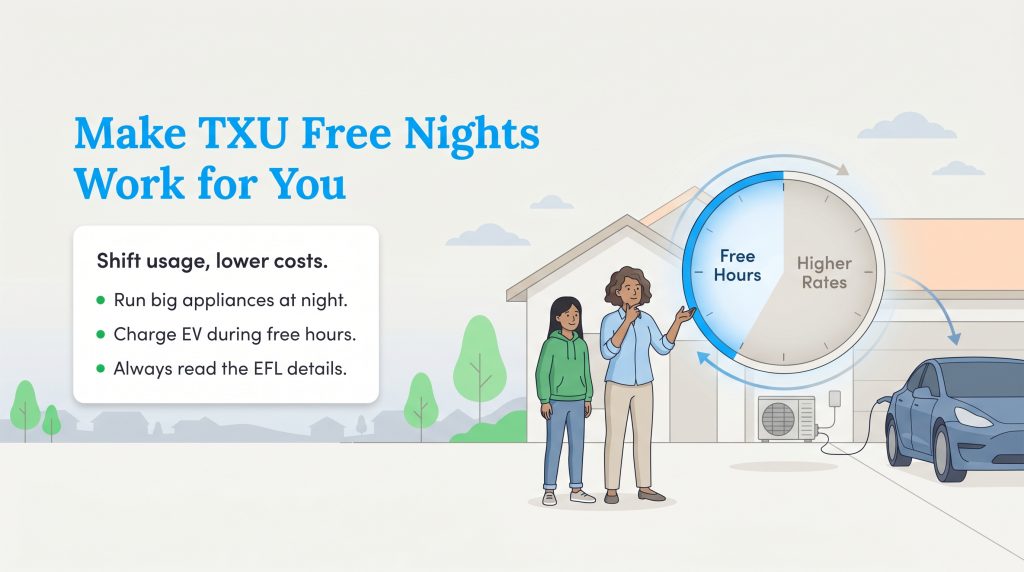
As one of the original retail electric providers to emerge following Texas deregulation, TXU Energy carries significant historical weight and a reputation for massive infrastructural reliability. TXU undeniably holds the edge when it comes to feature-rich offerings. A deep dive into their catalog highlights top-tier account management tools, smart thermostat integrations, and their widely recognized time-of-use plans.
Before locking in a contract, weigh these crucial benefits and drawbacks:
- Pro: Massive variety of specialized plans, including the popular TXU Energy Free Nights and Solar Days.
- Pro: Excellent mobile app functionality and seamless smart thermostat integration.
- Pro: Established track record of market stability during extreme weather events.
- Con: Plan structures are highly complex and require vigilant energy monitoring to guarantee savings.
- Con: Most plans include a monthly base charge regardless of how much power you consume.
Exploring TXU Free Nights and Weekends
TXU leans heavily into behavioral incentives. They understand that not every home consumes power the same way, and they have developed an extensive catalog of rate structures tailored to specific routines. These specialized plans work beautifully if your schedule aligns with their discounted timeframes, allowing you to slash your monthly expenses by shifting your power usage.
The conceptual math behind these specialized plans requires a strategic mindset. Providers still have to pay for the power you consume during a “free” period, so they offset those costs by charging a premium during peak daytime hours. To see why load shifting matters, consider a hypothetical household using 1,000 kWh in a month on a “free nights” plan with a steep 25 cents per kWh daytime rate. If you only shift a small portion of your usage to the free window, your bill easily outpaces a standard fixed rate. Shifting a larger percentage effectively lowers your average cost.
| Usage Shift | Daytime kWh (at $0.25) | Nighttime kWh (at $0.00) | Estimated Energy Charge |
|---|---|---|---|
| 25% Night / 75% Day | 750 kWh | 250 kWh | $187.50 |
| 45% Night / 55% Day | 550 kWh | 450 kWh | $137.50 |
| Plan Name | Rate /kWH | Plan Term | Cancellation Fee | |
|---|---|---|---|---|
| Smart 1000 Saver 12 | 11.5¢ | Month to Month | N/A | Check Availability |
| Smart Edge 12 | 13.5¢ | 12 Months | $150.00 | Check Availability |
| Clear Deal 12 | 13.8¢ | Month to Month | N/A | Check Availability |
| Smart Edge 24 | 13.9¢ | 24 Months | $295.00 | Check Availability |
| Smart 500 Start 12 | 16.5¢ | Month to Month | N/A | Check Availability |
| Solar Value 12 | 16.5¢ | Month to Month | N/A | Check Availability |
| On Your Terms | 16.9¢ | Month to Month | N/A | Check Availability |
| Simple Rate 12 | 17.3¢ | Month to Month | N/A | Check Availability |
| Free Nights & Cool Summer 12 | 17.9¢ | Month to Month | $Fixed | Check Availability |
| Ultimate Season Pass 12 | 18.8¢ | Month to Month | N/A | Check Availability |
| Solar Club 12 | 19.1¢ | 12 Months | $150.00 | Check Availability |
| Texas Choice 12 | 19.2¢ | 12 Months | $150.00 | Check Availability |
| Texas Choice 24 | 19.2¢ | 24 Months | $295.00 | Check Availability |
| Flex Rewards | 19.3¢ | Month to Month | $0.00 | Check Availability |
| Smart Deal 12 | 19.6¢ | 12 Months | $150.00 | Check Availability |
| Solar Saver 12 | 20.2¢ | Month to Month | N/A | Check Availability |
| Flex Forward | 20.2¢ | Month to Month | N/A | Check Availability |
| Smart Deal 24 | 20.4¢ | 24 Months | $295.00 | Check Availability |
| Smart Deal 36 | 20.4¢ | 36 Months | $395.00 | Check Availability |
| Saver's Discount 12 | 22.6¢ | Month to Month | N/A | Check Availability |
BKV Energy Overview: Pros, Cons, and Top Plans
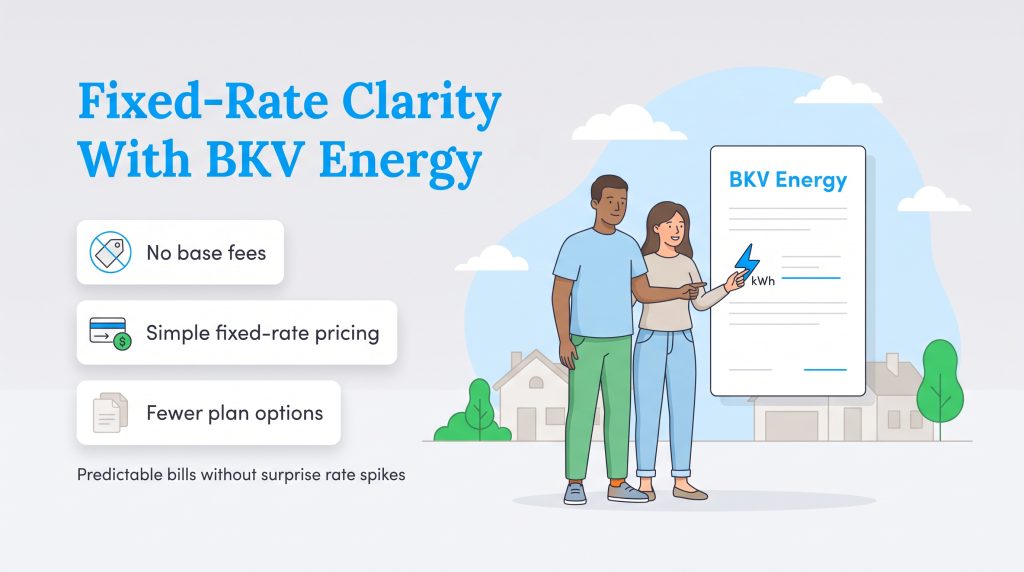
Many homeowners hesitate to switch to a newer utility company, naturally asking: is BKV Energy legit? BKV Energy operates as a fully licensed and regulated provider, building a stellar reputation by eliminating the gimmicks that plague the Texas energy market. When reading through BKV Energy reviews, you will quickly notice a recurring theme of customer satisfaction tied directly to their predictable billing practices.
Consider these essential points when evaluating their services:
- Pro: Zero monthly base fees, instantly lowering the starting cost of your monthly bill.
- Pro: Simple, transparent pricing that prevents the dreaded bill shock common in the summer.
- Pro: Highly favorable prorated early termination fees.
- Con: Limited plan variety compared to older legacy providers.
- Con: No specialized “free time” plans for EV owners looking to capitalize on overnight charging.
The BKV Energy Bluebonnet Plan
To truly appreciate BKV’s offerings, you must first define fixed-rate vs. variable-rate electricity. Fixed-rate energy plans lock in your exact price per kilowatt-hour for the entire duration of the contract. This shields your household budget from wild wholesale market spikes. Variable-rate plans, however, fluctuate based on grid demand and often result in expensive surprises.
The BKV Energy Bluebonnet plan strictly utilizes a simple fixed-rate model. It eliminates the need for spreadsheets and constant thermostat monitoring just to secure a fair rate. Because BKV Energy focuses heavily on straightforward pricing without confusing bill credits, budget-conscious shoppers can accurately forecast their monthly expenses without factoring in hidden penalties for fluctuating power usage.
| Plan Name | Rate /kWH | Plan Term | Cancellation Fee | |
|---|---|---|---|---|
| Pepper Tree 10 | 6.8¢ | Month to Month | N/A | Check Availability |
| Pepper Tree 12 | 7.2¢ | Month to Month | N/A | Check Availability |
| Lantana 6 | 13.3¢ | Month to Month | N/A | Check Availability |
| Lantana 11 | 14.3¢ | Month to Month | N/A | Check Availability |
| Lantana 12 | 14.4¢ | Month to Month | N/A | Check Availability |
| Lantana 18 | 14.4¢ | Month to Month | N/A | Check Availability |
| Lantana 15 | 14.6¢ | Month to Month | N/A | Check Availability |
| Lantana Green 12 | 14.7¢ | Month to Month | N/A | Check Availability |
| Lantana 24 | 14.9¢ | Month to Month | N/A | Check Availability |
| Lantana 36 | 15.1¢ | Month to Month | N/A | Check Availability |
| Lantana Green 24 | 15.1¢ | Month to Month | N/A | Check Availability |
| Lantana Green 36 | 15.8¢ | Month to Month | N/A | Check Availability |
Head-to-Head Comparison: Rates, Fees, and Perks
Evaluating raw numbers and promotional rates only tells half the story. The truest measure of a good utility contract depends entirely on how you actually live inside your home, the hidden fees buried in the contract, and your overall usage tier.
Electricity Rates and Pricing Tiers (500, 1000, and 2000 kWh)
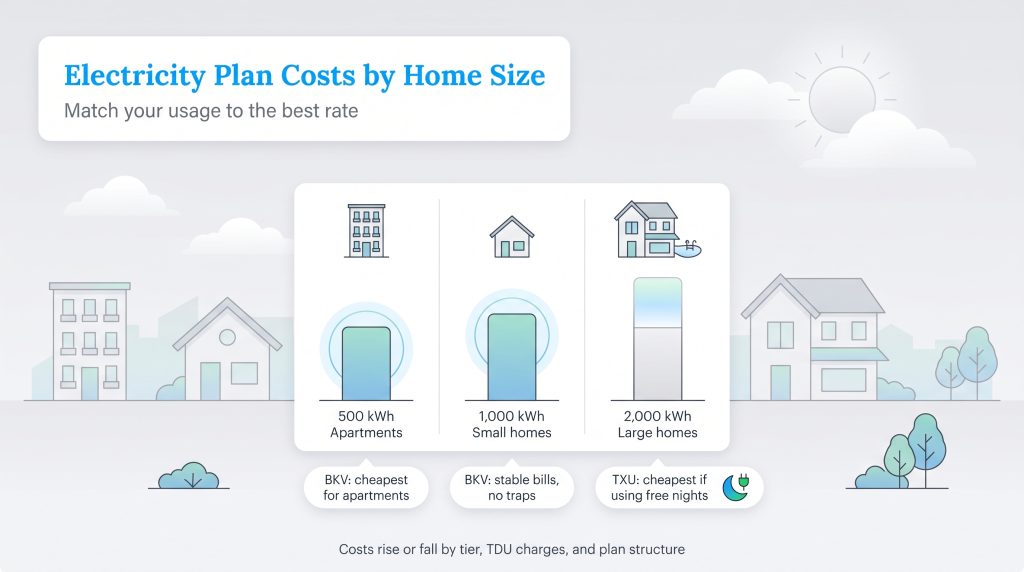
Because Texas operates on a deregulated grid, your effective rate depends heavily on how much electricity you consume. The local TDU delivery charges assessed by utility companies further impact these tiers. Here is how the two providers stack up across different home sizes:
- 500 kWh (Apartments): If you are setting up utilities in a Houston apartment, your usage likely falls into this lower bracket. In these smaller footprints, base fees dramatically inflate your average cost per kWh. Because they charge zero base fees, BKV Energy easily stands as the cheapest electricity in Texas for apartment renters.
- 1,000 kWh (Small Homes): At this middle tier, legacy providers often introduce conditional bill credits to artificially lower the advertised rate. However, without minimum usage thresholds to worry about missing, BKV Energy remains the cheapest and safest choice for a consistent, shock-free bill.
- 2,000 kWh (Large Homes): High-consumption households with swimming pools or multiple HVAC units completely change the math. If you possess a smart home capable of aggressively shifting usage to off-peak nighttime hours, TXU Energy often becomes the cheapest option through their specialized free nights structures.
Hidden Fees and Early Termination Fees
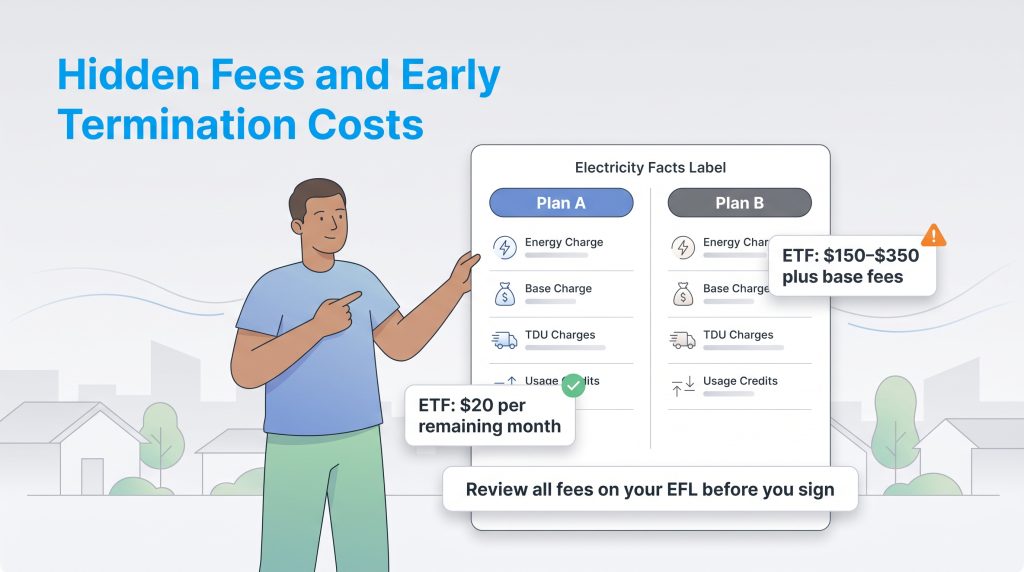
The smartest way to avoid deceptive pricing is to read the Electricity Facts Label (EFL) for every plan you consider. This standard document clearly breaks down the fees behind the marketing, and this is where the two companies diverge sharply.
🚩 Heads Up: BKV Energy charges a simple $20-per-remaining-month ETF and exactly zero base fees. In contrast, TXU Energy early termination fees are flat penalties ranging from $150 to $350, alongside recurring monthly base charges between $4.95 and $14.95. Always review these crucial fee disclosures on your EFL before signing a contract.
Renewable Energy and Green Plans

For those prioritizing sustainable living, finding renewable energy plans Texas residents can rely on is easier than ever. TXU Energy offers an impressive 9% to 100% renewable plan variance, leveraging their massive size to purchase extensive green power reserves. Their popular TXU Energy Free Nights and Solar Days plan perfectly blends eco-conscious goals with time-of-use savings.
BKV Energy steps up as a formidable environmentally mindful choice as well, featuring a 29% to 100% renewable variance. You can select green variations of the BKV Energy Bluebonnet plan, which are fully backed by renewable energy credits.
🌱 Eco Edge: Purchasing a Renewable Energy Certificate (REC) essentially represents the environmental attributes of one megawatt-hour of electricity generated from a renewable source. You directly fund future wind and solar development even though the physical electrons delivered to your home remain a mix of all grid sources.
To truly appreciate the scale of this green infrastructure, you can review the latest Texas renewable energy generation statistics to see exactly how these certificates support the transition away from fossil fuels.
Customer Service and PUC Ratings
Both companies maintain strong regulatory standing. You can verify a retail electric provider’s historical complaint data by checking the Public Utility Commission of Texas (PUCT) website. TXU Energy provides world-class digital tools, allowing for fast, automated customer service resolutions. BKV Energy customer service frequently earns high praise for simple, unscripted support and excellent billing transparency.
Making the Switch to the Right Texas Provider
Deciding between these two excellent providers ultimately comes down to acknowledging your own daily habits. BKV Energy delivers peace of mind for the budget-focused consumer who wants guaranteed low rates, zero base fees, and absolute simplicity without needing to micromanage their thermostat. TXU Energy caters brilliantly to the highly engaged homeowner eager to leverage smart home technology and specific daily routines to unlock massive discounts during off-peak hours.
There is no universal correct answer. The best provider depends entirely on your square footage, daily schedule, and risk tolerance for variable pricing. Take a moment to review your past usage history to see exactly when and how you consume power. Armed with that knowledge, you can confidently sign a contract that fits your life. If you want further strategies to reduce your monthly costs regardless of who supplies your power, check out our favorite ways to lower your electric bill.
Frequently Asked Questions About TXU Energy vs BKV Energy
Which is cheaper: TXU Energy or BKV Energy?
Does BKV Energy charge a base fee?
Do TXU Energy and BKV Energy offer renewable energy plans?
What are the early termination fees for TXU Energy and BKV Energy?
Does TXU Energy really offer free electricity?
Are fixed-rate energy plans better than variable ones?
About the Author

David has been an integral part of some of the biggest utility sites on the internet, including InMyArea.com, HighSpeedInternet.com, BroadbandNow.com, and U.S. News. He brings over 15 years of experience writing about, compiling and analyzing utility data.

LaLeesha has a Masters degree in English and enjoys writing whenever she has the chance. She is passionate about gardening, reducing her carbon footprint, and protecting the environment. She also recently served as President of the Board for City Sprouts (a community garden).