

While Both Providers Offer Premium Service And Similar Perks, Your Usage Habits Will Determine Which Energy Giant Is Actually Worth The Extra Cost
Key Takeaways
- Both TXU and Reliant are “premium” brands that charge higher rates in exchange for superior customer service and stability.
- Reliant often wins on plan simplicity for average homeowners, while TXU’s “Free Nights” plans can benefit specific high-usage households.
- Reading the Electricity Facts Label (EFL) is critical, as both companies use usage credits that can spike your bill if you don’t use enough power.
Choosing between TXU Energy and Reliant Energy is the Texas equivalent of choosing between Coke and Pepsi. Most of us know these two names better than any others on the market because they have been the dominant players since energy deregulation began. When it comes to the ultimate question of who is cheaper, Reliant Energy generally offers more affordable, straightforward fixed-rate plans for the average household, while TXU Energy is frequently cheaper for high-usage homes that consistently hit specific bill credit targets. If you are trying to find the best energy provider in Texas, neither of these premium companies is your absolute cheapest option per kilowatt-hour, but they remain the safest bets for customers who value 24/7 support over rock-bottom pricing. We are taking a brutally honest look at our TXU vs Reliant comparison, exposing the contract details and hidden fees that the slick television ads never show you.

- 10.9¢ /kWh
- 3-100%
- 60 days
- 1-36 Months
- Highest Trustpilot Rating 4.7/5 ★

- 14.1¢ /kWh
- 24%
- 90 days
- 0-36 Months
- Best for Smart Home Tools & App
*rates may vary by location and household usage
The Short Answer TXU Vs Reliant At A Glance
When you strip away the marketing fluff, the differences between these two providers often come down to how much energy your household uses and the contract flexibility you value most. This table breaks down the core metrics to help you quickly spot the winner for your specific situation, as typical rates currently hover in the mid-to-high teens.
| Feature | TXU Energy | Reliant Energy |
|---|---|---|
| Average 12-Month Rate (1000 kWh) | 16.5¢ — 18.9¢ | 15.9¢ — 18.5¢ |
| Monthly Base Charge | $9.95 | $9.95 |
| Early Termination Fee (ETF) Range | Flat fee ($150 — $395) | Prorated ($20 per month remaining) |
| Satisfaction Guarantee Window | 60 days | 90 days |
| Parent Company | Vistra Corp | NRG Energy |
Texas Utility Area Rate Comparison Oncor Vs CenterPoint
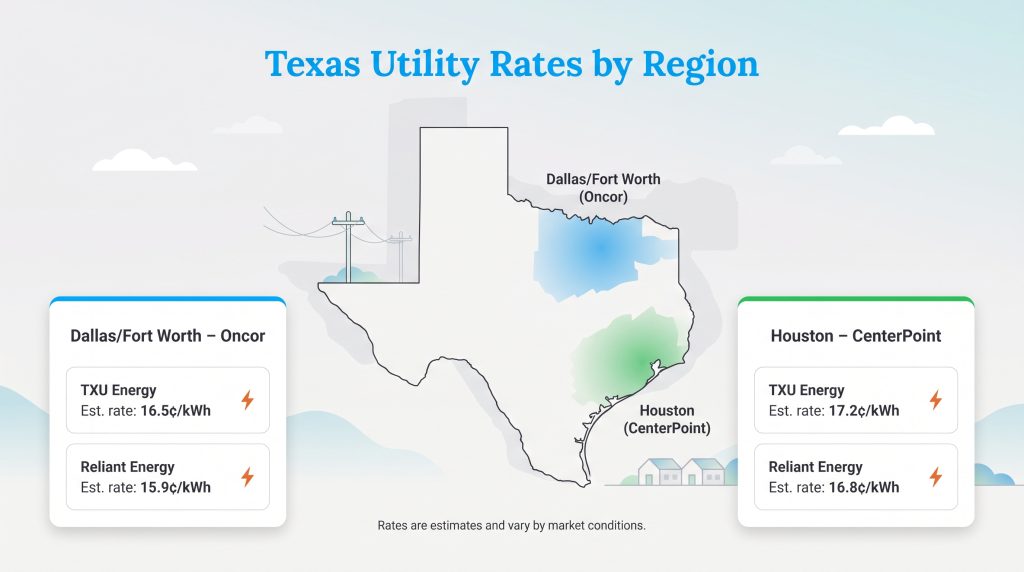
If you live in a deregulated region of Texas, the final price you pay depends heavily on your local utility company. The two largest transmission and distribution utilities (TDUs) are Oncor, serving the Dallas/Fort Worth metroplex, and CenterPoint Energy, serving the greater Houston area.
Because CenterPoint generally assesses slightly higher delivery charges than Oncor, your effective rate will vary by ZIP code even if you choose the exact same plan. Understanding these regional differences is vital when conducting a thorough TXU vs Reliant energy comparison. Here is a look at how the estimated base rates stack up across the major utility zones for an average home using 1,000 kWh.
| Utility Region | Local TDU Company | TXU Energy Est. Rate (1000 kWh) | Reliant Energy Est. Rate (1000 kWh) |
|---|---|---|---|
| Dallas/Fort Worth | Oncor | 16.5¢ / kWh | 15.9¢ / kWh |
| Houston | CenterPoint | 17.2¢ / kWh | 16.8¢ / kWh |
Signature Plans Head-To-Head Free Nights Vs Free Weekends

When comparing high-profile promotional offers, the debate usually centers on TXU Free Nights vs Reliant Free Weekends. Both of these time-of-use plans sound fantastic on paper, but you absolutely have to alter your lifestyle to make them work. If you do not shift your energy consumption into the designated free windows, you will end up paying significantly more than you would on a standard fixed-rate plan.
TXU Free Nights And Solar Days
This flagship plan gives you 100% free electricity every single night, typically running from 8:00 p.m. to 5:00 a.m. During the daytime hours, your power usage is offset by renewable solar energy credits. This plan structure is optimal for:
- Electric vehicle (EV) owners who plug in and charge their cars overnight.
- Night-shift workers who sleep during the expensive daytime peak hours.
- Disciplined households that can easily delay running the dishwasher, laundry machines, and pool pumps until after 8:00 p.m.
Reliant Truly Free Weekends
This popular weekend plan waives all energy charges from 8:00 p.m. Friday to 12:00 a.m. Monday, effectively giving you two full days of free power to run your household at maximum capacity. This plan is optimal for:
- Weekend warriors who travel for work and are rarely home Monday through Friday.
- Families who intentionally save all their heavy chores, baking, and bulk laundry for Saturday and Sunday.
- Homes that are largely empty and powered down during weekday peak hours.
To save money on either of these plans, you will usually need to shift roughly one-third or more of your total usage to the “free” window. If you work from home during the day, these time-of-use plans are almost guaranteed to increase your average bill.
Fixed-Rate Plans Compared
For the vast majority of homeowners, a standard fixed-rate plan is the safest financial bet. Reliant’s flagship plans, often labeled under “Basic Power” or “Conservation,” tend to offer flatter rate structures. This means the price you pay per kilowatt-hour doesn’t jump drastically whether you use 800 kWh or 1,500 kWh in a given month. If you have spent any time browsing PowerToChoose.org, you know that finding the right plan structure is a key step in learning how to save on your electric bill.
TXU often leans heavily on bill credit structures in their standard plans. These plans look incredibly attractive if you hit the specific usage target — usually around 1,000 or 2,000 kWh — but the rate per kWh can spike significantly if you fall short of that usage. If you want a predictable bill that doesn’t require you to constantly monitor your smart meter, Reliant’s standard fixed plans are often slightly more user-friendly.
| Plan Name | Rate /kWH | Plan Term | Cancellation Fee | |
|---|---|---|---|---|
| Smart 1000 Saver 12 | 11.5¢ | Month to Month | N/A | Check Availability |
| Smart Edge 12 | 13.5¢ | 12 Months | $150.00 | Check Availability |
| Clear Deal 12 | 13.8¢ | Month to Month | N/A | Check Availability |
| Smart Edge 24 | 13.9¢ | 24 Months | $295.00 | Check Availability |
| Smart 500 Start 12 | 16.5¢ | Month to Month | N/A | Check Availability |
| Solar Value 12 | 16.5¢ | Month to Month | N/A | Check Availability |
| On Your Terms | 16.9¢ | Month to Month | N/A | Check Availability |
| Simple Rate 12 | 17.3¢ | Month to Month | N/A | Check Availability |
| Free Nights & Cool Summer 12 | 17.9¢ | Month to Month | $Fixed | Check Availability |
| Ultimate Season Pass 12 | 18.8¢ | Month to Month | N/A | Check Availability |
| Solar Club 12 | 19.1¢ | 12 Months | $150.00 | Check Availability |
| Texas Choice 12 | 19.2¢ | 12 Months | $150.00 | Check Availability |
| Texas Choice 24 | 19.2¢ | 24 Months | $295.00 | Check Availability |
| Flex Rewards | 19.3¢ | Month to Month | $0.00 | Check Availability |
| Smart Deal 12 | 19.6¢ | 12 Months | $150.00 | Check Availability |
| Solar Saver 12 | 20.2¢ | Month to Month | N/A | Check Availability |
| Flex Forward | 20.2¢ | Month to Month | N/A | Check Availability |
| Smart Deal 24 | 20.4¢ | 24 Months | $295.00 | Check Availability |
| Smart Deal 36 | 20.4¢ | 36 Months | $395.00 | Check Availability |
| Saver's Discount 12 | 22.6¢ | Month to Month | N/A | Check Availability |
| Plan Name | Rate /kWH | Plan Term | Cancellation Fee | |
|---|---|---|---|---|
| Reliant Power on 9 Plan | 13.2¢ | 9 Months | $95.00 | Check Availability |
| Reliant Power On 12 Plan | 13.9¢ | 12 Months | $150.00 | Check Availability |
| Reliant Power On 18 | 14.9¢ | 18 Months | $180.00 | Check Availability |
| Reliant Power On 24 Plan | 15.4¢ | 24 Months | $295.00 | Check Availability |
| Reliant Basic Power 12 plan | 15.6¢ | Month to Month | N/A | Check Availability |
| Reliant Basic Power 24 plan | 15.9¢ | Month to Month | N/A | Check Availability |
| Reliant Power Savings 2,000 kWh 12 plan | 18.2¢ | Month to Month | N/A | Check Availability |
| Reliant Power Savings 2,000 kWh 24 plan | 20.7¢ | Month to Month | N/A | Check Availability |
Reading The Electricity Facts Label Checklist
Both companies frequently utilize targeted usage credits to make their rates look highly competitive on search engines. Before signing up for any Texas power plan, reading the Electricity Facts Label (EFL) is mandatory. Follow this five-point checklist to protect your wallet:
- Check the base charge: Look for the flat monthly fee (often $9.95) that is applied to your bill before you even flip a light switch.
- Identify usage credits: Determine if the plan requires you to hit a specific consumption threshold, such as 1,000 kWh or 2,000 kWh, to earn a $30 or $50 discount on your statement.
- Calculate the low-usage penalty: Note exactly how high the effective rate spikes if you use 999 kWh and narrowly miss the required bill credit threshold for the month.
- Review TDU delivery charges: Confirm whether the advertised price already includes the TDU delivery charges from Oncor or CenterPoint.
- Confirm the contract term: Verify that the fixed rate is secured for 12, 24, or 36 months to guarantee long-term price stability for your family.
Green Energy And Solar Buyback Options
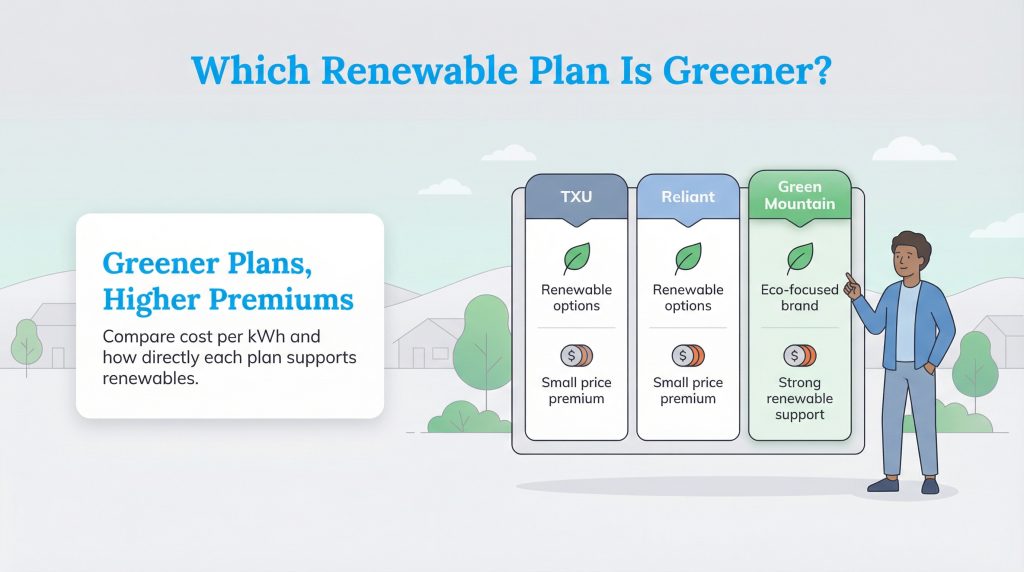
Sustainability is a rapidly growing priority for many Texans, making a comprehensive TXU vs Reliant solar buyback and green energy comparison essential. Both companies offer robust 100% renewable energy plans tailored for renters or homeowners who want to offset their carbon footprint using wind or solar power. However, these environmentally mindful options generally come with a slightly higher price per kilowatt-hour than standard fossil-fuel plans. When choosing between the two, it is worth noting that Reliant is owned by NRG Energy, which also operates Green Mountain Energy — the state’s premier dedicated eco-brand. Still, Reliant provides excellent standalone solar offset plans directly through its own portal.
If you have rooftop solar panels installed, finding a lucrative net metering policy is your top priority. TXU Energy consistently shines in this department with its Renewable Buyback plans, offering highly competitive credit rates for the excess electricity your panels send back to the grid. Reliant Energy also provides a solid solar buyback program, but their plans frequently cap the amount of surplus energy you can roll over from month to month. If maximizing the financial return on your home solar investment is the goal, TXU often edges out Reliant for comprehensive buyback value.
Contract Terms, Cancellation Fees, And Hidden Costs
In addition to your actual energy consumption, both providers tack on extra costs that can surprise you. When evaluating TXU vs Reliant hidden fees, it is crucial to look closely at the base monthly charges. Both companies typically assess a flat $9.95 base fee every single billing cycle just for having an active account, regardless of how much power you use. Furthermore, late payment penalties are strictly enforced. Both providers will charge a penalty equal to 5% of your past-due balance if you miss your scheduled payment date.
Life also happens. You might move out of state, or you might spot a much better market rate six months into your current contract. This is exactly where the TXU vs Reliant early termination fee structures differ completely.
TXU Energy typically charges a flat cancellation penalty based on the length of your original term. For a standard 12-month plan, the early termination fee is usually $150. If you sign up for a 24-month contract, the penalty jumps to $295, and a 36-month contract carries a hefty $395 cancellation cost. It is a clean break; you pay the flat fee, and you are entirely done.
Reliant Energy uses a mix of flat fees and prorated structures. On many of their popular fixed-rate plans, they charge $20 for every month remaining on your contract. If you leave 10 months early, that equates to a $200 fee. If you leave with only one month to go, it is just $20. This prorated approach makes Reliant far more forgiving if you need to switch providers near the end of your term.
Always check your contract expiration date before switching providers. Switching even two days early can trigger the full cancellation fee. Set a calendar reminder for 14 days before your contract expires to start shopping for a new rate.
Moving To Texas Same-Day Service And Deposits
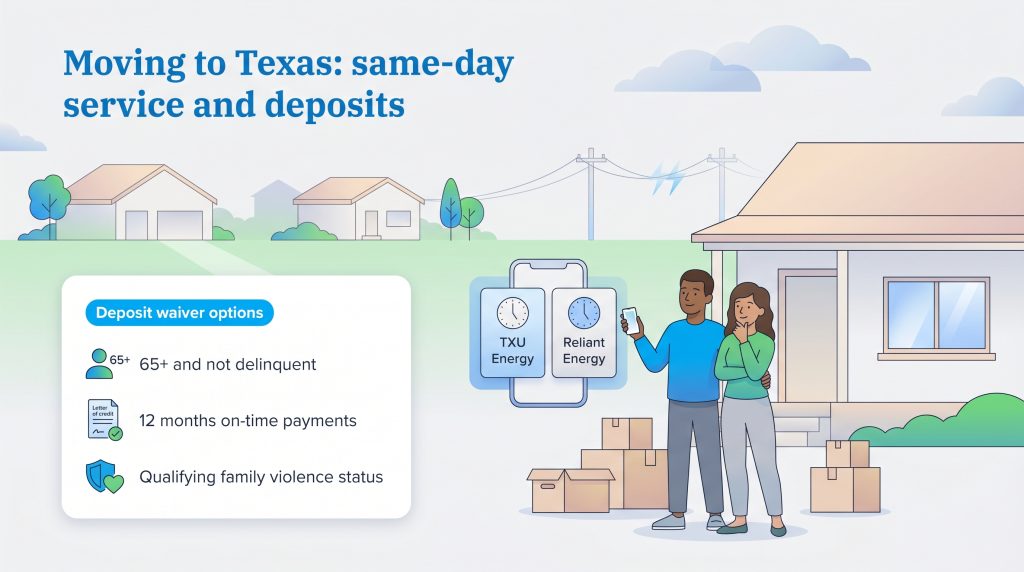
If you are actively moving and need your lights turned on immediately, same-day service cutoffs are a crucial factor to consider. TXU Energy offers slightly more flexibility in this arena, requiring same-day sign-ups to be submitted by 6:30 p.m. CST. On the other hand, Reliant Energy requires your request to be submitted by 5:00 p.m. CST if you want your electricity connected before the day ends.
Additionally, both providers will run a soft credit check when you apply for new service. If your credit score falls below their threshold, you may be hit with a hefty deposit request, sometimes totaling hundreds of dollars. However, you can secure a deposit waiver from either company if you meet specific regulatory criteria. If you are 65 years or older and not currently delinquent on another utility account, can provide a formal “Letter of Credit” from a previous provider showing 12 months of on-time payments, or possess legal family violence exemption status, you are legally entitled to bypass the deposit requirement entirely.
Customer Service And Reviews

A premium electricity provider should offer a premium digital experience and highly responsive support. If you are tired of clunky web portals, exploring Reliant Energy vs TXU Energy reviews reveals exactly why these two brands continue to dominate the Texas market. They consistently outrank smaller budget providers in comprehensive customer satisfaction surveys like those conducted annually by J.D. Power, justifying their slightly higher rates with reliable 24/7 call centers that are actually open on weekends.
Smart Home Tools And Mobile App Experience
- TXU Energy App: Highly rated on both major platforms (averaging 4.8 stars on the iOS App Store), TXU excels at advanced usage tracking tools. The dashboard breaks down your consumption by the hour, helping you spot power-hungry appliances and predict your upcoming bill with impressive accuracy before it even generates.
- Reliant Energy App: Also boasting excellent consumer scores (averaging 4.7 stars on the iOS App Store), Reliant shines with its robust smart home integrations. The app seamlessly connects with Google Nest thermostats and other smart devices, allowing you to optimize your HVAC schedule and control your home’s climate directly from your primary utility dashboard.
Comparison Scenarios Which Provider Fits You?
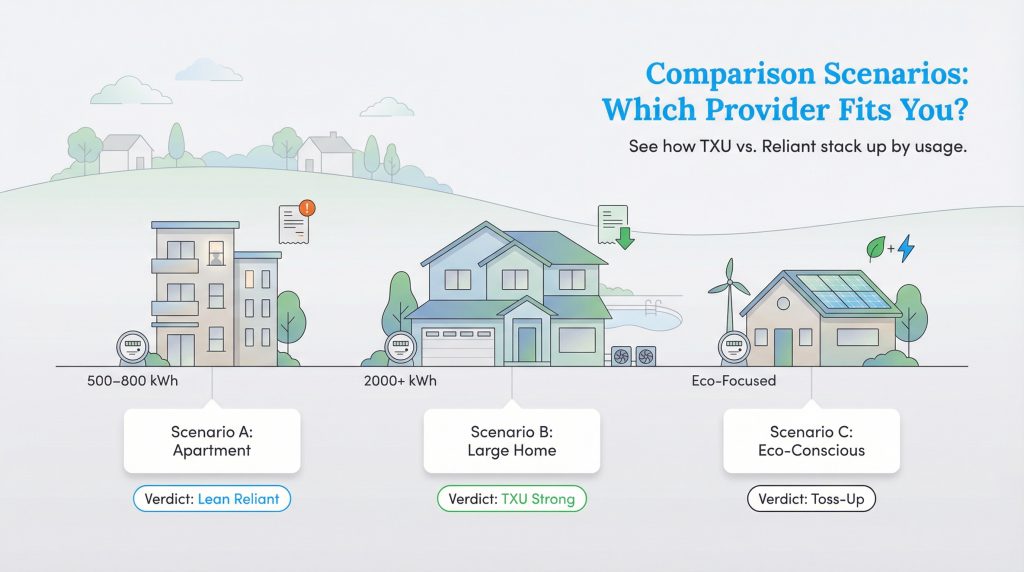
Rates and fees are abstract numbers until you apply them to real life. Here is how these two stack up for different types of residential living situations.
- Apartment Renters: Proceed with caution on both, but lean heavily toward Reliant. Many TXU plans are highly optimized for usage well over 1,000 kWh, meaning you might completely miss out on their bill credits in a small apartment and end up paying a much higher effective rate. Reliant offers simpler pricing structures that do not penalize efficient, lower usage.
- Large Family Homes: TXU Energy is an incredibly strong contender here. If you have multiple HVAC units running, a pool, and kids leaving lights on all day, you will easily hit those 2,000 kWh usage tiers where TXU’s bill credits kick in, reliably reducing your effective rate.
Choosing The Right Texas Electricity Provider For Your Home
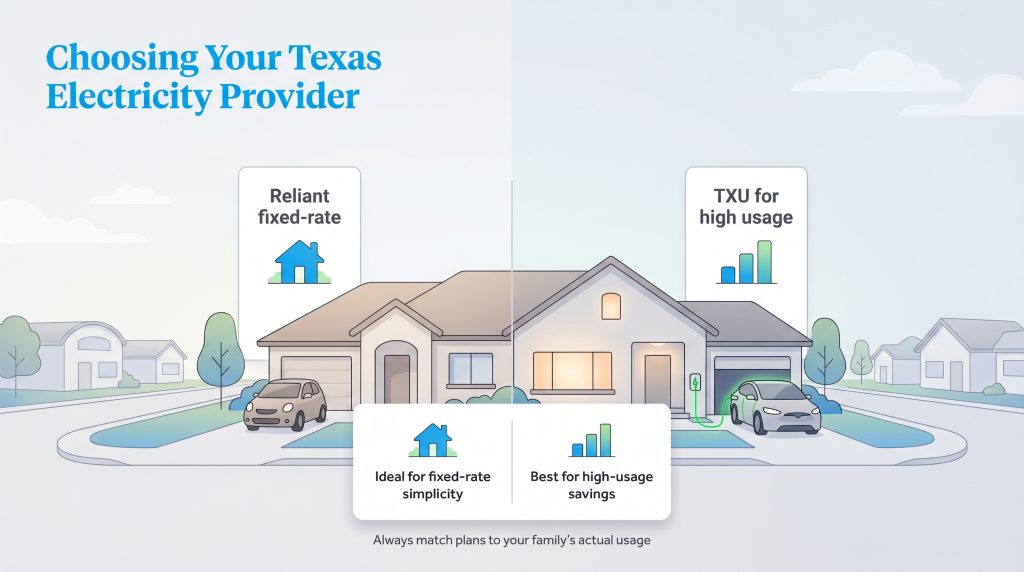
If you find yourself wondering who is cheaper — TXU or Reliant — the final answer lies entirely in your household’s daily habits. After a comprehensive review, Reliant Energy is the definitive winner for average Texas homeowners and apartment renters who want a predictable, straightforward fixed-rate plan without having to constantly micromanage their usage to earn a discount.
TXU Energy emerges as the ultimate winner for high-usage households, large families, and EV owners. When comparing popular fixed plans like the TXU Energy Clear Deal vs Reliant Power Savings, TXU’s structure consistently rewards high consumption. Once you hit their lucrative usage credits, your average price per kWh drops significantly.
Neither company will ever be the rock-bottom price leader in a highly deregulated market, but both are incredibly reliable, recognizable names with polished apps and stellar support. If you are willing to pay a slight premium for long-term stability, pick the provider whose plan structure perfectly matches how and when your family actually uses electricity — and always read your Electricity Facts Label before officially enrolling.
Frequently Asked Questions About TXU And Reliant
Who is cheaper TXU or Reliant?
Which company has a better cancellation policy, TXU or Reliant?
Do TXU and Reliant Energy require a credit check or deposit?
Do TXU and Reliant charge a base monthly fee?
Who has the better mobile app for tracking electricity usage?
Can I get same-day electricity with TXU or Reliant?
Is it hard to switch from TXU to Reliant?
About the Author

LaLeesha has a Masters degree in English and enjoys writing whenever she has the chance. She is passionate about gardening, reducing her carbon footprint, and protecting the environment. She also recently served as President of the Board for City Sprouts (a community garden).

David has been an integral part of some of the biggest utility sites on the internet, including InMyArea.com, HighSpeedInternet.com, BroadbandNow.com, and U.S. News. He brings over 15 years of experience writing about, compiling and analyzing utility data.