

Reliant Offers Stability and Smart Home Perks, While Gexa Energy Typically Wins on Lower Rates per kWh
Key Takeaways
- Gexa Energy usually offers lower rates for usage around 1,000 to 2,000 kWh, making them a budget-friendly choice for larger homes.
- Reliant Energy excels in customer service and offers massive plan variety, including flexible month-to-month options that renters love.
- Both providers offer 100% renewable plans, but their cancellation fees and bill credits differ significantly depending on your monthly usage.

- 14.1¢ /kWh
- 24%
- 90 days
- 0-36 Months
- Best for Smart Home Tools & App

- 7.3¢ /kWh
- 100%
- 60 days
- 12-36 Months
- Committed to Renewable Energy
*rates may vary by location and household usage
Navigating the Texas deregulated energy market can feel incredibly overwhelming, but reading a thorough Reliant vs. Gexa Energy comparison helps you quickly identify the best choice for your household. Choosing between these two powerhouse providers means comparing vastly different pricing structures, contract lengths, and renewable energy perks to lock in the best 2026 rates. We will help you cut through the marketing jargon and break down their unique plan offerings, hidden fees, and smart home benefits so you can skip the fluff and easily pick the clear winner for your specific home layout and budget.
At a Glance: Reliant vs. Gexa Energy
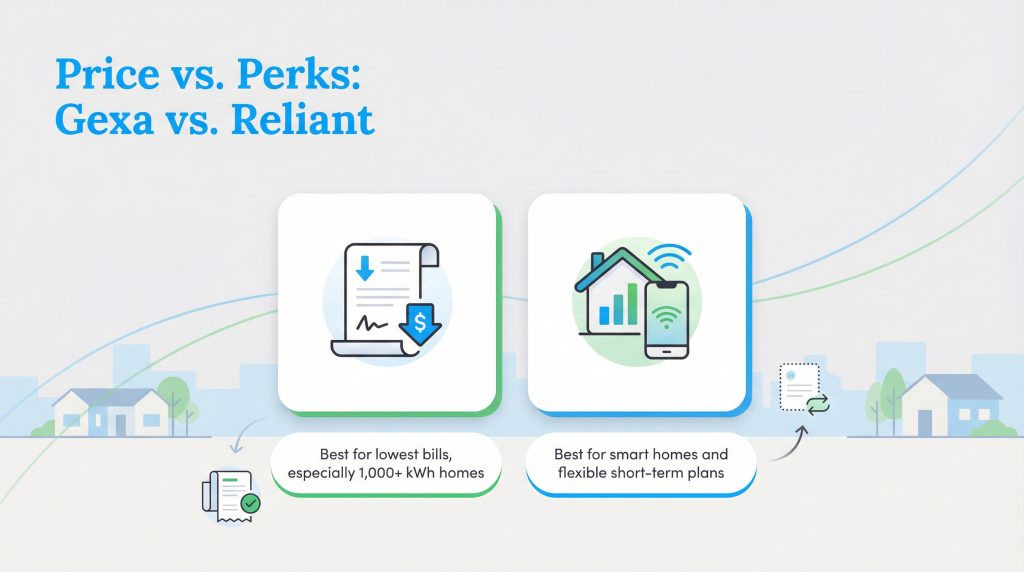
For a rapid visual breakdown of how these two retail energy giants stack up across essential categories, review the comparison table below. Evaluating average rates, plan types, and support capabilities side-by-side reveals the fundamental differences in their business models. We compiled this 2026 data so you can easily weigh the pros and cons before signing a long-term electricity contract.
| Feature | Reliant Energy | Gexa Energy |
|---|---|---|
| Average Rates | Slightly higher, flat-rate stability | Lower, dependent on bill credits |
| Monthly Base Charge | Varies (often around $4.95 to $9.95) | Often $0 to $9.95 depending on plan |
| Green Energy Status | Add-on or specific plans | 100% renewable on all standard plans |
| Satisfaction Guarantee | 90 days to test your plan | 60-day “Happiness Guarantee” |
| Customer Support Hours | 24/7 phone support | Standard business hours |
Plan Offerings and Electricity Rates
Navigating Texas fixed-rate energy plans requires understanding the crucial differences between base charges, utility delivery fees (TDU charges), and your raw energy usage rates. When evaluating Gexa vs Reliant electricity rates, the most critical factor is how each company handles your monthly consumption volume. Your ultimate electricity costs will depend heavily on your home’s square footage, your daily routine, and your willingness to monitor your thermostat.
Gexa Energy: Best for Green Energy and Bill Credits
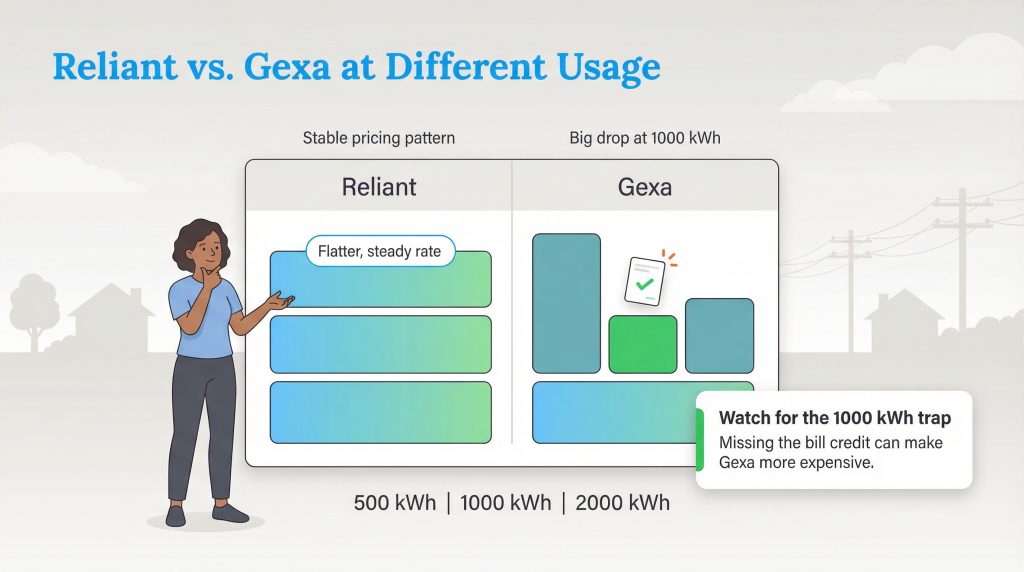
Gexa Energy aggressively targets mid-tier users by designing Gexa bill credit plans — financial discounts that only trigger once you cross an exact usage threshold. A flagship example of this pricing structure is the Gexa Eco Saver Plus 12 plan. Understanding this “usage gap” is vital. For example, if your plan mandates 1,000 kWh of usage to unlock a $50 credit, using 999 kWh means you pay the standard, often higher, base rate. The moment your meter hits 1,000 kWh, the credit applies and your effective rate plummets.
Let’s look at a hypothetical scenario to illustrate the math. At exactly 1,000 kWh of usage, your effective rate with Gexa might be an incredibly attractive 11¢ per kWh thanks to the applied credit. However, if your usage drops to 800 kWh during a mild October when you are not running your air conditioner, you miss the credit entirely. Suddenly, your effective rate could soar to 19¢ per kWh. This structure offers incredible savings if your usage is perfectly consistent, but it heavily penalizes households with fluctuating energy needs.
💸 Money-Saver: Watch out for the “1,000 kWh trap” with Gexa Energy plans. If you live in a smaller apartment and consistently only use 850 kWh, you will miss the bill credit threshold entirely, causing your effective rate to jump by several cents per kWh. Review your historical usage before signing up.
| Plan Name | Rate /kWH | Plan Term | Cancellation Fee | |
|---|---|---|---|---|
| Gexa Saver Plus 12 | 7.3¢ | Month to Month | N/A | Check Availability |
| Gexa Eco Saver Plus 12 | 7.3¢ | Month to Month | N/A | Check Availability |
| Gexa Eco Saver Plus 14 | 7.5¢ | 14 Months | $150 | Check Availability |
| Gexa Eco Saver Plus 24 | 8.4¢ | Month to Month | N/A | Check Availability |
| Gexa Eco Choice 3 | 11¢ | 3 Months | $150.00 | Check Availability |
| Gexa Eco Choice 8 | 11.7¢ | 8 Months | $150.00 | Check Availability |
| Gexa Eco Choice 12 | 13.9¢ | 12 Months | $150.00 | Check Availability |
| Gexa Prime Preferred 24 Plan | 13.9¢ | 24 Months | $295.00 | Check Availability |
| Gexa Prime Preferred 12 Plan | 14.4¢ | 12 Months | $150.00 | Check Availability |
| Gexa Eco Saver Value 12 | 15.1¢ | Month to Month | N/A | Check Availability |
| Gexa Light Saver 12 | 15.3¢ | Month to Month | N/A | Check Availability |
| Gexa Saver Edge 12 | 15.4¢ | Month to Month | N/A | Check Availability |
| Gexa Straight Saver 24 | 18¢ | 24 Months | $295.00 | Check Availability |
| Gexa Eco Saver Advantage 12 | 18.2¢ | Month to Month | N/A | Check Availability |
| Gexa Freedom 12 | 18.4¢ | 12 Months | $150.00 | Check Availability |
| Gexa Eco Saver Premier 24 | 18.9¢ | Month to Month | N/A | Check Availability |
| Gexa Eco Saver Lite 12 | 18.9¢ | Month to Month | N/A | Check Availability |
| Gexa Eco Saver Premier 12 | 19¢ | Month to Month | N/A | Check Availability |
| Gexa Saver Freedom 24 | 19.1¢ | 24 Months | $295.00 | Check Availability |
| Gexa Straight Saver 12 | 19.5¢ | 12 Months | $150.00 | Check Availability |
| Gexa Saver Freedom 36 | 20.1¢ | Month to Month | N/A | Check Availability |
| Gexa Prime Preferred Plus 24 | 21.4¢ | 24 Months | $295.00 | Check Availability |
| Gexa Prime Preferred Plus 12 | 21.7¢ | 12 Months | $150.00 | Check Availability |
Reliant Energy: Best for Smart Home Tech and Stability
Conversely, Reliant Energy plans Texas residents love tend to prioritize straightforward, flat-rate stability over complicated discount tiers. One of their standout options, the Reliant Power Savings 12 plan, ensures that your energy charges do not fluctuate as wildly across different usage levels. This guarantees highly predictable billing month after month. If your household consumes 1,000 kWh or ramps up to 2,000 kWh during the sweltering Texas summer, your base energy charge remains relatively steady.
This transparent pricing structure makes Reliant a significantly safer choice for households with highly variable energy consumption. You will never have to stress about missing an arbitrary usage threshold just to keep your bill affordable. While their advertised rates might look a penny or two higher than Gexa’s promotional offers at exactly 1,000 kWh, Reliant’s flat-rate stability often wins out over a full 12-month contract for standard homes.
| Plan Name | Rate /kWH | Plan Term | Cancellation Fee | |
|---|---|---|---|---|
| Reliant Power on 9 Plan | 13.2¢ | 9 Months | $95.00 | Check Availability |
| Reliant Power On 12 Plan | 13.9¢ | 12 Months | $150.00 | Check Availability |
| Reliant Basic Power 12 plan | 14.7¢ | Month to Month | N/A | Check Availability |
| Reliant Power On 18 | 14.9¢ | 18 Months | $180.00 | Check Availability |
| Reliant Power On 24 Plan | 15.4¢ | 24 Months | $295.00 | Check Availability |
| Reliant Basic Power 24 plan | 16¢ | Month to Month | N/A | Check Availability |
| Reliant Power Savings 2,000 kWh 12 plan | 18.9¢ | Month to Month | N/A | Check Availability |
| Reliant Power Savings 2,000 kWh 24 plan | 20.7¢ | Month to Month | N/A | Check Availability |
Green Energy and Sustainability Features
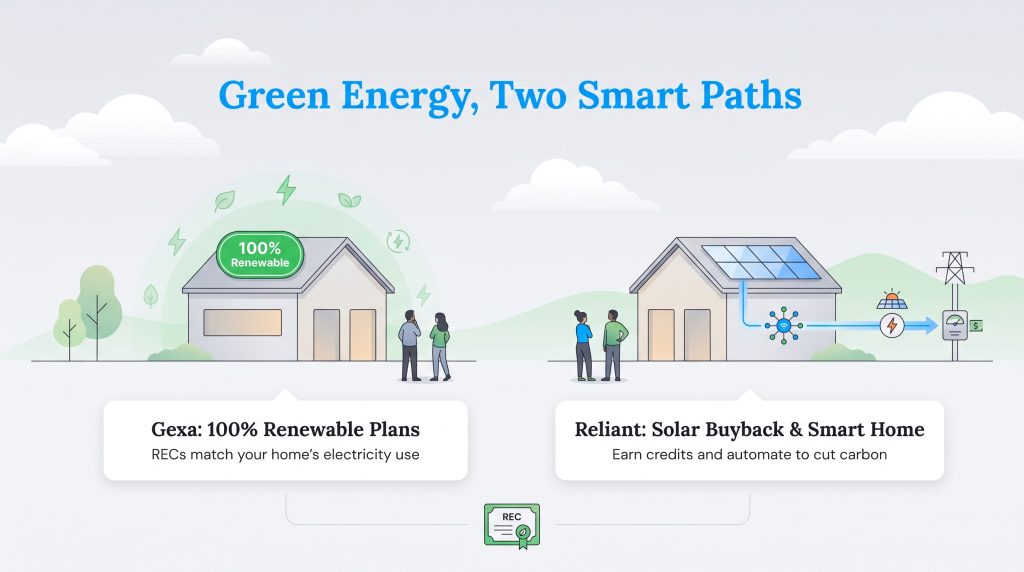
If creating an environmentally mindful home is a top priority, both of these companies rank among the best renewable energy providers Texas has to offer, but they execute their sustainability goals differently. Gexa Energy champions the green space by making all of its standard residential plans 100% renewable out of the box. They achieve this by purchasing Renewable Energy Certificates (RECs) to match your exact consumption, effectively offsetting your carbon footprint without requiring you to install expensive hardware.
Reliant Energy does not automatically bundle 100% renewable energy into all their standard plans, as those often contain a mix of natural gas and other traditional grid sources. However, they provide customized eco-solutions that Gexa lacks. Reliant shines through its robust solar buyback programs, allowing homeowners with rooftop panels to sell excess generated power back to the grid for statement credits. Furthermore, Reliant smart home integration bundles often include Google Nest thermostats or Vivint smart home systems. These advanced tools empower you to automate your HVAC usage, drastically lowering your household carbon footprint and saving you money simultaneously.
🌱 Eco Edge: A Renewable Energy Certificate (REC) essentially proves that 1 megawatt-hour of electricity was generated from a renewable source and fed into the grid. You can verify how RECs support green infrastructure through the EPA Green Power website.
Customer Service, App Experience, and Satisfaction Guarantees
When the grid falters or you face an unexpected billing error, raw numbers per kilowatt-hour suddenly matter a lot less than having access to reliable support. Scanning thousands of Gexa Energy reviews alongside Reliant Energy customer service feedback reveals stark differences in the digital user experience and peace of mind.
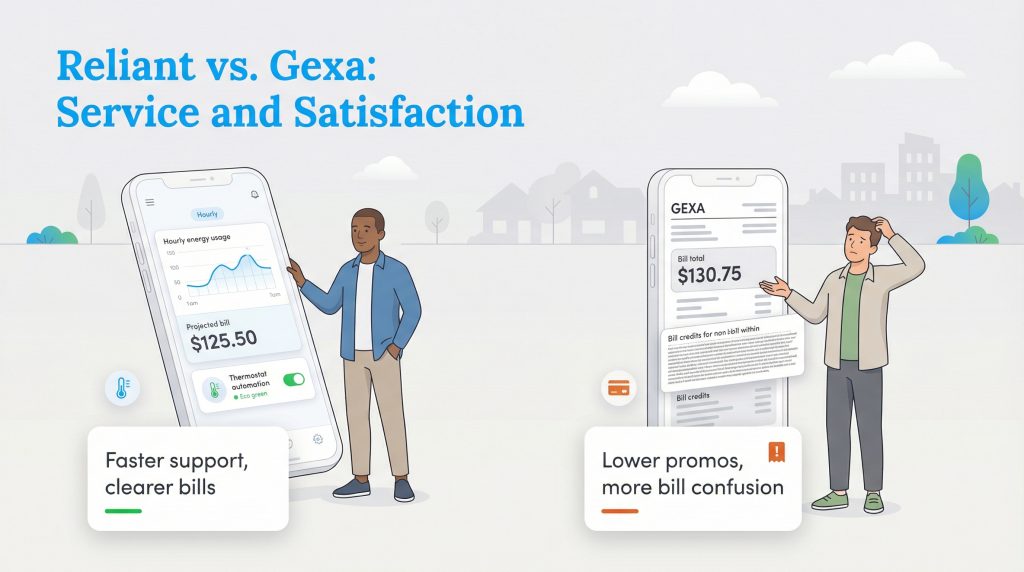
According to the official Texas Power to Choose scorecard, Reliant consistently boasts a five-star rating for customer service. This pristine rating stems from their 24/7 support response times, helpful phone agents, and clear billing statements. Reliant also offers an industry-leading 90-day satisfaction guarantee, giving you ample time to test out a plan and switch without penalty if it does not meet your needs. Additionally, Reliant is widely considered to have one of the best mobile apps in the market, providing highly detailed, real-time usage tracking.
On the other hand, Gexa Energy maintains a respectable, albeit slightly lower, four-star PUCT rating. Their agents operate during standard business hours, and they offer a 60-day “Happiness Guarantee.” While their customer support agents are reliable, user reviews frequently point to severe customer confusion regarding their bill credit thresholds. Because their billing structure is more complex, wait times for phone support can spike significantly during the peak summer months when customers call in to dispute unexpectedly high bills after missing a credit tier.
Hidden Fees, Base Charges, and Early Termination
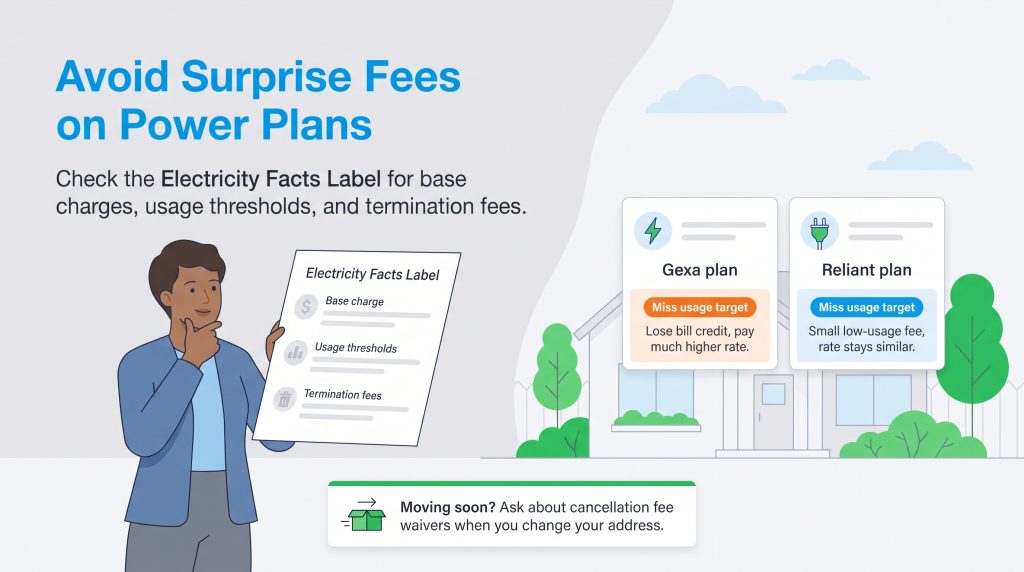
The aggressively advertised rate per kWh is rarely the final story on your monthly statement. Both providers enforce hidden costs if you break your contract early or fail to meet specific consumption criteria. To spot these financial traps, you must review the Electricity Facts Label (EFL) — a standardized state document that reveals the exact fees and base charges of your power plan before you officially sign the agreement.
We want you to be fully prepared before enrolling in a bill credit plan. Here is exactly what happens if you fail to hit the required 1,000 kWh usage mark:
- Gexa Energy: You entirely forfeit the promised bill credit (often $50 or $100). As a result, your effective electricity rate can skyrocket from an advertised 11¢ per kWh to as high as 19¢ or 20¢ per kWh for that specific billing cycle.
- Reliant Energy: If you are on a flat-rate plan like the Power Savings 12, missing a usage threshold does not drastically alter your base energy rate. You might simply see a standard low-usage fee (usually around $9.95) applied to your statement.
When it comes to breaking your contract, early termination fees Reliant enforces are typically prorated. For a standard 12-month or 24-month contract, they might charge $20 for every month remaining on your agreement. This structure is vastly cheaper and less punitive if you only need to break your agreement a few months early.
Conversely, the early termination fees Gexa enforces are notoriously rigid. They typically utilize a harsh flat-rate cancellation fee, which often ranges from $150 for a 12-month plan to $295 for a 24-month plan. If you break your contract with just one month left, you still pay that massive flat fee.
🚩 Heads Up: The cancellation fee for both Reliant and Gexa can be entirely waived if you are moving to a new address. To avoid the penalty, simply notify your provider 30 days in advance, supply your forwarding address, and provide proof of your move (like a new lease agreement or closing document).
Choosing the Right Provider for Your Home
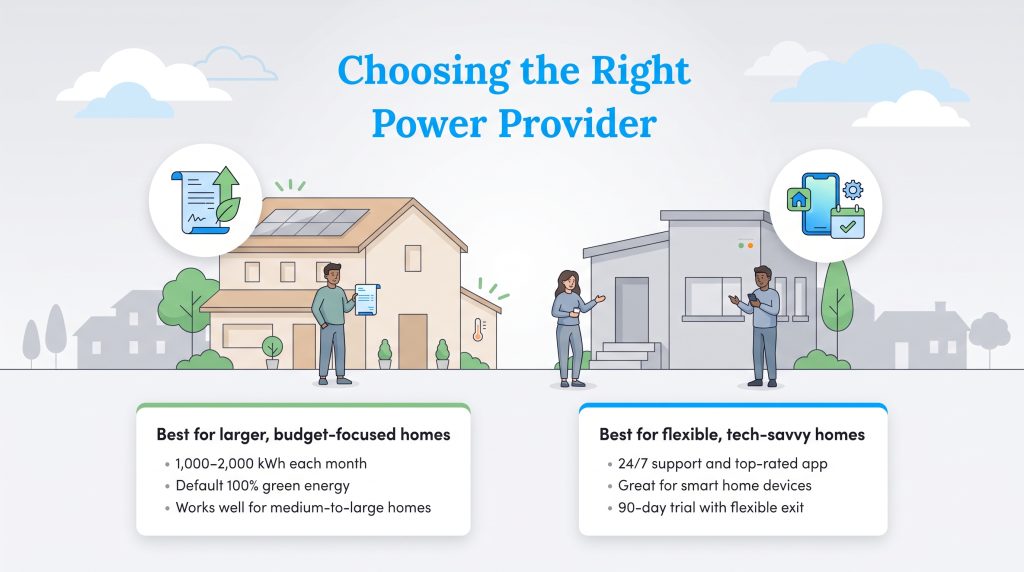
Ultimately, determining if Gexa or Reliant is the better choice depends entirely on the layout of your home, your monthly budget flexibility, and your daily lifestyle habits. Instead of settling for a generic overview, we segmented our final recommendations so you can confidently pick the brand that aligns perfectly with your specific household needs.
Choose Gexa Energy if…
- You are budget-conscious and consistently use between 1,000 and 2,000 kWh every single month, allowing you to reliably hit the required bill credit usage tiers.
- You want default 100% green energy baked into your standard residential plan without paying a massive premium.
- You live in a medium-to-large house and are willing to closely monitor your thermostat during milder spring and fall seasons.
Choose Reliant Energy if…
- You value 24/7 support and the digital convenience of managing your account through a top-rated mobile app.
- You utilize smart home tech for efficiency, taking advantage of free Google Nest thermostats or Vivint security bundles.
- You want a 90-day grace period to test your plan without worrying about harsh, flat-rate cancellation penalties.
Both companies are industry leaders, but locking in a long-term contract requires a close look at your historical power usage. If you are actively switching from Reliant to Gexa or vice versa, remember to check your current EFL to avoid unnecessary early termination fees. For more actionable strategies to lower your expenses regardless of the retail energy provider you ultimately select, read our complete guide on how to save on your electric bill.
Frequently Asked Questions About Reliant vs. Gexa Energy
Does Gexa Energy or Reliant Energy have a better satisfaction guarantee?
Reliant Energy currently offers a stronger safety net with an industry-leading 90-day satisfaction guarantee, giving you three full months to test out a plan and cancel without paying an early termination fee. Gexa Energy offers a slightly shorter 60-day “Happiness Guarantee” for their new customers.
Are Gexa Energy’s bill credit plans actually worth it for small apartments?
In most cases, no. Because Gexa’s best rates require you to use over 1,000 kWh per month to unlock their bill credits, apartment dwellers who use less power will usually miss the threshold. This causes their effective electricity rate to spike. Small apartments are generally better off with flat-rate options.
Which provider offers better smart home integrations to monitor and save electricity?
Reliant Energy easily leads in this category. They offer highly rated smart home integrations, including customized bundles that feature free Google Nest thermostats or comprehensive Vivint smart home security setups to help you automate your HVAC usage and save money.
Is it hard to switch from Reliant to Gexa Energy?
Switching electricity providers is a seamless backend process. Simply select your new Gexa plan online and choose your preferred start date. Gexa will communicate directly with your utility delivery company to transition the service on your behalf. Your power will never be physically disconnected during the switch.
Does Gexa Energy or Reliant have better customer service?
Reliant Energy generally boasts better customer service metrics. According to the Public Utility Commission of Texas (PUCT), Reliant consistently holds a five-star rating for their 24/7 support and helpful agents. Gexa Energy maintains a solid four-star rating, though customers occasionally report longer wait times during peak summer months.
Are Gexa Energy’s 100% renewable plans actually green?
Yes, their plans legitimately support green energy infrastructure. Gexa achieves their 100% renewable status by purchasing Renewable Energy Certificates (RECs) that match your exact home power consumption. This process officially offsets your carbon footprint by ensuring an equivalent amount of wind or solar energy is generated.
Do Reliant and Gexa require a deposit to start service?
Depending on your credit history, both companies may ask for a deposit. However, under Texas rules, many customers easily qualify for deposit waivers based on a positive payment history, being 65 years or older, or being a victim of family violence. Each provider has a slightly different screening process during enrollment.
How much is the Reliant Energy cancellation fee compared to Gexa?
Gexa Energy typically utilizes a rigid flat cancellation fee ranging from $150 to $295 for breaking a fixed-rate contract early. Reliant often uses a prorated approach, charging you $20 for every month left on your agreement, which is generally much cheaper if you cancel near the end of your term.
About the Author

David has been an integral part of some of the biggest utility sites on the internet, including InMyArea.com, HighSpeedInternet.com, BroadbandNow.com, and U.S. News. He brings over 15 years of experience writing about, compiling and analyzing utility data.

LaLeesha has a Masters degree in English and enjoys writing whenever she has the chance. She is passionate about gardening, reducing her carbon footprint, and protecting the environment. She also recently served as President of the Board for City Sprouts (a community garden).