

Your Address Determines Most Utility Providers, While Your Home’s Location and Equipment Shape Its Running Costs
Key Takeaways
- Confirm the providers serving your exact address before scheduling electricity, gas, water, and internet service.
- Check your cooling and heating equipment so you can plan for seasonal energy use, maintenance, and water consumption.
- Verify current rebates and solar incentives before purchasing equipment or signing an installation contract.
Moving to New Mexico means planning for more than a change of address. Your utility providers, heating needs, cooling options, and internet availability can vary widely between cities, mountain communities, and rural properties. We’ll help you identify the services your new home needs, schedule connections, and choose practical ways to manage energy and water costs.
What to Expect When Moving to the Land of Enchantment
New Mexico is the fifth-largest state by land area, yet it has a comparatively small population. That creates a unique mix of bustling urban centers like Albuquerque, Las Cruces, and Santa Fe surrounded by vast stretches of high desert, mesas, and alpine forests. Because the state’s elevation ranges from under 3,000 feet in the southern valleys to over 13,000 feet in the northern mountains, your day-to-day living expenses and utility needs will depend heavily on your exact zip code.
Climate and How It Impacts Your Home
Most people assume New Mexico is a scorching desert year-round, but altitude plays a massive role in local weather. While southern cities like Las Cruces experience hot summers and mild winters, northern hubs like Santa Fe (sitting at 7,200 feet) and Taos get heavy winter snow and frigid nights. Across the board, you will experience low humidity and dramatic temperature swings between day and night.
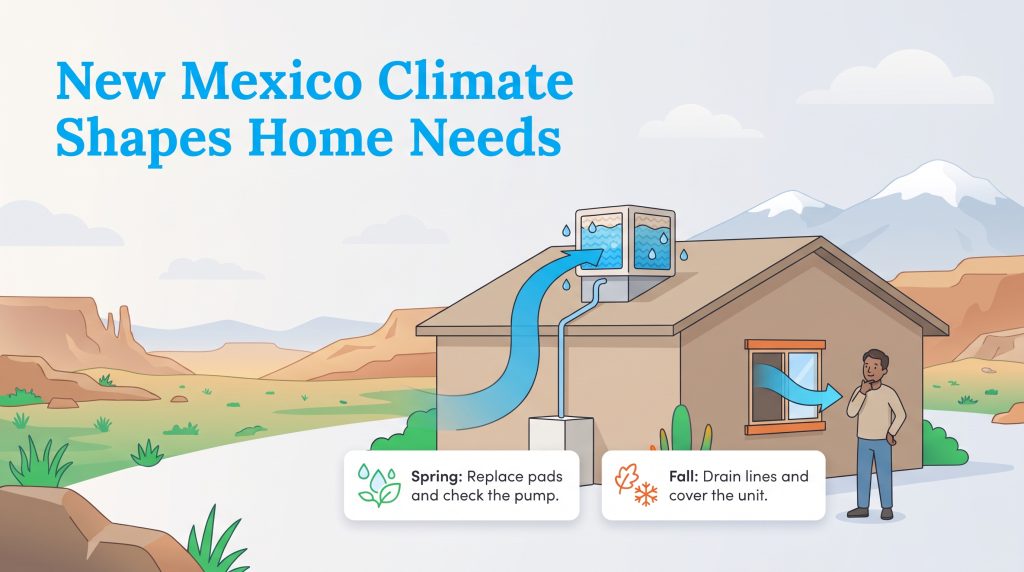
This high-desert climate directly affects how your home uses energy. Many New Mexico homes rely on evaporative coolers (locals call them “swamp coolers”) rather than traditional central air conditioning. While swamp coolers use far less electricity than traditional central air conditioning by pulling outside air over water-saturated pads, they have distinct limitations. They use significant amounts of water, require an open window for an exhaust path, and lose effectiveness as outdoor humidity rises. They also require regular seasonal maintenance.
Pro Tip
If your new home has an evaporative cooler, schedule a seasonal “start-up” in the spring to replace the pads and check the water pump, and a “winterization” in the fall to drain the lines and cover the unit so freezing pipes don’t crack.
Setting Up Your Essential New Mexico Utilities
Unlike deregulated states where you shop around for power companies, New Mexico has a regulated utility market. Your street address dictates which provider handles your electricity, natural gas, and water. We recommend contacting your local utilities well in advance to schedule transfers or new connections.
| Utility Type | Major Providers in New Mexico | Main Service Areas | Estimated Planning Allowance |
|---|---|---|---|
| Electricity | Public Service Company of New Mexico (PNM), El Paso Electric, Xcel Energy, Rural Electric Co-ops | Albuquerque/Santa Fe (PNM), Las Cruces (El Paso Electric), Eastern NM (Xcel), Rural areas (Co-ops) | Varies (allow up to two weeks) |
| Natural Gas | New Mexico Gas Company (NMGC), Zia Natural Gas, Las Cruces Utilities | Many communities (NMGC), Lincoln/Lea Counties (Zia), Las Cruces (Municipal) | Varies (allow at least one week) |
| Water & Sewer | ABCWUA, City of Santa Fe Water Division, Las Cruces Utilities, Mutual Domestic Associations | Managed at the city, county, or neighborhood association level | Varies (check local guidelines) |
| Internet | Xfinity, Lumen (CenturyLink/Quantum Fiber), Viasat, Starlink, Plateautel | Metro areas (Xfinity/Fiber), Rural Eastern NM (Plateautel), Statewide Rural (Satellite) | Varies (construction may take longer) |
Opening Your Utility Accounts
Before you contact any providers, gather the necessary information to open an account smoothly. Having these details ready will prevent installation delays and ensure you have power and water on move-in day.
- Service Address and Start Date: Schedule service to begin when your lease or ownership responsibility starts, and coordinate access with the landlord, seller, or property manager. If you are renting, verify whether utilities are individually metered or landlord-managed before opening an account.
- Identification: Have your government-issued ID and contact information ready.
- Lease or Closing Documents: Some utilities require proof of residency or ownership to establish an account, particularly if the previous occupant left a past-due balance.
- Previous Account Details: If you are transferring service within the state, have your old account number handy.
- Payment Method: Ask about connection fees, deposits, or first-month charges. You should also confirm whether activation requires you to be present for a technician’s visit.
Electricity Providers and Green Energy Options
According to the U.S. Energy Information Administration (EIA), New Mexico generates roughly half of its in-state electricity from renewable resources, led by massive wind and solar growth.
Depending on where you live, you will set up service with one of three investor-owned utilities (PNM, El Paso Electric, or Xcel Energy), one of the state’s rural electric cooperatives, or a municipal electric provider. When setting up your account, ask about green power programs. For example, PNM Sky Blue allows you to match a portion or 100% of your home’s electricity usage with wind and solar energy for a few extra dollars a month, making it an easy, environmentally mindful choice for renters and homeowners alike.
Natural Gas and Heating Services
Because desert temperatures plummet after sundown and mountain winters are fierce, reliable heating is non-negotiable. New Mexico Gas Company (NMGC) is the largest provider in the state, serving over 540,000 customers across Albuquerque, Rio Rancho, Santa Fe, and dozens of smaller communities. If you are moving to Las Cruces, the city’s municipal utility department manages your gas connection alongside your water and trash.
If you are moving to a rural property, an off-grid mesa home, or a mountain cabin, you might not have access to underground municipal gas lines. In those areas, homes typically rely on large residential propane tanks or wood-burning stoves (including traditional corner fireplaces called kivas). If your home uses propane, ask the previous owner which local delivery service owns or fills the tank so you can set up an inspection and refill schedule before autumn arrives.
Water, Sewer, and Trash Collection
Water is the most precious resource in the Southwest, and municipal water authorities take conservation seriously. In the Albuquerque metro area, you will set up your account through the Albuquerque Bernalillo County Water Utility Authority (ABCWUA), while the Solid Waste Management Department handles your trash and recycling bins. In Santa Fe and Las Cruces, a single municipal utility portal handles water, wastewater, and curbside collection. In rural areas, you might rely on mutual domestic water associations and other community water systems.
Many New Mexico cities use tiered water pricing during the summer months. Basic indoor water usage is billed at a standard rate, while excessive outdoor watering pushes your bill into higher pricing tiers. Even better, most local water utilities offer cash rebates when you swap out thirsty bluegrass lawns for drought-tolerant desert landscaping (xeriscaping), install rainwater harvesting barrels, or upgrade to WaterSense-labeled toilets and ENERGY STAR-certified clothes washers.
Eco Edge
Rebates vary by municipality, so check with your local water provider before purchasing equipment or planning a landscape remodel.
Connecting Internet and Home Services
Whether you work remotely or just want to stream movies after unpacking boxes, securing fast internet should be high on your moving checklist. Connectivity varies wildly between the Rio Grande corridor and New Mexico’s rural expanses.
In metro areas like Albuquerque, Rio Rancho, Santa Fe, and Las Cruces, you have strong competition between cable providers like Xfinity and fiber-optic networks. However, thick adobe or stucco walls (a staple of New Mexico’s Pueblo Revival architecture) can block Wi-Fi signals from traveling between rooms. Investing in a mesh Wi-Fi system is a smart way to eliminate dead zones in an adobe home.
If you are relocating to a rural community, tribal land, or a remote canyon, traditional cable and fiber lines might not reach your property. Look into regional fiber cooperatives like Plateau Telecommunications in eastern New Mexico or Sacred Wind Communications in the northwest. Otherwise, compare availability, latency, obstructions, installation cost, and data policies for fixed wireless providers or low-earth-orbit satellite internet to find the best fit for your specific address.
Tapping Into New Mexico Solar and Sustainability Incentives
With abundant sunshine and high elevation that intensifies solar radiation, New Mexico is one of the best states in the country for residential solar power. Making energy-saving upgrades here doesn’t just cut your carbon footprint; it can offer significant financial returns, depending on your installation price, financing, roof conditions, and electricity use.
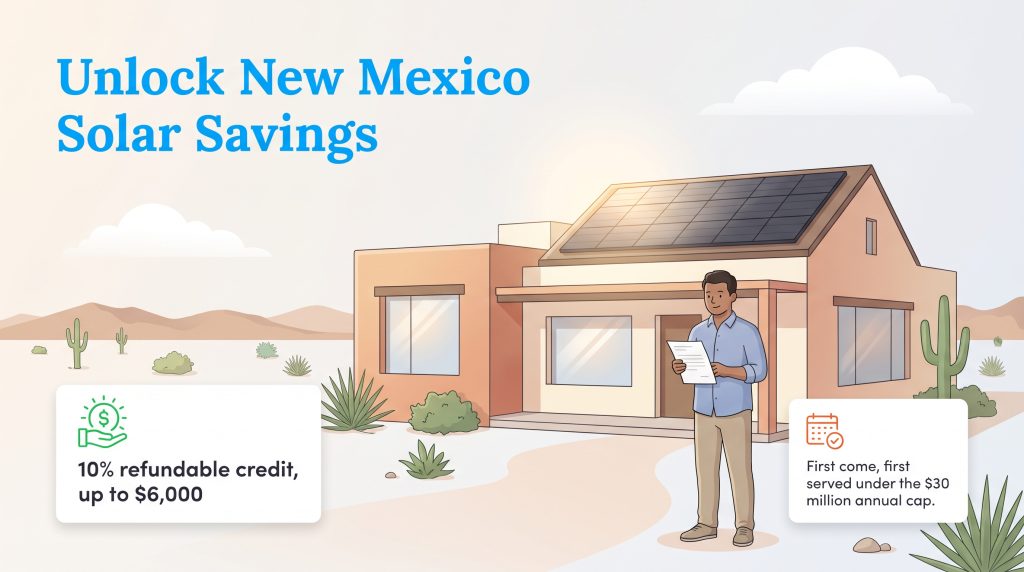
Homeowners who install rooftop photovoltaic (PV) panels can apply for the New Solar Market Development Tax Credit through the New Mexico Energy, Minerals and Natural Resources Department (EMNRD). This state incentive offers a refundable income tax credit worth 10% of your solar equipment and installation costs, up to $6,000. Additionally, qualifying residential solar value is excluded from increased property tax assessments. You should also check with your utility about its net-metering eligibility and compensation rules, as these vary by provider.
Not ready for solar panels, or renting your home? You can still lower your energy bills by scheduling a home energy checkup through PNM or NMGC. These programs provide heavily discounted ENERGY STAR smart thermostats, LED bulbs, and rebates on heat pump water heaters and evaporative cooler upgrades.
Money-Saver
New Mexico’s state solar tax credit has an annual funding cap of $30 million and is awarded on a first-come, first-served basis, so submit your certification paperwork to EMNRD immediately after your solar system passes its final building inspection.
Your Step-by-Step New Mexico Moving Checklist
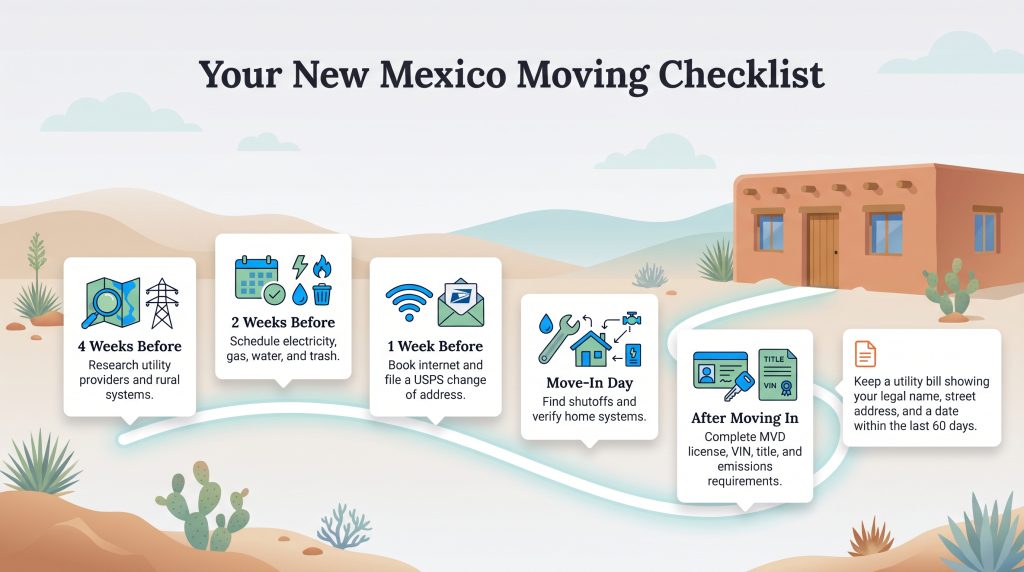
To keep your relocation organized and stress-free, follow this chronological checklist for handling your utilities and new resident responsibilities. Tackling these tasks early will help you avoid service interruptions on move-in day.
- Four Weeks Before Moving: Research which electric, gas, water, and internet providers serve your new address. Confirm well condition, recent water-quality testing, septic inspection history, and propane tank ownership before committing to a rural property.
- Two Weeks Before Moving: Contact PNM, El Paso Electric, Xcel Energy, or your local co-op to schedule your electricity activation. Do the same for New Mexico Gas Company and your city water and trash department.
- One Week Before Moving: Book your internet installation appointment and file an official change-of-address form with the U.S. Postal Service. Remember that broadband construction or installation in rural areas can take longer than a week, so start this process as early as possible.
- Move-In Day: Locate your main water shut-off valve, electric breaker box, and gas meter. Check that all utilities are active, test your smoke and carbon monoxide detectors, and inspect your swamp cooler or HVAC filter.
- After Moving In: Once you establish legal residency, visit the New Mexico Motor Vehicle Division (MVD). You are required to surrender your out-of-state driver’s license and apply for a New Mexico license. Separately, to register an out-of-state vehicle, you must complete a VIN inspection and title transfer. You will need a valid ID, proof of Social Security number, and two physical documents proving your New Mexico address. Note that residents in Bernalillo County (Albuquerque) must also pass a vehicle emissions test before registering a car.
Heads Up
Printed paperless utility bills are typically accepted as proof of residency at the New Mexico MVD, as long as they show your full legal name, your physical street address (no P.O. boxes), and are dated within the last 60 days.
Settling Into Your Sustainable New Mexico Home
Moving to New Mexico offers a rare chance to slow down, enjoy wide-open skies, and embrace a more eco-conscious way of living. Once your electricity, water, heating, and internet are up and running, you can focus on making your home work in harmony with the desert environment. From taking advantage of local water rebates to tapping into the state’s abundant solar power, small adjustments will keep your new home comfortable and your monthly utility bills manageable for years to come.
Frequently Asked Questions About Moving to New Mexico
Navigating a cross-state move involves keeping track of countless details and deadlines. Here are a few quick answers to common questions about managing utility costs and local regulations in New Mexico.
How much do utilities cost per month in New Mexico?
Can I choose my electric company in New Mexico?
Do utilities require a deposit when moving to New Mexico?
What is the difference between a swamp cooler and central air conditioning in New Mexico?
Does Albuquerque or Santa Fe require emissions testing for my car?
Are there water restrictions I need to know about in New Mexico?
About the Author

LaLeesha has a Masters degree in English and enjoys writing whenever she has the chance. She is passionate about gardening, reducing her carbon footprint, and protecting the environment. She also recently served as President of the Board for City Sprouts (a community garden).

David has been an integral part of some of the biggest utility sites on the internet, including InMyArea.com, HighSpeedInternet.com, BroadbandNow.com, and U.S. News. He brings over 15 years of experience writing about, compiling and analyzing utility data.