


Heat Pump Water Heaters Move Heat Rather Than Generating It Directly, Offering Massive Energy Efficiency For Homeowners With The Right Installation Space
Key Takeaways
- Heat pump water heaters act like a refrigerator in reverse, pulling warmth from the surrounding air to heat the water in your tank.
- Most residential units operate as “hybrid” systems, meaning they automatically switch to standard electric resistance heating during periods of high demand to ensure you never run out of hot water.
- Proper airflow is absolutely essential for efficiency, requiring installation in an unconditioned space with at least 1,000 cubic feet of ambient air to function correctly.
If you are searching for practical ways to slice your monthly utility bills, understanding how a heat pump water heater works is an excellent starting point. Unlike standard systems that consume massive amounts of energy to generate heat from scratch, a heat pump water heater operates by pulling ambient warmth from the surrounding air and transferring it into your water tank. This eco-conscious technology relies on a highly efficient refrigerant cycle rather than brute-force grid electricity or fossil fuels, making it an incredibly smart upgrade for modern households. In this comprehensive guide, we will break down the exact thermodynamics behind the appliance, evaluate hybrid water heater modes, and compare heat pump vs traditional water heater performance to help you decide if upgrading to a hybrid electric water heater is the right move for your home.
The Mechanics: A Refrigerator In Reverse
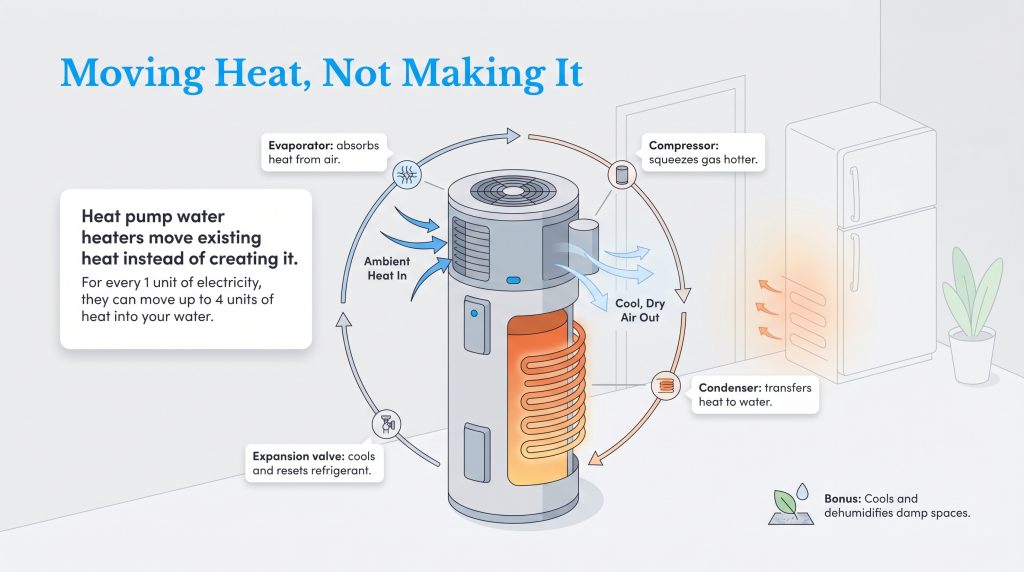
At its core, a heat pump water heater is an advanced appliance that uses a fraction of the electricity required by standard units to transfer environmental heat into a storage tank. By capitalizing on an impressive energy coefficient, these systems can successfully move up to four units of thermal energy into your water supply for every single unit of electricity they consume. This thermodynamic advantage drastically lowers your direct utility bill impacts. Because modern residential models also feature built-in electric resistance coils to assist during high-demand periods, these appliances are most commonly referred to as “hybrid water heaters.”
To grasp the underlying concept quickly, think about an appliance already humming away in your kitchen: your refrigerator. A fridge keeps your groceries cold by aggressively pulling heat out of the insulated box and exhausting it into your kitchen. A heat pump water heater executes this exact process in reverse. Instead of pushing heat away to cool an enclosed space, it pulls warmth from the ambient room air and forces it directly into your water supply.
Step-By-Step: The Refrigerant Cycle Explained
While the overarching concept is straightforward, the internal mechanics rely on a continuous, intelligent cycle of evaporation and compression. To understand exactly how the system achieves its impressive energy efficiency, look at the four-stage cycle operating at the top of the tank:
- Evaporator Coils: A fan located at the top of the appliance pulls ambient room air and passes it over the evaporator coils.
- Refrigerant: Inside these coils flows a specialized liquid refrigerant. This chemical mixture quickly absorbs the heat from the incoming air and immediately evaporates into a low-pressure gas.
- Compressor: The gaseous fluid travels directly into the compressor. This active mechanical component aggressively squeezes the gas, drastically increasing its pressure and raising its temperature until it becomes super-heated.
- Heat Exchanger: This scalding hot gas flows through a heat exchanger — typically a condenser coil securely wrapped around the core of the water tank. As the gas travels through this coil, it transfers its intense heat directly into your water supply. Afterward, the refrigerant cools, condenses back into a liquid, and passes through an expansion valve to restart the cycle.
Heat Pump Water Heaters Vs Traditional Systems
When weighing a heat pump vs traditional water heater, the foundational difference comes down to how the thermal energy is sourced. Traditional electric models operate exactly like a giant tea kettle; they send electricity through submerged metallic resistance elements, generating heat through sheer electrical friction. Meanwhile, conventional gas models rely on combusting fossil fuels to create an open flame. In stark contrast, heat pump systems source their heat from the air, using minimal electricity only to move it. This fundamental shift in technology creates wildly different cost structures, lifespans, and energy efficiency ratings.
| Feature | Heat Pump (Hybrid) Water Heater | Traditional Electric Water Heater | Traditional Gas Water Heater |
|---|---|---|---|
| Upfront Cost | $1,500 – $3,000 (Before rebates) | $400 – $800 | $600 – $2,000 |
| Yearly Operating Cost | Lowest ($110 – $160 annually) | Highest ($450 – $600 annually) | Moderate ($200 – $400 annually) |
| Energy Efficiency Factor (UEF) | 3.0 to 4.0 (300% – 400% efficient) | 0.90 to 0.95 (90% – 95% efficient) | 0.60 to 0.70 (60% – 70% efficient) |
| Expected Lifespan | 10 – 15 years | 8 – 12 years | 8 – 12 years |
| Space Requirements | Needs 1,000 cu. ft. of ambient air space | Can fit in tight, unventilated closets | Requires strict combustion clearances |
| Venting & Drainage | Requires a condensate drain or pump | No condensate drainage needed | Requires a dedicated exhaust flue |
Understanding Hybrid Water Heater Operating Modes
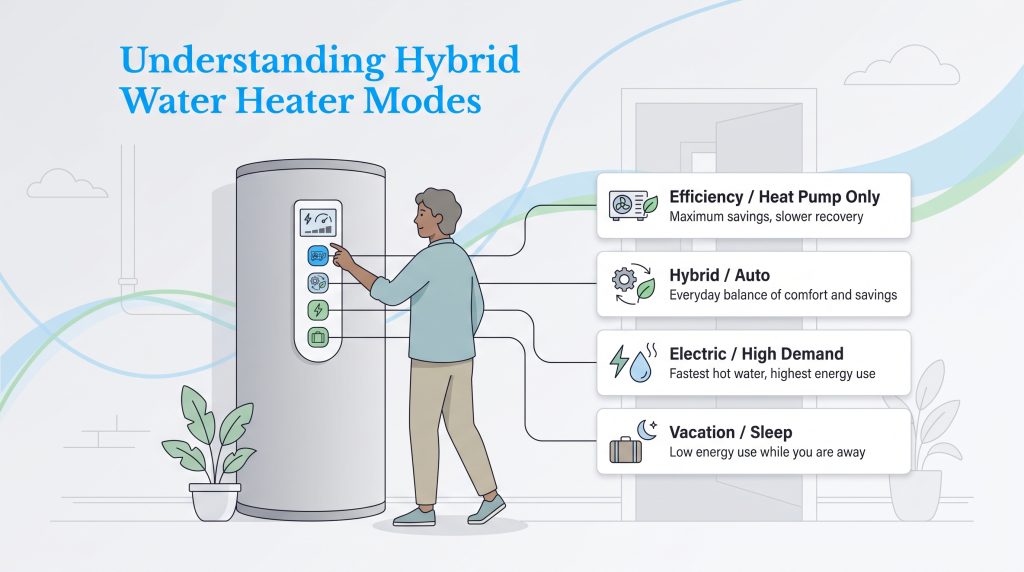
One of the greatest advantages of modern hybrid systems is their sheer adaptability. Because the mechanical heat pump process has a slightly slower recovery rate than brute-force electric elements, manufacturers include an intuitive control panel that lets you dictate exactly how the unit behaves based on your daily schedule. By choosing the right setting, you can perfectly balance robust energy savings with your household’s comfort.
Most standard hybrid models include four distinct operating modes that you can easily toggle between:
- Efficiency/Heat Pump Only: The system relies entirely on the heat pump mechanism to warm your water. This setting maximizes your utility savings — complementing other efforts to save on your water bill — but means the tank will recover its temperature much more slowly after heavy use.
- Hybrid/Auto: This is the recommended default setting for most households. The appliance primarily uses the ultra-efficient heat pump, but it will automatically detect sudden temperature drops — like when multiple family members shower back-to-back — and temporarily activate the electric backup elements to keep the hot water flowing seamlessly.
- Electric/High Demand: This mode temporarily bypasses the heat pump entirely and relies exclusively on the standard resistance elements. It provides the fastest possible recovery time but consumes the most electricity. It is ideal for when you are hosting a house full of out-of-town guests and demand is exceptionally high.
- Vacation/Sleep: When you leave town for an extended period, this setting drops the tank’s internal temperature to a safe baseline (usually around 60ºF). It prevents the internal water from freezing in colder climates while slashing your energy usage until you return home.
Space And Climate Requirements For Installation
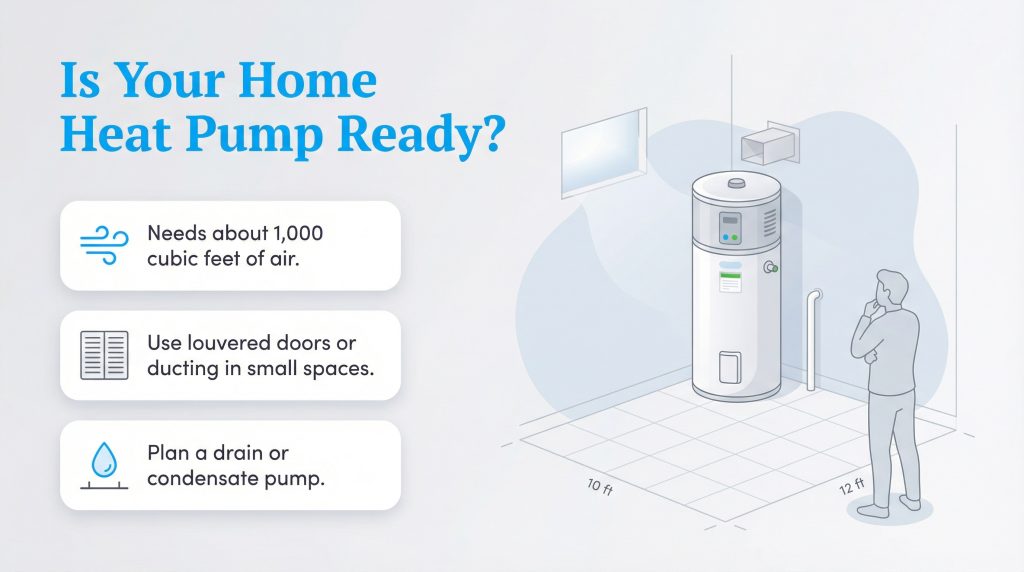
Upgrading your utility room requires careful planning, as heat pump water heater space requirements involve strict physical constraints that you simply cannot ignore. Because the appliance extracts heat from the surrounding environment, it needs plenty of room to breathe without suffocating itself in a bubble of cold air.
If you install the system in a tiny, unventilated closet, it will rapidly suck all the available heat out of the air. This plummets the room’s temperature, forcing the unit to abandon its efficient thermodynamic cycle and rely entirely on the expensive backup electric elements. Because of their temperature sensitivity, the most ideal installation spots are unconditioned basements, spacious utility rooms, or attached garages that do not experience freezing winter drafts.
Lastly, you must prepare for active condensate management. Just like an indoor air conditioning unit, the refrigerant cycle continuously pulls moisture out of the air as it operates. This natural dehumidification process creates steady liquid condensation that needs a clear exit path. During your plumbing installation, you will need to direct this runoff into a nearby floor drain, install a small condensate pump, or route a dedicated PVC drain line directly to your home’s exterior to prevent indoor flooding.
Financial Incentives: Federal Tax Credits And Utility Rebates
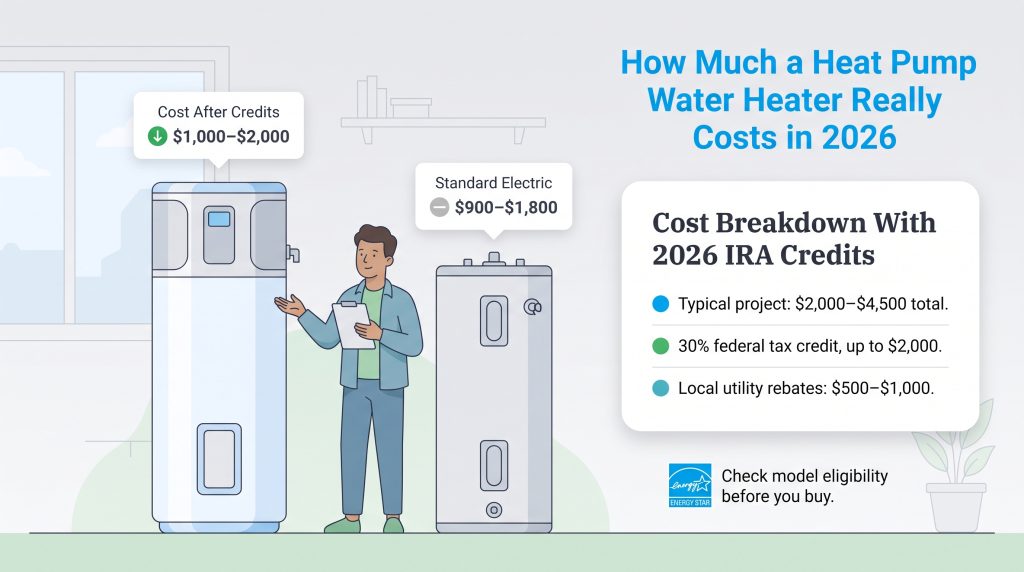
When evaluating heat pump water heater cost, it is crucial to look past the initial sticker shock. A standard hybrid unit generally costs between $1,500 and $3,000 upfront at the hardware store, which is noticeably more expensive than a basic resistance tank. Furthermore, you must also factor in the professional installation cost, which can run an additional $500 to $1,500 depending on the complexity of your home’s wiring and plumbing layout. However, thanks to a combination of unprecedented government and utility incentives, the actual out-of-pocket expense drops dramatically.
The biggest financial advantage currently available is the federal Energy Efficient Home Improvement Credit (25C). Under this provision of the Inflation Reduction Act (IRA), homeowners can claim a robust federal tax credit covering 30% of their total project cost (which includes both the physical appliance and the professional installation labor), capped at an impressive $2,000 annually. When you pair this generous federal credit with local utility provider rebates — which frequently offer instant point-of-sale discounts ranging from $500 to $1,000 — the premium price tag often matches or completely undercuts standard, inefficient electric models.
To ensure you capture every possible dollar of savings, we strongly instruct readers to verify that their chosen model is strictly ENERGY STAR® certified. Always utilize the official ENERGY STAR product finder to confirm eligibility and locate utility rebates before booking an installer.
Heat Pump Water Heater Pros And Cons
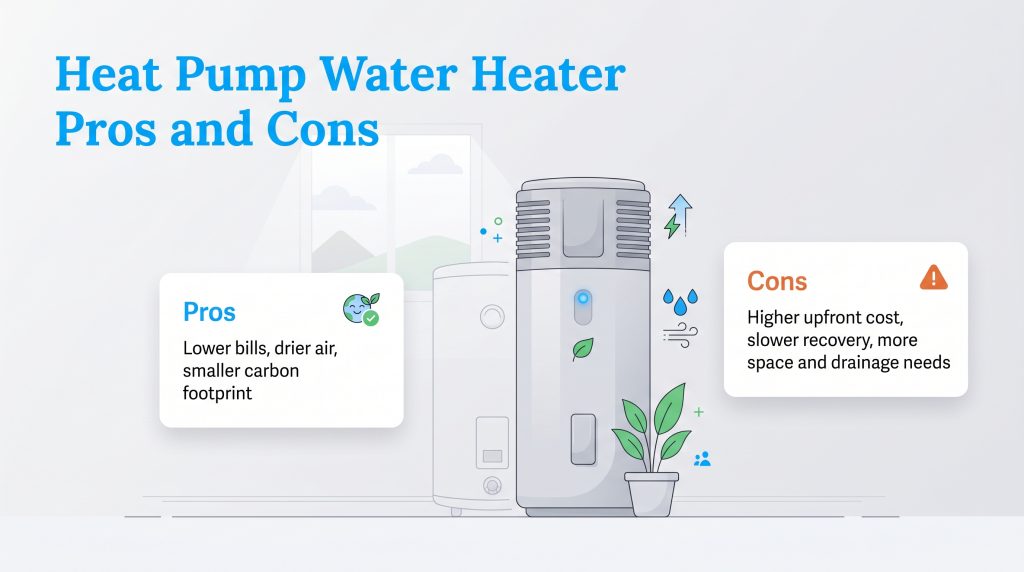
Before you commit to upgrading your home’s plumbing infrastructure — whether you are eyeing this technology or comparing tankless water heater pros and cons — it is important to weigh the specific benefits against the system’s operational quirks. Reviewing these heat pump water heater pros and cons will help you see if the technology aligns with your budget and physical space constraints.
The Pros:
- Massive Efficiency: A traditional 50-gallon tank draws about 3,500 kWh annually, whereas a similarly sized hybrid unit uses barely 1,000 kWh to accomplish the exact same job.
- Free Dehumidification: The system actively pulls moisture out of the surrounding air, helping keep damp basements dry during the summer months.
- Eco-Friendly Operation: By slashing your reliance on grid electricity, you directly lower your household’s overall carbon footprint.
The Cons:
- Higher Upfront Cost: The initial purchase price and professional installation fees are noticeably higher prior to applying tax credits.
- Slower Recovery Time: The highly efficient heat pump mechanism simply takes longer to reheat a fully depleted tank of water.
- Plumbing Additions: Because it pulls moisture from the air, you must install a dedicated condensation drain line or mechanical pump.
How To Size A Heat Pump Water Heater For Your Household
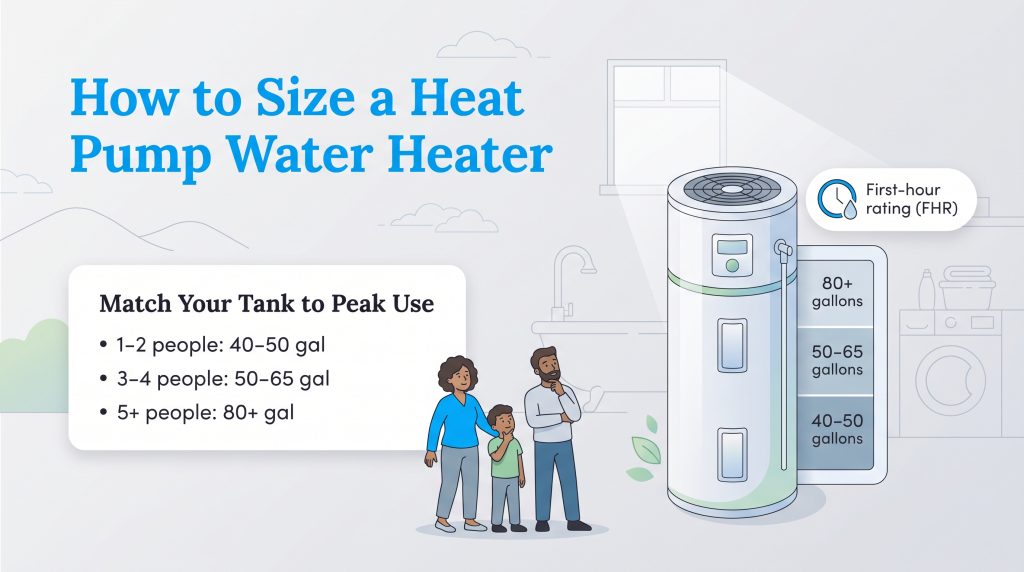
If you want to maximize your energy savings, getting your heat pump water heater sizing right is essential. A unit that is too small will constantly trigger the less-efficient electric resistance elements to keep up with your family’s demands. Conversely, an oversized unit will experience “standby heat loss,” forcing it to constantly re-warm water you have no immediate plans to use. To find the sweet spot, you calculate your household’s First-Hour Rating (FHR), which estimates how many gallons of hot water you need during peak usage hours. If you prefer a simpler estimation based on household size, you can refer to this general sizing chart:
| Household Size | Recommended Tank Capacity |
|---|---|
| 1 to 2 People | 40 to 50 Gallons |
| 3 to 4 People | 50 to 65 Gallons |
| 5 or More People | 80+ Gallons |
Essential Heat Pump Water Heater Maintenance
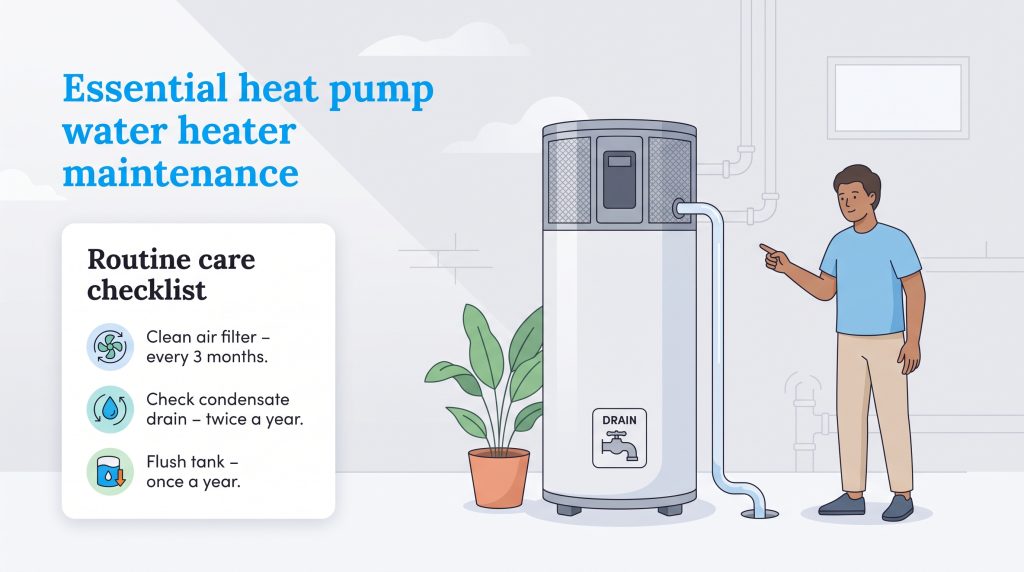
To ensure your hybrid system reaches its expected 15-year lifespan while maintaining peak efficiency, you cannot simply install it and forget about it. These units feature mechanical parts and air filters that require a bit more attention than a traditional baseline heater. Keep your appliance running smoothly by adhering to this routine checklist:
- Clean the Air Filter (Quarterly): Locate the washable mesh air filter located at the top of the unit, slide it out, and gently vacuum away any accumulated dust to maintain proper airflow.
- Check the Condensate Drain (Biannually): Inspect your PVC condensate line or mechanical pump to ensure there are no algae clogs preventing the liquid from draining away safely.
- Flush the Tank (Annually): Minerals found in your municipal supply will naturally settle at the bottom of the tank over time. Flush a few gallons of water through the drain valve to clear this sediment and prevent it from acting as an insulator.
Preparing For Your Heat Pump Water Heater Installation

If you have the appropriate unconditioned space, upgrading to a heat pump water heater is undeniably one of the smartest residential improvements you can make. Before you officially pick up the phone to schedule an installation with a licensed professional, make sure you finalize your decision by evaluating the specific pros and cons, verifying your sizing requirements, and committing to the basic upkeep of the machine.
By thoughtfully preparing your installation site, securing local rebates, and selecting an adequately sized unit that matches your household’s peak demand, you will enjoy decades of reliable service. While the internal mechanics might sound complex, the everyday result is beautifully simple: you get the exact same hot water pressure your family expects, but with drastically lower daily operating costs and a highly optimized carbon footprint.
Frequently Asked Questions About Heat Pump Water Heaters
Do heat pump water heaters work in cold climates?
Can I install a heat pump water heater in a small closet?
How much noise does a heat pump water heater make while running?
Can a heat pump water heater replace my gas water heater?
What is the lifespan of a heat pump water heater?
Do heat pump water heaters need a drain?
How much electricity does a heat pump water heater use?
About the Author

David has been an integral part of some of the biggest utility sites on the internet, including InMyArea.com, HighSpeedInternet.com, BroadbandNow.com, and U.S. News. He brings over 15 years of experience writing about, compiling and analyzing utility data.

LaLeesha has a Masters degree in English and enjoys writing whenever she has the chance. She is passionate about gardening, reducing her carbon footprint, and protecting the environment. She also recently served as President of the Board for City Sprouts (a community garden).

Jared Evans is a licensed electrician and the owner of Full Circuit Electric in Omaha, Nebraska. As an expert reviewer for UtilitiesForMyHome.com, Jared uses his 10+ years of hands-on experience to ensure our electrical advice is safe, accurate, and easy to follow. Whether he's troubleshooting a complex wiring issue or sharing tips on green energy upgrades, Jared is dedicated to helping you power your home efficiently — and safely.