
Solar thermal technology offers a highly efficient way to reduce your monthly water heating bills by harnessing the power of the sun.
Key Takeaways
- Solar thermal systems capture the sun’s heat directly to warm water for your home, operating completely differently than traditional solar panels that generate electricity.
- Homeowners must choose between active and passive systems, pairing them with specialized flat-plate or evacuated-tube collectors based on their local climate.
- Installing a qualifying solar water heater allows you to claim a 30% federal tax credit, substantially lowering upfront costs and accelerating your return on investment.
Are you tired of watching your hard-earned money drain away every time you turn on a hot water tap? Upgrading to solar thermal systems is an absolute game-changer for eco-conscious homeowners aiming to slash their utility bills. Simply put, a solar thermal system is a specialized heating technology that captures the sun’s radiant heat to directly warm your home’s water supply, seamlessly offsetting 50% to 80% of your domestic hot water needs. Most people immediately picture how solar panels work to generate electricity, but thermal technology offers an even more direct approach. By relying on free sunshine rather than expensive grid electricity or natural gas, you can drastically lower your carbon footprint and reduce what is typically the second-largest energy expense in a residence. If you are looking for an environmentally mindful choice that delivers immediate, tangible utility savings, we have designed this complete guide to walk you through exactly how these systems operate, the equipment you will need, and how to confidently calculate your long-term return on investment.
What Is a Solar Thermal System Versus Solar PV
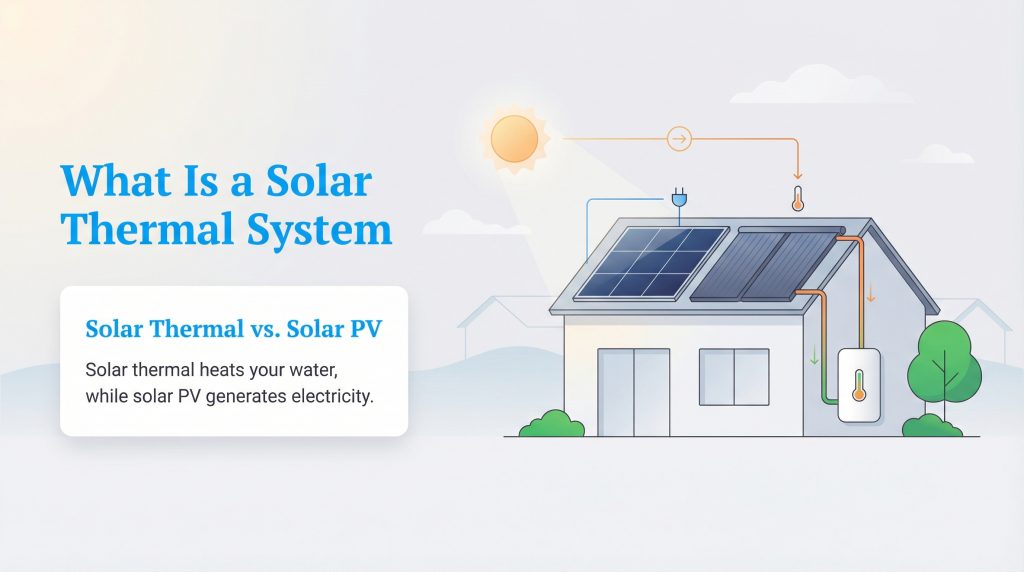
It is incredibly common for homeowners to confuse solar thermal technology with standard solar panels, but evaluating solar thermal vs. solar PV ultimately comes down to one core question: do you need to generate raw heat, or do you need to generate electricity? Both systems harness the sun’s power, but they serve entirely different utility purposes inside your home.
Solar thermal systems are dedicated workhorses strictly designed to capture heat for water and air. Because they transfer heat directly and efficiently, they require significantly less roof real estate — often just two or three collectors — to make a massive dent in your monthly bills. Conversely, Solar PV (Photovoltaic) systems use semiconductor materials to convert sunlight directly into electricity to keep your lights on, run your refrigerator, and power your air conditioning units. Here is a clear breakdown of how the two popular technologies compare:
| System Characteristic | Solar Thermal Systems | Solar PV (Photovoltaic) Systems |
|---|---|---|
| Primary Function | Heats water or air directly | Generates electricity for the whole home |
| Energy Output Type | Thermal energy (Heat) | Electrical energy (AC/DC power) |
| Roof Space Requirements | Minimal (Usually 2 to 3 collectors) | Substantial (Typically 10 to 20+ panels) |
| Average Upfront Cost | Lower initial investment | Higher initial investment |
| Best Residential Use Case | Domestic hot water and space heating | Powering appliances, lights, and HVAC |
🌱 Eco Edge: You do not necessarily have to choose just one. Many homeowners install a large solar PV array for their electricity alongside a compact solar thermal system specifically to tackle their heavy water heating demands, creating a truly sustainable property.
How Do Solar Thermal Systems Work?
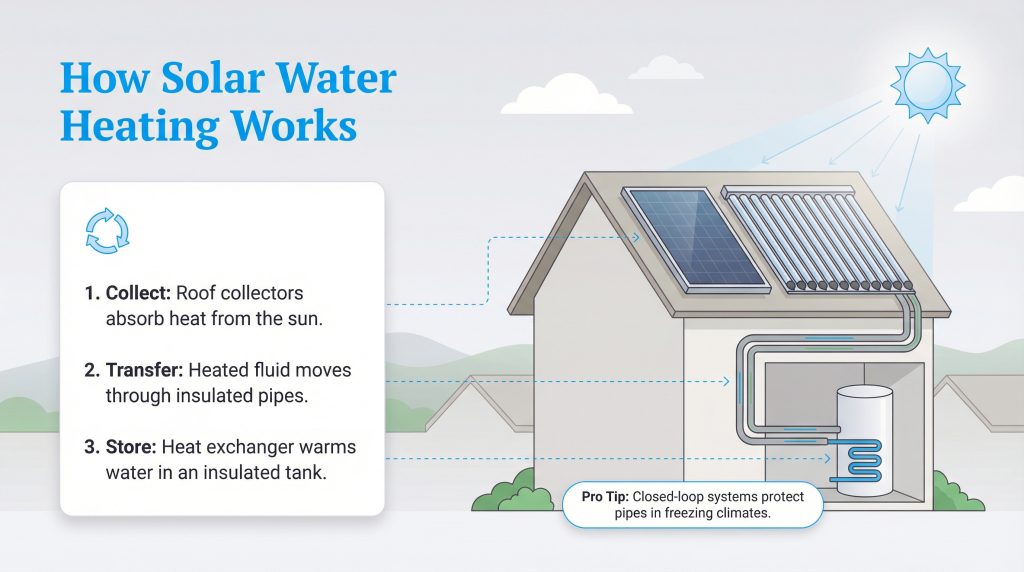
The core mechanics behind this energy-saving option are remarkably straightforward but incredibly effective, relying on a continuous cycle to move thermal energy from your roof down to your utility room. Instead of relying on complex semiconductors, these panels act like massive magnifying glasses on your roof. They absorb intense solar radiation and transfer that raw heat into a specialized fluid. This direct absorption process can achieve up to 70% solar thermal efficiency, capturing a massive amount of free energy to reduce your reliance on traditional fossil fuels.
Core Components: Collectors, Storage Tanks, and Transfer Fluids
To fully understand your new utility setup, it helps to break the heating process down into three chronological steps. Working together, your roof-mounted collectors, insulated storage tanks, and internal heat transfer fluids execute a continuous loop to keep your showers warm:
- Capture: The process begins on your roof, where weather-resistant collectors absorb the sun’s ambient heat throughout the day. The heat transfer fluid — usually a safe mixture of water and food-grade glycol to prevent winter freezing — rests inside copper tubes within the collectors, rapidly rising in temperature as the sun beats down.
- Transfer: Once the fluid reaches a target temperature, a dedicated circulation pump pushes this superheated liquid down into your home. It flows through a tightly coiled heat exchanger located safely inside your domestic hot water tank.
- Store: As the fluid flows through the exchanger, it releases its thermal energy directly into your home’s potable water supply. The newly heated water is securely held in your insulated storage tank until you turn on a tap, while the cooled heat transfer fluid loops back up to the roof collectors to repeat the cycle.
Types of Solar Thermal Collectors
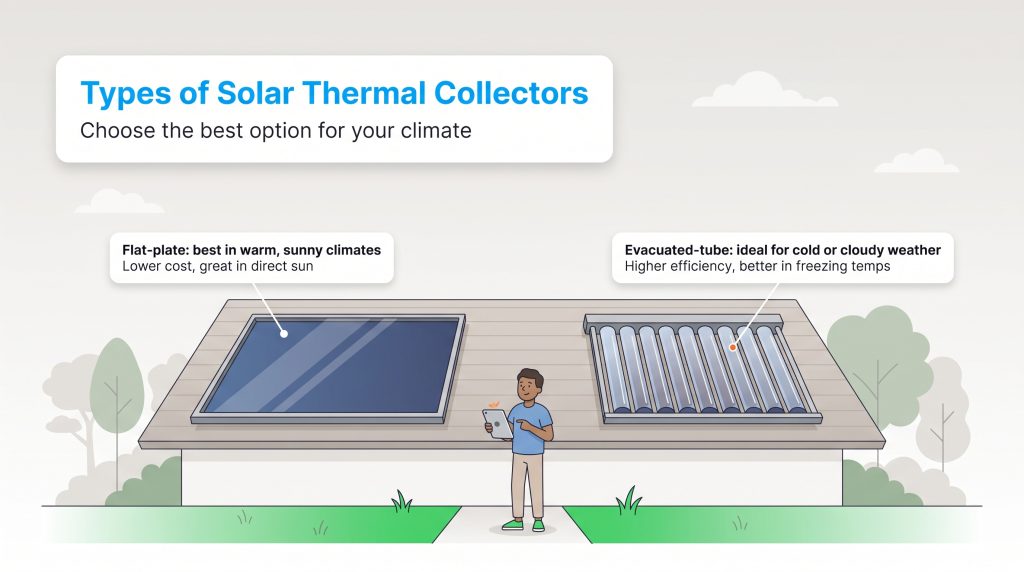
The specialized hardware mounted on your roof serves as the engine for your entire domestic hot water solar system. Depending on your local climate and your household’s specific utility demands, you will need to choose between two primary types of solar thermal panels: flat-plate or evacuated-tube designs.
Flat-Plate Collectors
Flat-plate collectors are the most common option for residential installations and visually resemble traditional types of solar panels. They consist of a dark, weather-resistant absorber plate housed inside an insulated metal box featuring a heavy-duty glass or plastic cover. They generally achieve temperature ranges between 140°F and 180°F and boast efficiency ratings of 60% to 70% during peak sunlight hours.
- Pros: Highly durable construction, lower upfront costs, and excellent performance in warm, direct sunlight.
- Cons: Susceptible to heat loss in freezing temperatures; heavier and slightly bulkier to install on steep roofs.
Evacuated-Tube Collectors
If you live in a region that experiences harsh, snowy winters, evacuated-tube collectors are the superior energy-saving option. This highly engineered design features rows of parallel, transparent glass tubes containing a vacuum space that perfectly surrounds an inner absorber tube. Because vacuums are extraordinary insulators, these panels can reach internal temperatures exceeding 200°F and maintain pristine efficiency ratings even on heavily overcast, sub-zero days.
- Pros: Exceptional year-round heat retention, highly efficient in cloudy and freezing climates, and individual tubes can be replaced without shutting down the whole system.
- Cons: Carry a higher initial purchase premium, and the glass tubes are more fragile when exposed to extreme hail compared to flat plates.
Active Versus Passive Solar Thermal Systems
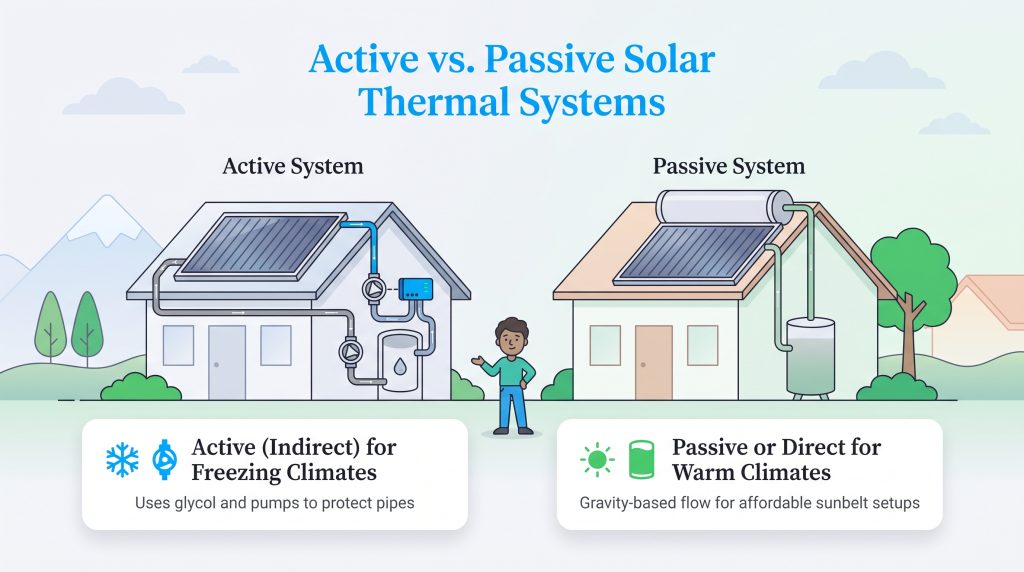
Beyond selecting your roof collectors, your system requires a reliable method for moving the heat into your home. We can broadly categorize these mechanical setups into active versus passive solar heating configurations. Choosing correctly ultimately depends on your geographical location and your tolerance for routine plumbing maintenance.
Active Systems for Direct and Indirect Circulation
Active setups utilize electric pumps and electronic controllers to circulate fluid, giving you precise temperature control and maximized efficiency.
- Direct Circulation: Pumps your actual household potable water directly through the roof collectors. Highly efficient, but strictly limited to tropical environments.
- Indirect Circulation: Pumps a non-freezing heat transfer fluid (glycol) through the collectors and into a heat exchanger. This is the undisputed gold standard for standard residential homes.
Passive Systems for Thermosiphon and Integral Collector Storage
Passive configurations rely purely on natural gravity and thermodynamics to move the water, offering a simpler, pump-free setup that requires less routine maintenance.
- Thermosiphon: The heavy water storage tank is installed physically higher than the solar collectors. As water heats up, it naturally rises into the storage tank, while cooler water sinks.
- Integral Collector Storage (Batch Systems): Features thick tubes set inside an insulated, glazed box. Cold water flows in, warms up over several hours in the sun, and flows directly to your conventional backup heater.
To summarize the golden rule of climate compatibility:
- Freezing Climates (Snow and Sub-Zero): You must install an active (indirect circulation) system. The antifreeze glycol mixture is the only way to prevent catastrophic burst pipes on your roof during a freeze.
- Non-Freezing Climates (Sunbelt and Tropical): You have the flexibility to choose highly affordable passive (thermosiphon) models or robust active (direct circulation) systems.
💡 Pro Tip: If you live in a region that experiences harsh winter freezes, an active indirect circulation system is the safest option to prevent catastrophic burst pipes on your roof.
How Much Does a Solar Thermal System Cost?
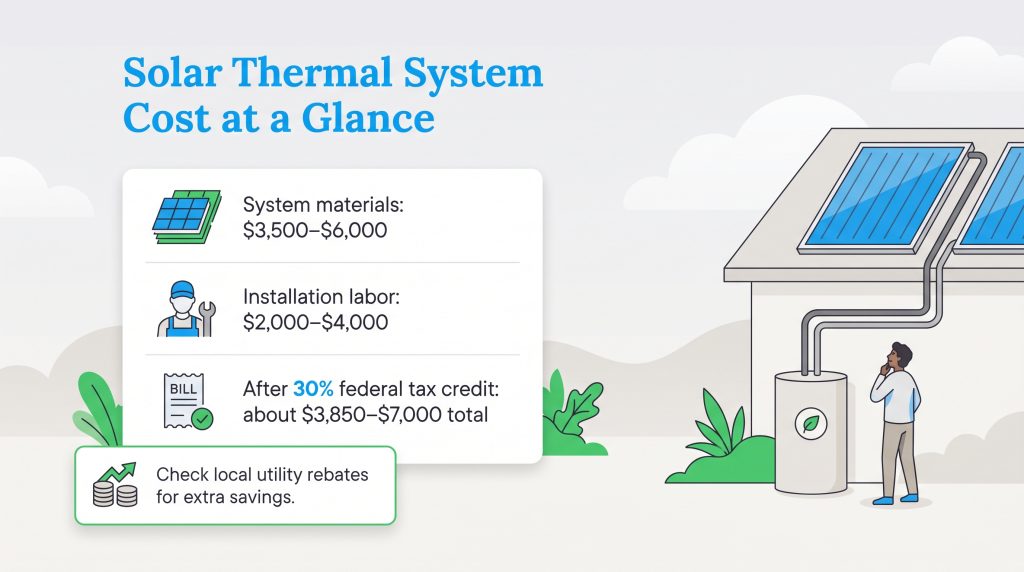
When evaluating the financial realities of a solar water heater upgrade, your total investment will depend on your tank size, plumbing complexity, and the premium nature of your collectors. On average, a professional residential installation costs between $5,500 and $10,000 before applying major financial incentives.
Fortunately, the federal government heavily subsidizes these eco-conscious improvements. Homeowners can confidently claim a generous 30% federal Investment Tax Credit (ITC) on their equipment and labor costs, significantly lowering your net expenditure. Here is a breakdown of what a standard installation might look like on paper:
| Expense Category | Estimated Cost Range |
|---|---|
| System Materials & Equipment | $3,500 – $6,000 |
| Professional Installation Labor | $2,000 – $4,000 |
| Total Gross System Cost | $5,500 – $10,000 |
| Federal Tax Credit Deduction (30%) | -$1,650 – -$3,000 |
| Net Final Cost to Homeowner | $3,850 – $7,000 |
💸 Money-Saver: Check with your local utility provider before signing an installation contract. Many public utilities offer instant cash rebates for upgrading to an energy-saving option like solar water heating that can legally stack with your federal incentives.
Pros and Cons of Solar Hot Water
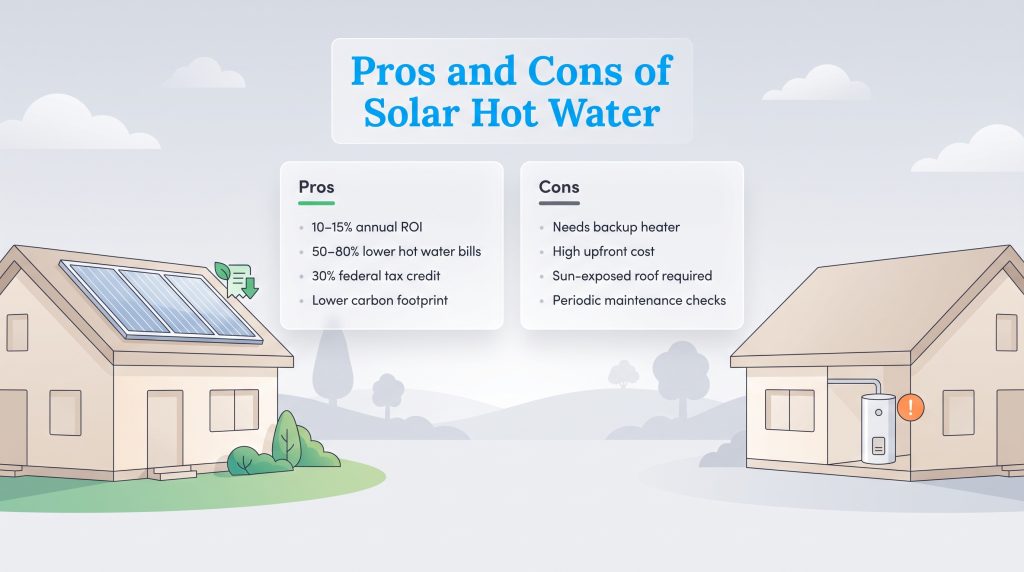
While harnessing free energy is a phenomenal way to update your home, these robust systems are not universally perfect for every household. Before you start requesting quotes from local installers, consider these primary advantages and drawbacks:
The Pros
- Exceptional ROI: You can typically expect a specific return on investment (ROI) between 10% and 15% annually, often seeing a full system payback within five to 10 years depending on local utility rates.
- Drastically Lower Bills: Reliably offsets 50% to 80% of your annual water heating costs.
- Federal Incentives: Qualifies for the robust 30% federal tax credit, making the initial buy-in much more accessible.
- Carbon Reduction: Acts as a highly effective environmentally mindful choice that significantly lowers your daily reliance on fossil fuels.
The Cons
- Dependence on Backup Systems: You will still need a conventional gas or electric backup water heater to guarantee a hot shower during multi-day storms or heavy usage spikes.
- High Upfront Investment: Even with tax credits, spending several thousand dollars out of pocket requires careful household budgeting.
- Roof Space and Orientation: Demands an unshaded, south-facing roof section to capture optimal daily sunlight.
- Maintenance Needs: Active systems have moving parts (pumps and sensors) that require periodic checkups.
Sizing Your System: Calculating Your Household Hot Water Needs
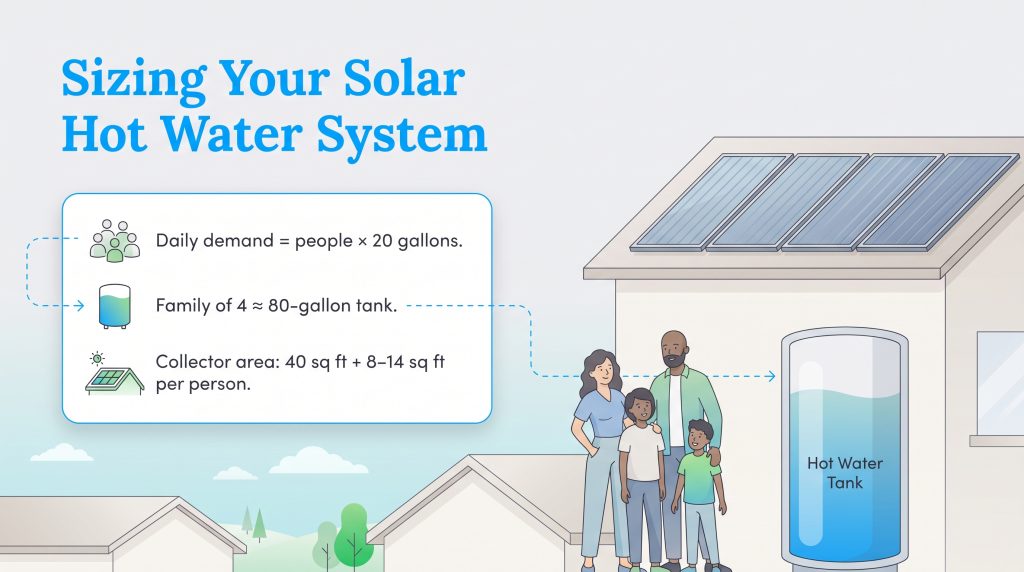
Buying a solar water heater is a major household investment, meaning you want to ensure the equipment is perfectly scaled to your daily lifestyle. Buying an oversized tank wastes money, while an undersized tank leads to frustrating cold showers. We use a simple, highly effective formula to calculate daily hot water usage and right-size your equipment.
The baseline rule of thumb is to account for 20 gallons of hot water per person per day. Here is a step-by-step approach to calculating your storage tank requirements based on your household size and peak usage times:
- Calculate Daily Demand: Multiply your total household size by 20 gallons. A typical family of four requires roughly 80 gallons of hot water daily for showers, laundry, and dishwashing.
- Determine Tank Capacity: Because solar panels only collect heat during the day, your storage tank needs to be large enough to hold an entire day’s worth of water for your family to use in the evening and early morning. If your daily demand is 80 gallons, your storage tank should hold a minimum of 80 gallons — though sizing up to a 100-gallon or 120-gallon tank provides an excellent buffer for houseguests or heavy laundry days.
- Calculate Collector Area: For a standard active system, plan on needing roughly 40 square feet of roof collector area for the first two family members, plus an additional eight to 14 square feet for each additional person.
Maintenance Requirements and Lifespan
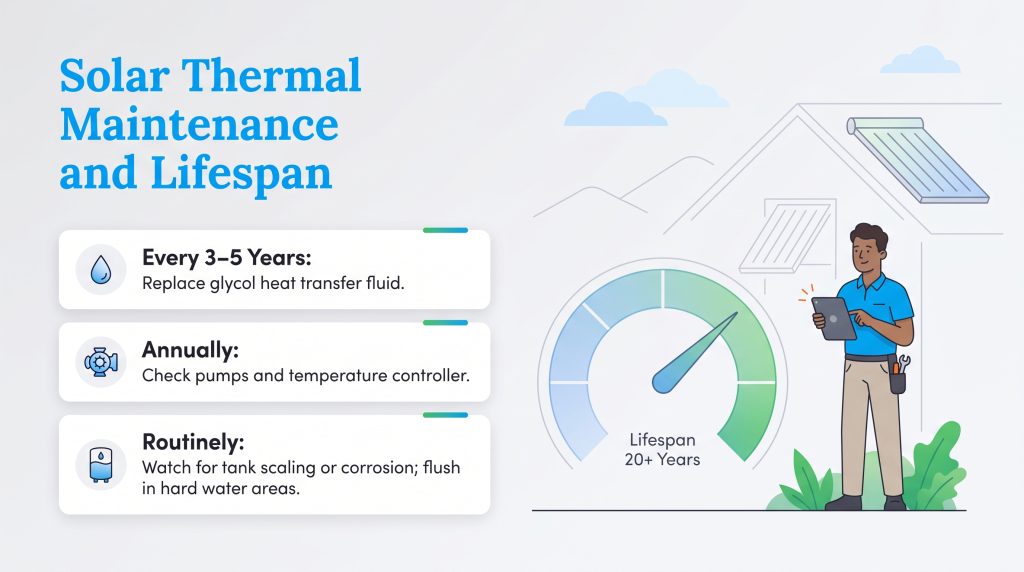
One of the strongest selling points of solar thermal technology is its impressive durability. When properly cared for, a high-quality solar water heating setup boasts an expected lifespan of 20+ years. Passive systems, which lack motorized pumps, can often outlast that metric. However, active indirect systems require a strict scheduled maintenance checklist to guarantee long-term ownership success.
To keep your equipment running smoothly and protect your warranties, we recommend following this routine maintenance schedule:
- Every 3 to 5 Years: Hire a professional to test and replace the heat transfer fluid (glycol). Over time, glycol breaks down chemically and loses its ability to prevent freezing, which could put your roof collectors at serious risk.
- Annually: Inspect the mechanical circulation pumps and digital temperature controllers to ensure they are powering on and communicating accurately.
- Routinely: Monitor your storage tanks and internal heat exchangers for scaling or corrosion. If you live in an area with hard water, flushing the tank annually helps prevent mineral buildup that ruins system efficiency.
Evaluating Solar Thermal Viability for Your Property
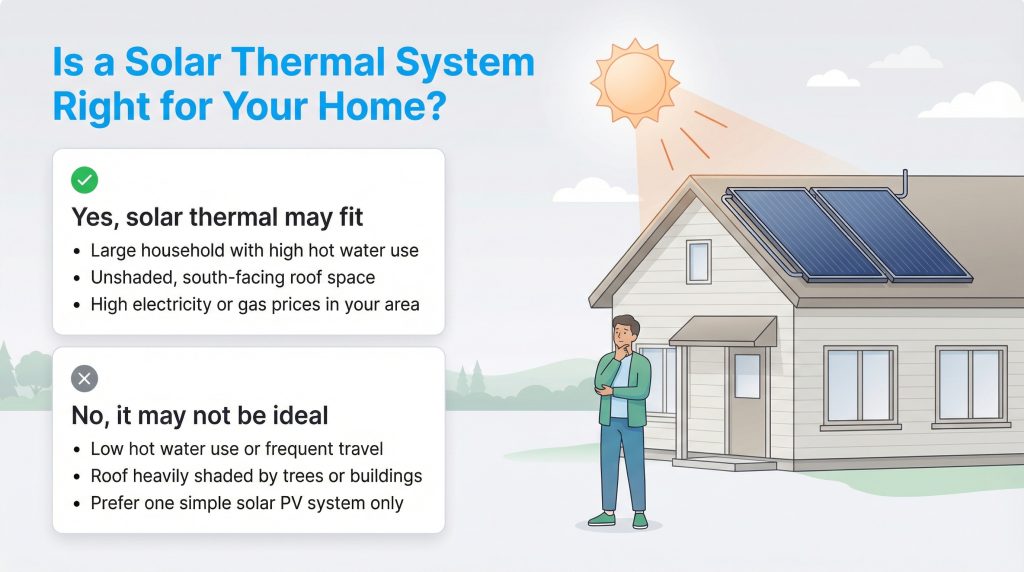
Committing to a full solar thermal installation is a significant residential construction project. Unlike simple electrical PV panels that can directly offset your utility bills through net metering, a thermal installation involves running highly insulated plumbing lines from your roof down through your attic and interior walls to reach your utility room. Evaluating solar thermal viability requires looking closely at your daily utility habits and roof structure. You are an optimal candidate if you have a large household with heavy hot water usage, a predominantly sunny, south-facing roof, and live in an area with exceptionally high electricity or natural gas rates.
Taking the Next Step Toward a Sustainable Home
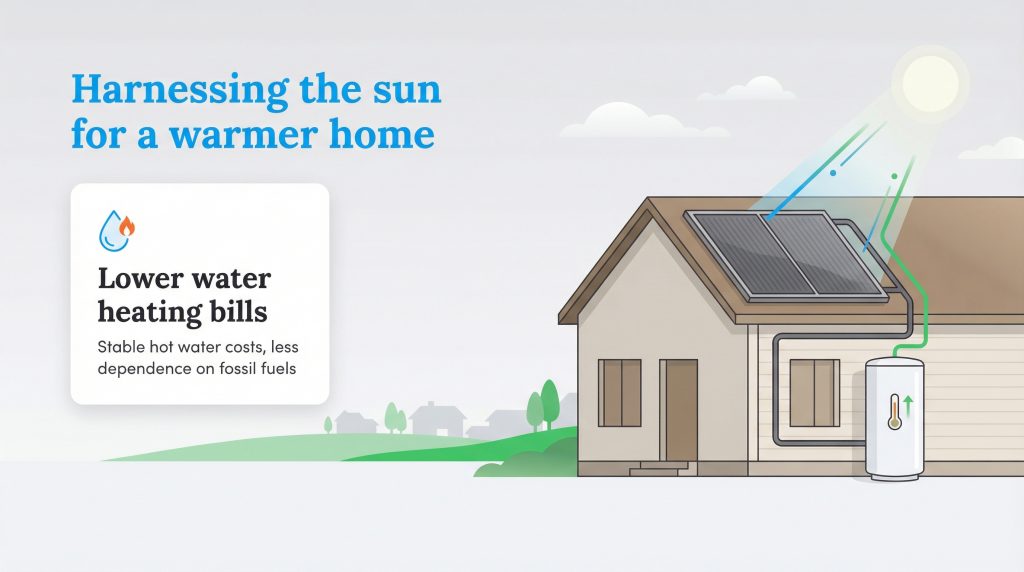
Ultimately, solar thermal systems are a proven, incredibly mature technology that offers unmatched efficiency for one of your home’s most demanding daily tasks. While standard solar PV often grabs the headlines for powering modern electronics, thermal technology remains the ultimate household champion for slashing your direct water heating costs. By clearly understanding how active and passive configurations work, properly sizing your daily water load, and leveraging massive federal tax credits, you secure an eco-conscious hot water supply that shields you from fluctuating utility rates for decades. If your home isn’t the perfect fit for a roof array but you are still looking for impactful ways to conserve resources, explore our comprehensive guide on water conservation strategies.
Frequently Asked Questions About Solar Thermal Systems
Do solar thermal panels work efficiently on cloudy days?
Yes, solar thermal collectors can utilize diffuse light to heat water, although their overall output will be slightly reduced compared to a brilliantly sunny day. Evacuated-tube collectors are particularly effective in overcast conditions because their vacuum insulation traps ambient heat exceptionally well. To ensure a continuous hot water supply during extended periods of poor weather, almost all systems are installed with a conventional electric or gas backup heater.
Can a solar thermal system heat my whole house?
Yes, but it requires a much larger, specialized setup. This specific application, known as solar space heating, works best when strategically paired with radiant floor heating because radiant systems require significantly lower water temperatures to keep a room perfectly comfortable. To reliably heat an entire house throughout the winter, you will need a massive array of roof collectors and a high-capacity thermal storage tank compared to a standard domestic hot water setup.
Do solar water heaters work in the winter or in cold climates?
Absolutely. If you live in an area prone to harsh winter freezes, you simply need to install an active indirect circulation system. These setups pump an antifreeze fluid (glycol) through the roof collectors to prevent ice blockages. When paired with high-efficiency evacuated-tube collectors, these systems easily generate steaming hot water even when temperatures drop below zero.
Are there tax credits available for residential solar thermal systems?
Yes, homeowners who install certified solar water heating equipment can claim a 30% federal Investment Tax Credit (ITC) under current legislation. This generous deduction applies to both the physical materials and the professional installation labor costs, making the upfront investment substantially more manageable.
What routine maintenance does a solar thermal water heater require?
These systems are incredibly durable but do require periodic checkups to maintain peak efficiency. Every three to five years, a professional should test the antifreeze fluid in active closed-loop systems to ensure it has not chemically degraded. You should also check for mineral scale buildup in your interior pipes and inspect the mechanical circulation pump to guarantee a reliable 20- to 25-year lifespan for the entire system.
What happens if the water gets too hot in the summer?
Overheating, known in the industry as stagnation, can occur on intensely hot summer days when you aren’t using much hot water. Modern system controllers have built-in safety features that either trigger a “heat dump” to safely dissipate the excess temperature or temporarily halt the circulation pump, keeping the superheated fluid safely contained in the roof collectors until the storage tank temperature drops back to normal limits.
Can I use a solar thermal system to heat my swimming pool?
Yes, heating a swimming pool is actually one of the most cost-effective uses of solar thermal technology. Because pools only require low-grade heat, you can often use simpler, unglazed flat-plate collectors. The existing pool pump easily circulates the water directly through the solar panels, meaning the installation is highly affordable and pays for itself rapidly by extending your swimming season.
Is solar thermal cheaper than solar PV?
Generally, a dedicated solar thermal system costs less upfront than installing a comprehensive whole-home solar PV array because it requires far fewer panels. However, when evaluating how much solar panels cost today, the price gap has narrowed considerably. Your choice ultimately depends on whether your primary utility goal is to zero out your water heating bill or to generate versatile electricity for your entire home.
Are solar thermal systems suitable for all climates?
Yes, solar thermal systems can be customized to work effectively in almost any climate across the country. While direct circulation setups are perfect for warm, tropical regions, active indirect circulation systems equipped with specialized antifreeze fluid and evacuated-tube collectors thrive in freezing, snow-prone areas without issue.
About the Author

LaLeesha has a Masters degree in English and enjoys writing whenever she has the chance. She is passionate about gardening, reducing her carbon footprint, and protecting the environment. She also recently served as President of the Board for City Sprouts (a community garden).