
Discover How Texas-New Mexico Power Handles Electricity Delivery, Outage Restoration, and Delivery Fees in Your Deregulated Texas Service Area
Key Takeaways
- Texas-New Mexico Power (TNMP) does not sell electricity; it is the utility company that maintains the grid, poles, and wires for over 280,000 homes and businesses across Texas.
- You will need to compare and select a Retail Electric Provider (REP) to set up your actual electricity plan and handle your monthly billing.
- Your monthly electricity bill will automatically include standard TNMP delivery charges, which cover the costs of maintaining infrastructure and restoring power during outages.
If you live in a deregulated region of Texas, setting up your electricity can feel a little complicated at first glance. While you have the freedom to shop around for the best electricity rate, the physical delivery of that power is handled by a single utility company based on your geographic location. For hundreds of thousands of Texans, that dedicated company is Texas-New Mexico Power. Whether you are moving into a new home and need to turn on the lights, trying to understand an unexpected delivery fee on your monthly bill, or looking for the fastest way to report a power outage, we have gathered everything you need to know about navigating your TNMP service smoothly.
What Is Texas-New Mexico Power?
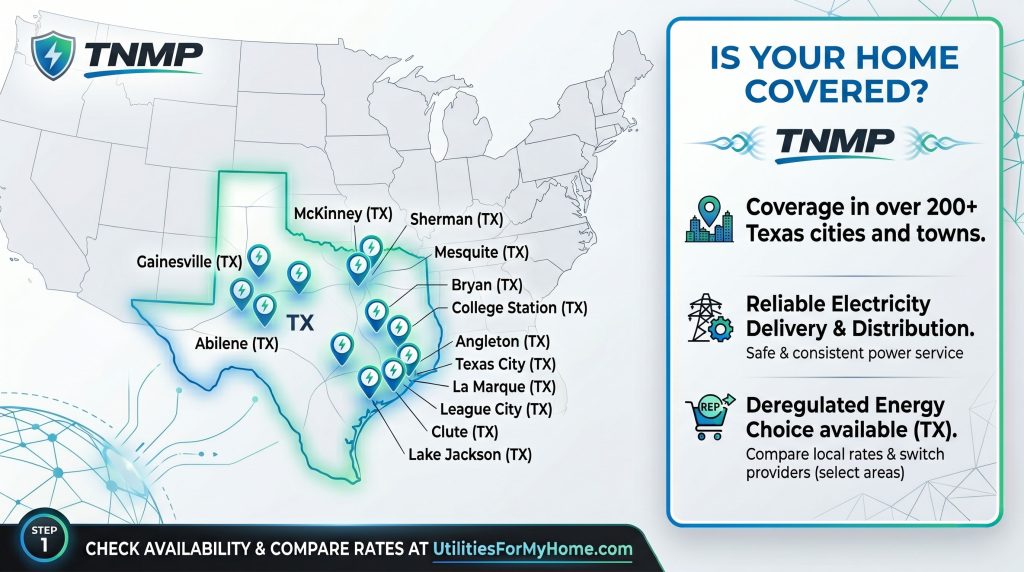
Texas-New Mexico Power, commonly known as TNMP, operates as a Transmission and Distribution Service Provider (TDSP) within the Electric Reliability Council of Texas (ERCOT) grid. As a wholly owned subsidiary of TXNM Energy, TNMP has a long history of reliable infrastructure management. They currently provide service to over 280,000 homes and businesses across Texas and employ more than 400 people throughout their 20-plus community locations.
It is crucial to understand that TNMP does not sell electricity. While you get to select your own electricity seller (a Retail Electric Provider or REP), TNMP handles the delivery of that energy behind the scenes. As a TDSP, they are strictly responsible for maintaining the physical infrastructure that brings power safely to your home — including the poles, wires, substations, and electric meters. They are also the dedicated team that dispatches crews to restore service following severe weather or unexpected grid emergencies.
TNMP History and Background
To fully grasp how Texas-New Mexico Power operates today, it helps to look at their long-standing roots in the energy sector. The company was originally founded in 1934 as the Community Public Service Co., and it spent decades steadily building electrical infrastructure across rural and suburban regions of the state. In 1981, the organization officially changed its name to Texas-New Mexico Power to better reflect its growing geographic footprint.
Today, TNMP operates as a prominent subsidiary of TXNM Energy. Over nearly a century, they have evolved from a small regional power company into a major regulatory player within the deregulated Texas energy market. Despite massive shifts in technology and population size, TNMP continues their core mission of ensuring safe and reliable electricity delivery for modern homes and rapidly expanding businesses.
Utility vs. Retail Electric Provider: Understanding the Difference
Because Texas operates on a deregulated energy model, the responsibilities of generating, selling, and delivering electricity are completely separate. This system gives you the freedom to choose your electricity seller, while a centralized utility handles the physical grid. If you mix up the roles of your local utility and your Retail Electric Provider, you might end up calling the wrong company during an emergency.
Here is a quick breakdown to help you understand exactly who does what when it comes to powering your home:
| Responsibility | Texas-New Mexico Power (TDSP) | Retail Electric Provider (REP) |
|---|---|---|
| Maintains poles and wires | Yes | No |
| Sells electricity plans | No | Yes |
| Handles billing and payments | No | Yes |
| Restores power during outages | Yes | No |
TNMP Coverage Area and Service Map
TNMP’s certified service territory lies entirely within the state of Texas. Rather than serving one massive, continuous block of the state, their delivery footprint is uniquely divided into three distinct regions. If you live in any of these territories, you will see a specific line item for TNMP delivery charges on your monthly bill.
TNMP actively provides service to more than 80 municipalities across these three regions. Here are the top 10 specific cities situated within the Texas-New Mexico Power service area:
- Lewisville
- Texas City
- Friendswood
- Pecos
- Fort Stockton
- Angleton
- Freeport
- Clute
- Flower Mound
- Glen Rose
Understanding TNMP Delivery Charges and TDSP Fees
A common point of confusion for new Texas residents is understanding exactly how they are billed for electricity. Even though TNMP maintains your lines and meters, you will not receive a direct bill from them. Instead, your chosen Retail Electric Provider automatically includes the TNMP delivery charges — often referred to as TDSP fees — on your monthly statement and passes those funds along to the utility on your behalf.
These charges are mandated and regulated by the Public Utility Commission of Texas (PUCT). Historically, the PUCT reviews and updates utility delivery rates twice a year, typically on March 1 and September 1, to accurately reflect the true cost of operating the grid. A recent adjustment in late 2026 introduced an approximate +1.8% increase for volumetric rates in order to fund ongoing grid modernization, aggressive storm hardening, and improved outage response infrastructure across the expanding TNMP footprint.
| Charge Type | Current Rate | How It Works |
|---|---|---|
| Fixed Monthly Base Charge | $7.85 per month | A flat fee applied to every billing cycle, regardless of how much electricity you use. It covers basic customer service, metering systems, and account administration. |
| Volumetric Charge | 7.4022¢ per kWh | A variable cost based on your actual energy consumption. The more kilowatt-hours (kWh) you use, the higher this portion of the delivery charge will be. |
💸 Money-Saver: The only way to lower the volumetric portion of your TNMP delivery charges is to reduce your overall home energy consumption. Upgrading your insulation or running heavy appliances during cooler parts of the day can help lower both your energy supply costs and your utility fees.
How to Find Your TNMP ESID
When you are moving into a new home or switching your electricity plan, your retail provider will ask for your Electric Service Identifier (ESID). The ESID is a unique 22-digit number that corresponds specifically to your home’s physical meter. Think of it like a digital address that tells TNMP exactly where to deliver the power.
If you live in the Texas-New Mexico Power service territory, your 22-digit ESID will always begin with the digits 10404. Here are the two easiest ways to locate it:
- Check your current electricity bill: Look at a recent monthly statement from your current retail provider. Your ESID is usually printed at the top of the first or second page under your account details or service address information.
- Look at your physical smart meter: If you do not have a previous bill, you can safely walk outside to your physical electric meter. You will typically find the ESID printed on a metal plate or sticker directly on the face of the meter box.
Compare Texas-New Mexico Power Electricity Rates
Because TNMP operates in a deregulated electricity market and strictly handles power delivery, you have the freedom to shop around and choose the Retail Electric Provider that fits your budget and lifestyle. Your REP determines your energy supply rate, the length of your contract, and any special perks like free weekend usage or renewable energy add-ons.
If you are searching for Texas New Mexico Power electricity plans, you are actually looking for plans offered by third-party suppliers who service the TNMP grid. Here is a comparison of estimated rates from top REPs currently operating in TNMP territory, highlighting popular plan types:
| Provider Name | Plan Type | Term Length | Estimated Rate (¢/kWh) |
|---|---|---|---|
| TXU Energy | Free Nights and Weekends | 12 Months | 14.5¢ |
| Gexa Energy | 100% Renewable Fixed-Rate | 24 Months | 12.2¢ |
| Reliant Energy | Conservation Fixed-Rate | 12 Months | 15.1¢ |
| 4Change Energy | Charitable Fixed-Rate | 12 Months | 11.9¢ |
| Direct Energy | Solar Buyback | 36 Months | 13.8¢ |
If your electricity bills are getting too high, lowering your energy supply rate is the fastest way to save money. Since TNMP’s delivery charges are unavoidable, choosing a cheaper REP is the smartest move you can make. Switching providers is entirely seamless, and you will not experience any interruption in your power supply during the transition.
Here is how to switch providers smoothly:
- Locate your ESID: Grab your most recent electricity bill and locate your Electric Service Identifier. This unique number tells your new provider exactly which meter TNMP needs to direct power to.
- Compare rates and read the EFL: Use a trusted comparison tool to search for rates by your zip code. Before signing up for any plan, you must check the Electricity Facts Label (EFL). The EFL is a legally required document that outlines exactly what you will pay at 500, 1,000, and 2,000 kWh of usage. Checking this document prevents you from falling victim to hidden tiered usage fees or bill credit traps.
- Sign up with your new REP: Once you find a plan with a favorable EFL, enroll online or over the phone. Your new provider will handle the entire transition process automatically by notifying TNMP and your previous supplier.
📌 Quick Fact: You do not need to call TNMP to switch your provider. As a delivery utility, they will continue to service your physical address just like before, regardless of which company name is at the top of your monthly bill.
Deals, Discounts, and Energy Efficiency Rebates
TNMP offers an extensive catalog of incentives aimed at lowering usage and improving overall grid efficiency. Because your delivery service is independent of your REP choice, you remain fully eligible for these programs no matter who you buy your power from. While TNMP does not directly generate electricity, reducing home consumption indirectly lowers demand on the entire grid and saves you money.
Key energy-saving programs include:
- Low-Income Weatherization: This program assists eligible households with high-impact upgrades like enhanced insulation, high-efficiency HVAC tune-ups, and the installation of smart thermostats to drastically cut winter heating and summer cooling costs.
- High-Performance Homes: Geared toward new construction, this program provides incentives for builders and buyers who invest in ENERGY STAR-certified homes that exceed standard building codes.
- The COMPASS Program: The Commercial Partners Achieving Specialized Solutions (COMPASS) initiative targets schools, local governments, and large commercial customers. It offers financial incentives — such as $400 per kW saved — for qualifying efficiency upgrades.
Additionally, TNMP’s grid infrastructure is fully compatible with robust solar net metering programs. If you install residential solar panels and pair them with an eco-conscious alternative buy-back plan from your REP, your home can send excess energy back to the grid for a direct bill credit. By leveraging TNMP’s energy efficiency incentives and renewable capabilities, you can drastically reduce your environmental footprint while keeping your monthly costs manageable.
TNMP Outage Map, ERCOT Load Shed, and Emergency Contacts
When the lights go out, getting accurate information and reporting the issue quickly is your top priority. Since TNMP maintains the local power grid, they are your direct point of contact during an outage, regardless of which retail provider you buy your electricity from.
If you suspect a power outage or spot a dangerous downed power line in your area, you can take the following steps:
- Check the Texas New Mexico Power outage map: Visit the TNMP outage map online for real-time updates, affected coverage zones, and estimated restoration times for your neighborhood.
- Call the 24/7 emergency hotline: Dial 1-888-866-7456 to report an outage or check on the status of a repair. Always call this number immediately if you see a direct hazard like a sparking transformer or a downed wire.
- Report the outage online: Use their online reporting form to quickly notify dispatchers of a localized issue without waiting on hold.
- Check social media: Follow their X account (formerly Twitter) @TNMPOne, where they frequently post critical updates during severe weather events or widespread grid issues.
ERCOT Load Shedding and Emergency Preparedness
During extreme weather events — like severe winter freezes or intense summer heatwaves — the Electric Reliability Council of Texas (ERCOT) may determine that the state’s power demand is exceeding the available supply. When this happens, ERCOT initiates an emergency load shedding event. As a regulated utility, TNMP is legally required to implement controlled, rotating outages across their coverage map to prevent a complete and catastrophic failure of the statewide power grid.
If you find yourself in the middle of an ERCOT load shedding event, keep these safety tips in mind:
- Unplug major electronics: Disconnect televisions, computers, and sensitive appliances to protect them from potential power surges when electricity is suddenly restored.
- Keep the refrigerator closed: An unopened refrigerator will keep your food safely chilled for about four hours, while a full freezer can maintain its temperature for up to 48 hours.
- Practice generator safety: If you use a backup portable generator, never run it inside your home or garage, as it poses a severe carbon monoxide risk. Always operate generators outdoors in well-ventilated spaces.
💡 Pro Tip: Never assume a neighbor has already called in an outage. Always file a report to ensure TNMP is aware of exactly how many individual households are affected in your immediate area, which can help them prioritize repairs.
Texas-New Mexico Power Reviews and Ratings
When searching for Texas New Mexico Power reviews online, it helps to understand exactly what customers are evaluating. A significant portion of negative reviews directed at TNMP actually stem from billing confusion regarding rates, unexpected fees, or termination notices. Because TNMP does not handle billing or sell energy plans, you should direct those financial concerns strictly to your Retail Electric Provider.
The majority of accurate and relevant feedback focuses strictly on grid reliability, community communication, and response times during outages. Across the Better Business Bureau (BBB) and local community forums, customer sentiment generally highlights TNMP working efficiently in the background during routine operations. Following major Texas storm events, some residents occasionally express frustration with prolonged restoration times, though TNMP’s dedicated local crews frequently receive praise for working in dangerous conditions to repair downed lines.
If you have an unresolvable dispute regarding utility infrastructure, smart meter accuracy, delivery standards, or property damage, you can escalate the issue by filing a formal complaint directly with the Public Utility Commission of Texas (PUCT).
Maximizing Your Value with Texas-New Mexico Power
Texas-New Mexico Power is a reliable, established utility handling the heavy lifting of electricity delivery for residents across North, West, and Gulf Coast Texas. While you do not get to choose TNMP as your utility — that is determined strictly by your home’s address — you do hold the power to control your overall electricity costs.
Because TNMP delivery charges are standardized and unavoidable, your best strategy is to proactively compare retail electric providers. By carefully evaluating different energy plans, thoroughly reading the Electricity Facts Label, leveraging TNMP’s robust energy efficiency rebates, and minimizing your household consumption, you can secure the best possible rate and ensure your utility bills stay predictable all year long.
Frequently Asked Questions About Texas-New Mexico Power
If you still have questions about your service, billing, or power delivery, we have answers. Here are the most common inquiries regarding Texas-New Mexico Power.
What is the TNMP customer service number?
Does Texas-New Mexico Power have a login portal for customers?
How do I report a Texas-New Mexico Power outage?
Why does my bill say Texas-New Mexico Power when I use a different provider?
Does TNMP offer net metering for solar panels?
Why did my TNMP delivery charges go up?
Who do I call to report a damaged Texas-New Mexico Power meter?
What should I do if I see a downed power line?
About the Author

David has been an integral part of some of the biggest utility sites on the internet, including InMyArea.com, HighSpeedInternet.com, BroadbandNow.com, and U.S. News. He brings over 15 years of experience writing about, compiling and analyzing utility data.