
What Oncor, CenterPoint, AEP Texas, and TNMP Delivery Adjustments Mean for Your Monthly Bill
Key Takeaways
- Texas transmission and distribution utilities adjust regulated delivery tariffs biannually on March 1 and Sept. 1, rolling in transmission, distribution, and energy-efficiency cost recovery riders approved by the state.
- Oncor’s comprehensive base rate settlement added $4.64 per month for average residential households consuming 1,000 kWh monthly to fund a five-year, $36 billion grid resilience and expansion program.
- TDU delivery charges are identical across all retail electric providers in your geographic territory, making shopping for a lower competitive supply rate your primary tool for reducing electric expenses.
If you live in a deregulated Texas electricity market, your monthly power bill is split into two distinct parts: the competitive electricity supply you choose from a retail provider, and the regulated delivery charges you pay to maintain the physical grid. Every year on March 1 and Sept. 1, the Public Utility Commission of Texas updates Transmission and Distribution Utility (TDU) delivery tariffs across the Electric Reliability Council of Texas (ERCOT) footprint. As the Sept. 1, 2026 adjustments take effect alongside Oncor’s base rate review settlement, understanding how these non-bypassable delivery fees work will help you budget accurately and identify genuine opportunities to lower your total energy costs.
Understanding the September 1 Biannual TDU Tariff Adjustments
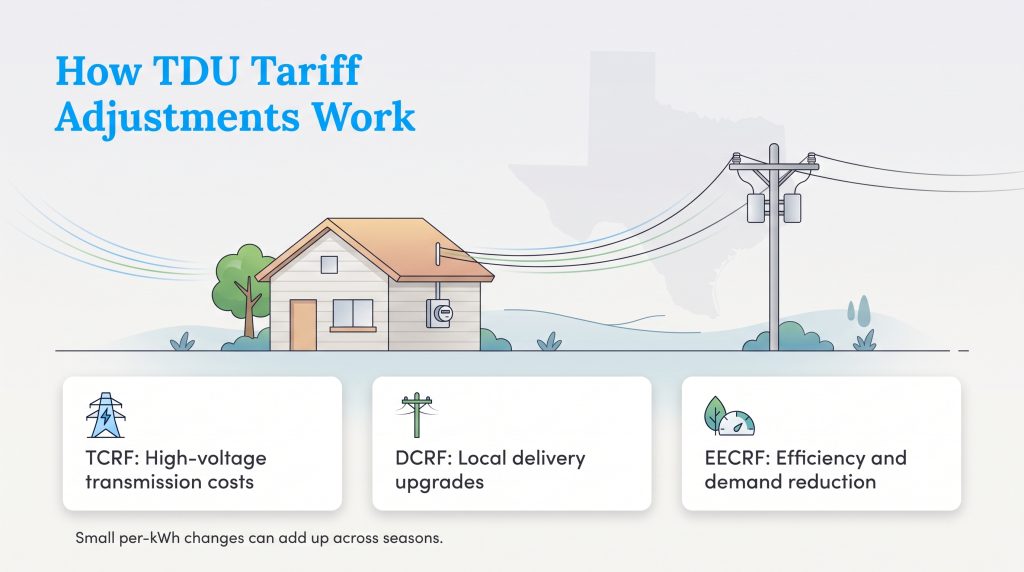
Texas electricity delivery tariffs are not static numbers. Under Texas Administrative Code regulations, regulated TDUs are permitted to file biannual adjustments to recover capital expenditures and operational costs associated with moving high-voltage electricity across the state.
These scheduled March and September tariff updates do not represent full rate cases. Instead, they adjust specific regulatory riders designed to reconcile actual system expenses:
- Transmission Cost Recovery Factor (TCRF): Recoups costs incurred for utilizing third-party high-voltage transmission lines throughout the ERCOT grid.
- Distribution Cost Recovery Factor (DCRF): Accounts for local distribution infrastructure upgrades, including new poles, transformers, substations, and automated metering systems.
- Energy Efficiency Cost Recovery Factor (EECRF): Funds state-mandated energy efficiency, weatherization, and peak-demand reduction programs.
While routine biannual updates often result in minor adjustments — fractional shifts ranging from a tenth to a third of a cent per kilowatt-hour — their cumulative impact directly affects your bottom line during high-consumption cooling and heating seasons.
Baseline TDU Delivery Rates Across Major Texas Utilities
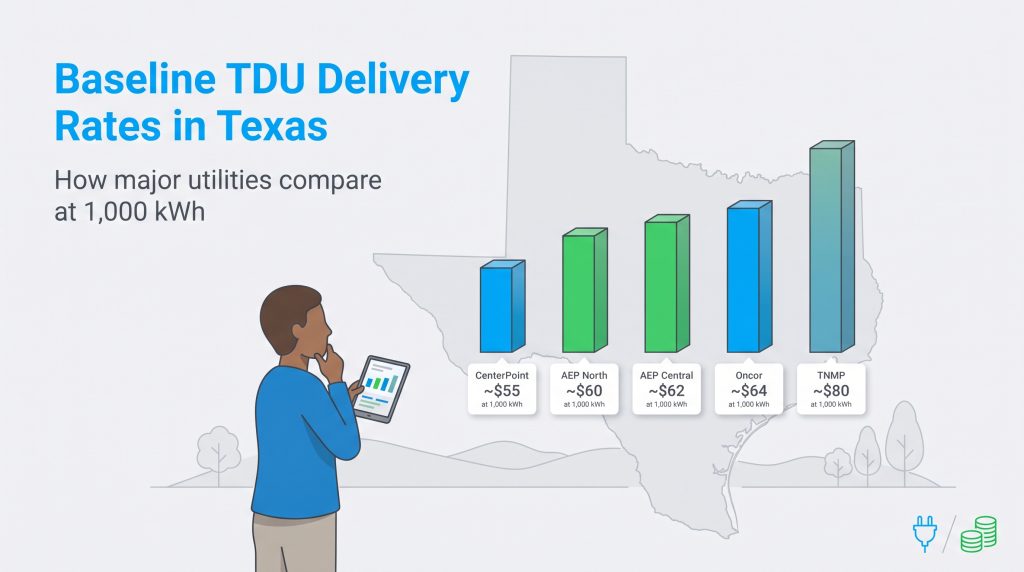
To assess how your utility compares, we examined baseline delivery charges for residential customers using a standard 1,000 kilowatt-hour (kWh) monthly benchmark across all five major deregulated service territories in Texas. Each utility structure combines a fixed monthly customer charge (a flat account fee) and a volumetric delivery charge (measured in cents per kWh).
| Utility (TDU) | Primary Service Region | Fixed Monthly Base Charge | Volumetric Delivery Rate (¢/kWh) | Total Delivery Cost at 1,000 kWh |
|---|---|---|---|---|
| CenterPoint Energy | Greater Houston & Gulf Coast | $4.90 | ~4.98¢ – 5.15¢ | ~$54.71 |
| AEP Texas North | Abilene, San Angelo & West Texas | $3.24 | ~5.67¢ | ~$59.94 |
| AEP Texas Central | Corpus Christi, Rio Grande Valley & Laredo | $3.24 | ~5.83¢ | ~$61.54 |
| Oncor Electric Delivery | Dallas–Fort Worth, North & Central Texas | $4.06 | ~6.03¢ – 6.12¢ | ~$64.36 |
| TNMP | North, Gulf Coast & West Texas Patchwork | $7.85 | ~7.24¢ | ~$80.25 |
Note: Baseline delivery charges reflect approved tariffs active leading into the Sept. 1, 2026 update. Volumetric rates combine base distribution and transmission riders.
Regional Breakdown: Affected Territories and Municipalities
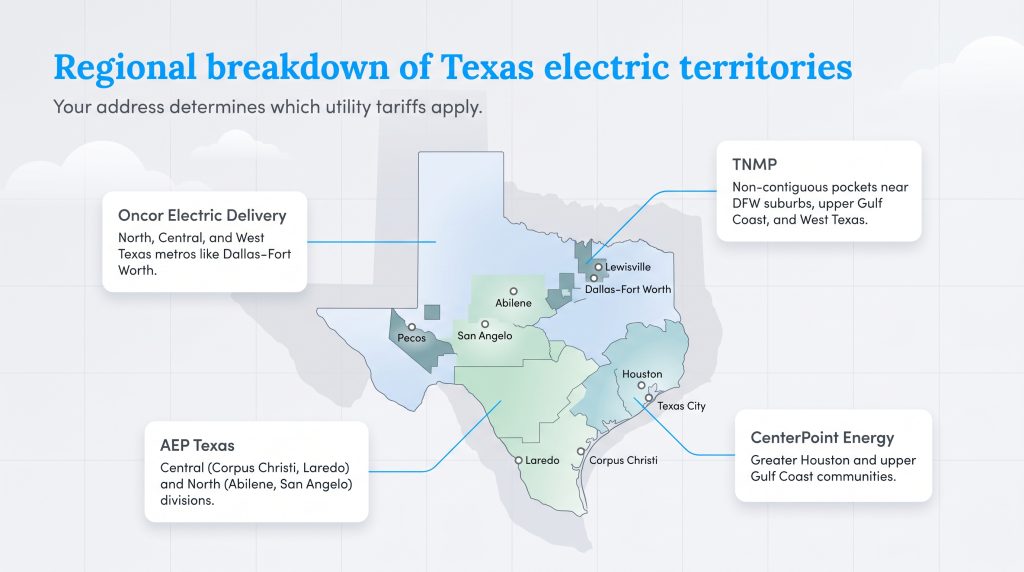
Because utility boundaries in Texas are defined by geographic franchise territories rather than county lines or city borders, your physical home address dictates your assigned delivery utility. Knowing your exact service territory is the first step in tracking which tariff adjustments apply to your household.
Oncor Electric Delivery Territory
Oncor serves more than 13 million residents across approximately 400 incorporated cities in North, Central, and West Texas. Key metropolitan areas include Dallas, Fort Worth, Arlington, and Plano.
CenterPoint Energy Houston Electric Territory
CenterPoint manages the grid infrastructure for roughly 2.6 million metered customers across the Greater Houston metropolitan area and the upper Texas Gulf Coast. Major communities include Houston, Pasadena, Sugar Land, and Pearland.
AEP Texas Central and North Divisions
AEP Texas operates two separate regulatory divisions covering vast sections of South and West Texas:
- AEP Texas Central: Covers Corpus Christi and Laredo.
- AEP Texas North: Serves Abilene, San Angelo, and surrounding rural West Texas municipalities.
Texas-New Mexico Power (TNMP) Territory
TNMP operates a non-contiguous service territory spanning three distinct geographic pockets: the northern suburbs of the DFW Metroplex (including Lewisville), the upper Gulf Coast (including Texas City), and western desert communities (including Pecos).
Oncor Base Rate Settlement: The $4.64 Monthly Increase
In addition to scheduled biannual rider updates, Oncor recently finalized a comprehensive base rate review with state regulators and intervening municipalities. This rate review addresses foundational infrastructure capital that cannot be recovered through routine biannual rider updates.
Under the unopposed settlement approved by the Commission in PUCT Interchange Docket No. 58306, Oncor adjusted its foundational base rates. For a residential consumer using 1,000 kWh per month on a retail contract priced around 15¢ per kWh, the settlement represents an estimated 3% total bill increase, or approximately $4.64 per month.
This rate review was initiated to support Oncor’s five-year, $36 billion capital investment plan. These investments address rapid commercial expansion across Texas, surging electricity demand from artificial intelligence data centers, extensive residential developments, and grid hardening against extreme weather events.
How Delivery Charges Interact With Your Retail Electric Plan
A common misconception among Texas homeowners is that choosing a different Retail Electric Provider (REP) can eliminate or discount TDU delivery fees. In reality, delivery charges and retail energy rates function as entirely independent components of your power bill.
Your retail electric provider — whether it is Reliant, TXU Energy, Direct Energy, Gexa, or Green Mountain Energy — is legally required to pass through official TDU delivery charges directly at cost without markup.
Because delivery fees apply uniformly across every provider in your utility zone, a delivery rate adjustment shifts every plan’s total cost by the exact same dollar amount. If Plan A was three cents cheaper per kilowatt-hour than Plan B prior to Sept. 1, Plan A remains three cents cheaper after the adjustment takes effect.
Actionable Steps to Lower Your Overall Texas Electric Bill
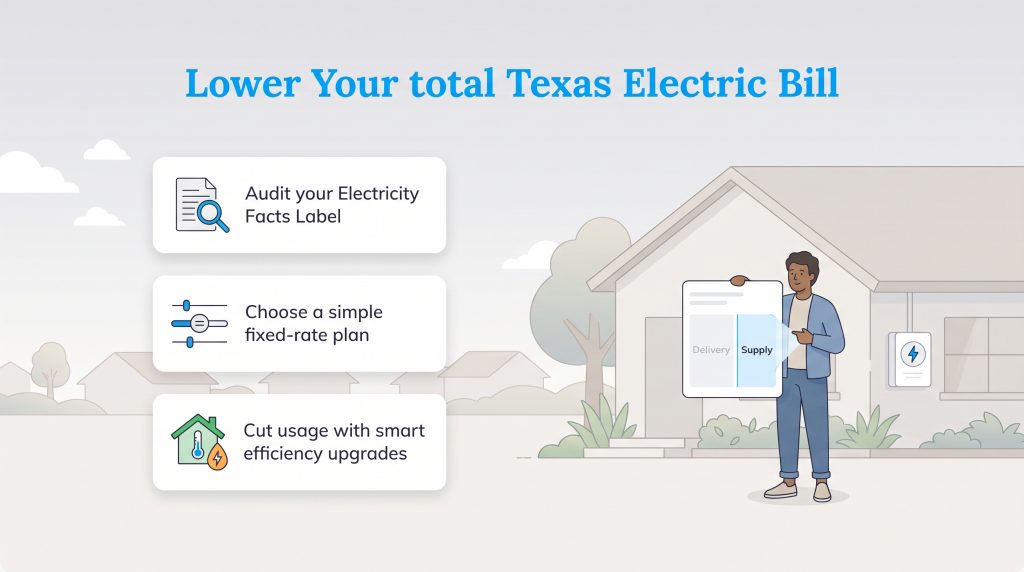
While you cannot avoid or negotiate your local TDU delivery charge, you have complete control over the retail supply rate and your household consumption habits. Focusing on the competitive side of your bill yields the highest potential savings.
1. Audit Your Electricity Facts Label (EFL)
Review your current EFL to ensure you are not paying high out-of-contract default rates. If your fixed-term contract is approaching expiration, compare active fixed-rate offers before rolling onto expensive month-to-month variable pricing.
2. Avoid Gimmick and Tiered-Rate Contracts
Plans featuring complex bill credits (e.g., “$100 credit only between 1,000 and 1,500 kWh”) or “free nights and weekends” often inflate your daytime supply charge to more than 20¢ per kWh. For most homes, a straightforward, fixed-rate plan offers more consistent savings.
3. Implement Energy-Saving Upgrades
Reducing total kilowatt-hour consumption reduces both your energy supply charges and your volumetric TDU delivery fees simultaneously.
- Install a programmable smart thermostat to optimize cooling schedules.
- Seal leaky ductwork and add attic insulation to lower HVAC runtime.
- Choose ENERGY STAR certified appliances and LED lighting for an eco-conscious alternative that lowers base load.
4. Explore Weatherization and Assistance Resources
If utility rate adjustments create household budget strain, check eligibility for state-supported programs such as the Comprehensive Energy Assistance Program (CEAP) or the federal Low-Income Home Energy Assistance Program (LIHEAP). Major TDUs also provide targeted rebates for attic insulation, air sealing, and high-efficiency heat pump installations under their EECRF programs. Data from the U.S. Energy Information Administration shows that efficiency upgrades remain the most reliable long-term hedge against retail rate shifts.
Navigating Your Texas Energy Costs for the Year Ahead
Navigating Texas electricity costs requires a clear view of where your monthly dollars actually go. While regulated utility delivery adjustments and Oncor’s base rate settlement reflect ongoing grid expansion across the state, your retail electricity supply choice remains the primary lever for keeping household expenses manageable. By checking your current contract terms, eliminating high-rate plans, and implementing smart efficiency upgrades, you can successfully protect your budget regardless of seasonal utility tariff adjustments.
Frequently Asked Questions About Texas Electricity Delivery Charges
What is the difference between a TDU and a retail electricity provider in Texas?
Can I choose a different delivery utility to get lower delivery rates?
How often do Texas TDU delivery rates change?
Does Oncor’s base rate increase affect customers in Houston or Corpus Christi?
About the Author

Claudio is a sustainability-focused writer with a background in Anthropology and Psychology from NC State University. He has spent over 15 years working in writing, interpretation, and translation, driven by a deep interest in how human culture shapes the environment. Today, he shares his curiosity with readers by writing about sustainable living solutions and the connection between everyday choices and environmental impact.