
Texas Electric Delivery Rates Hit Record Highs as CenterPoint and TNMP Adjust Non-Bypassable Utility Tariffs
Key Takeaways
- CenterPoint Energy increased its volumetric delivery charge by 28.7%, driving monthly delivery costs to $69.03 for a standard 1,000 kWh residential customer.
- Texas-New Mexico Power instituted a state-record volumetric rate of 7.4022¢/kWh, pushing delivery expenses to $81.87 before calculating generation supply charges.
- Approved by state regulators for grid hardening, these distribution tariffs are completely non-bypassable, preventing consumers from dodging the increases by switching retail electric providers.
If you opened your latest Texas electric bill and noticed a sudden jump in your total balance, your retail power supplier isn’t the only party responsible. Semiannual Transmission and Distribution Utility (TDU) tariff revisions evaluated in early September have introduced immediate delivery bill increases of approximately $15.00 to $20.00 per 1,000 kilowatt-hours (kWh) across Greater Houston, North Central Texas, and the Gulf Coast. While Texans have long relied on the state’s deregulated retail electricity market to shop for competitive kilowatt-hour rates, these distribution fees represent regulated monopoly charges that apply universally to every home connected to the grid. Understanding how these delivery charges work, why they’re climbing, and how they reshape your bottom line is the first step toward regaining control over your monthly utility expenses.
Understanding the September Delivery Rate Hikes
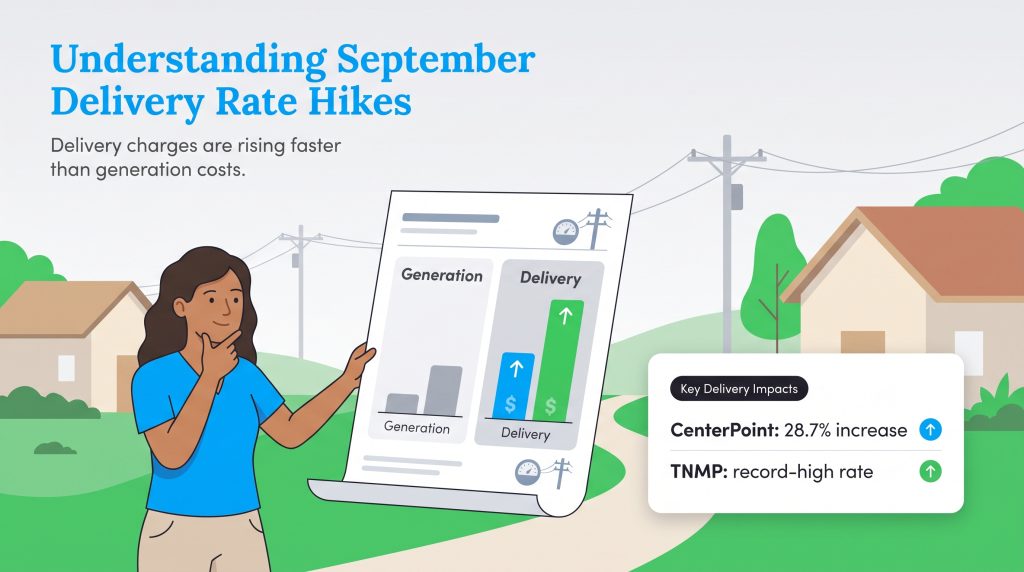
Every residential electricity bill in Texas’s competitive market is divided into two distinct components: retail electric provider (REP) generation charges and regulated TDU delivery charges. While your chosen REP bills you for the actual electricity your home consumes, your regional utility maintains the physical infrastructure — including the poles, transformers, substations, and automated meters — required to transport that electricity to your home.
In early September, the Public Utility Commission of Texas
evaluated semiannual tariff filings that resulted in substantial volumetric rate surges for two of the state’s largest distribution operators. Because distribution utilities operate as regulated geographic monopolies, consumers within their territories cannot choose another delivery company.
| Utility Company | Previous Volumetric Rate (¢/kWh) | New Volumetric Rate (¢/kWh) | Percentage Change | Monthly Base Meter Fee | Total Delivery Cost at 1,000 kWh |
| CenterPoint Energy | 4.9811¢ | 6.4130¢ | +28.7% | $4.90 | $69.03 |
| Texas-New Mexico Power (TNMP) | 6.4665¢ | 7.4022¢ | +14.5% | $7.85 | $81.87 |
CenterPoint Energy’s Historic Delivery Adjustment
CenterPoint Energy raised its residential volumetric delivery charge from 4.9811¢/kWh to 6.4130¢/kWh, representing a 28.7% hike. The company maintained its monthly fixed customer charge at $4.90 per meter. For a standard household utilizing 1,000 kWh during a billing cycle, CenterPoint’s delivery costs now total $69.03 each month, up from approximately $54.71 earlier in the year.
Texas-New Mexico Power Sets a State Record
Texas-New Mexico Power (TNMP) pushed volumetric delivery rates even higher, implementing a state-record rate of 7.4022¢/kWh alongside a $7.85 monthly recurring customer charge. For a 1,000 kWh residential customer, TNMP’s delivery charges now total $81.87 per month before adding a single cent for generation supply. At higher summer usage levels of 2,000 kWh, TNMP households face delivery-only expenses exceeding $155.89.
Why Delivery Charges Are Non-Bypassable for Texas Consumers
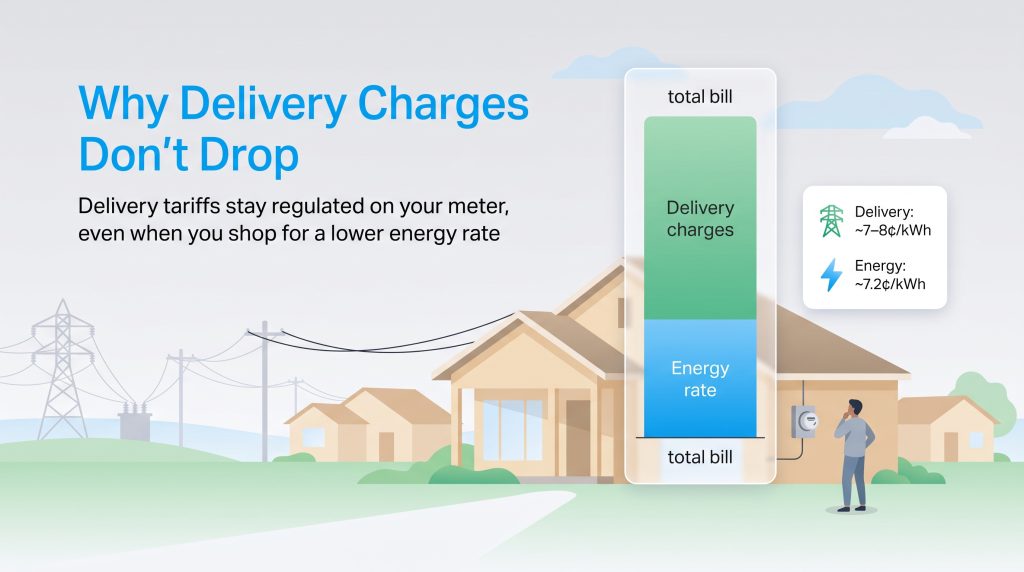
Delivery tariffs are classified under Texas utility regulations as non-bypassable line items that retail electric providers must collect directly from consumers and remit back to the utilities. Shopping for a lower energy rate on the open market provides meaningful savings on generation, but it cannot lower or eliminate the regulated TDU rate applied to your physical meter.
State regulators allow TDUs to recover extensive capital expenditures through statutory mechanisms such as Distribution Cost Recovery Factors (DCRF) and Transmission Cost Recovery Factors (TCRF). These adjustments permit utilities to recover capital spent upgrading aging substations, burying critical distribution lines, installing automated switches, and hardening coastal infrastructure against extreme weather events like tropical storms and severe winter freezes.
The practical consequence for household budgets is a sharp rise in effective retail electricity costs. According to monthly baseline data compiled by the U.S. Energy Information Administration
, retail energy prices fluctuate based on seasonal generation conditions, but rising transmission and distribution costs establish an ever-higher pricing floor. For example, a homeowner who secured an attractive retail supply contract between 7.10¢ and 7.40¢/kWh will now experience an effective composite electricity rate exceeding 14.00¢ to 15.25¢/kWh once CenterPoint or TNMP delivery tariffs and base meter fees are factored in.
Regional Breakdown of Impacted Texas Communities
The September tariff updates directly affect millions of residential ratepayers across three key regions of the state. Because utility service territories follow historical infrastructure footprints rather than municipal boundaries, neighbors living in adjacent subdivisions can sometimes fall under different TDU providers.
CenterPoint Energy Service Territory
CenterPoint serves more than 2.5 million electricity customers across the Greater Houston metropolitan area and coastal southeast Texas. The service territory spans all or parts of eight counties:
- Harris County: Houston, Pasadena, Baytown, Spring, Cypress, Humble, and Bellaire.
- Fort Bend County: Sugar Land, Missouri City, Richmond, and Rosenberg.
- Montgomery County: The Woodlands, Spring, and Conroe fringes.
- Brazoria, Galveston, Liberty, Waller, and Chambers Counties: Pearland, League City, Katy, and surrounding Gulf Coast suburbs.
Texas-New Mexico Power (TNMP) Service Territory
TNMP operates in distinct non-contiguous pockets across Texas, serving roughly 270,000 homes and businesses across three distinct geographic zones:
- Gulf Coast Corridor: Communities south of Houston, including Texas City, League City, Friendswood, Dickinson, La Marque, Alvin, Angleton, and West Columbia.
- North Central Texas: Fast-growing North Texas suburbs in Denton, Collin, and Grayson counties, including Lewisville, Pilot Point, Aubrey, Princeton, and Farmersville.
- West Texas & Permian Basin: Far West Texas communities in Pecos, Reeves, Ward, and Winkler counties, encompassing Fort Stockton, Pecos, and Kermit.
Actionable Steps to Reduce Your Monthly Electric Exposure
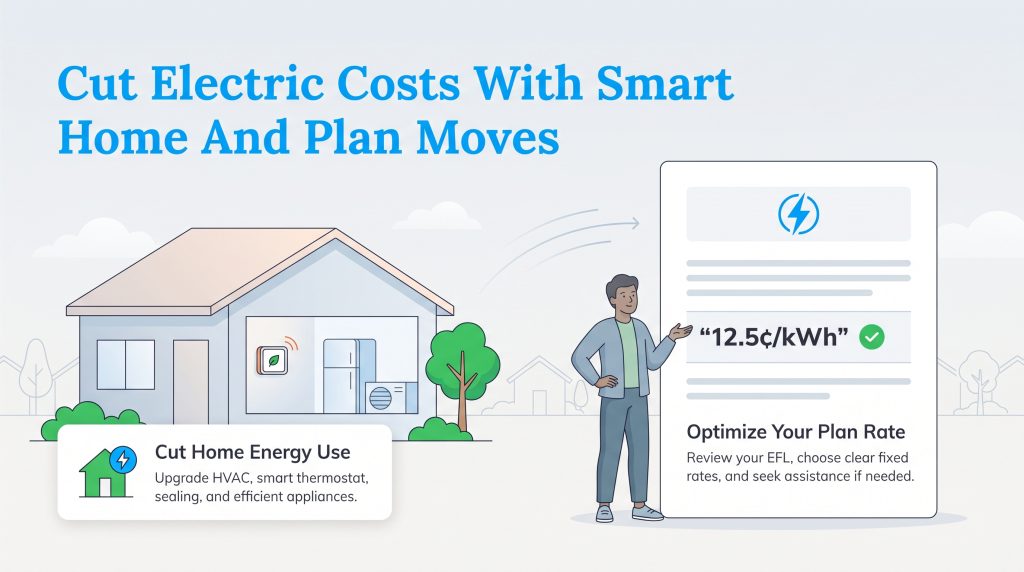
Because you can’t bypass delivery charges by switching providers, your financial defense must focus on two primary strategies: reducing overall kilowatt-hour consumption and optimizing the retail portion of your electricity plan. Every kilowatt-hour you avoid using saves you both the retail generation fee and the elevated volumetric delivery rate.
Implement Energy-Saving Home Upgrades
Targeting your home’s biggest energy consumers provides an immediate buffer against high volumetric delivery rates:
- Tune your HVAC operation: Heating and cooling account for more than 50% of residential power usage in Texas. Installing a smart thermostat programmed to raise indoor temperatures a few degrees when you’re away can reduce monthly cooling consumption by 10% to 15%.
- Select an eco-conscious alternative for appliances: When replacing water heaters, refrigerators, or laundry units, look for certified ENERGY STAR equipment. Choosing high-efficiency heat pump systems represents an environmentally mindful choice that lowers household electricity demand year-round.
- Seal envelope leaks: Adding attic insulation and weatherstripping exterior doors prevents conditioned air from escaping, keeping your HVAC compressor from running continuously during humid Texas afternoons.
Review Your Retail Electric Contract
While you cannot lower TDU rates, keeping your supply rate as competitive as possible prevents compounding expenses:
- Audit your Electricity Facts Label (EFL): Check your current contract expiration date. Avoid falling onto expensive month-to-month default rates, which can spike retail supply costs above 18.00¢/kWh.
- Compare fixed-rate structures: Look for transparent, fixed-rate plans without minimum usage fees or gimmick tiers that penalize you for varying energy consumption across seasons.
- Explore assistance programs: If rising bills create financial strain, explore support programs such as the Low-Income Home Energy Assistance Program (LIHEAP), local utility weatherization initiatives, and deferred payment arrangements through your REP.
Navigating the Future of Texas Utility Delivery Costs
Balancing reliable power distribution with affordable household electric rates remains one of the state’s most pressing ongoing challenges. As transmission and distribution utilities accelerate multi-billion-dollar system-hardening plans to protect the grid against severe storms and rapid population growth, non-bypassable delivery fees will likely represent a growing share of every Texan’s power bill. By auditing your current retail contract terms, monitoring seasonal kilowatt-hour consumption, and adopting energy-saving home habits, you can insulate your household budget against rising baseline utility tariffs.
Frequently Asked Questions About Texas TDU Delivery Charges
Can I avoid CenterPoint or TNMP delivery charges by switching retail providers?
Why did Texas delivery charges increase so significantly in September?
How can I verify what TDU delivery charges apply to my home?
Are other Texas utilities raising their delivery charges as well?
About the Author

Claudio is a sustainability-focused writer with a background in Anthropology and Psychology from NC State University. He has spent over 15 years working in writing, interpretation, and translation, driven by a deep interest in how human culture shapes the environment. Today, he shares his curiosity with readers by writing about sustainable living solutions and the connection between everyday choices and environmental impact.