Navigate your Georgia Power service with confidence, from choosing the right rate plan to reporting an outage.
Key Takeaways
- Compare seven residential rate plans to find the best fit for your home’s energy usage and budget.
- Quickly report outages using the Georgia Power outage map, mobile app, or dedicated SMS tools.
- Lower your monthly bill by taking advantage of smart usage tools, rebates, and green energy initiatives.
With over 140 years of service, Georgia Power supplies electricity to approximately 2.8 million customers across the state as a vertically integrated utility. This means they physically handle the generation, transmission, and distribution of electricity straight to your neighborhood grid. Whether you’re moving into a new residence and setting up your utilities or you simply want to dial back a pricey monthly electric bill, understanding your options is the absolute key to maximizing your household budget. From comparing Georgia Power rate plans to navigating the online account login portal, we’ve gathered everything you need to make smart, energy-efficient decisions in a regulated market.
Georgia Power Service Area and Major Cities
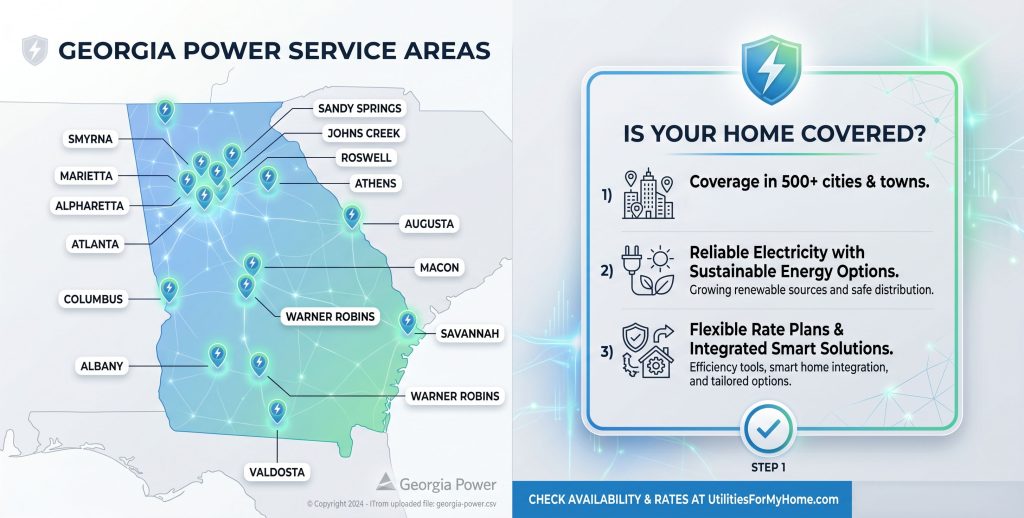
Georgia Power serves an overwhelming majority of the state, covering 155 of Georgia’s 159 counties. The utility’s vast service territory encompasses the largest metropolitan hubs, meaning you will almost certainly use them if you live in Atlanta, Augusta, Savannah, Macon, or Columbus.
However, once you leave the dense city centers and travel into suburban or rural areas, the power grid boundaries become much more complex. To power the areas that large investor-owned utilities historically avoided, Georgia utilizes a network of 41 rural Electric Membership Corporations (EMCs). Local EMCs (such as Cobb EMC, Sawnee EMC, or Jackson EMC) operate as not-for-profit cooperatives owned by the people they serve. Depending on exactly where property lines fall, you might find that one side of a neighborhood is serviced by Georgia Power, while the house across the street belongs to an EMC.
Georgia Power Customer Service Contacts
Keeping important utility numbers handy can save you time and stress, especially during severe weather. Use the quick-reference table below to access the proper Georgia Power customer service channels, handle a quick Georgia Power bill pay transaction, or visit the direct Georgia Power login portal for managing your account online.
| Service Needed | Contact Information |
| Report a Power Outage | 1-888-891-0938 (Available 24/7) |
| General Customer Service | 1-888-660-5890 (Mon-Fri, 7 a.m. to 6 p.m.) |
| Automated Bill Pay Phone Line | 1-800-642-2352 (Available 24/7) |
| Authorized Payment Locations | Pay in person at Walmart, Kroger, and CVS ($1.50 transaction fee applies) |
| Online Account Login | Georgia Power Login Portal |
Georgia Power Rate Plans & Pricing
Because you can’t switch utility companies if your home falls within Georgia Power’s territory, your best strategy for saving money is choosing the right billing structure. Georgia Power rates per kWh generally average between 14 and 16 cents once fuel riders are factored in, though your base rate fluctuates dramatically based on the season and the specific plan you select. Georgia Power offers seven distinct residential rate plans designed to fit different lifestyles, home sizes, and usage habits.
| Rate Plan | Best For… | Pricing Structure | Estimated Rate (per kWh) |
|---|---|---|---|
| Standard Residential Service | Typical households with consistent, unpredictable usage. | Seasonal Tier Pricing (Higher rates in summer months). | 8.4¢ – 15.1¢/kWh |
| Smart Usage | Homes that can shift heavy appliance use to off-peak hours. | Time-of-Use + Demand Charge. | 1.5¢ – 14.3¢/kWh + demand charge |
| FlatBill | Budget-conscious renters or homeowners who want predictable bills. | Fixed monthly payment customized to your past 12 months of usage. | Custom fixed monthly rate |
| Overnight Advantage | Electric Vehicle (EV) owners who charge at night. | Time-of-Use (Ultra-low overnight rates). | 2.2¢ – 29.8¢/kWh |
| Nights & Weekends | People who work away from home during weekday afternoons. | Time-of-Use (Lower rates on nights and weekends). | 7.6¢ – 29.8¢/kWh |
| PrePay | Customers who want to avoid deposits and track daily spending. | Pay-as-you-go. Requires a smart meter. | 8.4¢ – 15.1¢/kWh (Standard base rates) |
| Pay by Day | Those needing exact predictability without long-term commitments. | A fixed daily rate based on historical usage. | Custom fixed daily rate |
💡 Pro Tip: If you aren’t sure which plan is best for your household, log into your Georgia Power account and use the official Residential Rate Advisor tool. It analyzes your actual historical usage to show you exactly how much you would have paid under each of the different plans.
Standard Residential Service (R-30)
The Standard Residential Service (R-30) plan is the default option for most new customers and uses a Seasonal Tier Pricing structure. This means the price you pay per kilowatt-hour changes based on two factors: the time of year and the total amount of energy you consume. During the winter months (October through May), base rates remain relatively flat at around 8.4 cents per kWh. During the summer months (June through September), rates climb higher because heavy demand for air conditioning strains the electrical grid. As you use more electricity during a summer billing cycle, your base rate automatically jumps into a more expensive pricing tier:
- Tier 1 (0 – 650 kWh): ~$0.088 per kWh
- Tier 2 (650 – 1,000 kWh): ~$0.146 per kWh
- Tier 3 (Above 1,000 kWh): ~$0.151 per kWh
Smart Usage & FlatBill Plans
If you want to take an active role in lowering your monthly expenses, the Georgia Power Smart Usage plan utilizes a Time-of-Use (TOU) pricing model combined with a monthly demand charge. Unlike seasonal tier pricing, TOU pricing focuses strictly on when you use power and how many heavy appliances you run simultaneously. To see actual savings on this plan, you have to commit to a slight lifestyle shift. If you can avoid running major energy hogs — like your dishwasher, clothes dryer, or AC — during peak summer afternoon hours (2 p.m. to 7 p.m., Monday through Friday), you lock in significantly cheaper rates for the remaining 19 hours of the day.
On the flip side, if you want total predictability without watching the clock, the Georgia Power FlatBill plan might be your ideal match. With FlatBill, the utility calculates a custom, fixed monthly price based on your home’s past 12 months of usage and weather patterns. Regardless of summer heatwaves or extra holiday guests, your bill stays the exact same amount for an entire year. To qualify, you must have at least 12 months of prior metered usage at your current residence and agree to a 12-month contract commitment.
🚩 Heads Up: New enrollments for the FlatBill plan are periodically paused by Georgia Power during periods of high market volatility. If enrollment isn’t open when you check your portal, you can sign up for the official Enrollment Notification waitlist. If you need predictable payments right away, opt for the Levelized Billing Plan instead. Levelized Billing calculates a rolling 12-month average of your usage, keeping your monthly payment relatively steady without locking you into a strict annual contract.
Overnight Advantage & Nights & Weekends
Electric vehicle owners and night owls should look closely at the Overnight Advantage plan. This specialized Time-of-Use rate offers an ultra-low energy price of roughly 2.2 cents per kWh from 11 p.m. to 7 a.m. every night. By programming your EV charger, dishwasher, and laundry machines to run while you sleep, you drastically cut the cost of powering your home compared to standard daytime rates.
If you don’t own an EV but commute to an office Monday through Friday, the Nights & Weekends plan offers a similar structure without requiring late-night hours. You’ll pay a discounted off-peak rate during weeknights (7 p.m. to 2 p.m. the next day) and all weekend long. Just keep in mind that both plans charge nearly 30 cents per kWh during summer peak afternoons (2 p.m. to 7 p.m.), so keeping your thermostat turned up while you’re away from home is essential.
How to Start, Stop, or Transfer Georgia Power Service
Whether you’re moving to Georgia for the first time or relocating across town, setting up your electricity is straightforward. You can schedule a Georgia Power start service request, stop service at an old address, or transfer your existing account entirely online up to 60 days before your move-in date.
Before you begin the application, gather the following details to ensure a smooth setup:
- Your new service address: Include specific apartment, suite, or unit numbers.
- Requested start or stop date: You can schedule connections up to 60 days in advance (same-day connection is often available at homes with existing smart meters).
- Social Security Number (SSN): Required to run a soft credit check that determines if a security deposit is needed.
- Government-issued photo ID: A driver’s license, state ID, or passport to verify your identity.
Once you have your documents ready, follow these five steps to get your lights turned on:
- Visit the online moving portal: Navigate to the “Start, Stop, or Move Service” page on the official Georgia Power website or log into your existing profile if you’re transferring service.
- Enter your address and dates: Input your new street address and select the exact date you want the electricity activated in your name.
- Select your rate plan: Choose from the available residential rate plans. If you’re moving into a new home without 12 months of personal usage history at that meter, you’ll typically start on Standard Residential Service, Smart Usage, or PrePay.
- Complete the identity and credit verification: Enter your SSN and ID details. The system will instantly let you know if your credit score qualifies to waive the security deposit.
- Confirm your account setup: Review your order details and submit your request. A standard $30 New Account Establishment Fee will be added to your first monthly statement.
💸 Money-Saver: Want to skip the upfront credit deposit? You can bypass the security deposit requirement entirely by enrolling in the PrePay plan (provided your home has a smart meter) or by submitting an official letter of credit showing 12 months of on-time payments with your previous electric utility.
Fees, Guarantees, and Understanding Your Bill
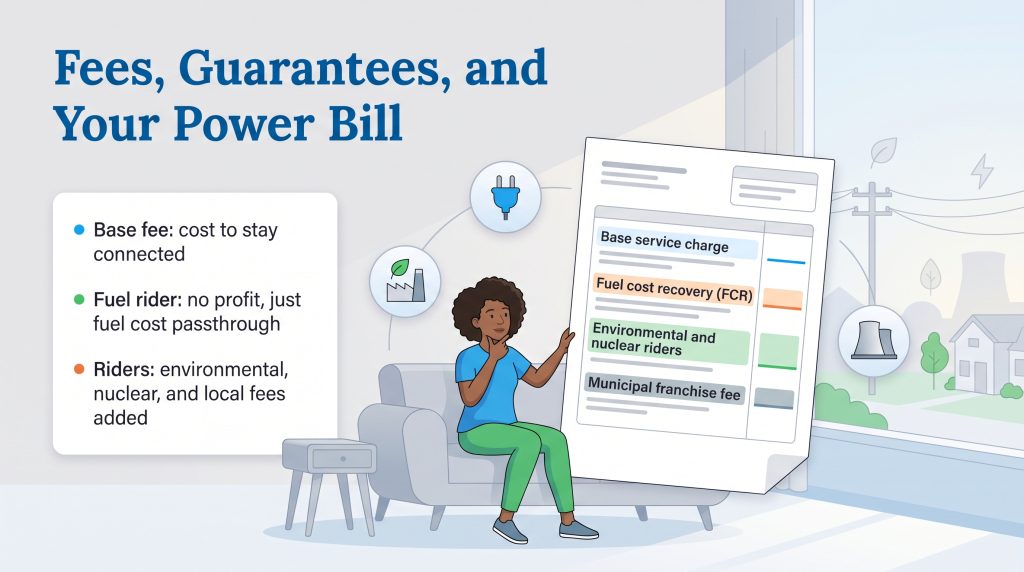
If you’ve ever stared at your monthly statement and wondered why the total doesn’t match your simple math, you aren’t alone. A typical Georgia Power bill isn’t just a straightforward calculation of electricity used. It actually breaks down into three separate parts: base distribution and service charges, actual fuel and energy usage costs, and supplemental line-item fees called “riders.”
Because utilities operate vast, expensive infrastructures, state regulators allow them to pass certain operating costs directly to the consumer. Understanding these line items and administrative charges will help you decipher unexpected bill spikes:
- Account Activation & Deposit Fees: Starting or transferring service triggers a mandatory $30 New Account Establishment Fee. Depending on your soft credit check, Georgia Power may also require a refundable security deposit of up to two times the home’s average monthly bill before turning on your power.
- Base Service Charge: A fixed monthly fee (roughly $14 per month) just for having an active meter connected to the grid, regardless of whether you use a single drop of power.
- Fuel Cost Recovery (FCR) Rider: This is the variable “fuel rider” you often hear about. It covers the fluctuating market cost of the natural gas and coal used to generate your electricity. Georgia Power is legally not allowed to make a profit on fuel costs, but they do pass 100% of these expenses on to you.
- Storm Recovery Costs: Following destructive hurricanes, ice storms, and severe weather across the Southeast, the utility spends hundreds of millions of dollars rebuilding downed power lines and replacing transformers. Once approved by state regulators, these infrastructure repair expenses are recouped over time through temporary storm recovery adjustments on residential bills.
- Environmental Compliance Cost Recovery (ECCR): A fee that covers the utility’s expenses for meeting federal and state environmental mandates, such as installing scrubbers on coal plants or safely managing coal ash ponds.
- Nuclear Construction Cost Recovery (NCCR): This rider is directly tied to the construction and operation of Plant Vogtle. Yes, residential customers are currently paying a small percentage on their monthly bills to fund the expansion of Georgia’s nuclear power capabilities.
- Municipal Franchise Fee: A local tax collected by Georgia Power and paid directly to your city or county government for the right to run power lines along public roads.
📌 Quick Fact: Fuel riders are adjusted dynamically with regulatory approval. If global natural gas prices soar during a volatile summer, your Georgia Power bill can go up even if you used the exact same amount of electricity as the year prior.
Deals, Discounts, and Ways to Save
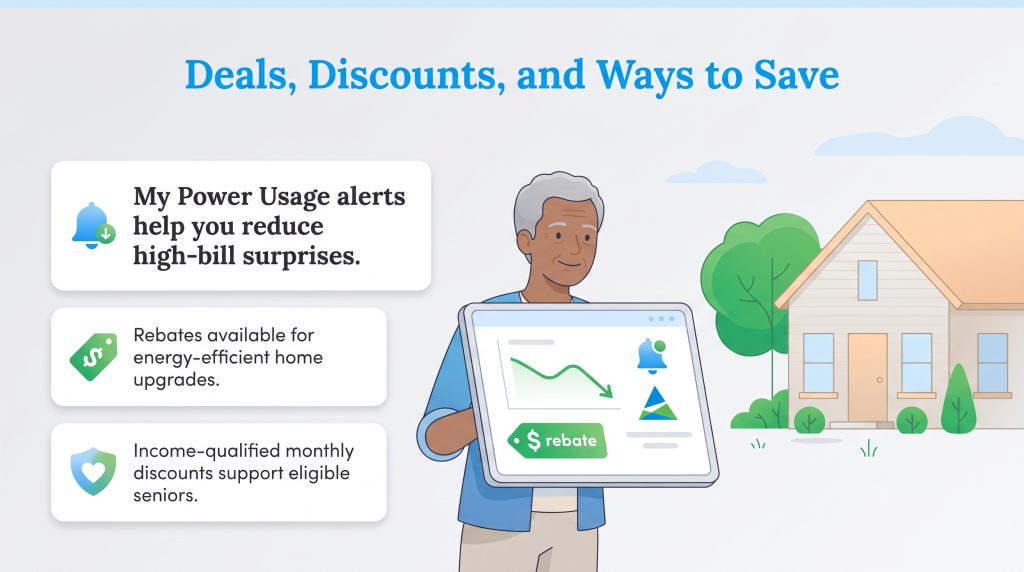
Georgia Power offers a variety of tools, programs, and incentives to help customers save money and improve energy efficiency across their homes. One of the most effective free features is the My Power Usage tool available in your online portal. This dashboard allows you to track your daily energy consumption and set up high-usage alerts. If your home uses more electricity than your customized daily dollar or kWh threshold, you’ll receive an automated text or email, giving you time to adjust your thermostat before a high bill arrives.
Additionally, the Home Energy Improvement Program (HEIP) provides robust rebates for energy-saving upgrades. Homeowners can receive up to $1,000 for qualifying heat pump water heater replacements, $300 for professional air sealing, and up to $200 for smart thermostats. The Georgia Power Marketplace also offers instant rebates on energy-efficient products, including LED lighting and smart home devices.
For those facing financial hardship, the Project SHARE Bill Payment Assistance program — administered in partnership with The Salvation Army — helps vulnerable households cover emergency utility costs. Furthermore, the utility provides a vital Georgia Power senior discount that takes up to $33.50 off your monthly energy bill (waiving the base customer charge and offering a discount on fuel fees). To qualify for this ongoing Low-Income Senior Citizen Discount, you must meet the following criteria:
- You must be 65 years of age or older.
- The Georgia Power account must be in your name.
- The service address must be your primary residence.
- Your combined household income must sit at or below 200% of the federal poverty guidelines (you will be asked to provide proof of income).
How to Report and Search for Outages
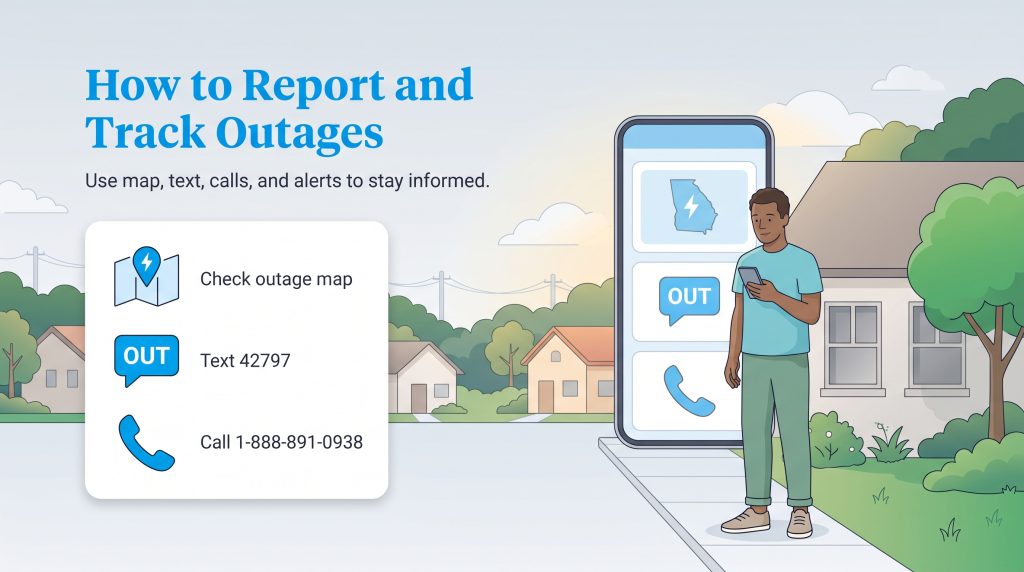
Severe weather in the Southeast can occasionally disrupt service. Fortunately, Georgia Power offers several streamlined tools to help you stay informed and report problems safely. If your lights go out, follow these five actionable steps:
- Check your home’s breakers: Before contacting the utility, verify that the outage isn’t an isolated electrical trip at your main breaker panel.
- Consult the Georgia Power outage map: Visit the official Georgia Power Outage Map online. This interactive tool provides real-time updates on power interruptions across the state, showing the scope of the outage and estimated restoration times.
- Report via text message: For the fastest reporting, text the word “OUT” to 42797. Make sure you are texting from the mobile phone number associated with your utility account.
- Call the outage hotline: If you prefer to speak to an automated system or a human representative, call the dedicated emergency reporting line at 1-888-891-0938.
- Set up alerts: Sign up for text or email notifications through your account preferences so you’re always in the loop regarding restoration crew progress.
Georgia Power Mobile App Features
The official Georgia Power app — available for download on both the Apple App Store and Google Play — is designed to provide customers with fast, convenient access to their account information. Through this free mobile application, you can bypass clunky web browsers and manage your utilities directly from your smartphone. Its clean, user-friendly interface makes it easy to monitor daily spending and utilize advanced digital features on the go.
Key features of the app include:
- Secure Biometric Login: Set up Face ID or Fingerprint recognition for instant, password-free access to your account, which is a lifesaver when you’re fumbling in the dark during a power outage.
- Pay Your Bill: Make one-time Georgia Power bill pay transactions easily, and utilize Digital Wallet options (like Apple Pay or Google Wallet) for seamless checkout.
- Track Energy Usage: View detailed charts that break down your daily and monthly power consumption alongside local weather temperatures.
- Report Outages: Alert the utility to neighborhood outages with just a few taps.
- Monitor Restoration Times: Check live updates on when crews expect your neighborhood to come back online.
- Access Special Programs: Navigate directly to the Georgia Power Marketplace to find energy-saving rebates.

- Calculate Your Moving Costs
- Compare Moving Companies
- Get Multiple Quotes
- Move with Confidence
Sustainability and Green Energy Initiatives
Georgia Power utilizes a diverse energy portfolio to meet the state’s rapidly growing electricity needs. In its current operations, the utility’s energy mix includes approximately 41% natural gas, 34% nuclear, 13% coal, and 12% from renewable sources such as solar, biomass, and hydropower. To keep up with surging population growth and commercial data center demand, Georgia Power’s latest Integrated Resource Plan (IRP) outlines a massive grid expansion, committing to building 1,000 miles of new transmission lines and 4,000 MW of new battery storage over the next 10 years to bolster grid reliability and store clean solar power.
🌱 Eco Edge: The completion of reactors 3 and 4 at the Vogtle Electric Generating Plant has significantly increased the state’s nuclear capacity, contributing to a cleaner energy profile without producing carbon emissions.
Georgia Power & Nuclear Energy Generation
The highly publicized completion of Units 3 and 4 at Plant Vogtle marks a massive shift in Georgia’s energy landscape. For the average consumer, these new reactors represent a bit of a trade-off. On one hand, the addition of Units 3 and 4 generates over 17 million megawatt-hours of clean energy annually — enough to power approximately 1 million homes. This monumental output prevents an estimated 10 million metric tons of carbon dioxide emissions each year, drastically reducing the overall carbon footprint of your home’s electricity supply.
On the other hand, the multi-billion-dollar cost overruns associated with Vogtle’s construction are partially funded by consumers. Through the Nuclear Construction Cost Recovery (NCCR) fee on your monthly bill, residents bear a portion of the financial weight required to bring this clean energy source online.
Beyond nuclear generation, Georgia Power is actively investing in an environmentally mindful choice for the grid by procuring an additional 4,000 megawatts of renewable resources by 2035. For eco-conscious consumers looking to offset their personal emissions right now, the utility offers several opt-in programs. The Simple Solar program empowers residential customers to match their electricity usage with Renewable Energy Credits (RECs), effectively supporting solar generation without installing panels on your roof. Additionally, the Green Energy Program allows you to support 100% renewable energy from solar and wind sources for a small monthly premium.
Why Choose Georgia Power and Who Each Plan Is Best For
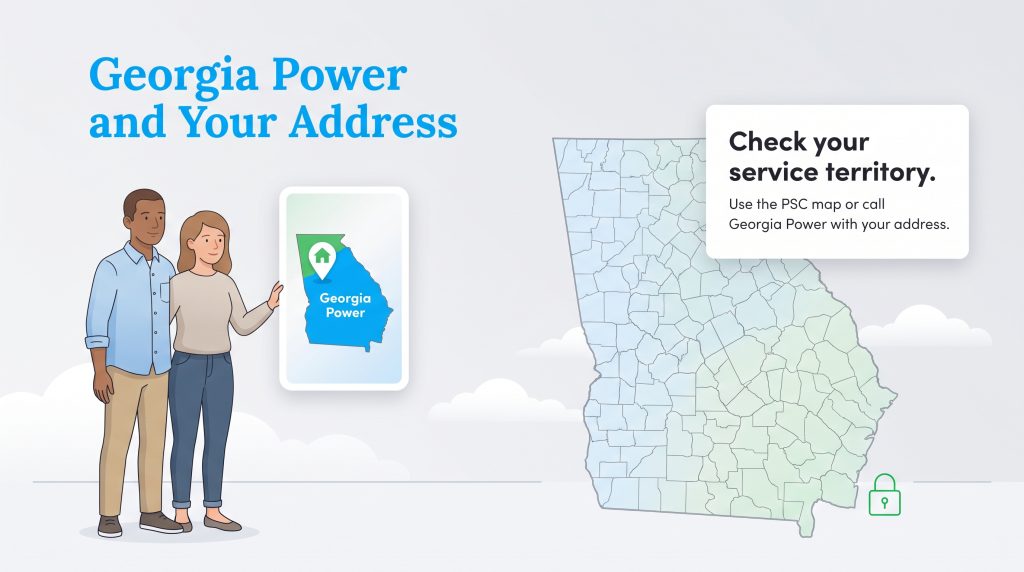
One of the most common questions from new residents moving to the state is, “Can I choose a different electricity provider?” The short answer is almost always no. Unlike deregulated states (such as Texas) where dozens of retail electric providers compete for your business, Georgia operates under a regulated electricity market governed by the 1973 Territorial Electric Service Act.
This state law dictates strict physical boundary limitations between Georgia Power, municipal city utilities, and the 41 local EMCs. Regulators mapped out specific service territories decades ago, creating legally binding monopolies in each zone. Unless you’re building a massive commercial or industrial facility with an initial connected load of 900 kilowatts (kW) or greater, you don’t have the legal right to switch electric providers. To confirm which utility serves your address, you can check the territorial map on the Georgia Public Service Commission website or call Georgia Power directly.
Even though you can’t shop around for a competing company in Georgia Power’s territory, the utility offers much more rate flexibility than a typical monopoly. Here is how their overall service stacks up:
| Pros of Georgia Power | Cons of Georgia Power |
|---|---|
| Seven diverse residential rate plans tailored to different lifestyles | No competing provider options in designated service zones |
| Robust mobile app with daily usage tracking and live outage maps | Expensive summer tier jumps on the standard R-30 rate plan |
| Generous HEIP smart home and energy-efficiency rebates | Mandatory Fuel Cost Recovery (FCR) and Plant Vogtle nuclear riders |
| Large carbon-free nuclear and expanding battery storage footprint | Strict deposit requirements for new customers with lower credit |
Because your savings depend entirely on choosing the right internal billing structure, here is how we recommend matching your household profile to the ideal Georgia Power plan:
- Remote Workers & Stay-at-Home Parents: Stick with Standard Residential Service (R-30) or Levelized Billing. Because you need the air conditioning running between 2 p.m. and 7 p.m. on weekdays, Time-of-Use plans will penalize you with high peak rates.
- Electric Vehicle (EV) Owners: Enroll in Overnight Advantage. Charging your vehicle between 11 p.m. and 7 a.m. at ~2.2¢/kWh is the single biggest rate discount Georgia Power offers.
- 9-to-5 Office Commuters: Choose Smart Usage or Nights & Weekends. If your house sits empty during weekday afternoons, you can set your smart thermostat to 78 degrees while you’re gone and enjoy cheap electricity every evening and weekend.
- Budget-Conscious Seniors: Combine Standard Residential Service with the Low-Income Senior Citizen Discount (if eligible) and Levelized Billing to keep monthly fixed incomes insulated from summer heatwaves.
- Short-Term Renters & College Students: Opt for PrePay. You’ll skip the hefty upfront security deposit, avoid long-term contracts, and easily track daily energy spending on your phone.
What People Are Saying: Reviews, BBB, and Reddit Sentiment
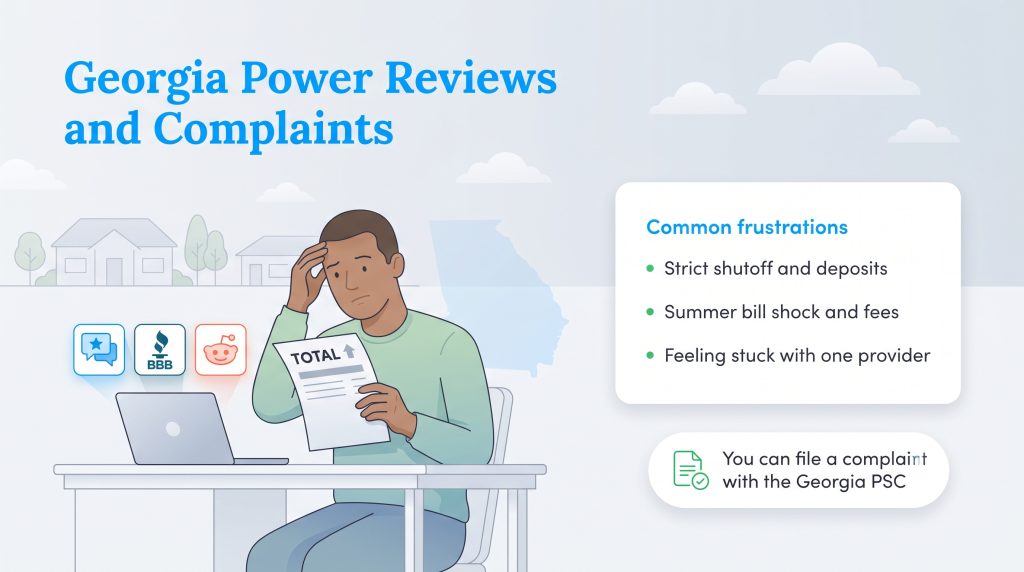
When it comes to large utility monopolies, public sentiment is rarely glowing. Looking closely at Georgia Power reviews across major consumer platforms reveals several consistent frustrations. On the Better Business Bureau (BBB) website, customer complaints primarily center around strict disconnection policies, high deposit requirements for new accounts, and steep bills during the humid summer months.
Discussions on local Reddit forums, particularly in the Atlanta and Savannah subreddits, echo these same concerns. A frequent topic of conversation is summer “bill shock.” Many residents share stories of their monthly statements doubling from May to July, expressing widespread frustration over the fuel riders and nuclear cost recovery fees that bulk up their bottom line. Homeowners often note that when base tier jumps combine with riders, conserving electricity requires serious effort to yield noticeable savings.
If you find yourself in an unresolvable dispute over billing inaccuracies, meter reading errors, or deposit issues, you don’t have to fight the battle alone. While standard customer service should always be your first stop, you have the right to escalate your complaint. You can file a formal consumer grievance with the Georgia Public Service Commission (PSC), the elected state body that regulates utility rates and holds the provider accountable for fair consumer practices.
Taking Control of Your Georgia Power Account
Georgia Power continues to invest heavily in grid infrastructure, securing the state’s growing energy demands with expansive projects like Plant Vogtle and thousands of megawatts of new battery storage. While the company has agreed to freeze base electricity rates through the end of 2028, variable costs associated with fuel generation and severe storm recovery will still impact consumer bills moving forward.
Ultimately, because you can’t shop around for a cheaper competitor, keeping your home energy costs manageable requires proactive planning. From relying on the Georgia Power app to track your daily usage to running the Residential Rate Advisor to find a plan tailored to your routine, you have the tools necessary to protect your budget. By taking advantage of smart home rebates and advocating for yourself when billing questions arise, you can keep your home comfortable year-round without overpaying.
Frequently Asked Questions About Georgia Power
Is Georgia Power the only electricity provider in my area?
How do I pay my Georgia Power bill?
What is the Georgia Power FlatBill plan?
How much does it cost to turn on Georgia Power?
Why were Georgia Power base rates frozen, and can my bill still go up?
What is the difference between Georgia Power FlatBill and Levelized Budget Billing?
How do I check the Georgia Power outage map?
Does Georgia Power offer budget billing or payment plans?
Does Georgia Power reimburse for spoiled food after an outage?
Can I get a discount for using less energy during peak times?
Does Georgia Power offer solar power options?
Why did my Georgia Power bill go up so much?
How do I contact Georgia Power customer service to dispute a bill?
Does Georgia Power have a grace period for late payments?
Is Georgia Power a monopoly?
About the Author

David has been an integral part of some of the biggest utility sites on the internet, including InMyArea.com, HighSpeedInternet.com, BroadbandNow.com, and U.S. News. He brings over 15 years of experience writing about, compiling and analyzing utility data.