

Navigate Georgia’s Unique Deregulated Energy Market and Set Up Your Essential Services With This Step-by-Step Guide
Key Takeaways
- Georgia features a deregulated natural gas market, meaning you must carefully compare rates and select a specific retail marketer to fuel your home.
- Your electric provider is strictly determined by your property’s location, falling under Georgia Power, a municipal system, or a local Electric Membership Corporation (EMC).
- Start your utility setup exactly two weeks before moving to accommodate standard credit checks, process deposits, and avoid potential technician delays.
When you are moving to Georgia, setting up utilities for a new home needs to be the absolute top priority on your relocation checklist. Rather than stressing immediately over unpacking heavy boxes or coordinating furniture deliveries, we strongly recommend focusing first on securing your essential home services to avoid disruptive delays. Georgia uses a highly unique system that pairs a deregulated natural gas market with rigidly fixed electric territories, which can easily frustrate new residents trying to establish a functional living space. This step-by-step guide walks you through exactly how to confidently navigate your local energy providers, shop around for your gas provider, gather your mandatory application documents, and execute a precise activation timeline so your power, water, gas, and broadband internet are fully operational the moment you step through the front door.
1. The 14-Day Pre-Move Timeline
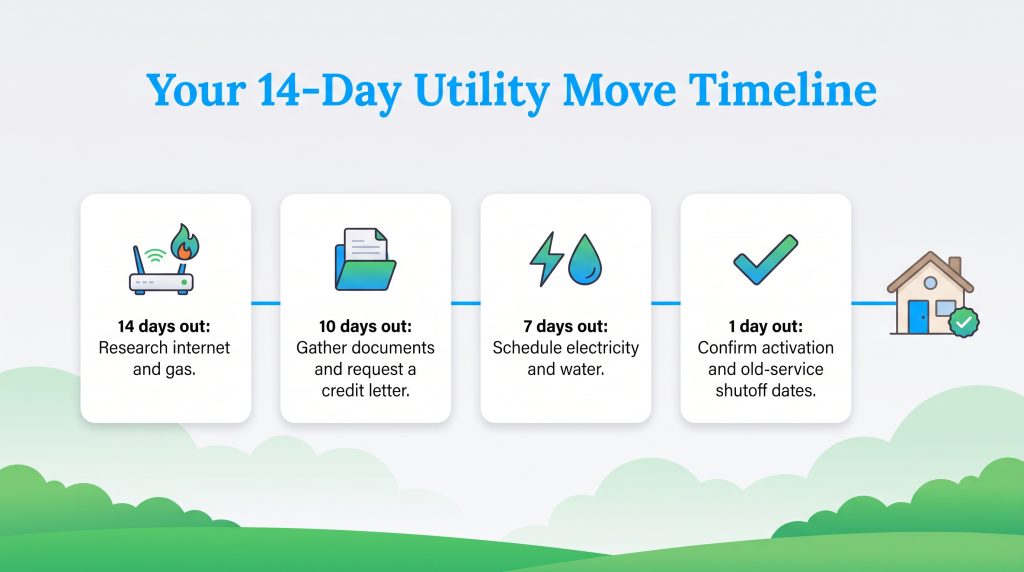
Timing is everything when it safely comes to transferring your crucial services. A disorganized approach can easily leave you unpacking in the dark or without running water on your busy move-in day. When executing your moving utilities checklist in Atlanta or any surrounding county, procrastination is truly your biggest enemy. Follow this comprehensive chronological timeline to guarantee a stress-free transition into your new space.
- 14 Days Out (Internet and Natural Gas): Two weeks before moving, compare natural gas marketers on the PSC website and actively research broadband internet availability for your specific street address. Securing these appointments early ensures technicians have availability on your move-in date.
- 10 Days Out (Required Documents): Begin gathering your mandatory setup documents, including your government-issued ID, Social Security Number, and a copy of your lease or property deed. Reach out to your previous provider to request a formal letter of credit.
- 7 Days Out (Electricity and Water): Exactly one week out, log into the Georgia Power or your local EMC portal to formally schedule your electricity transfer. This is also the optimal time to call your municipal water department to establish your new local account. Be prepared to clear routine credit checks during this window.
- 1 Day Out (Old Utility Disconnection): Contact your new providers to confirm that all activation orders are successfully loaded in their systems for the next morning. Additionally, verify the strict disconnection dates at your previous residence so you know exactly how to cancel utilities after moving without paying for excess energy you no longer use.
2. Setting Up Electricity: Georgia Power Vs. Local EMCs
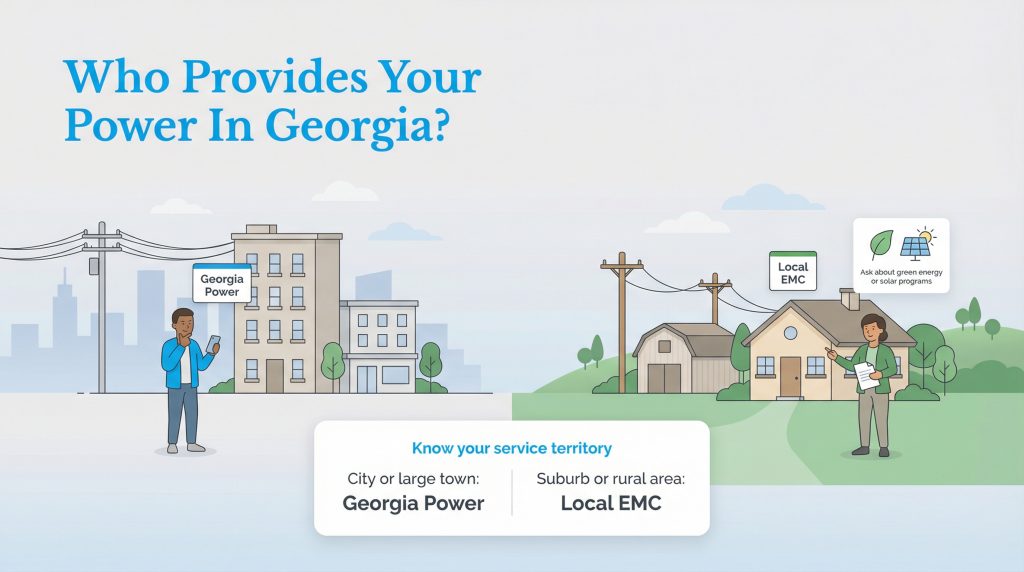
In the Peach State, your electric provider is tied directly to your physical address. Unlike the state’s natural gas landscape, you generally cannot shop around or switch electricity providers simply because you found a lower rate somewhere else. The state map is geographically divided into strict service territories managed by one of three primary entities: an investor-owned utility (Georgia Power), localized municipal electric systems, or Electric Membership Corporations (EMCs). Understanding who legally controls the power grid in your specific neighborhood (you can search your zip code to check local boundaries) is the very first step to illuminating your new home.
Georgia Power is by far the largest electricity provider in the state, proudly serving millions of residents across major metropolitan hubs like Atlanta, Savannah, and Macon. If your new property falls within their expansive territory, executing a Georgia power set up new service request is highly straightforward. To establish your connection, simply navigate to the official start service portal and select the option for a new residential account.
Conversely, if you are relocating to a sprawling suburban neighborhood or a quieter rural setting, your home is very likely served by one of the state’s 41 local EMCs. An EMC operates as a customer-owned, non-profit cooperative. Instead of generating massive profits for distant corporate shareholders, these specialized utility organizations prioritize local community service, proactively keep administrative overhead low, and frequently return excess revenue to their members. If you belong to one of the top three largest cooperatives in the state, you can reach them here:
- Cobb EMC: Call 770-429-2100 to start service in the northwest metro suburbs.
- Jackson EMC: Call 1-800-462-2667 to connect power in the rapidly growing northeast Georgia region.
- Sawnee EMC: Call 770-887-2363 to establish an account in Cumming and the surrounding northern communities.
While you cannot choose your electric provider, many EMCs and Georgia Power offer sustainable options. Enrolling in community solar programs or time-of-use plans is an environmentally mindful choice that provides a smart way to save on your electric bill while reducing strain on the state grid.
3. Navigating Georgia’s Deregulated Natural Gas Market
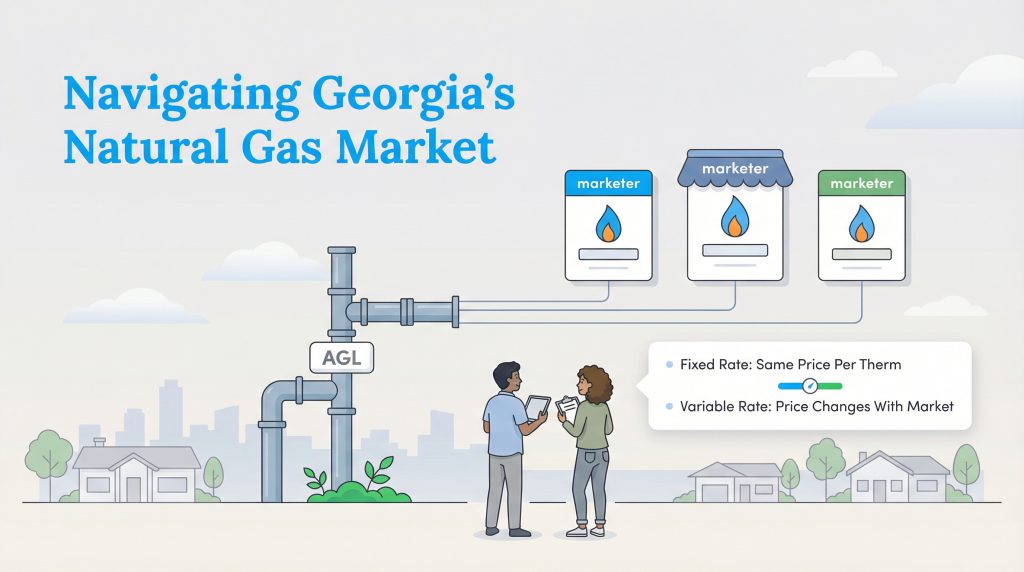
The most confusing aspect of setting up essential services for out-of-state movers is often navigating the deregulated gas market Georgia uniquely utilizes. A significant portion of the state, particularly the greater Atlanta metro area and its sprawling suburbs, relies on extensive underground pipelines owned by Atlanta Gas Light (AGL). However, it is vital to know that AGL strictly maintains the physical infrastructure — they absolutely do not sell natural gas directly to everyday consumers. You cannot call them to open a billing account.
Because of this deregulated structure, you must explicitly purchase your home’s energy supply by visiting the Georgia Public Service Commission’s website to choose from one of several state-approved retail marketers. These private companies actively compete for your business, handle your monthly billing inquiries, and set your specific price per therm. We created a clear breakdown of the top three marketers competing in the area (or you can search your zip code for a full list).
| Top Gas Marketers | Contract Types Offered | Typical Sign-On Perks |
|---|---|---|
| Gas South | Fixed (6, 12, or 24 months) and Variable | Bill credits for new customers, no deposit options |
| Georgia Natural Gas (GNG) | Fixed (6, 12, or 18 months) and Variable | Guaranteed flat bills, aggressive competitive rate matching |
| SCANA Energy | Fixed (6, 12, or 18 months) and Variable | Senior discounts, specialized military rates, charitable donations |
Because these retail marketers operate in a highly competitive market, locking in a fixed rate during the mild spring or fall shoulder months is a highly practical strategy to avoid sudden winter price spikes when statewide heating demands soar. Once you choose your preferred marketer, they will coordinate directly with AGL to ensure your physical meter is turned on safely.
Every gas bill will include an “AGL Pass-Through Charge.” This mandatory base cost covers physical pipeline maintenance and safe delivery. It remains identical regardless of which retail marketer you select for your home.
4. Establishing Water And Sewer Service By County
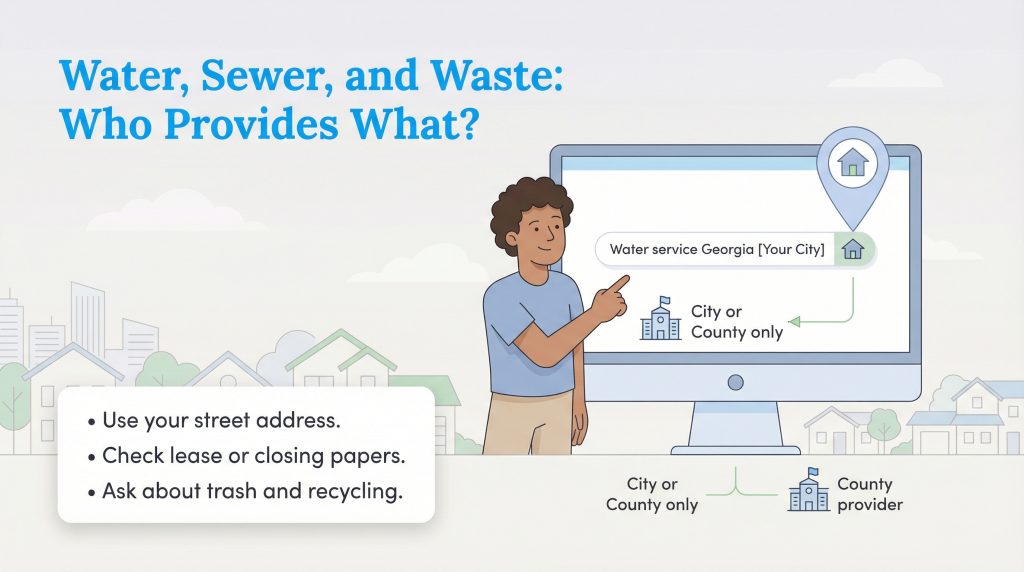
Unlike your competitive natural gas choices, a water and sewer setup Georgia connection is managed entirely at the local level by your specific city or county government. You are firmly assigned a single designated provider with absolutely no option to shop around. Water services are strictly controlled by local municipal authorities to ensure safe drinking standards and effectively maintain vital underground infrastructure.
When you prepare to transfer utilities when moving to a new home, you must immediately contact your hyper-local watershed authority. If you are unsure of your exact jurisdiction, you can search your zip code to identify your municipal provider. Always check for unpaid past water charges tied directly to the property prior to transferring service. Some municipalities in Georgia require the previous owner’s balance to be completely cleared, or they will ask for a finalized lease or closing document to prove you are not responsible for the previous debt.
- City of Atlanta Addresses: Properties inside the primary city limits fall under the direct jurisdiction of the City of Atlanta Department of Watershed Management. You must contact them directly via their online portal or customer service line to establish a new connection.
- Unincorporated Fulton and Neighboring Counties: If your home sits just outside the city borders in an unincorporated area, your water is managed by county-level entities like the Fulton County Department of Public Works or the DeKalb County Watershed. Always check your specific municipal zone before calling to avoid routing errors.
5. Internet, Cable, And Trash Collection Setup
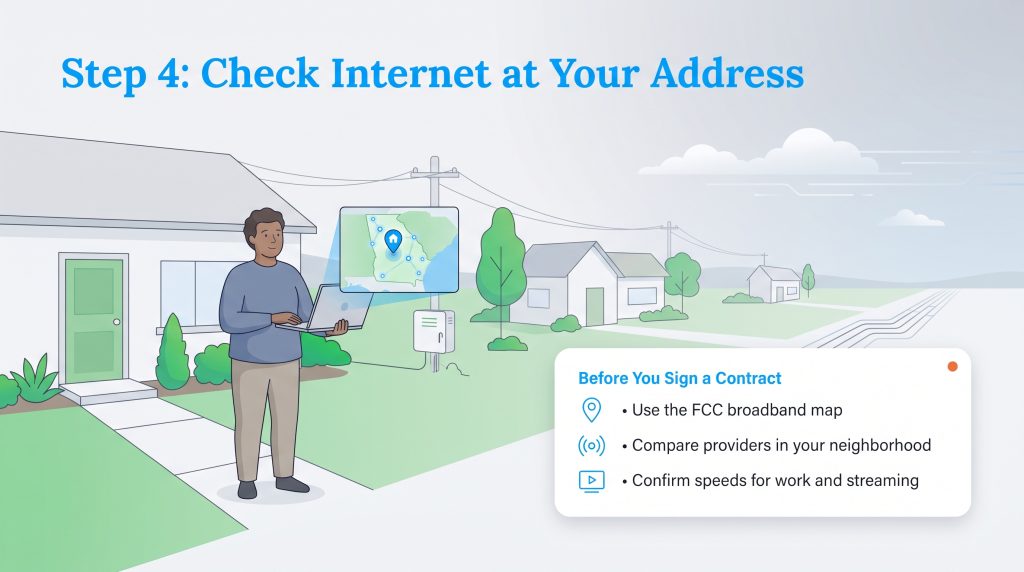
Staying securely connected is a massive priority for modern residents, and finding the best internet providers in Georgia depends entirely on your exact neighborhood layout. Because high-speed fiber coverage can vary wildly even within the exact same residential subdivision, we highly recommend verifying reported data speeds on the FCC National Broadband Map before you commit to a restrictive annual contract. This step guarantees you have the reliable bandwidth necessary for remote work and syncing your home’s smart energy monitors.
The top three broadband internet providers you will encounter across Georgia include:
- AT&T: Offers extensive fiber networks with symmetrical upload and download speeds, primarily dominant in metro Atlanta and major suburban centers.
- Xfinity (Comcast): Provides widely available high-speed cable internet and aggressive promotional bundles for new movers throughout the state.
- Spectrum: Operates largely in areas slightly outside the primary AT&T footprint, offering no-contract plans with reliable basic speeds.
Unlike many other states where waste management is seamlessly bundled into your monthly municipal water bill, trash collection in unincorporated Georgia counties typically requires a private subscription. You must actively contact a local hauling company to rent a bin and schedule weekly curbside pickup.
6. Required Documents And Average Deposit Fees
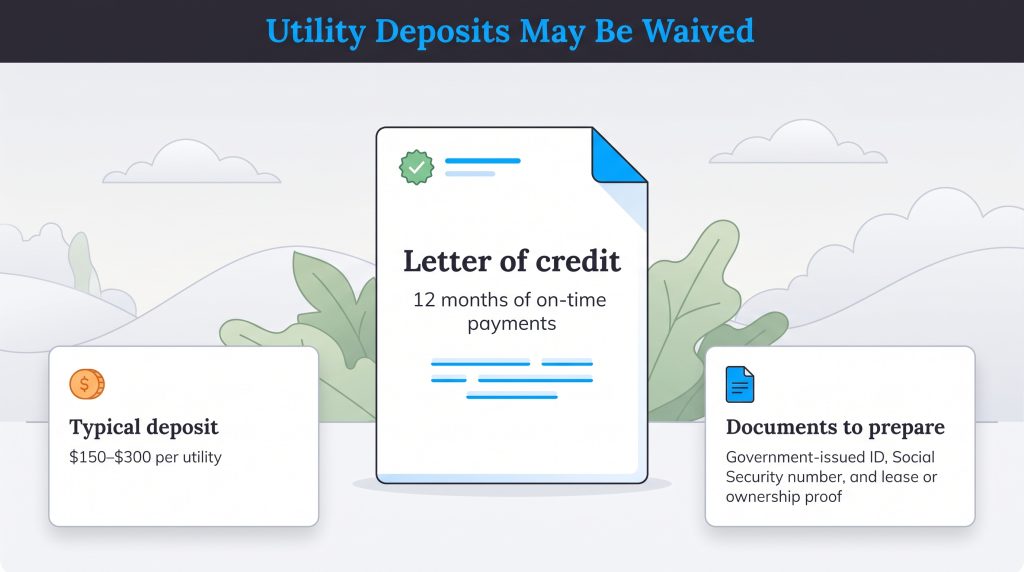
The initial utility deposit fees Georgia energy companies charge can easily catch busy new residents completely off guard. Based on a standard soft credit check, providers may legally ask for an upfront deposit — typically ranging from $150 to $300 per utility — before they turn on the lights or process your natural gas connection. To securely establish your accounts, you must have the following mandatory documents ready:
- Government-Issued ID: A valid driver’s license, state identification card, or current passport to officially verify your identity.
- Social Security Number: Required by nearly all energy providers to run your introductory soft credit check.
- Proof of Ownership or Lease: The first and last page of your signed lease agreement, or a finalized settlement statement for homeowners, proving your legal right to establish service at the property address.
There is a strategic way to bypass those frustrating upfront fees. You can successfully waive utility deposits by requesting a formal letter of credit from your previous out-of-state utility provider. If this official letter proves you comfortably paid your energy bills on time for the past 12 consecutive months, many generous Georgia providers will eagerly waive the deposit requirement entirely, keeping more vital cash in your pocket to cover hidden moving costs.
If natural gas service has been shut off for an extended period, local building codes may require a licensed plumber to perform a mandatory pressure test before the utility will safely reconnect your service. Ask your marketer or AGL about this rigid requirement early to avoid sudden delays in getting your heat turned on.
7. Powering On Your Georgia Home
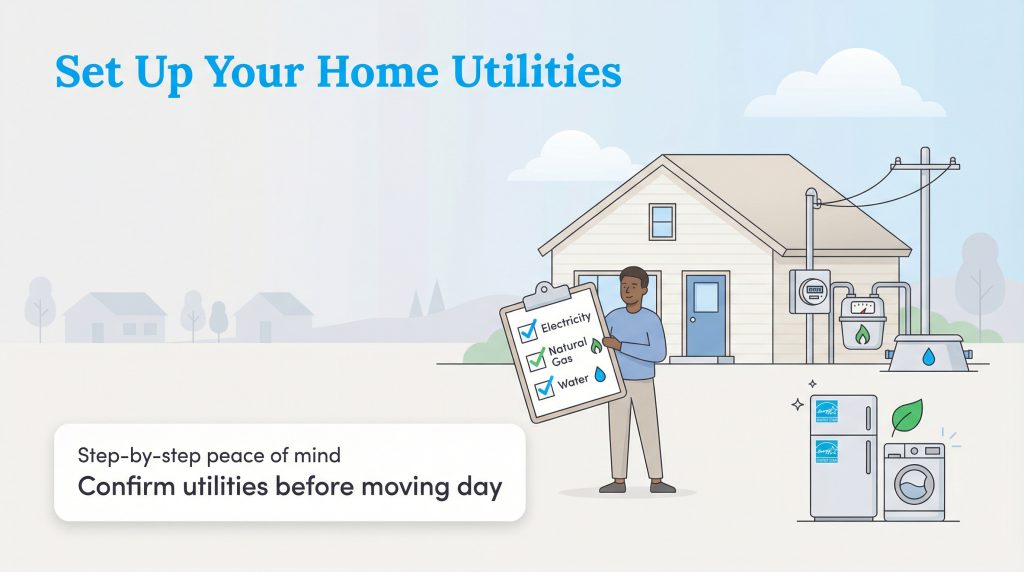
While navigating the unique mix of rigidly regulated electricity and a highly deregulated natural gas market might seem incredibly complicated at first glance, breaking the entire process down into actionable daily steps makes it highly manageable. Before you eagerly start unpacking boxes in your new living room, there are a few highly practical final tasks to complete to ensure a safe and completely successful utility activation on move-in day.
First, explicitly verify all meter readings immediately upon your arrival. Take clear, well-lit photos of your electric, water, and gas meter dials. This smart habit profoundly protects you from being unfortunately overcharged for energy the previous occupant selfishly used. Next, familiarize yourself with your home’s vital infrastructure by physically locating your main water shut-off valve and your essential electrical breaker box. Knowing exactly where these critical controls reside prevents minor household plumbing issues from quickly turning into major property damage in the event of an unexpected emergency.
Finally, utilize your newly established services to seamlessly update your official state residency. Once your accounts are fully active, print your very first official statement. You can use this physical document to easily satisfy the Georgia state utility bill requirements for a driver’s license transfer at the Department of Driver Services (DDS). When you proactively tackle your essential setups, you comfortably set the stage for a wonderfully welcoming environment, allowing you to happily shift your focus to enjoying everything the beautiful Peach State has to offer.
Frequently Asked Questions About Georgia Utilities
How much is the average utility bill in Georgia?
The average combined utility bill in Georgia largely depends on your exact usage, the size of your home, and seasonal weather patterns. Typically, residents can expect to pay around $130 to $150 for electricity, $40 to $80 for natural gas, and $60 to $80 for water and sewer each month. These costs fluctuate heavily during the peak summer air conditioning season and winter heating months.
Can I choose my electricity provider in Georgia?
No, you generally cannot casually choose your electric provider anywhere in the state. Your provider is dictated entirely by the strict physical location of your home. Most of the Atlanta metro area is heavily served by Georgia Power, but depending on your exact neighborhood or growing suburb, you might be strictly assigned to a nearby cooperative EMC or a localized municipal electric system.
How do I set up natural gas if I am moving to Atlanta?
When moving to Atlanta, Atlanta Gas Light (AGL) owns and rigorously maintains the physical pipelines safely delivering gas to your home, but they do not sell the actual fuel to you directly. You are completely required to independently select a retail natural gas marketer (such as Gas South, SCANA Energy, or Georgia Natural Gas) to competitively purchase your actual supply and carefully handle your monthly billing needs.
Do Georgia utility companies require a deposit to start service?
Depending heavily on your soft credit check, utility deposit fees in Georgia typically equal the estimated cost of one to two full months of service. Many major providers, including Georgia Power and various retail natural gas marketers, will happily waive these initial deposits if you can provide a formal letter of credit demonstrating 12 months of consecutive on-time payments with your previous utility company.
How do I transfer utilities in Georgia?
To successfully transfer essential services, you must directly contact each provider individually. If you are staying within the exact same electric territory (like Georgia Power), you can typically update your service address effortlessly through their online digital portal. However, if you are moving to a totally new area served by a different EMC or municipal utility, you must fully close your old account and open a brand new one safely tied to your new meter.
Do I need a utility bill to transfer my out-of-state driver’s license to Georgia?
Yes, the Georgia Department of Driver Services (DDS) requires two distinct forms of proof of residential address to successfully issue a new license. A printed, current utility bill (such as a water, gas, or electric statement) is one of the most widely accepted and easily accessible documents you can use to fulfill this mandatory residency requirement.
Who do I call if I smell gas?
If you smell gas, evacuate the surrounding area immediately. Once you are safely far away from the property, urgently call Atlanta Gas Light (or your specific local pipeline operator) or simply dial 911. Do not mistakenly call your retail gas marketer for emergencies, as they solely handle basic billing and do not physically repair infrastructure or plug active pipeline leaks.
About the Author

David has been an integral part of some of the biggest utility sites on the internet, including InMyArea.com, HighSpeedInternet.com, BroadbandNow.com, and U.S. News. He brings over 15 years of experience writing about, compiling and analyzing utility data.

LaLeesha has a Masters degree in English and enjoys writing whenever she has the chance. She is passionate about gardening, reducing her carbon footprint, and protecting the environment. She also recently served as President of the Board for City Sprouts (a community garden).