
Your monthly electric bill could average $225 this summer, but strategic rate plans and utility rebates can keep your cooling costs under control.
Key Takeaways
- Typical residential customers using 1,000 kilowatt-hours per month are seeing average summer bills of $225 as rates climb between 14¢ and 17¢ per kWh.
- Because state law bans switching electric companies, you must manage costs by choosing the right Georgia Power residential rate plan or using programs like FlatBill.
- Homeowners can combat rate hikes by tapping into up to $2,500 in energy efficiency rebates and exploring specialized low-income senior discounts.
If you have opened your recent Georgia Power statement and felt a sudden chill that had nothing to do with your air conditioning, you’re definitely not alone. Between the rising cost of fuel and the massive, multi-year nuclear expansion project at Plant Vogtle, typical households across the state are now staring down average summer cooling bills of $225 — with rates landing between 14¢ and 17¢ per kilowatt-hour. Because our goal at UtilitiesForMyHome.com is to help you navigate your home setup without draining your bank account, we’ve broken down exactly why these rates are climbing, which cities are hit hardest, and the concrete steps you can take today to lock in lower rates, claim valuable cash-back rebates, and keep your home comfortably cool.
Why Georgia Power Rates Are Climbing
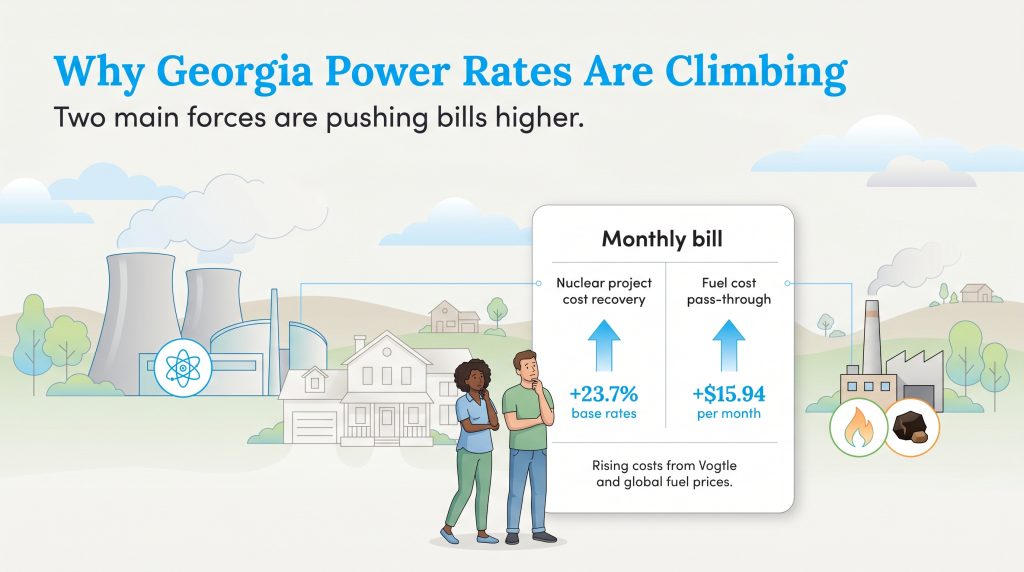
These rising electricity costs aren’t just a sudden summer fluke. They’re the result of several major structural adjustments approved over the last few years by the state’s utility regulators. Two primary drivers are responsible for the higher numbers on your monthly utility statements: nuclear energy capital recovery and global fuel price fluctuations.
The Multi-Billion Dollar Plant Vogtle Expansion
Plant Vogtle, located southeast of Augusta, is home to the first newly constructed nuclear reactors in the United States in over three decades. While these two new reactors provide reliable, carbon-free energy to the state’s grid, the project suffered from extensive schedule delays and massive cost overruns. Originally projected to cost around $14.3 billion, the final price tag ballooned to approximately $35 billion over a 14-year construction timeline.
To pay for these construction overruns, the state approved $11.1 billion in capital and financing costs to be collected directly from ratepayers. This cost-recovery deal resulted in a cumulative 23.7% rate increase for residential customers. This rate hike was divided into two phases: a 7.85% base rate increase when Unit 3 went online, followed by a 15.9% increase when Unit 4 began commercial operations in May 2024. These charges are in addition to the Nuclear Construction Cost Recovery surcharge that on-bill customers paid between 2009 and 2024, which added 8% to 10% to monthly bills for 15 years before the reactors ever delivered a single kilowatt-hour of power.
Natural Gas Volatility and Fuel Cost Recovery
In addition to paying for nuclear steel and concrete, Georgia consumers have been heavily impacted by the volatile prices of the natural gas and coal used to run traditional power plants. By law, Georgia Power is allowed to pass the actual cost of fuel directly to customers on a dollar-for-dollar basis, meaning they aren’t legally permitted to make a profit on these charges.
After fuel prices spiked globally between 2020 and 2022, the utility built up a $2.1 billion deficit in under-recovered fuel costs. To recoup this balance, regulators approved the FCR-26 fuel cost recovery adjustment. This added roughly $15.94 per month to the typical household bill. To cushion the blow, the recovery is being spread over a three-year amortization period instead of the standard two years, which successfully lowered the immediate monthly shock by 25%. While base rates are frozen through 2028, these fuel cost adjustments and storm recovery fees can still cause your monthly bills to fluctuate.
Can You Switch Electric Providers in Georgia?
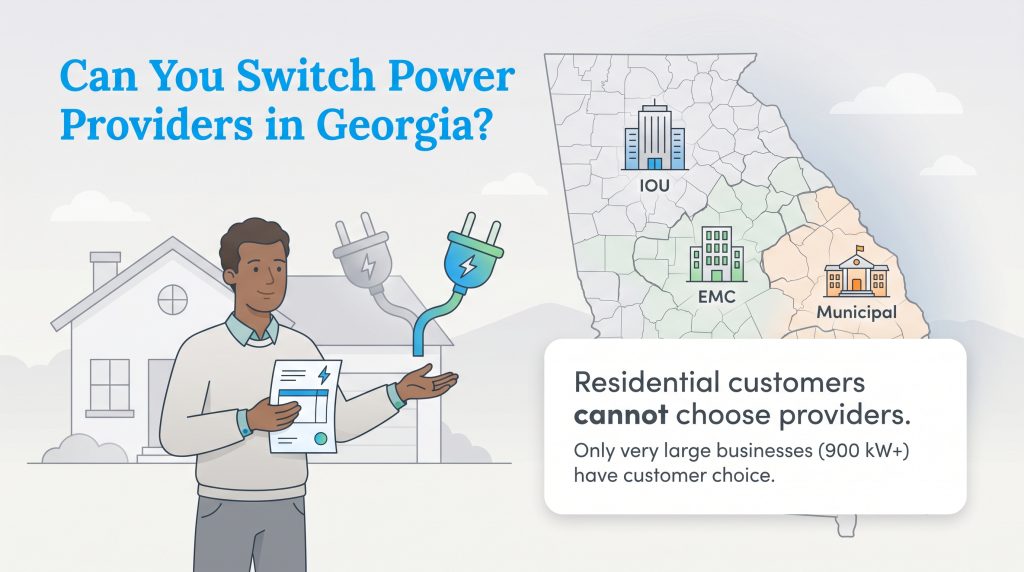
If you’re moving to Georgia from a deregulated energy state like Texas or Ohio, you might expect to shop around for a cheaper electricity provider. However, the electric market in the Peach State operates under a much more traditional model.
Understanding the Georgia Territorial Electric Service Act of 1973
Under the Georgia Territorial Electric Service Act of 1973, residential electric service is strictly monopolistic and tied to your physical address. The state is divided into distinct geographic territories managed by either an investor-owned utility, a member-owned Electric Membership Corporation, or a municipal electric system as overseen by the STATE OF GEORGIA Public Service Commission portal.
Because of this territorial law, you cannot switch electric providers simply because you found a cheaper rate somewhere else. The only customers who have “Customer Choice” — the legal right to choose their electricity supplier — are large commercial and industrial facilities with a connected load of 900 kilowatts or greater at initial operation.
Where These Major Rate Hikes Strike Hardest
Because Georgia Power is the dominant electric provider in the state, serving roughly 2.7 million customers across 155 of Georgia’s 159 counties, these rate hikes directly impact the state’s largest urban and suburban centers. The primary metropolitan areas feeling the financial squeeze include:
Comparing Your Georgia Power Rate Plan Options
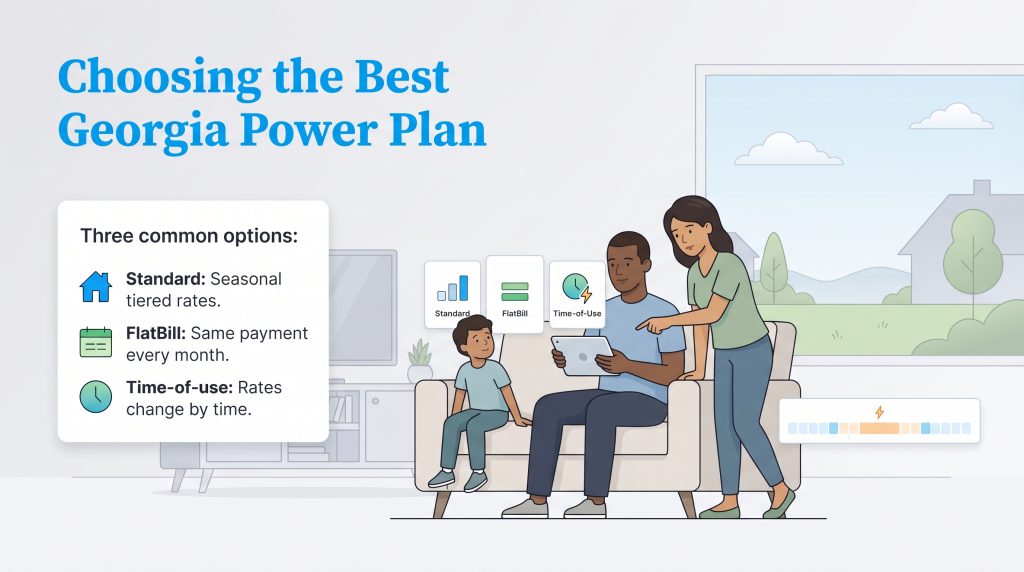
While you can’t swap your utility company, you do have the power to change how you’re billed. Georgia Power offers seven different residential rate plans. Finding the right billing structure for your family’s lifestyle is one of the easiest ways to keep your summer bills manageable, and you can view all options on the Georgia Power rate plans page online.
Traditional Residential Service Versus FlatBill
The standard Residential Service rate plan is what most customers default to when setting up their accounts. This plan relies on seasonal, tiered rates during the high-demand summer months from June through September. The tiered pricing structure — which means your costs rise as you consume more electricity — is designed to keep rates lower for smaller users, but it can punish larger families during hot months. Under this plan, you pay 8.6¢ per kWh for your first 650 kWh, 14.3¢ per kWh for the next 350 kWh, and 14.8¢ per kWh for anything over 1,000 kWh. In the winter, the rate drops to a flat 8.1¢ per kWh.
If you hate seasonal bill spikes, you might consider the FlatBill program. This plan offers a customized, fixed monthly payment that is locked in for 12 months, regardless of how much power you use. To calculate this, the utility looks at your home’s historical energy usage and current rates, then applies a “risk adder” of up to 10% to protect themselves from extreme weather swings. The mathematical formula for this plan looks like this:
Monthly FlatBill Payment = Expected Annual Bill/12
While the FlatBill plan provides excellent budget predictability, it has a major drawback: the “buffet effect.” Because your monthly payment stays the same no matter how low you keep your thermostat, there’s no immediate financial incentive to conserve energy. This often leads to increased usage, which can result in a massive rate hike when your plan is recalculated at the end of the year.
Time-of-Use and Demand-Response Rate Plans
If you’re willing to adjust when you run major appliances, you can find excellent savings on a time-of-use plan.
- Nights & Weekends: This plan charges a steep 29.8¢ per kWh during peak summer weekday afternoons (2:00 p.m. to 7:00 p.m., June through September). However, the price drops to 7.6¢ per kWh during all off-peak hours, weekends, and holidays.
- Overnight Advantage: Similar to Nights & Weekends, this plan charges 29.8¢ per kWh during peak afternoon hours and 10.2¢ per kWh off-peak. The real magic happens between 11:00 p.m. and 7:00 a.m., when the rate plunges to just 2.2¢ per kWh. This is an environmentally mindful choice for electric vehicle owners who want to charge overnight.
- Smart Usage: This plan offers incredibly low energy rates (1.5¢ per kWh off-peak and 14.3¢ per kWh peak) but introduces a monthly demand charge of $12.21 per kW based on your single highest hour of usage. If you run your air conditioning, clothes dryer, and water heater all at the same time, you’ll trigger a massive demand charge that applies to your entire monthly bill.
| Rate Plan | Peak Summer Rate | Best For | Potential Drawbacks |
| Residential Service | Tiered (8.6¢ to 14.8¢) | Standard homes | Summer bills spike quickly |
| FlatBill | None (Fixed monthly amount) | Budget predictability | Includes up to a 10% risk premium |
| Nights & Weekends | 29.8¢ per kWh | Load-shifters | Failure to curtail peak use is costly |
| Overnight Advantage | 29.8¢ per kWh | EV owners | Strict afternoon discipline required |
| Smart Usage | 14.3¢ per kWh | Highly coordinated homes | Heavy demand fee of $12.21 per kW |
How to Save Money with Energy-Saving Rebates
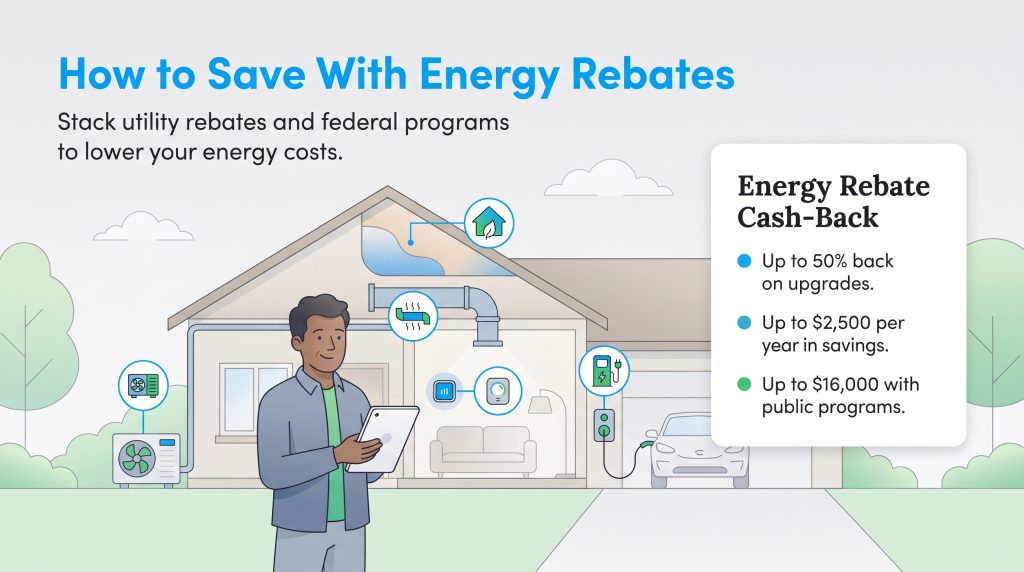
While selecting the right rate plan manages how you pay for your power, the absolute best way to lower your bill is to reduce your home’s energy consumption. Fortunately, we can help you find excellent cash-back incentives that make green home improvements incredibly affordable.
Georgia Power Home Energy Improvement Program
Under the Home Energy Improvement Program, you can receive up to 50% cash back on qualifying energy-efficiency upgrades, capped at a maximum of $2,500 per customer per year. The program includes both professional contractor-led projects and simple do-it-yourself options:
- Air Sealing: Receive up to $300 back for sealing air leaks around windows, doors, and plumbing.
- Duct Sealing: Get up to $400 back to seal leaky heating and air ducts.
- Attic Insulation: Up to $200 back for DIY attic insulation projects, or $250 when hired through an approved program contractor.
- Air Source Heat Pump: Get up to $1,000 back when converting to an energy-saving heat pump system.
- Smart Thermostat: Receive up to $75 back for installing an ENERGY STAR certified smart thermostat.
- Level 2 EV Charger: Get up to $50 back for installing a home vehicle charging station.
The Temp Check Demand-Response Program
To unlock even more savings, you can enroll your smart thermostat in the utility’s Temp Check program. By linking a qualifying Nest, ecobee, or Sensi thermostat, you’ll receive an immediate $50 prepaid card, followed by a $25 incentive for each year you remain enrolled. This program allows the utility to make minor, temporary temperature adjustments during peak summer afternoons, helping to reduce stress on the local power grid while keeping your home comfortable.
State and Federal Assistance Programs
For households looking for deeper energy upgrades, you can coordinate utility incentives with wider public programs. The Georgia’s Home Energy Rebates includes federal funds from the Home Efficiency Rebates and Home Electrification and Appliance Rebates programs. Depending on your household income and expected energy savings, these programs can provide low- and moderate-income families with up to $16,000 in energy-saving retrofits and appliance upgrades.
Seniors and Low-Income Household Support Programs
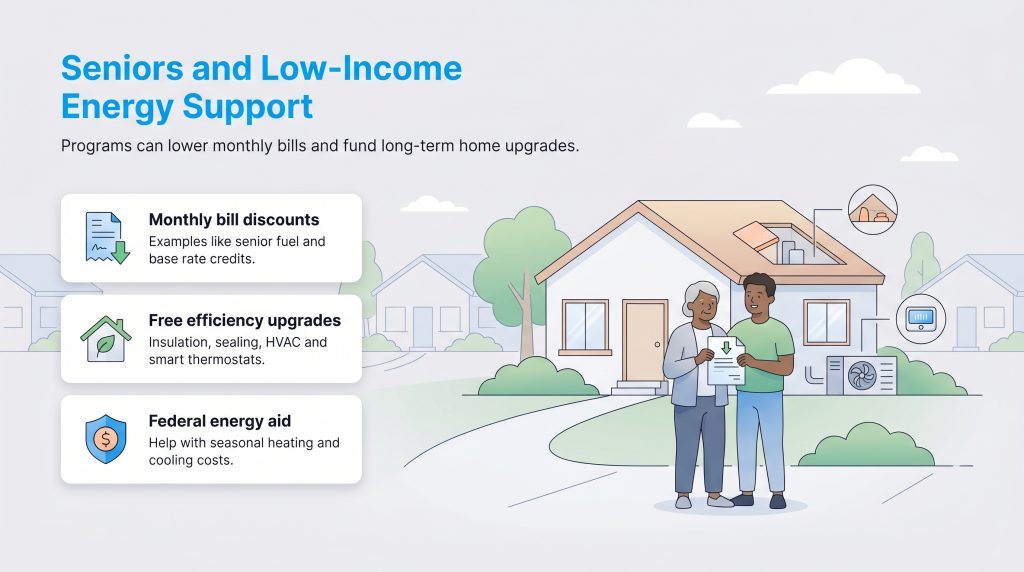
We understand that high summer cooling bills can be incredibly stressful for low-income households and seniors living on fixed incomes. Fortunately, there are several dedicated assistance programs designed to provide direct financial relief.
Income-Qualified Senior Citizen Discount
For seniors aged 65 or older with a combined household income at or below 200% of the federal poverty guidelines, Georgia Power offers a combined monthly discount of $33.50. This helpful credit consists of a $24 base rate reduction and an additional $9.50 fuel discount applied directly to your monthly bill.
EASE for Seniors
The Energy Assistance for Savings & Efficiency for Seniors program provides completely free energy efficiency upgrades to homeowners aged 60 or older who meet income guidelines. Approved contractors will conduct an in-home assessment and install upgrades — like attic insulation, air and duct sealing, HVAC maintenance, and smart thermostats — at zero cost to the homeowner, permanently lowering future utility bills.
LIHEAP and Weatherization Assistance
For families of all ages facing high energy burdens, federal programs are administered locally through state agencies. The Low Income Home Energy Assistance Program provides direct financial help to cover seasonal heating and cooling bills. Additionally, the Weatherization Assistance Program offers free home energy audits and professional physical upgrades to help permanently reduce your home’s energy footprint.
Navigating Your Way to a More Affordable Georgia Summer
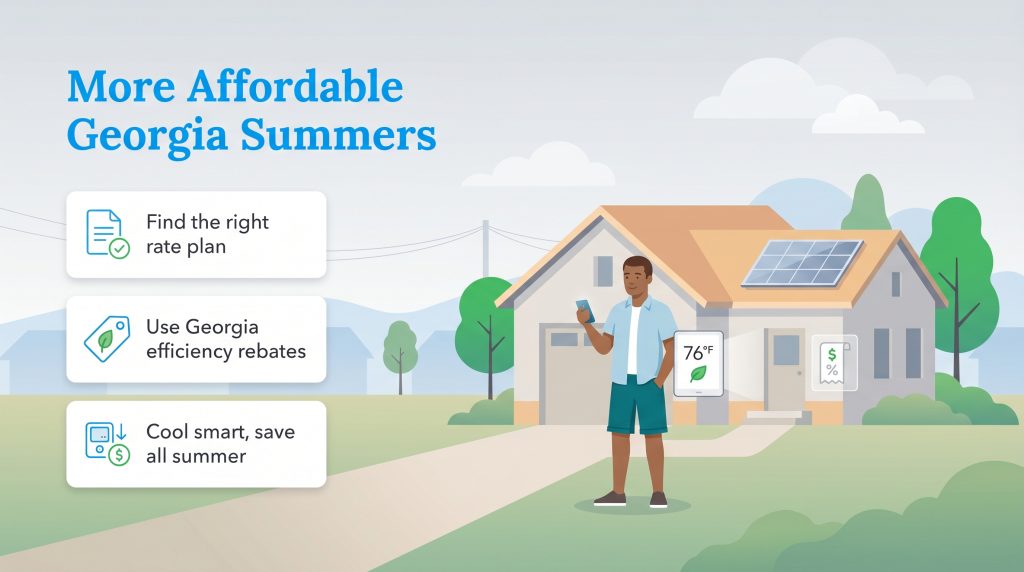
Rising electric rates in Georgia might feel overwhelming, but taking control of your monthly utility bills is completely doable. By finding the right rate plan, taking advantage of local efficiency rebates, and implementing smart cooling habits, you can keep your home comfortable all summer long while keeping your hard-earned money in your wallet. We’re here to help you make these smart, green decisions every step of the way — so go ahead, adjust that thermostat, claim your cash-back rewards, and enjoy a stress-free summer.
Frequently Asked Questions About Georgia Power Summer Bills
Can I switch from Georgia Power to another electric company if I find a cheaper rate?
What is the risk adder fee on the Georgia Power FlatBill plan?
How do I qualify for the monthly senior citizen discount?
About the Author

Claudio is a sustainability-focused writer with a background in Anthropology and Psychology from NC State University. He has spent over 15 years working in writing, interpretation, and translation, driven by a deep interest in how human culture shapes the environment. Today, he shares his curiosity with readers by writing about sustainable living solutions and the connection between everyday choices and environmental impact.