
Choosing the right provider comes down to understanding your specific monthly usage and tolerance for bill credits
Key Takeaways
- Gexa Energy generally offers lower headline rates for specific usage tiers (usually 1,000 to 2,000 kWh) but relies heavily on bill credits that disappear if you miss the usage window.
- Just Energy tends to offer stable, predictable pricing structures and longer contract terms, making them a safer choice for consumers who want to set it and forget it.
- Cancellation fees vary significantly between the two, with Just Energy often charging a flat fee per remaining month and Gexa typically charging a fixed lump sum.
Choosing between Gexa Energy and Just Energy can feel overwhelming, but the difference in your monthly bill usually hides within the fine print. While both companies operate as massive players in the Texas deregulated energy comparison landscape, they appeal to two very different types of consumers. One provider actively rewards the vigilant user who hits specific usage targets every single month, while the other caters to the homeowner seeking long-term pricing stability and predictability. We analyzed the current rates, official Public Utility Commission (PUC) ratings, and contract terms to help you determine which provider genuinely deserves your business and crowns themself as the best Texas electricity provider 2026 has to offer. Please note that rates and plan details change frequently, so we reviewed plan structures and Electricity Facts Labels (EFLs) available in the Texas market to provide this comprehensive guide.

- 7.3¢ /kWh
- 100%
- 60 days
- 12-36 Months
- Committed to Renewable Energy

- 8.8¢ /kWh
- 31%
- 60 days
- 12-36 Months
- Popular Bill Credit Plans
*rates may vary by location and household usage
At a Glance: Key Differences and 2026 PUC Ratings
If you need a quick answer before diving into the details, this scorecard breaks down the primary differences between these two major providers. We have highlighted the winning provider in bold for each category to help you quickly identify where each company excels.
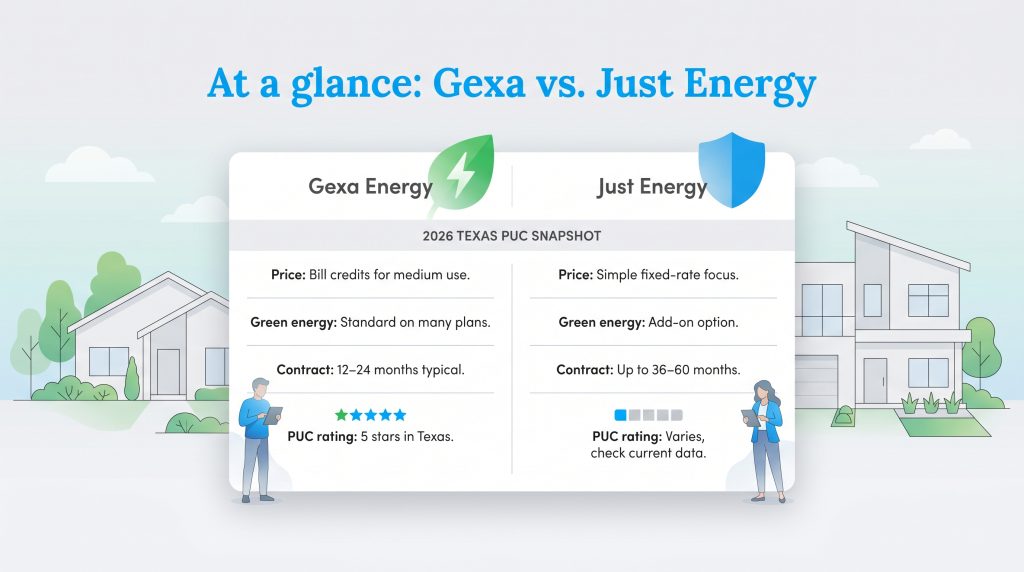
| Feature | Gexa Energy | Just Energy |
|---|---|---|
| Price Stability | Variable (Bill Credit Dependent) | High (Fixed Rate Focus) |
| Green Energy | Standard on many plans | Available as an add-on |
| Contract Length | Usually 12–24 months | Up to 36–60 months |
| Texas PUC Rating | 5-Star Rating | 4-Star Rating (Varies) |
| Customer Support Channels | Phone, Email, App | Phone, Email, App, Live Chat |
| Trustpilot/BBB Rating | A+ BBB, Mixed Trustpilot | A+ BBB, Better App Store Rating |
To further simplify your decision, review these core strengths and weaknesses for both companies.
Gexa Energy Pros & Cons
- Pro: Often features the lowest advertised headline rates for households using 1,000+ kWh.
- Pro: 100% green energy is frequently included by default at no extra premium.
- Con: Missing the required usage threshold causes significant and sudden rate spikes.
- Con: Flat cancellation fees can be a harsh penalty if you break your contract early.
Just Energy Pros & Cons
- Pro: Stable, predictable fixed rates mean no hidden usage traps or surprise spikes.
- Pro: Prorated cancellation fees and generous switching incentives ease the transition.
- Con: Generally higher baseline rates than competitors’ promotional bill credit plans.
- Con: Long-term contracts may lock you in for up to 60 months, reducing flexibility.
Gexa Energy vs Just Energy Reviews and Customer Service
When comparing Gexa Energy vs Just Energy reviews online, you will notice distinct patterns in what customers praise and critique. Both companies are established veterans in the competitive Texas energy market, but their varying pricing models directly impact the customer service experience.
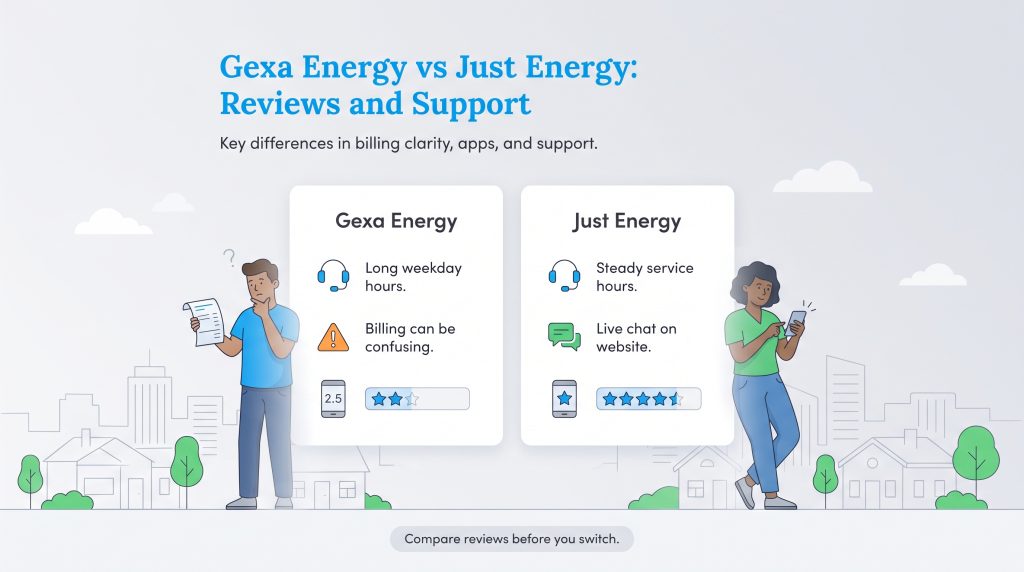
A frequent theme in Gexa Energy reviews revolves around perceived billing confusion. Because their plans rely heavily on precise usage windows, customers are often surprised when their bill spikes — mistaking the strict contract rules for a billing error. If you use 999 kWh on a plan requiring 1,000 kWh, your rate skyrockets. This leads to frustrated calls to support. However, it is essential to note that Gexa maintains a prestigious 5-star rating from the Texas PUC, meaning they resolve official complaints quickly and transparently.
Conversely, Just Energy has invested heavily in improving its accessibility and digital experience. They are generally viewed as a highly stable provider with excellent customer retention. Their straightforward plans mean fewer billing surprises, which translates to smoother customer service interactions. Additionally, Just Energy offers live chat functionality directly on their website and boasts significantly higher ratings on both the Apple App Store and Google Play Store. A functional mobile app is a critical feature when you need to track your daily usage during a blistering Texas heatwave or quickly set up autopay.
| Support Feature | Gexa Energy | Just Energy |
|---|---|---|
| Customer Service Hours | Mon-Fri 7 AM – 8 PM, Sat 8 AM – 2 PM CST | Mon-Fri 8 AM – 7 PM, Sat 9 AM – 6 PM CST |
| Live Chat Availability | Limited availability | Yes, directly on website |
| iOS App Store Rating | ~2.5 / 5 Stars | ~4.1 / 5 Stars |
| Android App Store Rating | ~3.0 / 5 Stars | ~4.3 / 5 Stars |
Understanding the Pricing Models: Gexa Bill Credit Plans Explained vs Just Energy Fixed Rates
If you are evaluating the Gexa bill credit plans explained within the fine print against the standard Gexa vs Just Energy fixed rates, you must understand exactly how these companies calculate your price per kilowatt-hour (kWh). If you ignore this section, you might accidentally sign up for a plan that costs you hundreds of dollars in hidden fees throughout the year.
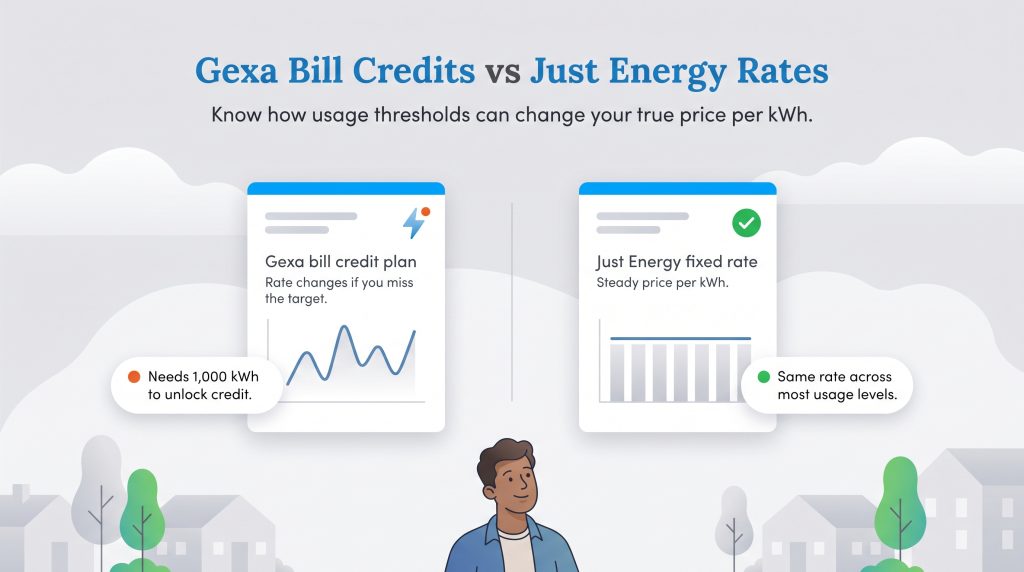
Gexa Energy frequently utilizes a “bill credit” model. This is an aggressive strategy where you receive a massive discount — often between $30 and $100 deducted right off your invoice — but only if your monthly usage falls within a specific window, such as 1,000 to 2,000 kWh. It is vital to understand the math behind these advertised rates so you do not fall into a pricing trap.
- The Target Usage: A plan might advertise an appealing 12 cents per kWh based precisely on 1,000 kWh of usage.
- The Threshold Requirement: That low rate relies on a large bill credit that only applies after you hit the 1,000 kWh mark.
- The Penalty for Missing: If the weather cools down and you use 999 kWh — just one unit short of the threshold — you miss the credit entirely.
- The Final Bill: Without that credit, your effective rate jumps significantly, causing an unexpected spike in your monthly costs despite using less power.
💡 Pro Tip: Gexa’s lowest advertised rates require careful monitoring. If you live in a small apartment and only consume 500 kWh, your rate per kWh will be much higher than the headline price on a bill credit plan.
In stark contrast, Just Energy typically offers bundled rates or straightforward fixed pricing. This means your rate per kWh stays relatively consistent regardless of how much power your household consumes. You do not have to stress over hitting a specific target to avoid a massive penalty. This makes it much easier to compare Just Energy and Gexa electricity rates without needing a spreadsheet or calculator every month.
How to Read an Electricity Facts Label
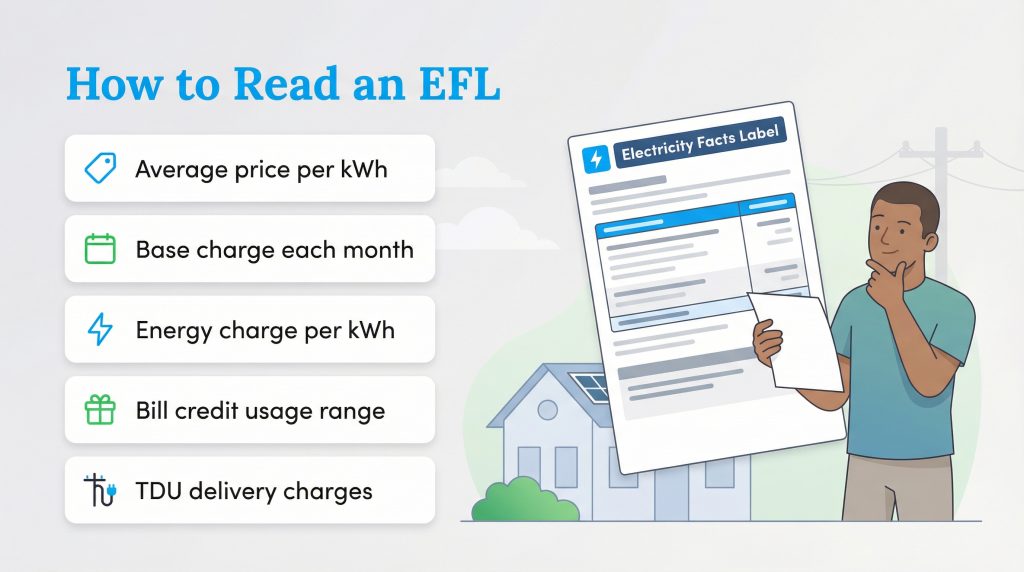
To truly understand how these models will impact your wallet, you must read the Electricity Facts Label (EFL). This state-mandated document serves as the nutrition label for your energy contract. Always check the average price per kWh for your specific usage level, the base charge, the energy charge, and the exact criteria required to earn any bill credits before signing.
Plan Options and Perks Compared Side-By-Side
When you are shopping for the cheapest rates, your physical location plays a major role in your final bill because Transmission and Delivery Utility (TDU) charges vary by region. Whether you are in the CenterPoint zone in Houston or the Oncor zone in Dallas, both Gexa Energy and Just Energy pass these delivery charges through to you without markup. Gexa often ranks as a top choice in high-fee areas because their robust bill credits can effectively offset those local delivery fees. Let’s compare their most popular offerings.
Just Energy Smart Choice vs Gexa Eco Saver
When comparing the Just Energy smart choice vs Gexa eco saver plans, the decision boils down to your tolerance for risk. The Gexa Eco Saver plan is a powerhouse for large homes, requiring you to hit a strict 1,000 kWh threshold to unlock a substantial bill credit. If you hit the mark, your effective rate drops significantly. Conversely, the Just Energy Smart Choice plan offers locked-in stability. There are no minimum usage requirements or hidden traps; you pay a straightforward fixed rate for up to 36 months, providing absolute peace of mind against seasonal market fluctuations.
Gexa Energy Renewable Energy Plans vs JustGreen
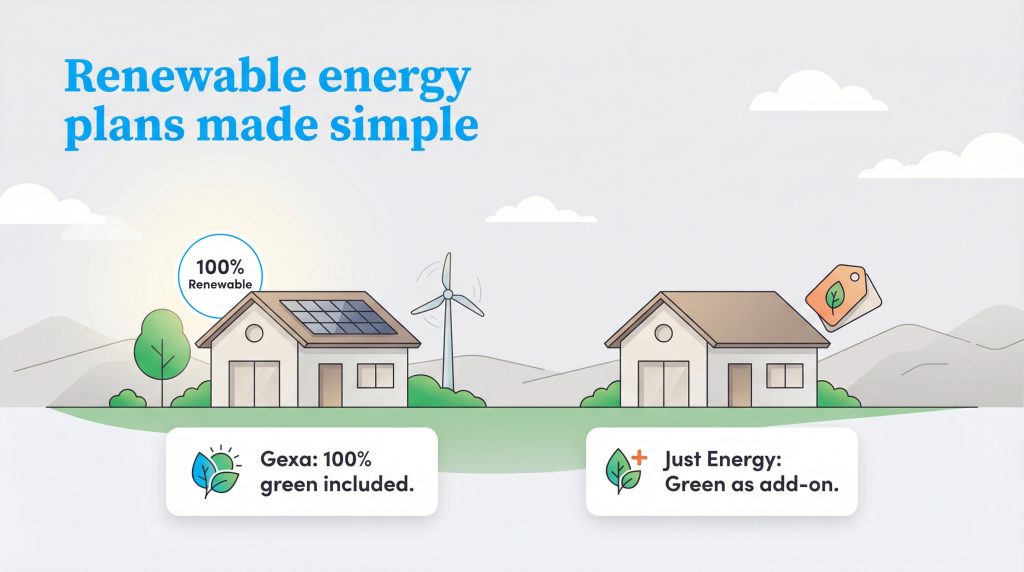
For those looking to make an environmentally mindful choice, Gexa Energy typically holds the advantage. Because they are backed by a massive generator of clean energy, Gexa frequently includes 100% renewable energy in its default plans at no extra cost. Just Energy provides green options via their “JustGreen” program, but this is normally an add-on product that costs a few extra dollars each month. Renewable Energy Certificates (RECs) substantiate these green power claims.
- Gexa Simply Low: A straightforward fixed-rate option for medium usage that features standard 100% green energy and predictable monthly billing.
- Gexa Free Mornings & Evenings: Ideal if your household uses the bulk of its power during off-peak hours, allowing you to run heavy appliances for free.
- Just Energy Power Plus: Offers a highly competitive bundled rate for households that want a straightforward, no-surprises bill, averaging around 14–17 cents per kWh depending on your TDU.
- Just Energy Nights Free: Provides free electricity during overnight hours, perfect for night owls or electric vehicle owners who charge at home.
| Plan Name | Rate /kWH | Plan Term | Cancellation Fee | |
|---|---|---|---|---|
| Gexa Saver Plus 12 | 7.3¢ | Month to Month | N/A | Check Availability |
| Gexa Eco Saver Plus 12 | 7.3¢ | Month to Month | N/A | Check Availability |
| Gexa Eco Saver Plus 14 | 7.5¢ | 14 Months | $150 | Check Availability |
| Gexa Eco Saver Plus 24 | 8.4¢ | Month to Month | N/A | Check Availability |
| Gexa Eco Choice 3 | 11¢ | 3 Months | $150.00 | Check Availability |
| Gexa Eco Choice 8 | 11.7¢ | 8 Months | $150.00 | Check Availability |
| Gexa Eco Choice 12 | 13.9¢ | 12 Months | $150.00 | Check Availability |
| Gexa Prime Preferred 24 Plan | 13.9¢ | 24 Months | $295.00 | Check Availability |
| Gexa Prime Preferred 12 Plan | 14.4¢ | 12 Months | $150.00 | Check Availability |
| Gexa Eco Saver Value 12 | 15.1¢ | Month to Month | N/A | Check Availability |
| Gexa Light Saver 12 | 15.2¢ | Month to Month | N/A | Check Availability |
| Gexa Saver Edge 12 | 15.4¢ | Month to Month | N/A | Check Availability |
| Gexa Eco Saver Lite 12 | 16.8¢ | Month to Month | N/A | Check Availability |
| Gexa Straight Saver 24 | 18¢ | 24 Months | $295.00 | Check Availability |
| Gexa Eco Saver Advantage 12 | 18.2¢ | Month to Month | N/A | Check Availability |
| Gexa Freedom 12 | 18.4¢ | 12 Months | $150.00 | Check Availability |
| Gexa Eco Saver Premier 24 | 18.9¢ | Month to Month | N/A | Check Availability |
| Gexa Saver Freedom 24 | 19.1¢ | 24 Months | $295.00 | Check Availability |
| Gexa Straight Saver 12 | 19.5¢ | 12 Months | $150.00 | Check Availability |
| Gexa Saver Freedom 36 | 19.8¢ | Month to Month | N/A | Check Availability |
| Gexa Eco Saver Premier 12 | 20.4¢ | Month to Month | N/A | Check Availability |
| Gexa Prime Preferred Plus 24 | 21.4¢ | 24 Months | $295.00 | Check Availability |
| Gexa Prime Preferred Plus 12 | 21.7¢ | 12 Months | $150.00 | Check Availability |
| Plan Name | Rate /kWH | Plan Term | Cancellation Fee | |
|---|---|---|---|---|
| Power Plus - 24 | 8.8¢ | 24 Months | $0.00 | Check Availability |
| Smart Choice - 24 | 8.9¢ | 24 Months | $0.00 | Check Availability |
| Smart Choice - 6 | 10.3¢ | 6 Months | $0.00 | Check Availability |
| Power Plus - 12 | 10.9¢ | 12 Months | $0.00 | Check Availability |
| Sustainable Living Bundle - 3 | 11.5¢ | 3 Months | $175.00 | Check Availability |
| Sustainable Days Bundle - 3 | 11.5¢ | 3 Months | $175.00 | Check Availability |
| Smart Choice - 12 | 12.1¢ | 12 Months | $175.00 | Check Availability |
| Simple Choice- 12 | 15.4¢ | 12 Months | $0.00 | Check Availability |
| Basics - 12 | 16.3¢ | 12 Months | $0.00 | Check Availability |
| Simple Choice- 24 | 16.5¢ | 24 Months | $0.00 | Check Availability |
| Basics - 24 | 16.7¢ | 24 Months | $0.00 | Check Availability |
| Basics PTC - 60 | 16.9¢ | 60 Months | $175.00 | Check Availability |
| Basics PTC - 24 | 16.9¢ | 24 Months | $175.00 | Check Availability |
| Mega Saver - 24 | 20.2¢ | 24 Months | $0.00 | Check Availability |
🌱 Eco Edge: Gexa Energy is owned by NextEra Energy, a global leader in clean energy. This vertical integration allows them to offer 100% green plans more aggressively than many local competitors, making them a fantastic eco-conscious alternative since Texas leads in wind generation.
Just Energy Cancellation Fee Comparison vs Gexa Energy Penalties
Life happens, and sometimes you need to break a contract because you are moving or you found a drastically better rate. The cost of leaving early is a major differentiator, making a Just Energy cancellation fee comparison an essential step before you sign any paperwork.
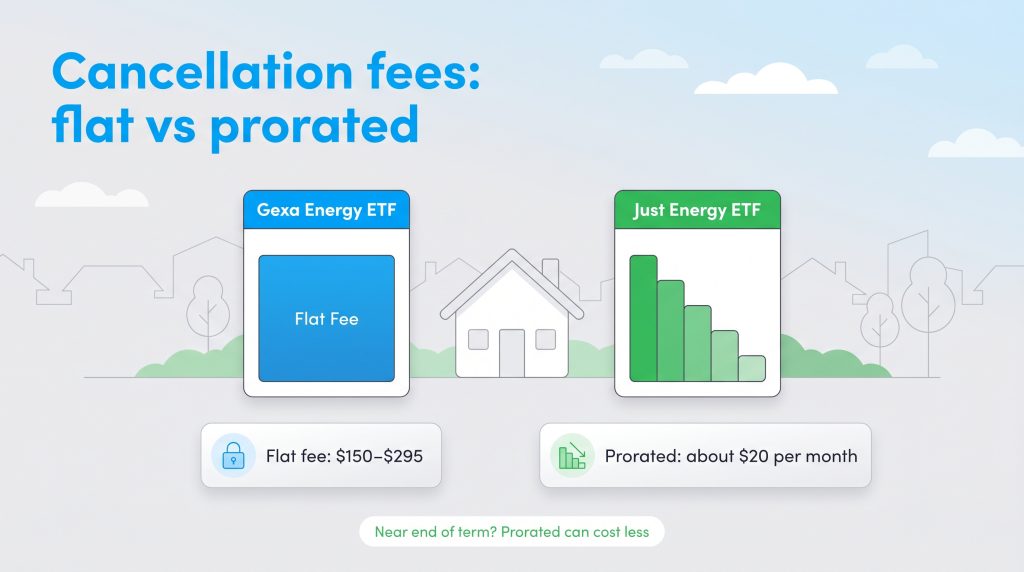
Gexa Energy typically charges a fixed Early Termination Fee (ETF). This is usually a lump sum, such as $150 or $295, regardless of when you cancel. Whether you have one month left or 11 months left on your agreement, the penalty remains exactly the same. This can feel extremely punishing if you only have a few weeks left on your plan.
Just Energy often uses a much more forgiving prorated structure. Their cancellation fees are frequently calculated per month remaining on the contract. For example, if your fee is $20 per month remaining and you cancel with a year left on your contract, you would owe $240. However, if you cancel with only two months left, you would only owe $40. More importantly, Just Energy frequently offers up to $150 in reimbursement for cancellation fees if you are a new switcher coming from another provider, completely offsetting the cost of leaving your current plan early.
| Fee Type | Gexa Energy | Just Energy |
|---|---|---|
| Structure | Flat Fee (Lump Sum) | Prorated ($ per month remaining) |
| Typical Cost | $150 – $295 | $20 per month remaining |
| Best For… | Staying the full term | Leaving near the end of term |
Just Energy or Gexa Energy for Apartments
If you are renting a smaller space, you might be wondering whether to choose Just Energy or Gexa Energy for apartments. Because apartments naturally have less square footage to heat and cool, your monthly energy consumption will be drastically lower than a single-family home. The average Texas apartment often uses between 500 and 700 kWh per month, especially during the mild spring and fall seasons.
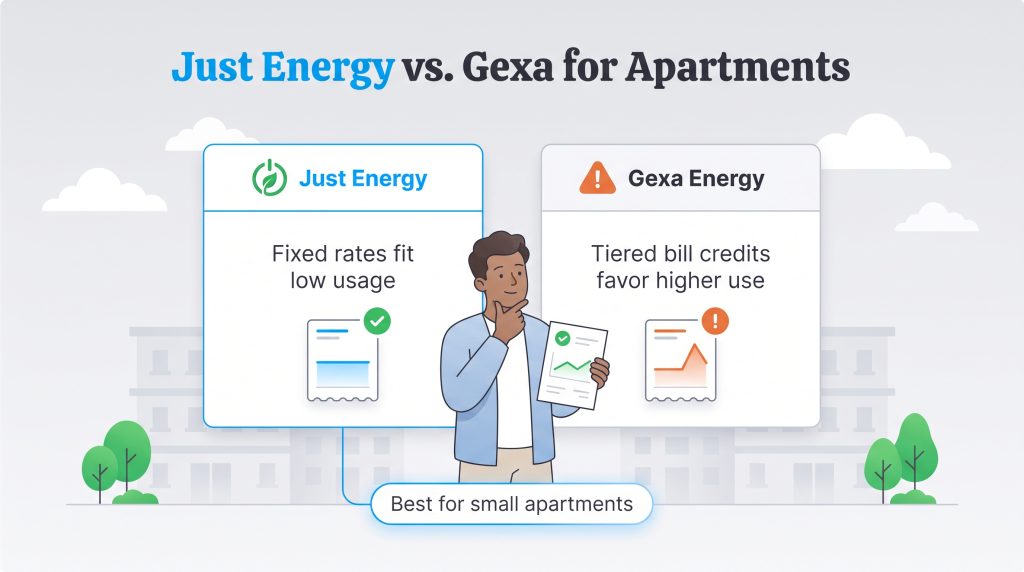
For this specific demographic, we strongly recommend Just Energy. Fixed rates are significantly safer for users under 1,000 kWh. If you choose a Gexa Eco Saver plan but only use 600 kWh, you will miss out on the large bill credit designed to lower your rate. Without that credit, you are left paying the high baseline energy charge, which can result in an unpleasantly high bill for a small space. By choosing a straightforward fixed rate from Just Energy, apartment renters protect themselves from usage penalties and ensure their bill directly reflects exactly what they consumed.
How to Switch Electricity Providers Without Penalty
Navigating the complex market does not have to be a stressful ordeal. If you want to switch electricity providers without penalty, simply follow this three-step process.
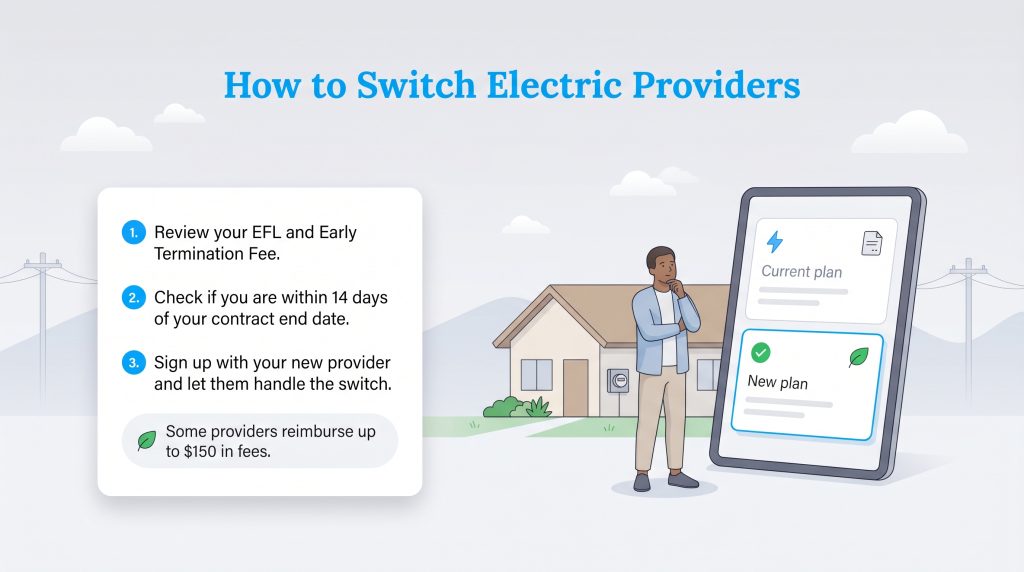
- Review Your Current EFL: Pull up the Electricity Facts Label and Terms of Service for your existing plan. Look closely at the “Early Termination Fee” section so you know exactly what you might owe if you leave your contract before it officially ends.
- Verify End-of-Contract Dates: Texas law is on your side here. The state allows you to switch providers up to 14 days before your current contract expires without incurring a termination fee. If you are outside this window, remember that you can leverage switching incentives. For instance, Just Energy often offers up to $150 in fee reimbursements for new customers to cover their old provider’s penalty.
- Initiate the Transfer: Once you choose your new energy plan, simply sign up online or over the phone. Your new provider will handle the transition directly with ERCOT and your local utility (like CenterPoint or Oncor). You will not experience any interruption in your daily service, and no one has to come to your house to flip a switch.
Preparing for Your Switch: Next Steps
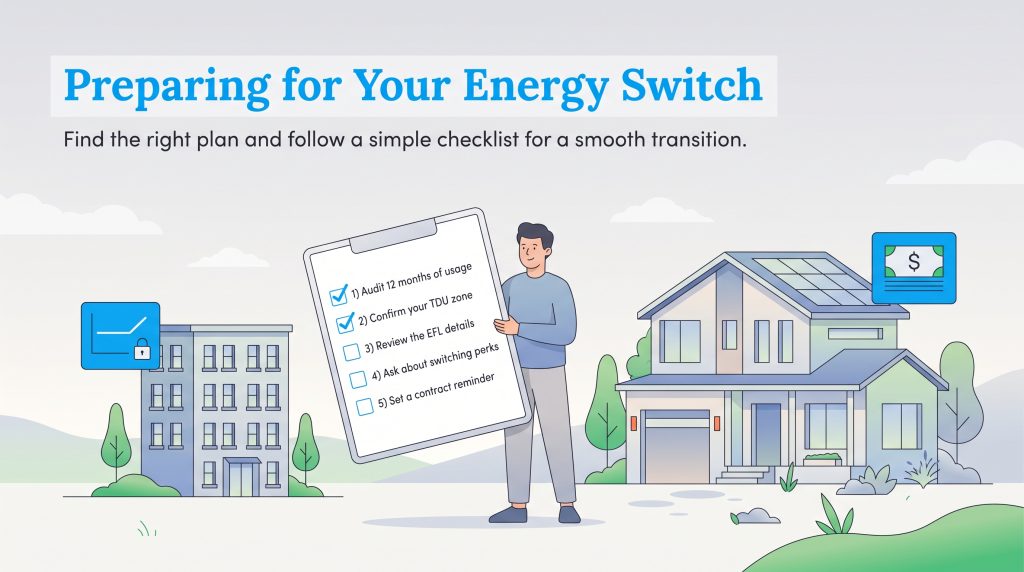
Ultimately, the choice between Gexa Energy and Just Energy comes down to your housing situation and how closely you want to monitor your smart thermostat. If you live in a larger home and consistently consume over 1,000 kWh per month, Gexa Energy is likely your best option to maximize bill credits. If you value predictability or live in an apartment, Just Energy takes the crown with their stable, flat-rate structures. Before you sign your new contract, complete this quick checklist to ensure a seamless transition.
- Audit Your Past 12 Months of Usage: Log into your current provider’s portal and write down your exact kWh usage for every month, paying special attention to the summer peaks and winter lows.
- Verify Your Exact TDU Zone: Confirm whether you reside in CenterPoint, Oncor, AEP, or TNMP territory, as these utility fees are added to your base rate and affect your final comparison.
- Read the Fine Print on the EFL: Never rely solely on the advertised headline rate. Open the EFL document and verify the energy charge, base fee, and any required usage thresholds.
- Check for Switching Incentives: If you are breaking a contract early, call your prospective provider to ask if they are currently offering bill credits or ETF reimbursements for new customers.
- Set a Calendar Reminder: Once you sign up, set a reminder on your phone for 30 days before your new contract expires so you can start shopping for your next great rate without lapsing into a costly month-to-month plan.
Frequently Asked Questions About Gexa Energy and Just Energy
Are Gexa Energy and Just Energy the same company?
No, they are completely separate entities. Gexa Energy is a subsidiary of NextEra Energy, one of the world’s largest generators of wind and solar power. This backing allows them to offer robust 100% renewable energy plans. Just Energy is an independent retail energy provider that operates across multiple deregulated states and countries, focusing heavily on long-term fixed-rate stability.
How do I check if my home uses enough electricity for Gexa’s bill credits?
The easiest way to check your historical usage is to log into your current electricity provider’s online portal or review your past 12 paper bills. Look for the line item detailing your total monthly kilowatt-hours (kWh). If your usage consistently sits above 1,000 kWh every month — even during the mild spring and fall seasons — you are an excellent candidate for a Gexa Energy bill credit plan.
Does Just Energy require a deposit to start service?
Like most Texas retail electricity providers, Just Energy performs a soft credit check when you apply for service. If you meet their credit requirements, the deposit is waived. If your credit score falls below their threshold, you may be required to pay a refundable deposit before your power is turned on. Some providers also waive deposits if you are 65 or older, or if you can provide a letter of credit from a previous utility.
Which provider has better mobile app reviews for tracking daily usage?
Just Energy generally boasts better mobile app reviews across both the iOS Apple App Store and the Google Play Store. Customers frequently praise the Just Energy app for its intuitive design, making it easy to pay bills, set up autopay, and monitor daily usage trends. Gexa Energy’s app tends to have lower ratings, with some users reporting occasional glitches when attempting to view their real-time usage data.
Does Just Energy cover early termination fees if I switch to them?
Yes, in many cases. Just Energy frequently runs promotions where they will reimburse up to $150 of the Early Termination Fee (ETF) you incur from your previous provider. You usually have to submit your final bill from your old company to claim this credit. Always verify this promotion is active directly with a representative before making the switch.
How do PUC ratings affect my choice of a Texas electric company?
The Public Utility Commission (PUC) of Texas issues scorecards based on a provider’s history of customer complaints and how efficiently they resolve issues. Choosing a provider with a high score — like Gexa Energy’s current 5-star rating — means you are statistically less likely to encounter unresolved billing disputes, deceptive marketing, or poor customer support.
About the Author

David has been an integral part of some of the biggest utility sites on the internet, including InMyArea.com, HighSpeedInternet.com, BroadbandNow.com, and U.S. News. He brings over 15 years of experience writing about, compiling and analyzing utility data.