

Understanding The Difference Between Gexa’s Tiered Usage Credits And Rhythm’s Flat-Rate Renewable Plans Is The Key To Avoiding Bill Shock In Texas
Key Takeaways
- Gexa Energy often advertises lower introductory rates that rely on specific usage credits, making them risky for customers with fluctuating energy use.
- Rhythm Energy focuses on 100% renewable plans with flat rates and transparent pricing, though their base price per kWh is sometimes higher.
- Cancellation fees are significantly different, with Rhythm offering a unique “30-Day Test Drive” that allows penalty-free switching early in the contract.

- 7.3¢ /kWh
- 100%
- 60 days
- 12-36 Months
- Committed to Renewable Energy

- 8.3¢ /kWh
- 100%
- 30 days
- 3-36 Months
- No Hidden Fees, Fair Pricing
*rates may vary by location and household usage
Shopping for electricity in Texas comes down to choosing between complex pricing strategies and straightforward consistency. In a direct Gexa Energy vs. Rhythm comparison, the core difference lies in how they bill your household every month. Gexa relies heavily on tiered usage credits that reward you for hitting exact consumption targets, while Rhythm champions flat-rate pricing that stays incredibly predictable regardless of your usage habits. To help you navigate the tricky Texas energy market, we break down their hidden fees, real-world rate calculations, regulatory complaint scores, and digital tools so you can confidently pick the right provider for your home.
At A Glance: Gexa Energy Vs Rhythm Feature Matrix
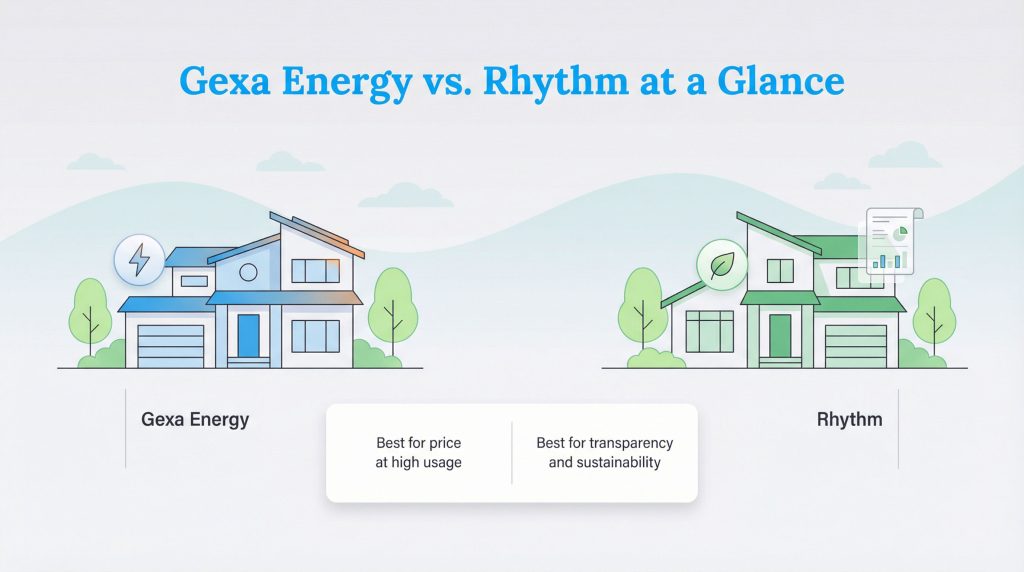
If you want a fast way to evaluate these providers, this matrix serves as the ultimate Texas electricity providers comparison. We organized the core features into a clear side-by-side table, highlighting critical factors like contract terms, renewable options, and official 2026 regulatory scores so you can easily spot the right choice for your household.
| Feature | Gexa Energy | Rhythm Energy |
|---|---|---|
| Contract Lengths | 12 to 36 months | 12 to 36 months |
| Pricing Structure | Usage-tiered credits | Flat fixed rates |
| Cancellation Fees | Flat fee ($150–$295) | Pro-rated ($20/mo) |
| Green Energy | Opt-in specific plans | 100% renewable standard |
| Solar Buyback | Capped or annual reset | Month-to-month rollover credits |
| Trial Period | 60-Day Guarantee (Plan swap only) | 30-Day Test Drive (Penalty-free exit) |
| 2026 PUCT Score | 1.92 complaints per 1,000 customers | 0.38 complaints per 1,000 customers |
Understanding Pricing Structures: Flat Rates Vs Bill Credits
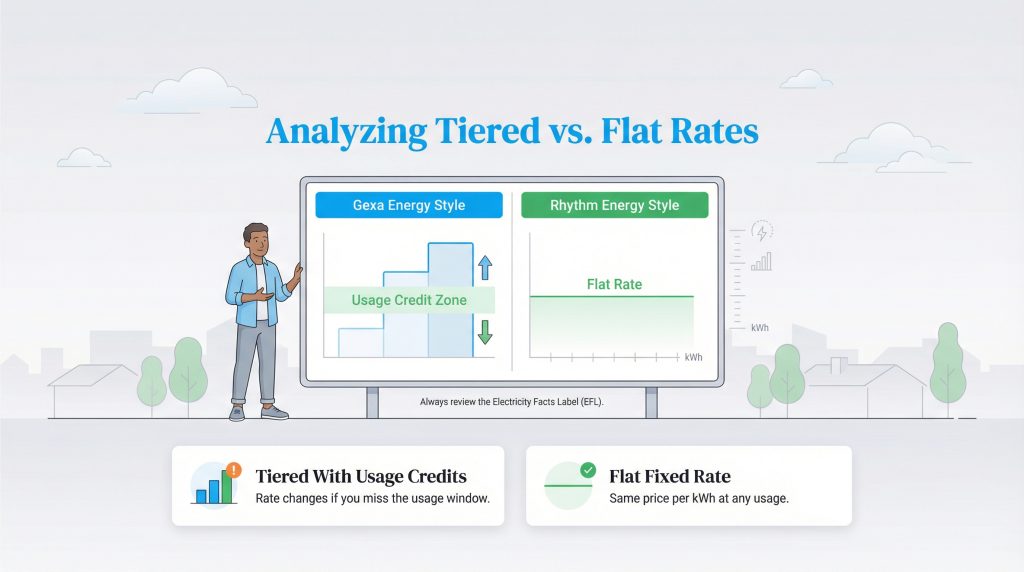
Evaluate the actual structure of the plan, not just the large promotional font on the advertisement. To successfully find cheap electricity plans, you must understand the underlying mechanics of how each provider calculates your final balance. Comparing Gexa vs Rhythm electricity rates requires diving into the stark differences between a conditional bill credit plan and a stable flat-rate plan.
Gexa Energy’s Usage-Tiered Plans (Bill Credits Explained)
Gexa Energy relies heavily on a pricing strategy built around strict minimum usage thresholds and bill credit plans. Take their popular Gexa Eco Saver Plus plan, for example. You might see an incredibly low rate advertised at exactly 1,000 kWh, but that rate is strictly conditional. To unlock it, your household must consume enough power to trigger a specific bill credit (often $50 to $100) during that exact billing cycle.
Imagine your home uses exactly 999 kWh during a mild spring month. Because you fall just one kilowatt-hour short of the 1,000 kWh threshold, you completely forfeit the Gexa Energy bill credits. This causes your effective rate to skyrocket, sometimes doubling your expected cost for that month. However, if you turn on the dryer one more time to hit 1,000 kWh, the massive credit kicks in, and your effective rate drops back down to a highly competitive level. This strict requirement creates a “bill shock” phenomenon for customers who do not closely monitor their thermostats.
| Plan Name | Rate /kWH | Plan Term | Cancellation Fee | |
|---|---|---|---|---|
| Gexa Eco Saver Plus 12 | 7¢ | Month to Month | N/A | Check Availability |
| Gexa Saver Plus 12 | 7.3¢ | Month to Month | N/A | Check Availability |
| Gexa Eco Saver Plus 14 | 7.5¢ | 14 Months | $150 | Check Availability |
| Gexa Eco Saver Plus 24 | 8.4¢ | Month to Month | N/A | Check Availability |
| Gexa Eco Choice 3 | 11¢ | 3 Months | $150.00 | Check Availability |
| Gexa Eco Choice 8 | 11.7¢ | 8 Months | $150.00 | Check Availability |
| Gexa Eco Choice 12 | 13.9¢ | 12 Months | $150.00 | Check Availability |
| Gexa Prime Preferred 24 Plan | 13.9¢ | 24 Months | $295.00 | Check Availability |
| Gexa Prime Preferred 12 Plan | 14.4¢ | 12 Months | $150.00 | Check Availability |
| Gexa Light Saver 12 | 14.6¢ | Month to Month | N/A | Check Availability |
| Gexa Eco Saver Value 12 | 15.1¢ | Month to Month | N/A | Check Availability |
| Gexa Saver Edge 12 | 15.6¢ | Month to Month | N/A | Check Availability |
| Gexa Eco Saver Lite 12 | 16.8¢ | Month to Month | N/A | Check Availability |
| Gexa Straight Saver 24 | 18¢ | 24 Months | $295.00 | Check Availability |
| Gexa Eco Saver Advantage 12 | 18.1¢ | Month to Month | N/A | Check Availability |
| Gexa Eco Saver Premier 12 | 18.2¢ | Month to Month | N/A | Check Availability |
| Gexa Freedom 12 | 18.4¢ | 12 Months | $150.00 | Check Availability |
| Gexa Eco Saver Premier 24 | 19¢ | Month to Month | N/A | Check Availability |
| Gexa Saver Freedom 24 | 19.1¢ | 24 Months | $295.00 | Check Availability |
| Gexa Straight Saver 12 | 19.5¢ | 12 Months | $150.00 | Check Availability |
| Gexa Saver Freedom 36 | 20.2¢ | Month to Month | N/A | Check Availability |
| Gexa Prime Preferred Plus 24 | 21.4¢ | 24 Months | $295.00 | Check Availability |
| Gexa Prime Preferred Plus 12 | 21.7¢ | 12 Months | $150.00 | Check Availability |
Rhythm’s Transparent Fixed Rates
Rhythm Energy takes a completely different path by operating on a foundation of flat-rate pricing. You will not find any confusing minimum usage thresholds or hidden target windows buried in their flagship plans, such as the Rhythm Clear Choice 12. Rhythm offers a consistent, linear price per kWh regardless of how much energy your home uses in a given month.
While Rhythm’s advertised base rate might initially appear a few cents higher than Gexa’s best-case credit scenario, the transparency ensures your monthly bill remains predictable. If you use 800 kWh or 1,200 kWh, your rate per kilowatt-hour stays exactly the same, protecting you from unexpected spikes during shoulder seasons like spring and fall.
| Plan Name | Rate /kWH | Plan Term | Cancellation Fee | |
|---|---|---|---|---|
| Rhythm Max Saver 12 | 8.3¢ | Month to Month | N/A | Check Availability |
| Rhythm Max Saver 24 | 8.5¢ | Month to Month | N/A | Check Availability |
| Digital Choice 3 | 9.9¢ | 3 Months | $20 / remaining month | Check Availability |
| Rhythm Saver 12 | 9.9¢ | Month to Month | N/A | Check Availability |
| Digital Choice 6 | 10.4¢ | 6 Months | $20 / remaining month | Check Availability |
| Digital Choice 12 | 12.2¢ | 12 Months | $20 / remaining month | Check Availability |
| Digital Choice 24 | 12.7¢ | 24 Months | $20 / remaining month | Check Availability |
| Simply Select 6 | 13.5¢ | Month to Month | N/A | Check Availability |
| PowerShift Payback 12 | 13.9¢ | Month to Month | N/A | Check Availability |
| Digital Choice 36 | 14.1¢ | 36 Months | $20 / remaining month | Check Availability |
| PowerShift 12 | 14.5¢ | Month to Month | N/A | Check Availability |
| Simply Select 36 | 14.9¢ | Month to Month | N/A | Check Availability |
| Simply Select 12 | 14.9¢ | Month to Month | N/A | Check Availability |
| Simply Select 24 | 15.2¢ | Month to Month | N/A | Check Availability |
| Watt a Deal 24 | 16.5¢ | Month to Month | N/A | Check Availability |
| Clear Choice 12 | 16.6¢ | 12 Months | $20.00 | Check Availability |
| Clear Choice 36 | 17¢ | 36 Months | $20.00 | Check Availability |
| Clear Choice 24 | 17¢ | 24 Months | $20.00 | Check Availability |
| Watt a Deal 12 | 18¢ | Month to Month | N/A | Check Availability |
💡 Pro Tip: Low advertised rates often come with high usage requirements. Always read the Electricity Facts Label (EFL) carefully to see your exact price at the 500 kWh, 1,000 kWh, and 2,000 kWh consumption levels.
Real-World Rate Calculations By TDSP (Oncor And CenterPoint)
To truly grasp this Texas electricity providers comparison, we need to look at how these plans perform in the real world across different usage levels. Your local Transmission and Distribution Service Provider (TDSP) — like Oncor in Dallas or CenterPoint in Houston — charges standard delivery fees that are baked into your final bill. How those fees interact with flat rates versus bill credits is what determines your true monthly cost.
Below is a simulated monthly bill estimate based on average 2026 pricing for both providers’ top 12-month plans across three standard usage tiers. Notice how drastically the Gexa pricing shifts once the 1,000 kWh credit is triggered, compared to Rhythm’s steady climb.
| Monthly Usage Tier | Gexa Energy (Oncor / CenterPoint) | Rhythm Energy (Oncor / CenterPoint) |
|---|---|---|
| 500 kWh (Apartment) | $98.00 / $104.00 | $75.00 / $81.00 |
| 1,000 kWh (Medium Home) | $115.00 / $122.00 | $145.00 / $157.00 |
| 2,000 kWh (Large Home) | $295.00 / $312.00 | $285.00 / $309.00 |
As the data illustrates, Rhythm consistently wins the small apartment category because they do not penalize low usage. However, right at the 1,000 kWh mark, Gexa’s bill credit applies, dramatically undercutting Rhythm’s price for medium-sized homes that consistently hit the “sweet spot.”
Customer Service And PUCT Complaint Scores
When you are committing to a long-term utility contract, you want to know the company will treat you fairly if an issue arises. We highly recommend looking past subjective online reviews and focusing on objective regulatory data. The Public Utility Commission of Texas (PUCT) maintains a rigorous scorecard that tracks formal complaints across all retail electric providers. Evaluating these PUCT complaint scores helps you avoid future billing disputes.
Based on the most recent 2026 PUCT complaint scores Texas regulators have published, Rhythm Energy boasts one of the lowest formal complaint ratios in the entire state at an impressive 0.38 complaints per 1,000 customers. Because they do not use deceptive usage tiers, their billing department experiences far fewer customer disputes. Gexa Energy, while maintaining a reliable operational record given their massive size as a subsidiary of NextEra Energy, holds a much higher ratio of 1.92 complaints per 1,000 customers. A significant portion of the formal grievances directed at Gexa revolve around customers experiencing confusion and bill shock after missing their required usage targets by just a few kilowatt-hours.
Credit Checks, Deposits, And Moving In
Setting up electricity at a new address can be stressful, especially when upfront costs are involved. Both Gexa Energy and Rhythm run soft credit checks during the enrollment process to determine if you need to pay a security deposit. A soft inquiry will not impact your credit score, but you generally need a credit score of 600 or higher to automatically qualify for zero-deposit service with either provider.
If your credit score falls below their threshold, both companies offer pathways to waive the deposit. Rhythm Energy is particularly accommodating to new movers and renters; they frequently waive deposits if you provide a Letter of Credit from your previous utility provider showing 12 months of on-time payments, or if you enroll in AutoPay and paperless billing. Gexa Energy also accepts a Letter of Credit and offers deposit waivers for customers who are 65 or older, victims of family violence, or medically indigent. Understanding these deposit waivers ensures you keep more money in your pocket during a costly move.
📌 Quick Fact: Texas law requires retail electricity providers to refund your security deposit, plus interest, after you complete 12 consecutive months of on-time payments.
Renewable Energy And Solar Buyback Programs
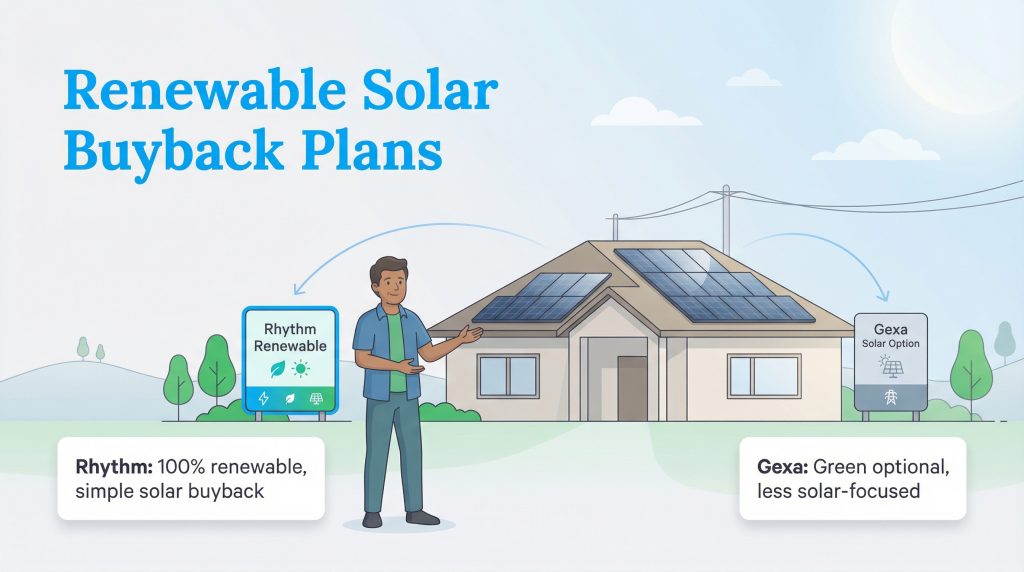
If sustainability is a priority for your household, you need to understand how these companies source their green power. Texas leads the nation in wind energy production, and providers utilize Renewable Energy Certificates (RECs) to offset carbon emissions. RECs guarantee that for every megawatt-hour of electricity you consume, an equivalent amount of clean energy is generated and added to the grid.
Looking for 100% green energy plans Texas residents can trust? Rhythm Energy makes sustainability effortless by including 100% renewable energy as the standard on every single plan they offer. You do not have to pay a premium or hunt for an eco-conscious alternative. Furthermore, the Rhythm Energy solar buyback program is one of the most competitive solar buyback programs on the market. They allow your excess generation credits to roll over from month to month, meaning the extra sunshine you capture in May can actively offset your high air conditioning usage in August.
While Gexa Energy does offer excellent green options backed by NextEra Energy, it is not their universal default. You must carefully filter your search and select a specific renewable plan during checkout. If you own rooftop solar panels, Gexa’s buyback policies are often more restrictive, occasionally capping your credits or resetting them annually, making Rhythm undisputedly the better provider for solar homeowners.
🌱 Eco Edge: Choosing an electricity plan backed by Texas wind and solar RECs is one of the fastest, most effective ways to lower your household’s carbon footprint without installing expensive equipment on your roof.
Cancellation Fees (ETFs) And Satisfaction Guarantees
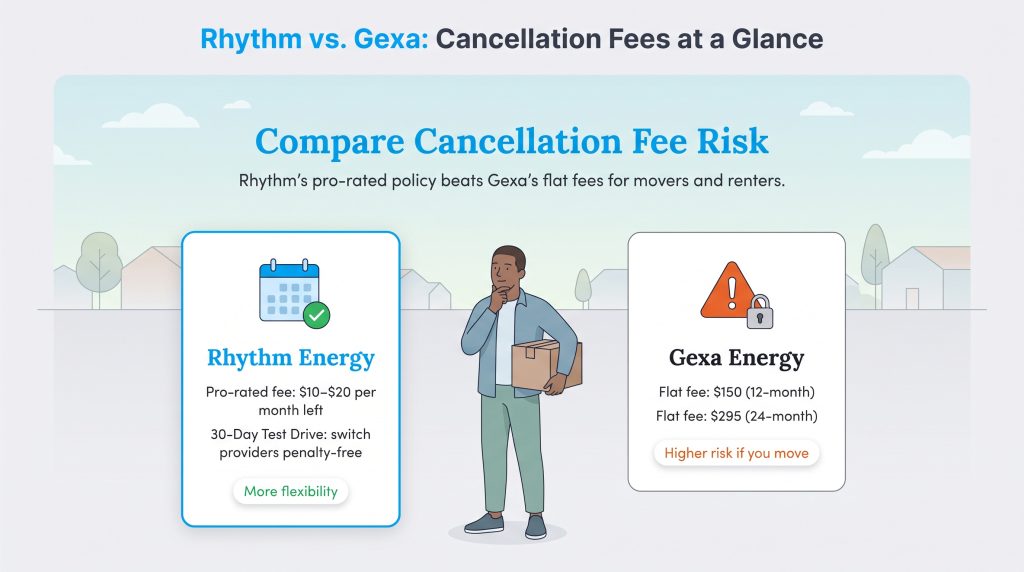
Breaking a utility contract early can cause major financial friction if you fail to read the fine print. When evaluating cancellation fees Rhythm vs Gexa, understanding exactly how much you will pay to walk away is vital for renters or anyone who might move unexpectedly.
To protect yourself from a hefty Gexa early termination fee, you must realize they rely on a punitive flat-fee cancellation structure. If you are on a 12-month plan, breaking the contract usually results in a flat $150 penalty. For 24-month plans, that fee often jumps to an unforgiving $295. Whether you have 11 months left on your term or just two weeks, Gexa charges you the identical maximum amount to end your service.
Rhythm Energy takes a much more consumer-friendly approach by charging a pro-rated cancellation fee. You simply pay a flat $20 for every individual month remaining on your agreement, which naturally decreases the longer you stay with them. Furthermore, Rhythm offers a highly publicized 30-Day Test Drive, allowing you to switch providers completely penalty-free within the first month of service. Gexa counters this with a 60-Day Satisfaction Guarantee, but there is a major catch: Gexa’s guarantee only allows you to switch to another Gexa plan without a penalty, whereas Rhythm allows you to leave the company entirely. This flexibility makes Rhythm ideal for residents with changing living situations in Houston and Dallas.
The Digital Experience: Apps And Account Management
Today’s modern consumer expects seamless smart home integration and easy mobile account management. When reviewing the digital footprint of these two companies, they cater to very different expectations.
Rhythm Energy champions a tech-forward, customer-first digital experience. Recent Rhythm Energy reviews consistently highlight the mobile application’s high overall customer satisfaction ratings, with users frequently praising the highly intuitive interface on both the Apple App Store and Google Play. The Rhythm app excels by offering granular daily usage tracking, weekly usage alerts, and direct smart thermostat syncing. For solar customers, the app even integrates solar monitoring so you can track your generation credits in real time, helping you actively manage your consumption before the monthly bill arrives.
In contrast, Gexa Energy provides a more traditional utility experience. While they do offer a mobile app for basic bill payment and account management, it often sits with lower average feedback — hovering around 3.2 stars — on the app stores. Gexa benefits from stable, old-school phone support channels, but if you want cutting-edge usage graphs and smart home integration in the palm of your hand, Rhythm easily wins the digital management category.
Selecting The Best Electricity Provider For Your Texas Home
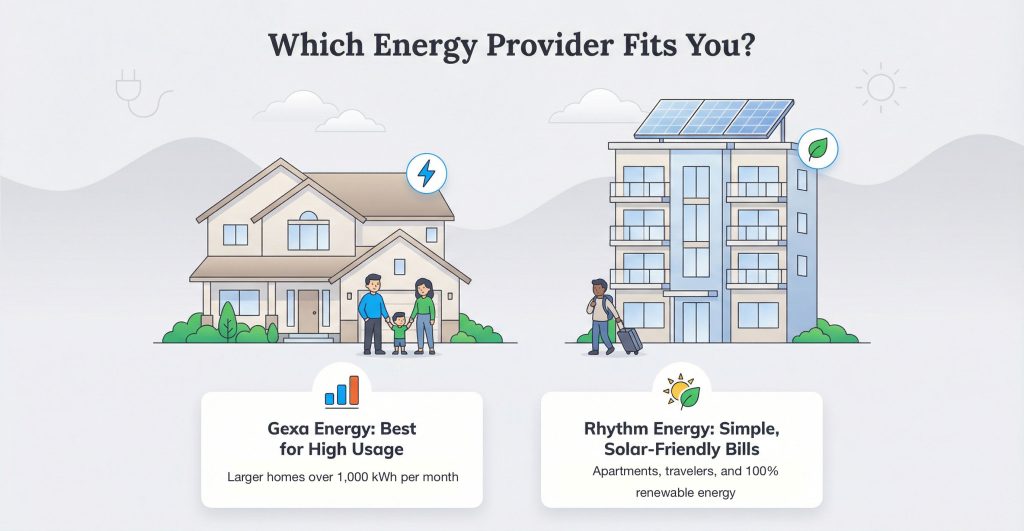
Choosing your next Texas electricity provider comes down to understanding your specific housing situation and energy habits. There is no universally perfect provider, but evaluating the data reveals clear winners for different lifestyle needs.
If you live in an apartment, a small townhome, or have rooftop solar panels, Rhythm Energy is arguably your best choice. Because apartment dwellers typically use less than 1,000 kWh per month, they rarely consume enough energy to qualify for Gexa’s lucrative bill credits. Rhythm’s flat-rate pricing ensures you aren’t penalized with a higher rate simply for having a smaller, energy-saving floor plan, and their month-to-month solar rollover credits are unmatched.
Conversely, if you own a large single-family home (over 2,000 square feet) and consistently use well over 1,000 kWh every single month, Gexa Energy becomes a powerhouse option. By carefully managing your consumption to hit their strict usage tiers, large households can unlock massive monthly credits that drive the effective rate down significantly. Before you sign a new contract, we strongly recommend pulling your past 12 months of electricity bills so you can confidently select a plan that fits your exact consumption profile.
Frequently Asked Questions About Gexa Energy Vs Rhythm
Is Gexa Energy cheaper than Rhythm?
It depends entirely on your usage. Gexa Energy can be cheaper if you use a specific amount of energy (often right at the 1,000 or 2,000 kWh mark) that qualifies for their usage credits. However, Rhythm is typically cheaper for customers in apartments or those with variable usage, as they do not penalize you for using less power.
Which provider has cheaper early termination fees?
Rhythm Energy offers significantly cheaper and more flexible early termination fees. They charge a pro-rated fee, calculated at exactly $20 multiplied by the number of months remaining on your contract. Gexa Energy generally charges a rigid flat fee ranging from $150 to $295, regardless of whether you have 11 months or one month left on your agreement.
Does Rhythm Energy or Gexa require a credit check or deposit?
Yes, both providers run a soft credit check during enrollment. If your credit score is below their threshold (usually around 600), you may be asked to pay a security deposit. However, both companies offer deposit waivers if you can provide a Letter of Credit from a previous utility provider or meet other specific criteria like enrolling in AutoPay.
Can I transfer my Rhythm or Gexa plan if I move to a new house in Texas?
Yes, both Rhythm Energy and Gexa Energy allow you to transfer your existing electricity plan and rate to a new address, provided your new home is located within a deregulated area of Texas that the company services. Transferring your service prevents you from having to pay any early termination fees.
How do Gexa Energy bill credits work if I use exactly 999 kWh?
If your specific plan includes a usage credit that only triggers at 1,000 kWh, using exactly 999 kWh means you fall completely short of the target and forfeit the entire credit. This typically causes your effective price per kilowatt-hour to spike, resulting in a much higher overall electricity bill than you anticipated.
How does the Gexa Energy 60-day satisfaction guarantee work compared to Rhythm’s 30-day test drive?
The Rhythm 30-Day Test Drive allows you to cancel your new service entirely and switch to a completely different provider without paying an early termination fee. In contrast, the Gexa 60-Day Satisfaction Guarantee only allows you to switch to a different plan within Gexa’s own network; you cannot leave the company without paying the cancellation penalty.
Is Rhythm Energy actually 100% renewable?
Yes, Rhythm Energy provides 100% renewable energy across all of its available electricity plans. They achieve this by purchasing Renewable Energy Certificates (RECs) from wind and solar farms to offset the exact amount of power your home pulls from the grid.
Does Gexa Energy offer renewable plans?
Yes, Gexa Energy does offer 100% renewable energy plans. However, unlike Rhythm, where every single plan is renewable by default, you must specifically filter for and select a designated green plan when signing up with Gexa.
Which provider has a better app?
Many customer reviews report that Rhythm Energy offers a superior digital experience. Their mobile app is modern, user-friendly, and provides excellent daily transparency regarding your energy usage, whereas Gexa’s app is built for more basic account management and bill payments.
About the Author

David has been an integral part of some of the biggest utility sites on the internet, including InMyArea.com, HighSpeedInternet.com, BroadbandNow.com, and U.S. News. He brings over 15 years of experience writing about, compiling and analyzing utility data.

Claudio is a sustainability-focused writer with a background in Anthropology and Psychology from NC State University. He has spent over 15 years working in writing, interpretation, and translation, driven by a deep interest in how human culture shapes the environment. Today, he shares his curiosity with readers by writing about sustainable living solutions and the connection between everyday choices and environmental impact.