
Rhythm Energy Excels With Transparent Renewable Pricing, While TXU Energy Offers Established Reliability And Perks For Time-Specific Usage
Key Takeaways
- Rhythm Energy offers 100% renewable plans with transparent, flat-rate pricing and a risk-free 30-day test drive for new customers.
- TXU Energy provides high brand stability and popular “Free Nights” plans that can save money if you strictly shift usage to off-peak hours.
- Reading the Electricity Facts Label (EFL) is essential, as TXU’s tiered rates can be complex compared to Rhythm’s simple fixed-rate structure.
When evaluating a TXU Energy vs. Rhythm comparison, the primary difference lies in their overall pricing philosophy. TXU Energy is the established legacy giant heavily focused on promotional perk plans, while Rhythm Energy is the green-focused challenger prioritizing flat-rate transparency. You can confidently find the best electricity provider in Texas for your household by analyzing their unique rate tiers, exploring their eco-friendly initiatives, and carefully reviewing their contract terms. Enter your zip code below to check your exact local rates, as pricing varies by TDU territory.

- 10.9¢ /kWh
- 3-100%
- 60 days
- 1-36 Months
- Highest Trustpilot Rating 4.7/5 ★

- 8.3¢ /kWh
- 100%
- 30 days
- 3-36 Months
- No Hidden Fees, Fair Pricing
*rates may vary by location and household usage
At A Glance: TXU Vs Rhythm Energy
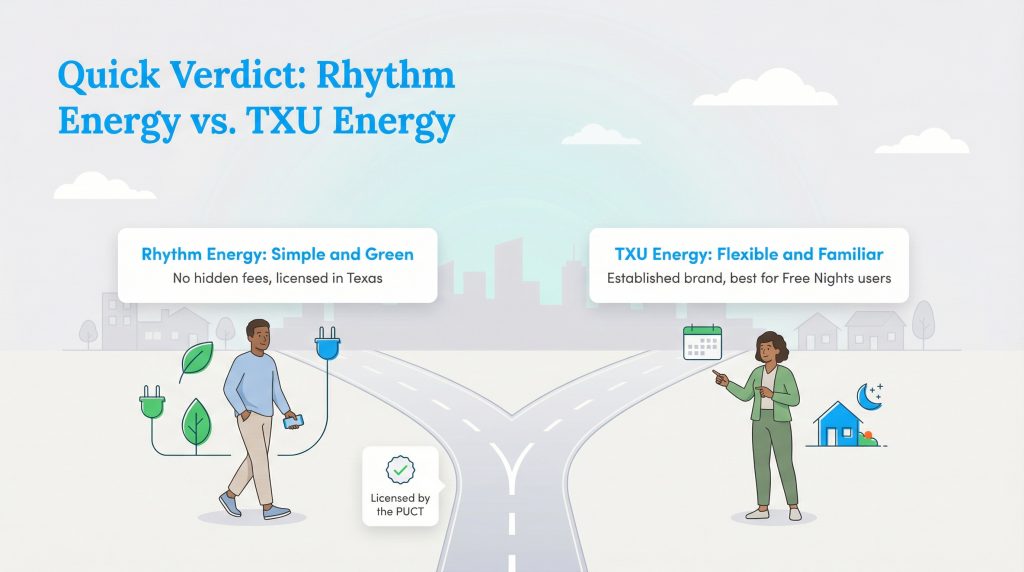
If you are skimming for a fast recommendation, placing these two providers side-by-side reveals completely different approaches to the deregulated market. TXU Energy leverages its massive grid infrastructure to offer flexible, time-of-use promotions tailored for varied lifestyle schedules. Rhythm Energy, on the other hand, operates with a modern, straightforward approach that rewards loyalty and eliminates complex pricing tiers.
Understanding their base offerings provides a solid foundation for your decision. Below is a rapid comparison of how they match up on critical features, including average pricing for a standard 1,000 kWh household.
| Feature | TXU Energy | Rhythm Energy |
|---|---|---|
| Lowest Rate (1,000 kWh Profile) | ~15.5¢ (Highly variable by plan) | ~14.9¢ (Flat-rate standard) |
| Green Energy Availability | Available as optional add-ons | 100% renewable default |
| Cancellation Fee Range | $150 – $395 flat fee | $20 per remaining month |
| Trial Period Availability | None | 30-day penalty-free test drive |
Comparing Electricity Rates At 500, 1000, And 2000 kWh
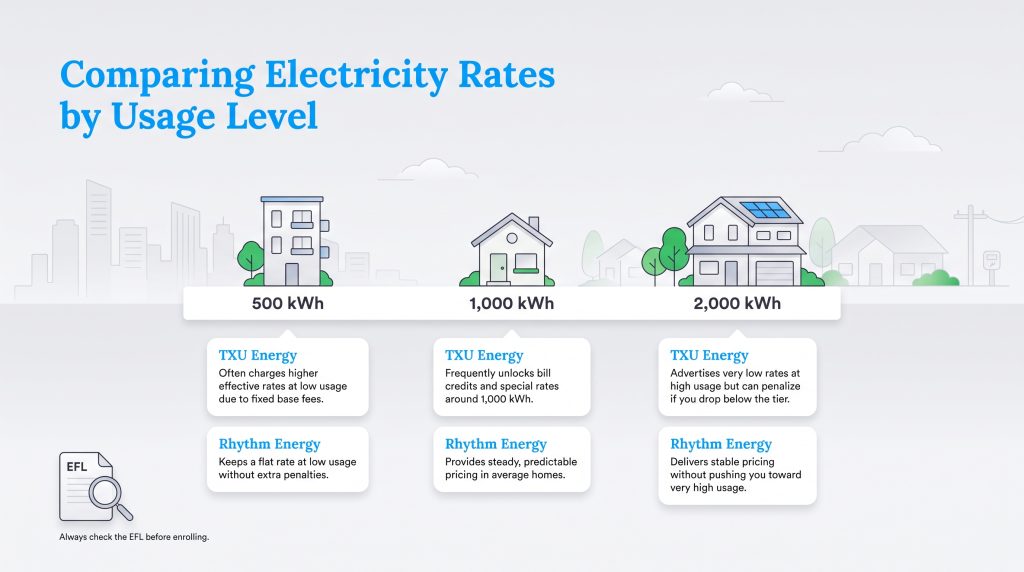
When analyzing TXU vs Rhythm energy rates, comparing costs across different usage levels is the single most effective way to avoid unexpected bill spikes. A contract that looks incredibly cheap for a large 2,000 kWh suburban home can easily trigger hidden base charges if you live in a smaller 500 kWh downtown apartment.
| Monthly Usage Tier | TXU Energy Rate Impact | Rhythm Energy Rate Impact |
|---|---|---|
| 500 kWh (Apartment) | Often subject to high base charges, significantly raising the average cost per kWh. | Maintains a consistent flat rate without low-usage penalty fees. |
| 1,000 kWh (Small Home) | The sweet spot for unlocking promotional bill credits on their tiered plans. | Provides standard, predictable monthly pricing across all seasons. |
| 2,000 kWh (Large Home) | Rates appear incredibly low, but dropping below this tier triggers steep penalties. | Offers reliable stability without forcing you to hit massive consumption goals. |
Because every family uses power differently, you must always read the Electricity Facts Label (EFL) before enrolling. The state mandates every plan has one (as outlined in strict state regulations), giving you a transparent breakdown of all base charges. We recommend benchmarking every plan using the 1,000 kWh tier, which mirrors the average monthly usage for a standard Texas home.
Plan Features: Free Nights And Weekends Vs Flat Rate Transparency
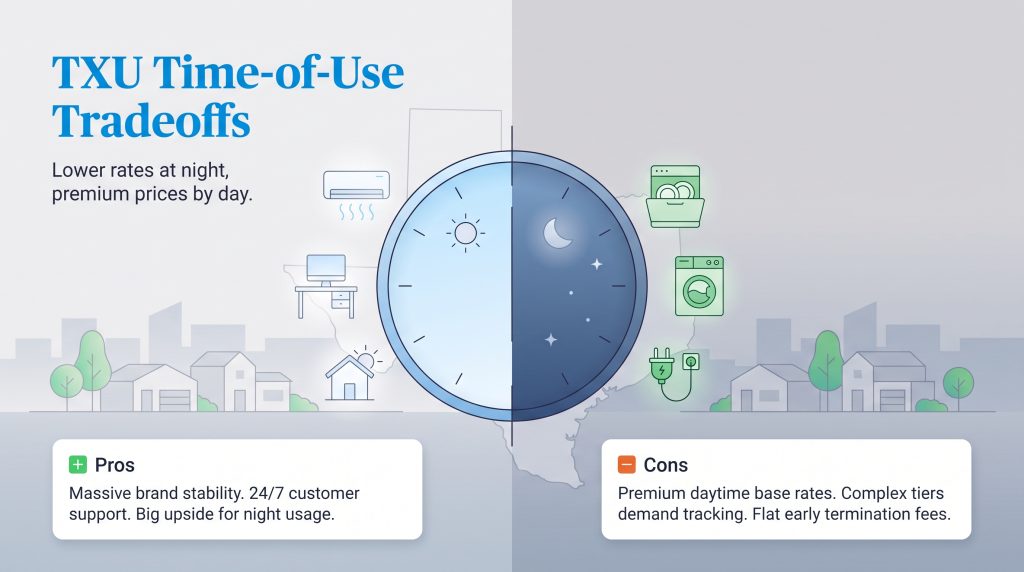
When comparing TXU Energy Free Nights vs Rhythm Energy plans, the underlying math dictates your true savings. TXU heavily promotes its “Free Nights” and “Free Weekends” packages, which sound fantastic on paper. However, to offset the cost of those free nocturnal hours, TXU must significantly inflate the daytime rate — sometimes pushing it well above the state average while the sun is up. If you work from home or run your air conditioning heavily during peak afternoon hours, this time-of-use structure can lead to massive summer bills.
Conversely, Rhythm Energy champions flat-rate transparency. With Rhythm, you pay the exact same amount per kilowatt-hour whether you are running the dishwasher at 2 p.m. or 2 a.m. This straightforward approach protects you from unexpected TXU Energy hidden fees that are often masked by complex usage tiers and shifting hourly schedules. If you prefer not to micromanage your thermostat just to secure a low rate, a flat-rate plan is easily the safer bet.
Check your exact TXU Energy pricing by entering your zip code below.
| Plan Name | Rate /kWH | Plan Term | Cancellation Fee | |
|---|---|---|---|---|
| Smart 1000 Select 12 | 11.5¢ | Fixed Months | $3 | Check Availability |
| Smart 1000 Saver 12 | 11.5¢ | Month to Month | N/A | Check Availability |
| Smart Edge 12 | 13.5¢ | 12 Months | $150.00 | Check Availability |
| Smart Edge 24 | 13.9¢ | 24 Months | $295.00 | Check Availability |
| Clear Deal 12 | 14.5¢ | Month to Month | N/A | Check Availability |
| Solar Value 12 | 15.9¢ | Month to Month | N/A | Check Availability |
| Simple Rate 12 | 16.4¢ | Month to Month | N/A | Check Availability |
| On Your Terms | 16.9¢ | Month to Month | N/A | Check Availability |
| Smart 500 Start 12 | 17.1¢ | Month to Month | N/A | Check Availability |
| Simple Value 12 | 18¢ | 12 Months | $150.00 | Check Availability |
| Ultimate Season Pass 12 | 18.7¢ | Month to Month | N/A | Check Availability |
| Solar Club 12 | 19.1¢ | 12 Months | $150.00 | Check Availability |
| Flex Forward | 19.1¢ | Month to Month | N/A | Check Availability |
| Texas Choice 12 | 19.2¢ | 12 Months | $150.00 | Check Availability |
| Texas Choice 24 | 19.2¢ | 24 Months | $295.00 | Check Availability |
| Flex Rewards | 19.3¢ | Month to Month | $0.00 | Check Availability |
| Smart Deal 12 | 19.6¢ | 12 Months | $150.00 | Check Availability |
| Smart Deal 24 | 20.4¢ | 24 Months | $295.00 | Check Availability |
| Smart Deal 36 | 20.4¢ | 36 Months | $395.00 | Check Availability |
| Solar Saver 12 | 21.3¢ | Month to Month | N/A | Check Availability |
| Saver's Discount 12 | 21.9¢ | Month to Month | N/A | Check Availability |
Green Energy And Renewable Options
If powering your home with a minimal carbon footprint is a priority, exploring Rhythm Energy renewable plans offers a refreshing, seamless experience. Rhythm makes 100% renewable energy the default standard for all residential customers. Their electricity is sourced entirely from Texas wind and solar generation through verified renewable energy credits. To learn more about how green energy credits support long-term grid sustainability, you can review the EPA’s official guide to green power markets.
While TXU Energy absolutely provides green solutions — such as their specialized “Solar Days” plans and optional renewable add-ons — these eco-friendly options typically cost a premium rather than being baked into their base pricing model. Furthermore, if you generate your own rooftop power, checking out local solar buyback options is essential. Rhythm typically edges out legacy providers here by offering transparent crediting systems without punishing caps on excess generation.
Customer Service And PUCT Complaint Data
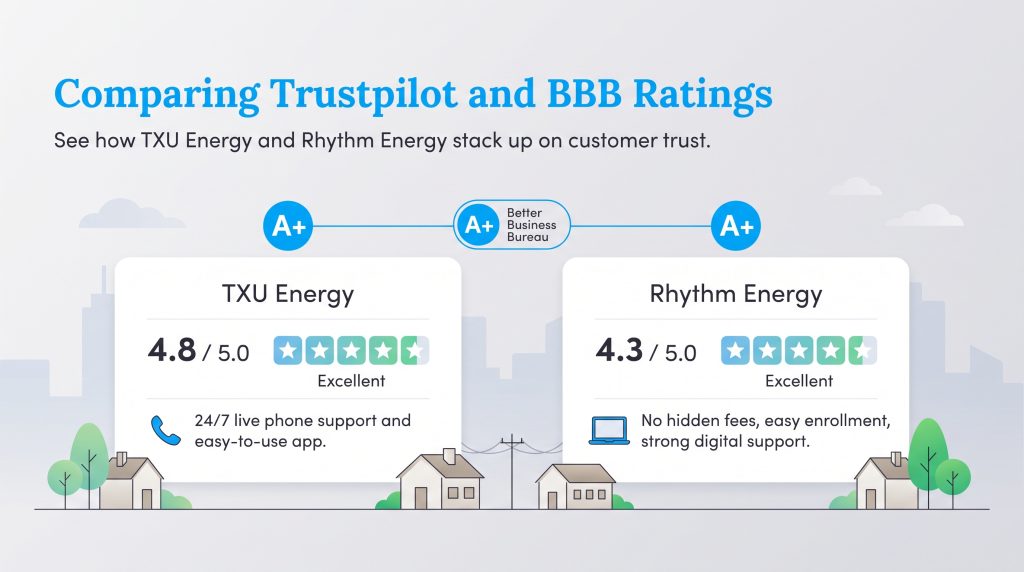
Establishing consumer trust requires looking past marketing slogans and examining official regulatory data. When checking the Public Utility Commission of Texas (PUCT) complaint scorecard, both providers perform exceptionally well compared to the statewide average. TXU Energy maintains a very low complaint ratio, proving its reliability as a legacy provider with massive operational resources. Rhythm Energy also boasts a superb scorecard, validating its position as a consumer-first alternative. You can always verify their active license and standing directly through the state’s regulatory portal.
When diving into a TXU vs Rhythm customer service comparison based on third-party reviews, their strengths cater to different preferences. TXU utilizes its vast resources to provide true 24/7 live phone support, contributing heavily to its stellar 4.8 Trustpilot rating. If you read the Rhythm Energy reviews Texas residents have posted online, you will find they hold a highly respectable 4.3 Trustpilot score and an A+ BBB rating by taking a modern approach. Rather than overnight phone support, Rhythm focuses on an intuitive digital portal and lightning-fast local daytime support, sparing customers from endless corporate phone trees.
Contract Terms, Cancellation Fees, And Test Drives

Committing to a new provider can be daunting, which is why clearly understanding the exit terms is crucial for your financial security. If you decide to switch from TXU to Rhythm, you gain immediate access to the Rhythm Energy 30-day test drive. This rare, consumer-friendly perk allows you to experience their billing, platform, and service entirely risk-free. If you aren’t completely satisfied within your first 30 days of service, you can cancel and walk away without paying a single penalty.
If you break a contract later down the line, the TXU Energy cancellation fee operates on a strict flat-rate penalty structure. You will generally pay a steep $150 early termination fee (ETF) for breaking a standard 12-month contract, and a hefty $295 ETF for exiting a 24-month agreement early. In stark contrast, Rhythm utilizes a sliding scale, charging a straightforward $20 for each remaining month left on your term. If you only have three months left on your Rhythm contract and need to move, it costs just $60 to cancel, making it far more flexible than legacy flat fees.
Check your exact Rhythm Energy pricing by entering your zip code below.
| Plan Name | Rate /kWH | Plan Term | Cancellation Fee | |
|---|---|---|---|---|
| Rhythm Max Saver 24 | 7.5¢ | 24 Months | $20 / remaining month | Check Availability |
| Rhythm Max Saver 12 | 8.3¢ | Month to Month | N/A | Check Availability |
| Rhythm Saver 12 | 9.9¢ | Month to Month | N/A | Check Availability |
| Digital Choice 8 | 10.9¢ | 8 Months | $20 / remaining month | Check Availability |
| Digital Choice 12 | 12.7¢ | 12 Months | $20 / remaining month | Check Availability |
| Digital Choice 24 | 12.7¢ | 24 Months | $20 / remaining month | Check Availability |
| Simply Select 6 | 13.4¢ | Month to Month | N/A | Check Availability |
| PowerShift Payback 12 | 13.8¢ | Month to Month | N/A | Check Availability |
| Digital Choice 36 | 14¢ | 36 Months | $20 / remaining month | Check Availability |
| PowerShift 12 | 14.5¢ | Month to Month | N/A | Check Availability |
| Simply Select 12 | 15¢ | Month to Month | N/A | Check Availability |
| Simply Select 24 | 15.4¢ | Month to Month | N/A | Check Availability |
| Simply Select 36 | 16.3¢ | Month to Month | N/A | Check Availability |
| Clear Choice 12 | 16.6¢ | 12 Months | $20.00 | Check Availability |
| Clear Choice 24 | 17¢ | 24 Months | $20.00 | Check Availability |
| Clear Choice 36 | 17¢ | 36 Months | $20.00 | Check Availability |
| Watt a Deal 24 | 17.5¢ | Month to Month | N/A | Check Availability |
| Watt a Deal 12 | 18¢ | Month to Month | N/A | Check Availability |
Making Your Final Provider Selection
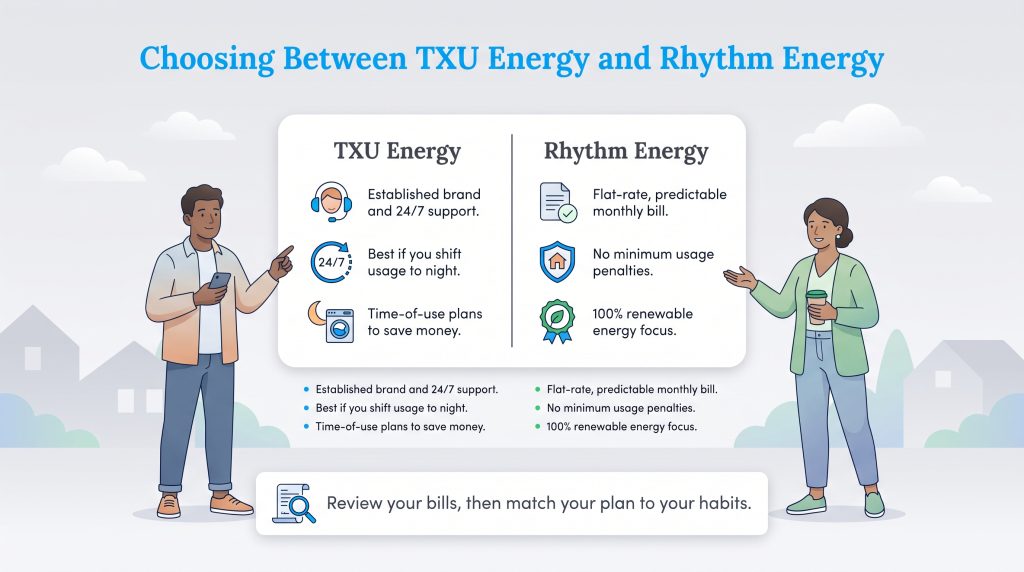
Choosing a winner between TXU Energy and Rhythm Energy ultimately comes down to analyzing your personal consumption habits and how much value you place on green initiatives. By taking a few minutes to review your past electricity bills, you can confidently lock in the right contract.
- Choose TXU Energy if: You prioritize established brand familiarity, demand 24/7 live account support, or have the strict discipline to shift your heavy appliance usage strictly to nighttime hours. If you can manage their time-of-use promotions effectively, this is a great way to save on your electric bill.
- Choose Rhythm Energy if: You want a predictable, flat-rate monthly bill without minimum usage penalties. They are the undeniable choice for environmentally mindful homeowners who prefer their energy to be sourced from 100% renewable generation.
Both providers bring immense value to the Texas grid, but they are built for entirely different consumers. Evaluate your daily routine, check your exact local rates, and utilize the provider that aligns closest with your lifestyle and budget goals.
Frequently Asked Questions About TXU Energy Vs Rhythm
Is it hard to switch from TXU to Rhythm Energy?
No, switching electricity providers is an entirely seamless process. Once you enroll online with Rhythm Energy, they automatically notify TXU Energy and your local utility transmission company to coordinate the transfer. You will not experience any interruption in your home’s power service during the switch.
Does Rhythm Energy have hidden fees or usage penalties?
Rhythm Energy is widely recognized for its transparent, flat-rate pricing structures. Unlike many legacy providers, Rhythm does not apply hidden minimum usage penalties or arbitrary bill credits that disappear if you miss a specific usage target by a single kilowatt-hour.
Are TXU free nights and weekends plans actually worth it?
TXU Free Nights plans are only worth it if you can heavily shift your massive electricity usage (such as running the laundry, blasting the AC, and charging electric vehicles) strictly to the eligible free hours. Because the daytime rates on these plans are significantly elevated, consuming power normally during the day will likely result in a higher bill than a standard flat-rate plan.
How do TDU delivery charges affect my bill with Rhythm or TXU?
Transmission and Distribution Utility (TDU) charges are applied to every electricity bill in Texas, regardless of whether you choose TXU or Rhythm. These fees are set by your local utility company (like CenterPoint or Oncor) to maintain the power lines and are passed through to you at the exact same rate by both providers.
Is Rhythm Energy cheaper than TXU Energy?
For the average household looking for predictability, Rhythm Energy’s flat-rate plans often yield a cheaper and more consistent monthly bill. TXU Energy can technically be cheaper, but only if you select a time-of-use plan and aggressively manage your daily consumption schedules to maximize off-peak credits.
What is the cancellation fee for Rhythm compared to TXU Energy?
Rhythm Energy utilizes a sliding scale for early termination, charging a reasonable $20 for every remaining month left on your contract. TXU Energy implements a standard flat fee, which typically hits you with a $150 penalty for a 12-month plan and scales up to $295 for a 24-month contract.
Which has better solar buyback plans, TXU or Rhythm?
While both companies offer solar buyback programs, Rhythm Energy is widely considered to have the superior, more transparent structure. They offer highly competitive compensation for excess energy generated by your home’s rooftop panels, typically bypassing the complex crediting caps associated with older legacy provider contracts.
About the Author

David has been an integral part of some of the biggest utility sites on the internet, including InMyArea.com, HighSpeedInternet.com, BroadbandNow.com, and U.S. News. He brings over 15 years of experience writing about, compiling and analyzing utility data.