

Understanding Plan Types, Fees, and Usage Patterns Helps You Choose an Electricity Rate That Fits Your Budget and Your Home
Key Takeaways
- Fixed-rate plans offer price stability by locking in your cost per kilowatt-hour for the duration of your contract, shielding your budget from seasonal market spikes.
- Variable and indexed rates fluctuate monthly based on the wholesale energy market, providing potential savings during mild weather but carrying the risk of costly price hikes in summer and winter.
- Reading the plan disclosure before you sign helps you estimate real costs, spot fees, and avoid surprise contract terms.
Picking the wrong energy provider can easily cost you hundreds of dollars a year in inflated rates and hidden fees. Moving into a new home within a deregulated market often feels like navigating a maze of confusing contracts, leaving you worried about making an expensive mistake. We understand the sheer overwhelm of staring at dozens of complicated provider offers when all you really want is to flip the light switch without draining your wallet. Our goal is to act as your objective advisor, breaking down the frustrating jargon so you can confidently evaluate your options. Getting all the different types of energy plans compared side-by-side — including fixed, variable, and prepaid options — reveals exactly how retailers structure their pricing, empowering you to secure a contract that genuinely fits your household’s daily rhythms.
Fixed vs Variable Electricity Plans
The most consequential choice you face when activating service involves deciding between locking in a guaranteed price or gambling on the wholesale energy market. Understanding the difference between fixed vs. variable rates fundamentally comes down to how much risk your monthly budget can tolerate. Let’s look at the actual math to visualize the difference. Imagine your household consumes 1,000 kWh of electricity in a month. On a secure fixed plan charging 15¢ per kWh, your energy charge stays locked at $150. Conversely, if you rely on a variable plan, your spring rate might hover beautifully at 12¢ ($120). But when a brutal August heatwave strains the power grid, that same variable rate can increase sharply to 22¢ or higher, suddenly driving your baseline energy charge to $220 for the exact same amount of electricity. These examples reflect only the energy supply charge, so your actual bill will also include utility delivery charges, standard taxes, and monthly administrative fees.
To help you visualize the core differences, we have mapped out how providers structure these two primary offerings side-by-side.
| Feature | Fixed-Rate Plans | Variable-Rate Plans |
|---|---|---|
| Price Stability | High stability; your rate locks in for the entire term. | Low stability; rates fluctuate monthly with the market. |
| Contract Length | Typically ranges from 12 to 36 months. | Month-to-month with no long-term commitment. |
| Risk Level | Low risk; protects against seasonal price spikes. | High risk; vulnerable to extreme weather grid demand. |
| Best Use Case | Homeowners seeking predictable monthly utility budgets. | Short-term renters or those moving within a few months. |
Fixed-Rate Plans
Locking down a fixed-rate contract remains the safest bet for families needing rigid financial predictability. When evaluating these options, you will need to choose between short term vs long term energy contracts. Short-term contracts usually last three to six months, while long-term agreements can stretch from 12 to 36 months or more. Regardless of length, it is vital to remember that “fixed” only applies to the rate formula (your specific cost per kilowatt-hour) — not your final monthly bill total. Your overall invoice will still fluctuate depending on how much electricity you physically pull from the grid each month.
When shopping around for these secure agreements, always check the fine print for the early termination fee electricity charge. Providers enforce these costly exit penalties to recoup their financial losses if you break your agreement before the term naturally expires. Depending on the provider, these fees can range from a $150 flat penalty to a recurring $20 charge for every single month remaining on your contract.
Variable-Rate Plans
Riding the market with a variable setup offers a high-risk, high-reward scenario for consumers. These month-to-month agreements tie your rate directly to the extreme volatility of wholesale energy markets. While you might enjoy substantially lower rates during a breezy spring afternoon, a harsh winter freeze can send the market skyrocketing, doubling or tripling your rate overnight. To help you decide if this risk is worth taking, consider these key advantages and disadvantages:
- Pro: No long-term commitment, making it ideal for temporary housing situations.
- Pro: Zero early cancellation fees if you need to switch providers abruptly.
- Con: Severe vulnerability to sudden wholesale market price spikes.
- Con: Requires rigorous daily monitoring of your home’s energy consumption to avoid bill shock.
If you choose to stay on a variable rate during peak summer or winter seasons, you will immediately need to implement rigorous ways to lower your summer electric bill to mitigate those higher-than-expected charges.
Prepaid and No-Deposit Electricity Plans
If you want to avoid soft credit checks or hefty upfront deposits, determining whether a prepaid electricity plan is right for you is your first step toward utility independence. Prepaid electricity works more like a pay-as-you-go mobile phone account than a traditional monthly utility bill. Instead of paying for the power you consumed over the last 30 days, you purchase electricity in advance. As you use power, modern smart meters track your daily consumption in real time to deduct funds directly from your prepaid account balance.
There are several exact scenarios where you might actively choose this setup. It is a fantastic option for individuals moving into temporary housing, college students managing a strict semester budget, or consumers actively working on building their credit who simply cannot afford a $200 utility deposit. Providers offer helpful visibility into your daily consumption via text alerts, letting you know exactly when you need to reload your account. The drawbacks, however, are steep. Prepaid customers generally suffer higher baseline rates and face the immediate risk of disconnection if their balance unexpectedly runs out. Fortunately, many prepaid providers must issue warning notices, and localized consumer protections often apply to prevent shutoffs during extreme weather events.
Time-of-Use and Promotional Energy Plans
Beyond standard pricing structures, retail providers also try to woo customers with highly specialized niche contracts. These alternative models cater to specific usage habits, nontraditional work schedules, and unique lifestyle circumstances. Understanding exactly how these promotions operate helps you avoid expensive marketing traps.
Free Nights and Weekends
Searching for free nights and weekends energy plans often tempts night-shift workers or heavy weekend consumers. These contracts designate specific off-peak hours where the energy supply charge drops to zero. However, providers compensate for this generosity by significantly inflating the rate you pay during standard daytime hours. This setup primarily benefits people who are away from home during peak weekday hours or electric vehicle owners who exclusively charge their cars in the garage overnight.
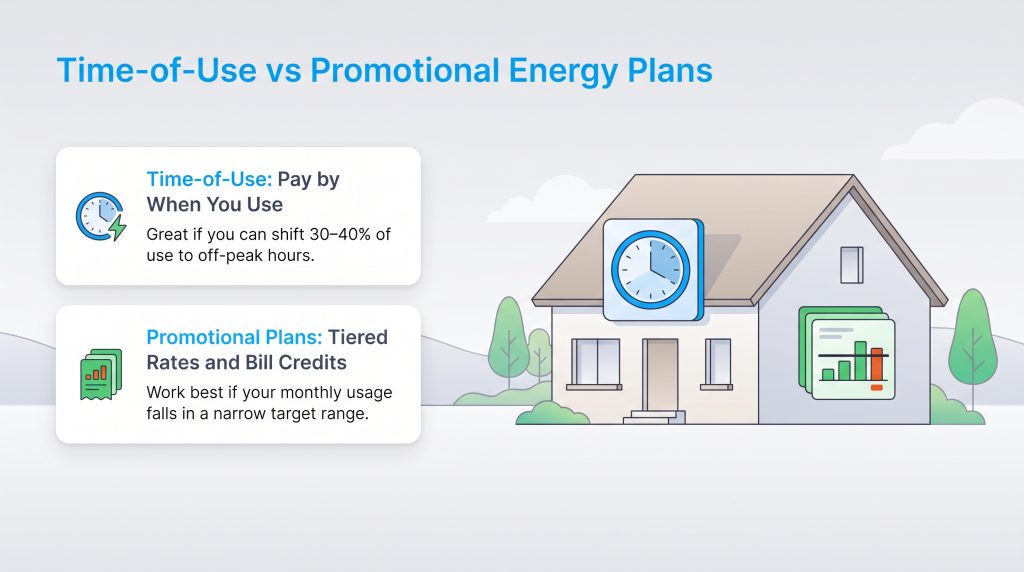
Before you sign up, you must calculate your actual off-peak usage. Review your past smart meter data to ensure you can shift at least 30% to 40% of your total power consumption to those designated free hours. If you cannot realistically delay running your dishwasher, doing laundry, or cooling your house until 9:00 p.m., the higher daytime rates will aggressively inflate your overall bill.
Tiered Rates and Bill Credits
Getting time of use electricity rates explained shouldn’t be confused with understanding tiered setups or bill credit promotions. While time-of-use (TOU) charges you based on when you consume power, tiered plans charge you based on how much total power you use during the billing cycle. For instance, a tiered setup might offer a fantastic flat rate up to 1,000 kWh, but charge a sharply higher premium for every single kilowatt-hour you consume beyond that threshold.
Bill credit plans operate similarly, offering a flat discount (like a $50 credit) only if your monthly usage lands within a highly specific window — typically between 1,000 and 1,500 kWh. If you use 999 kWh, you lose the credit and your average rate skyrockets. These specialized setups reward households with highly predictable, heavily monitored usage but heavily penalize those who guess their consumption incorrectly.
Renewable and Green Energy Plans
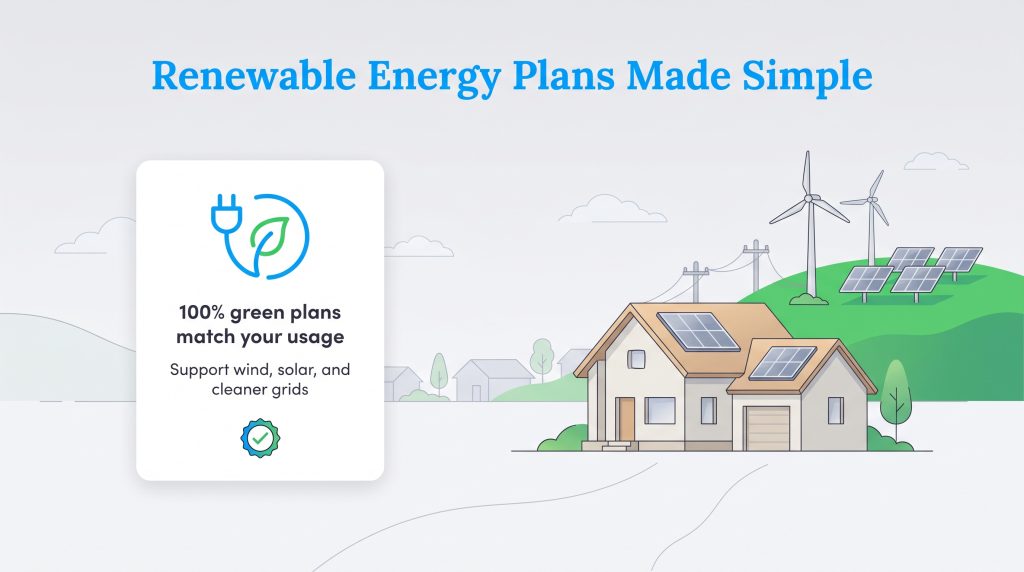
Powering your home no longer requires relying exclusively on fossil fuels. Getting renewable energy plans compared reveals a booming market of providers eager to support a cleaner grid. These eco-conscious alternative contracts work primarily through the purchase of Renewable Energy Certificates (RECs) or verified carbon offset programs. When you sign up for a 100% green plan, the provider guarantees they will purchase enough renewable energy from wind or solar farms to match your household’s exact consumption, injecting it back into the overall power grid on your behalf. This means the actual electrons flowing into your home aren’t physically separated from the rest of the grid, but your purchase directly supports the environmental attributes of renewable generation.
Opting for a green contract serves as a highly accessible, environmentally mindful choice for renters or homeowners who lack the capital for rooftop installations. If you own your home and want to generate power directly, exploring residential solar panels may be a stronger long-term option, depending on your roof, budget, incentives, and local utility rules. To better understand how retail providers source and verify their sustainable power claims across the country, review the strict guidelines established by the EPA’s Green Power Partnership.
How to Compare Fixed Rate Energy Plans
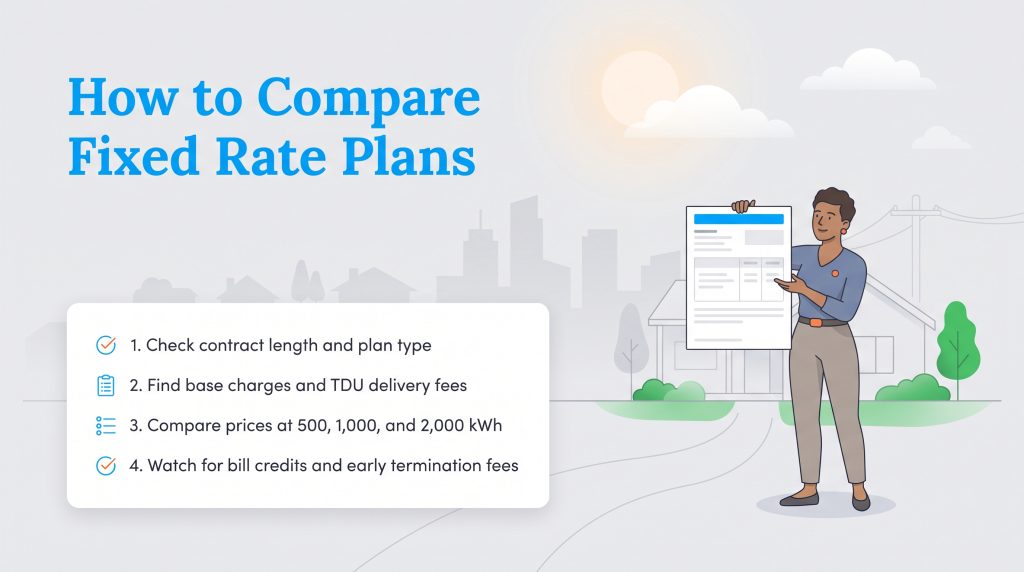
Navigating an open market successfully demands a methodical approach. When figuring out how to compare fixed rate energy plans, never rely on a company’s bold marketing claims or flashy sign-up bonuses. You must dive into the standardized disclosure documents required by your state’s public utility commission.
Electricity Facts Label Explained
Knowing how to read an electricity facts label is crucial for cutting through provider marketing jargon. In Texas, this document is officially called the Electricity Facts Label (EFL), though other deregulated states use similar terms like a “Contract Summary” or “Disclosure Statement.” To read an EFL effectively, follow these core steps:
- Check the Header: Look directly at the top of the document to confirm the exact contract length and whether the plan is fixed, variable, or indexed.
- Locate the Base Charge: Find the section detailing monthly base charges or flat administrative fees that apply regardless of your usage.
- Identify Delivery Fees: Spot the Transmission and Distribution Utility (TDU) charges. These are mandatory fees passed down by the local company that physically maintains the power lines.
- Review the Penalty Clause: Scan the bottom sections to find the exact cost of the early termination fee.
Matching Your Monthly Usage (500 vs 1000 vs 2000 kWh)
The most critical section of any standardized disclosure form is the pricing table evaluating the 500, 1,000, and 2,000 kWh pricing tiers. Reviewing these three distinct usage levels is absolutely mandatory for an accurate rate comparison. A provider might advertise a brilliantly low rate at exactly 1,000 kWh by factoring in a $50 bill credit. However, if you live in a small apartment and only use 500 kWh, you won’t trigger that credit, meaning your actual rate could be double the advertised price. Conversely, running a large HVAC system in a 2,500-square-foot home might push your usage to 2,000 kWh, exposing you to higher tiered rates.
Fortunately, you don’t have to brave the chaotic private broker websites alone. Start by choosing an electric provider using official, state-sponsored shopping portals designed to enforce transparency. For example, the Texas Power to Choose marketplace and the PA Power Switch shopping tool both maintain robust, unbiased comparison tools. If you are preparing to relocate, utilizing these public tools should be a priority on your moving utilities checklist.
Selecting Your Ideal Energy Strategy
Taking control of your monthly utility bills boils down to aligning your contract length, financial risk tolerance, and daily household habits with the correct plan structure. To secure the best type of electricity plan for your home, follow this definitive three-step checklist:
- Pull Your Usage Data: Before you even look at a single provider offer, command your current utility portal to export your past 12 months of usage statements. If you are moving into a brand-new build, ask the builder or neighbors for average square-footage estimates.
- Filter by Structure: Enter your zip code into a trusted state comparison site and immediately filter out variable and indexed plans if you require budget stability. Focus exclusively on long-term fixed rates.
- Audit the Fine Print: Cross-reference your historical usage with the plan’s disclosure document to ensure you aren’t penalized by tiered thresholds or steep cancellation fees.
The best energy contract isn’t always the one with the lowest advertised price — it’s the one that accurately matches how and when you consume power. Armed with this transparent data and an honest assessment of your family’s routine, you can confidently sign an agreement that delivers lasting energy savings year-round.
Frequently Asked Questions About Types of Energy Plans
What is the best type of electricity plan for a new home?
Are free nights and weekends energy plans actually worth it?
How do I avoid an early termination fee when switching energy plans?
Is a fixed-rate energy plan always better than a variable-rate plan?
What is the cheapest energy plan type available?
Do I have to pay a deposit for a new electricity plan?
How do I switch my electricity plan without losing power?
Do renewable energy plans cost more?
What happens when my fixed-rate energy contract expires?
About the Author

LaLeesha has a Masters degree in English and enjoys writing whenever she has the chance. She is passionate about gardening, reducing her carbon footprint, and protecting the environment. She also recently served as President of the Board for City Sprouts (a community garden).

David has been an integral part of some of the biggest utility sites on the internet, including InMyArea.com, HighSpeedInternet.com, BroadbandNow.com, and U.S. News. He brings over 15 years of experience writing about, compiling and analyzing utility data.