

Discover How No Deposit Prepaid Electricity Plans Let You Skip the Credit Check and Take Control of Your Monthly Energy Budget
Key Takeaways
- Prepaid electric plans let you pay for electricity upfront, offering no long-term contracts, zero credit checks, and real-time usage tracking to easily manage your home budget.
- While these plans help avoid surprise statements, they require frequent balance monitoring and can feature slightly higher rates per kilowatt-hour compared to traditional fixed-rate options.
- Pay-as-you-go setups are perfect for consumers with no credit history, poor credit, or short-term living situations, providing an immediate, hassle-free way to activate household power.
Looking for a flexible, hassle-free way to manage your utility bills? Pre-paid electricity plans no deposit options allow you to secure power today without enduring a hard credit check or signing a restrictive long-term contract. By loading funds directly into your account upfront, you easily bypass hefty security fees and entirely avoid surprise end-of-month statements, making understanding your electric bill much simpler. Whether you are hunting for no credit check electricity plans for a new apartment or you just want absolute transparency over your monthly spending, these modern energy structures give you complete financial control. Let’s break down exactly how these services work, the top providers to consider, and how to determine if switching to a pay-as-you-go plan is the smartest choice to keep your lights on and your budget intact.
What Are No-Deposit Pre-Paid Electricity Plans?
No-deposit pre-paid electricity plans allow you to pay for your power upfront, functioning much like loading minutes onto a prepaid cell phone or buying a reloadable debit card. Instead of receiving a massive statement at the end of the month based on past usage, you simply load your account with funds and consume electricity against that balance in real time. Historically, traditional utility providers required lengthy multi-year contracts and significant security deposits before they would even think about turning on the grid. This created massive barriers for everyday consumers trying to get their households up and running.
Today, these highly flexible month-to-month options eliminate those outdated barriers, offering instant access to essential utilities for any household. Because the energy company assumes zero financial risk — since you pay before you use the electricity — they do not need to run a stringent background check or hold a security deposit. As your appliances use power, the cost is deducted directly from your account balance. This makes it an incredibly efficient and empowering way to manage your daily home energy consumption without being tied down by corporate red tape.
Top Pre-Paid Energy Companies With No Deposit
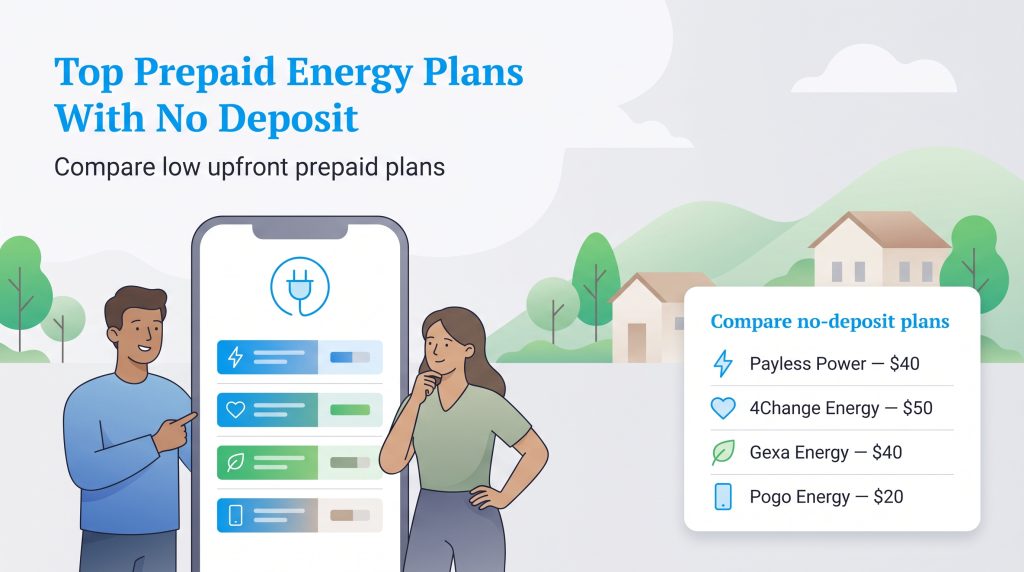
Finding cheap prepaid electricity no deposit options is much easier when you know exactly what the top-rated providers require to turn on the grid. If you live in a deregulated energy market, shopping around allows you to find highly competitive rates without being forced to hand over a massive security deposit. Review these industry-standard providers, widely considered some of the best prepaid electric companies, to understand typical market requirements and easily compare plan structures.
| Provider | Minimum Upfront Payment | Contract Length | Credit Check Requirement |
|---|---|---|---|
| Payless Power | $40 | Month-to-month | No |
| 4Change Energy | $50 | Month-to-month | No |
| Gexa Energy | $40 | Month-to-month | No |
| Pogo Energy | $20 | Month-to-month | No |
Payless Power
As a prominent market leader in the prepaid sector, payless power no deposit plans are specifically designed for maximum flexibility and transparency. They require a reasonable $40 initial connection balance, and every penny of that goes directly toward your future electricity usage. Payless Power offers daily text and email alerts, making it incredibly easy to track your spending and adjust your household habits. They are an excellent option for consumers who want straightforward pricing and a highly rated customer service experience.
4Change Energy
While traditionally known for their charitable contributions and fixed-rate plans, 4Change Energy also offers competitive prepaid options. You can usually get started for around $50 upfront. What sets 4Change Energy apart is their commitment to local communities — a portion of their profits goes directly to prominent local charities. Their pay-as-you-go structure provides the same reliable grid power while helping you support a good cause, all without committing to a multi-year contract.
Gexa Energy
If sustainability is a core priority for your household, Gexa Energy is an environmentally mindful choice. Many of their prepaid plans are backed by 100% renewable energy, allowing you to seamlessly reduce your carbon footprint without submitting to a hard credit inquiry. With an initial setup balance of just $40, Gexa makes it highly accessible to secure an eco-conscious alternative that strictly aligns with your monthly budget.
Pogo Energy
Pogo Energy boasts one of the lowest barriers to entry in the deregulated market, often requiring just a $20 initial balance to get the lights turned on. They operate entirely without hidden administrative fees or surprise monthly surcharges. Pogo is a highly digitally focused provider, meaning you manage your account, reloads, and usage tracking entirely through their streamlined mobile interface. This setup makes them ideal for tech-savvy consumers who prefer to manage their utilities on the go.
$0 Down Electricity: Pre-Paid Versus Traditional Postpaid Plans
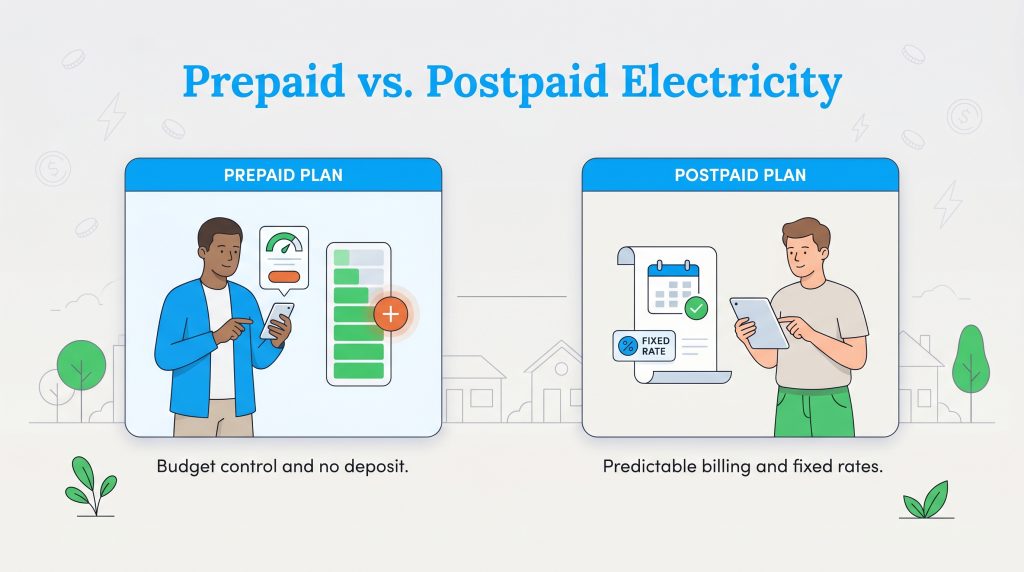
When you start shopping for energy, you generally encounter two main structures: prepaid and postpaid. Understanding the distinct differences between a $0 down prepaid setup and a traditional postpaid plan that happens to waive your deposit is crucial for making the right financial decision for your home.
| Feature | Pre-Paid Electricity Plans | Traditional Postpaid (Deposit Waived) |
|---|---|---|
| Upfront Deposit | $0 down (only an initial balance to fund the account) | Waived (but only if you meet strict criteria) |
| Credit Check Requirements | No credit check required | Hard credit check usually required |
| Payment Structure | Pay-as-you-go (fund before you use) | Billed at the end of the month for past usage |
| Contract Length | Month-to-month (highly flexible) | Typically 12, 24, or 36-month terms |
| Rate Stability | Variable rates; can fluctuate with the market | Usually fixed rates for the duration of the contract |
When choosing between a prepaid and a traditional postpaid plan, the right decision ultimately comes down to your financial flexibility, credit history, and current lifestyle. With reloadable utility plans, you take absolute control over how much you spend by funding your account in advance. These structures are especially helpful if you are working with tight finances or rent short-term and do not want to lock into a lengthy agreement. Conversely, conventional postpaid plans fit best if you prefer predictable billing cycles, want to secure a long-term fixed rate, and have the credit score necessary to get the utility company to waive their standard deposit requirements.
How To Get Same-Day Electricity With No Deposit
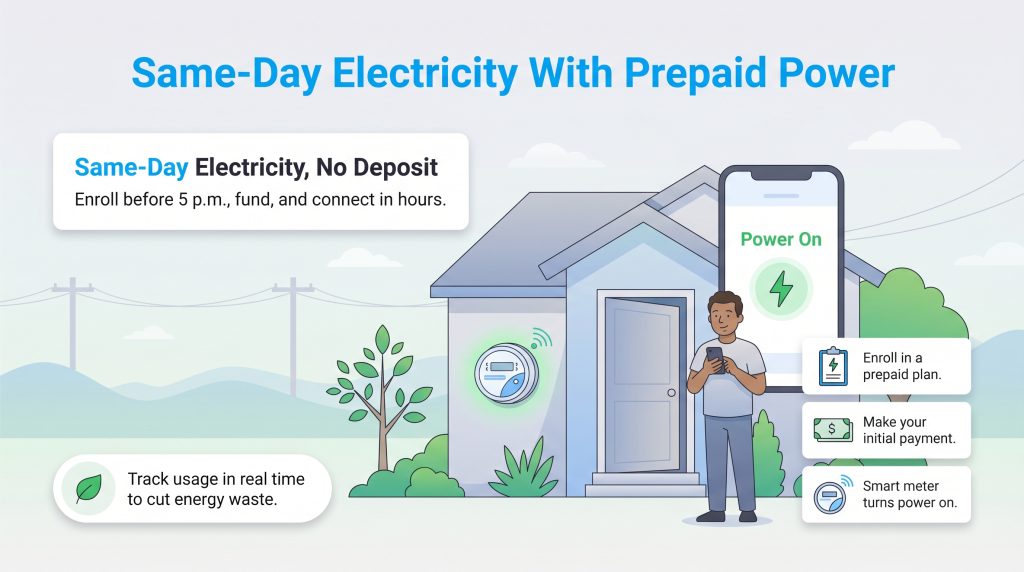
Securing same day electricity no deposit service is incredibly common and highly efficient across deregulated markets. Because modern smart meters allow for seamless remote communication, the utility company can activate your grid power digitally without ever dispatching a technician to your physical property.
If you are moving into a new residence in a rush and need pay as you go electricity same day, it is absolutely possible — provided you act early in the day. Here are the actionable steps you need to follow to guarantee your smart meter activates quickly:
- Locate your smart meter identifier: Also known as your ESID (Electric Service Identifier), this number is attached to your home’s physical meter. Having this ready ensures the provider digitally connects the right address without delays.
- Complete your digital enrollment: Select your preferred provider online, fill out your basic contact information, and opt for a prepaid plan. Remember, there are zero credit inquiries involved, so approval takes seconds and bypasses the usual bureaucratic red tape.
- Fund your initial minimum balance: Pay the required $20 to $75 starting amount using a credit card, debit card, or an authorized local payment kiosk. Because every dollar you load goes toward your future power use, this is not a deposit.
🚩 Heads Up: Always check the provider’s daily cutoff time. Most energy companies require you to submit your initial payment before 4:00 p.m. or 5:00 p.m. local time to guarantee same-day activation. If you miss this crucial window, your power will likely not turn on until the following business morning.
Four Ways To Waive Upfront Energy Deposits
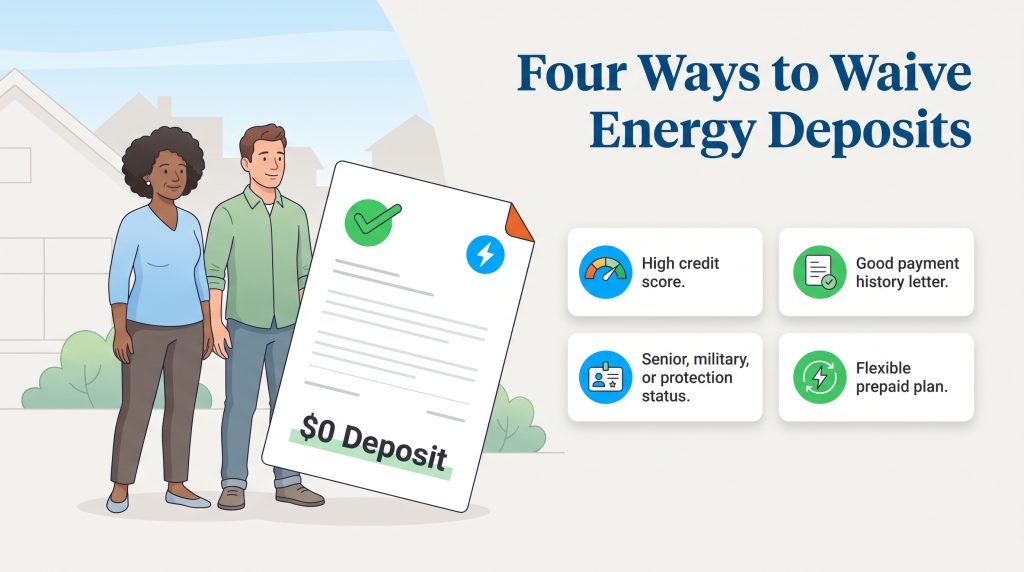
If you ultimately prefer the predictable billing cycle of a traditional postpaid contract but desperately want to avoid massive security fees, you still have viable options. Depending on your state’s specific public utility commission rules and your chosen provider, you can frequently secure $0 down electricity plans using one of these four exact methods:
- Maintain a high credit score: Most conventional energy companies will automatically waive security deposits if your credit score confidently meets their strict internal threshold during the initial application process.
- Provide a letter of good credit: If you paid your utility bills exactly on time for the last 12 consecutive months at your former residence, your previous provider can issue an official letter of good standing to instantly satisfy the new company’s financial safety requirements.
- Prove age 65+ or active military status: Senior citizens, active-duty military personnel, and honorably discharged veterans frequently qualify for mandatory deposit waivers by simply presenting a valid ID or official military paperwork. Victims of domestic violence can also often qualify through verified medical or shelter certification.
- Enroll in a flexible pre-paid plan: By officially opting for a highly flexible pay-as-you-go structure, you eliminate the security deposit requirement entirely and only pay directly for the power you actively consume.
Pros And Cons Of Pay-As-You-Go Energy
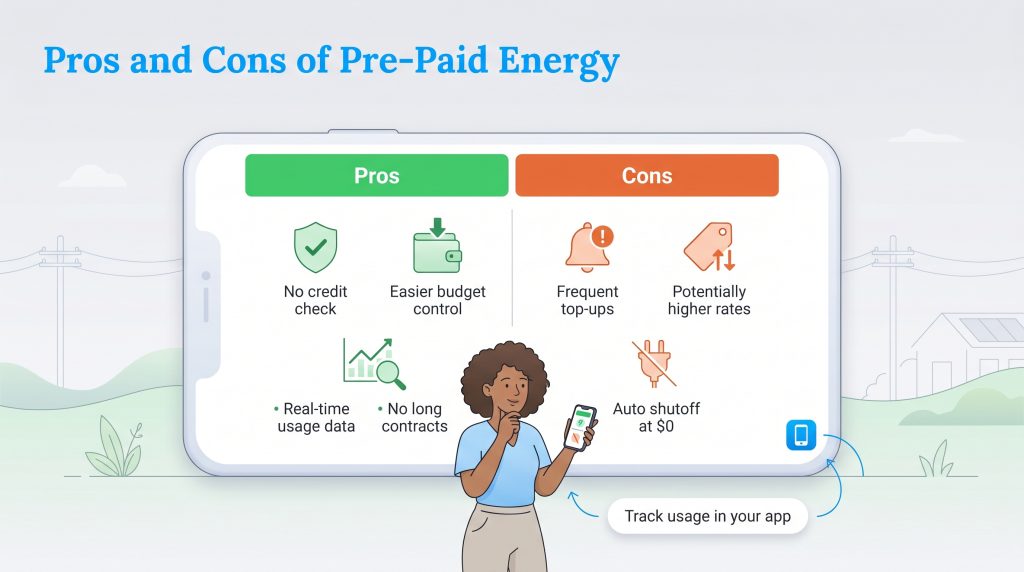
Pre-paid structures give you ultimate financial control and make it incredibly easy to lower your electric bill and stay strictly on budget. While they serve as highly effective setups for those actively rebuilding their finances or seeking short-term solutions, it is essential to weigh both the distinct benefits and the potential drawbacks before making your final commitment to the grid.
- Pros:
- Bypasses hard credit checks entirely, making grid approval immediate and completely stress-free.
- Eliminates massive, surprise end-of-month statements and hidden administrative fees.
- Provides robust, real-time energy tracking to help you consciously reduce your daily consumption and establish an energy-saving routine.
- Operates entirely without restrictive long-term contracts or expensive early cancellation penalties.
- Cons:
- Requires frequent balance monitoring and manual digital reloads to keep your power fully active.
- Rates per kilowatt-hour can sometimes fluctuate alongside market demands or sit slightly higher than traditional fixed-rate plans.
- Smart meters automatically disconnect your service if your account balance reaches zero, leading to potential immediate outages.
💡 Pro Tip: Monitor your daily usage closely through your provider’s smartphone app. Identifying which appliances drain the most power can help you proactively lower your consumption and stretch your prepaid balance significantly further.
Ideal Candidates For $0 Down Electricity Plans
While anyone can technically sign up for a pay-as-you-go service, these unique utility structures are specifically tailored to benefit certain demographics. If you fall into any of the following categories, you are an ideal candidate to take full advantage of prepaid lights no deposit:
- Short-term renters and transients: If you are moving into an apartment or a temporary living situation for just a few months, signing a 12-month or 24-month fixed contract makes no financial sense. Prepaid plans allow you to seamlessly cancel at any time without facing brutal early termination fees.
- Households seeking low income electricity plans no deposit: For those on a strict budget, the ability to load $20 or $30 at a time offers unmatched flexibility. You never have to worry about a massive $200 bill arriving in the mail when money is already incredibly tight.
- Consumers with poor or no credit history: Traditional utility providers often demand security deposits upwards of $300 to $500 if your credit score is deemed too low. Because prepaid plans do not pull your credit report, they completely level the playing field and provide you with fair, equal access to the power grid.
- First-time utility customers: College students or young adults moving out on their own for the first time usually lack the extensive credit history required for standard postpaid plans. A $0 down setup is simply the easiest way to establish household utilities independently.
Activating Your No-Deposit Power Today
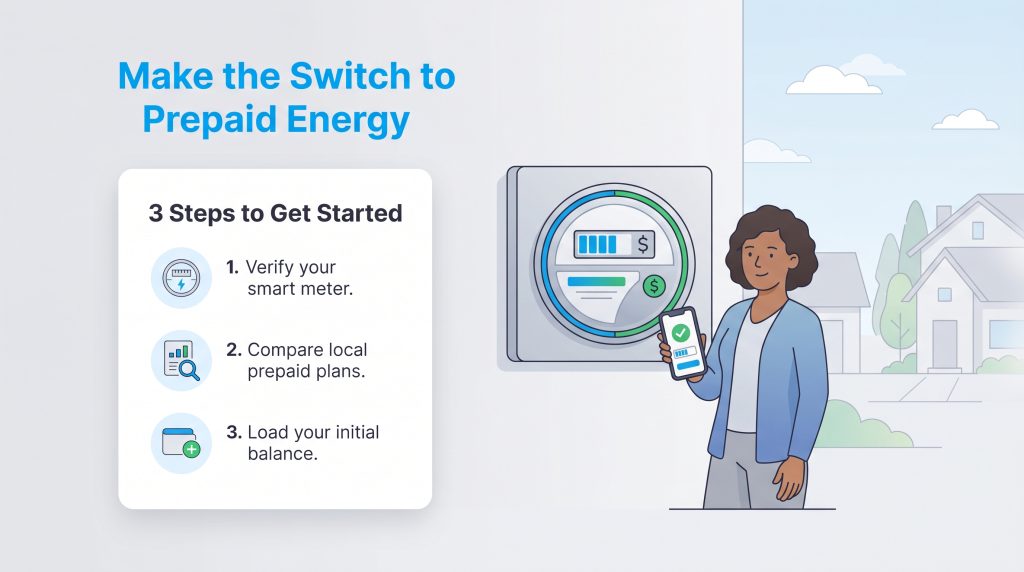
Taking authoritative control of your home energy costs has never been more straightforward. If you want to skip the massive security fee, avoid rigorous credit inquiries, and comfortably manage your monthly utility budget entirely on your own terms, pre-paid electricity plans offer an excellent, highly reliable solution. To successfully activate your no-deposit power today, just follow this simple three-step process:
- Check your meter status: Confidently confirm that your residence is actively equipped with a functional smart meter. Without a modern smart meter, the provider cannot accurately track your real-time energy consumption or activate your power remotely.
- Compare local rates: Do not just settle for the very first provider you see online. Take a few minutes to compare competitive local plans in your deregulated area, paying exceptionally close attention to minimum reload thresholds and daily administrative charges.
- Fund your initial balance: Submit your modest starting payment via a secure online portal, a mobile app, or an authorized payment center to officially trigger your activation sequence.
By taking these simple steps, you can confidently power your home, drastically reduce your carbon footprint by mindfully monitoring real-time usage, and completely eliminate the frustrating guesswork from your daily utility expenses.
Frequently Asked Questions About No Deposit Electricity
Do pre-paid electricity plans require a credit check?
Can I get same-day electricity with no deposit?
What happens if my pre-paid electricity balance reaches zero?
How do I add money to my prepaid electric account?
Are prepaid electric plans more expensive?
What is the minimum credit score for electricity with no deposit?
Do I have to pay an initial fee for a no deposit plan?
Are month-to-month electricity plans without a deposit safe?
What is the cheapest pre-paid electricity plan with no deposit?
Can I get $0 down electricity plans with bad credit?
Do I need a state ID for a no credit check electricity plan?
About the Author

David has been an integral part of some of the biggest utility sites on the internet, including InMyArea.com, HighSpeedInternet.com, BroadbandNow.com, and U.S. News. He brings over 15 years of experience writing about, compiling and analyzing utility data.

LaLeesha has a Masters degree in English and enjoys writing whenever she has the chance. She is passionate about gardening, reducing her carbon footprint, and protecting the environment. She also recently served as President of the Board for City Sprouts (a community garden).