

We Dive Into How to Spot the Real Deals and Avoid the Gimmicks When It Comes to Cheap Electricity Plans
Key Takeaways
- Teaser rates frequently expire after a few months, causing your monthly bill to spike unexpectedly.
- Usage tiers dictate your final bill because the lowest advertised price often requires hitting a highly specific consumption target.
- Fixed-rate plans guarantee budget stability and absolute protection against market volatility compared to risky month-to-month contracts.
Living in a deregulated energy market gives you the power to choose your provider, but actually securing a cheap electricity plan requires you to actively compare options rather than jumping at the first flashy offer. When you understand how utility rates are structured and take the time to evaluate plans based on your actual household consumption, you instantly filter out deceptive gimmicks. The fastest way to permanently lower your monthly expenses is to learn exactly how these contracts work, use a trusted comparison tool to search your local zip code, and lock in a transparent rate designed for your home’s unique energy requirements.
Understand Your Monthly Usage Tiers
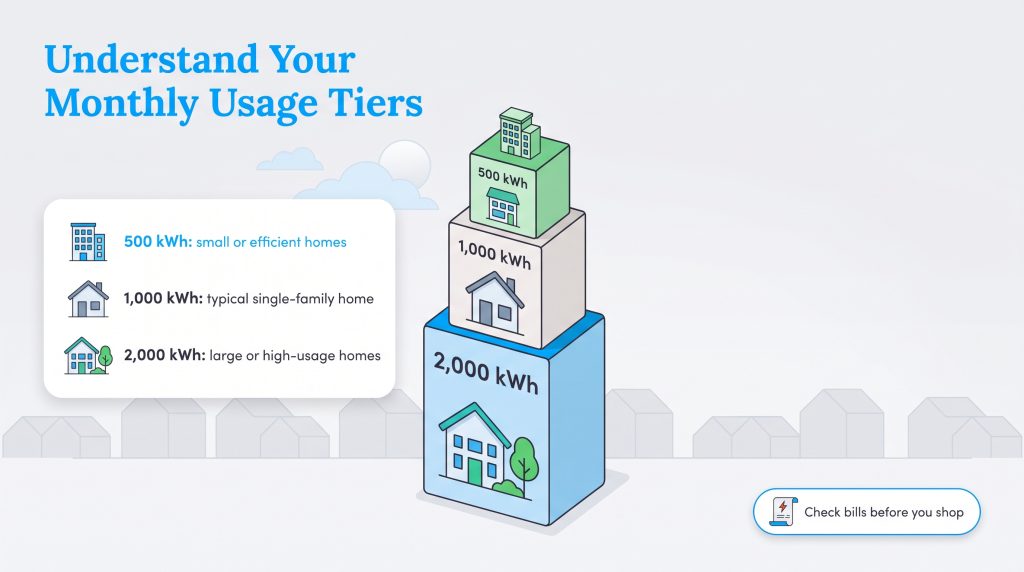
To accurately compare electricity providers, you must first pinpoint exactly how much power your household uses every month. Because mandatory utility delivery charges and promotional offers fluctuate drastically based on your consumption, looking at a generic national average electricity rate simply won’t help you secure the best deal. Pull up your past three to six months of utility bills to find your average monthly usage. If you fail to properly align your shopping strategy with your actual historical data, you might unintentionally trap yourself in an expensive contract. Let’s break down the three standard usage tiers you will see advertised on every plan:
- 500 kWh (Low Usage): Perfect for small apartments, condos, or highly energy-efficient homes with minimal heating and cooling demands.
- 1,000 kWh (Average Usage): The baseline standard for a typical medium-sized, single-family home. Many retail energy companies target their promotional rates specifically at this tier.
- 2,000 kWh (High Usage): Common for large properties, homes with older HVAC systems, or households running heavy air conditioning during sweltering summer months.
| Provider Name | Plan Name | Rate (at 1,000 kWh) | Term Length |
|---|---|---|---|
| EcoPower Solutions | Value Fixed 12 | 13.5¢ / kWh | 12 Months |
| National Grid Partners | Stable Home 24 | 14.1¢ / kWh | 24 Months |
| Green Energy Choice | Renewable Saver 36 | 14.5¢ / kWh | 36 Months |
| FlexPower Direct | Month-to-Month Basic | 16.2¢ / kWh | No Contract |
💡 Pro Tip: In deregulated states like Texas or Pennsylvania, your monthly statement is firmly divided into two parts. The supply charge is the electricity you purchase from a retail provider, while the delivery charge is the non-negotiable cost for the local utility company to physically route the power to your house.
Types of Electricity Plans Explained
When you step into the modern deregulated energy market, the specific contract structure you select dictates your long-term financial success. Knowing the difference between these core plan types ensures you can comfortably navigate extreme seasonal weather shifts without panicking over an unexpectedly massive monthly statement.
Compare Fixed-Rate and Variable-Rate Plans
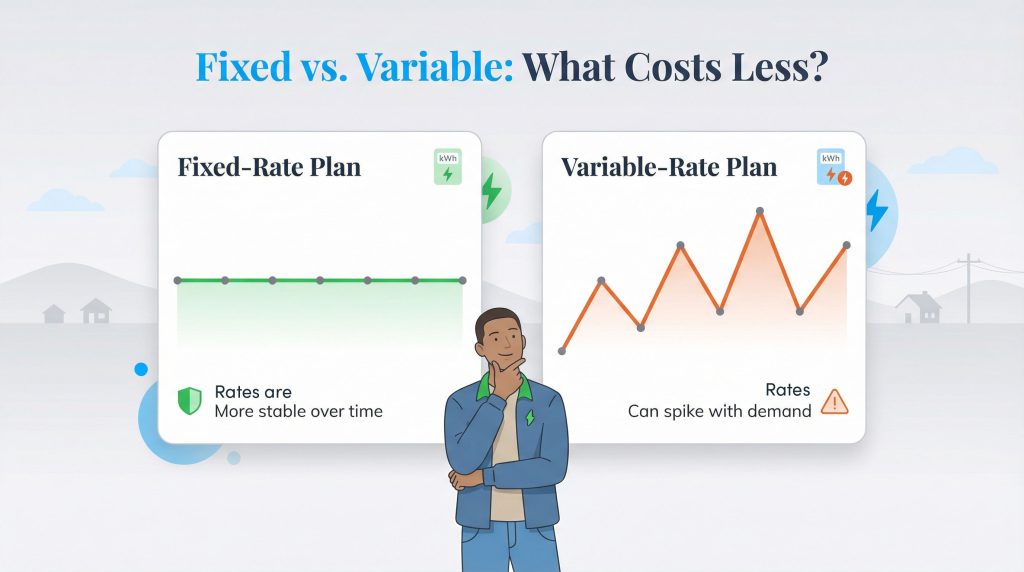
A fixed-rate electricity plan allows you to lock in a highly specific, unchanging price per kilowatt-hour (kWh) for your entire contract term — usually spanning anywhere from 12 to 36 months. This brilliant strategy acts as a protective shield for your household budget. If a sweltering heatwave causes local wholesale market prices to suddenly surge, your locked-in rate remains completely untouched. For the vast majority of homeowners deciding between a fixed or variable rate, we highly recommend choosing a fixed-rate plan to guarantee reliable, long-term affordability.
Conversely, variable-rate plans fluctuate dynamically from billing cycle to billing cycle based on immediate grid demand. They often feature a tantalizingly low introductory teaser rate that abruptly vanishes the moment your first month concludes. While they offer the appealing flexibility of zero early cancellation fees, they carry an immense financial risk if you aren’t paying incredibly close attention to broader energy trends.
Prepaid and No-Deposit Plans
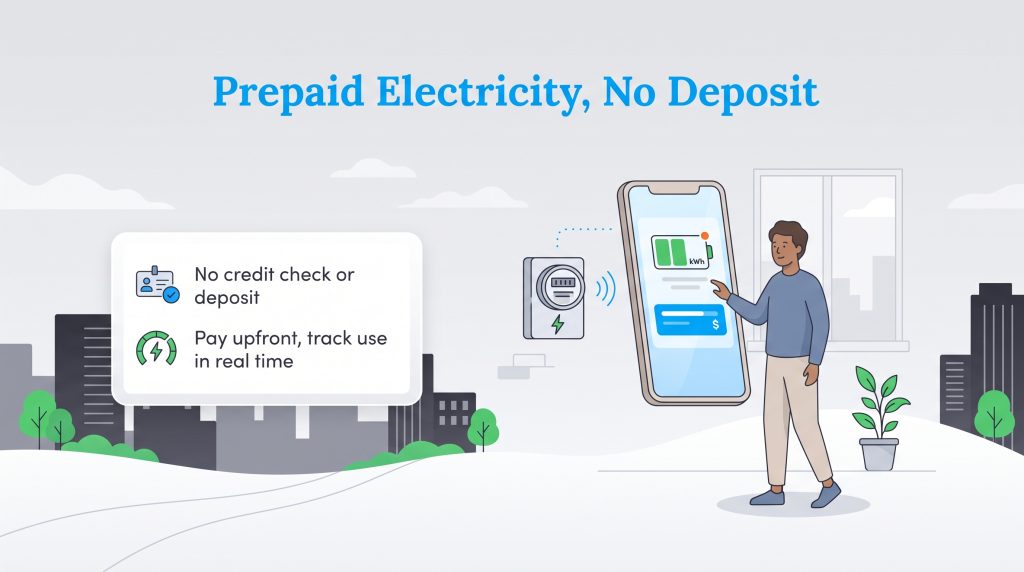
If you are renting an apartment short-term, moving quickly, or actively working to rebuild your credit score, standard lengthy contracts might pose a frustrating financial hurdle. Fortunately, you can easily find prepaid electricity plans with no deposit required to seamlessly bridge this gap. These highly flexible prepaid electricity plans leverage smart meter technology to let you pay for your power entirely upfront, completely bypassing the need for a hard credit check or an expensive initial security deposit.
You simply load funds into a digital account via an app and track your consumption balance in real time. However, this unmatched level of convenience naturally comes with a recognized trade-off: the base rate per kWh is typically slightly higher than what you would secure with a standard traditional agreement.
Green and Renewable Energy Plans
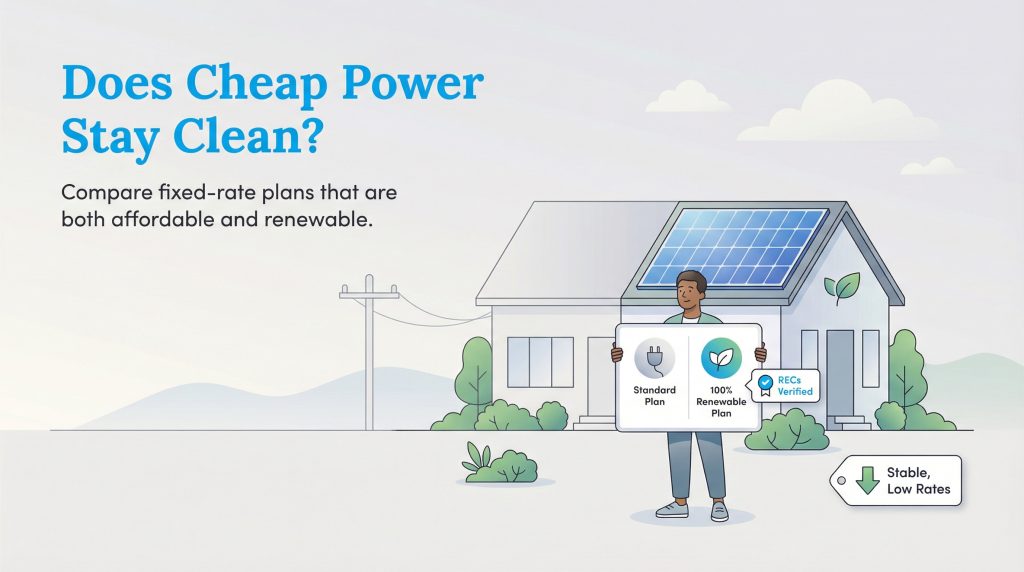
Beyond credit-friendly options, the modern grid fiercely caters to eco-conscious consumers looking to reduce their carbon footprint. You can readily find 100% renewable energy plans priced highly competitively against traditional fossil fuels. Securing clean power for your household no longer demands paying a massive monthly premium. Instead, you receive the vital financial security of a fixed-rate structure while proudly supporting a cleaner national infrastructure.
If you eventually transition your property toward home solar, your long-term environmental savings compound even further. The U.S. Energy Information Administration (EIA) continually tracks this impressive competitive growth nationwide, proving that sustainability and affordability finally go hand in hand.
🌱 Eco Edge: Retail providers now frequently offer 100% renewable energy options at equivalent or even cheaper rates than traditional plans. Always check the official plan details for “REC” (Renewable Energy Certificate) disclosures to confidently verify the actual environmental impact of your purchase.
How to Read the Electricity Facts Label
Securing a truly competitive deal requires you to actively look past the flashy marketing and intimately understand your Electricity Facts Label. This state-mandated document functions exactly like a nutritional label for your energy contract. It standardizes pricing across all retail providers so you can accurately forecast your upcoming electricity bill and completely dodge devastating bill shock.
Never sign an agreement without reviewing this critical summary. When evaluating an “Electricity Facts Label” (EFL), run through this mandatory checklist to uncover the true cost of power:
- Base Charge: Verify if the provider charges a fixed monthly customer fee just for keeping the account open, regardless of how much power you use.
- Energy Charge: Locate the unbundled, raw cost the retail provider actually charges for the electricity itself, entirely stripped of any conditional promotional credits.
- Delivery Charges: Confirm the non-negotiable pass-through fees mandated by your local Transmission and Distribution Utility (TDU). These ensure grid maintenance and represent your baseline delivery charge.
| Fee Type | Cost Breakdown |
|---|---|
| Base Charge | $5.00 per month |
| Energy Charge | 8.5¢ per kWh |
| TDU Delivery Charge | 4.2¢ per kWh + $4.39 monthly |
| Effective Rate (at 1,000 kWh) | 13.6¢ per kWh |
🚩 Heads Up: The standardized pricing table on your EFL will list estimated rates at 500, 1,000, and 2,000 kWh. Always judge the plan’s true affordability based on the specific usage column that mathematically matches your home’s historical behavior.
Watch Out for Pricing Gimmicks and Bill Credits
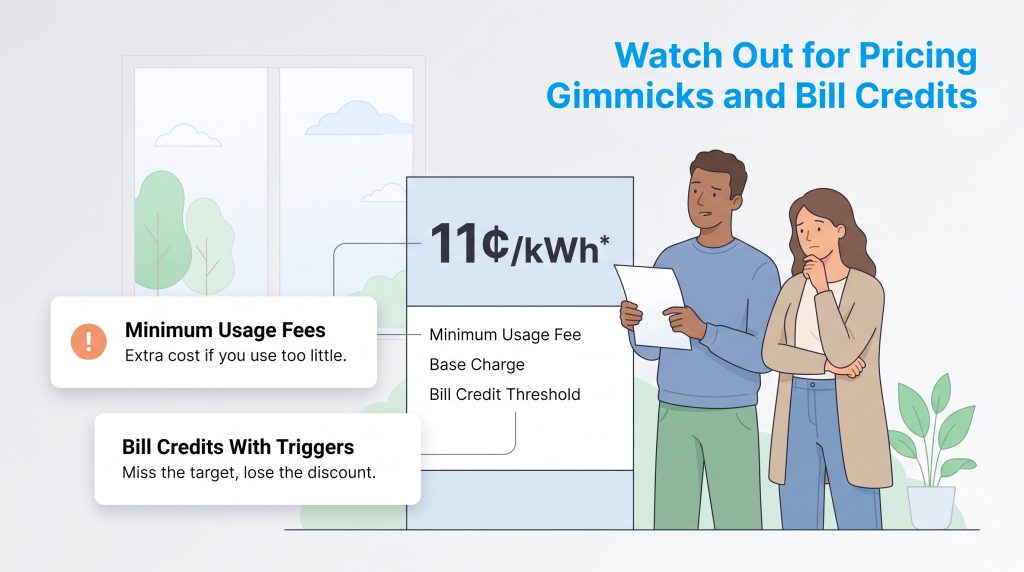
Shopping for a utility provider requires extreme vigilance. Many retail energy companies design heavily stylized marketing campaigns that proudly tout unbelievably low prices, but those eye-catching numbers rarely tell the whole story. You must protect your wallet by learning how to identify the subtle tricks buried in the fine print — especially plans that rely on strict usage thresholds to trigger targeted “bill credits.”
To understand how these deceptive pricing structures operate, suppose a provider advertises an incredibly cheap 1,000 kWh usage rate that explicitly includes a massive $75 bill credit — but only if you hit exactly 1,000 kWh in a single billing cycle. When that generous credit is applied, your effective rate drops to a highly competitive 11 cents per kWh. However, these promotional usage tiers are notoriously unforgiving.
If a mild spring month rolls around and your household only consumes 999 kWh, you instantly forfeit that $75 credit. Your effective rate drastically reverts back to the provider’s un-discounted premium rate. Overnight, your projected monthly bill wildly spikes simply because you missed the designated sweet spot by a single unit of energy. To prevent this, always watch out for the following contract traps:
- Minimum Usage Fees: Additional financial penalties slapped onto your invoice if your household fails to consume a predetermined baseline of power (typically under 500 kWh).
- Base Charges: A flat, recurring monthly fee that some companies enforce regardless of how much physical electricity you actually pull from the grid.
Step-by-Step Guide to Comparing Providers
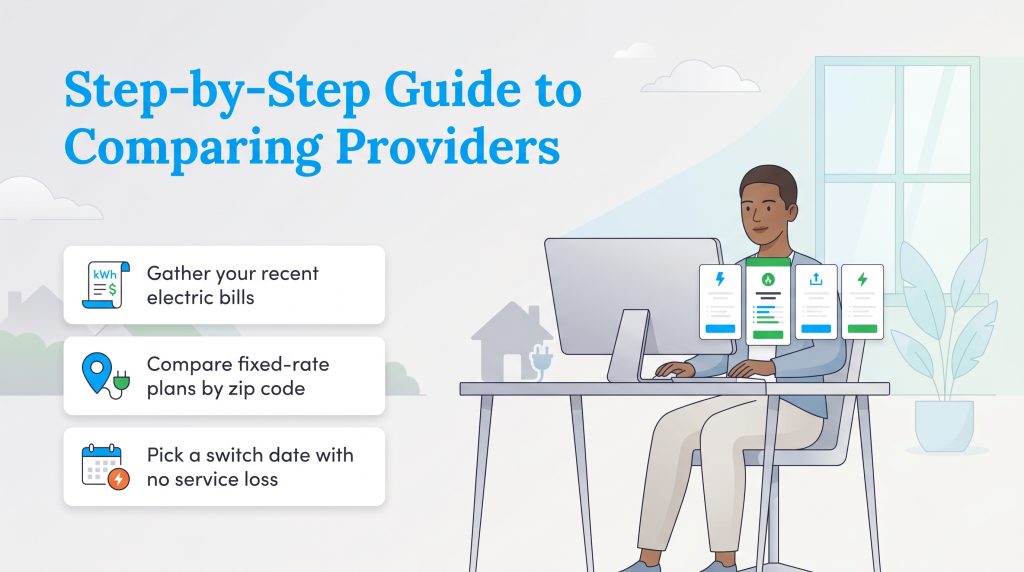
Taking actionable steps to finalize a cheaper energy contract is incredibly seamless once you clearly understand the core mechanics of the deregulated marketplace. There is absolutely no physical disruption to your daily service when changing companies. Your local utility continues delivering your power exactly as before, managing the wires and poles without interruption. Follow these exact steps to execute a flawless transition:
- Gather your old bills: Pull up three to six months of previous billing statements to determine if your home consistently hits the low (500 kWh), average (1,000 kWh), or high (2,000 kWh) consumption tier. This hard data dictates which plan structures will actually benefit your budget.
- Enter your zip code in a comparison tool: Because delivery charges vary locally, inputting your specific zip code is the only way to see accurate, real-time rates tailored to your neighborhood.
- Filter for fixed-rate electricity plans: Sort the available options to exclusively show fixed-rate structures, ensuring you lock in long-term pricing stability and avoid sudden market spikes.
- Check the Electricity Facts Label (EFL): Thoroughly scan each EFL for hidden gotchas. Verify the unbundled energy charge and actively rule out tricky tiered usage credits that rely on strict consumption thresholds.
- Complete the signup process: Once you locate a transparent, budget-friendly fixed rate, select your ideal connection date and complete the digital enrollment. Your brand-new retail provider will seamlessly contact the local utility to process the swift switch behind the scenes.
For brilliant additional strategies on lowering your monthly utility expenses well beyond just securing a better rate, we highly encourage you to explore our targeted tips on how to save on your electric bill.
Locking In Your Lowest Rate
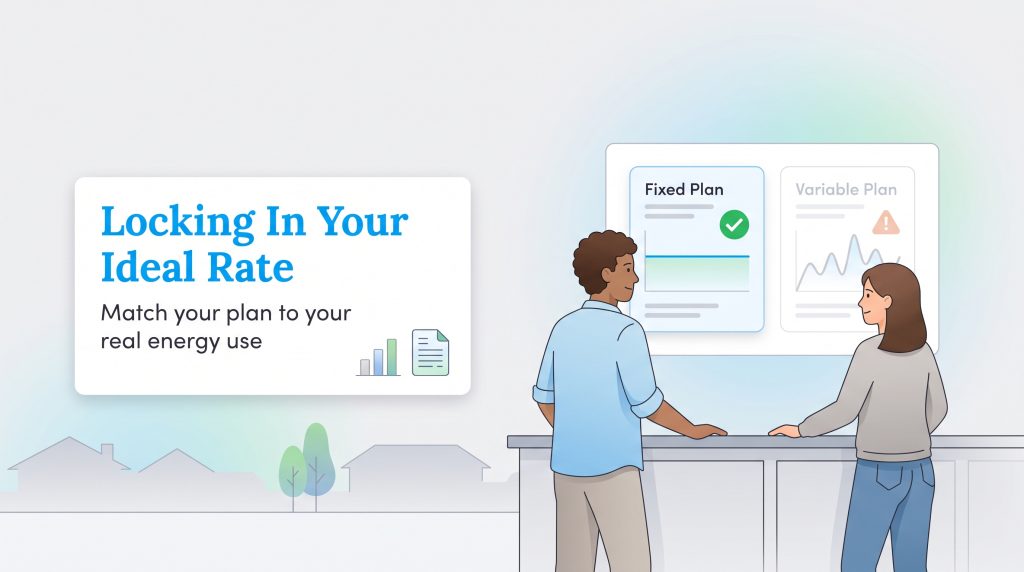
Pinpointing the absolute best electricity setup requires looking far beyond a flashy banner ad or a wildly low introductory teaser rate. The most cost-effective plan overall is invariably the one that mathematically aligns with your historical consumption habits while offering profoundly transparent, unbundled pricing. Taking just a few short minutes to carefully scrutinize your state-mandated EFL, intelligently weigh fixed versus variable benefits, and thoroughly compare current localized offers deeply protects your budget from sudden, devastating price hikes.
When you successfully pair a fair, honest contract with a few incredibly straightforward energy-saving habits, you effortlessly keep your household utility costs remarkably low. Empower yourself with data, avoid the hidden gimmicks, and confidently lock in a predictable energy strategy that keeps your home running efficiently year-round.
Frequently Asked Questions About Cheap Electricity Plans
What is a good rate for electricity per kWh?
Should I choose a fixed or variable electricity plan?
How do bill credits work on electricity plans?
Do I need a deposit for a cheap electricity plan?
Does my home’s energy usage affect my electricity rate?
How often do electricity rates change?
What is the best month to switch electricity providers?
Read more: Best Time to Switch Providers
About the Author

Claudio is a sustainability-focused writer with a background in Anthropology and Psychology from NC State University. He has spent over 15 years working in writing, interpretation, and translation, driven by a deep interest in how human culture shapes the environment. Today, he shares his curiosity with readers by writing about sustainable living solutions and the connection between everyday choices and environmental impact.

David has been an integral part of some of the biggest utility sites on the internet, including InMyArea.com, HighSpeedInternet.com, BroadbandNow.com, and U.S. News. He brings over 15 years of experience writing about, compiling and analyzing utility data.