

Finding the best electricity plan between Reliant and Just Energy comes down to matching their rates and perks with your actual household energy usage.

- 14.1¢ /kWh
- 24%
- 90 days
- 0-36 Months
- Best for Smart Home Tools & App

- 8.8¢ /kWh
- 31%
- 60 days
- 12-36 Months
- Popular Bill Credit Plans
*rates may vary by location and household usage
Key Takeaways
- Reliant Energy offers robust smart home integrations, making it an excellent choice for tech-savvy households looking to optimize their usage.
- Just Energy frequently provides straightforward, long-term fixed rates that shield price-conscious consumers from seasonal market volatility.
- Always calculate your estimated monthly bill based on actual usage, as free weekend plans from both providers frequently carry significantly higher weekday rates.
Navigating the deregulated Texas energy market can feel like solving a complex puzzle, leaving many residents frustrated by confusing jargon and unpredictable monthly bills. Instead of throwing complicated terms your way, we focus on delivering absolute transparency and real-world math so you know exactly what to expect before you sign a contract. Choosing between Reliant vs. Just Energy requires a hard look at how these prominent retail providers structure their plans, assess their hidden fees, and handle early termination penalties. We break down the true costs associated with both brands, helping you confidently lock in a reliable electricity plan that aligns seamlessly with your daily routine, budget, and environmental values.
Head-to-Head Provider Snapshot: Reliant vs. Just Energy
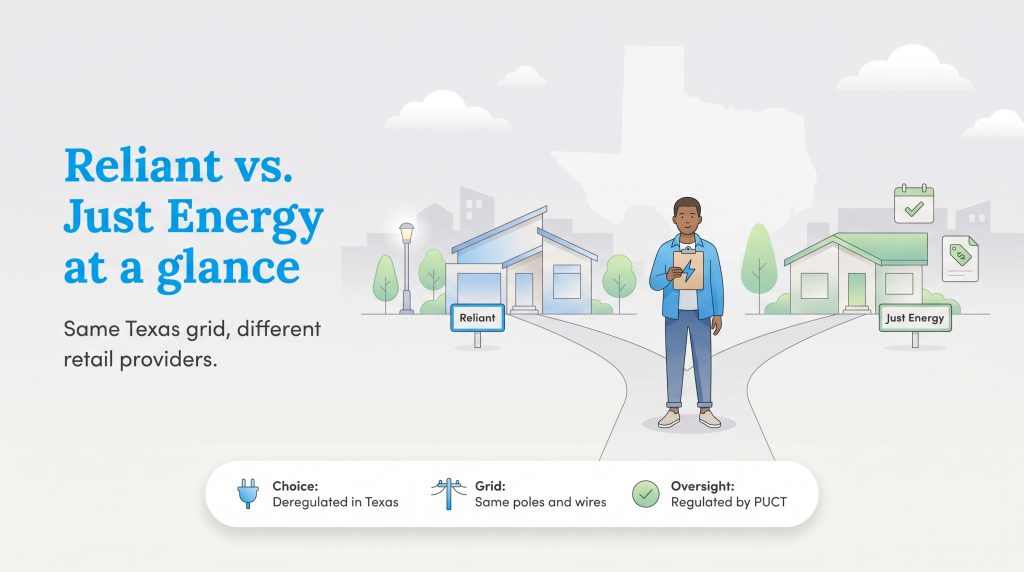
Texas boasts a uniquely deregulated energy market, meaning most residents have the power to choose their retail electricity provider rather than being stuck with a state-assigned utility company. This freedom sparks fierce competition, especially when comparing major Texas electricity providers like Reliant and Just Energy. Reliant Energy operates as a legacy brand with deep roots and a massive presence across local communities, particularly for those setting up utilities in major metro areas like Houston. Meanwhile, Just Energy serves as a widespread North American powerhouse known for offering long-term stability and straightforward pricing structures. Keep in mind that regardless of which retailer you ultimately select, the physical delivery of your power and the maintenance of the physical poles remain regulated by the state and your local transmission and distribution utility, overseen by the Public Utility Commission of Texas.
To give you a clearer picture of how these two industry heavyweights stack up against each other, we have compiled a quick snapshot of their operational history, regulatory standing, and primary plan focus. Reviewing these foundational metrics helps establish baseline expectations for customer service and billing transparency before you dive into their specific rate charts.
Reliant Energy Snapshot:
- PUCT Rating: 4 out of 5 Power Circles (indicating strong customer complaint resolution)
- Years in Business: Operating since the beginning of Texas deregulation in 2001 (backed by parent company NRG Energy)
- Primary Plan Focus: Smart home integrations, tech-forward app management, and tiered usage rewards
Just Energy Snapshot:
- PUCT Rating: 2 to 3 out of 5 Power Circles (indicating higher average complaint volumes)
- Years in Business: Founded in 1997 and operating internationally
- Primary Plan Focus: Basic fixed-rate contracts, long-term 36-month options, and easily accessible green energy offsets
Pros and Cons of Each Provider
When you are in a rush to secure a new electricity plan, sorting through pages of marketing material can be overwhelming. Every provider highlights their best features while quietly burying the drawbacks in the fine print. To streamline your decision-making process, we have broken down the top advantages and disadvantages for both Reliant and Just Energy. This scannable breakdown highlights exactly what you need to consider before committing to a multi-year residential energy contract.
Reliant Energy
- Pro: Consistently ranks as having one of the best mobile apps in the Texas market, making account management and usage tracking incredibly easy.
- Pro: Offers deep integrations with smart home devices, frequently running promotions that bundle smart thermostats with new residential plans.
- Pro: Maintains a massive 24/7 localized support network, meaning you can typically reach a helpful representative at any hour.
- Con: Standard base rates are typically higher than smaller, independent discount providers operating in the same zip codes.
- Con: Early termination fees are steep, scaling up to nearly $300 if you break a 24-month contract early without moving.
- Con: Many of their flagship plans rely on strict bill credit tiers that penalize you if you fall slightly short of the required usage threshold.
Just Energy
- Pro: Provides highly predictable, straightforward billing on standard fixed-rate plans, appealing to strict household budgeters.
- Pro: Features a simple, flat-rate early termination fee, which makes calculating cancellation costs much easier if you need to break a lease.
- Pro: Makes upgrading to a 100% renewable energy option incredibly simple for almost any base plan they offer.
- Con: Customer service ratings and Public Utility Commission scores frequently trail behind legacy Texas competitors.
- Con: Relies on older digital interfaces, offering far fewer high-tech mobile management tools compared to Reliant.
- Con: Base energy charges on their promotional “free usage” plans are notoriously high during normal weekday hours.
Reliant vs. Just Energy Rates: Which Is Cheaper?
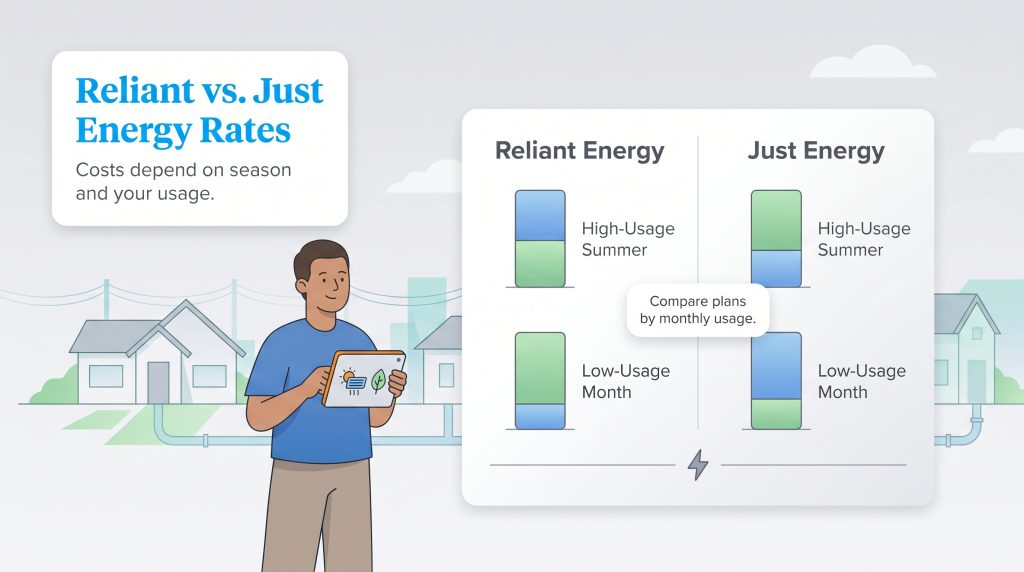
Determining which company provides cheaper electricity isn’t just a matter of glancing at a billboard rate. The total cost of your monthly bill depends heavily on your household’s unique consumption habits and the specific time of year. Both companies structure their pricing using a combination of flat base charges, energy charges for the actual kilowatt-hours (kWh) you consume, and passthrough delivery fees. These passthrough fees are billed by your local utility to cover the physical maintenance of power lines and meters, meaning they cost exactly the same whether you choose Reliant or Just Energy.
To accurately compare Reliant vs. Just Energy rates, we have consolidated their top offerings into a single table. This side-by-side view strips away the marketing fluff and focuses entirely on the core mechanics of their most popular residential plans. Remember that the final cents per kWh rate on your monthly bill will fluctuate based on exactly how much energy you use during that 30-day billing cycle.
| Provider | Popular Plan Name | Term Length | Key Pricing Feature |
|---|---|---|---|
| Reliant Energy | Power Savings 12 | 12 Months | Offers a substantial bill credit only if you hit exactly 1,000 kWh. |
| Reliant Energy | Secure Advantage 24 | 24 Months | Provides locked-in rate stability without complex usage tiers. |
| Reliant Energy | Truly Free Nights | 12 Months | Features a $0 energy charge during designated overnight hours. |
| Just Energy | Base Saver Plus 12 | 12 Months | Delivers a high-value bill credit designed strictly for heavy energy users. |
| Just Energy | Simple Power 24 | 24 Months | Maintains a straightforward, flat fixed rate with no gimmicks. |
| Just Energy | Free Nights 12 | 12 Months | Provides free overnight usage, offset by a higher daytime premium. |
💸 Money-Saver: Always check the Electricity Facts Label (EFL) for hidden base fees that kick in if you consume under a certain threshold. Paying a financial penalty for successfully conserving energy during cooler months is a frustrating surprise you want to gracefully avoid.
Comparing Flagship Plans Side-by-Side
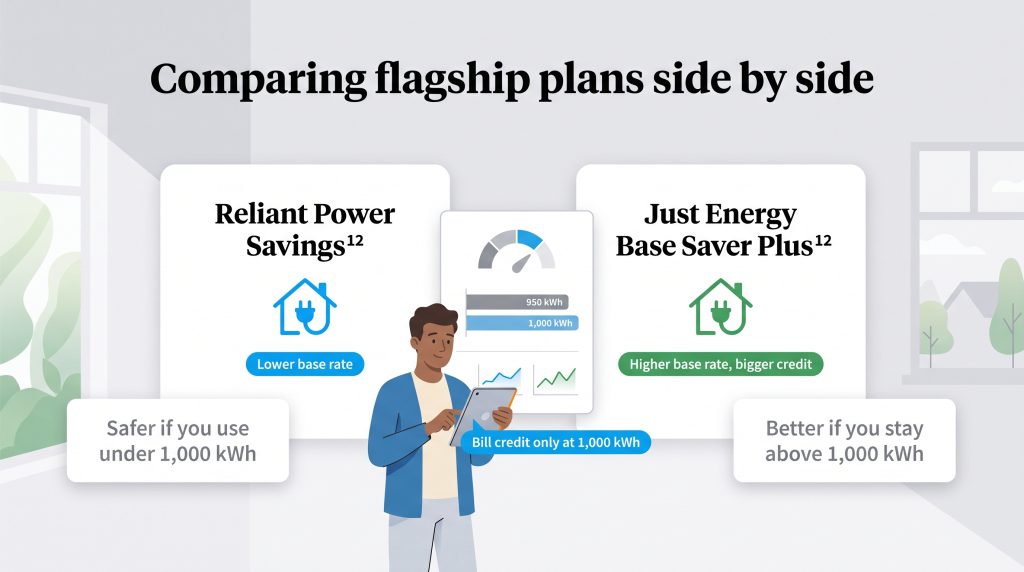
To truly understand how hidden fees and bill credits manipulate your final utility costs, we need to compare the flagship 12-month fixed-rate plans from both providers side-by-side. For this breakdown, we are evaluating the Reliant Power Savings 12 plan against the Just Energy Base Saver Plus 12 plan. Both of these contracts heavily feature “bill credits” — promotional discounts applied to your invoice only if your household consumes a very specific amount of electricity.
The Reliant Power Savings 12 plan typically features a slightly lower base energy charge but requires you to hit exactly 1,000 kWh of usage to unlock a $50 bill credit. Conversely, the Just Energy Base Saver Plus 12 plan usually carries a slightly higher baseline energy charge, but it attempts to offset that higher cost by offering a more generous $75 bill credit when you hit that same 1,000 kWh threshold. While a larger discount sounds appealing at first glance, the underlying danger of these tiered structures is incredibly real for the average consumer.
If you live in a moderately sized apartment or a highly efficient home, you might only consume 950 kWh during a mild spring month. Because you fell 50 kWh short of the required threshold, neither provider will apply their promotional bill credit. Suddenly, your effectively advertised rate of 12 cents per kWh skyrockets to 17 or 18 cents per kWh, simply because you did not use enough electricity to trigger the discount. When choosing between these flagship options, you must scrutinize your historical usage. If you consistently use between 1,200 and 1,800 kWh year-round, Just Energy’s larger bill credit will likely yield higher savings. However, if your usage fluctuates wildly and often drops below 1,000 kWh, the lower base energy charge offered by Reliant will provide far better financial protection during those low-usage months.
The Truth Behind Free Nights and Weekends Promos
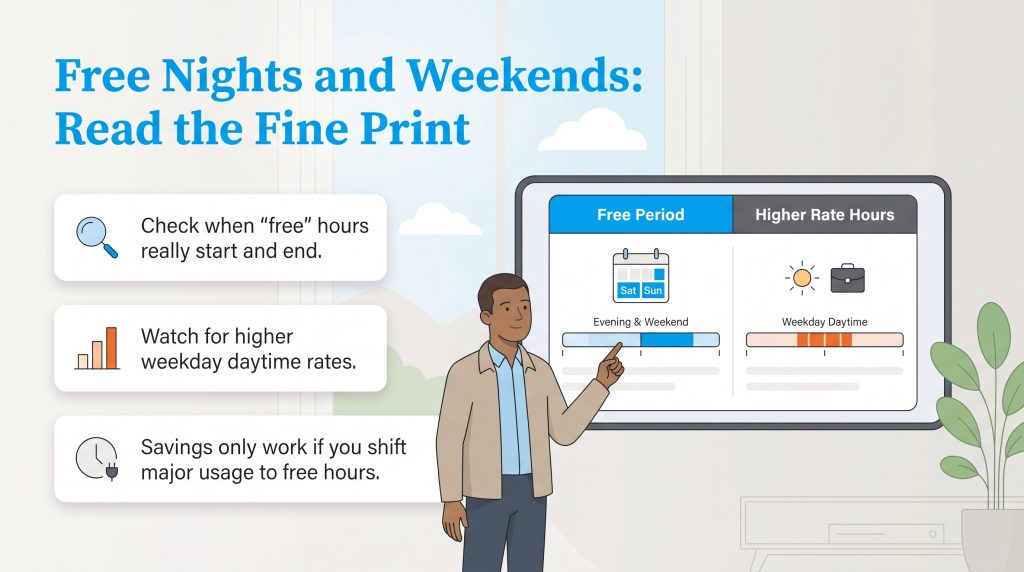
Both Reliant and Just Energy aggressively market promotional plans that sound incredible on paper, promising completely free power during your highest usage periods. When comparing Reliant vs. Just Energy free nights and weekends options, you have to look closely at the fine print defining exactly when those promotional hours actually begin and end. The difference of just one hour can drastically impact your monthly budget if you run large appliances at the wrong time.
Under the Reliant “Truly Free Nights” program, the designated free window typically starts precisely at 8:00 p.m. and ends at 6:00 a.m. every single day. In contrast, Just Energy’s overnight promotional plans frequently shift that window later, officially starting at 9:00 p.m. and ending at 7:00 a.m. If you naturally prefer to start your laundry or run the dishwasher right after dinner at 8:15 p.m., the Reliant plan will cover that heavy usage entirely. If you performed that exact same chore under the Just Energy contract, you would be paying a massive premium for those 45 minutes of heavy power draw before their free window finally opens.
To offset the massive cost of giving away overnight or weekend electricity, retail providers must charge a significantly higher energy rate during daytime weekday hours. If you consistently run major appliances, blast your air conditioning, or charge electric vehicles during a Wednesday afternoon, the inflated weekday rate will rapidly erase any savings you accrued over the weekend. Success with free plans demands a highly disciplined lifestyle where you intentionally defer almost all heavy power usage until the exact moment the designated free window opens.
🚩 Heads Up: If you or your partner work from home during standard business hours, signing up for a free nights and weekends plan will likely cause a noticeable increase in your monthly utility costs. These plans are designed exclusively for people whose houses sit empty during the workday.
Smart Home Tools vs. Green Energy Options

For the modern homeowner, interacting with electricity extends far beyond the basic flip of a switch; it now involves seamless digital management and active consumption tracking. When evaluating digital conveniences, Reliant firmly pulls ahead for tech-focused users by offering comprehensive smart home integrations. Reliant frequently runs seasonal promotions that bundle Google Nest smart thermostats or home security devices directly into your initial contract. Syncing an intelligent thermostat with their highly-rated mobile app allows you to monitor consumption patterns remotely and make real-time adjustments, which aligns perfectly with the proven efficiency guidance found through the official ENERGY STAR smart thermostat program. On the flip side, Just Energy limits their tech offerings, prioritizing a straightforward digital portal focused on basic billing rather than heavy gadgetry.
Despite their differences in smart home offerings, both companies actively cater to Texans wanting to offset their carbon footprint. They do this by offering 100% green energy plans backed by renewable energy certificates (RECs). When you sign up for a green plan, the provider purchases RECs representing wind or solar generation to match your exact household consumption. This serves as a highly accessible, environmentally mindful choice for renters or condo owners who cannot physically alter their property’s infrastructure.
- Reliant’s Make It Green Program: An eco-conscious alternative that allows you to effortlessly upgrade your standard energy plan to 100% Texas wind power. This add-on typically carries a minor premium of around one to two cents per kWh.
- Just Energy’s JustGreen Option: Empowers customers to offset up to 100% of their power usage through certified RECs where applicable. Just Energy makes it incredibly easy to select this upgrade during the initial online checkout process.
- Supplemental Home Upgrades: If you own a single-family property, you can bypass retail green premiums entirely. You can pair a standard retail plan with a dedicated solar panel system to permanently reduce your reliance on the commercial power grid.
🌱 Eco Edge: Enrolling in a 100% renewable plan directly supports the market demand for clean generation through RECs. Your slightly higher monthly payment helps fund and support the continuous expansion of vital wind and solar infrastructure across the state of Texas.
Customer Reviews and Early Termination Fees
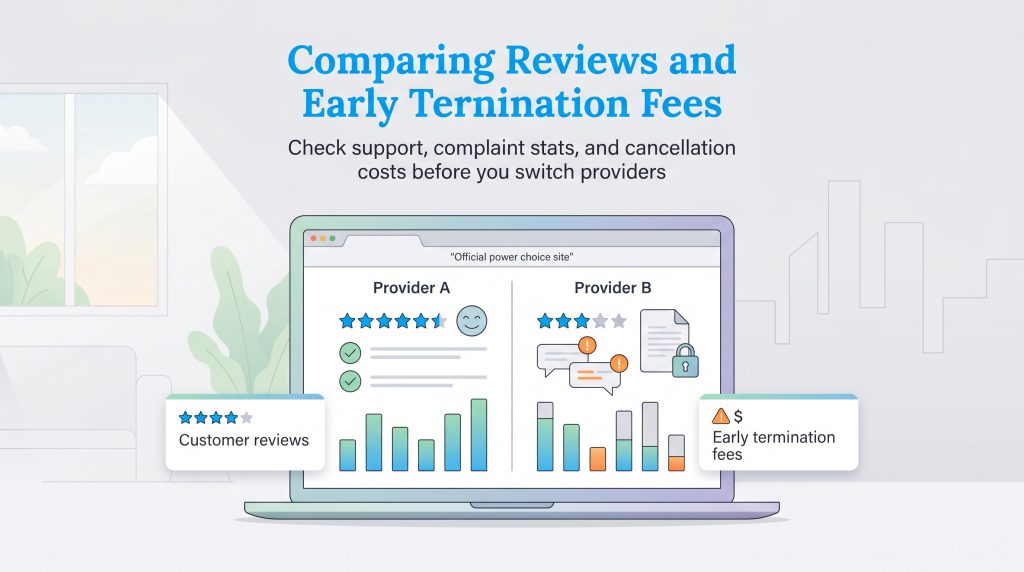
Evaluating independent customer reviews for Just Energy and Reliant reveals distinct differences in how consumers experience their daily billing support and long-term contract management. Reliant routinely scores high marks for localized customer service, rapid issue resolution, and an incredibly smooth mobile app experience that empowers users to troubleshoot their own accounts. Meanwhile, Just Energy garners praise for their straightforward renewal notices, though numerous users note sharp frustration with their strict enforcement of contract terms and somewhat dated support infrastructure. It always pays to check the verified complaint statistics available on the official Power to Choose website, which acts as the state’s authorized resource for tracking objective provider performance metrics.
A major friction point for renters, students, or anyone planning an impending move involves breaking a lengthy energy contract ahead of schedule. When looking closely at the early termination fees (ETFs) for both companies, they enforce strict financial penalties if you switch providers before your agreed term officially expires. If you cancel your service early without providing valid proof that you are physically moving to a new address, you will be hit with a sizable final bill.
| Provider | Contract Length | Standard Early Termination Fee |
|---|---|---|
| Reliant Energy | 12-Month Plan | $150 Flat Fee |
| Reliant Energy | 24-Month Plan | $295 Flat Fee |
| Just Energy | All Fixed-Term Plans | $175 Flat Fee |
Before deciding to willingly absorb a massive cancellation fee just to chase a slightly lower promotional rate, take a step back and calculate the math. The cost of a $295 penalty from Reliant will often wipe out a full year of potential savings earned from a cheaper competitor. Instead of canceling, try implementing a few proven strategies on how to save on your electric bill to make your current high-rate plan much more manageable until the contract organically ends.
How to Switch From Reliant to Just Energy (or Vice Versa)
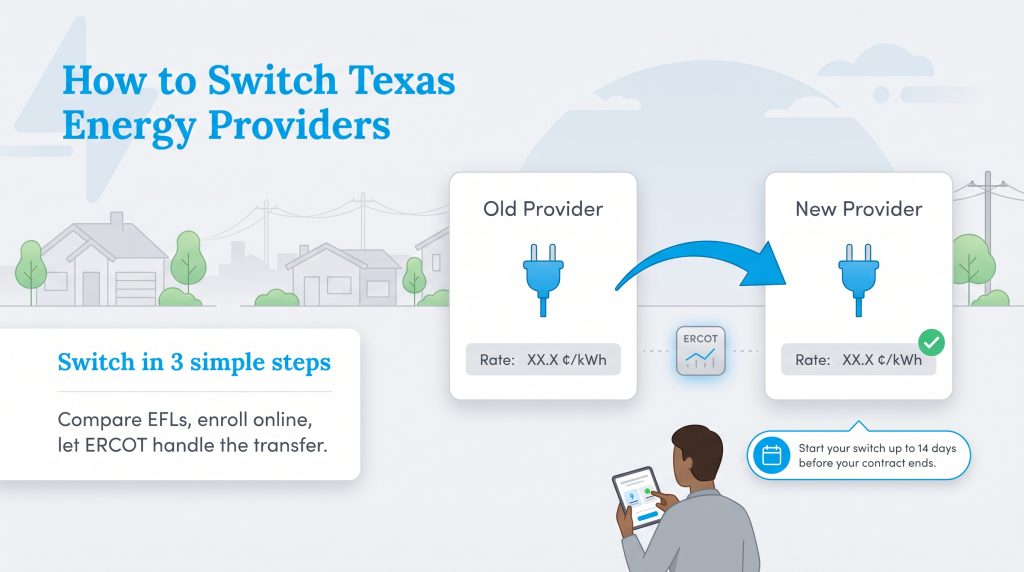
If you have successfully reached the end of your contract — or you have done the math and decided that paying the early termination fee is worth the long-term savings — switching between retail energy providers in Texas is actually a remarkably simple process. Because the physical grid is managed centrally by ERCOT (the Electric Reliability Council of Texas), changing your retail billing provider requires absolutely no physical modifications to your home. No technicians will need to visit your property, and your lights will not flicker or temporarily shut off during the transition.
- Compare Your Current Document to the New EFL: Pull up your current contract and look at your exact cents per kWh rate. Compare that directly to the new Electricity Facts Label from your desired provider to verify that the switch will actually result in tangible monthly savings.
- Enroll Online with Your Target Start Date: Navigate to the website of your new chosen provider. Enter your exact service address, select your preferred fixed-rate plan, and choose a transition date that aligns closely with the expiration of your old contract.
- Let the New Provider Handle the Cancellation: Once you submit your enrollment, your new provider sends an electronic notification directly to ERCOT. ERCOT seamlessly processes the switch and automatically informs your old provider that the service has been transferred. You do not need to call your old provider to cancel; the system handles the transition automatically on your chosen date.
📌 Quick Fact: To guarantee a smooth transition without incurring early termination fees, Texas regulations allow you to initiate a switch up to 14 days before your current contract officially expires without being penalized by your old provider.
Choosing Your Ideal Texas Electricity Provider
Finding the ultimate winner between these two prominent retail giants hinges entirely on your personal lifestyle priorities and daily household routine. If you own a tech-forward home, deeply value smart thermostat integrations, and rely heavily on robust mobile apps to manage your bills, Reliant Energy stands out as the superior choice. Their localized customer service presence and intuitive digital tools make them an exceptional match for active homeowners who want granular control over their daily consumption data.
Conversely, if you prefer long-term rate security and a straightforward, distraction-free billing experience, Just Energy serves as an incredibly solid alternative. Their 36-month fixed contracts and flat-rate cancellation fees provide excellent predictability for budget-conscious renters who want to lock in a rate and forget about it. As you finalize your moving checklist and finish setting up your electric utilities, take a deep breath knowing that carefully reviewing the Electricity Facts Label will confidently steer you toward the most affordable and comfortable energy setup for your home.
Frequently Asked Questions About Reliant vs. Just Energy
What are the hidden fees with Just Energy?
Does Reliant or Just Energy have better customer service?
How much is the Just Energy early termination fee?
Can I switch from Reliant to Just Energy without losing power?
What is the Power to Choose website?
Are free nights and weekends plans actually worth it?
Which provider is the best energy company in Texas?
About the Author

David has been an integral part of some of the biggest utility sites on the internet, including InMyArea.com, HighSpeedInternet.com, BroadbandNow.com, and U.S. News. He brings over 15 years of experience writing about, compiling and analyzing utility data.

Claudio is a sustainability-focused writer with a background in Anthropology and Psychology from NC State University. He has spent over 15 years working in writing, interpretation, and translation, driven by a deep interest in how human culture shapes the environment. Today, he shares his curiosity with readers by writing about sustainable living solutions and the connection between everyday choices and environmental impact.