

Choosing between Reliant and 4Change Energy comes down to whether you prefer straightforward pricing or strategic bill credits to lower your monthly electricity costs.
Key Takeaways
- 4Change Energy often provides cheaper effective rates through targeted bill credits, making it ideal for homes with predictable, moderate energy usage.
- Reliant Energy offers robust plan variety and established customer service tools, better suiting dynamic households or those wanting free nights and weekends.
- Both providers offer 100% renewable energy options, allowing you to power your home sustainably without sacrificing reliability.
Navigating the deregulated Texas energy market feels like a full-time job, especially when confusing plan terms hide the true cost of your power. We know how frustrating it is to decipher fine print just to keep the lights on, which is why we are putting these two popular providers head-to-head. While 4Change Energy is heavily marketed to everyone, it is actually the best option strictly for households that consistently hit exact 1,000 or 2,000 kWh usage tiers. On the other hand, Reliant Energy stands out as the better choice for homes with dynamic, unpredictable energy consumption and larger footprints. Our Reliant vs. 4Change Energy comparison uncovers the real costs, hidden fees, and official state complaint data so you can make a confident, energy-saving choice for your household.

- 7.2¢ /kWh
- 9-100%
- 60 days
- 8-24 Months
- Best for High-Usage Homes

- 13.9¢ /kWh
- 24%
- 90 days
- 0-36 Months
- Best for Smart Home Tools & App
*rates may vary by location and household usage
At a Glance: Corporate Strategy and Core Differences
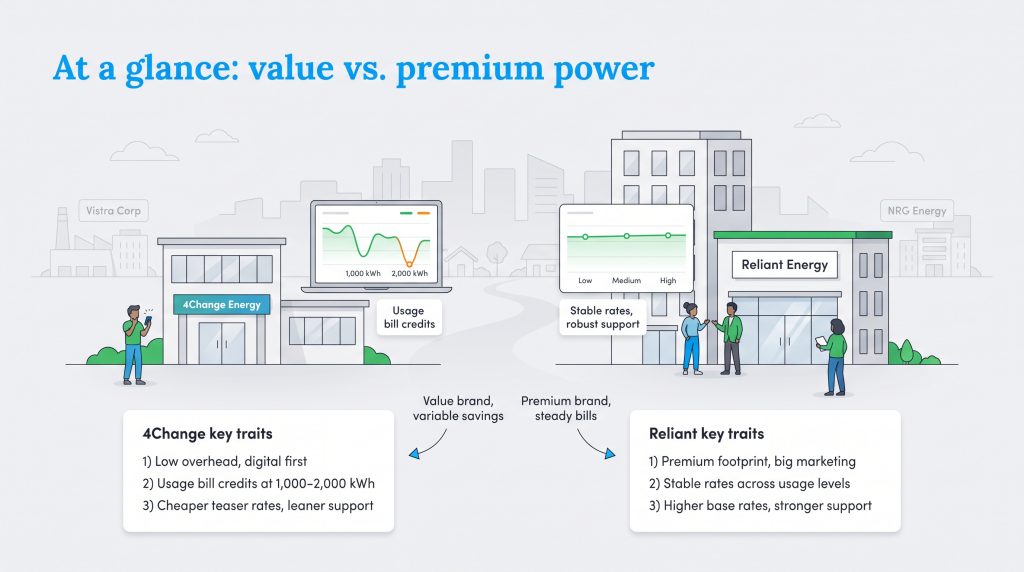
Pinning down the cheapest electricity plan requires looking far beyond the flashy advertised price. To truly understand this Texas electricity comparison, you have to peel back the layers and examine how their business models differ at a fundamental, corporate level. These two retail providers take completely different approaches to operational overhead, marketing, and customer acquisition.
At the corporate level, examining NRG Energy vs Vistra Corp helps explain the pricing disparities you see on your screen. Reliant Energy is a premium flagship brand owned by NRG Energy. They invest heavily in a massive physical footprint across Texas, expensive marketing campaigns, robust tech integrations, and an extensive 24/7 customer service network. Conversely, 4Change Energy is owned by Vistra Corp (the same conglomerate behind TXU Energy). Vistra operates 4Change as a value-brand with a much lower operational overhead and a digital-first approach. By keeping their internal costs low, 4Change can offer aggressive teaser rates and generous charitable donations — but often at the expense of premium customer support resources.
- 4Change Energy’s Pricing Model: This provider builds its identity around usage-based bill credits. If your household manages to use a specific amount of power — often exactly 1,000 kWh or 2,000 kWh in a billing cycle — you are rewarded with a steep discount. If you fall short, your effective rate skyrockets.
- Reliant Energy’s Pricing Model: As an established legacy provider, Reliant takes a more traditional approach. They offer a much steadier rate across all usage levels, which protects you from sudden bill spikes. While their base rates might start slightly higher, their straightforward approach removes the stress of constantly monitoring your smart thermostat to game the system.
| Feature | 4Change Energy | Reliant Energy |
|---|---|---|
| Parent Company | Vistra Corp | NRG Energy |
| Primary Pricing Structure | Tiered bill credits based on usage | Straightforward fixed rates |
| Average Base Charge | Often $0 to $4.95 | Varies significantly by plan |
| Early Termination Fee (ETF) | $20 per month remaining | Flat fee ($150 to $295) |
| Satisfaction Guarantee | 60 Days | 90 Days |
Usage Tier Pricing: How 500, 1000, 1500, and 2000 kWh Compare
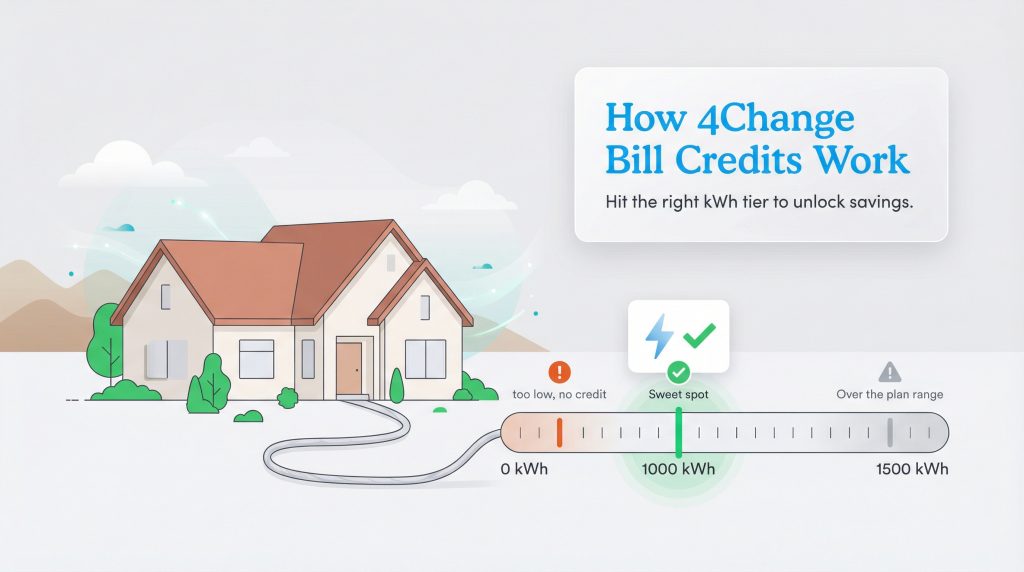
To accurately compare energy plans, you must look at how much you actually pay across different household consumption levels. This is where understanding 4Change Energy bill credits becomes critically important. When you look at a credit-based plan side-by-side with the standard fixed-rate electricity plans Texas residents rely on from Reliant Energy, the financial differences at various milestones are jarring.
| Monthly Usage Level | 4Change Energy (Bill Credit Model) | Reliant Energy (Flat-Rate Model) |
|---|---|---|
| 500 kWh (Small Apartment) | High effective rate (Credit missed) | Stable standard rate |
| 1,000 kWh (Medium Home) | Lowest effective rate (Credit applied) | Stable standard rate |
| 1,500 kWh (Transition Zone) | High effective rate (Credit diluted) | Stable standard rate |
| 2,000 kWh (Large Home) | Moderate to low rate (Credit applied) | Stable standard rate |
A popular 4Change plan might advertise a fantastic 7.2¢ per kWh rate, but that rock-bottom price only activates if your usage crosses the exact 1,000 kWh threshold. If you live in a moderate-sized apartment and use only 800 kWh during a mild spring month, you miss the credit entirely, causing your effective rate to spike to 15¢ or 18¢ per kWh for that cycle.
Even more problematic is the 1,500 kWh “dead zone.” If you use exactly 1,500 kWh — common for older Texas homes during June or July — 4Change’s bill credits heavily dilute. You have surpassed the 1,000 kWh sweet spot, but you haven’t yet unlocked the secondary 2,000 kWh credit threshold. Those extra 500 kilowatt-hours are charged at a premium rate, severely dragging up your average bill cost.
Conversely, Reliant Energy’s straightforward plans maintain a fairly stable effective rate whether you use 500 kWh or 1,500 kWh. Think about the extremes of Texas weather: your usage will inevitably surge during a 100-degree August and plummet during a pleasant November. If your household’s energy usage is a rollercoaster, Reliant’s pricing stability is often worth its weight in gold. Always consult the Power to Choose shopping guide and FAQ before signing a contract to check exactly where those credit thresholds sit.
Reliant Plans and Pricing
Here are the current top flagship plans offered by Reliant Energy, curated to showcase their most popular flat-rate and time-of-use options.
| Plan Name | Rate /kWH | Plan Term | Cancellation Fee | |
|---|---|---|---|---|
| Reliant Power on 9 Plan | 13.2¢ | 9 Months | $95.00 | Check Availability |
| Reliant Power On 8 Plan | 13.9¢ | 8 Months | $75.00 | Check Availability |
| Reliant Power On 12 Plan | 14¢ | 12 Months | $150.00 | Check Availability |
| Reliant Power on 6 | 14.3¢ | 6 Months | $75.00 | Check Availability |
| Reliant Power On 18 | 14.7¢ | 18 Months | $180.00 | Check Availability |
| Reliant Power On 13 | 14.7¢ | 13 Months | $150.00 | Check Availability |
| Reliant Basic Power 24 plan | 14.7¢ | Month to Month | N/A | Check Availability |
| Reliant Power On 24 Plan | 15.2¢ | 24 Months | $295.00 | Check Availability |
| Reliant Basic Power 12 plan | 15.7¢ | Month to Month | N/A | Check Availability |
| Reliant Power Savings 2,000 kWh 24 plan | 18.6¢ | Month to Month | N/A | Check Availability |
| Reliant Power Savings 2,000 kWh 12 plan | 20.3¢ | Month to Month | N/A | Check Availability |
4Change Energy Plans and Pricing
Below are the most competitive flagship plans from 4Change Energy, highlighting their aggressive bill credit structures for targeted usage tiers.
| Plan Name | Rate /kWH | Plan Term | Cancellation Fee | |
|---|---|---|---|---|
| Maxx Saver Value 8 | 7.2¢ | 6 Months | $20.00 | Check Availability |
| Maxx Saver Value 12 | 7.4¢ | Month to Month | N/A | Check Availability |
| Maxx Saver Value 24 | 9¢ | Month to Month | N/A | Check Availability |
| Maxx Saver Value 36 | 10.7¢ | Month to Month | N/A | Check Availability |
| Maxx Saver Select 12 | 12.7¢ | Month to Month | N/A | Check Availability |
| Maxx Saver Select 24 | 13¢ | Month to Month | N/A | Check Availability |
| Maxx Select Green 12 - Exclusive Offer! | 13.2¢ | 12 Months | $20.00 | Check Availability |
| Charitable Saver 24 | 13.5¢ | Month to Month | N/A | Check Availability |
| Maxx Saver Select 18 - Exclusive Offer! | 14.3¢ | 18 Months | $20.00 | Check Availability |
| Charitable Saver 12 | 14.4¢ | 12 Months | $20.00 | Check Availability |
| Power Saver 12 | 16.7¢ | Month to Month | N/A | Check Availability |
| Savvy Saver 24 | 16.9¢ | 24 Months | $20.00 | Check Availability |
| One Rate 12 | 17¢ | Month to Month | N/A | Check Availability |
| Power Saver 24 | 17¢ | Month to Month | N/A | Check Availability |
| One Rate 24 | 17.2¢ | 24 Months | $20.00 | Check Availability |
| Perfect Fit 12 | 17.3¢ | Month to Month | N/A | Check Availability |
| Cash Money 12 | 17.7¢ | Month to Month | N/A | Check Availability |
| Power Maxx Saver 24 | 18.2¢ | Month to Month | N/A | Check Availability |
| Power Maxx Saver 12 | 18.8¢ | Month to Month | N/A | Check Availability |
| Power Maxx Advantage 24 | 19.1¢ | Month to Month | N/A | Check Availability |
| Power Maxx Advantage 12 | 19.1¢ | Month to Month | N/A | Check Availability |
| Power Saver Monthly | 19.8¢ | Month to Month | N/A | Check Availability |
💡 Pro Tip: If you rent a smaller apartment, bill credit plans might not work in your favor. Smaller floor plans rarely consume 1,000 kWh a month, meaning you will likely miss out on the discount and pay a much higher premium for your power.
Flagship Plan Matchup: Maxx Saver vs. Truly Free Nights
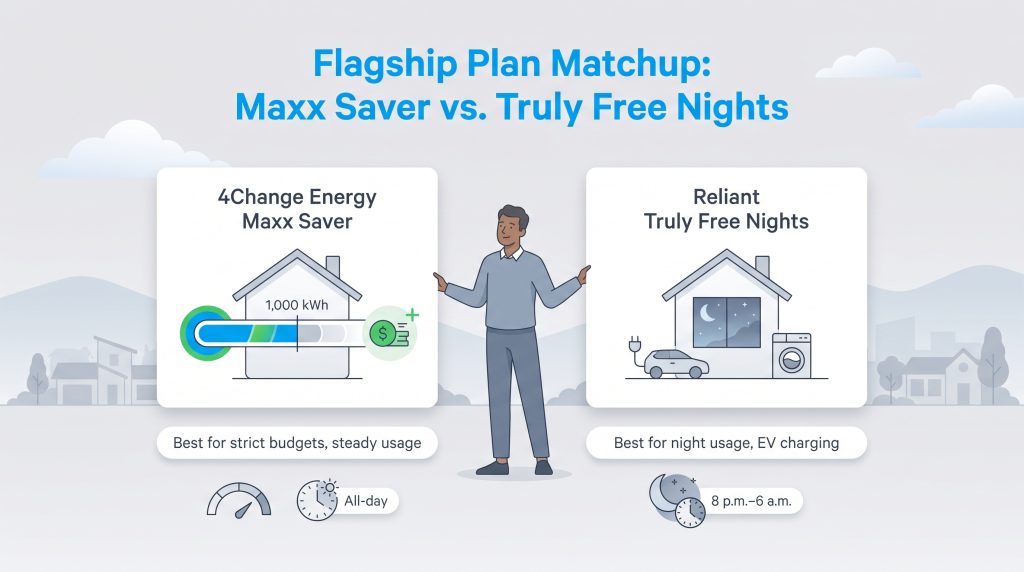
To truly understand how these providers cater to different lifestyles, we have to put their most famous plans head-to-head. 4Change Energy Maxx Saver and Reliant Truly Free Nights represent the peak offerings of their respective business models, and they require completely different household behaviors to be cost-effective.
| Plan Feature | 4Change Energy Maxx Saver | Reliant Truly Free Nights |
|---|---|---|
| Best For | Strict budgets and moderate, highly consistent usage | Night owls, EV owners, and smart home enthusiasts |
| Pricing Mechanism | Generous bill credit applied at 1,000 kWh | 100% free electricity from 8:00 p.m. to 6:00 a.m. |
| Daytime Rate | Highly dependent on hitting exact usage tiers | Premium daytime fixed rate |
| Management Effort | High (Requires strict monthly usage monitoring) | Moderate (Requires shifting chores to nighttime) |
The 4Change Energy Maxx Saver plan is an incredible money-saver — provided you live in a Goldilocks zone of electricity usage. It requires your home to consistently cross the 1,000 kWh mark month after month. If you have an older, inefficient HVAC system that pushes your usage to 1,800 kWh in the summer, or a small footprint that only requires 700 kWh in the winter, the Maxx Saver will punish your wallet. This plan demands that you regularly monitor your daily consumption and artificially tweak your thermostat to ensure you hit that lucrative credit threshold without flying too far past it.
On the flip side, the Reliant Truly Free Nights plan completely changes the rules of the game by focusing on when you use power, rather than how much. Your daytime rate will be noticeably higher than average, but the meter effectively pauses from 8:00 p.m. until 6:00 a.m. every single day. If you work away from home during the day and can shift your heavy lifting to the evening — running the dishwasher, doing excessive laundry, dropping the AC temperature before bed, or plugging in an electric vehicle — this plan offers immense value. It rewards behavioral adjustments rather than punishing you for unpredictable seasonal weather.
Prepaid Plans and Credit Check Requirements
For many residents, finding prepaid electricity with no credit check is an absolute necessity. Whether you are rebuilding your credit score, establishing utility history for the first time, or just prefer paying for your power upfront to avoid surprise monthly bills, the prepaid market offers a vital safety net.
In this category, Reliant Energy is the clear winner because 4Change Energy does not currently offer prepaid electricity options. 4Change requires a standard soft credit check during enrollment, and if your score falls below their threshold, they will mandate an upfront deposit before turning on your lights.
Reliant Energy, however, caters directly to this demographic with their popular Prepaid Power plan. As long as your home is equipped with a smart meter, you can set up an account with a very minimal starting balance (often as low as $50). There is zero credit check required and no long-term contract tying you down. You simply fund your account, and Reliant deducts your daily usage via smart meter readings. They even send you daily text or email alerts letting you know your remaining balance, allowing you to top up your account right from your smartphone.
Hidden Fees: TDU Charges and Early Termination
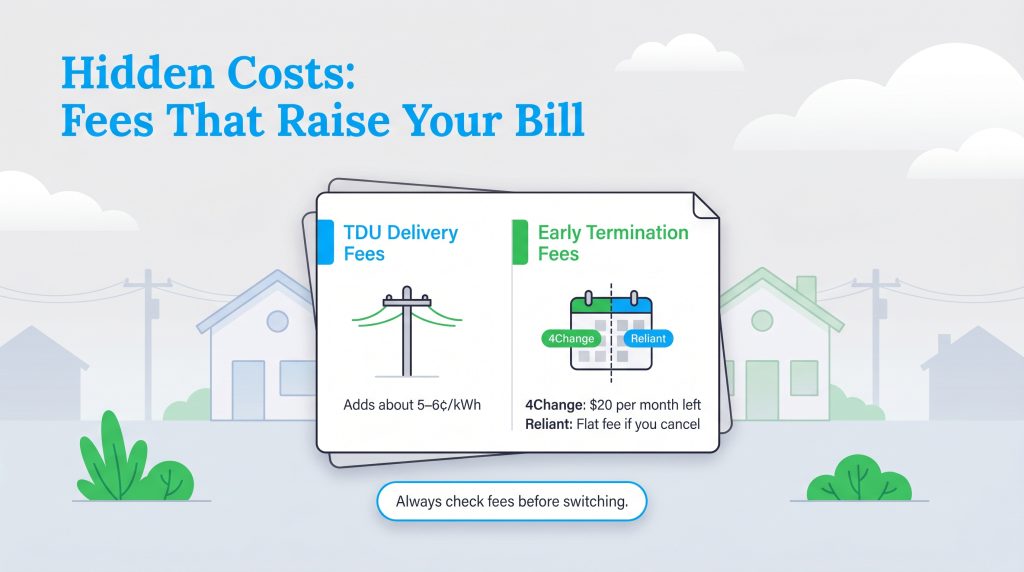
No Texas electricity comparison is complete without addressing the hidden fees that catch everyday consumers off guard. The two most significant extra costs you need to monitor are energy delivery fees and early termination fees (ETFs).
If you sign a fixed-rate contract and decide to leave before it expires, you will face a steep penalty. Early termination fees in Texas electricity contracts vary wildly depending on how a provider structures their business.
- 4Change Energy (Prorated ETF): Typically charges $20 for every month remaining on your contract. If you break a 12-month contract with 10 months left, you will owe a hefty $200 penalty.
- Reliant Energy (Flat-Fee ETF): Generally uses a flat-fee structure. Breaking a 12-month contract usually triggers a flat $150 fee, while breaking a 24-month contract costs $295, regardless of how much time is left.
Beyond cancellation penalties, you must also account for TDU delivery charges. Your local Transmission and Distribution Utility (like Oncor in Dallas or CenterPoint in Houston) charges a fee to maintain the power lines, fix outages, and read your meter. These energy delivery fees (TDU) often add around 5¢ to 6¢ per kWh to your monthly bill. Because TDU fees are regulated by the state, they apply equally to both 4Change and Reliant customers, but they are rarely included in the massive headline font on provider websites.
🚩 Heads Up: Always look closely at the fine print for TDU charges on the Electricity Facts Label. These mandatory delivery fees are not always prominently displayed in a provider’s advertised teaser rate, which can lead to frustrating first-month bill shock.
Customer Satisfaction and PUCT Complaint Ratios
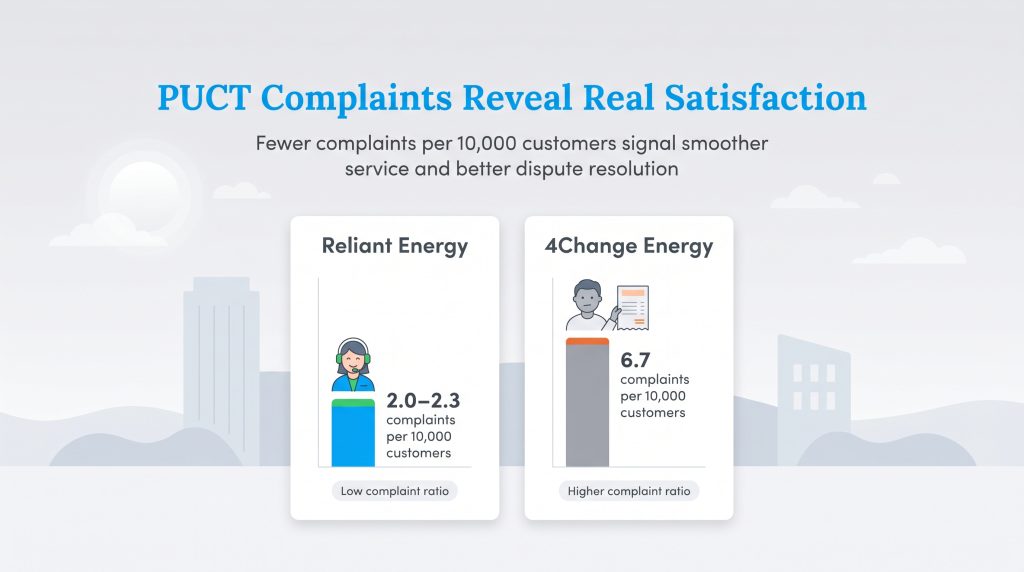
When evaluating the reliability of a utility company, marketing claims mean very little compared to official state data. The Public Utility Commission of Texas (PUCT) tracks every formal grievance filed against retail electric providers, allowing us to see an objective PUCT complaint ratio. This vital metric shows exactly how many complaints a provider receives per 10,000 customers, cutting through the noise to reveal true consumer satisfaction.
When reading 4Change vs Reliant reviews online, you might notice mixed sentiments, but official data paints a much clearer picture. Despite its massive size and millions of residential customers across the state, Reliant Energy maintains an exceptionally low complaint ratio. They consistently register roughly 2.0 to 2.3 complaints per 10,000 customers. This low score indicates a highly polished customer service infrastructure. Because of NRG Energy’s deep pockets, Reliant Energy customer service includes comprehensive 24/7 phone support, detailed live chat, and a sophisticated mobile app to resolve issues instantly.
4Change Energy also holds a respectable record within the industry, but their complaint ratio sits noticeably higher at around 6.7 complaints per 10,000 customers. Many of the common frustrations with bill credit providers revolve around confusion over strict usage tiers and sudden renewal rate increases. Furthermore, because Vistra Corp runs 4Change as a lean, value-based brand, their phone support is generally limited to standard business hours (Monday through Friday, plus limited Saturday morning hours). If your power cuts out on a Sunday afternoon, reaching a live representative at 4Change is significantly more difficult than it is with Reliant.
Renewable Options and Smart Home Perks
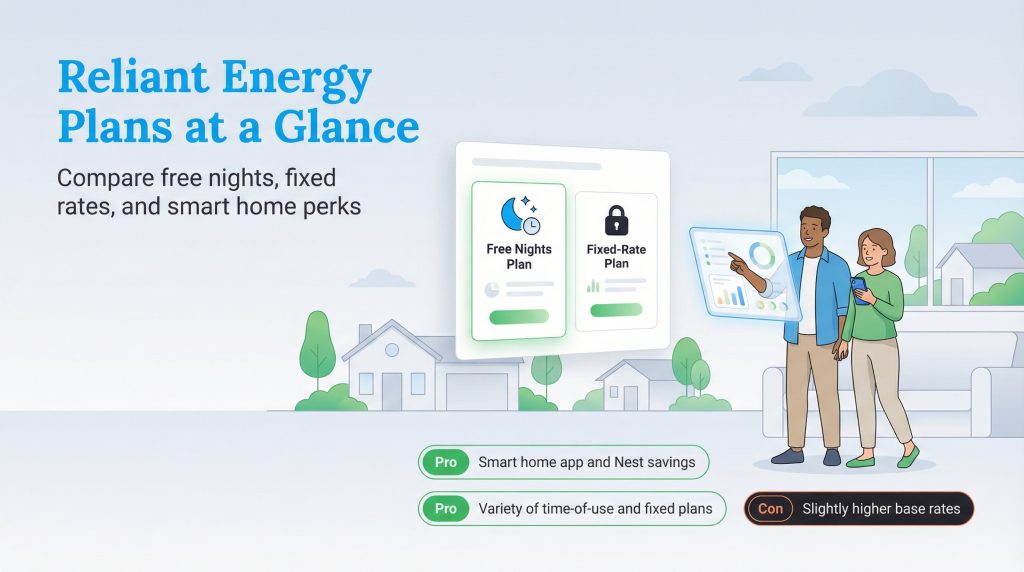
Beyond basic electricity supply, both providers offer distinct qualitative perks designed to improve your daily lifestyle and lessen your environmental impact. If you are aiming for an environmentally mindful choice, both companies excel at offering 100% renewable plan options typically backed by verified Renewable Energy Certificates (RECs). Reviewing Texas renewable energy generation data shows just how accessible wind and solar power have become, allowing providers to offer green energy without sacrificing grid stability.
Reliant Energy stands out by pairing its robust electricity supply with incredible tech integrations. As a major legacy provider, Reliant partners directly with Google Nest and frequently offers promotions that include smart thermostats right out of the box. They also feature sophisticated time-of-use options, including their wildly popular Free Nights and Weekends plans. If you want to explore other residential electric options that pair seamlessly with modern smart home ecosystems, it is hard to find a competitor matching Reliant’s impressive level of digital convenience.
4Change Energy takes a noticeably different approach to their qualitative perks. Rather than focusing heavily on smart home gadgets or free night schedules, they prioritize a mission of charitable giving. A set percentage of their annual profits is consistently donated to local Texas charities, supporting critical causes like community feeding programs, cancer research, and disaster relief efforts. This philanthropic model is a highly appealing energy-saving option for consumers who want the peace of mind that their monthly utility payment is doing actual good in their local community.
🌱 Eco Edge: Opting for an eco-conscious alternative does not mean you have to pay a massive premium in Texas. The abundance of local wind farms keeps renewable electricity rates highly competitive across both brands, ensuring you can support the planet while still protecting your wallet.
How to Switch Between Reliant and 4Change Energy
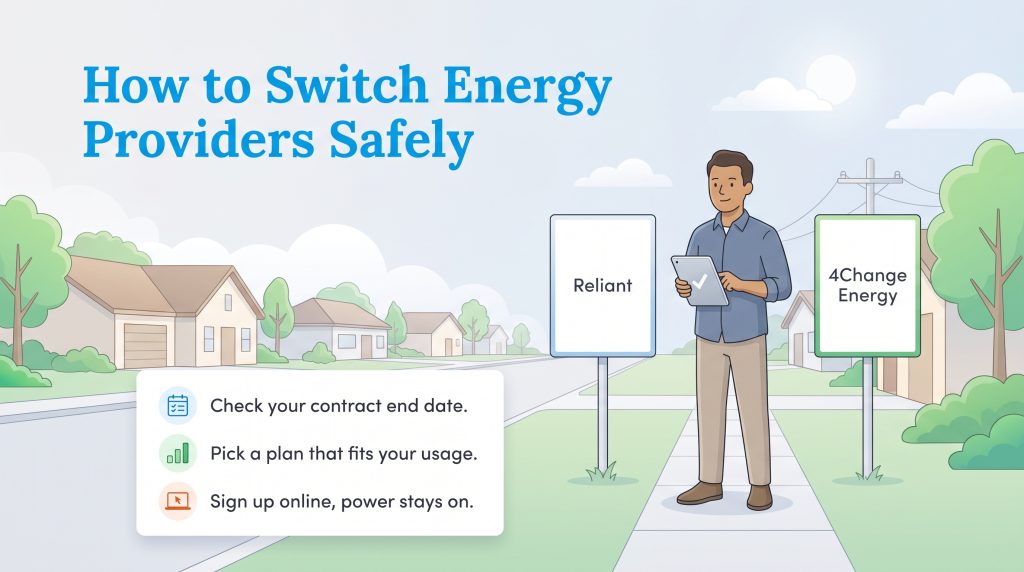
If you are ready to trim your monthly expenses and secure a better rate, switching providers is a surprisingly seamless process. The primary hurdle most homeowners face during this transition is navigating the switch without triggering a harsh early termination penalty. Always check your current contract details first to identify any looming cancellation fees. Fortunately, according to the Public Utility Commission of Texas, if you are within 14 days of your existing contract expiring, you are legally allowed to switch to a new provider entirely penalty-free.
Whether you are moving into a brand new build or simply managing your utilities in Houston, the transition happens entirely on the backend of the energy grid. You will absolutely not lose power during the changeover, and nobody needs to visit your property to physically flip a switch or change out hardware.
Follow these three simple, foolproof steps to switch providers safely:
- Review your current Electricity Facts Label to confirm your exact contract end date and avoid any surprise fees.
- Select a new electricity plan that aligns perfectly with your historical energy usage to maximize your potential bill credits or lock in a secure flat rate.
- Sign up with your newly chosen provider online. They will handle all the complex transition communication with your local Transmission and Distribution Utility (TDU), ensuring a seamless handover without any interruption to your daily life.
Locking In the Right Texas Electricity Provider for Your Home
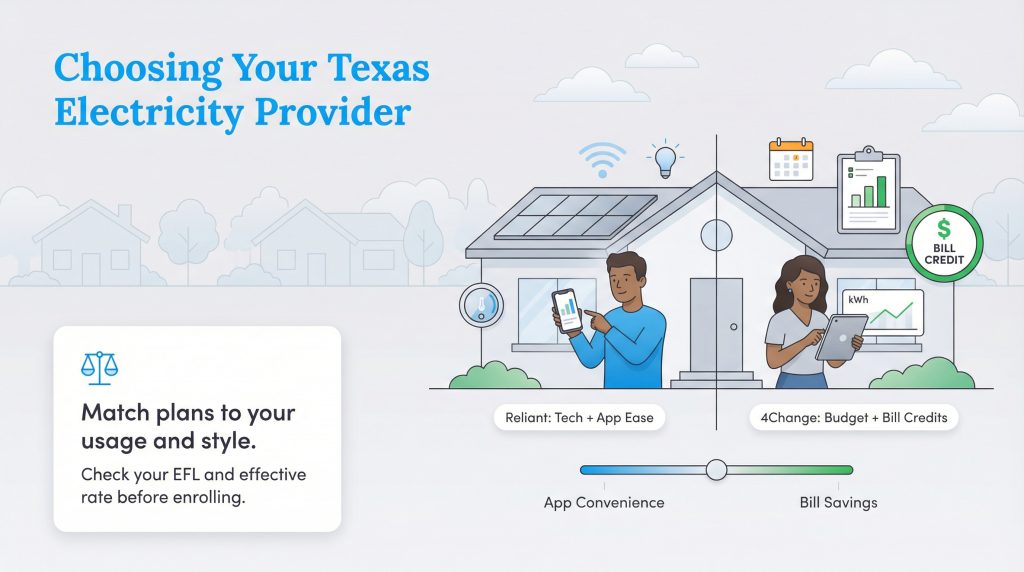
Choosing the right power company ultimately boils down to your personal management style, budget flexibility, and household footprint. There is no single provider offering the absolute cheapest electricity in Texas because your final rate depends entirely on how you consume power. After evaluating both companies closely, here is how the competition shakes out:
- Price Winner: 4Change Energy (Conditionally). If your home consistently consumes exactly 1,000 kWh or 2,000 kWh every month, 4Change’s bill credit plans will save you more money over the course of a year. If your usage is unpredictable, Reliant takes the win for pricing stability.
- Plan Variety Winner: Reliant Energy. With a vast array of prepaid, fixed-rate, and sophisticated time-of-use options like Truly Free Nights, Reliant caters to a much broader spectrum of homeowners and unique lifestyles.
- Customer Service Winner: Reliant Energy. Backed by NRG Energy’s deep pockets, Reliant offers 24/7 support, a phenomenal mobile app, and a superior PUCT complaint ratio that 4Change simply cannot match.
- Green Energy Winner: Tie. Both providers offer robust 100% renewable plans backed by verified RECs, allowing you to seamlessly lower your carbon footprint.
By identifying your past usage history and embracing one of these strategies to save on your electric bill, you can confidently lock in a contract that truly serves your home and lifestyle.
Frequently Asked Questions About Reliant and 4Change Energy
Who owns Reliant Energy and 4Change Energy?
Which provider has the cheapest electricity in Texas?
Does Reliant or 4Change Energy offer prepaid electricity?
Which provider is better for homes using over 2,000 kWh per month?
How do 4Change Energy bill credits work?
Are Oncor or CenterPoint delivery fees included in Reliant rates?
Can I cancel my 4Change Energy or Reliant plan without a penalty?
How does Reliant Energy’s customer service compare to 4Change Energy’s?
About the Author

David has been an integral part of some of the biggest utility sites on the internet, including InMyArea.com, HighSpeedInternet.com, BroadbandNow.com, and U.S. News. He brings over 15 years of experience writing about, compiling and analyzing utility data.

LaLeesha has a Masters degree in English and enjoys writing whenever she has the chance. She is passionate about gardening, reducing her carbon footprint, and protecting the environment. She also recently served as President of the Board for City Sprouts (a community garden).