

Streamline The Moving Process By Organizing Utility Transfers, Accessing Senior-Specific Benefits, And Ensuring Essential Services Are Ready On Day One
Key Takeaways
- Create a centralized utility folder with account numbers, medical device requirements, and previous addresses to speed up provider calls.
- Request priority restoration status from electric companies if you or a family member relies on life-sustaining medical equipment.
- Ask for senior discounts and low-income assistance programs like LIHEAP, and use our chronological utility checklist to reduce monthly costs from the start.
Moving to a new home brings complicated logistical hurdles, but this complete Seniors Utility Setup Guide provides a highly structured roadmap to ensure essential services are functioning perfectly the moment you arrive. By leveraging the right scheduling timelines and federal assistance programs, you can focus on saving money on fixed incomes rather than stressing over unexpected connection fees. Whether you are managing your own relocation or acting as a caregiver for an aging parent, these actionable steps guarantee a seamless, affordable, and safe transition.
The 4-Week Moving Utility Checklist For Seniors
Managing utility transfers requires sharp coordination and precise timing to avoid a dangerous lapse in heating or cooling. A dedicated moving utility checklist for seniors helps break these logistical chores into manageable weekly tasks so you are never overwhelmed. By handling a few phone calls each week, you completely bypass the chaotic rush that causes many people to overlook valuable senior discounts. Follow this chronological breakdown to keep your transition perfectly on track:
| Time to Move | Action Required | Providers to Contact |
|---|---|---|
| Week 4 (Audit and Research) | Gather current account numbers, your Social Security Number, and the exact physical address of your new residence. Request a formal “Letter of Credit” to bypass future deposit fees. | Current providers (Electric, Gas, Water) |
| Week 3 (Schedule Disconnections) | Schedule your shut-off dates. When figuring out how to cancel utilities after moving, always set the disconnection for 48 hours after you physically move out. | Current providers (Internet, Trash, Electric) |
| Week 2 (Initiate New Services) | Contact companies two weeks before move-in to guarantee connection dates. Request your medical priority paperwork if you use life-sustaining medical equipment. | New municipal water district, regional gas, and internet providers |
| Week 1 (Confirm and Pack) | Make brief confirmation calls to ensure all orders are locked in. Pack a physical “utility folder” containing confirmation numbers and caregiver authorization forms in your personal travel bag. | All newly established providers |
Concierge Services Vs. DIY Utility Setup
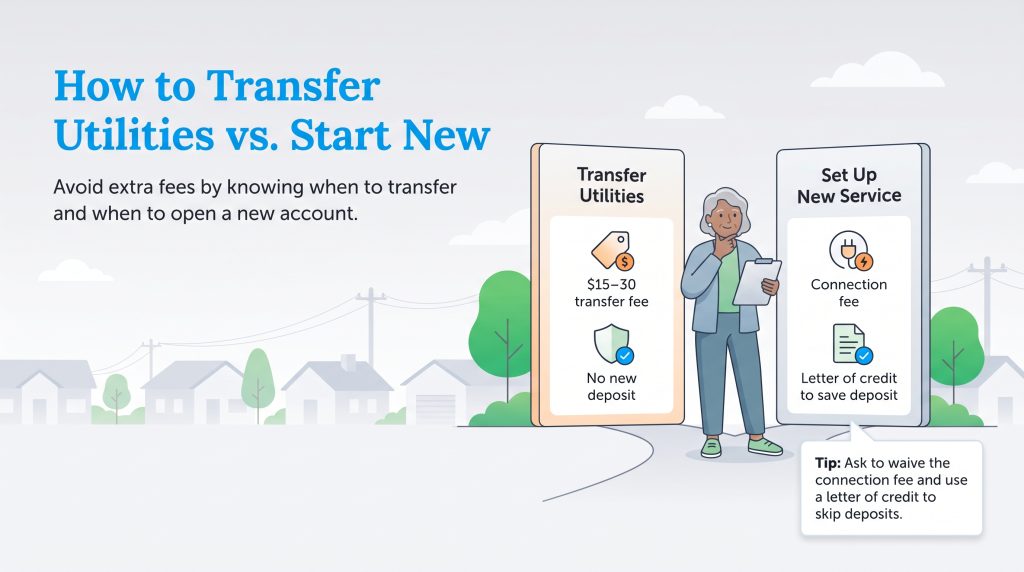
If you are an adult child acting as a caretaker who needs to transfer utilities for elderly parents, time is likely your most precious resource. Managing a downsizing utility setup often forces families to choose between hiring a third-party utility concierge service or handling the administrative burden themselves. Understanding the administrative difference between transferring utilities and setting up entirely new services plays a huge role in this decision.
When transferring existing accounts to a new home within the same municipal territory, you usually only face a modest administrative fee of $15 to $30. If you are starting fresh in a new region, however, establishing the account often requires navigating complex credit checks and deposit waivers. Here is a breakdown of your two primary setup options:
- Pros of Concierge Services: These services save caretakers hours of frustrating hold times. They provide a single point of contact and coordinate the connection of electricity, internet, and water simultaneously.
- Cons of Concierge Services: You must hand over highly sensitive data — including your parent’s Social Security Number — to a third-party broker. Some aggressive concierges also push expensive internet bundles to earn commissions.
- Pros of DIY Setup: Calling the providers directly ensures maximum data privacy. It also gives you the perfect opportunity to negotiate deposit waivers and directly apply for senior citizen utility rate reductions.
- Cons of DIY Setup: It is incredibly time-consuming. You must fax or securely upload legal documentation, like a Financial Power of Attorney, to every individual utility provider to establish your authority.
Federal And State Utility Assistance Programs
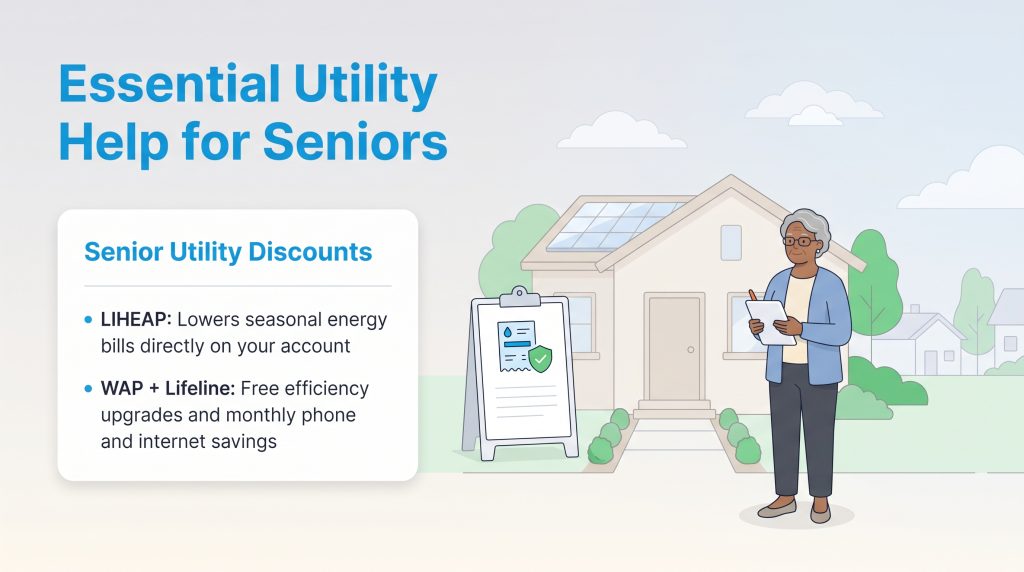
Living on a fixed retirement income leaves little room for unpredictable seasonal energy spikes. While many local municipal districts offer basic deposit waivers, the most robust financial safety nets come from state and federal initiatives. Accessing senior utility assistance programs ensures your household budget is protected against severe winter storms or intense summer heatwaves. Eligibility for these critical lifelines is usually based on a central income metric: households must generally fall at or below 200% of the federal poverty level to qualify.
Low-Income Home Energy Assistance Program (LIHEAP)
Submitting a LIHEAP application for seniors is one of the single most impactful financial moves you can make during a relocation. The Low-Income Home Energy Assistance Program is a federally funded resource designed specifically to help vulnerable households manage the high costs of heating and cooling. Rather than handing you a check, LIHEAP issues grants directly to your local utility provider, which automatically lowers the outstanding balance you owe during extreme weather months.
Because these federal funds are dispersed by individual states and run out rapidly each season, verify your local eligibility immediately. You can check your eligibility criteria through the National Council on Aging’s BenefitsCheckUp.org tool, by calling the official federal toll-free number at 1-866-674-6327, or by reviewing state-specific application deadlines online.
Weatherization Assistance Program (WAP)
While LIHEAP tackles your immediate bills, the Weatherization Assistance Program WAP solves the underlying cause of long-term energy loss. This federal initiative provides completely free, permanent home improvements to eligible residents. Certified contractors will evaluate your new residence and install energy-saving upgrades like heavy attic insulation, advanced weatherstripping around drafty doors, and necessary HVAC repairs.
Low-income senior energy assistance extends beyond just heating and cooling. Older adults who meet the strict income criteria for WAP frequently qualify for the federal Lifeline Support program as well, allowing them to secure steep monthly discounts on essential broadband internet and phone services.
How To Secure Utility Discounts For Senior Citizens
Utility discounts for senior citizens are widespread across the country, but they are rarely advertised on the front page of a municipal provider’s website. If you want to secure these lucrative rate reductions or standard deposit waivers, you have to initiate the conversation. Many local water districts and regional energy cooperatives offer unpublicized perks for customers starting at age 62 or 65, but customer service agents are usually not required to volunteer this information unless explicitly prompted.
To guarantee you receive every possible financial accommodation during your setup call, use this exact phrasing when speaking to the customer service representative:
“Hi, my name is [Your Name], and I am calling to set up my new service. As a senior citizen living on a fixed income, I want to ensure my account is structured as affordably as possible. Can you please tell me exactly what age-based rate reductions, deposit waivers, or local low-income assistance programs your company currently offers?”
💡 Pro Tip: If you are moving to a deregulated energy market where you can choose your own provider, always ask for a “Letter of Credit” from your previous utility company. Proving 12 months of on-time payments is the most effective way to force a new provider to completely waive your initial security deposit.
Balancing Energy Savings With Home Safety
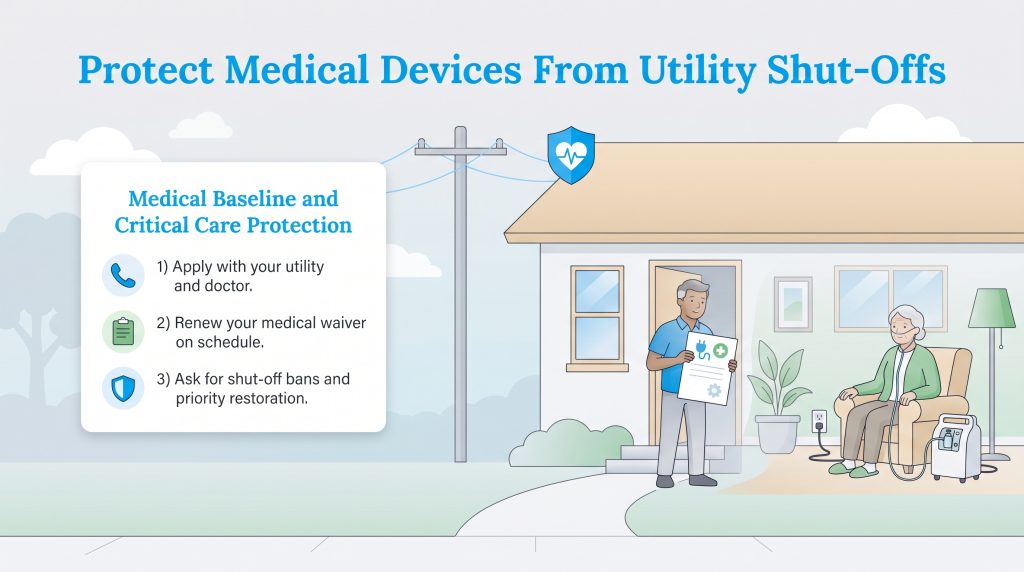
A sudden power outage is a frustrating inconvenience for most people, but it can quickly escalate into a life-threatening emergency if you or a family member relies on oxygen concentrators, CPAP machines, or refrigerated medications. Utility companies maintain strict protocols to protect medically vulnerable customers, but you must actively request a 30-Day Medical Certificate. Having your primary care physician sign this document guarantees your home is placed on a “Priority Restoration” list during major storms and prevents aggressive disconnections due to billing errors.
Lighting Upgrades And Fall Prevention
When searching for energy saving tips for elderly homeowners, the most critical rule we share with our readers is this: Do not sit in the dark just to save a few dollars. Sacrificing visibility inside your home dramatically increases the risk of severe, life-altering falls.
Instead of turning the lights off, command your energy usage by completely replacing every traditional incandescent bulb in your new home with ENERGY STAR-certified LEDs. These exceptionally bright, eco-conscious alternatives provide maximum visibility in dangerous areas like stairwells and bathrooms, while simultaneously reducing your lighting electricity costs by an astonishing 90%.
Temperature Management For Older Adults
Proper temperature control is vital for older adults, who are significantly more susceptible to heatstroke and hypothermia. Thankfully, finding the best smart thermostats for older adults has never been easier. Look for intuitive models that feature high-contrast, exceptionally large readable fonts. By integrating a voice-activated smart thermostat into your living room, you gain the ability to adjust the temperature perfectly without risking a fall by climbing on a step-stool or getting out of a comfortable chair.
How To Identify And Avoid Utility Scams
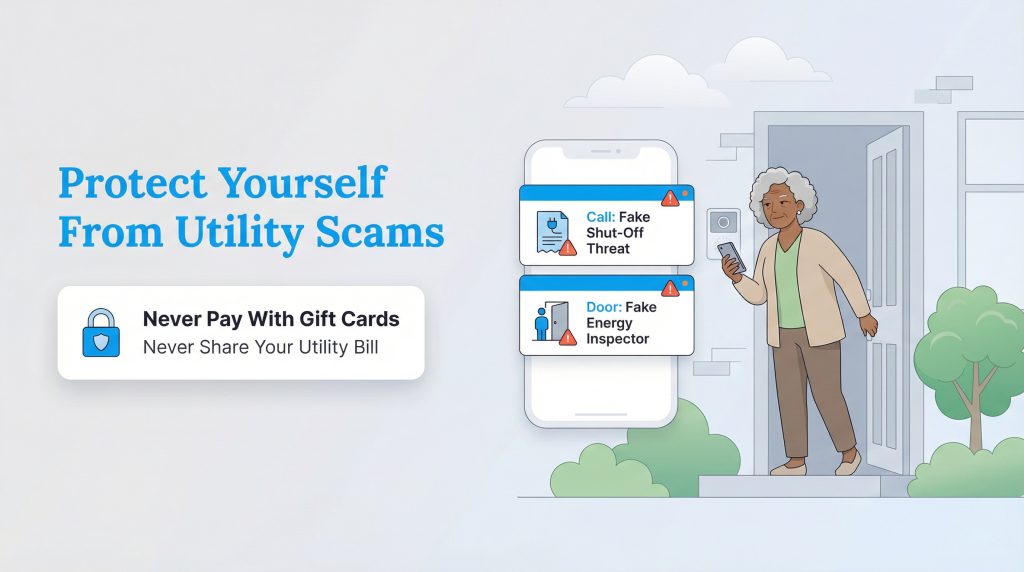
Unfortunately, the chaos of moving makes senior citizens prime targets for opportunistic criminals. Fraudulent utility setup scams peak during the transitional moving phase, as thieves rely heavily on your natural anxiety about getting the lights turned on before you arrive. To protect your financial security, stay highly vigilant and watch for these top three red flags:
- Demanding Immediate Payment via Gift Card: Legitimate utility companies will absolutely never demand that you pay a security deposit or a past-due balance using prepaid retail gift cards, wire transfers, or cryptocurrency. If a caller insists on these untraceable payment methods, it is a scam.
- Threatening Immediate Shutoffs: Criminals frequently spoof caller ID numbers to make it look like your electric provider is calling, threatening to cut your power in 30 minutes if you do not pay immediately. Real utilities are legally required to send multiple written notices through the mail before taking drastic disconnection action.
- Unannounced Door-to-Door Sales: If a high-pressure salesperson shows up unannounced at your new front door demanding to see your electric bill to “lower your rate,” politely close the door. They are often attempting to trap you in an aggressive, predatory energy contract.
If you ever suspect you are dealing with a fraudulent caller, hang up the phone immediately without sharing any information. Locate a recent paper bill or search for your municipal utility district’s official website online, and dial the customer service number printed directly on your physical statement to confirm your actual account status.
Preparing For Your First Day In The New Home
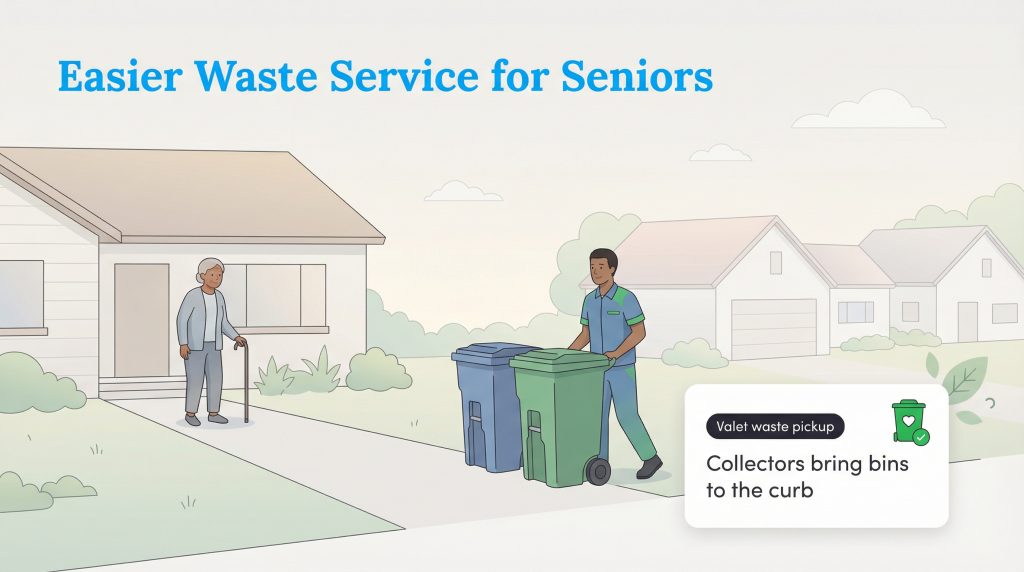
To successfully finalize your transition, take a moment to evaluate the physical accessibility of your ongoing household chores. Dragging heavy trash and recycling bins down a long, icy driveway is incredibly dangerous. Before you officially move in, contact your municipal waste management company and ask if they offer a premium “valet service” or “door service.” Many municipalities offer this accommodation for seniors at a steep discount, sending sanitation workers directly up the driveway to retrieve and return your bins safely.
By securing your 30-Day Medical Certificate for priority restoration, explicitly asking for age-based discounts, and thoroughly confirming your 48-hour service overlaps, you completely remove the stress of setting up utilities for a new home. Advocating for your rights and tapping into available financial assistance ensures your new house remains a secure, relaxing, and highly affordable sanctuary for years to come.
Learn more in Utility Bills 101: A Complete Guide to Costs, Setup, and Savings.
Frequently Asked Questions About Setting Up Utilities For Seniors
Do senior citizens get a discount on utilities?
Yes, many senior citizens can secure utility discounts, though the specifics depend heavily on your local municipality or retail energy provider. You can often get initial security deposits waived by requesting a senior accommodation, and many districts offer small percentage discounts for customers aged 65 and older who explicitly ask for rate reductions.
How do I apply for LIHEAP utility assistance for my elderly parents?
To apply for LIHEAP utility assistance on behalf of your elderly parents, you must gather proof of their fixed income, recent utility bills, and proof of residence. If they are cognitively unable to sign the paperwork themselves, you will need to provide a notarized Financial Power of Attorney. You can verify their eligibility and find local application offices by calling 1-866-674-6327 or visiting the National Council on Aging’s BenefitsCheckUp portal.
How much notice do utility companies need when transferring service?
We highly recommend contacting your utility companies at least two full weeks before your scheduled moving date. This 14-day buffer ensures you have ample time to process caregiver authorization paperwork, secure medical baseline waivers, and lock in overlapping connection dates so you are never left in the dark.
Does Medicare cover any utility or electricity costs for medical equipment?
No, Medicare is strictly a health insurance program and absolutely does not cover any monthly household utility bills or setup fees, even if you require continuous electricity for essential medical devices like CPAP machines. Seniors who need financial help paying for the electricity to run these devices should instead apply for the federal Low-Income Home Energy Assistance Program (LIHEAP).
Can utilities be shut off if an elderly person lives in the home?
Yes, utility providers can legally disconnect service for non-payment even if an elderly person resides in the home. However, you can prevent these dangerous shut-offs by submitting a 30-Day Medical Certificate signed by a physician, which confirms the use of life-sustaining medical equipment and enacts a strict shut-off protection policy.
Is there a government program to help seniors with internet costs?
Yes, the federal Lifeline Support program provides a reliable monthly discount on phone or broadband internet services for eligible low-income subscribers. You can quickly apply through the National Verifier website to confirm if your household income meets the required criteria.
About the Author

David has been an integral part of some of the biggest utility sites on the internet, including InMyArea.com, HighSpeedInternet.com, BroadbandNow.com, and U.S. News. He brings over 15 years of experience writing about, compiling and analyzing utility data.

LaLeesha has a Masters degree in English and enjoys writing whenever she has the chance. She is passionate about gardening, reducing her carbon footprint, and protecting the environment. She also recently served as President of the Board for City Sprouts (a community garden).