

Discover Practical Steps To Secure Emergency Utility Assistance, Navigate Government Programs Like LIHEAP, And Permanently Reduce Your Energy Costs
Key Takeaways
- Reach out to your energy provider immediately to request a payment plan or ask about hardship programs before your service is disconnected.
- Use federal resources like the Low Income Home Energy Assistance Program (LIHEAP) and local 2-1-1 directories to find emergency financial relief.
- Reduce your long-term energy costs by applying for the Weatherization Assistance Program, which provides free eco-conscious home energy upgrades.
Facing a sudden utility shut-off notice brings a heavy, immediate wave of panic, but starting by calling your provider today is your very first step toward finding fast, reliable relief. We know exactly how overwhelming it feels to stare at an overdue balance when funds are tight, which is why we created this comprehensive guide to help you uncover realistic, actionable solutions for your household. If you are facing an imminent disconnection, jump straight down to what to do immediately if you can’t pay your utility bill. Whether you desperately need an emergency grant to keep the lights on tomorrow morning or you are looking for long-term strategies to find cheap electricity plans and permanently lower your monthly charges, finding the right assistance paying utility bills simply requires knowing where to look and what to ask. We will walk you through proven steps to protect your home’s vital services, navigate local and federal applications, and secure the financial breathing room you deserve.
What To Do Immediately If You Can’t Pay Your Utility Bill
When you are facing a potential shut-off, time is your most valuable asset. Knowing exactly what to do first can help reduce your stress and immediately halt a looming disconnection before extra fees pile up. Grab your most recent billing statement and look at the back page or the bottom footer — this is where companies usually list their direct emergency contact number, which often bypasses standard hold times. Follow this quick, time-sensitive checklist to secure your home’s essential services before the situation escalates further:
- Call the utility company to declare financial hardship: Bypass the automated payment system and explicitly ask to speak with the internal hardship assistance team. Formally declaring a financial hardship is often required to unlock protective status on your account and prevent immediate termination.
- Request a budget billing or installment plan: Ask your representative to spread your past-due balance across the next six to 12 months. Specifically instruct them to evaluate your account for “Equal Pay” or “Level Pay” options. These plans average out your annual usage so you pay a predictable, flat rate every month, eliminating massive seasonal spikes. You should also request information on arrearage management plans (AMP), where the utility company will sometimes forgive a portion of your past-due balance for every month you successfully pay your current charges on time.
- Ask for a temporary shut-off extension: If you cannot afford an installment plan today, request a standard 30-day grace period. Most utility providers will instantly grant a temporary extension if you confidently inform them that you are actively gathering documents to apply for federal or local assistance paying utility bills.
When you call your energy provider, bypass the standard billing agents and specifically ask to be transferred to the “hardship department” or “customer assistance program.” Representatives in these specialized tiers have the actual authority to halt disconnections and approve emergency payment plans.
Federal Government Assistance For Utility Bills
If your energy provider cannot offer enough relief through an internal payment plan, it is time to look into federal safety nets designed specifically to keep vulnerable households safe and warm. Government programs for utility bills are robust, reliable, and designed to address both short-term financial crises and long-term household energy efficiency. Accessing these funds requires a bit of paperwork, but the payoff can completely erase your utility debt.
Low Income Home Energy Assistance Program (LIHEAP)
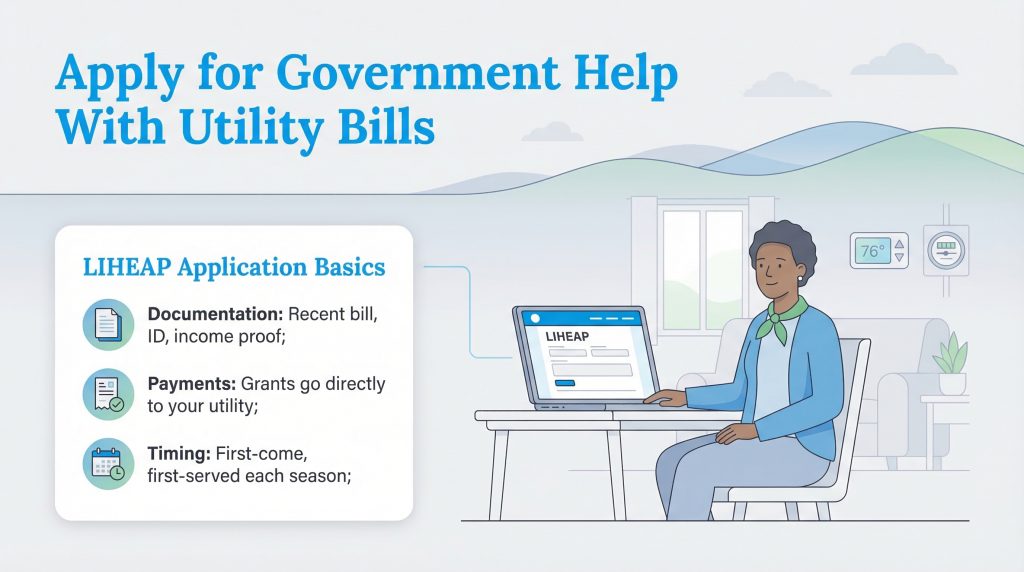
The Low Income Home Energy Assistance Program (LIHEAP) is one of the oldest, most robust forms of federal support available today. This federally funded initiative provides direct financial grants to low-to-moderate-income families, seniors, and disabled individuals who are struggling to cover their natural gas or electric heating and cooling costs. The program responsibly sends the approved grant money directly to your energy provider to erase or heavily reduce your outstanding balance.
You can call the national LIHEAP toll-free number directly at 1-866-674-6327 to find the exact community action agency processing applications for your ZIP code. The application process differs slightly depending on your living situation. If you are a homeowner, you will need to provide property records or a mortgage statement to prove residency alongside your income documents. Renters can absolutely apply as well — simply bring a copy of your active lease agreement proving that you are legally responsible for paying the utility bills at that specific address.
Because funding operates on a strict first-come, first-served basis, you must pay attention to application windows. In most states, LIHEAP applications open in October or November to prepare for winter heating costs, while a secondary window often opens in the spring for summer cooling assistance. Check your eligibility early and schedule an intake appointment before funds deplete for the season.
Weatherization Assistance Program (WAP)
Once the immediate crisis has safely passed and your lights stay on, shift your focus toward permanent cost reduction. The Weatherization Assistance Program (WAP) is a fantastic, energy-saving option that tackles the true root cause of high bills. This vital federal initiative provides eligible households with free, professional home upgrades like robust attic insulation, targeted door weatherstripping, and essential HVAC repairs.
By sealing up drafty windows and optimizing aging heating systems, this environmentally mindful choice permanently reduces your power draw without requiring a single dime of upfront investment. WAP sends a certified energy auditor directly to your property to identify exactly where your home is leaking conditioned air. Embracing these eco-conscious upgrades acts as a long-term shield against volatile energy markets. If you want to explore more tips to save on your electric bill, applying for WAP alongside your LIHEAP grant is the perfect place to start your journey.
Wondering about the difference between WAP and LIHEAP? LIHEAP is a program that provides direct cash grants to pay off your immediate, past-due energy bills. WAP, on the other hand, provides physical, permanent upgrades to your home (like new insulation) to ensure those bills never get too high in the first place.
Rent And Utility Assistance Programs
Struggling to cover electricity often goes hand-in-hand with falling behind on monthly housing payments. Recognizing this overlap, many local housing authorities and regional community action agencies now bundle their relief efforts into comprehensive rent and utility assistance programs. These combined grants are specifically designed to keep vulnerable tenants safely housed by tackling eviction risks and utility disconnections simultaneously.
If you are a renter facing a dual hardship, search for your state’s Department of Housing or local Public Housing Authority (PHA). When you apply for rental relief through these portals, you can often check a dedicated box to include utility arrears in your primary application. Once approved, the agency will dispatch federal block grant funds directly to your landlord for the rent, and separately to your utility provider to clear out your energy debt. Best of all, depending on the specific program’s funding levels, these grants can occasionally cover both past-due balances and provide a forward-facing credit for future energy costs over the next few months.
Non-Profit And Charity Utility Relief Grants
Federal grants can sometimes take weeks to process, and if you simply need a faster solution to prevent an imminent disconnection tomorrow, finding emergency utility bill assistance near me becomes your top priority. Bridging the gap means tapping into your local community network. Regional churches and dedicated nonprofit organizations maintain responsive emergency crisis funds designed to keep the power flowing. These funds are frequently categorized under names like “Hardship Grants” or “Family Funds,” signaling that they are cooperative community programs meant for rapid relief.
The Salvation Army And Share The Warmth
The Salvation Army operates some of the most accessible emergency utility assistance initiatives in the country. Because Salvation Army utility assistance is localized, they frequently partner directly with regional utility companies to administer targeted community programs. For example, many locations facilitate the Share the Warmth program, which provides immediate, one-time grants to households facing a sudden loss of income or an unexpected medical emergency.
These local charities often have far less rigid application requirements than federal government structures. Because their internal processing is streamlined, caseworkers can issue binding financial pledges directly to your provider within 24 to 48 hours, effectively stopping a pending disconnection order in its tracks.
St. Vincent De Paul And United Way (211)
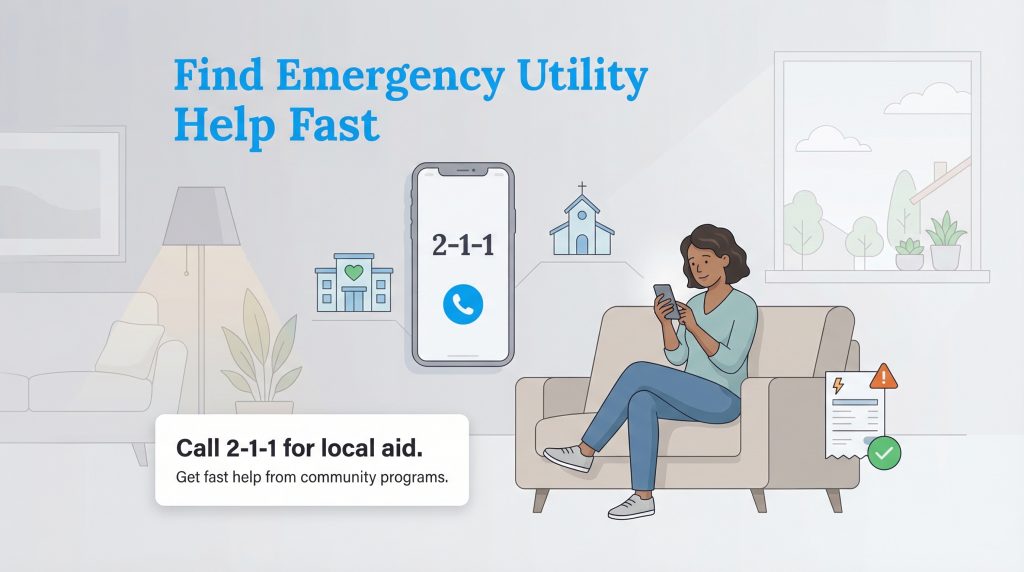
One of the absolute fastest ways to locate hardship grants for utility bills near you is by utilizing the national 2-1-1 directory managed by the United Way. Knowledgeable 2-1-1 operators have access to a continuously updated database and can guide you toward specific regional programs that currently have open funding. For example, they can connect you with the Society of St. Vincent de Paul, which frequently dispatches volunteers to assess your hardship and provide rapid utility vouchers.
They can also point you toward Project Share, a common cooperative fund that relies on neighbor-to-neighbor community donations to stop imminent shut-offs. To successfully apply for these non-profit programs and successfully continue managing your home’s electric service or water service during a crisis, you must arrive prepared. Always bring your government ID, current utility bill, and proof of income to your local intake appointment.
Utility-Sponsored Customer Assistance Programs (CAP)
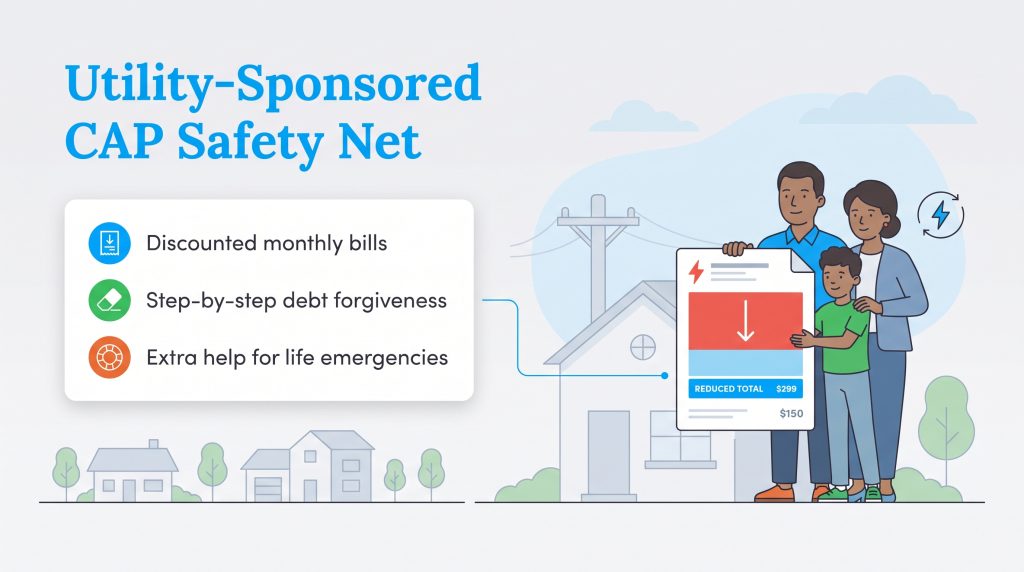
If you have exhausted federal aid and local charities but still cannot afford standard energy rates, it is time to explore utility-sponsored Customer Assistance Programs (CAP). Mandated by state Public Utility Commissions (PUCs), CAPs are specialized affordability tiers built directly into the operating structure of regulated utility companies. Rather than offering a one-time emergency payout, a CAP fundamentally restructures how your household is billed.
When you call your regulated utility company and explicitly request a CAP screening, you unlock access to a bundle of protective services designed to keep service affordable year-round. Core CAP benefits generally include:
- Discounted Monthly Bills: CAPs frequently place households on a Percentage of Income Payment Plan (PIPP). Instead of paying based on the amount of electricity you use, your monthly bill is strictly capped at an affordable percentage of your total household income (often between 3% and 6%).
- Debt Forgiveness: Many CAPs incorporate arrearage management. For every on-time monthly payment you make under your new discounted rate, the utility company legally forgives a portion of your past-due debt until your balance reaches zero.
- Dedicated Hardship Funds: Enrolling in a CAP often grants you exclusive access to internal, utility-managed hardship funds that provide emergency grants if you experience a severe life event, such as a job loss or medical crisis.
State And Local Utility Discount Programs
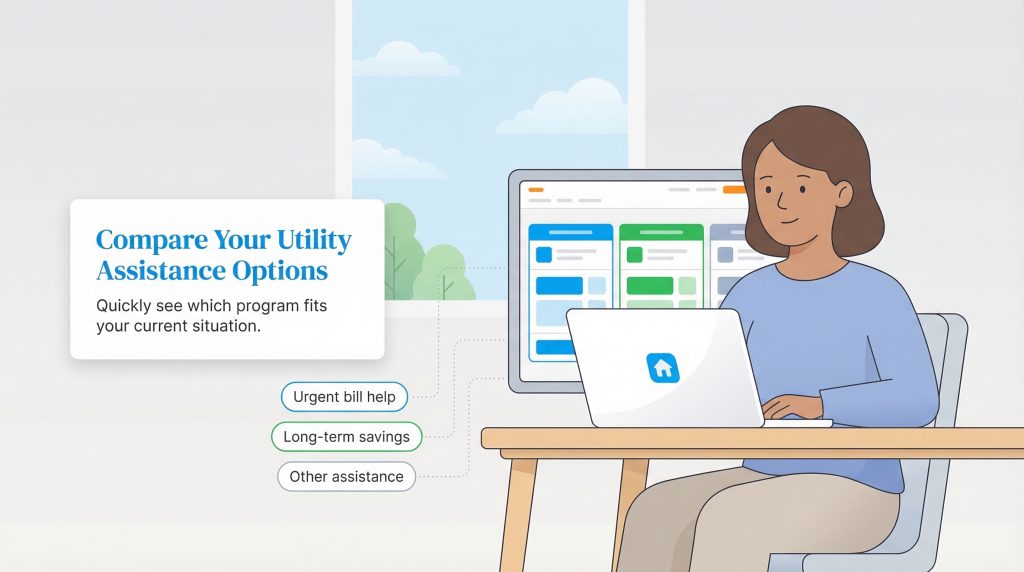
Because no two financial emergencies are exactly alike, it is crucial to understand that different energy bill assistance programs serve vastly different needs. Depending on your situation, getting help with utility bills for low-income families might mean qualifying for a direct cash grant, a permanent monthly discount, or a physical home upgrade. Use this comparison table to quickly identify which option makes the most sense for your current household situation.
| Program Name | Program Type | Income Limit | Assistance Type |
|---|---|---|---|
| LIHEAP | Federal | Typically up to 150% of Federal Poverty Level | Direct Grant |
| Weatherization (WAP) | Federal | Typically up to 200% of Federal Poverty Level | Home Upgrade |
| Rent and Utility Assistance Programs | State / Local | Varies; usually targets renters facing eviction | Combined Direct Grant |
| Customer Assistance Programs (CAP) | Local Provider | Based on household size and state mandates | Discount / Forgiveness |
| Salvation Army / Share the Warmth | Charity | Varies strictly by local chapter and need | Emergency Grant |
| Arrearage Management Plan (AMP) | Local Provider | Based on past-due balance and hardship | Discount / Forgiveness |
| 2-1-1 Emergency Crisis Funds | Charity | Imminent shut-off notice usually required | Emergency Grant |
Beyond standard electric and gas assistance, maintaining active telecommunication services is an absolute necessity. If you are struggling with internet or phone bills, look into the federal Lifeline program administered by the Federal Communications Commission (FCC). Lifeline provides a direct monthly discount on broadband internet for qualifying low-income consumers, helping to subsidize your bill by up to $9.25 per month (and up to $34.25 for residents on qualifying Tribal lands).
Understanding Utility Disconnection Protection Laws
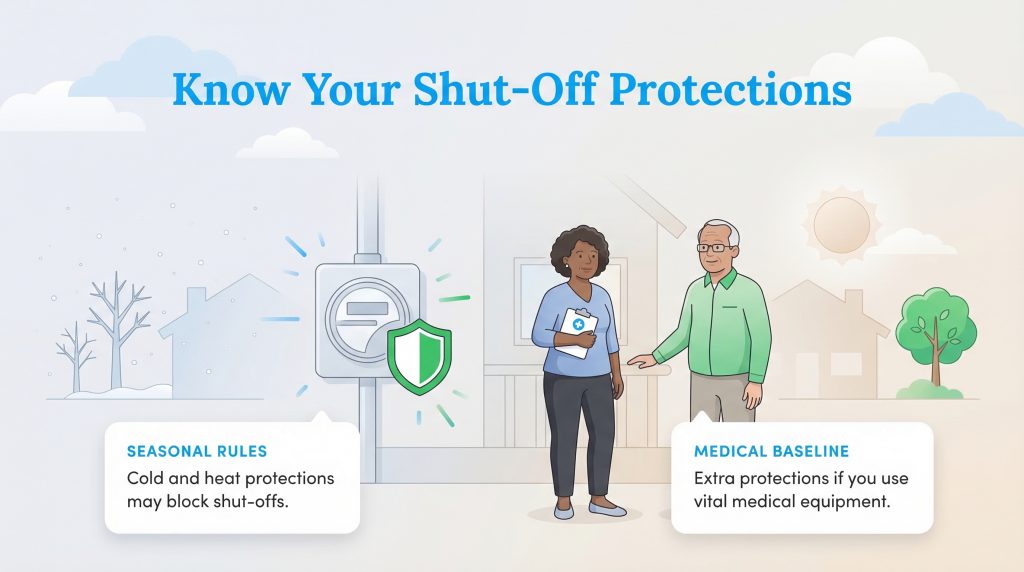
Depending on exactly where you live, you might be protected by strong utility disconnection protection laws mandated by your state’s Public Utilities Commission. Local governments recognize that losing power or gas during extreme weather is a severe health hazard, so they force utility companies to halt disconnections during specific, dangerous periods. Furthermore, households with specific health or age-related needs often qualify for permanent billing protections.
Understanding your basic rights as a utility consumer can prevent unlawful shut-offs. Here are the three most common types of protective measures you should explore immediately:
- The Cold Weather Rule: Many northern and midwestern states legally enforce this rule, which prevents utility companies from disconnecting your essential heating services between November and March, regardless of your past-due balance. Similar heat protections exist in southern states during dangerous summer heatwaves.
- Seniors and Infants: Many states offer strict age-based protections that legally block utility shut-offs for households with residents over the age of 65, or for families possessing infants under 12 months of age, ensuring vulnerable individuals are not left without climate control.
- Life-Saving Medical Equipment: If someone in your home relies on a CPAP machine, dialysis equipment, or an oxygen concentrator, you can ask your provider for a medical baseline application. Submitting this form with a quick doctor’s signature provides incredibly strict legal protections against sudden power losses and often secures a discounted energy rate.
How To Avoid Utility Assistance Scams
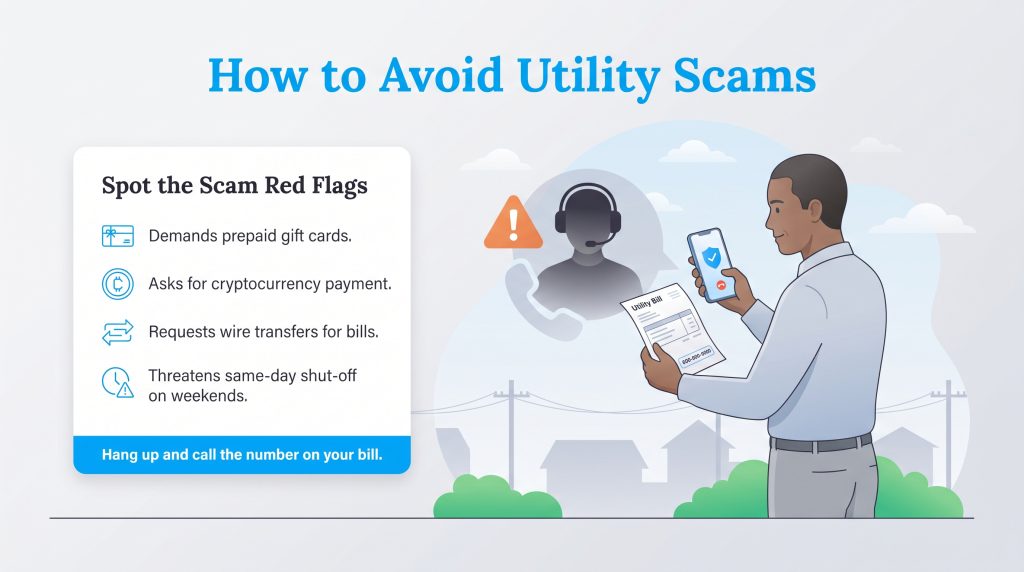
Predatory individuals frequently target households experiencing obvious financial distress, meaning you must stay fiercely protective of your personal information when seeking relief. Scammers cast wide nets with automated, spoofed phone calls, posing as utility representatives demanding immediate payment to avoid an instant shut-off. They use aggressive, fear-based tactics to pressure you into making a costly mistake in the heat of the moment.
Protect yourself by reviewing this standard checklist. If the caller demands any of the following, you are dealing with a scammer, not your real electric company:
- Prepaid Gift Cards: Real utilities will never ask you to drive to a pharmacy and read them the numbers off a generic gift card.
- Cryptocurrency: Demands for Bitcoin or other digital currencies are always fraudulent.
- Wire Transfers: Official companies do not use untraceable wire transfer services like Western Union for standard bill collections.
- Weekend Shut-Offs: Utility companies rarely, if ever, perform manual disconnections on weekends or major holidays.
Legitimate government organizations and registered local charities will never ask you to pay an upfront “processing fee” to receive financial relief. If you ever feel suspicious about an incoming call regarding your account balance, hang up immediately. Take a deep breath, pull out your physical bill, and dial the official customer service number listed directly on the printed statement.
Securing Your Household’s Energy Future
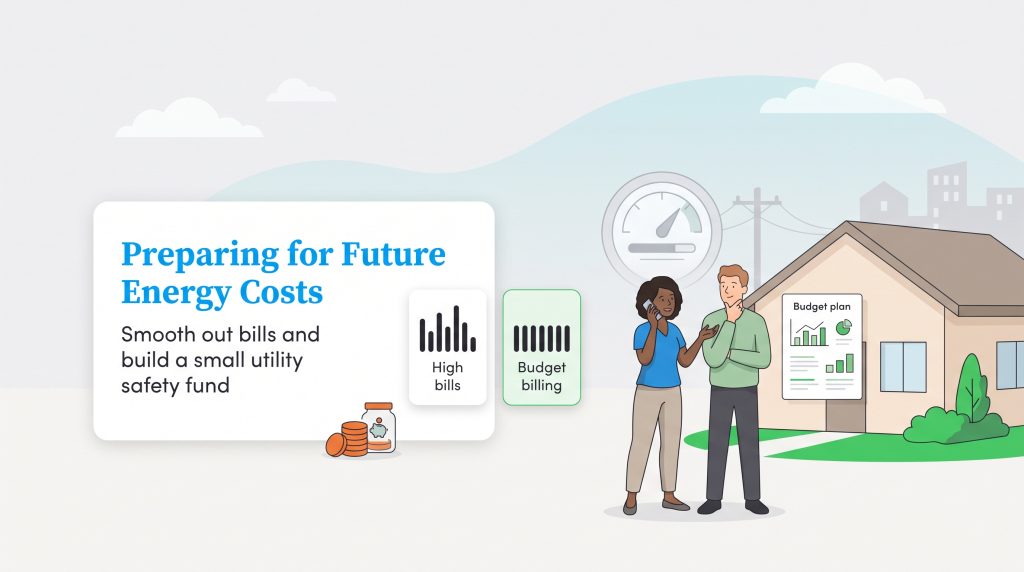
Once you have navigated the immediate hurdle of finding assistance paying utility bills, the best thing you can do for your future peace of mind is to proactively prepare for the months ahead. To avoid finding yourself in the exact same stressful situation next season, call your energy provider today and request to be placed on a budget billing plan. Budget billing takes your total yearly energy usage and divides it evenly, allowing you to pay a flat, predictable rate every single month. This simple change completely eliminates those terrifying, budget-breaking spikes that happen during the peak of winter or the dead of summer.
Furthermore, taking small steps today will safeguard your household from unexpected utility burdens tomorrow. Consider adopting this forward-thinking checklist to solidify your energy independence:
- Build a Micro-Emergency Fund: Automate a small, manageable deposit into a separate savings account dedicated strictly to your home’s essential services. Even $10 a week builds a reliable financial buffer over time.
- Measuring Electric Usage: Download your energy provider’s mobile app to set up daily or weekly usage alerts. Knowing when your consumption spikes allows you to adjust your thermostat before a massive bill arrives.
- Schedule Regular HVAC Maintenance: Ensure your heating and cooling systems operate efficiently by replacing air filters every few months. A clean system draws significantly less power.
By combining federal grants, non-profit emergency funds, and proactive internal payment plans, you can successfully shield your household from utility disconnections. Embracing these strategies guarantees that your home stays comfortable, safe, and fully powered throughout the year.
Frequently Asked Questions About Assistance Paying Utility Bills
Where can I find emergency utility bill assistance near me?
The fastest way to locate emergency assistance in your immediate area is to dial 2-1-1 on your phone. This connects you to a free, confidential directory managed by the United Way. The operators will guide you to local charities, churches, and community action agencies currently accepting applications for hardship grants and rapid utility relief.
How do I qualify for the Low Income Home Energy Assistance Program (LIHEAP)?
To qualify for LIHEAP, your total household income must generally fall at or below 150% of the Federal Poverty Guidelines, though exact limits vary by state. You will need to provide proof of income (such as recent pay stubs or benefit letters), a valid government-issued ID, and your most recent utility bill when submitting your application to your local community action agency.
Can my electric company shut off my power during the winter?
It depends heavily on your state’s specific utility regulations. Many states enforce a “Cold Weather Rule” that legally blocks utility companies from disconnecting heating services during extreme winter months (typically November through March). However, you often still need to contact your provider to declare a financial hardship and formally establish this protection on your account.
Do rent and utility assistance programs cover past-due balances?
Yes, many rent and utility assistance programs administered by local housing authorities are designed specifically to clear out past-due balances. When approved, these combined grants send funds directly to your energy provider to erase your arrears, protecting you from eviction and utility shut-offs simultaneously.
What are customer assistance programs (CAP) for low-income families?
Customer Assistance Programs (CAP) are utility-sponsored affordability tiers mandated by state Public Utility Commissions. Instead of paying standard rates, low-income families enrolled in a CAP receive a discounted monthly bill capped at a small percentage of their income. CAPs also frequently offer debt forgiveness for past-due balances as long as current monthly payments are made on time.
Where can I get emergency utility assistance today?
For immediate, same-day or next-day relief, your best option is to dial 2-1-1 or contact your local chapter of The Salvation Army. These organizations operate rapid-response emergency crisis funds designed to halt imminent disconnections within 24 to 48 hours, often processing applications much faster than federal programs.
What documents do I need to apply for utility relief grants?
While specific programs vary, almost all charities and federal programs require three core documents: a valid government-issued photo ID for the primary applicant, your most recent past-due utility bill (or active shut-off notice), and proof of your household’s total income for the last 30 to 60 days. Renters may also need to bring a copy of their current lease.
How does a medical baseline program protect my utilities?
If someone in your home depends on life-saving medical equipment (such as an oxygen concentrator or dialysis machine), a medical baseline program ensures your home receives strict legal protections against shut-offs. After submitting a form signed by a licensed doctor, your utility company will flag your account, preventing standard disconnections and often granting you a significantly lower energy rate.
About the Author

David has been an integral part of some of the biggest utility sites on the internet, including InMyArea.com, HighSpeedInternet.com, BroadbandNow.com, and U.S. News. He brings over 15 years of experience writing about, compiling and analyzing utility data.

LaLeesha has a Masters degree in English and enjoys writing whenever she has the chance. She is passionate about gardening, reducing her carbon footprint, and protecting the environment. She also recently served as President of the Board for City Sprouts (a community garden).