

Reduce your monthly energy bills and improve home safety with this federally funded benefit for homeowners and renters
Key Takeaways
- The Weatherization Assistance Program (WAP) helps low-income households save an average of $372 per year on energy costs through free home upgrades.
- Eligibility is generally based on income (typically at or below 200% of the federal poverty line), with priority given to seniors, families with children, and individuals with disabilities.
- Services include insulation, air sealing, and HVAC repairs, but the program does not cover major structural repairs like a new roof or full siding replacement.
For many families, high utility bills create a stressful “heat or eat” dilemma where they must choose between staying warm and buying groceries. The Weatherization Assistance Program (WAP) offers a practical, government-funded solution to this problem by permanently reducing energy costs for eligible households. This program is not a loan that you have to pay back; it is a grant designed to make your home safer, more comfortable, and highly energy-efficient at absolutely no cost to you. Whether you own your home or rent an apartment, applying for this assistance can unlock long-term financial relief while simultaneously lowering your carbon footprint.
What Is the Weatherization Assistance Program?
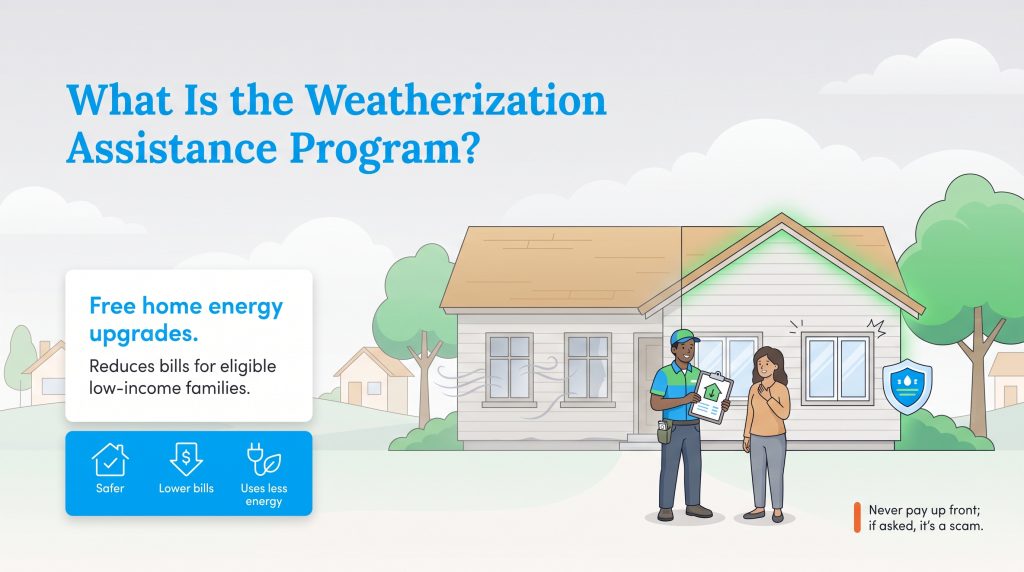
The Weatherization Assistance Program is the nation’s largest residential energy efficiency initiative. Established and funded by the U.S. Department of Energy (DOE), it provides financial resources to states, which then work closely with local community action agencies and nonprofits to deliver on-the-ground services. The core goal is simple: to reduce energy costs for low-income families by improving the energy efficiency of their homes while simultaneously ensuring their health and safety.
By upgrading older, inefficient housing, the Department of Energy WAP helps eligible households save an average of $372 per year on heating and cooling bills. The program is a massive engine for good, supporting thousands of local jobs and improving tens of thousands of homes across the country every year. Because these upgrades reduce overall energy consumption, weatherization is also an environmentally mindful choice that benefits the local power grid.
💡 Pro Tip: Do not confuse this program with a loan. Weatherization services are completely free for eligible households. If someone asks for a down payment or bank account number to “hold your spot,” it is a scam.
Eligible Weatherization Services List
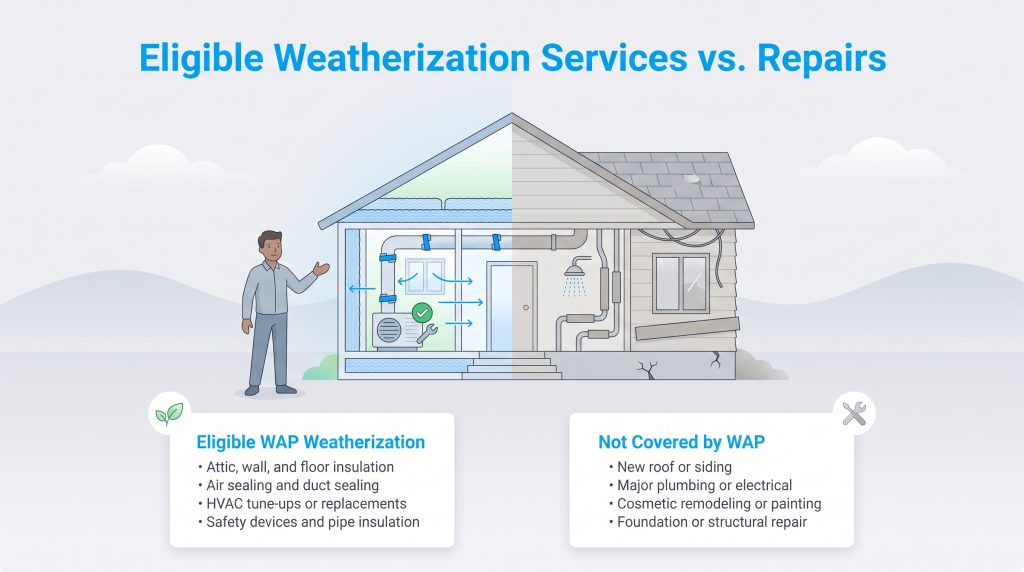
The program focuses on “whole-house” weatherization, meaning crews evaluate your entire home as an interconnected system to see where energy is actively being wasted. It covers various types of housing, including single-family homes, multifamily buildings, and manufactured (mobile) homes.
While the exact upgrades you receive depend entirely on what your customized home energy audit reveals, the weatherization services list usually targets the areas with the highest potential for energy savings. Applying for these upgrades is a great way to start creating a more sustainable home.
| Covered by WAP (Energy Upgrades) | Not Covered by WAP (Structural Repairs) |
|---|---|
| Attic, wall, and floor insulation | New roof installation or major roof replacement |
| Air sealing (caulking, weather-stripping) | Replacing full home siding |
| HVAC tune-ups, repairs, or replacements | Major plumbing or electrical overhauls |
| Duct sealing and insulation | Cosmetic remodeling or painting |
| Smoke and carbon monoxide detectors | New window installation (unless strictly necessary for energy savings) |
| Pipe insulation and low-flow showerheads | Foundation repair or structural leveling |
Weatherization Assistance Program Eligibility and Income Limits
To qualify for this free home insulation program, you must meet specific financial criteria. Weatherization income limits are set locally, but most states require your household income to be at or below 200% of the federal poverty guidelines. Alternatively, some states base eligibility on 60% of the state median income. You may be automatically eligible if your household already receives Supplemental Security Income (SSI) or Temporary Assistance for Needy Families (TANF).
Because the demand for low-income energy efficient home improvements is incredibly high, local agencies legally prioritize applicants who are most vulnerable to extreme temperatures. You will be bumped higher on the waiting list if your household includes:
- Seniors over 60 years of age
- Individuals with documented disabilities
- Families with young children in the home
It is also a common misconception that this benefit is strictly for homeowners. Renters are fully eligible for weatherization assistance program eligibility, provided they get written, signed permission from their landlord before any physical work begins.
WAP Deferrals: Why Your Home Might Be Rejected
Sometimes, an energy auditor will inspect your property and determine that weatherization cannot legally or safely proceed. This is called a “deferral.” A deferral is not a permanent rejection — it simply means certain hazardous conditions must be fixed at your own expense or through a different home repair grant before weatherization crews can do their job.
Common reasons for a WAP deferral include:
- Active roof leaks: Installing fresh attic insulation under a leaking roof will cause mold and ruin the new materials.
- Standing water: Flooded basements or significant moisture problems must be mitigated to protect workers and equipment.
- Asbestos or lead paint hazards: If weatherization work would disturb friable asbestos (like old pipe wrap) or dangerous lead paint, the home must be professionally abated first.
- Major structural damage: If a wall is rotting or a floor is caving in, sealing it for energy efficiency is unsafe.
🚩 Heads Up: If your home is deferred, ask your local agency if they have connections to other municipal grant programs that specifically cover roof repairs or mold remediation. Once the hazard is cleared, your weatherization application can be reactivated.
LIHEAP vs. WAP: What Is the Difference?
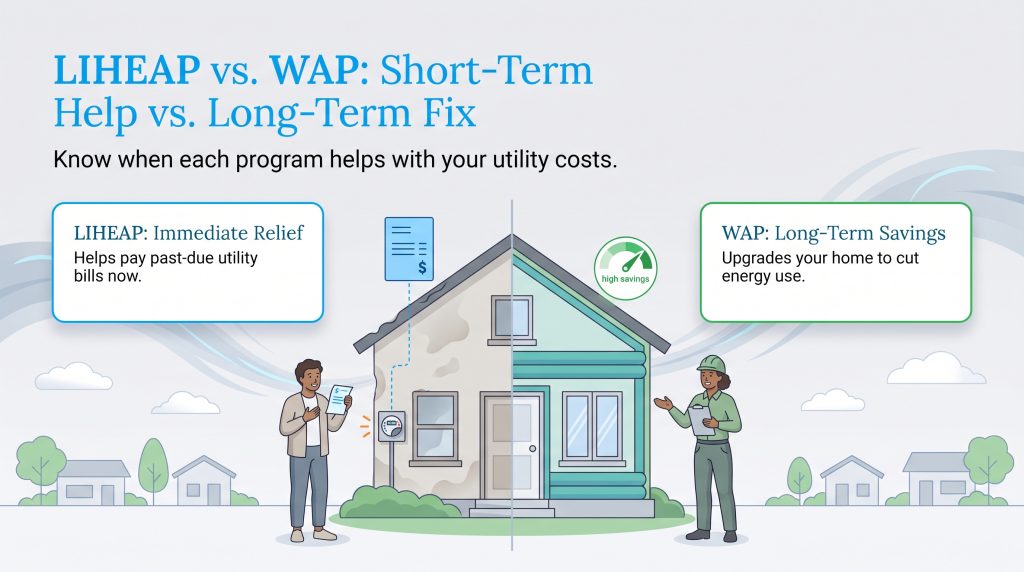
It is easy to confuse the Weatherization Assistance Program (WAP) with the Low Income Home Energy Assistance Program (LIHEAP), especially since you often apply for both at the exact same local agency. However, they serve completely different purposes in managing your utility costs.
LIHEAP is a short-term financial lifeline. It provides direct payment assistance to your utility company to help you pay past-due bills or secure fuel delivery during a crisis. It keeps the lights on and the heat running today. In contrast, WAP is a long-term, permanent solution. It fixes the physical structure of your home to lower your utility consumption for years to come.
| Program Feature | LIHEAP | WAP (Weatherization) |
|---|---|---|
| Primary Goal | Immediate bill payment assistance | Permanent home energy efficiency |
| How It Helps | Funds are sent to your utility provider | Contractors physically upgrade your home |
| Timeframe | Short-term, seasonal relief | Long-term, permanent utility reduction |
| Typical Wait Time | Fast processing for crisis intervention | Longer waitlists for contractor availability |
While LIHEAP acts as a financial band-aid, weatherization is the cure that stops the energy waste at its source. If you are looking for more ways to manage your monthly costs, read our guide on how to save on your electric bill or visit our electric utilities guide.
How to Apply for Weatherization Step by Step
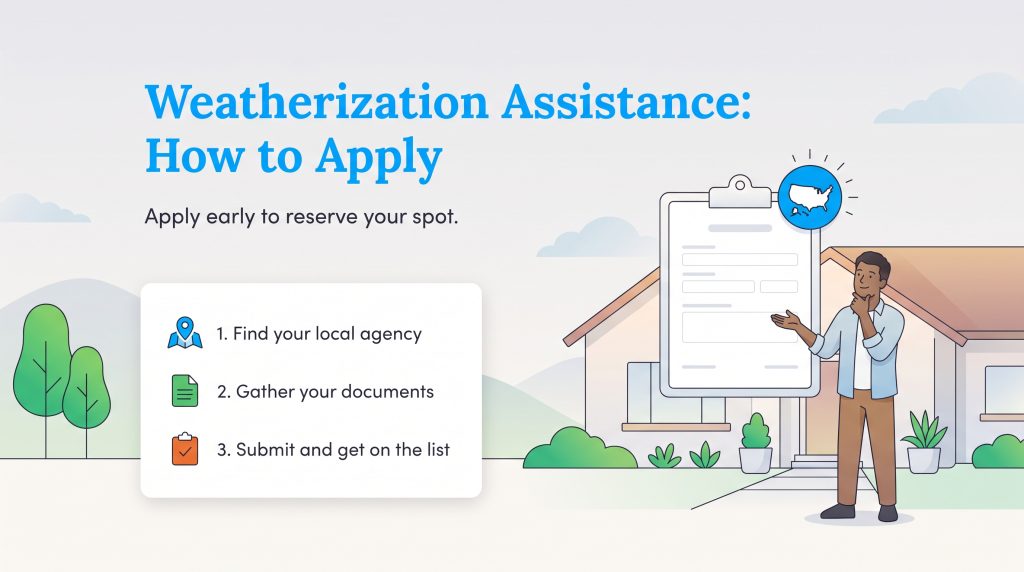
The WAP program application process requires a little patience, but the long-term savings make it well worth the effort. Follow this step-by-step process to get your home in the queue:
- Locate your state’s sub-grantee: You cannot apply directly on a federal website. The DOE provides funding to states, which distribute it to local Community Action Agencies or municipal nonprofits. Search online for your state’s Community Action Agency network to find the specific office assigned to your county.
- Gather your required documentation: You will need to prove your identity, income, and residence. Be prepared to provide proof of income for the last 12 months (such as W-2s, pay stubs, or Social Security benefit letters), proof of homeownership or a signed lease agreement, and a full year of recent utility bills so the agency can establish a baseline of your energy usage.
- Submit your application and wait: Once your paperwork is complete, file it with your local agency. Remember that approval does not mean contractors will show up tomorrow. Demand is high, and waitlists can sometimes take several months to a year depending on your region’s funding.
📌 Quick Fact: Because funding is released on an annual cycle, applying in the spring or early summer is often the best strategy to get placed high on the waiting list before the rush of winter heating emergencies begins.
Preparing for Your Home Energy Audit
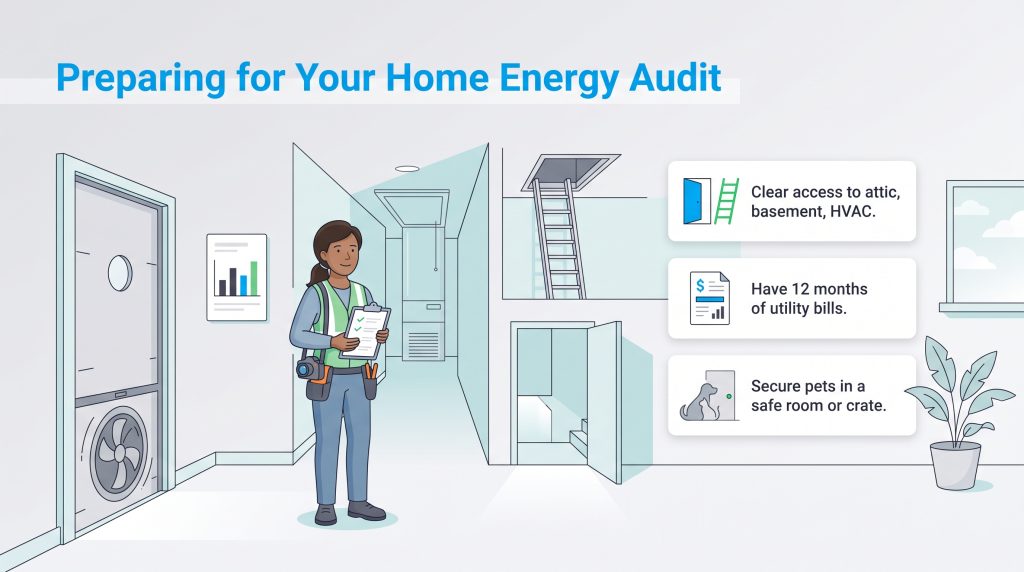
Once you reach the top of the waitlist, the local agency will schedule a free home energy audit. Do not let the word “audit” cause anxiety — this is a friendly, diagnostic visit. A certified technician will visit your home using specialized tools like a “blower door” (a massive fan temporarily sealed into your front door frame) and infrared cameras to pinpoint exactly where your house is leaking air.
To ensure the visit goes smoothly, you should prepare your home ahead of time:
- Ensure clear physical access: The auditor will need to inspect your attic, basement, crawlspaces, and all HVAC equipment. Move boxes, furniture, or clutter blocking these access points.
- Gather 12 months of utility bills: Even if you submitted bills during your application, have your most recent electric and gas bills printed and ready. The auditor uses these numbers to calculate which upgrades will provide the highest return on investment.
- Secure your pets: Because the auditor will be leaving doors open for blower tests and walking through every room of the house, it is best to secure dogs and cats in a closed room or a crate for their safety.
Turning Weatherization Into Long-Term Relief
While gathering paperwork and navigating a waiting list can feel like a chore, the long-term benefits of the Weatherization Assistance Program are undeniable. Beyond the significant financial savings, your home will simply feel better — warmer in the winter, cooler in the summer, and free of frustrating drafts. At UtilitiesForMyHome.com, we view this program as an essential resource for families looking to take control of their utility costs. By cutting out energy waste, you are not only easing your own budget, but you are also making a highly eco-conscious choice that reduces your household’s overall energy footprint for decades to come.
Frequently Asked Questions About the Weatherization Assistance Program
What is the income limit for weatherization assistance in 2026?
Is the Weatherization Assistance Program completely free?
Can renters apply for the Weatherization Assistance Program?
Does the weatherization program replace windows?
How long does the weatherization process take?
Is there a different weatherization program for seniors?
About the Author

LaLeesha has a Masters degree in English and enjoys writing whenever she has the chance. She is passionate about gardening, reducing her carbon footprint, and protecting the environment. She also recently served as President of the Board for City Sprouts (a community garden).

David has been an integral part of some of the biggest utility sites on the internet, including InMyArea.com, HighSpeedInternet.com, BroadbandNow.com, and U.S. News. He brings over 15 years of experience writing about, compiling and analyzing utility data.