
Understand Con Edison’s coverage area, default energy rates, and the best ways to manage your utility account.
Key Takeaways
- Con Edison is the primary delivery utility for electricity, natural gas, and steam across New York City and Westchester County.
- New York is a deregulated energy market, which means you have the power to choose a retail energy provider (ESCO) to lock in fixed rates and avoid seasonal price surges.
- The Con Edison app and outage map are essential tools you should download to monitor your usage, report accurate meter readings, and track local power restorations.
Whether you’re unpacking boxes in a Brooklyn walk-up or settling into a family home in Westchester, setting up your utilities is at the top of your moving checklist. In this part of New York, that almost always means setting up an account with Consolidated Edison, widely known as Con Edison. While they’re the default delivery company for more than 3.6 million households and businesses, many residents don’t realize they actually have the power to choose who supplies their energy. Navigating variable market rates, delivery fees, and time-of-use billing can feel overwhelming if you don’t know the rules of the grid. We’re here to break down how Con Edison operates, explain your supply vs. delivery charges, and help you pick the right rate plan to keep your monthly energy bills in check.
Con Edison Coverage Area and Services
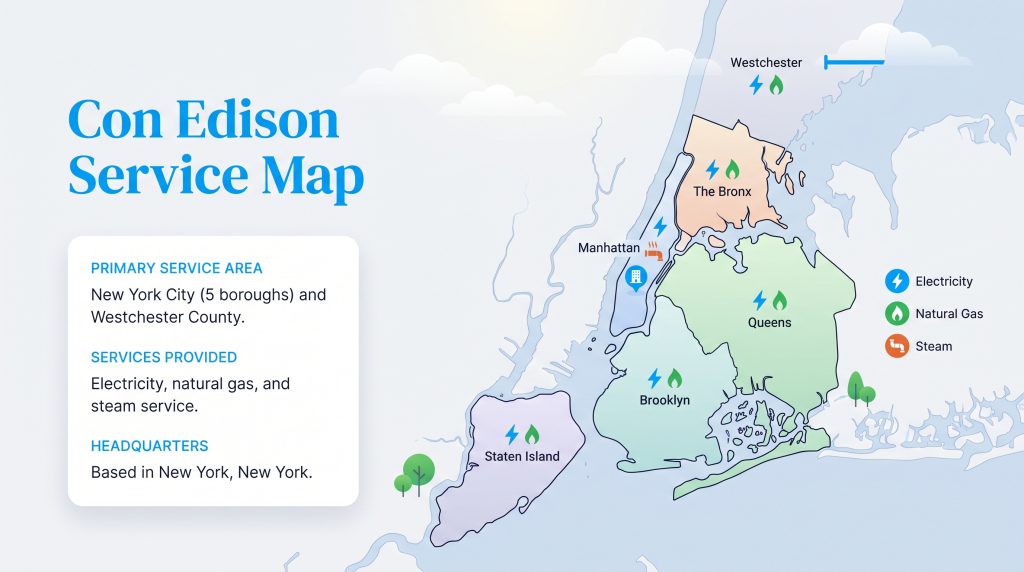
Founded in 1823, Con Edison maintains the massive underground and overhead grid that powers the city that never sleeps. The Con Edison coverage area encompasses the five boroughs of New York City — Manhattan, Brooklyn, Queens, The Bronx, and Staten Island — as well as neighboring Westchester County, including major cities like Yonkers, New Rochelle, Mount Vernon, White Plains, and Peekskill.
Con Edison operates across three distinct utility sectors:
- Electricity: Powering all five boroughs of NYC (excluding the Rockaway Peninsula in Queens, which relies on PSEG Long Island) and almost all of Westchester County, including Yonkers, New Rochelle, Mount Vernon, White Plains, and Peekskill.
- Natural Gas: Heating Manhattan, The Bronx, parts of northern Queens, and most of Westchester County. Note that Brooklyn, Staten Island, and the remainder of Queens receive natural gas delivery from National Grid.
- Steam: Primarily concentrated in Manhattan from the Battery up to 96th Street, running through underground pipes to heat, cool, and humidify large apartment complexes and commercial skyscrapers.
| Primary Service Area | New York City (5 Boroughs, excluding the Rockaway Peninsula for electric) and Westchester County (Yonkers, New Rochelle, Mount Vernon, White Plains, Peekskill) |
| Services Provided | Electricity, Natural Gas, Steam |
| Headquarters | New York, NY |
Understanding Your Con Edison Bill: Supply vs. Delivery (ESCOs)
To truly manage your energy costs, you need to understand the fundamental difference between Con Edison supply vs delivery. When you look at your monthly bill, it is split into two distinct sections.
Because New York is a deregulated energy state, customers have the power to choose their energy suppliers. Con Edison is your delivery utility. They maintain the power lines, fix the gas pipelines, and respond to local emergencies. You cannot change your delivery company. When you inspect the breakdown on your statement, you’ll see a flat Basic Service Charge (around $20 per month for residential accounts) that covers metering and customer service, regardless of how much power you use. You’ll also notice a small Merchant Function Charge, which covers Con Edison’s administrative cost of buying energy on the wholesale market — a fee that disappears from your bill if you switch to a third-party supplier. In 2026, when you combine supply charges (roughly 10¢ to 13¢ per kWh) with Con Edison’s delivery rates (around 18¢ to 21¢ per kWh) plus local taxes and surcharges, New Yorkers pay an average all-in cost of 33¢ to 36¢ per kWh. For a typical NYC apartment using 400 kWh per month, that translates to a total bill between $132 and $144.
However, the supply charge is where you have choices. The supply represents the actual electricity or gas you consume. By default, Con Edison automatically supplies your energy at a variable market rate. But you have the legal right to shop around and choose an Energy Service Company (ESCO) — also known as a retail electric provider (REP) or retail natural gas provider (RNGP) — to supply your home. When you switch to a New York ESCO, Con Edison still delivers the power safely to your home without interruption, but you gain the ability to secure better rates or specialized green energy plans.

- Calculate Your Moving Costs
- Compare Moving Companies
- Get Multiple Quotes
- Move with Confidence
Con Edison Plans and Pricing Options
If you rely on Con Edison for your supply, your price per kilowatt-hour (kWh) fluctuates every single month based on global energy markets and weather events. During extreme summer heatwaves or winter freezes, these variable Con Edison rates can spike dramatically.
Con Edison Delivery Rate Plans
While supply rates change monthly, you also have control over how Con Edison calculates your delivery charges. Many customers confuse Con Edison’s Time-of-Use rate with the Smart Energy Plan, as both reward off-peak consumption, but they operate on totally different schedules and billing structures. Here is how Con Edison’s five residential delivery rate plans compare:
| Plan Type | How It Works | Best For |
|---|---|---|
| Standard Rate (EL1) | Flat variable rate per kWh regardless of the time of day. However, summer delivery rates are tiered, charging a higher price per kWh for any usage above 250 kWh from June through September. | Households with standard usage habits who do not want to monitor the clock before running appliances. |
| Time-of-Use (TOU) | Bills your usage based on the time of day. Off-peak hours run from midnight to 8 a.m. year-round with significantly lower rates, while peak hours run from 8 a.m. to midnight every day (with summer super-peak pricing). | Best for overnight EV charging or night owls who can shift heavy electricity use past midnight. |
| Smart Energy Plan | Uses demand-based delivery pricing based on the highest intensity of electricity you pull at once during peak hours (Monday through Friday, noon to 8 p.m.). Weekends and all other hours are off-peak. | Rewards users who stagger heavy appliance use so the AC, dryer, and oven never run simultaneously on weekday afternoons. |
| Steady Use Rate | A demand-based rate that rewards households that spread energy use evenly throughout the day. Peak hours are Monday through Friday, noon to 8 p.m. | Best for homes with electric heat pumps, geothermal systems, or consistent 24/7 climate control needs. |
| Standby Rate | Calculates delivery charges based on your home’s contract demand and daily peak usage rather than standard per-kWh consumption. | Homeowners with on-site solar arrays and battery storage who mostly generate their own power and only use Con Edison as a backup. |
To avoid unexpected market surges on the supply side of your bill, many New Yorkers opt for fixed-rate plans through third-party suppliers. A fixed-rate plan locks in your price per kWh for the duration of your contract — typically 12 to 36 months — providing much-needed budget predictability year-round.
Top Retail Energy Providers (ESCOs)
Here are some of the most popular REPs serving the Con Edison delivery area:
| Provider | Renewable Options | Contract Terms | Notable Features |
|---|---|---|---|
| Constellation Energy | Yes | 12–36 months | Fixed-rate plans, usage alerts |
| Green Mountain Energy | 100% Renewable | 12–24 months | Eco-friendly plans, carbon offset programs |
| Direct Energy | Yes | 12-24 Months | Bill credits, smart home deals |
| Ambit Energy | Yes | 12-36 Months | Referral bonuses |
| Just Energy | Yes | 12–60 months | Variable and fixed rates, green energy plans |
Note: Availability and exact pricing terms may vary by location. Search your ZIP code to find details for your specific area.
💡 Money-Saver: Before switching to a new provider, locate your average monthly usage (in kWh) on your most recent Con Edison bill. Use that exact number to compare potential plans, as some suppliers offer lower rates exclusively for high-usage households.
Why Choose (or Skip) Con Edison Supply: Who It’s Best For
Deciding whether to stay with Con Edison’s default energy supply or sign a contract with an independent ESCO comes down to your household’s risk tolerance and sustainability goals. While an ESCO can protect you from mid-August AC bill shock, third-party contracts require you to keep an eye on renewal dates so your fixed rate doesn’t quietly roll over into a pricey month-to-month plan.
| Con Edison Default Supply (Pros & Cons) | Third-Party ESCO Supply (Pros & Cons) |
|---|---|
| Pro: No long-term contracts, cancellation penalties, or renewal dates to track. | Pro: Fixed-rate contracts lock in your supply price per kWh for 12 to 36 months, shielding you from winter and summer market spikes. |
| Pro: Direct pass-through of wholesale energy costs regulated by the state, plus elimination of the Merchant Function Charge if you leave. | Pro: Easy access to 100% renewable electricity and carbon-offset natural gas plans. |
| Con: Variable rates fluctuate every month and surge sharply during summer heatwaves and winter polar vortexes. | Con: Some plans carry early termination fees (often $50 to $150) if you cancel before your contract expires. |
| Con: Default power mix relies heavily on fossil fuels and nuclear generation rather than 100% green energy. | Con: Failing to renew or switch when your contract ends can drop you into an expensive variable rate. |
Still on the fence? Use these quick guidelines to decide which supply path fits your home:
- Stick with Con Edison Default Supply if… you want complete flexibility with zero contract commitments, want to avoid early termination fees (ideal for short-term renters or students), or qualify for low-income Energy Affordability Program (EAP) assistance. Under New York State rules, ESCOs are legally blocked from enrolling low-income assistance customers unless they offer a state-approved guaranteed savings product, making default utility supply the safest choice for EAP households.
- Switch to a Third-Party ESCO if… you want a predictable fixed rate to protect your family budget against winter heating and summer cooling spikes, or you want an environmentally mindful choice like a 100% renewable energy supply contract backed by wind and solar certificates.
How to Start, Stop, or Transfer Con Edison Service
If you’re getting ready for a big move in NYC or Westchester, setting up your Con Edison start service early is one of the easiest ways to avoid moving-day headaches. Thanks to the widespread installation of automated Smart Meters across the five boroughs and Westchester County, most NYC apartments and homes qualify for same-day or next-day remote activation without waiting around for a technician to visit the basement.
Before you hop online to set up your account, gather these four essential details:
- Valid Government ID: A driver’s license, state ID, or passport.
- Tax Identification: Your Social Security Number (SSN) or Individual Taxpayer Identification Number (ITIN) for a soft identity and credit check.
- Lease or Deed Details: Your exact street address, apartment or unit designation (e.g., Apt 4B vs. Floor 4), and landlord or property management contact info.
- Official Move-In Date: The exact day your lease begins so you aren’t billed for the previous tenant’s electricity or gas usage.
Follow this step-by-step process to start, stop, or transfer your utility service:
- Submit Your Request Early: Visit the Con Edison website or open the mobile app and select “Start, Stop, or Move Service.” Try to submit your order at least one to two weeks before your move date, though smart-metered apartments can often be activated within 24 hours.
- Choose Your Action: First-time customers can select “Turn On Service” to create a profile. Existing customers moving within NYC or Westchester can log into “My Account” and select “Transfer Service,” which lets you schedule your old apartment’s shut-off date and your new home’s turn-on date in a single transaction.
- Verify Your Unit and Meter: Enter your new address carefully. In multi-family brownstones or pre-war apartment buildings, double-check your exact apartment number on your lease to make sure your account links to the right smart meter.
- Confirm Remote Activation: Once submitted, Con Edison will email you a confirmation number. Because automated Smart Meters communicate wirelessly with Con Edison’s central hub, your power and gas billing will switch into your name automatically on your scheduled morning.
Deals, Discounts, and Ways to Save
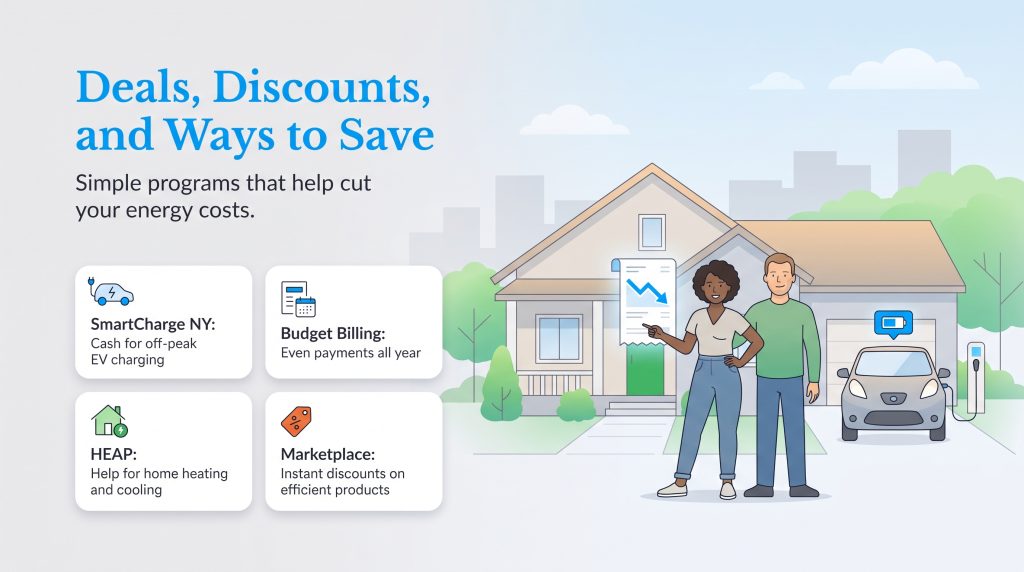
If you want to optimize your overall household efficiency and keep more cash in your bank account, Con Edison offers several rebate and bill-relief programs. Taking advantage of these incentives can significantly lower your long-term energy expenses.
- Energy Affordability Program (EAP): Provides automatic monthly bill discounts to New Yorkers who participate in qualifying government assistance programs like SNAP, SSI, Medicaid, or Federal Public Housing Assistance.
- 2026 Enhanced Energy Affordability Program (EEAP): Expanded for 2026, this program bridges the gap for moderate-income households that earn too much for traditional assistance (HEAP/EAP) but still earn below the state median income, providing vital monthly bill credits to offset rising delivery rates.
- NYS Clean Heat Rebates: Homeowners and building managers who upgrade from fossil fuel boilers or furnaces to energy-efficient electric air-source or ground-source heat pumps can claim thousands of dollars in upfront rebates and incentives.
- SmartCharge NY: If you drive an electric vehicle, this program offers cash incentives for charging your car during off-peak hours, helping to reduce stress on the grid while putting money back in your pocket.
- Budget Billing: Con Edison will calculate your annual energy costs and divide them evenly into 12 predictable monthly payments. You still pay for exactly what you use over the year, but the costs are smoothed out to prevent winter or summer billing shock.
- Home Energy Assistance Program (HEAP): A federally funded program that provides direct financial grants to help eligible, low-income New Yorkers heat and cool their homes.
- Residential Marketplaces: Enjoy instant discounts on ENERGY STAR certified smart thermostats, LED bulbs, and energy-efficient appliances through the Con Edison marketplace.
How to Report and Search for a Con Edison Outage
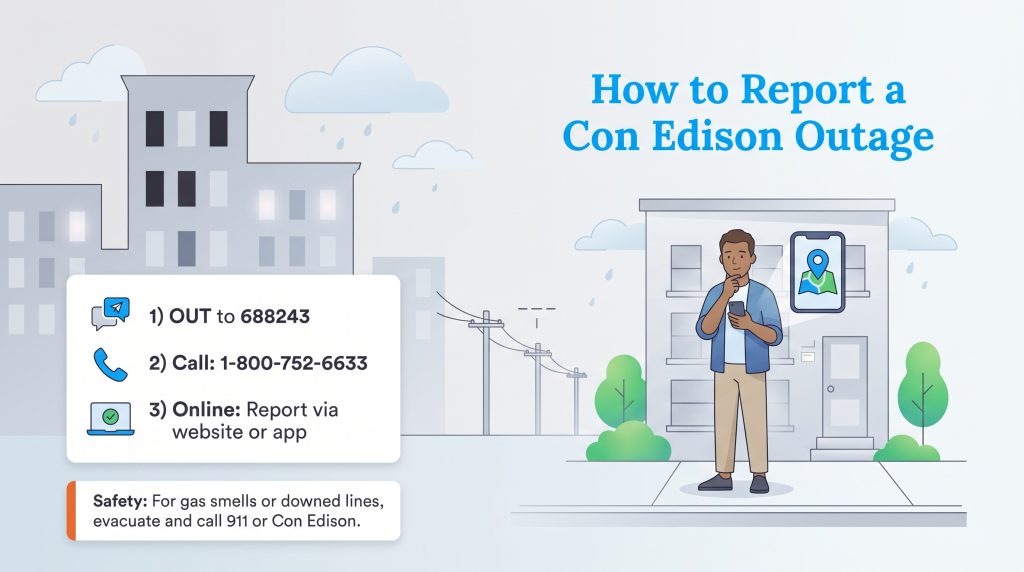
Power outages happen, especially during harsh New York winters or sweltering summer thunderstorms when air conditioners push local transformers to their limits. Fortunately, Con Ed makes it easy to search for active blackouts, check estimated restoration times, and report emergencies safely.
Bookmark the Con Edison outage map on your smartphone right now — it is the fastest way to get real-time, neighborhood-level restoration updates during a grid failure.
If you lose power, here is exactly how to report it:
- Text Alerts: Sign up for immediate notifications by texting OUT to 688243.
- Phone: Call their dedicated emergency line at 1-800-752-6633.
- Web & App: Use the online portal or mobile app to report the outage directly tied to your account address.
🚩 Heads Up: If you ever smell natural gas or see a downed power line, do not attempt to report it via the app. Evacuate the area immediately and call 911 or the Con Edison emergency line.
Managing Your Account and the Con Edison Mobile App
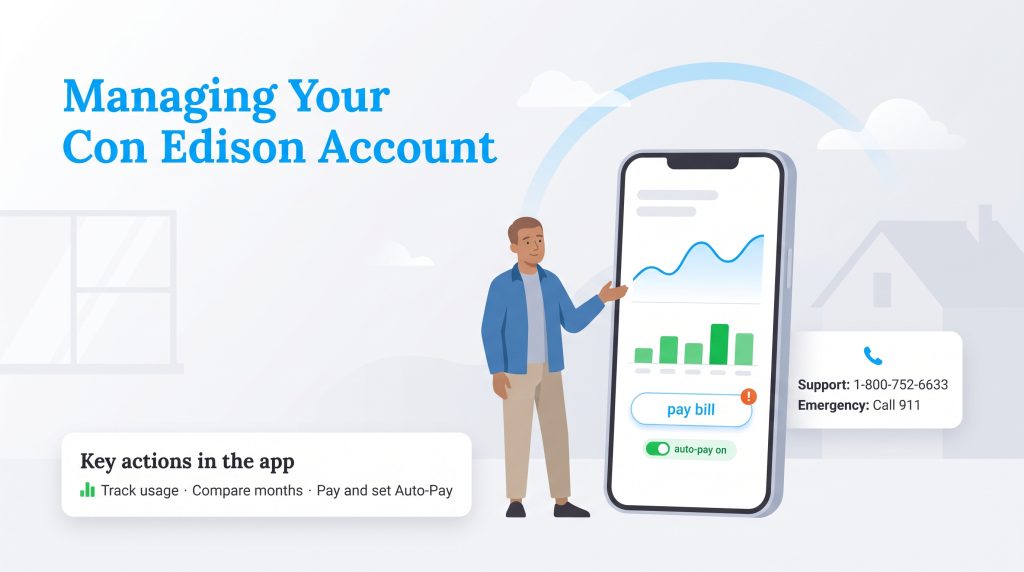
Managing your utility bills shouldn’t require a filing cabinet full of paper statements. The Con Edison app is available for free on both iOS and Android devices, serving as a central hub for your household energy data. Unlike many clunky utility apps, Con Edison’s mobile platform earns remarkably high marks for user satisfaction, boasting 4.8 stars on the iOS App Store and 4.5 stars on the Google Play Store.
Once inside the dashboard, you can check your smart meter’s real-time energy usage in 15-minute intervals, compare your current consumption against previous months, and choose your preferred Con Edison bill pay option. Here are all the ways you can pay your monthly statement:
- Online Portal & Mobile App: Pay directly with zero fee using an ACH bank transfer (checking or savings account), or pay via Visa, Mastercard, Discover, American Express, Apple Pay, or Google Pay through Con Edison’s third-party processor.
- Auto-Pay: Link your bank account to have your monthly balance deducted automatically on your due date, protecting you from accidental late fees.
- Pay by Phone: Call the automated payment line at 1-888-925-5016 to pay by bank account or credit/debit card 24/7.
- Pay by Mail: Send a personal check or money order payable to Consolidated Edison to P.O. Box 1702, New York, NY 10116-1702.
- In-Person Authorized Payment Agents: Pay with cash or money order at hundreds of authorized neighborhood check-cashing locations, pharmacies, and grocery stores across NYC and Westchester.
If you need to speak with a Con Edison customer service representative or report a hazard over the phone, save these essential numbers:
- Con Edison Customer Service Number: 1-800-752-6633
- Gas Emergency: 1-800-752-6633 or call 911
- Electric Emergency: 1-800-752-6633
Con Edison Fees and Guarantees
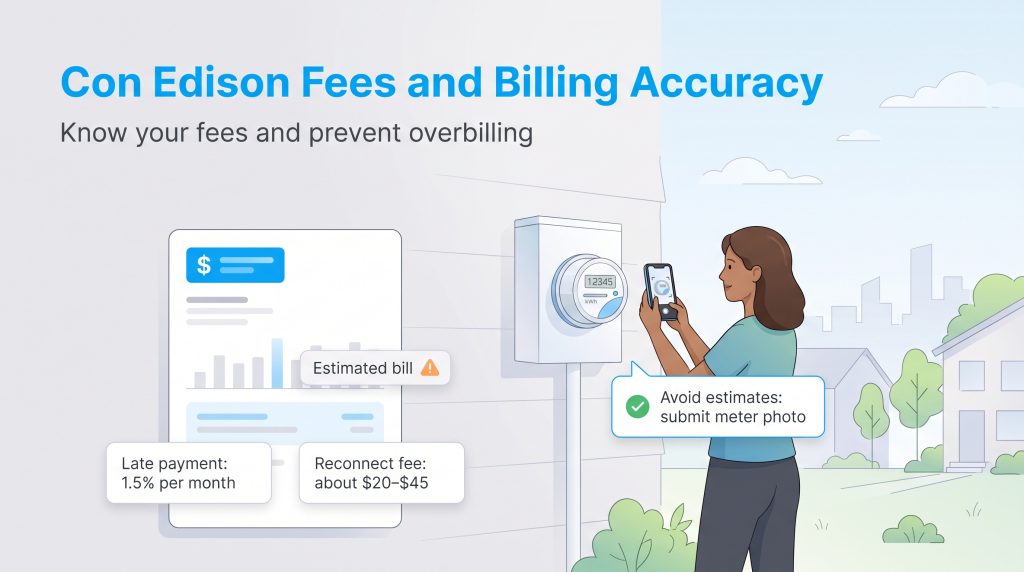
Financial transparency is critical when managing your home utilities. Like any major provider, Con Edison enforces a schedule of fees for specific account actions.
- Late Payment Fees: Con Edison typically assesses a late payment charge of 1.5% per month on any overdue balance.
- Service Connection and Disconnection Fees: While standard digital meter activations often occur without a fee, physical reconnections or specialized service calls may incur a one-time charge ranging from $20 to $45.
- Estimated Billing: If your building still has an older analog meter and Con Edison cannot access it, they will issue an “estimated bill” based on past usage. These estimates are notoriously inaccurate during changing seasons and can result in massive overcharges. To guarantee accurate billing, you can use the mobile app to snap a photo of your meter and submit your own verified reading, or request a free upgrade to a wireless Smart Meter.
Sustainability, Community Solar, and Green Energy Initiatives
While the state’s broader energy mix relies heavily on natural gas and nuclear power, Con Edison’s owned electric production capacity leans remarkably towards renewables, including solar (61.74%), wind (11.41%), and petroleum (0.23%). The company also supports robust net metering policies, allowing local homeowners with rooftop solar panels to send excess energy back into the grid in exchange for utility bill credits.
Don’t own a roof? You aren’t locked out of clean energy savings. Through Community Solar, NYC apartment renters, co-op owners, and homeowners with shaded roofs can subscribe to a shared, local solar farm in New York without installing a single panel. Once enrolled, the solar farm feeds clean power directly into Con Edison’s grid, and you earn a guaranteed 5% to 15% credit on your monthly Con Edison electric bill for the solar power your share produces. Low-income customers enrolled in EAP can even join Con Edison’s Solar Within Reach program for guaranteed automatic bill savings with zero subscription fees.
On a macro level, Con Edison is investing heavily in renewable transmission projects like the Brooklyn Clean Energy Hub and offshore wind interconnections to align with New York’s Climate Leadership and Community Protection Act mandate to reach 100% zero-emission electricity by 2040.
🌱 Eco Edge: If you want to maximize your use of Con Edison green energy, you don’t have to install solar panels. You can use the deregulated market to select a certified ESCO that offers 100% renewable energy plans. It is an easy, impactful way to shrink your household carbon footprint while keeping Con Ed as your delivery company.
Customer Reviews: What Real New Yorkers Are Saying
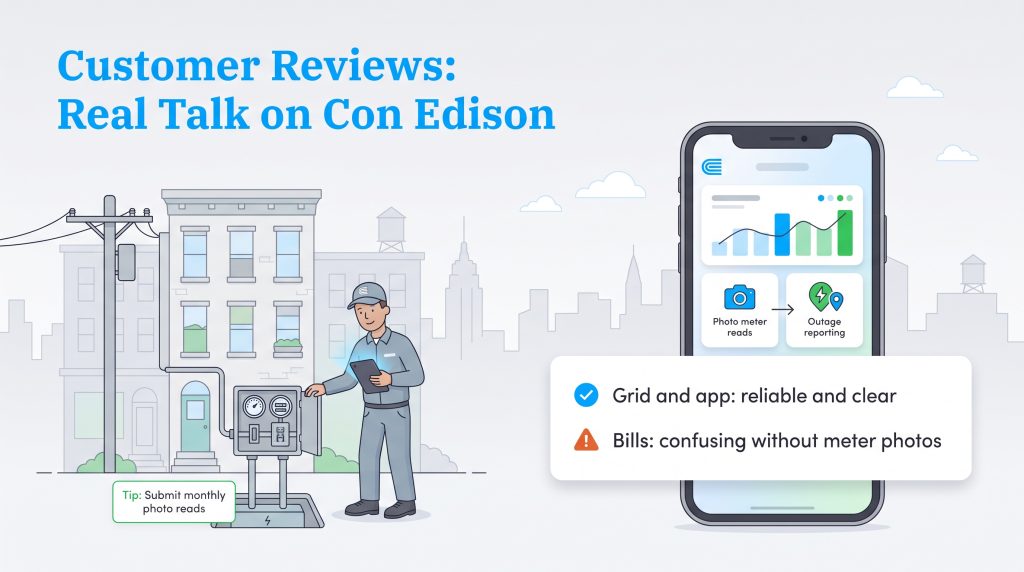
When analyzing verified public sentiment drawn from New York State Department of Public Service (DPS) complaint logs, the Better Business Bureau (BBB), and active local Reddit threads on r/AskNYC and r/Westchester, Con Edison reviews reveal a sharp divide between engineering excellence and billing frustration. Understanding what ticks off longtime locals can help you avoid the exact same traps.
On the positive side, customers consistently give Con Edison high marks for grid reliability and digital tools. Maintaining an underground network for millions of residents is no small feat, and repair crews are widely praised on neighborhood forums for restoring power quickly after nor’easters and summer heatwaves. New Yorkers also love the redesigned mobile app, noting that checking real-time smart meter graphs and reporting outages takes seconds.
Conversely, complaints logged with the BBB and DPS center almost entirely on steep 2025 and 2026 delivery rate hikes, legacy billing estimation errors prior to the smart meter rollout, and confusion over alternative rate plans. On r/AskNYC and r/Westchester, dozens of threads feature homeowners shocked that their delivery charges now regularly exceed the cost of the electricity itself. Furthermore, customers who casually opted into the Time-of-Use or Con Edison smart energy plan without changing their daytime appliance habits frequently complain about painful peak-hour surcharges. The takeaway from seasoned locals? Make sure your building has an active Smart Meter (or submit photo meter reads monthly through the app), and audit your family’s weekday schedule before switching off the standard rate plan.
Making the Best Call for Your Con Edison Service
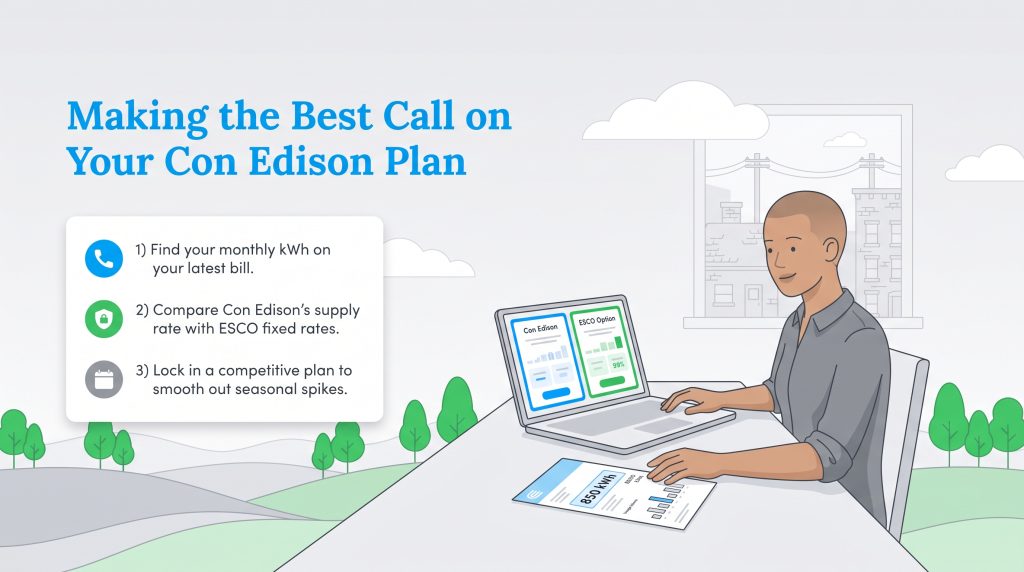
Taking control of your monthly utility costs starts with understanding how your home uses energy and what options are on the table. If you stick with the default Con Edison supply, you get a no-strings-attached monthly arrangement, though your wallet remains exposed to wholesale market spikes during August heatwaves and January freezes.
Once your service is active, take 10 minutes to open your Con Edison app, check your monthly kWh usage, and see if you qualify for community solar or EEAP bill credits. From there, compare third-party ESCO rates against Con Edison’s standard supply charge. Whether you lock in a fixed-rate green energy contract or stay on the default plan and enroll in Budget Billing, a few proactive tweaks will keep your lights on and your utility budget predictable year-round.
Frequently Asked Questions About Con Edison
What does Con Edison do?
Con Edison (Consolidated Edison) delivers electricity, natural gas, and steam to homes and businesses in New York City and Westchester County. They maintain the infrastructure (power lines, gas pipelines, etc.), while customers can choose either Con Ed or a third-party supplier for their actual energy supply.
Can I choose a different electricity provider than Con Edison?
Yes. While Con Edison securely delivers your energy and cannot be replaced for grid maintenance, New York is a deregulated market. This means you can choose an independent Energy Service Company (ESCO) to supply your electricity or natural gas, which often allows you to secure a lower fixed rate or opt into 100% green energy plans.
Why is my Con Edison bill so high this month?
Your bill can spike due to seasonal usage changes (like running the AC heavily in July), variable rate increases in the wholesale energy market, or estimated billing if your physical meter was not accurately read that month. If you are on the Smart Energy Plan, utilizing heavy appliances during daytime peak hours will also cause high surcharges.
What are Con Edison’s peak hours for the Smart Energy Plan?
Under Con Edison’s demand-based Smart Energy Plan, peak hours run Monday through Friday from noon to 8 p.m. All weekend hours and weekday hours outside that afternoon window are off-peak. Keep in mind that this differs from Con Edison’s standard Time-of-Use (TOU) rate, where peak hours run from 8 a.m. to midnight every day and off-peak hours are midnight to 8 a.m.
What is the difference between Con Edison’s Time-of-Use and Smart Energy plans?
The Time-of-Use (TOU) plan bills you per kilowatt-hour based on when you use electricity, offering cheap off-peak rates overnight (midnight to 8 a.m.) and higher rates from 8 a.m. to midnight, making it ideal for overnight EV charging. The Smart Energy Plan uses demand-based delivery pricing, charging you based on the maximum burst of power your home pulls at one time during weekday peak hours (Monday through Friday, noon to 8 p.m.), which rewards households that stagger heavy appliance use.
How do I start or transfer Con Edison service when moving?
You can start or transfer service online through the Con Edison website or mobile app by selecting the “Start, Stop, or Move Service” option. You will need to provide a valid government ID, your Social Security Number or ITIN, your new address and lease start date. Because most NYC and Westchester residences now have automated Smart Meters, your service can usually be activated remotely the same day or next day without a technician visit.
Can NYC apartment renters sign up for Con Edison community solar?
Yes! NYC renters do not need a roof or landlord permission to join a community solar program. As long as you have an active Con Edison electric account in your name, you can subscribe to a local shared solar farm and automatically receive a 5% to 15% credit on your monthly Con Edison electric bill for the clean power produced by your share.
How do I dispute an estimated meter reading with Con Edison?
If you receive a surprisingly high estimated bill, log into the Con Edison mobile app or online portal. You can submit your own actual meter reading by typing in the numbers displayed on your physical meter or by uploading a clear photo of the meter dial to override the company’s estimate.
How do I pay my Con Edison bill?
You can pay your bill via the online portal, the mobile app (iOS and Android), Auto-Pay, by phone, through the mail with a check, or in person at authorized local payment centers.
Does Con Edison offer payment plans or assistance?
Yes, they provide several options including Deferred Payment Agreements for overdue bills, the Energy Affordability Program (EAP) for low-income discounts, and Budget Billing to help stabilize your monthly payments.
Does Con Edison offer fixed-rate electricity plans?
No, Con Edison only provides a default variable rate for your energy supply, meaning prices fluctuate based on market demand. If you want a fixed-rate electricity plan to lock in your pricing, you must switch your supply service to a third-party retail energy provider.
What happens if I miss a Con Edison bill payment?
If you miss a payment, Con Edison will typically apply a late fee of 1.5% to your overdue balance. If the bill remains unpaid over an extended period, they may require a security deposit on your account or eventually issue a service disconnection notice.
About the Author

David has been an integral part of some of the biggest utility sites on the internet, including InMyArea.com, HighSpeedInternet.com, BroadbandNow.com, and U.S. News. He brings over 15 years of experience writing about, compiling and analyzing utility data.