
Understanding the new utility rate changes in New York City and Westchester County can help you keep your monthly bills under control.
Key Takeaways
- Con Edison delivery charges are increasing by 3.5% for electricity and 4.4% for natural gas in 2026 to fund grid modernization and climate mandates.
- Over 100,000 customers in Westchester and New York City are automatically reverting to default utility variable rates following the quiet shutdown of municipal aggregation programs.
- You can protect your household budget by shopping for fixed-rate third-party suppliers or switching to time-of-use billing.
If you just moved into a new home in New York City or Westchester County, or if you are trying to trim your current household budget, we have some important news that might make your wallet pinch. The New York State Public Service Commission has officially approved a new three-year rate plan for Consolidated Edison (Con Edison), which means your utility bills are going up immediately. While the state heavily scaled back the utility’s original double-digit requests, you will still see an immediate delivery rate hike of 3.5% for electricity and 4.4% for natural gas starting in 2026. Don’t worry, though — we have got you covered with a complete guide on why these rates are changing, who is affected, and exactly how you can fight back to keep your energy bills as low and sustainable as possible.
Why Are Con Edison Rates Changing?
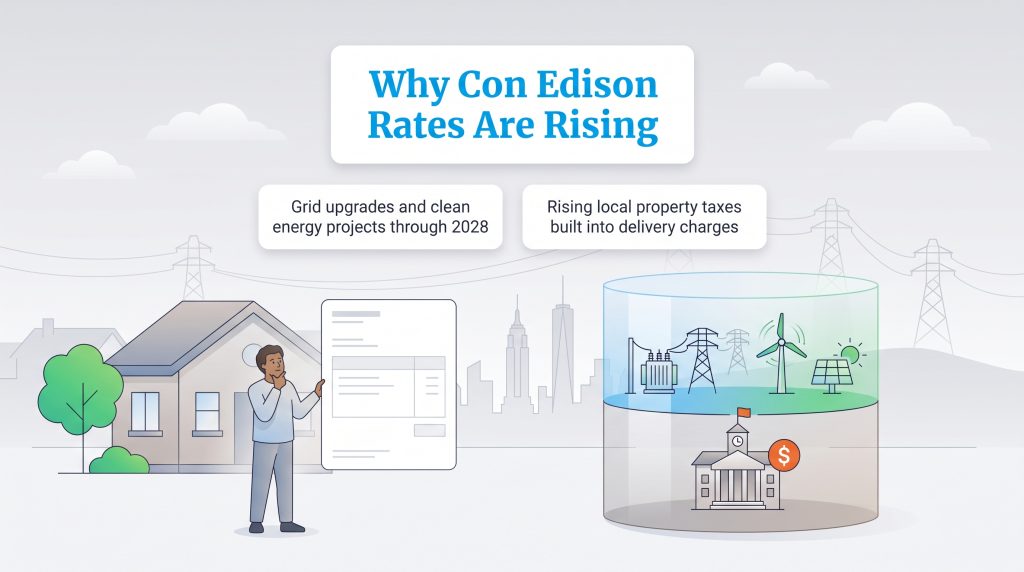
Con Edison is updating its infrastructure to make the grid more resilient and support the state’s ambitious clean energy targets. This shift requires massive capital investments to upgrade power transmission lines, build new substations, and transition to cleaner sources. Under the newly approved rate agreement, the utility is executing a massive $11.7 billion in electric grid investments and $2.8 billion in natural gas system improvements through 2028.
A major portion of this capital is funding infrastructure projects that are legally required to align with New York’s Climate Leadership and Community Protection Act, which mandates a 100% zero-emissions grid by 2040. These projects include building the Brooklyn Clean Energy Hub to integrate offshore wind power directly into the downstate grid. Con Edison is also constructing the Idlewild Substation Complex in Queens to handle growing power demands from John F. Kennedy International Airport, support the transition to electric buses, and handle building electrification.
On top of clean energy, we are also paying for local property taxes through our utility statements. Con Edison expects its customers to fund more than $3.2 billion in local property taxes in 2026 alone. Because nearly a quarter of your delivery charge goes directly to fund these municipal taxes, local property tax increases are a silent driver behind why your utility rates are rising.
How Much More Will You Pay Each Month?
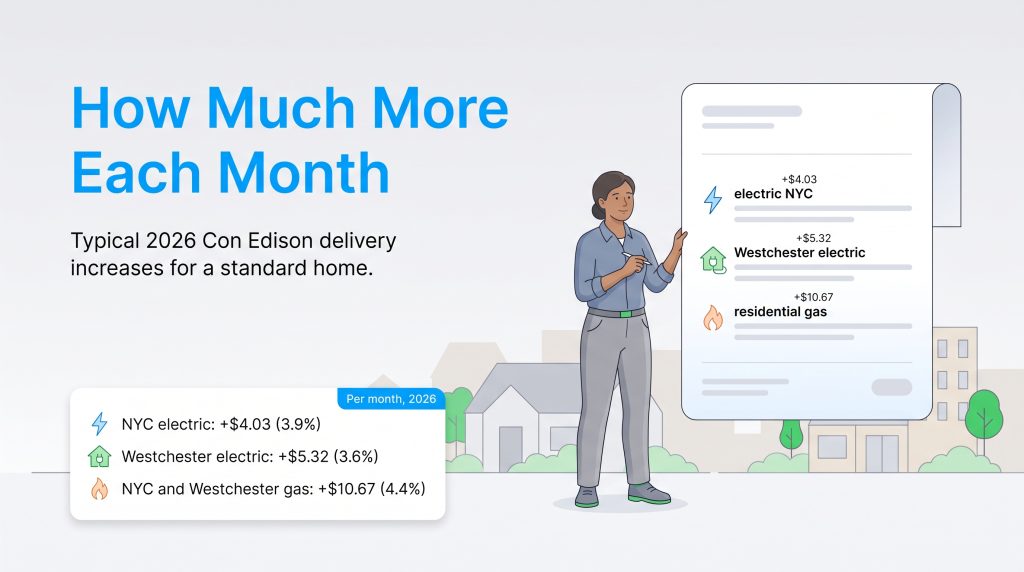
The approved three-year rate plan uses a structured approach to prevent immediate massive spikes in your monthly budget. While the rate plan spans through December 31, 2028, you will see the initial delivery charge increases show up right away on your billing statements.
Because the state delayed its final vote on the rate case until late January 2026, Con Edison was temporarily billing customers at 2025 rates. Now that the new rates are approved, they are backdated to the start of the year. This means you will see a temporary retroactive surcharge on your subsequent bills to make up the difference for those early months.
To help you understand how this changes your day-to-day household budget, here is a breakdown of the typical monthly increases starting in 2026:
| Region and Customer Class | Standard Monthly Consumption | Estimated Monthly Bill Increase (2026) | Total Percentage Bill Change (2026) |
| NYC Residential Electric | 280 kWh | $4.03 | 3.9% |
| Westchester Residential Electric | 425 kWh | $5.32 | 3.6% |
| NYC and Westchester Residential Gas | 100 therms | $10.67 | 4.4% |
While electric delivery charges will increase steadily over the next three years, your summer electric supply charges will vary. For the summer of 2026, New York City residential customers are projected to see a 5.7% increase due to rising wholesale commodity supply costs. Interestingly, Westchester County residential electric customers are projected to see an average summer bill decrease of 2.8% due to localized supply dynamics and transmission capacity.
Who Is Impacted by the Rate Increase?
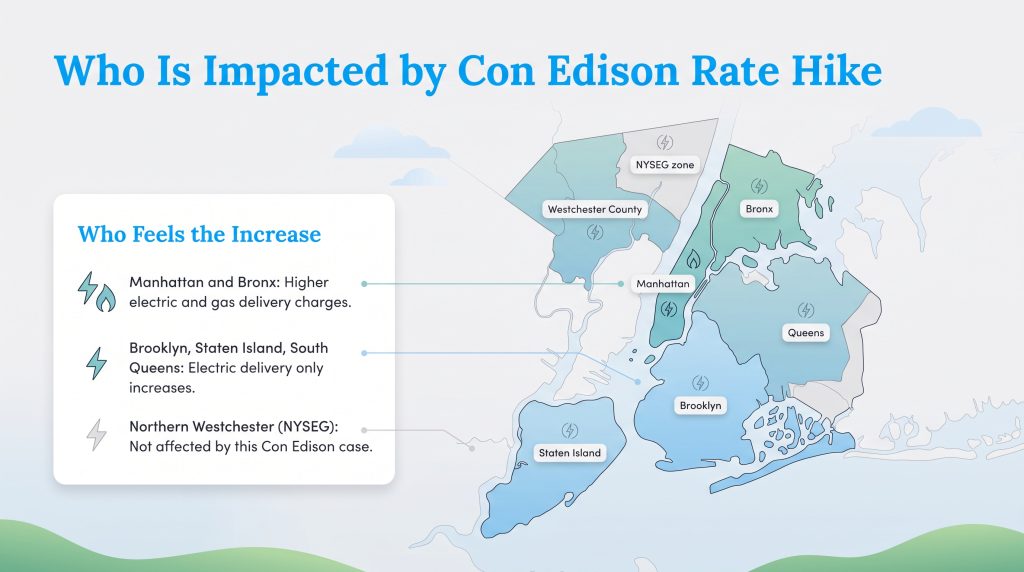
Con Edison’s massive service area covers 660 square miles and delivers power to over nine million residents. Depending on where you live and which utilities deliver your electricity or natural gas, your household budget will be impacted in different ways.
New York City Boroughs
If you live in Manhattan or the Bronx, Con Edison delivers both your electricity and your natural gas, meaning you will feel the rate hike on both parts of your bill. However, if you reside in Brooklyn, Staten Island, or the southern half of Queens, Con Edison only delivers your electricity. Your natural gas is delivered by National Grid, so your gas bill is completely unaffected by this specific rate case.
Westchester County
For Westchester residents, the rate hikes impact almost the entire county, including major cities like Yonkers, New Rochelle, Peekskill, and Mount Kisco. If you live in northern Westchester and receive your energy delivery from the New York State Electric & Gas (NYSEG) corporation, you are unaffected by this specific Con Edison rate hike, though NYSEG has its own rate case pending before the state.
The Quiet Collapse of New York’s Community Choice Aggregations
If you live in Westchester, you might have previously participated in Westchester Power, a local Community Choice Aggregation (CCA) program. This program allowed local governments to pool their buying power to secure fixed-rate green energy. Under this model, you were automatically enrolled in the program unless you explicitly chose to opt out.
In late 2025, Sustainable Westchester announced that it was permanently shutting down its Westchester Power program. This unexpected decision was triggered by strict new consumer outreach, education, and pricing transparency rules adopted by the New York Public Service Commission. The state rejected multiple municipal filings from Sustainable Westchester due to “universal deficiencies,” including incorrect price comparisons and missing outreach records.
With the collapse of these programs, municipal electric CCA programs have quietly wound down statewide. If you were enrolled, you have been automatically returned to standard default variable rates from Con Edison or NYSEG. Your lights will stay on, and no physical service will be interrupted, but your supply rates will now fluctuate with monthly market conditions.
What You Can Do to Lower Your Utility Bill
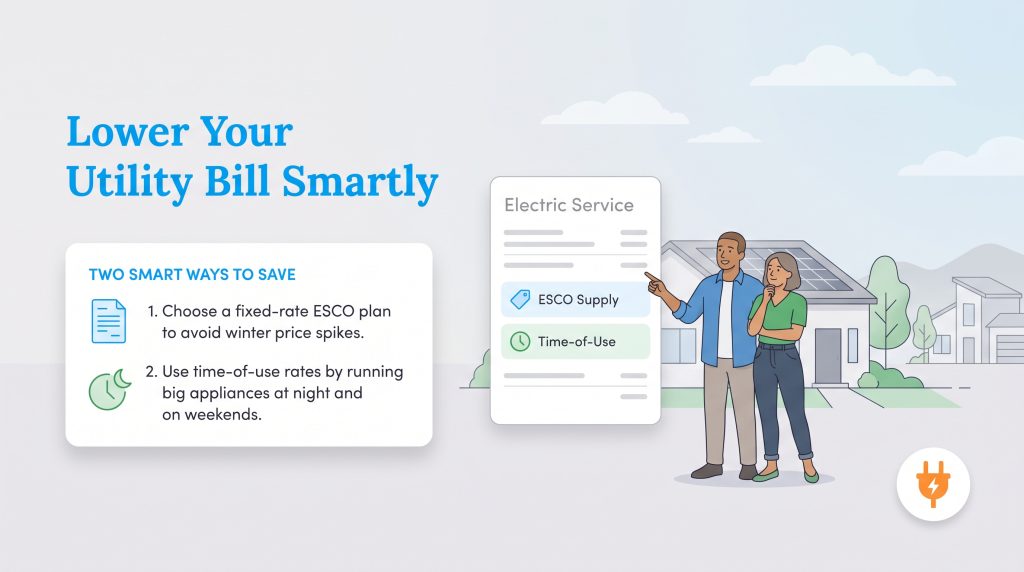
Now that opt-out community buying programs have ended, the responsibility of keeping your bills low falls entirely on your shoulders. Fortunately, New York’s deregulated energy market gives you options.
Shop for a Third-Party Energy Supplier
While Con Edison always handles the physical grid delivery, you can choose to buy your actual energy supply from third-party Energy Service Companies (ESCOs). These companies compete for your business and offer different pricing models, including fixed-rate plans. A fixed-rate plan lets you lock in your rate for six to 24 months, shielding you from wild winter price surges.
To protect consumers, the state caps variable ESCO rates to guarantee they do not exceed what you would have paid under the default utility supply rate over a trailing 12-month period. Fixed-rate plans can charge a maximum premium of only 5% above that 12-month average. You can compare registered providers safely using the official New York Power to Choose Portal
or look up active suppliers on the Con Edison Shop for ESCOs Page.
Switch to Time-of-Use Rates
If you can shift your heaviest electricity usage — like running your dishwasher, doing laundry, or charging your electric vehicle — to nights and weekends, you should look into Con Edison’s Smart Energy Billing Plan. This time-of-use (TOU) tariff charges you higher rates during peak weekday hours and much lower rates off-peak, which can save you 10% to 20% on your bill. To make it worry-free, Con Edison offers a risk-free one-year price guarantee for qualifying electric vehicle owners who switch to TOU rates, promising to credit your account if you end up paying more than you would have under the standard residential plan.
Financial Assistance and Free Energy Efficiency Programs
If you are struggling to keep up with your heating or cooling bills, you are not alone. There are several highly effective state and utility programs designed to provide direct financial relief and help you consume less energy.
Direct Utility Bill Assistance
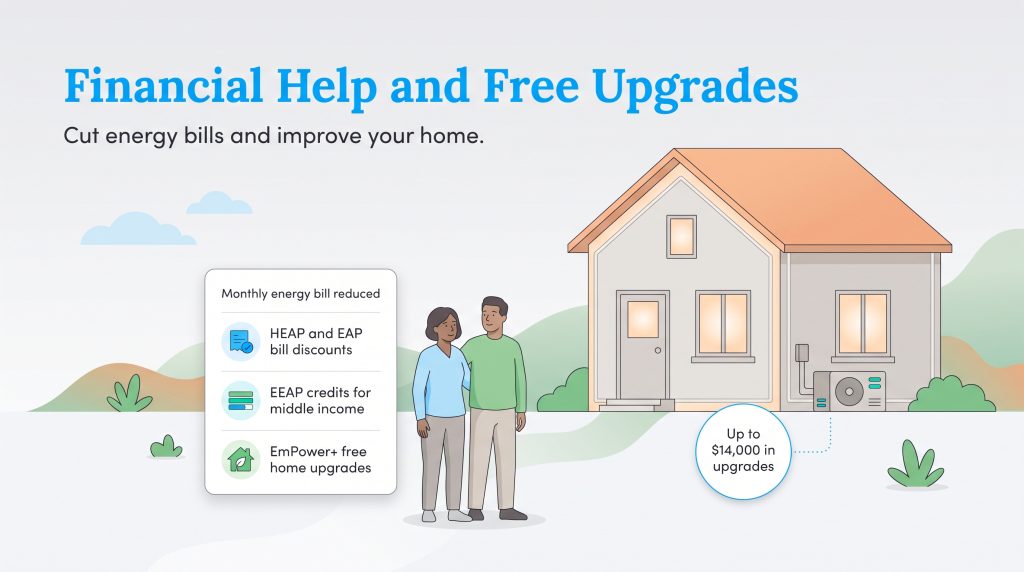
Low-income households can apply for the federal Home Energy Assistance Program (HEAP), which offers direct grants to cover seasonal heating and cooling costs. If you receive a HEAP grant, you will be automatically enrolled in Con Edison’s Energy Affordability Program (EAP) to receive direct monthly bill discounts. For middle-income households, the state’s Enhanced Energy Affordability Program (EEAP) is an active pilot program offering tiered monthly bill credits to families earning between 60% and 100% of the State Median Income.
Free Home Energy Upgrades
If you want to lower your physical energy consumption, applying for the NYSERDA EmPower+ Program is an excellent, environmentally mindful choice. This state program provides income-eligible homeowners and renters with a free, comprehensive home energy assessment to find where your home is losing energy. Following the assessment, approved contractors can install energy-saving upgrades — including air sealing, wall insulation, and highly efficient heat pumps — at absolutely no cost to you (up to $14,000 for qualifying low-income households downstate).
Taking Charge of Your Energy Choices in New York
Navigating the complex world of utility rates can feel overwhelming, but taking a few proactive steps can make a massive difference in your household budget. Whether you choose to shop for a fixed-rate green ESCO, switch to time-of-use billing, or apply for state-funded energy-saving upgrades, we are here to support you in creating a more sustainable and affordable home. By staying informed and making intentional choices, you can protect both your pocketbook and our shared environment.
Frequently Asked Questions About Con Edison Rates
Why is my Con Edison bill higher if my actual energy usage stayed the same?
Will I lose power if I choose to switch to a third-party energy supplier (ESCO)?
What happened to the Westchester Power green energy program?
About the Author

Claudio is a sustainability-focused writer with a background in Anthropology and Psychology from NC State University. He has spent over 15 years working in writing, interpretation, and translation, driven by a deep interest in how human culture shapes the environment. Today, he shares his curiosity with readers by writing about sustainable living solutions and the connection between everyday choices and environmental impact.