

Setting Up Your Electricity, Gas, Internet, And Water Before Move-In Day Ensures A Smooth And Stress-Free Transition To Your New NYC Apartment
Key Takeaways
- Schedule Con Edison at least two weeks before your move-in date to ensure your power is on and to avoid unexpected connection delays.
- Verify your specific building’s internet wiring with the landlord or super, as your choices are often limited to one or two exact providers.
- Check your lease for water and heat terms to understand exactly what your landlord is legally required to cover versus what you must pay for directly.
Relocating to the city requires you to establish three essential connections before you even unpack: electricity, cooking gas, and internet. Managing your moving to New York setting up utilities checklist effectively means you can flip the light switch on move-in day and instantly make your new apartment feel like home. We know the local infrastructure inside and out, so we have created this step-by-step checklist to help you skip the administrative headaches. Let us help you check these essential utility connections off your to-do list efficiently, allowing you to focus on unpacking and exploring your new neighborhood rather than sitting in a dark, unheated room.
Step 1: Confirm Lease Inclusions For NYC Renters
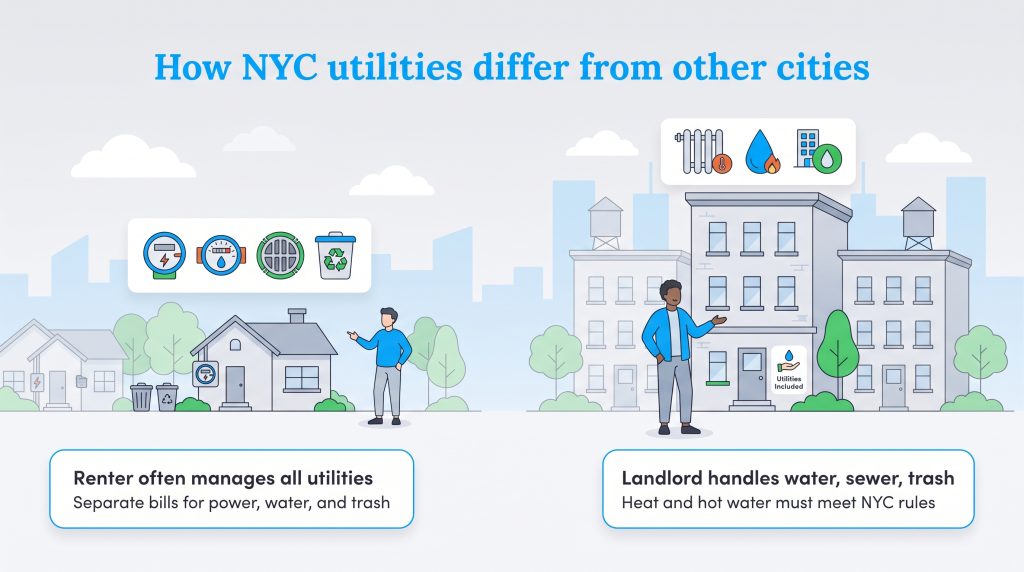
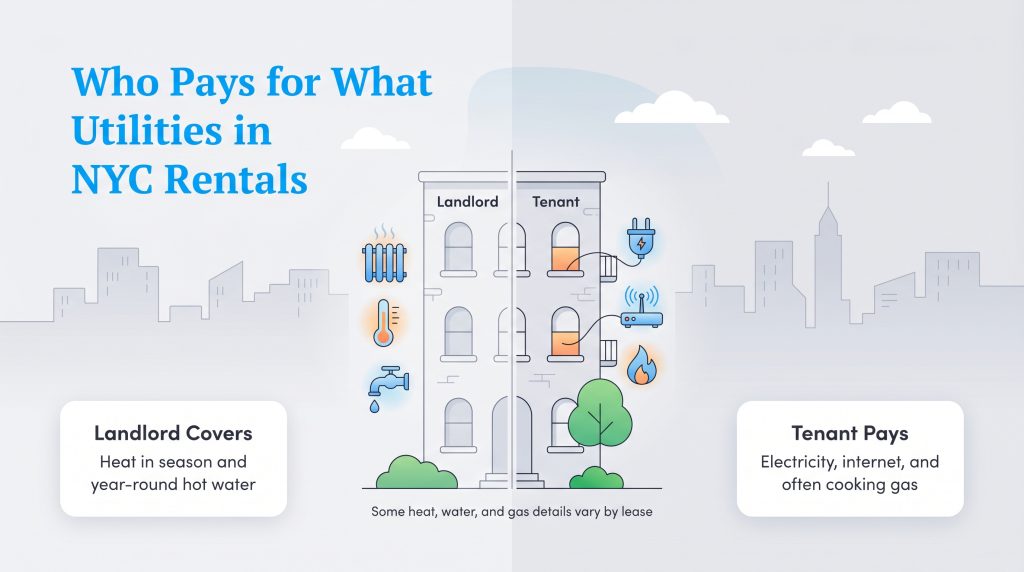
Before you dive into the logistics of your apartment utility setup in NYC, you must figure out what is actually your financial responsibility. New York City housing laws strictly dictate certain landlord obligations. In almost all multi-family buildings, having water and heat included NYC rent is the legal standard. Landlords are legally required to provide heat and hot water during the designated “Heat Season,” which runs from Oct. 1 through May 31. During this window, indoor temperatures must be maintained at 68 degrees during the day whenever the outside temperature drops below 55 degrees, and at least 62 degrees overnight regardless of outdoor conditions. Similarly, your building owner is directly billed for municipal water, sewer, and standard trash collection.
While water and heat are typically covered, you must carefully review your lease to verify your responsibilities for electricity and cooking gas before you navigate how to transfer utilities. Older rent-stabilized buildings usually roll cooking gas into your monthly rent, while modern high-rises typically meter it individually. Getting this information directly from your property manager prevents you from opening unnecessary accounts or facing a service shut-off.
🚩 Heads Up: Always ask your broker or landlord explicitly which utilities are sub-metered versus shared before signing a lease. Getting this in writing prevents unexpected billing disputes during your first few months in the apartment.
Step 2: Establish NYC Electricity (Con Edison & PSEG)
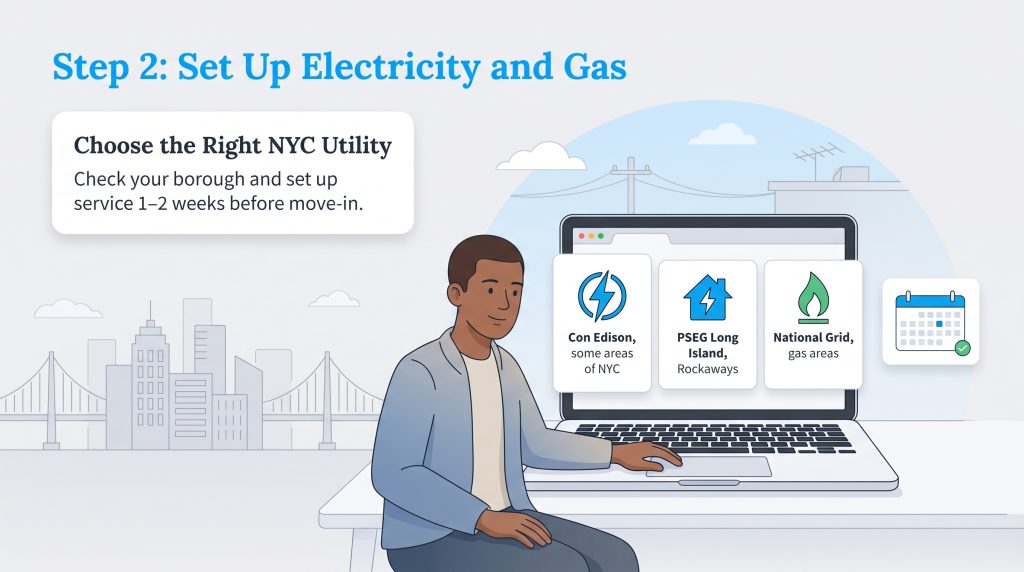
New York’s energy infrastructure is divided by exact neighborhood boundaries, meaning you do not get to pick your baseline delivery utility. Submitting a Con Edison start service NYC request is standard for most residents, as Con Edison covers electricity for all five boroughs except the Rockaway Peninsula. If you are moving to the Rockaways in Queens, you must navigate a PSEG Rockaways electricity setup instead. Con Edison allows you to conveniently schedule your activation online up to 30 days in advance, and we strongly recommend initiating this process at least two weeks prior to your move-in date to ensure your power is flowing.
| Provider | Service Area | Utility Provided | Action Link |
|---|---|---|---|
| Con Edison | Manhattan, Bronx, Brooklyn, Queens (except Rockaways) | Electricity & Gas | Start / Stop Service |
| PSEG Long Island | The Rockaways (Queens) | Electricity | Start / Stop Service |
| National Grid | Brooklyn, Staten Island, parts of Queens | Natural Gas | Start / Stop Service |
Step 3: Connect NYC Cooking Gas (National Grid & Con Ed)
If your lease states that you are personally responsible for cooking gas, determining your specific provider depends entirely on your borough. When setting up natural gas service, Con Edison handles Manhattan, the Bronx, and select parts of Queens. Conversely, a National Grid NYC moving request covers gas delivery for Brooklyn, Staten Island, and the remainder of Queens. You should contact your designated gas provider approximately two weeks before your move.
💡 Pro Tip: Turning on a new gas line frequently requires an in-person appointment. An adult over the age of 18 must be physically present in the apartment while the technician conducts a thorough safety check of the valves and appliances.
Step 4: Secure Your NYC Internet Provider
When you setup internet NYC apartment style, you will quickly discover that your choices are heavily dictated by how your specific building is wired. While the city boasts massive telecommunications infrastructure, many older brownstones only support one cable provider, while newly constructed high-rises could feature exclusive fiber-optic lines. Before comparing promotional packages online, you must ask your property manager which internet service providers are actively wired into your building.
Once you know what your building supports, you can choose the right internet service provider. When comparing Spectrum vs Verizon Fios NYC, Fios is widely considered the gold standard, offering highly reliable, symmetrical fiber-optic speeds ideal for remote work. Spectrum is a highly common cable alternative spanning Manhattan and beyond, offering robust speeds that easily support typical streaming. Finally, Optimum is frequently found in Brooklyn and the Bronx, providing both fiber and traditional cable connection packages depending on your local neighborhood’s infrastructure.
Utility Setup Requirements For International And Out-Of-State Movers
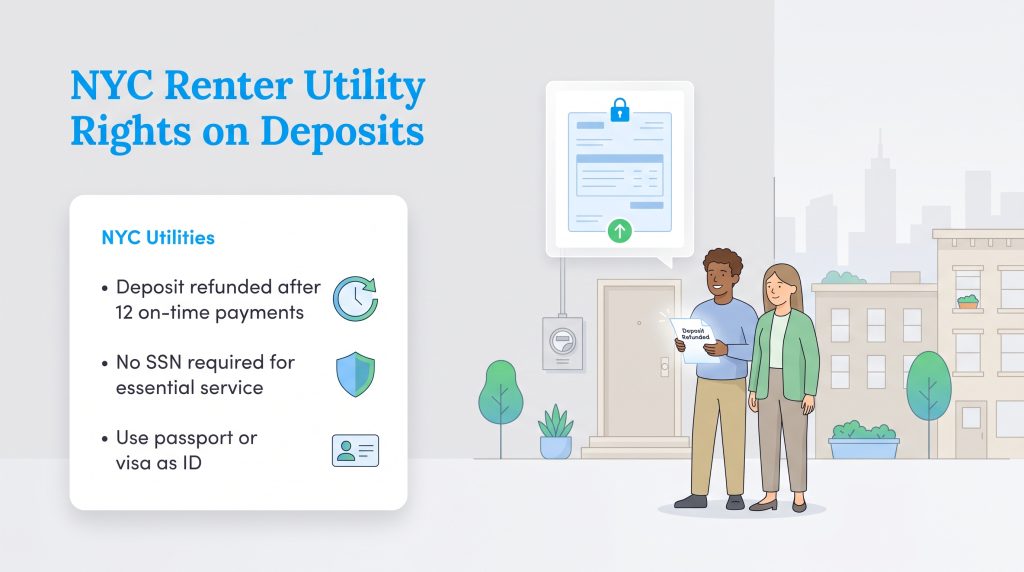
Understanding your renter utility rights protects you from unnecessary financial burdens, especially if you are relocating from abroad. When you establish a new electricity or gas account, utility companies perform a soft credit check. If you lack a U.S. credit history or have a poor credit score, the provider mandates a security deposit before activating your service. However, New York law dictates that utility companies must refund this deposit, plus accrued interest, after 12 months of consecutive on-time payments.
For international students and expats, setting up accounts without a Social Security Number (SSN) requires a few extra steps. Providers cannot deny you essential services simply because you do not have an SSN. To bypass this, you must avoid the automated online portal and call the customer service line directly. You will be asked to provide alternative proof of identity, which can include:
- A valid international passport
- An Alien Registration Card (Alien ID)
- A valid U.S. student visa
- Consular identification documents
Navigating ESCOs And Energy Choice In NY
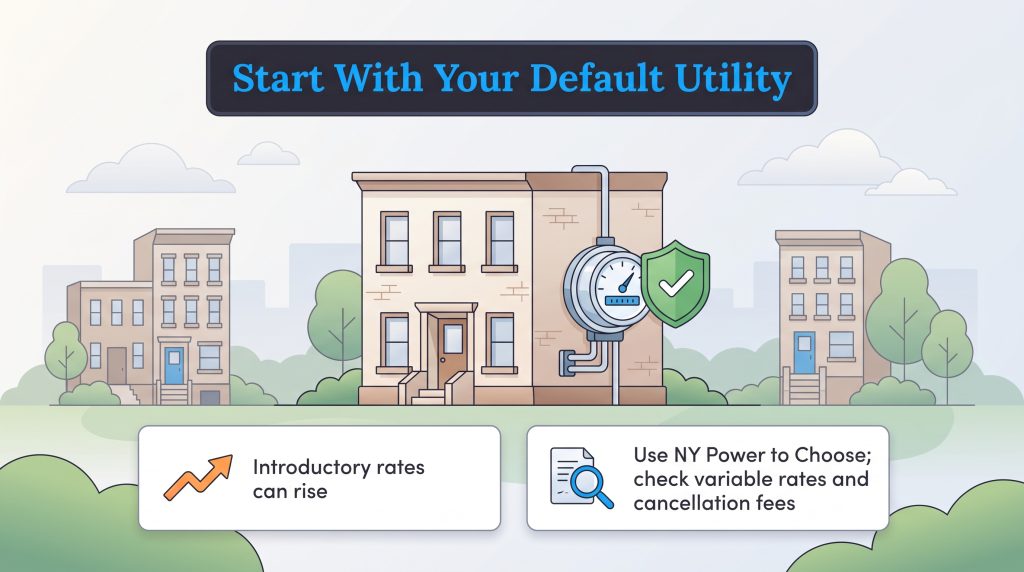
New York features a deregulated energy market, meaning you have the option to choose a third-party Energy Service Company (ESCO) for your electricity supply. While having choices sounds appealing, you must be extremely cautious to avoid ESCO utility scams NYC residents frequently encounter. Many third-party suppliers lure renters in with low introductory rates that skyrocket after the first few months, resulting in significantly higher bills.
We strongly recommend sticking with your default utility supplier upon move-in. Once you are settled and understand your standard monthly usage, you can carefully verify ESCO rates using the state’s official Power to Choose portal before making a switch. Always read the fine print for cancellation fees and variable rate clauses if you choose to explore the open market.
Understanding The Average NYC Utility Bill
Giving yourself a realistic expectation of an average NYC utility bill, and understanding the basics of utility costs, will help you budget effectively. Your monthly bill fluctuates wildly depending on the square footage of your unit, the age of the building’s insulation, and your personal consumption habits. Running an inefficient window AC unit around the clock in August will spike your electricity bill dramatically.
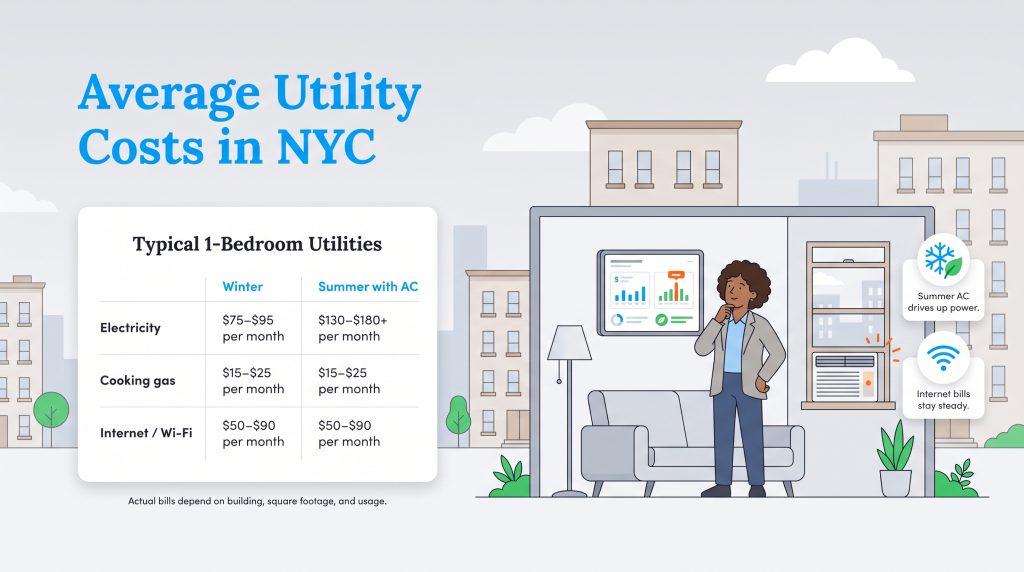
Below is an estimated pricing table breaking down the average monthly cost of electricity, cooking gas, and basic internet for a standard 1-bedroom apartment in NYC.
| Utility Service | Winter Average Cost | Summer Average Cost (With AC) |
|---|---|---|
| Electricity | $75 to $95 | $130 to $180+ |
| Cooking Gas | $15 to $25 | $15 to $25 |
| Internet / Wi-Fi | $50 to $90 | $50 to $90 |
Energy-Saving Choices For Your Apartment
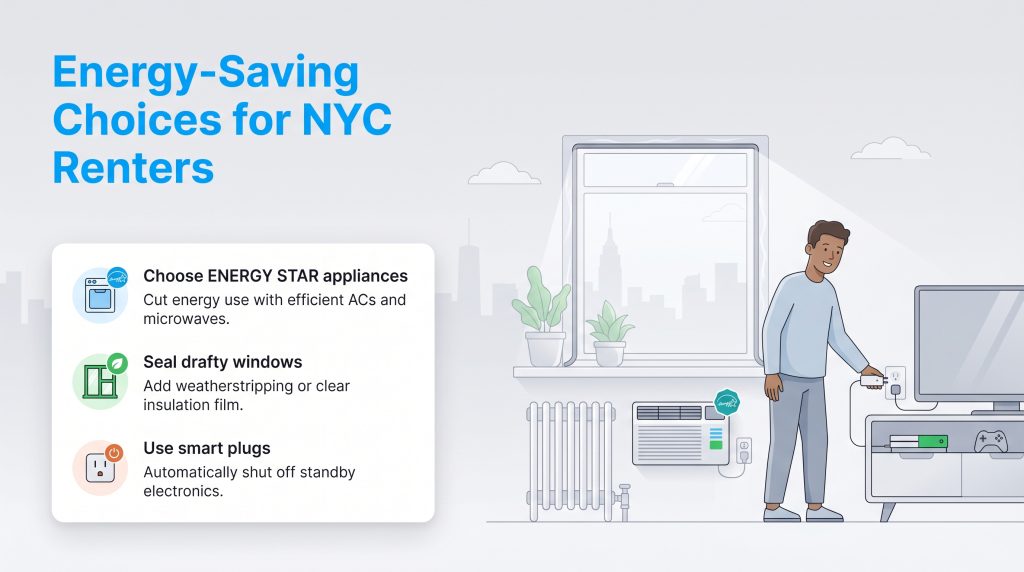
Even if you are renting on the fifth floor and cannot install personal solar panels, there are still plenty of ways to create an environmentally mindful home. If you are supplying your own window air conditioners, prioritize purchasing ENERGY STAR certified products. Additionally, older city apartments are notorious for drafty windows. Installing simple weatherstripping provides an affordable, energy-saving option that drastically reduces the strain on your heating system during the winter.
💸 Money-Saver: Simple, everyday habits like switching to LED bulbs or utilizing smart power strips can offset high local energy rates. Implementing these minor adjustments will significantly reduce your monthly electric bill without requiring major lifestyle changes.
Preparing For Your NYC Move-In Day
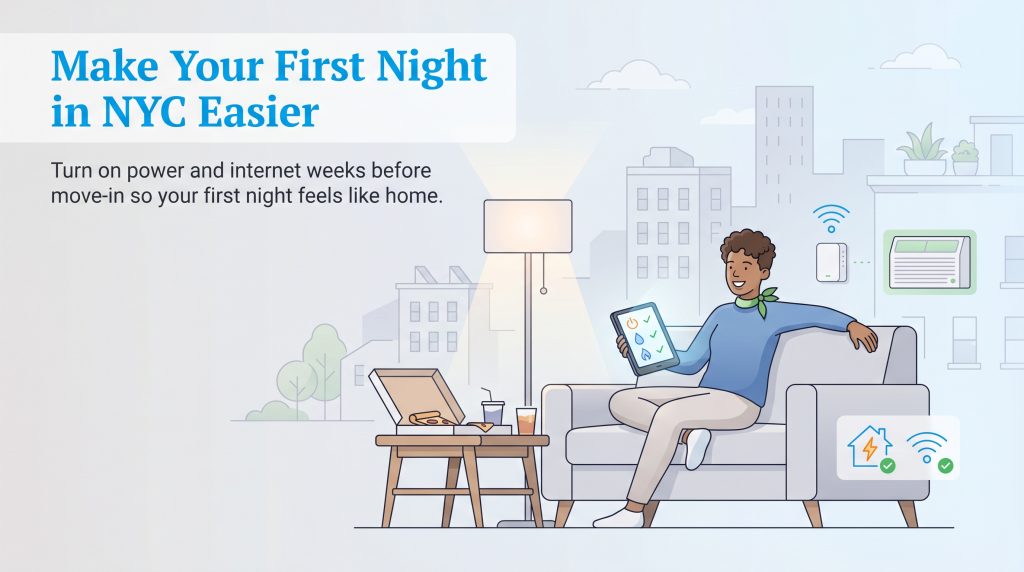
Knocking out your moving utilities checklist before you pack your first moving box transforms a chaotic relocation into a highly organized transition. By tackling these utility connections early, you can successfully avoid hidden moving costs and enjoy a relaxing first night in the city. Welcome to New York — we hope settling into your new apartment is just the beginning of an incredible chapter.
Frequently Asked Questions About Setting Up Utilities In NYC
Setting up your apartment connections often sparks a few lingering questions. Here are the most common inquiries renters have when managing their accounts across the five boroughs.
How far in advance should I set up utilities in NYC?
Do renters pay for water and heat in an NYC apartment?
Can I choose my internet provider in a NYC apartment?
How do I set up Con Edison without a Social Security Number?
Why is my first NYC electric bill so high?
Can I choose a renewable electricity plan in NYC?
About the Author

LaLeesha has a Masters degree in English and enjoys writing whenever she has the chance. She is passionate about gardening, reducing her carbon footprint, and protecting the environment. She also recently served as President of the Board for City Sprouts (a community garden).

David has been an integral part of some of the biggest utility sites on the internet, including InMyArea.com, HighSpeedInternet.com, BroadbandNow.com, and U.S. News. He brings over 15 years of experience writing about, compiling and analyzing utility data.