

Understanding your Con Edison delivery charges can help you identify what you can change, what you cannot, and where your best savings opportunities are.
Key Takeaways
- Con Edison delivery charges make up 50% to 65% of a typical electric bill and cover the cost of maintaining the local grid rather than the electricity itself.
- Delivery charges are based on grid maintenance in dense urban areas, meaning they can often exceed the actual supply charges on your bill.
- While you cannot switch delivery utility companies in Con Edison’s service territory, you can lower these costs by shifting usage times and exploring community solar offsets.
Experiencing bill shock after opening your latest New York City or Westchester utility statement is understandable when the fees just to get power to your home eclipse the cost of the energy itself. To help you take control of your monthly budget and combat rising Con Edison delivery charges, we break down exactly what these fees cover, why they run so high in our region, and actionable ways you can reduce them.
What Are Con Edison Delivery Charges?
When trying to get a Con Edison bill breakdown, the easiest way to understand the charges is by thinking about your favorite online shopping habit. The actual electricity you consume is like the product you add to your cart, while the delivery charge serves as the shipping fee required to get that package to your front door. Con Edison splits your monthly statement into these two distinct functions: generating the power and physically delivering that power to your home.
Many New Yorkers feel understandably frustrated when they realize the “shipping fee” often costs more than the electricity itself. It helps to know how the utility makes its money: Con Edison makes zero profit on the electricity supply, which it passes straight through to you at wholesale market cost. Instead, the company generates its regulated revenue exclusively through New York Public Service Commission (NY PSC) approved delivery rates to fund and maintain the complex web of wires, transformers, and substations that keep your lights on.
Con Edison Delivery Charges Breakdown: Line-by-Line
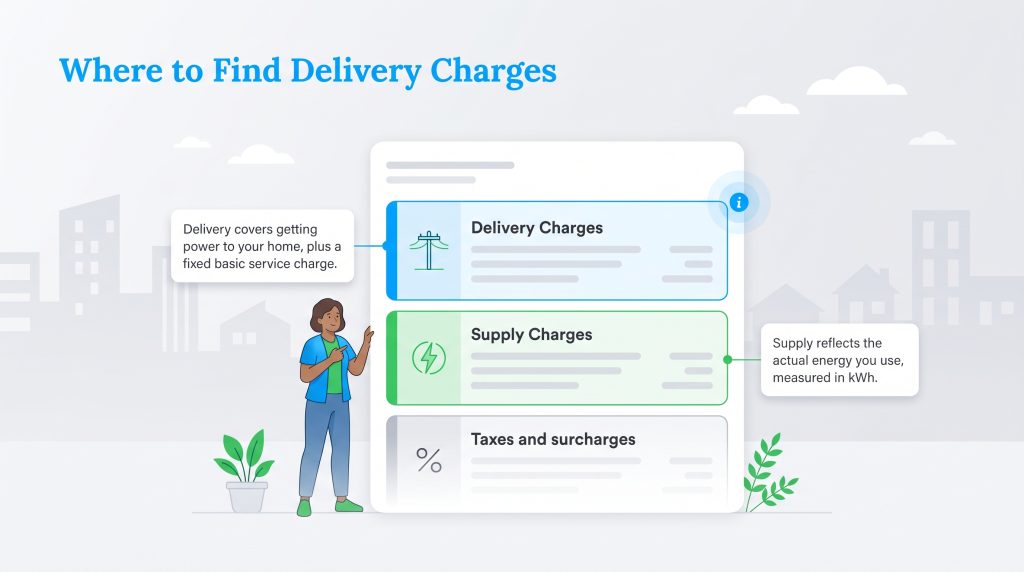
Understanding your electric bill starts with knowing where to look and what numbers are normal for our area. Your Con Edison bill separates your total amount due into three primary sections so you can track where your money goes each billing cycle.
- Delivery Charges: This section normally accounts for 50% to 65% of your total bill. It includes a flat $21.00 to $22.60 basic service charge alongside usage-based fees averaging 16¢ to 18¢+ per kilowatt-hour (kWh) for transporting electricity to your home.
- Supply Charges: This reflects the wholesale market cost of the raw energy you consumed, typically hovering around 12¢ to 14¢ per kWh depending on seasonal demand, plus a small merchant function charge of roughly 0.4¢ to 0.6¢ per kWh if Con Edison buys power on your behalf.
- Taxes and Surcharges: State and local fees, including the Gross Receipts Tax (around 2.4% to 5.2%), a 4.5% local residential sales tax, and state energy surcharges, are itemized inside and at the bottom of your delivery and supply breakdowns.
Delivery vs. Supply Charges
Evaluating Con Edison delivery vs. supply charges reveals why cutting back on usage doesn’t always cut your bill in half. The supply charge on your statement reflects the actual energy generated by power plants and consumed by your household. Conversely, the delivery portion funds the physical infrastructure required to transport that energy. This encompasses the miles of electrical wires, utility poles, underground cables, substations, and the cost of reading your smart meter. You can explore Con Edison’s interactive bill breakdown to see exactly where these separate line items appear on your unique statement.
The Basic Service Charge
At the very top of your delivery section, you will notice a line item known as the Con Edison basic service charge. For standard residential customers (Service Classification 1), this flat, unchangeable fee ranges from $21.00 to $22.60 per month, plus an embedded billing and payment processing fee of roughly $1.73. This baseline charge is applied to every single bill before a single kilowatt-hour is consumed, meaning you will owe roughly $23 to $24 even if you turn off your circuit breaker and go on vacation for a month. It covers fixed administrative expenses like customer service operations, billing systems, and regular meter maintenance.
Per-kWh Delivery Rate
Right beneath the basic service charge sits your usage-based Con Edison delivery rate per kWh. Unlike the flat basic service fee, this charge scales directly with how much electricity your household uses. For most residential customers in New York City and Westchester, the per-kWh delivery rate typically hovers between 16¢ and 18¢+ per kWh, with rates climbing slightly higher during the peak summer air conditioning season (June through September).
Because this variable delivery fee regularly exceeds the 12¢ to 14¢ per kWh supply rate, every kilowatt-hour you consume actually triggers a larger charge on the delivery side of your ledger than on the supply side.
System Benefits Charge (SBC), GRT, and Surcharges
Rounding out the delivery column are several smaller adjustments and pass-through taxes that quietly add $10 to $20 to an average monthly statement. The most common question marks for homeowners and renters include:
- System Benefits Charge (SBC): The System Benefits Charge Con Edison collects is a state-mandated fee (usually around 0.5¢ to 0.7¢ per kWh) that funds public policy initiatives across New York. Managed primarily by the New York State Energy Research and Development Authority (NYSERDA), SBC funds pay for statewide energy efficiency rebates, clean energy research, and low-income energy assistance programs.
- Gross Receipts Tax (GRT) and Surcharges: Municipalities in New York impose taxes on the gross revenue of utility companies operating within their borders. Rather than absorbing that cost, utilities are legally permitted to pass the Gross Receipts Tax and other regulatory surcharges (like the Clean Energy Standard delivery surcharge and Dynamic Load Management fees) directly on to the consumer as a percentage markup at the bottom of the delivery section.
🚩 Heads Up: Con Edison’s residential delivery charges include fixed and usage-based components, and the exact amount can change by season, rate class, and approved tariff updates. Check your current Con Edison rate schedule or bill details before using any estimate for budgeting.
How to Calculate Your True Cost per kWh (Sample Bill Math)
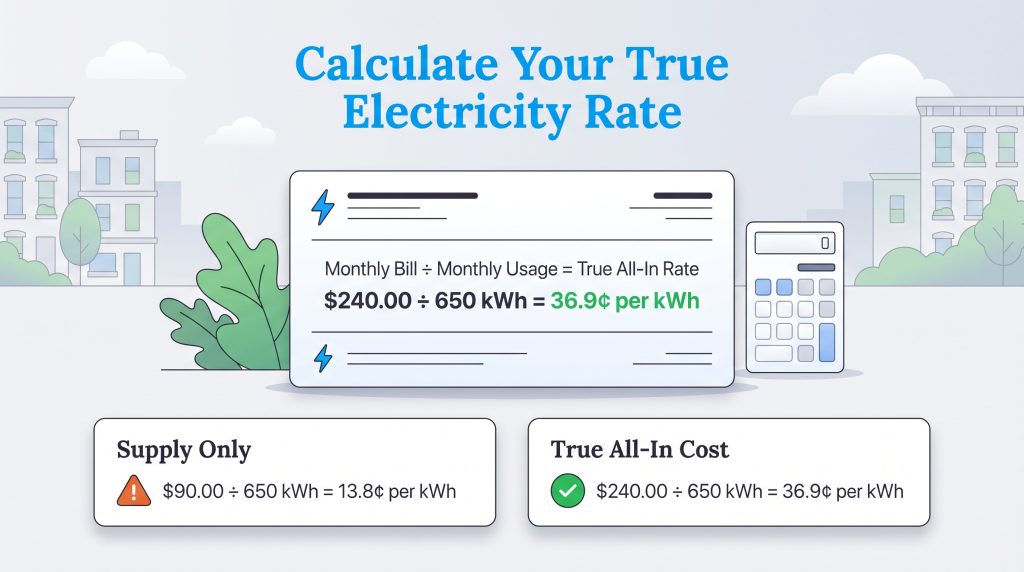
One of the biggest traps New Yorkers fall into when reviewing their utility statement is looking only at the supply rate and thinking their electricity costs about 13¢ or 14¢ per kWh. Because your per-kWh delivery rate, basic service charge, and taxes are bundled separately, your perceived rate is less than half of what you actually pay out of pocket.
To see how these numbers stack up in the real world, let’s examine a sample monthly residential statement for a household consuming 650 kWh of electricity during a warm month.
| Con Edison Bill Component (650 kWh Usage) | Monthly Cost |
|---|---|
| Supply Charge (650 kWh @ ~13.0¢/kWh) | $84.50 |
| Merchant Function Charge, GRT & Supply Taxes | $5.50 |
| Total Supply Charges | $90.00 |
| Basic Service Charge (plus $1.73 billing fee) | $22.73 |
| Delivery Charge (650 kWh @ ~17.5¢/kWh) | $113.75 |
| System Benefits Charge (SBC), GRT & Delivery Taxes | $13.52 |
| Total Delivery Charges | $150.00 |
| Total Monthly Electric Bill (All-In) | $240.00 |
You can calculate your true all-in electricity rate in two quick steps:
- Avoid the false supply-only math: If you only divide your Total Supply Charges ($90.00) by your monthly usage (650 kWh), you get a misleading rate of 13.8¢ per kWh. Many third-party energy salespeople use this lower number to pitch you on supply contracts, ignoring the bigger half of your bill.
- Calculate the true all-in rate: Divide your Total Monthly Electric Bill ($240.00) by your total monthly usage (650 kWh). This reveals an all-in cost of 36.9¢ per kWh (about 34¢ to 37¢ per kWh depending on local sales tax). Knowing this real number helps you accurately calculate how much money energy-efficient appliances will save you each month.
Why Are Con Edison Delivery Charges So High?
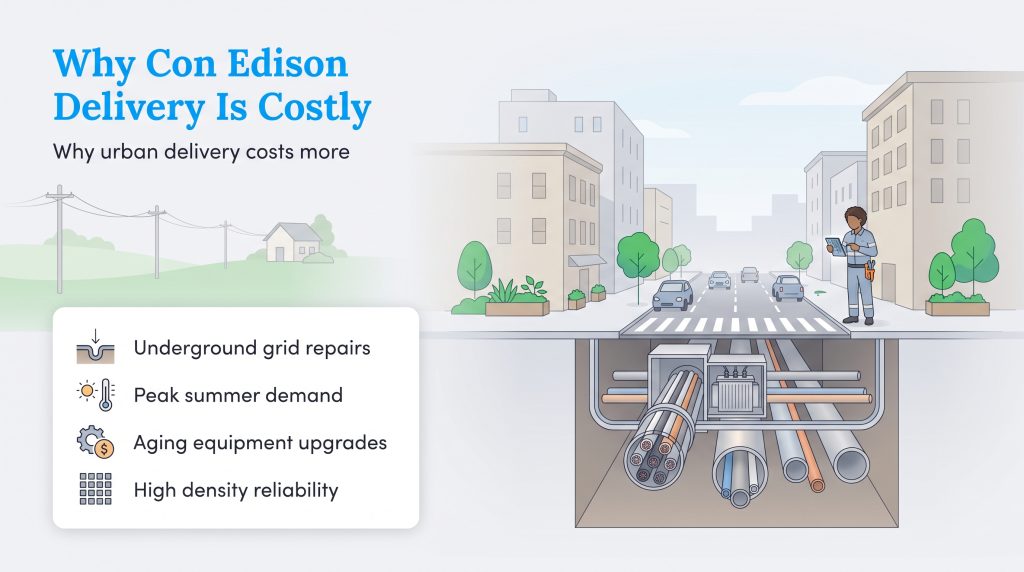
If you find yourself frequently asking why Con Edison delivery charges are so high, you are not alone. Maintaining the power grid in one of the most densely populated regions on the planet requires extraordinary capital investment. Unlike sprawling suburban grids where wooden utility poles are cheap and easy to replace, the vast majority of New York City’s electrical infrastructure runs deep underground — and underground networks cost five to 10 times more to build and maintain than overhead lines.
Excavating heavily trafficked, paved streets to repair aging transformers and subterranean feeder cables is labor-intensive and expensive. Con Edison crews must navigate complex subterranean mazes of century-old water mains, steam pipes, subway tunnels, and fiber-optic lines just to keep the power flowing. Beyond physical maintenance, municipal property taxes on utility pipes, wires, and substations, alongside mandated storm hardening and clean energy grid investments, are baked directly into your delivery tariff.
Comparing our localized costs against other national regions quickly validates your frustration. Here is a look at the structural cost drivers that push urban delivery bills so much higher than national averages.
| Factor | Why It Matters for Delivery Charges |
|---|---|
| Underground infrastructure | Building and repairing subterranean cables costs five to 10 times more than maintaining suburban overhead lines. |
| Municipal property taxes | Local governments levy heavy property taxes on Con Edison’s pipes, wires, and equipment, which are passed directly to ratepayers. |
| Storm hardening and clean energy | Billions in state-mandated coastal flood protections, battery storage, and green grid upgrades are recovered through delivery rates. |
| Peak summer demand | Heavy air conditioning use across dense apartment blocks requires redundant transformers and backup feeder lines. |
| Aging equipment | Replacing decades-old substations and underground vaults requires complex street excavation and traffic coordination. |
2026–2028 Con Edison Delivery Rate Increases
If your electric bills feel noticeably heavier this year, it isn’t just in your head. Under the multi-year rate plan approved by the New York Public Service Commission (NY PSC Case 25-E-0072), Con Edison is rolling out three consecutive annual delivery rate hikes running from Jan. 1, 2026, through Dec. 31, 2028. While Con Edison originally requested a jarring 11.4% total bill increase for 2026 alone, negotiations with the NY Department of Public Service (DPS) and consumer advocates scaled the approved Joint Proposal down to an average total bill impact of roughly 3.5% in 2026, 3.2% in 2027, and 3.1% in 2028.
Because these rate hikes are applied specifically to the delivery portion of your statement, the actual percentage increase on your delivery line items is higher than the overall bill average, and each year builds upon the previous year’s hike. You can read our complete analysis of the Con Edison New York rate increases for 2026 to see how the utility is spending this revenue on grid resilience. Below is the official breakdown of how the approved 2026–2028 rate plan impacts monthly residential bills across three typical usage tiers.
| Residential Monthly Usage Tier | Rate Year 1 (2026) Increase | Rate Year 2 (2027) Increase | Rate Year 3 (2028) Increase |
|---|---|---|---|
| 280 kWh/month (Small NYC Apartment) | +$3.35/mo (+5.4% delivery / +3.5% total) | +$3.15/mo (+4.8% delivery / +3.2% total) | +$3.10/mo (+4.5% delivery / +3.1% total) |
| 425 kWh/month (Average NYC Household) | +$4.75/mo (+5.4% delivery / +3.5% total) | +$4.50/mo (+4.8% delivery / +3.2% total) | +$4.45/mo (+4.5% delivery / +3.1% total) |
| 600 kWh/month (Westchester / Larger Home) | +$6.45/mo (+5.4% delivery / +3.5% total) | +$6.10/mo (+4.8% delivery / +3.2% total) | +$6.05/mo (+4.5% delivery / +3.1% total) |
Understanding Demand Charges and Time-of-Use Rates
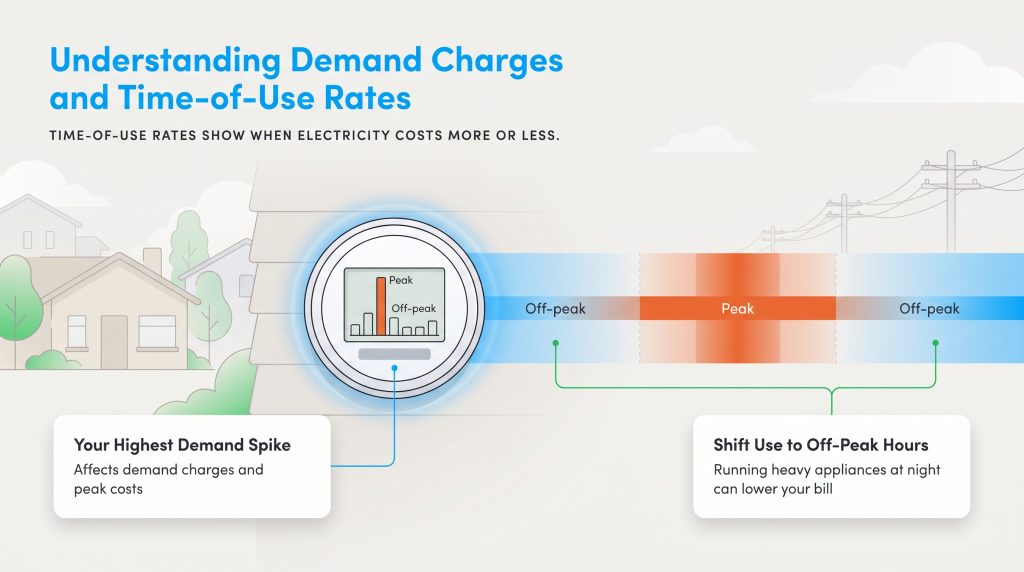
Some Con Edison customers, especially those on specialized residential rate classes or commercial plans, may see demand-related charges. Instead of calculating costs purely based on the total volume of energy you consume throughout the month, demand charges evaluate the highest spike of power you pull from the grid at any given moment. For most standard residential customers, however, the bigger opportunity lies in understanding how timing impacts your delivery and supply rates.
Con Edison offers voluntary Time-of-Use (TOU) rates and Smart Energy Plan options, where delivery and supply prices fluctuate depending on the time of day. Under Con Edison Time-of-Use rates, delivery charges are significantly higher during peak hours (typically 8:00 a.m. to midnight, with summer super-peak pricing in the afternoon and evening) and drop to a fraction of the standard cost during overnight off-peak hours (midnight to 8:00 a.m.). If you charge an electric vehicle at home or run heavy appliances overnight, opting into a TOU plan can slash the delivery rate you pay during off-peak windows.
Understanding these time-based structures is crucial when managing your overall utility budget. As you evaluate your electric service setup guides, paying close attention to your real-time smart meter data and aligning your household habits with off-peak windows offers a tangible way to sidestep peak-period surcharges.
Practical Ways to Lower Your Con Edison Delivery Costs
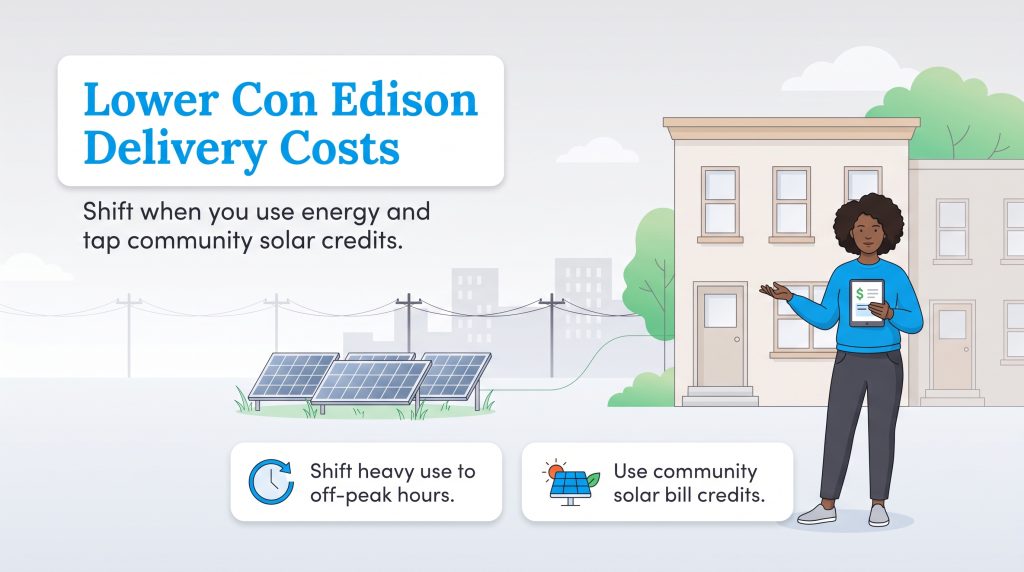
Because Con Edison owns the physical pipes, poles, and wires in your neighborhood, you cannot shop around for a competing delivery company. However, that does not mean you are stuck helplessly absorbing every Con Edison delivery rate increase in 2026 and beyond. Because the bulk of your delivery bill is calculated on a per-kWh basis (~17.5¢/kWh), every kilowatt-hour you eliminate saves you even more on delivery than it does on supply.
Learning how to lower Con Edison delivery charges comes down to catching billing anomalies, upgrading inefficient cooling gear, and enrolling in bill-credit programs that directly offset your final balance.
What You Can and Cannot Change on Your Bill
| Bill Item | Can You Change It? | What You Can Do |
|---|---|---|
| Delivery utility | No | Con Edison remains the exclusive delivery provider in its service territory. |
| Basic service charge | No (Unless EAP Eligible) | Income-eligible customers can receive monthly bill discounts via the Energy Affordability Program. |
| Electricity supplier | Sometimes | Compare ESCO supply offers carefully, as many charge more than Con Edison’s default supply rate. |
| Total kWh usage | Yes | Cut usage with efficient appliances to reduce both your 17.5¢/kWh delivery fee and 13¢/kWh supply fee. |
| Time of use | Sometimes | Shift heavy appliance or EV charging usage if you enroll in a TOU or Smart Energy plan. |
| Total bill with solar credits | Sometimes | Subscribe to a local community solar farm to earn a 5% to 10% credit on your total monthly bill. |
Auditing Your Meter Reads and Billing Cycles
Whenever your Con Edison bill suddenly spikes without an obvious change in weather or household routine, your first step should be a zero-cost audit of the meter detail section on page two of your statement. Look closely at two critical data points:
- Verify “Actual” vs. “Estimated” Reads: Check whether your meter reading is labeled “Actual” or “Estimated.” While most NYC and Westchester homes now have automated smart meters, connectivity glitches inside basement utility rooms can still trigger estimated bills. If Con Edison underestimates your usage for two months and then logs an “Actual” read on the third month, you will get hit with a massive catch-up bill that lumps all those unbilled delivery kilowatt-hours onto a single statement. If you see “Estimated,” submit a manual photo of your meter through your online Con Edison account immediately.
- Check the Number of Billing Days: Look at the exact date range of your billing cycle. Standard cycles run between 28 and 30 days, but scheduling shifts around holidays can stretch a billing period to 33 or 34 days. Five extra days of summer air conditioning in a 33-day cycle can easily inflate your delivery charges by 15% to 20% compared to a 28-day month, even if your daily habits stayed identical.
Reducing Peak Energy Usage
Since usage-based delivery costs compound with every kilowatt-hour you pull from the grid, upgrading how you heat and cool your home is your strongest financial defense. We recommend exploring our comprehensive guide to saving on your electric bill for deeper strategies, and starting with these proven upgrades:
- Install a smart thermostat: Upgrading to an ENERGY STAR-certified smart thermostat like an Ecobee or Google Nest can cut heating and cooling costs by 8% to 15% a year by automatically adjusting temperatures when you leave the apartment or go to sleep.
- Switch to inverter and dual-hose AC units: Standard single-hose portable air conditioners create negative air pressure that sucks hot summer air back into your apartment through door gaps. Upgrading to a dual-hose inverter portable AC or an inverter window unit (such as a Midea U-Shaped AC) reduces room cooling electricity loads by up to 60% compared to older single-hose models, slashing both your delivery and supply kWh totals during expensive summer months.
- Delay running major appliances: If you are enrolled in a Time-of-Use rate plan, wait until after midnight (or off-peak morning hours) to run your dishwasher, washing machine, and electric dryer, and use smart plugs to cut phantom vampire loads from home entertainment centers.
Community Solar and Eco-Conscious Offsets
One of the most effective, environmentally mindful choices available to New Yorkers is subscribing to local community solar programs. These state-supported initiatives allow residents — including NYC apartment renters and co-op owners who cannot install rooftop panels — to subscribe to a shared solar farm located in the Hudson Valley or elsewhere in Con Edison’s territory. Community solar supports renewable generation in your region, and in return, clean energy credits are applied directly to your Con Edison statement, typically saving you 5% to 10% on the total electricity and delivery charges offset by your share.
This guaranteed bottom-line discount is vastly superior to switching your supplier through third-party Energy Service Companies (ESCOs). If you browse the New York Department of Public Service Power to Choose portal to select an ESCO, you can only change the supply side of your bill, leaving your Con Edison delivery charges untouched. Community solar, on the other hand, reduces the final dollar amount you owe Con Edison. For more details on how these shared farms operate on a national scale, you can reference the U.S. Department of Energy community solar guide.
🌱 Eco Edge: Subscribing to a community solar farm makes a practical eco-conscious alternative if rooftop solar is not an option. Many programs advertise discounted credits, but savings depend on the project, contract terms, and your usage.
Con Edison Affordability and Financial Assistance Programs
If high delivery charges are straining your household budget, Con Edison offers structured billing tools and financial relief programs that directly lower or smooth out your monthly obligations:
- Energy Affordability Program (EAP): If you or someone in your household receives qualifying government assistance — such as SNAP, Medicaid, SSI, HEAP, or Public Assistance — you can enroll in Con Edison’s EAP. Depending on your tier and whether you pay for electric heating, EAP applies an automatic monthly discount ranging from roughly $32 to over $160 per month directly to your bill, effectively wiping out the Basic Service Charge and a large chunk of your delivery fees.
- Budget Billing (Levelized Payment Plan): While it does not reduce your total annual rate, Budget Billing eliminates summer AC and winter heating bill shock by spreading your estimated annual Con Edison costs into 12 predictable monthly payments. Con Edison reviews your actual usage every few months and adjusts the levelized amount so you aren’t blindsided by a $350 August delivery spike.
- EnergyShare and HEAP Grants: Administered in partnership with HeartShare Human Services of New York, the EnergyShare program provides emergency grants of up to $200 for eligible Con Edison customers facing active disconnection or financial hardship, stacking alongside seasonal federal Home Energy Assistance Program (HEAP) grants.
Taking Control of Your Monthly Electric Costs
Dealing with the realities of the New York utility market often feels like fighting an uphill battle, especially when delivery fees account for up to two-thirds of your bill and NY PSC rate hikes continue through 2028. While we cannot change the expensive nature of the city’s underground grid, we have the tools to mitigate the financial impact. Understanding your true all-in cost of ~36.5¢ per kWh is the vital first step toward reclaiming your monthly budget.
By auditing your statement for estimated meter reads, switching to high-efficiency inverter cooling equipment, enrolling in the Energy Affordability Program if eligible, and tapping into community solar credits, you can push back against rising grid costs. A few smart adjustments to your setup will keep your home comfortable while keeping those Con Edison delivery fees firmly in check.
Frequently Asked Questions About Con Edison Delivery Charges
These quick answers cover the billing questions people most often have after comparing Con Edison supply and delivery charges. Use them to double-check what each line item means before switching suppliers or changing your usage habits.
What is the merchant function charge on my Con Ed bill?
What is the current Con Edison delivery rate per kWh?
What is the System Benefits Charge (SBC) on my Con Edison bill?
Why did my Con Edison bill go up even though my electricity usage went down?
What percentage of a Con Edison bill is delivery charges?
Can I change my delivery company in New York City?
How do ESCOs affect my delivery charges?
🚩 Heads Up: Always read ESCO contracts very carefully. Many sales pitches promise lower electric bills, but they only control the supply rate and will not eliminate the hefty Con Edison delivery fees responsible for your bill shock.
Why is my delivery charge higher than my supply charge?
About the Author

David has been an integral part of some of the biggest utility sites on the internet, including InMyArea.com, HighSpeedInternet.com, BroadbandNow.com, and U.S. News. He brings over 15 years of experience writing about, compiling and analyzing utility data.

LaLeesha has a Masters degree in English and enjoys writing whenever she has the chance. She is passionate about gardening, reducing her carbon footprint, and protecting the environment. She also recently served as President of the Board for City Sprouts (a community garden).